
Religion & Philosophy / Philosophy
The Philosophy Collection · Volume I
The examined life.
From the questions of Athens to the inward life of Copenhagen.
Curated by Christopher Adkins of Huntersville, NC

Follow a question from the Athenian world to nineteenth-century Copenhagen. Raphael’s Renaissance gathering imagines ancient thinkers sharing an architectural world. It is an interpretation of philosophy’s history, painted in 1509–1511, not a record of a meeting that actually took place.
Raphael; public-domain reproduction via Wikimedia Commons · Public domain.


Explore the historical images.
Begin with a question
What makes a life worth living?
What do you mean by a good life? How do you know that a belief is true? What do you owe the people around you—and what happens when conscience and public opinion collide? Philosophy begins when a familiar answer stops being enough. This collection follows four remarkable thinkers through those questions, using substantial essays, historical places, works of art, and the arguments themselves. Read a complete five-chapter portrait, or choose a question and follow it across the collection.
New: explore philosophy hands-on
The Great Conversation
An interactive star map of fifty thinkers across twenty-eight centuries, from the Upanishads and Confucius to Kierkegaard, Du Bois and Dr. King, with the threads of influence drawn between them.
Open the map →Thought Experiment Lab
Ten famous puzzles, from Plato’s Cave and the Ring of Gyges to the Trolley Problem and Mary’s Room. Make your choice, read the case for every answer, and see your philosophical fingerprint.
Enter the lab →The World’s Religions
Nine illustrated chapters on the traditions that shaped these thinkers, with a sacred-places map, a Golden Rule wheel and “Ask the traditions.”
Read the guide →Four distinct voices · five chapters each
Meet the thinkers

c. 469–399 BCE · Five chapters
Socrates
The courage to ask what we mean.
Enter the collection →

c. 428–347 BCE · Five chapters
Plato
Beyond appearances. Into the questions that shape a life.
Enter the collection →

384–322 BCE · Five chapters
Aristotle
The world is worth understanding. A life is worth learning to live well.
Enter the collection →

1813–1855 · Five chapters
Søren Kierkegaard
The individual, the leap, and the difficult art of becoming a self
Enter the collection →
Choose your reading route
Follow an idea.
You do not have to read twenty chapters in sequence. Choose a question and follow it across the collection.
Judgment and virtue
From examining convictions to forming character and accepting commitment.
Justice and conscience
Follow the tension between individual judgment and life with others.
Truth and education
Ask what questioning, learning, and explanation allow us to see.
Faith and the self
Explore desire, responsibility, inwardness, and the demands of love.
Compare without flattening the differences
A conversation across centuries
Each thinker asks for more than agreement. These contrasts are an orientation to the essays; the chapters preserve the complications.
| Thinker | Central question | How to read | Keep in mind | Begin with |
|---|---|---|---|---|
| Socrates | What can survive examination? | Questions and tested definitions. | Sources differ; no surviving authored works. | Apology; Euthyphro |
| Plato | What are justice and knowledge? | Dialogues, images, and argument. | Distinguish speaker from author. | Republic VII; Symposium |
| Aristotle | What explains flourishing? | Distinctions, observation, practical judgment. | Examine his exclusions critically. | Nicomachean Ethics I–II |
| Søren Kierkegaard | How does belief become a life? | Pseudonyms and inward responsibility. | Preserve his Christian context. | Fear and Trembling; Works of Love |
A visual history of ideas


Twenty essays · a living reading room
The complete chapter library
Search by thinker, title or subject. Every card opens a complete illustrated chapter.
20 of 20 chapters shown

Socrates in Athens: A Life We Reconstruct
Meet Socrates in the troubled city of Athens and learn how Plato, Xenophon and Aristophanes shaped the evidence for his life.
1,645 words · 9 min read
The Socratic Method: How a Question Changes a Mind
Follow the Socratic method through Euthyphro, Laches and Meno, with clear examples of definitions, objections and honest uncertainty.
1,613 words · 9 min read
Virtue, Conscience and the Good Life
Explore the ethical heart of Socrates: care of the soul, knowledge and virtue, courage, non-retaliation, and the challenge of living by reasons.
1,592 words · 8 min read

The Trial of Socrates: Conscience before the City
Read the trial and death of Socrates through Apology, Crito and Phaedo, with historical context and careful distinctions between evidence and later art.
1,553 words · 8 min read

The Socratic Afterlife: Legacy and Reading Socrates
Trace the many later uses of Socrates, distinguish influence from historical evidence, and follow a seven-dialogue path into his enduring questions.
1,838 words · 10 min read
Plato’s Athens: A Life Rebuilt as Dialogue
Meet the city and the literary imagination behind Plato: a world of political crisis, philosophical friendship, competing teachers, and questions that outlived their speakers.
1,632 words · 9 min read

Out of the Cave: Forms, Knowledge, and the Good
A close, accessible reading of the Forms, the sun, the divided line, and the cave, with the objections that make Plato’s theory a living philosophical problem.
1,623 words · 9 min read

The Soul in Love: Desire, Beauty, and Mortality
Explore the Symposium’s ladder of love, the Phaedrus’s winged soul, and the Phaedo’s confrontation with death—without reducing Platonic love to a modern slogan.
1,572 words · 8 min read

The Republic: Justice, Education, and the Danger of Power
Read Plato’s city and soul together: the challenge of injustice, the training of guardians, philosopher-rule, women’s education, censorship, and the descent toward tyranny.
1,590 words · 8 min read
The Philosopher Who Distrusted Art—and Wrote Masterpieces
Why does Plato challenge poets while creating unforgettable scenes? Follow his arguments about images and writing, his later experiments, and the long transformation of his work.
1,725 words · 9 min read

A Mind at Work: Aristotle’s Life, Landscapes, and Lyceum
Follow Aristotle’s life through the places, relationships, and research practices that shaped his philosophy—and learn to separate historical evidence from seductive legend.
1,775 words · 9 min read
How the World Makes Sense: Logic, Causes, and Being
Understand syllogisms, the four causes, matter and form, potentiality and actuality, and the difference between knowing a fact and knowing why it is true.
1,969 words · 10 min read

The Art of Living Well: Virtue, Friendship, and Flourishing
A detailed guide to eudaimonia, the doctrine of the mean, practical wisdom, responsibility, weakness of will, friendship, and the place of contemplation in Aristotle’s ethics.
1,979 words · 10 min read

Citizens, Speakers, and Stories: Politics, Rhetoric, and Tragedy
Explore the polis and citizenship, constitutional government, Aristotle’s defenses of hierarchy, ethical persuasion, and the enduring questions of plot, tragedy, and catharsis.
1,989 words · 10 min read

The Philosopher Across Civilizations: Legacy and Reading Aristotle
Discover how Aristotle was preserved, translated, transformed, and challenged by later thinkers, then follow an accessible reading path through his major works.
1,954 words · 10 min read

Kierkegaard’s Copenhagen: A Life of Love, Loss, and Literary Defiance
Walk through the Copenhagen that shaped Søren Kierkegaard, from his merchant family and university years to Regine Olsen, Socratic irony, and the public controversies of his final decade.
1,726 words · 9 min read

Either/Or: Desire, Commitment, and the Voices Inside a Life
Explore Kierkegaard’s pseudonyms, the aesthetic and ethical lives, the seducer, Judge William, irony, marriage, and the choices that shape a self.
1,728 words · 9 min read

Fear and Trembling: Abraham, Faith, and the Limits of Explanation
Read Fear and Trembling through its narrator Johannes de silentio, Abraham’s ordeal, infinite resignation, the ethical problem, and the difference between faith and self-authorized certainty.
1,743 words · 9 min read
Anxiety and Despair: The Difficult Work of Becoming a Self
Understand The Concept of Anxiety and The Sickness unto Death: why possibility can unsettle us, what Kierkegaard means by despair, and how his Christian account of selfhood differs from self-invention.
1,756 words · 9 min read

Works of Love: The Neighbor, the Crowd, and Kierkegaard’s Legacy
Discover Kierkegaard’s account of neighbor-love, his attack on comfortable Christendom, his critique of the public, and a thoughtful route through his continuing philosophical and Christian legacy.
1,757 words · 9 min read
No chapters match. Try a broader word or choose all four thinkers.
Four voices, a continuing conversation
Socrates makes confidence answer questions. Plato gives philosophical inquiry the drama of conversation, desire, conflict, and imagined worlds. Aristotle asks for careful distinctions, explanations, and an account of how a life takes shape through activity. Kierkegaard brings the argument close to the person who must actually choose, love, believe, and act.
Their differences make reading them together valuable. One question can expose a weakness in an answer that another thinker makes attractive. The aim is neither to declare a winner nor to combine every idea into one agreeable system. It is to become a more attentive reader and a more exact judge of reasons. These four form one inviting entrance into a much wider philosophical landscape.
Imagine a promise that has become inconvenient, a popular claim supported by weak reasons, or a rule that troubles your conscience. Different thinkers help reveal different parts of the difficulty. Their disagreement gives the reader something valuable: more than one disciplined way to begin, and a reason to keep examining the first answer.
Beyond the famous quotation
A memorable sentence can open a book; it should not replace the book. In Plato’s Euthyphro, questions about piety develop through successive attempts at a definition. Aristotle’s Metaphysics begins by connecting the desire to know with experience and explanation. Kierkegaard’s publication record distinguishes named pseudonyms from signed religious works. Context changes what a passage can responsibly be made to say.
Throughout the collection, follow the argument beyond the line that first catches your attention. Ask who is speaking, what problem the claim addresses, and what objection it must survive. A quotation becomes more powerful when its setting is restored. Understanding also includes permission to disagree: reverence for a famous name should never make an unconvincing argument immune from examination.
See the world around the ideas
Portraits, archaeological sites, manuscripts, and paintings help restore philosophy to a human setting. A ruined meeting place asks us to imagine conversation as an event. A title page reveals how a work presented itself to its first readers. A later painting shows how another age chose to remember a thinker or interpret a story. These are different kinds of evidence, and the captions preserve those differences.
Use the images as invitations to look more closely. What does an artist emphasize? What remains outside the frame? How does a grand public interior change the atmosphere of an argument about conscience? The visual collection accompanies the essays so that places and objects can deepen attention without pretending to prove the philosophical claims. The question remains yours to consider.
Choose your way into the collection
Begin chronologically if you enjoy the development of a thinker’s life and work. Start with a thematic route if a particular question already troubles or interests you. Judgment and virtue connect examination with character; justice moves between personal conscience and civic institutions; truth and education ask what learning changes; faith and selfhood explore the distance between understanding an idea and living through it.
You do not need technical training to begin. Read one chapter slowly, follow a source when it matters, and keep one unresolved question in view. Returning to a difficult passage after encountering another thinker can be more revealing than rushing to finish. Philosophy becomes rewarding when reading changes the quality of the questions we bring to experience—and when those questions remain open to reasons we have not yet considered.
Choose the question
Four voices. A question worth staying with.
Compare the emphases below, then read the linked chapters for the arguments, historical setting, and disagreements. These concise comparisons are editorial orientation.
Socrates
Start by examining what you claim to know. A contradiction reveals a problem in an account; further inquiry must discover what should replace it.
Read the chapter →Plato
Ask what makes understanding more stable than an appearance or opinion. The cave and divided line connect education to a reorientation of the soul.
Read the chapter →Aristotle
Distinguish a valid inference from justified premises and a description from an explanation. Knowing why requires attention to causes and the kind of subject investigated.
Read the chapter →Kierkegaard
Ask how a truth becomes a task for an existing person. Pseudonyms and indirect communication complicate the relation between a proposition and the way a life embodies it.
Read the chapter →Socrates
Test whether wealth, reputation, and survival outrank the condition of the soul. An attractive outcome does not settle whether the action that produced it was just.
Read the chapter →Plato
Follow desire, education, and the ordering of the soul. Ask why justice should benefit its possessor even when nobody rewards it.
Read the chapter →Aristotle
Examine sustained activity, developed character, practical wisdom, and friendship. Flourishing belongs to a whole life and cannot be reduced to an isolated pleasant feeling.
Read the chapter →Kierkegaard
Ask what it means to become a self, make a commitment, and love the neighbor. Religious responsibility reaches beyond the social appearance of an admirable life.
Read the chapter →Socrates
The trial makes public questioning and conscience dangerous. Compare refusal to do wrong with the reasons offered against escape in the Crito.
Read the chapter →Plato
Ask whether rulers understand the good and how education shapes their desires. Investigate the coercion and exclusions carried by the proposed political order.
Read the chapter →Aristotle
Distinguish common advantage from the rulers’ advantage, then examine citizenship and institutions. His exclusions of women and enslaved people demand explicit criticism.
Read the chapter →Kierkegaard
Examine the crowd, public opinion, and established religious authority. Collective belonging can diffuse the responsibility that a single person still has to answer for.
Read the chapter →Socrates
Socratic questioning includes piety and a reported divine mission. Read the ancient setting before assigning him a modern religious or secular identity.
Read the chapter →Plato
The good, the soul, myth, and intelligible reality enter overlapping inquiries. Later religious uses of Plato are important acts of interpretation, not proof of doctrinal identity.
Read the chapter →Aristotle
Accounts of being, intellect, and causation became resources for Jewish, Christian, and Muslim thinkers. Their revisions and disagreements are part of the philosophy.
Read the chapter →Kierkegaard
The demands of faith are staged through pseudonymous voices and signed religious works. Private certainty is not a simple answer to the problem of ethical justification.
Read the chapter →The visual reading room
Look closely. Ask better questions.
Eight images invite a slower look at places, portraits, manuscripts, and later interpretations. What can an image reveal—and what must a text or argument establish? Select any image to enlarge it; the source and reuse credit remain with every item.


Geographic orientation
Ideas have places. Maps have histories.
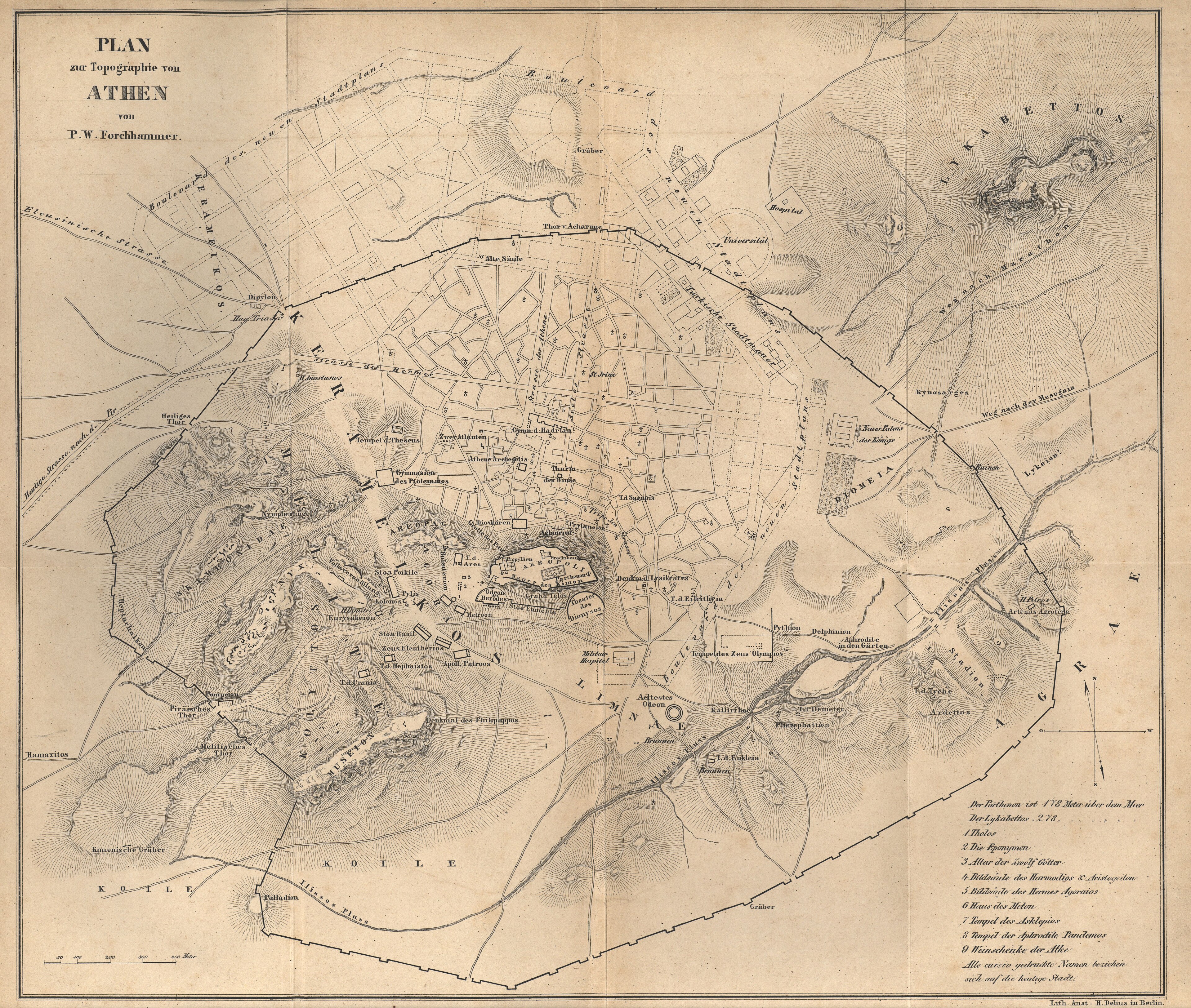
Athens supplies the civic and intellectual setting for much of this collection: public argument, Socrates’ trial, Plato’s Academy, and Aristotle’s Lyceum. Keep the differences between those institutions and generations in view.
Forchhammer’s 1841 plan is a historical reconstruction of ancient Athens. Its labels and proposed identifications belong to nineteenth-century scholarship; it is not a modern excavation plan or a photograph of the ancient city. Use it for orientation, then consult current site scholarship.
Words with their sources
Read the quotation. Follow the argument.
A memorable sentence opens a question. Speaker, translation, and textual location help keep it connected to the work from which it comes.
“the life which is unexamined is not worth living”
Plato, Apology 38aBenjamin JowettRead the chapter and its context →
“wonder is the feeling of a philosopher, and philosophy begins in wonder.”
Socrates in Plato, Theaetetus 155dBenjamin JowettRead the chapter and its context →
“Every realm of nature is marvellous”
Parts of Animals I.5, 645aWilliam OgleRead the chapter and its context →
“to find the idea for which I will live and die.”
Journal AA:12, 1 August 1835; SKS 17, pp. 24–26 (excerpt).Editorial translation from the verified Danish original; not presented as a quotation from a published English translation.Read the chapter and its context →
Continue the conversation
Follow the question into another room.
These are invitations to comparison. A shared question does not make different thinkers or traditions interchangeable.
Sacred texts
Move from philosophical questions to the scriptures, canons, and histories that shape religious traditions.
Explore this connection →Presbyterianism
Explore belief, worship, history, and the place of a confessional community.
Explore this connection →Writers and belief
Continue with literary argument and religious reflection in the C. S. Lewis reading room.
Explore this connection →Lives in action
Explore the wider collection of people, institutions, decisions, and legacies.
Explore this connection →A few questions before you begin
Where should I begin?
Start with Socrates for questioning, Aristotle for character, Plato for justice, or Kierkegaard for faith and selfhood.
Must I agree with these thinkers?
No. Read sympathetically, examine the reasoning, and make room for serious objections.
Keep exploring
The World’s Religions
Nine illustrated chapters, from Judaism and Hinduism to Sikhism and Shinto, with maps, timelines and quizzes.
Explore the world’s religions →Sacred texts
Explore scripture, commentary and the religious worlds in which many philosophical questions have been asked.
Open the Sacred Texts collection →Profiles in Action
Follow political and intellectual lives through the books, speeches and choices that put ideas to the test.
Explore the biographies →