
Religion & Philosophy / Philosophy / Aristotle
Aristotle · Chapter 01 of 05
A Mind at Work: Aristotle’s Life, Landscapes, and Lyceum
From Stagira and Plato’s Academy to the shores of Lesbos and a new community of inquiry.
Curated by Christopher Adkins of Huntersville, NC

When does a careful description become an explanation? The surviving archaeological remains of the Lyceum in Athens locate Aristotle’s school in a real urban landscape. The visible structures provide context, not a complete reconstruction of his teaching spaces.
Carole Raddato / Following Hadrian, via Wikimedia Commons · CC BY-SA 2.0.


Explore the historical images.
01 / 07
An outsider who made Athens his intellectual home
Aristotle was born in 384 BCE at Stagira, far from the Athenian setting that dominates popular images of Greek philosophy. His father, Nicomachus, was associated with the Macedonian royal court as a physician. The temptation is to read an entire scientific destiny into that detail: the doctor’s son supposedly learned observation at home and never stopped. The evidence supports the family connection, but not a recovered childhood curriculum. Good biography distinguishes a suggestive setting from a documented cause. Much of the ancient information comes through later authors, including Diogenes Laërtius, whose account preserves incompatible stories alongside valuable chronological material.
At about seventeen Aristotle went to Athens and joined Plato’s Academy. He remained associated with it for roughly twenty years, until Plato’s death in 347 BCE. That is a substantial intellectual apprenticeship, followed by mature participation in a demanding philosophical community. Aristotle’s later disagreements with Plato grew from sustained engagement rather than from a passing encounter between two opposite personalities. The questions they shared concerned how knowledge differs from opinion, what makes a thing what it is, and how understanding bears on a good life.
Athens was his intellectual home without being his native city. This matters when the philosophical story becomes political. The city in which he taught belonged to a network of rival powers and was increasingly constrained by Macedonian strength. His family connections and later royal employment were not private background details that could always be kept apart from public life. Even a school devoted to explanation occupied a vulnerable place in history.
02 / 07
Learning from Plato without becoming a Platonist
The familiar painting of Plato pointing upward and Aristotle gesturing outward provides a memorable image of disagreement. It is a Renaissance interpretation, not a diagram drawn by either philosopher. Aristotle did reject the explanatory usefulness of separate Forms as he understood Plato’s theory: if we want to explain a living horse, it is not enough simply to posit another, independently existing Horse. The proposed explanation must show how it accounts for the concrete creature’s being, movement, and intelligibility. Aristotle presses such objections in Metaphysics I.
Yet he did not abandon the search for general understanding. An inventory of individual horses is not already a science of animals. A collection of admirable actions is not already an account of virtue. He retained the ambition to understand what kinds of things are and why their characteristic features belong to them. The important difference concerns how that explanation is related to the particular things we encounter. For Aristotle, the form of a living organism normally explains the organization and activity of that organism rather than occupying a separate realm beside it.
There is a useful lesson in the length of the relationship. Philosophical independence need not begin by caricaturing one’s teacher. A serious objection often requires retaining much of the question that made the earlier answer powerful. Aristotle’s treatment of Plato can be severe and is itself contested by interpreters of Plato. Reading both therefore asks more of us than choosing a team. We must distinguish what Plato actually argues, what Aristotle attributes to him, and what later tradition makes of their disagreement.
“Every realm of nature is marvellous”
Parts of Animals I.5, 645aWilliam Ogle

03 / 07
The Aegean as a place of inquiry
After leaving Athens, Aristotle spent time at Assos on the coast of Asia Minor and then on Lesbos. His relationship with Hermias, the ruler associated with Assos, and his collaboration with Theophrastus connect philosophical work to patronage, friendship, and travel. The surviving historical record leaves gaps, but these eastern Aegean years are important to accounts of his biological investigations. Coastal life offered fishermen, marine animals, reproductive cycles, and unfamiliar structures to observe and compare. A landscape can become intellectually productive when someone learns to ask precise questions of it.
The opening of Parts of Animals shows how much work is involved before explanation even begins. Should an investigator describe each species separately, or first study features shared across groups? How should analogous structures be compared? In what order should the facts and their explanations be presented? These are questions of research design. They are recognizably serious even where Aristotle’s eventual classifications or causal claims differ from modern biology.
A photograph of the Gulf of Kalloni should therefore serve as a setting for inquiry, not as proof that a particular observation occurred at the exact spot pictured. The attraction of the shore is explanatory: it helps readers imagine a world in which detailed knowledge could come from watching, handling, asking local specialists, and comparing reports. Aristotle’s work was never simply a lone gaze directed at nature. It depended on inherited arguments and on information whose quality had to be assessed. The intellectual achievement lies partly in turning miscellaneous encounters into questions that can be investigated together.
04 / 07
Alexander and the problem of the philosopher near power
Ancient tradition places Aristotle’s tutorship of Alexander in the 340s BCE, usually beginning in 343 or 342. The association is secure enough to belong in a basic biography, but the details invite overstatement. We do not possess a complete set of lesson plans, and we cannot trace every decision of the future conqueror to a philosophical lesson. The historian should resist making Aristotle either the secret author of Alexander’s campaigns or the innocent teacher whose influence explains nothing. Personal instruction and political action are connected by many contingencies.
The relationship raises an enduring question that does not depend on filling those gaps. What happens when a thinker who asks about excellence has access to a person who can command armies? Instruction may widen a ruler’s imagination; it may also supply the ruler with prestige. Philosophy can be an occasion for examination or an ornament attached to ambition. Neither possibility settles the historical case by itself. It does show why the tutor-and-pupil image should be approached with curiosity rather than reverence.
Aristotle’s later political writings remain centered largely on the polis, the city as an organized community, even though his lifetime witnessed the expansion of Macedonian power. Readers should not assume that the Politics is a handbook for Alexander’s empire. Its categories of citizenship, constitutions, and collective deliberation ask questions at a different scale. Bringing those scales into view makes the biography more interesting: the philosopher of the city lived in a world whose political horizons were being transformed. His connection to that transformation was intimate, but his surviving theory does not simply mirror it.

05 / 07
What the Lyceum made possible
Aristotle returned to Athens in the mid-330s BCE and established his own school at the Lyceum. The name already belonged to a place associated with a sanctuary and gymnasium; he did not conjure an intellectual institution out of an empty site. The school’s later designation as Peripatetic is associated with walking or a covered walk. Ancient explanations vary, so the pleasing picture of every lesson delivered while strolling should not become a rigid historical claim. The archaeological site offers material context without reproducing a complete classroom.
What makes the Lyceum remarkable is the breadth of its coordinated inquiry. Questions about animals stood beside questions about constitutions, reasoning, language, poetry, and the heavens. Such subjects do not share one identical procedure. The ethical investigator must attend to circumstances and character; the logician abstracts from many features of particular cases; the natural philosopher asks what changes and why. A community can sustain this variety more effectively than a picture of genius working entirely alone suggests.
The surviving writings often feel like working instruments: compressed, argumentative, full of distinctions, and sometimes difficult to read continuously. Their form should encourage patience. A paragraph may be setting out an opponent’s view, marking a problem, or introducing a provisional distinction rather than declaring a final doctrine. The reading experience is closer to joining an inquiry already in progress than to listening to a polished modern lecture. To enter the Lyceum imaginatively is to enter a workshop of explanation, with disagreements and unfinished edges still visible.
06 / 07
Observation, confidence, and error
Aristotle’s invitation to study unglamorous animals is one of the most attractive passages in his corpus. In Parts of Animals I.5, the intellect finds interest in structures that may initially repel the senses. The argument enlarges the range of worthy attention. A small creature does not become insignificant because it is inconvenient to examine or because a grand astronomical problem sounds more dignified. Understanding requires giving the object time to show what it is.
This intellectual generosity coexists with errors. Aristotle did not have modern instruments, experimental methods, or evolutionary theory. He could move too quickly from a limited observation to an account of natural purpose. Some failures arose from inadequate evidence; others from assumptions built into his explanatory framework. The appropriate response is neither to dismiss all ancient inquiry as primitive nor to rescue every claim through ingenious reinterpretation. A mistaken theory can still reveal an excellent question, and an excellent question does not make the answer correct.
For a modern reader, the productive test is concrete. What would count as evidence against this explanation? Which feature was observed, which was reported, and which was inferred? Does the proposed purpose illuminate the structure, or merely restate it in flattering language? These questions bring Aristotle’s research ambitions into a critical relationship with our own. They also guard against a danger that extends beyond ancient science: the pleasure of a coherent account can make an investigator less attentive to facts that resist it.

07 / 07
A death, a school, and an unfinished conversation
After Alexander died in 323 BCE, Aristotle left Athens for Chalcis on Euboea, where he died in 322. Ancient accounts associate his departure with the changed political climate and a charge of impiety. The often-repeated story that he refused to let Athens offend twice against philosophy belongs to the tradition surrounding him; it should not be treated as a recorded last statement. His life ended without the theatrical scene that Plato gives Socrates, but the comparison reveals how strongly later readers wanted philosophers’ departures to express their philosophies.
Theophrastus continued the school. Aristotle’s writings and reputation then followed histories too complicated for the notion of an unbroken master’s voice. The surviving corpus is the product of transmission, selection, and editorial work; many writings intended for broader audiences were lost. A reader who finds the extant texts austere should remember that this is partly an accident of survival. The textual history changes how confidently we reconstruct an author from the books available to us.
The life leaves us with a better opening image than a marble bust alone: a person moving between cities, teachers, political patrons, coastlines, and collaborators, trying to bring different forms of experience into intelligible relation. His achievement was immense; his perspective remained situated and fallible. That combination makes the next chapter possible. We can study the tools with which he sought understanding while keeping open the question of how well they work. The proper tribute to an investigator is an investigation that continues.
The visual reading room
Look closely. Ask better questions.
Eight images invite a slower look at places, portraits, manuscripts, and later interpretations. When does a careful description become an explanation? Select any image to enlarge it; the source and reuse credit remain with every item.


Geographic orientation
Ideas have places. Maps have histories.
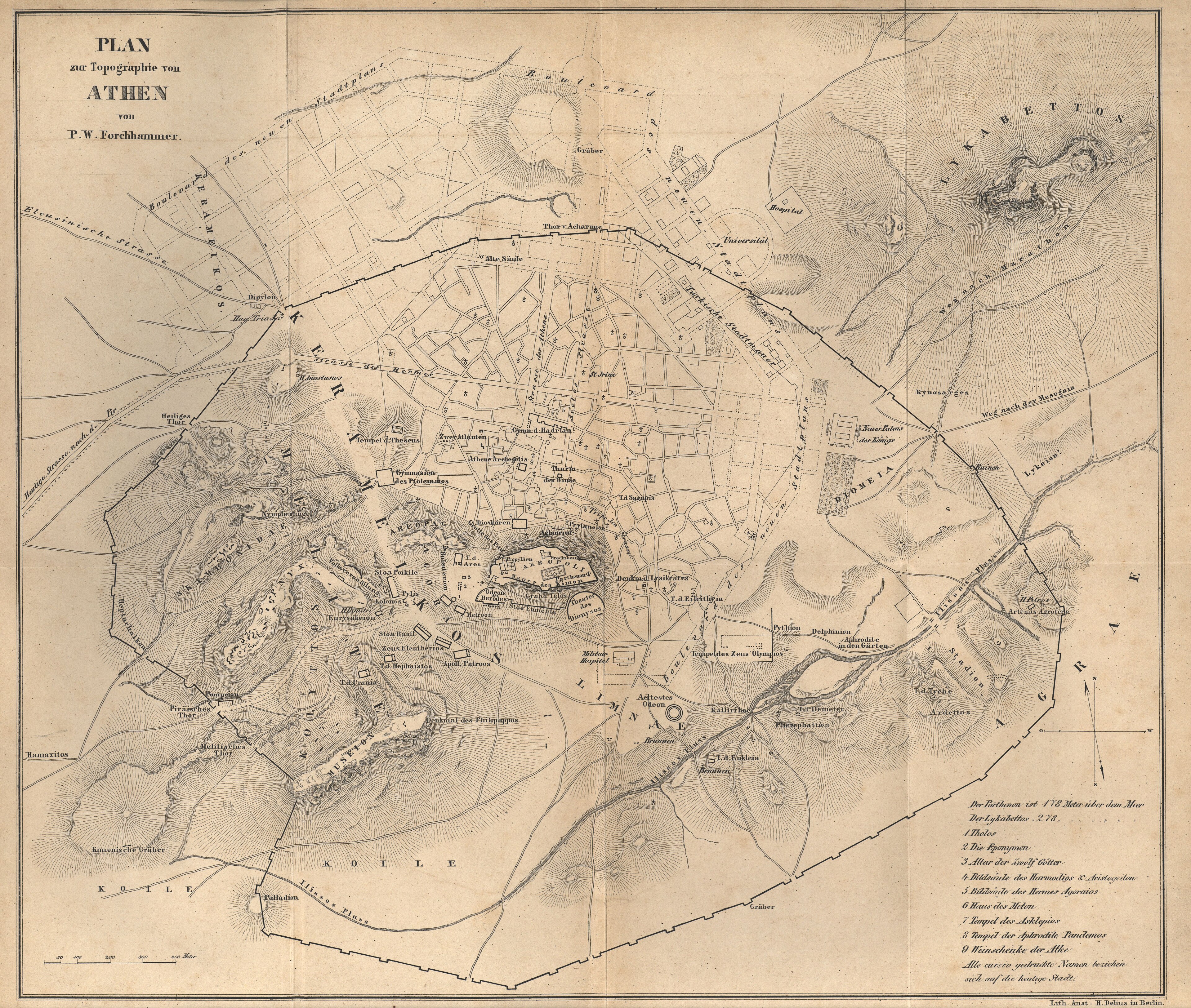
Athens supplies the civic and intellectual setting for much of this collection: public argument, Socrates’ trial, Plato’s Academy, and Aristotle’s Lyceum. Keep the differences between those institutions and generations in view.
Forchhammer’s 1841 plan is a historical reconstruction of ancient Athens. Its labels and proposed identifications belong to nineteenth-century scholarship; it is not a modern excavation plan or a photograph of the ancient city. Use it for orientation, then consult current site scholarship.
The argument workshop
Observation is the beginning
When does a careful description become an explanation?
Imagine identifying a repeated pattern in living things. Description tells us what appears; explanation asks why it occurs. Aristotle’s project joins those ambitions, while also showing how confident explanations can outrun the evidence.
1. Keep the levels distinct
Separate what has been seen, what has been reported by others, and what has been inferred. A vivid account of an animal is not automatically an adequate theory of its development.
2. Make the explanation answerable
What observation would make you revise the proposed account? Aristotle’s achievements are more interesting when examined alongside the limitations of his methods and assumptions.
3. Follow the institutions
The Academy and Lyceum organize inquiry differently from a solitary genius myth. Ask what collecting, comparison, teaching, and collaboration contribute to the production of knowledge.
Return to the chapter’s primary-text anchor: Parts of Animals I.5, 645a. These exercises are editorial prompts, not quotations from the philosopher.
Check the distinction
Read the answer and explanation
He made major contributions to systematic inquiry that still require critical assessment Historical importance does not require infallibility. Aristotle’s questions, methods, evidence, and conclusions can be assessed separately.
Continue the conversation
Follow the question into another room.
These are invitations to comparison. A shared question does not make different thinkers or traditions interchangeable.
Plato’s Academy
Place Aristotle’s early formation beside the intellectual community in which he studied.
Explore this connection →Socrates and evidence
Compare the kinds of evidence that support ancient philosophical biography.
Explore this connection →The natural world
Bring ancient natural inquiry into a careful comparison with modern evolutionary explanation.
Explore this connection →History of God
Consider how broad histories organize the relation between ideas and their settings.
Explore this connection →Pause · question · discuss
Carry the argument further
Did Aristotle invent science?
That claim is too broad. He made major contributions to systematic inquiry and biological explanation, within traditions of Greek and other ancient learning. His methods and conclusions must be distinguished from modern experimental science.
Did Alexander simply put Aristotle’s philosophy into practice?
We cannot establish that. The tutorship is part of the biographical tradition, but Alexander’s policies cannot be read directly from Aristotle’s surviving treatises.
The reading room
Primary texts and source notes
- Diogenes Laërtius, Lives of the Eminent Philosophers, Book V: AristotleR. D. Hicks translation, 1925, public domain. A late ancient source containing conflicting traditions; anecdotes are not treated as eyewitness evidence.
- Christopher Shields, Aristotle, Stanford Encyclopedia of PhilosophyScholarly overview and orientation to disputed interpretations.
- Hellenic Heritage: Aristotle’s LyceumOfficial archaeological destination account for the surviving Lyceum site.
- Aristotle, Parts of Animals, Book IWilliam Ogle translation. Especially I.1 on method and I.5 on the worth of studying animals.
- Aristotle, Metaphysics, Book IW. D. Ross translation. Experience, explanation, wonder, and criticism of earlier philosophy.
- The Textual Transmission of the Aristotelian Corpus, Stanford Encyclopedia of PhilosophyThe difference between Aristotle’s lost public works and the surviving technical corpus; manuscript history and Bekker references.