


Nature › After dark
Nature · After darkNorth Carolina after dark
When the sun goes down, the state lights up. Fireflies that flash together like a held breath. A blue glow drifting over the forest floor. Lighthouses under the Milky Way. This is the night side of wild North Carolina.
By Christopher Adkins · The Lake Norman Brief · Huntersville, North Carolina
Move across the picture. The fireflies notice you.
Fireflies that flash as one


Each summer, for about two weeks between late May and mid-June, one firefly in the Southern Appalachians puts on a show unlike anything else in North America. Males of Photinus carolinus fly through the dark understory flashing in short bursts, five to eight quick pulses followed by several seconds of darkness. Then, as more males join in, the bursts begin to line up. Whole hillsides blink on together and go dark together.
The best-known viewing site is Elkmont, on the Tennessee side of Great Smoky Mountains National Park, where crowds became so large that the park now runs a lottery for parking passes and a shuttle during the peak. The species also lives in other high, moist hardwood forests of the Southern Appalachians, including parts of western North Carolina. Check the National Park Service for dates and rules before planning a trip.
Why flash together? Fireflies use their lights to court. Each male flashes his species’ code and watches for a female’s answering flash from the ground. Researchers think synchrony may help females pick out their own species’ pattern in a forest full of competing lights, and it may let each male see a reply during the shared dark pause.


Watch synchrony emerge
Each dot below is a firefly with its own internal clock. When a neighbor flashes, every firefly nudges its own clock a little forward. Turn the nudging up and the flashes snap into step on their own, with no leader. Mathematicians call these pulse-coupled oscillators, and the same idea describes pacemaker cells in the heart.
Firefly sync simulator
A simplified model inspired by Mirollo and Strogatz (1990)The blue ghosts of the Blue Ridge


The blue ghost firefly, Phausis reticulata, does not flash at all. The males glow with a steady bluish-white light for many seconds while drifting slowly a foot or two above the forest floor, like tiny lanterns being carried through the woods. Females cannot fly. They wait in the leaf litter and glow back faintly.
Blue ghosts appear from late May into June in damp, mature forests in the mountains of western North Carolina. DuPont State Recreational Forest near Brevard and parts of Pisgah National Forest are well-known places to see them. Peak-season crowds have led managers to close or limit access to some trails, so check for current rules before you go.
Because the females live on the ground, a single careless step off trail can crush them. Stay on the path, keep your flashlight off or covered with red film, and let your eyes adjust for 20 minutes. The light is faint, and it only appears once the woods are truly dark.
Foxfire, glowing water and other living light
Fireflies are not the only living lights in North Carolina. On damp nights deep in the mountains, rotting logs can give off a pale green glow called foxfire. The light comes from fungi, including honey mushrooms, whose threads spread through decaying wood. Foxfire is old Appalachian knowledge: the name lent itself to the famous series of books on mountain life, and it was used as a dim, cold light long before electricity.
Along the coast, summer swimmers sometimes see the water sparkle around their hands. That is bioluminescence from tiny marine organisms such as dinoflagellates and from comb jellies, which flash when disturbed. It is most visible on moonless nights in warm water.
Some insects and fungi glow in ways scientists are still studying. Glowing click beetles, glow-worm larvae and mushrooms such as the jack-o’-lantern, which is poisonous, all add to the night. Never eat a wild mushroom unless an expert has identified it.
Who is out there? Night voices
Listen in any river bottom or swamp for the barred owl’s famous call, “Who cooks for you? Who cooks for you all?” Screech owls whinny, and whip-poor-wills and chuck-will’s-widows repeat their names on summer nights.
Bats are among the most important night animals. North Carolina is home to about 17 bat species, from the tiny eastern pipistrelle (tricolored bat) to the hoary bat. Several cave-dwelling species have been devastated by white-nose syndrome, a fungal disease, which is one reason caves and mines in the mountains are often closed to visitors. A single bat can eat a great many insects in a night.
In the high spruce-fir forests lives one of the state’s rarest mammals, the Carolina northern flying squirrel, an endangered subspecies that glides between trees after dark and survives only on a few high mountain ranges.
Where to find truly dark skies


Most North Carolinians have never seen the Milky Way from home. The glow of Charlotte, the Triad and the Triangle washes out all but the brightest stars for many miles. But the state still has some of the darkest skies in the eastern United States, in the mountains and on the Outer Banks.
Mayland Earth to Sky Park on Mayland Community College’s campus near Burnsville in Yancey County was designated an International Dark Sky Park in 2014. It includes the Bare Dark Sky Observatory and holds public stargazing programs. PARI, the Pisgah Astronomical Research Institute near Rosman, is a former NASA tracking station that now hosts science education and night-sky programs.
Many Blue Ridge Parkway overlooks are wonderfully dark, though some close at night or in winter. On the coast, the long undeveloped stretches of Cape Hatteras and Cape Lookout national seashores and Ocracoke Island offer black skies over the ocean, with lighthouses for foreground. Inland, state forests and game lands in the Sandhills and southeastern Coastal Plain can be surprisingly dark.
How dark is the sky?
Approximate Bortle class, 1 = darkest, 9 = inner city


The year’s best meteor showers
Peak rates below are typical maximums under perfectly dark skies with the radiant overhead. Real counts from North Carolina are usually lower, and moonlight can cut them sharply.
Typical peak hourly rates
Zenithal hourly rate, from standard meteor-shower tablesThe Brown Mountain Lights

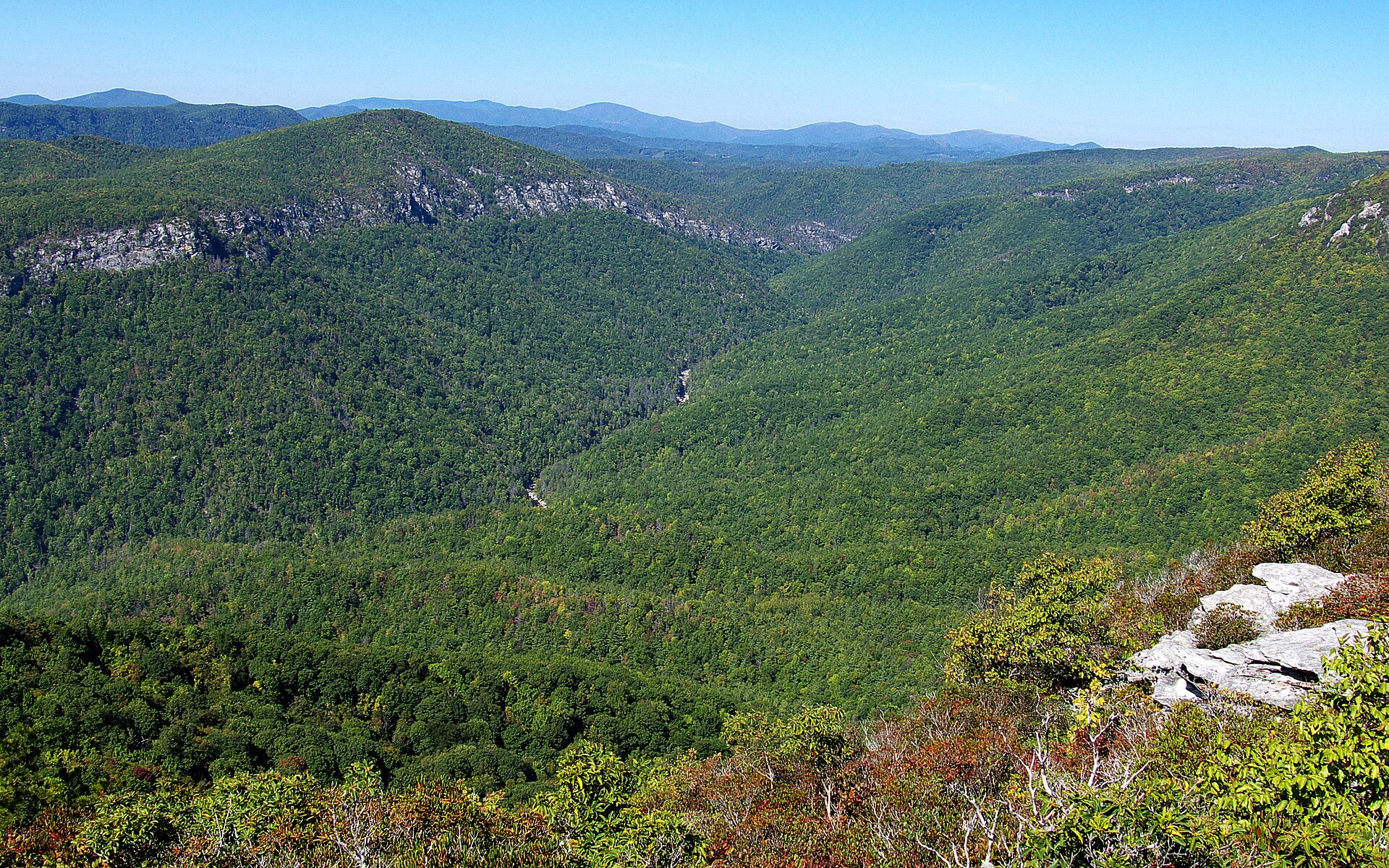
For more than a century, people in Burke County have reported strange lights hovering and bobbing above Brown Mountain, a long, low ridge near Linville Gorge. Stories tell of lanterns carried by searchers or ghosts, and the lights inspired a popular song. Overlooks on N.C. 181 and the Blue Ridge Parkway have become places to watch for them on clear autumn nights.
Investigators have offered many explanations over the years, including distant car headlights and train lights, campfires, reflections and unusual atmospheric conditions. Scientists from Appalachian State University have set up cameras to study the phenomenon. No single explanation has satisfied everyone, which is part of the appeal.
Read the folklore side of the story in our mountain ghost stories, then watch for yourself from a safe overlook. Leave the gorge trails for daylight.
How to enjoy the night without harming it
- Use red light. A red headlamp or red film over a flashlight protects your night vision and disturbs fireflies less.
- No flash photography. Flash confuses fireflies and ruins other people’s view.
- Stay on the trail. Female blue ghosts and many firefly larvae live in the leaf litter.
- Do not catch fireflies at viewing sites, and if children catch them at home, let them go the same night.
- Turn off porch lights in early summer and skip lawn pesticides. Leave some leaf litter and tall grass. Fireflies need dark, damp, unsprayed ground.
- Plan for safety. Tell someone your route, carry a spare light and check weather and road closures.
After dark FAQ
Are there synchronous fireflies in North Carolina?
The synchronous firefly, Photinus carolinus, lives in the Southern Appalachians, including parts of western North Carolina. The most famous viewing site, Elkmont, is on the Tennessee side of Great Smoky Mountains National Park and requires a lottery pass during the peak, usually late May to mid-June.
Where can I see blue ghost fireflies?
In damp, mature mountain forests of western North Carolina, including DuPont State Recreational Forest and parts of Pisgah National Forest, usually from late May into June. Check current access rules, which can change during peak season.
Where is the darkest sky in North Carolina?
Mayland Earth to Sky Park near Burnsville is a certified International Dark Sky Park, and remote parts of the Blue Ridge Parkway, Cape Hatteras and Cape Lookout national seashores and Ocracoke Island are also very dark.
When is the best meteor shower?
The Geminids in mid-December and the Perseids in mid-August are usually the best, with the Quadrantids in early January close behind when the moon cooperates.
What are the Brown Mountain Lights?
Lights reported for more than a century above Brown Mountain in Burke County. Proposed explanations include distant headlights and train lights, campfires and atmospheric effects. No single explanation is accepted by everyone.
How can I help fireflies at home?
Turn off outdoor lights at night in early summer, avoid lawn pesticides, leave some leaf litter and unmowed grass, and keep any water features natural.
Sources and further reading
- National Park Service, Synchronous fireflies
- Science Friday, The eerie glow of blue ghost fireflies
- Explore Asheville, Where to see synchronous fireflies near Asheville
- DarkSky International, Mayland Earth to Sky Park
- Mayland Community College, Earth to Sky Park
- Pisgah Astronomical Research Institute
- American Meteor Society, Meteor showers
- Mirollo and Strogatz, Synchronization of pulse-coupled biological oscillators (SIAM Journal on Applied Mathematics, 1990)
- N.C. Wildlife Resources Commission, Bats

Christopher Adkins is a Huntersville, North Carolina attorney, the founder of Adkins Law, PLLC, and the editor of The Lake Norman Brief. A Charlotte native, former Army officer and former CMPD officer, he writes these guides to share the wild places that make North Carolina home.
Keep exploring wild North Carolina
 Nature atlas home
 Bears, elk, wolves & wild horses
 Nature calendar & fall color
 Blue Ridge Parkway
 Outer Banks
 Lake Norman’s wild side
 Salamander capital
 Venus flytrap & carnivorous plants
 Mountains
 Piedmont
 Coast & Coastal Plain
 Waterfalls
 250 hiking trails
 Wildlife field guide
 Plants & trees
 Lakes & river basins
 Mount Mitchell & Kuwohi
 Nature by the numbers
 Intracoastal Waterway
 Article directory