
The Lake Norman Brief / C. S. Lewis
The Lion, the Witch and the Wardrobe
Lucy finds Narnia by touch. Edmund finds the same country and says it does not exist. Follow the four children from wartime England to the Stone Table and back, with chapter readings, photographs, and maps.
Start with a question
When does a private betrayal become a responsibility to others?


Reading note: Full spoilers: all seventeen chapters, Aslan’s sacrifice and return, and the ending are discussed.
The book in focus
Four children arrive at a stranger’s house because London is being bombed. Three of them glance into a spare room, see a wardrobe, and move on. Lucy tries the handle. Lewis gives the reader time to go with her, and that small arrangement has consequences. By the time Lucy asks her brothers and sister to believe her, we have been in the wood ourselves. The family argument that follows turns on what the others owe a witness when they have missed the event.
First published in 1950, The Lion, the Witch and the Wardrobe was the first Narnia book to appear, although chronological editions label it Book Two in the story’s internal chronology. It follows Peter, Susan, Edmund, and Lucy into a land held in an unnaturally prolonged winter. Their adventure combines a family conflict, a resistance story, a transformation of seasons, and a deeply Christian pattern of betrayal, sacrifice, and renewed life.


In his essay on the book’s beginnings, Lewis remembered the faun with the parcels before he remembered a plot. The parcels matter. What could a creature out of classical mythology have been buying, and for whom? An umbrella leads a reader to wonder about the weather. A parcel leads to Christmas, errands, and other people. By the time Tumnus invites Lucy home, that unlikely collection of objects has already given him a life beyond his role in her adventure. Read Lewis’s account of the image that came first.
The journey before the wardrobe
Before Lucy opens the wardrobe, someone has already decided where she and her siblings must live. They have been sent away from London because of the air raids. An English child reading the novel in 1950 could remember what it meant to be taken somewhere safe by adults and then left among strangers. In Stepney on 1 September 1939, children from Myrdle School assembled at five in the morning to leave. The photograph catches the part of evacuation that a timetable leaves out: a child still has to carry the case.


Lewis gives the Pevensies a whole house to explore, but very little say in how they came to it. Lucy’s first independent decision is wonderfully small. She stays behind to try a door when the others have lost interest. Later, in a country where a ruler claims the right to decide who may go free, the children will have to decide whom they themselves can shelter. The movement from displaced guest to responsible host begins in that upstairs room.
Read the government history of the evacuation · Explore the Brief’s Second World War collection.
A guide through the chapters
Chapters 1–3 · The wardrobe, the Faun, and a disputed discovery
“Lucy Looks into a Wardrobe,” “What Lucy Found There,” and “Edmund and the Wardrobe” establish the passage from wartime displacement to another endangered world. Sent away from London, the four children enter a house whose unfamiliar rooms invite exploration. Lucy’s discovery begins with sensation: coats give way to branches, cold, snow, and an unexpected lamp-post. The story makes the impossible convincing through ordinary physical experience.
Mr. Tumnus offers warmth and hospitality while concealing an intention to surrender Lucy to the Witch. His remorse supplies the first moral turning point: a person implicated in wrongdoing can choose differently at real risk. Returning to England, Lucy finds that no time appears to have passed and nobody believes her. Edmund’s later entrance confirms Narnia’s reality for him, but knowledge alone does not make him truthful or kind. The siblings’ different responses to the same extraordinary world become central to the plot.
Read the crossing once as a sequence of touches. At first Lucy has the reassuring weight of fur against her face. The next thing she brushes against is unexpectedly rough. Lewis lets her make a perfectly ordinary mistake about a sensation and then correct it. The reader crosses the frontier in the interval between those two judgments. By the time Lucy sees the lamp, the question is no longer whether the wood exists. It is who could have put a piece of street furniture so far from a street.


Primary reading: The Lion, the Witch and the Wardrobe — Chapters 1–3 · The wardrobe, the Faun, and a disputed discovery. Analysis and interpretation.
Chapters 4–6 · Appetite, betrayal, and entering together
“Turkish Delight” turns comfort into manipulation. The White Witch offers Edmund warmth, enchanted food, attention, and imagined status. Her promises exploit both immediate appetite and his wish to be more important than his siblings. The temptation is therefore richer than a warning against sweets: she offers a story in which his resentment becomes entitlement.
“Back on This Side of the Door” exposes the cruelty of Edmund’s decision to deny what he knows. The Professor asks the others to reconsider their judgment of Lucy, making trust and testimony part of the adventure. In “Into the Forest,” all four finally enter Narnia and find Tumnus’s home ransacked. A private discovery becomes an obligation toward someone endangered because he helped Lucy. Their decision to continue begins an education in responsibility beyond personal amusement.
The robin poses a harder question than the Professor did. The children could at least tell him what Lucy had said. A bird offers no testimony they can cross-examine. Peter and Edmund can look at precisely the same red breast and draw opposite conclusions about the risk of following it. Lewis keeps both objections alive. Going forward might be foolhardy. Going back means leaving Tumnus to pay for his kindness. The children have to make a decision before they can settle the argument.


Primary reading: The Lion, the Witch and the Wardrobe — Chapters 4–6 · Appetite, betrayal, and entering together. Analysis and interpretation.
Chapters 7–9 · Hospitality, prophecy, and the Witch’s house
“A Day with the Beavers” and “What Happened after Dinner” place political resistance inside domestic hospitality. Food, shelter, practical conversation, and trust prepare the children to hear about Aslan and the hope attached to the four thrones at Cair Paravel. The name Aslan affects them before they understand who he is, giving expectation an emotional force beyond information.
Edmund leaves the shared meal and reaches the Witch’s castle in “In the Witch’s House.” Stone figures make her rule visible as a condition of arrested life. His anticipated reward becomes disappointment and fear. Yet the narration does not make him incapable of change; even within resentment, he registers disturbing details. The contrast between the Beavers’ nourishment and the Witch’s addictive promise distinguishes a relationship that sustains a person from one that makes him easier to control.
Watch where the reader’s attention goes during dinner. There are fish to catch and potatoes to bring to the table. There is news everyone wants to hear. Only afterward does anyone notice the empty place. Edmund’s disappearance works because the reader has been as happily occupied as his siblings. On a second reading the warm room becomes an uncomfortable test. Knowing how a scene ends changes which person you watch while everyone else is talking.


Primary reading: The Lion, the Witch and the Wardrobe — Chapters 7–9 · Hospitality, prophecy, and the Witch’s house. Analysis and interpretation.
Chapters 10–12 · The thaw and the first test of courage
“The Spell Begins to Break” introduces Father Christmas, whose arrival marks a weakening of the Witch’s prohibition on celebration. His gifts are responsibilities as well as equipment. In “Aslan Is Nearer,” the melting landscape changes the practical conditions of pursuit and the emotional conditions of hope. Spring does work in the plot: the Witch’s mode of travel fails as her apparent permanence dissolves.
“Peter’s First Battle” brings the children to Aslan and requires Peter to act against a threatening wolf. Courage appears as action amid fear rather than the absence of fear. Susan and Lucy’s encounter with Aslan also complicates the expectation that goodness must be harmless or easily managed. The chapter frames authority as something that can inspire trust and awe together, while leaving readers room to question the assumptions attached to kingship and battle.
The thaw can be heard before its full consequences are visible. Water starts making a noise again. What is liberation for a stream is terrible news for a passenger in a sledge. Edmund, who first met the Queen as someone grand enough to be driven through the snow, ends up having to walk. That change in how two bodies move through the same country does more to show the loss of her power than an announcement about the end of winter could.


Primary reading: The Lion, the Witch and the Wardrobe — Chapters 10–12 · The thaw and the first test of courage. Analysis and interpretation.
Chapters 13–15 · Edmund’s rescue and Aslan’s sacrifice
“Deep Magic from the Dawn of Time” restores Edmund to the others before the full cost of his betrayal has been resolved. Aslan’s private conversation with him is not disclosed. The narrative thus protects a space for repentance that does not require the reader to watch humiliation or hear every confession. The Witch’s claim under the Deep Magic then turns his rescue into a conflict over guilt, obligation, and release.
In “The Triumph of the Witch,” Aslan voluntarily accepts death in Edmund’s place. Susan and Lucy accompany him, witness his degradation, and remain in grief after the crowd departs. “Deeper Magic from Before the Dawn of Time” reverses the apparent victory: Aslan returns to life and explains a reality the Witch’s knowledge did not encompass. The sequence connects mercy with costly action and gives the girls’ fidelity a central place in the story’s revelation.
The Witch’s followers leave once they believe the important part is over. Susan and Lucy stay. For a while there is almost nothing they can do, and Lewis is unusually patient with that helplessness. He even gives the mice a task the girls cannot accomplish with their hands. On a first reading the reader wants to hurry toward the miracle. On a second, the unhurried work beside the body deserves attention in its own right. The sisters have no promise that their care will be rewarded.


Primary reading: The Lion, the Witch and the Wardrobe — Chapters 13–15 · Edmund’s rescue and Aslan’s sacrifice. Analysis and interpretation.
Chapters 16–17 · Restored life, victory, and the return
“What Happened about the Statues” makes liberation bodily. Aslan restores the petrified creatures, including Tumnus, and the revived community goes to the battlefield. The book’s decisive reversal is therefore more than a contest between two powerful rulers: beings reduced to objects regain movement, speech, and participation.
“The Hunting of the White Stag” recounts the victory, Edmund’s brave attack on the Witch’s wand, Lucy’s healing work, and the children’s coronation. Their adult reign stretches beyond the brief adventure readers have followed. Pursuing the White Stag eventually leads them back through the wardrobe, where they are children again and almost no English time has elapsed. The ending preserves both fulfillment and loss. They have become more than they were, yet cannot simply display that history or summon Narnia whenever they wish.
At the end, Lucy is old enough to remember a childhood place as a faint, nagging impression. That small lapse makes the years at Cair Paravel feel lived in. The lamp-post, once the most peculiar thing in the wood, has become unfamiliar to the very people who arrived beside it. Read the two encounters with the lamp back to back. An object that first made a strange country recognizable now makes the children strangers to their own past. Returning home costs them something the first crossing could never have disclosed.
Primary reading: The Lion, the Witch and the Wardrobe — Chapters 16–17 · Restored life, victory, and the return. Analysis and interpretation.
Edmund: responsibility without permanent condemnation
Edmund’s wrongdoing includes deliberate cruelty, concealment, and betrayal. The enchanted food intensifies his desire, but the narrative also shows choices that precede and accompany the enchantment. He wants his siblings to be wrong and wants the authority the Witch promises. His failure cannot be explained by appetite alone.
His recovery is equally more than receiving a pardon. He changes his relationship to other people’s suffering and later acts courageously. The story refuses to identify him forever with his worst choice. That is one of its strongest moral possibilities: accountability can be real without making restoration impossible. Lucy’s healing and Aslan’s refusal to reopen Edmund’s shame help turn that possibility into a communal practice.


The conversational storyteller
Lewis’s narrator addresses the reader with confidences, practical reminders, judgments, and humor. The repeated attention to keeping a wardrobe door safe places ordinary common sense beside impossible magic. That voice can make the story feel like a trusted adult telling an adventure aloud. It also guides sympathies strongly, sometimes announcing what a sensible or good child would do. Readers can enjoy the warmth while noticing how the narration steers judgment. The most interesting moments occur when a character becomes more complicated than the label initially attached to them, as Edmund does through shame, compassion, courage, and forgiveness.
A Christian story with more than one imaginative language
Aslan’s voluntary death, humiliation, return to life, and liberation of captives strongly invite Christian readings. The sisters’ witness, the breaking of the Stone Table, and the transformation from winter to spring reinforce the pattern. These are features of the fictional narrative and its religious imagination; they are not presented here as historical evidence for Christian claims.
A rigid one-to-one code, however, makes the story smaller. Tumnus, Father Christmas, talking animals, classical creatures, and fairy-tale monarchy belong to a mixed imaginative world. Aslan can be read as an imagined manifestation of Christ within that world without requiring every object or character to equal one biblical counterpart. Likewise, the Deep Magic should not be forced to settle every theological dispute about atonement. The narrative brings guilt, mercy, sacrifice, and victory into relation through its own invented conditions.
Questions about gender, monarchy, and violence
The allocation of gifts and warnings reflects gendered expectations about fighting and care. Peter’s martial testing and Lucy’s healing receive different forms of emphasis, while Susan and Lucy witness the book’s central death and resurrection. Their importance complicates any claim that they are simply excluded, but it does not erase the limits placed on their roles. Readers can appreciate their courage while examining those assumptions.
The happy ending also assumes benevolent monarchy and distinguishes rightful rule from tyranny largely through the character of rulers. That is a fairy-tale political imagination, not a worked-out account of accountable government. Battle resolves the Witch’s violent domination, but restoration, hospitality, forgiveness, and healing are equally necessary to the book’s idea of victory. Paying attention to those activities keeps the martial climax from swallowing the whole moral vision.
Time, memory, and returning to ordinary life
The final return is more unusual than a simple awakening from a dream. The children have lived into adulthood and exercised responsibility, yet resume their former ages in England. Narnia’s time preserves an experience that ordinary chronology cannot accommodate. The Professor’s response suggests that returning matters, but that the doorway cannot be treated as a machine for reproducing wonder on demand.
Prince Caspian later deepens this problem by returning the children to a Narnia that has aged far beyond them. Reading the two together makes restoration less like possession. A world can be loved without remaining permanently available in the form one remembers. The adventure’s value must therefore survive the loss of immediate access to it.
Questions worth staying with
- Why does Edmund deny an experience he knows is real?
- How do the Witch’s gifts differ from the Beavers’ hospitality?
- Why does Lewis leave Edmund’s private conversation with Aslan unreported?
- What do Susan and Lucy contribute that battlefield courage cannot replace?
- Where does a Christian reading illuminate the story, and where might a rigid code reduce it?
- What does the return to childhood preserve or unsettle about the children’s growth?
Sources & further reading
This is an original critical reading of the book. Chapter references follow the novel. Pagination varies by edition. Historical background, institutional records and related reading are linked below.
- C. S. Lewis, The Lion, the Witch and the Wardrobe (Geoffrey Bles, 1950)Primary text: all seventeen chapters. Original publication and story chronology are distinguished.
- C. S. Lewis official site: author and publication chronologyOfficial author/publisher chronology; original publication 1950. Site may redirect to HarperCollins.
- C. S. Lewis official site: The Narnian Order of ThingsDistinguishes original publication order from internal chronological order. This guide does not require one reading order.
- C. S. Lewis, “It All Began with a Picture…”The author’s retrospective account, collected in Of Other Worlds.
- UK Government History Blog, “Child Evacuees in the Second World War”The September 1939 departures and the Myrdle School photograph.
- EastSide Tourism, C. S. Lewis SquareThe visitor centre’s walking map for the Belfast sculpture trail.
A reader’s atlas
Where the children part ways
Start at the wardrobe, then look for the fork at the Beavers’ dam. Edmund walks to the castle expecting a crown. His siblings set out to meet a lion they have every reason to fear. On the return to the castle in chapter 16, its meaning changes again. The first visitor saw a courtyard full of statues. The later visitors see people who can still be brought home.
Walk the story in Belfast
At C. S. Lewis Square in east Belfast, you can walk between the robin, the Beavers, the White Witch and the Stone Table in a few minutes. Maurice Harron’s sculptures turn a sequence that takes days on the page into a public space you can cross on foot. The map marker sits beside the Aslan sculpture.
Open the Belfast street map · Visitor centre and sculpture trail map · © OpenStreetMap contributors
Find Lewis’s Oxford on an older map
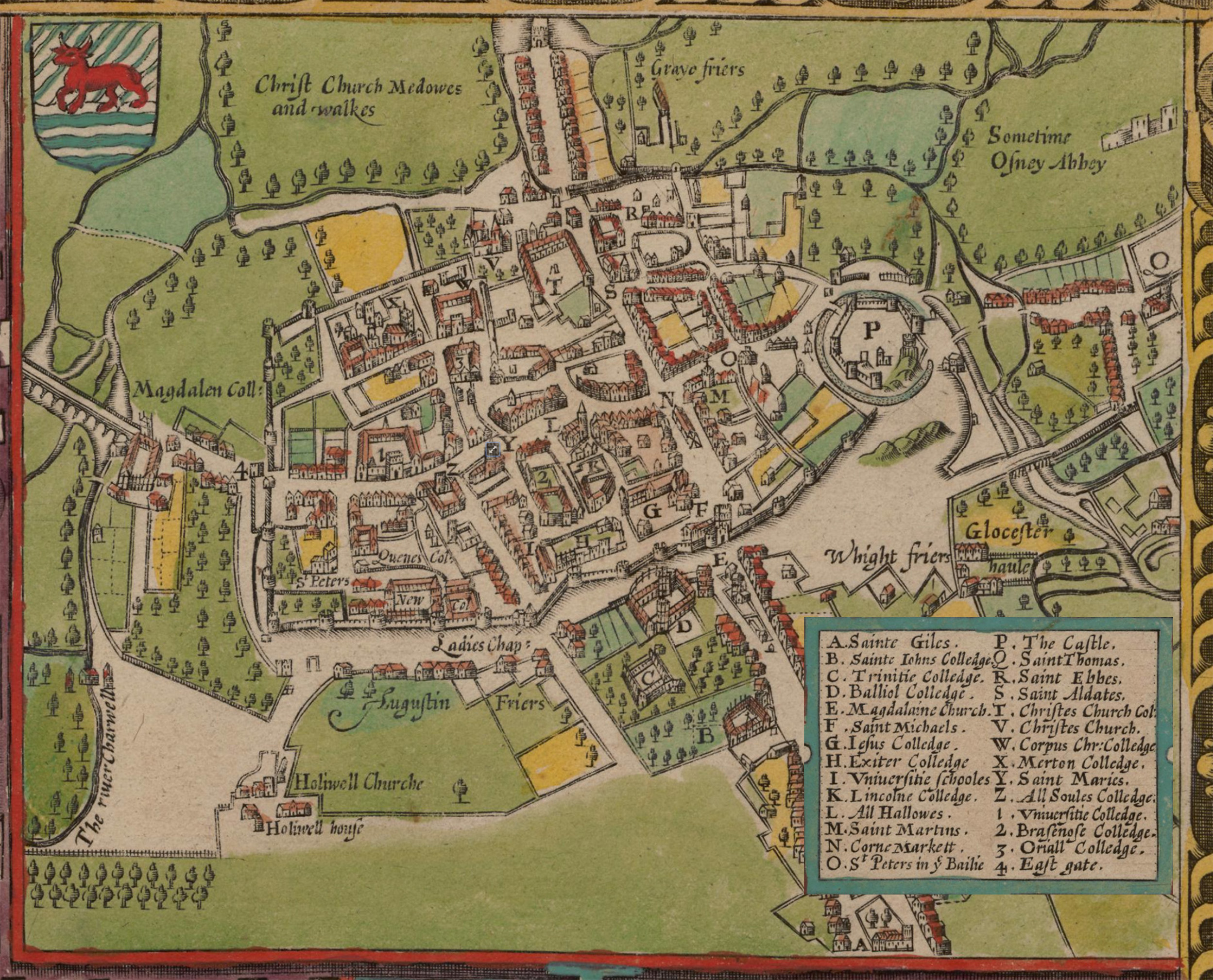
John Speed’s 1605 plan puts north at the bottom. Begin with the walled city, then look just outside it for Magdalen College, where Lewis would teach more than three centuries later. Turning the map around is a fitting exercise after a book in which an utterly familiar lamp-post can make four people lose their bearings.


In Lewis’s words
Three lines to read aloud
“Always winter and never Christmas”
Mr Tumnus, chapter 2
The two halves pull against one another. A child might welcome the first snowfall precisely because it promises Christmas. Tumnus has to explain what it is to keep the weather and lose the day everyone was waiting for. That is how Lucy first begins to understand what the Witch has taken.
“Who said anything about safe?”
Mr Beaver, chapter 8
Listen to the impatience in the question. Mr Beaver answers as someone who knows the country and is getting supper cleared away. He makes no attempt to sound like a prophet. That homely voice gives the children room to admit that meeting someone good might still frighten them.
“At first they were not a story, just pictures.”
C. S. Lewis, “It All Began with a Picture…”
The distinction explains the pleasure of the lamp-post. We can look at it, wonder about it, and remember it long before we have a theory about its meaning. Try letting a new reader spend a moment with the picture before explaining what Narnia stands for.
Photographs, art & places
A visual companion
The Belfast sculptures give the characters a second life in the author’s home city. Open a photograph to inspect the artist’s choices, then compare them with the scene you pictured while reading.


Winter woodland in the masthead and quotations section: Andrew Gritt · CC BY-SA 2.0. Cropped and faded for display. The reader’s atlas uses a faded detail of John Speed’s public-domain 1605 plan of Oxford.
Keep reading
Continue through the collection

Prince Caspian
A guide to all fifteen chapters of C. S. Lewis’s story of hidden history, faith, and a country changed by time
Read the illustrated guide →

The Voyage of the Dawn Treader
A guide to all sixteen chapters of C. S. Lewis’s eastward voyage and its different kinds of homecoming
Read the illustrated guide →

The Silver Chair
A complete guide to Jill, Eustace, and Puddleglum’s search for Prince Rilian—and the worlds beneath Narnia.
Read the illustrated guide →
The illustrated reading room
Look closer: an illustrated reading path
Enlarge a photograph, map, manuscript, or artwork. Each caption explains its connection to the reading and identifies its source.


The illustrated reading room
Trust, temptation, and repair
An invitation to test an interpretation, follow an argument, and bring a more precise question back to the text.
Try this while you read
Follow Edmund through a particular decision. Identify what he wants, what he conceals, and what he refuses to consider. Then distinguish admitting fault from repairing its consequences.
Open the next question
What should a careful reading keep in view?
Christian resonances reward attention, but a scene also works through its setting, dialogue, and suspense. Read those details before substituting a single label for the whole story.
Build a stronger response
State the author’s claim in terms the author would recognize. Identify the passage that supports your interpretation. Offer an objection, then ask what would count as a fair answer to it.
The illustrated reading room
Continue the conversation
Follow a different discipline or a contrasting voice. These links connect the book to the wider Religion & Philosophy collection.