
Religion & Philosophy / Philosophy / Plato
Plato · Chapter 04 of 05
The Republic: Justice, Education, and the Danger of Power
A magnificent argument—and a political vision that demands resistance
Curated by Christopher Adkins of Huntersville, NC

Would justice still matter if nobody could detect injustice? A Renaissance Latin manuscript page identified as Plato’s Republic. The material page recalls the work of copying, translating, and interpreting through which the dialogues reached new readers. Public domain.
Anonymous manuscript artist and scribe / Wikimedia Commons · Public domain.


Explore the historical images.
01 / 07
1. Why be just if injustice would pay?
The Republic is often introduced as a blueprint for an ideal state. Its driving question begins closer to home: what does justice do to the person who possesses it? At Republic II, 357a–367e, Glaucon and Adeimantus demand an answer stronger than a catalogue of rewards. Praise, money, favorable treatment, and a good reputation might follow the appearance of justice just as readily as its reality.
Glaucon’s story of a ring that makes its wearer invisible intensifies the problem. If a person could act without being detected, would justice still have authority? The imagined case removes the usual fear of exposure. It is not a report that every human being would certainly behave the same way; it is a challenge to explain why anyone should prefer justice when social incentives appear to favor wrongdoing.
The brothers then separate reputation from character. Imagine a just person treated as unjust and an unjust person admired as just. The question becomes painfully clear: has justice itself any value that survives the reversal of appearances? Modern equivalents can be constructed whenever an institution rewards a result while failing to examine the means. But Plato’s challenge is more radical than a complaint about unfair rewards. It asks whether success achieved through corruption might conceal a deeper damage to the person who succeeds.
02 / 07
2. Building a city to read a soul
Socrates proposes examining justice in a larger object, the city, before returning to the individual. The imagined city begins with mutual need and a division of labor. A more luxurious city expands its wants, creating the need for additional resources and defense. The discussion of institutions therefore grows out of an inquiry into desire: what a community regards as necessary helps determine the powers it must organize and the conflicts it will face.
In Republic IV, 427d–434c, wisdom, courage, moderation, and justice are located in the city’s ordered relations. Justice is associated with each group doing its proper work without usurping the function of another. The proposal offers an account of coordination, but it also creates a hierarchy. We should ask who determines the appropriate role, how an incorrect assignment can be challenged, and whether social peace can conceal the denial of a person’s capacities.
The analogy then moves inward. Reason, spirit, and appetite are distinguished through conflicts within motivation, especially at 436a–441c. A person can desire something while judging that it should be refused; anger can oppose appetite or reinforce a judgment of honor. Justice within the soul is an appropriate ordering of these elements. Yet a city is made of persons, not psychological parts. The analogy helps organize the inquiry; it does not erase the independent moral standing of the people whose lives a political arrangement governs.
“do you wish really to persuade us, or only to seem to have persuaded us”
Glaucon in Plato, Republic II, 357aBenjamin Jowett; excerpt from Glaucon’s question

03 / 07
3. Education reaches deeper than information
The guardians must be courageous without becoming brutal toward those they protect. Physical training alone cannot accomplish that balance. Stories, music, rhythm, examples, and habits of admiration shape what the young find noble or shameful before they can offer a developed argument. Republic III, especially 386a–412b, treats education as the formation of perception and desire, not merely the transmission of facts.
That insight remains disturbing because it contains a truth without settling the authority to act on it. Cultural experience does influence what people admire, fear, and excuse. It does not follow that rulers should control every representation citizens may encounter. Plato’s proposed restrictions on poetry and portrayal of the gods invite censorship precisely where the desire to produce good character becomes a claim to manage the imagination.
The myth of the metals, introduced at 414b–415d, adds another problem. It presents citizens as members of one earthborn family with different metals mixed into their souls, supporting social unity and differentiated roles. The story permits movement when a child’s nature differs from the parents’, but it still authorizes political mythmaking from above. A reader who values honest government should ask why an account of justice depends on a story its educators regard differently from its audience. The problem is not answered simply by giving deception an honorable purpose.
04 / 07
4. What philosopher-rule tries to solve—and cannot guarantee
The proposal that philosophers should rule appears at Republic V, 473c–d. Its underlying diagnosis is that political authority and understanding are separated. People who most desire power may be poorly equipped to use it, while those capable of seeing beyond immediate advantage may withdraw from public life. Philosophy is supposed to supply both a grasp of the Good and a character less vulnerable to the usual temptations of office.
The educational program is correspondingly long. Mathematical study, dialectic, practical experience, testing, and eventual return to public service are part of the design in Books VI–VII. These are not rulers selected merely because they possess academic credentials or enjoy abstract debate. Plato demands a transformation of motivation as well as training of intellect. That makes the ambition more serious, but it does not dissolve its central political danger.
Who can reliably recognize a person who knows the Good? What happens when the recognized expert is mistaken, self-deceived, or successfully impersonated? What rights do citizens retain when their judgment conflicts with a guardian’s? Modern constitutional thinking often responds by dividing power and making officeholders answerable through institutions. That is a comparison, not a claim that Plato secretly proposed constitutional liberalism. The Republic is powerful partly because it forces an uncomfortable distinction: we need informed judgment, yet a claim to superior understanding cannot by itself justify unlimited rule.

05 / 07
5. Radical openings beside severe restrictions
Book V argues that women with the relevant capacities should share the education and work of guardians. At Republic 451c–457b, the question is whether a difference in sex is relevant to the function under consideration. The move challenges an exclusion that Greek social practice largely took for granted. Plato is capable of asking whether convention has mistaken an irrelevant difference for a decisive one.
That opening must be read beside the limits of the surrounding arrangement. The argument does not establish equal rights for every woman or eliminate the hierarchies of the city. The guardian system also abolishes ordinary private households for that class, regulates reproduction, and assigns the raising of children to public arrangements. It restricts personal attachments in pursuit of civic unity. These proposals are coercive even if their stated aim is to prevent private loyalties from corrupting public service.
Precision matters here. The communality of property and family is principally the arrangement of the guardian class; it should not be generalized carelessly to every producer in the city. Nor should the admission of women to guardianship be celebrated as if it canceled the rest. Plato’s thought can expose the weakness of one inherited exclusion while endorsing controls that modern readers should reject. A serious reading can acknowledge the philosophical advance in asking about relevant capacities and still insist that persons need protections against an institution’s ambition to organize their whole lives.
06 / 07
6. The descent toward tyranny
In Republic VIII, political decline parallels changes in the dominant desires of a person. An honor-centered regime gives way to a regime centered on wealth, then to democracy, and finally to tyranny. The sequence is a philosophical construction, not a reliable timetable into which every historical society must be fitted. Its value lies in the examination of what happens when one kind of good becomes the measure of all the others.
Wealth can become the sole qualification for esteem. Freedom can be interpreted as the refusal of every ordering principle. A leader can present himself as the people’s protector while producing dependence and eliminating rivals. Plato’s treatment of democracy is unsympathetic and should be argued with; he gives insufficient weight to the corrective value of citizen participation and institutions of accountability. His criticism nevertheless asks a question democratic societies must answer: what practices allow freedom to coexist with informed judgment and mutual restraint?
Republic IX, 571a–580c, turns the apparent master into the least free person. The tyrannical soul is dominated by appetites that continually demand satisfaction and generate fear. This completes the answer to the invisible wrongdoer: escaping external punishment may leave internal disorder untouched. Whether Plato proves every part of the claim is open to debate. But he offers a compelling distinction between having the power to obtain what one wants and having desires that make a life worth living.

07 / 07
7. How to argue with the Republic without dismissing it
Two shortcuts impoverish the book. One treats every objection as evidence that Plato was simply a monster whose questions can be ignored. The other treats the grandeur of his questions as permission to excuse his coercive institutions. The more productive reading separates the problem, the proposed explanation, and the proposed remedy. A diagnosis can reveal a real weakness even when its prescribed political cure is unacceptable.
Try a three-column comparison while reading: what danger is Plato addressing, what institution does he propose, and what new danger does that institution create? The training of guardians addresses incompetence but raises questions about exclusion and control. Restrictions on property address corruption but impose severe limits on private life. Philosophical rule addresses shallow judgment but concentrates authority. This is an original method of critical reading; it neither assumes the modern answer in every case nor suspends the reader’s moral judgment.
The Republic ultimately asks us to examine the constitution of a life. Which desire rules when no one is watching? Which pleasures train our attention? Can reason persuade our ambitions to serve a good they did not invent? Its political arrangements require strong resistance at important points, but those questions cannot be dismissed with them. The book remains useful when it makes our own standards more articulate—and when we apply to its confident constructions the same demand for reasons that Socrates applies to everyone else.
The visual reading room
Look closely. Ask better questions.
Eight images invite a slower look at places, portraits, manuscripts, and later interpretations. Would justice still matter if nobody could detect injustice? Select any image to enlarge it; the source and reuse credit remain with every item.


Geographic orientation
Ideas have places. Maps have histories.
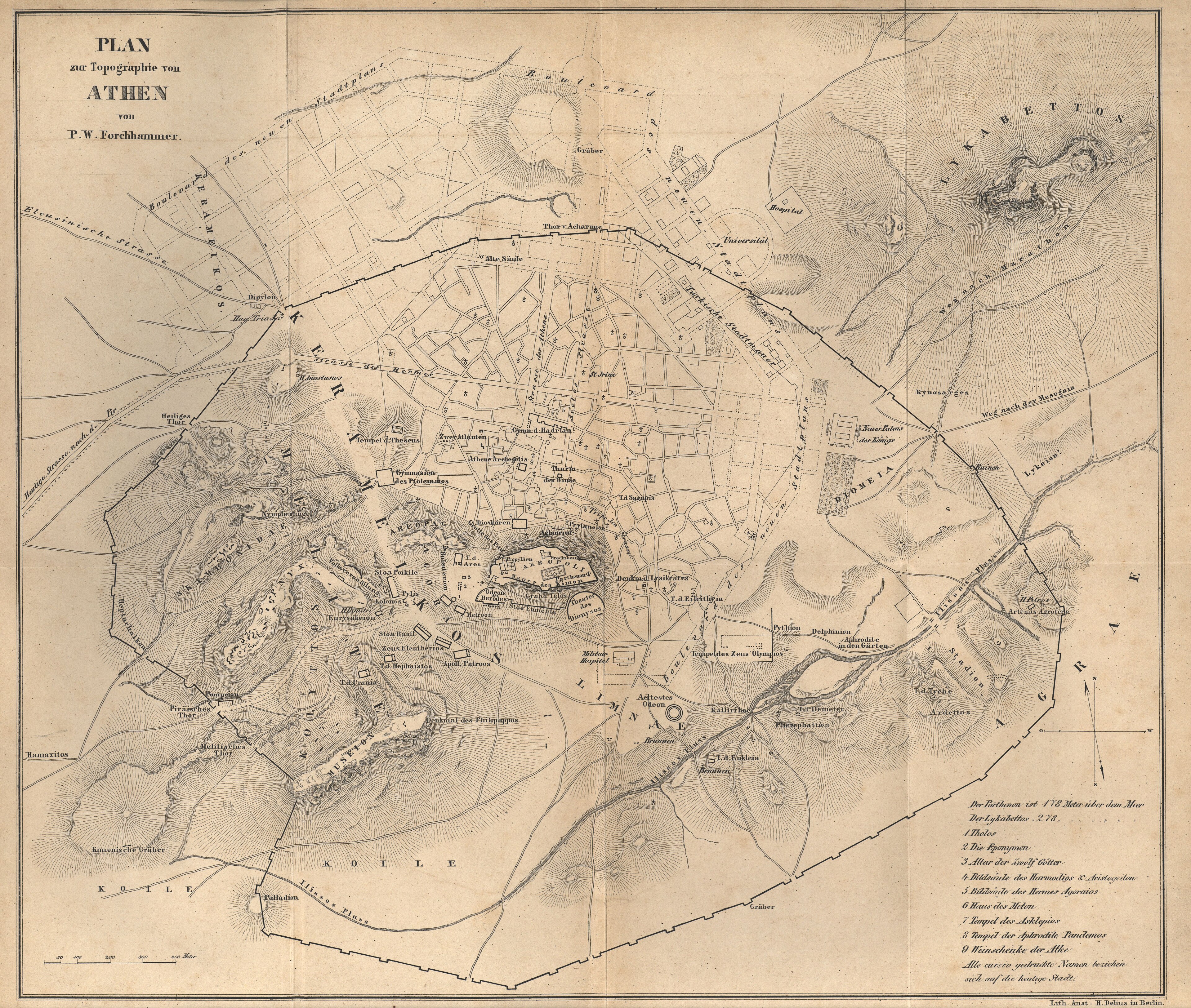
Athens supplies the civic and intellectual setting for much of this collection: public argument, Socrates’ trial, Plato’s Academy, and Aristotle’s Lyceum. Keep the differences between those institutions and generations in view.
Forchhammer’s 1841 plan is a historical reconstruction of ancient Athens. Its labels and proposed identifications belong to nineteenth-century scholarship; it is not a modern excavation plan or a photograph of the ancient city. Use it for orientation, then consult current site scholarship.
The argument workshop
Justice without an audience
Would justice still matter if nobody could detect injustice?
The ring of Gyges removes the ordinary risk of discovery. The challenge is designed to separate the benefits of being just from the rewards of merely appearing just.
1. Accept the difficult version
Do not answer only that dishonesty is eventually exposed. The thought experiment deliberately removes that reassurance and asks what injustice does to the person who practices it.
2. Test the city–soul analogy
The city makes patterns of order easier to see. Ask what justifies moving from political classes to psychological parts, and where the comparison might fail.
3. Examine the political cost
Plato’s educational ambition is bound to coercive institutions and exclusions. A reader can investigate his diagnosis of appetite and power while critically assessing who decides what the common good requires.
Return to the chapter’s primary-text anchor: Glaucon in Plato, Republic II, 357a. These exercises are editorial prompts, not quotations from the philosopher.
Check the distinction
Read the answer and explanation
Why justice benefits its possessor even apart from reputation The challenge is about justice itself. A defense resting only on praise, rewards, or the fear of punishment leaves Glaucon’s central demand unanswered.
Continue the conversation
Follow the question into another room.
These are invitations to comparison. A shared question does not make different thinkers or traditions interchangeable.
Socrates’ trial
Keep the problem of conscience and public authority in view.
Explore this connection →Aristotle’s constitutions
Compare the ideal city with analysis of political forms and common advantage.
Explore this connection →Tocqueville
Extend the conversation about democracy, education, and civic life.
Explore this connection →Elinor Ostrom
Compare a later approach to institutions and cooperation without assuming agreement with Plato.
Explore this connection →Pause · question · discuss
Carry the argument further
Is the Republic only a plan for government?
No. Its central inquiry asks why justice benefits the person who possesses it. The city is developed partly to make justice easier to examine before returning to the soul.
Did Plato argue for women’s education?
He argues that suitably capable women should share guardian education and functions. This important opening coexists with severe social hierarchy and coercive controls; it is not a modern program of universal equal rights.
Does philosopher-rule mean electing academics?
No. Plato describes an exceptionally demanding intellectual and moral formation. The more serious objection remains how alleged wisdom can be identified and held accountable.
The reading room
Primary texts and source notes
- Plato, Republic II357a–367e: challenge to justice; 369b onward: the city in speech.
- Plato, Republic IIIEducation and the myth of metals, especially 414b–415d.
- Plato, Republic IV427d–441c: civic virtues and parts of the soul.
- Plato, Republic V451c–466d on guardians, women, and family; 473c–d on philosopher-rule.
- Plato, Republic VII521c–540c: guardian education and public responsibilities.
- Plato, Republic VIIIPolitical decline and the psychological analogy.
- Plato, Republic IX571a–580c: the tyrannical soul. Primary texts translated by Jowett.