


World War II · European Theater · September 1944 – March 1945
The Hürtgen Forest and the Bridge at Remagen, 1944–1945
The longest battle the U.S. Army fought in Europe, in a dark forest on the German border that cost some 33,000 American casualties, and the March afternoon when a company of armored infantry ran across the last bridge standing over the Rhine. Nine illustrated chapters, from the West Wall to the Ruhr.
In September 1944 the American armies that had raced across France reached the German border and the fortifications of the West Wall. Beside the First Army’s path past Aachen lay the Hürtgen Forest, fifty square miles of dark fir woods, gorges and ridges. Over the next five months division after division was fed into it, and it became the longest and one of the costliest battles the U.S. Army fought in Europe. A month after the forest was finally cleared, the same army found a bridge over the Rhine still standing at Remagen, and in an afternoon changed the plans of the whole Allied command.
Key facts
What happened
The First Army reached the West Wall in mid-September. To protect its flank as it attacked past Aachen, General Hodges and General Collins decided to clear the Hürtgen Forest (Chapter 1). The 9th Infantry Division, raised at Fort Bragg, attacked first and lost about 4,500 men in October to gain about 3,000 yards (Chapter 2). On 2 November the 28th Division attacked across the Kall gorge and took Schmidt, only to lose it two days later to a German counterattack; its only supply route was a cart track down the gorge (Chapter 3).
The 28th lost 6,184 men. In the gorge, German and American medics arranged truces to care for the wounded of both sides (Chapter 4). In mid-November the 4th, 8th and 1st Divisions joined the attack, the 4th alone suffering more than 6,000 casualties, and in December the Rangers took Hill 400 (Chapter 5). After the Ardennes offensive interrupted the battle, the 78th Division from Camp Butner took Kesternich and Schmidt and reached the Roer dams in February 1945, too late to stop the Germans from flooding the valley (Chapter 6).
On 7 March 1945 Task Force Engeman of the 9th Armored Division reached the Rhine at Remagen and found the Ludendorff Bridge still standing. As Lt. Karl Timmermann’s company rushed it, the German demolition charges failed (Chapter 7). For ten days the Germans attacked the bridge with everything they had, Hitler had its officers shot, and American engineers built bridges beside it under fire; on 17 March it collapsed (Chapter 8). Chapter 9 counts the cost of both battles and visits their memorials.
Why it matters
The Hürtgen is the clearest case in the American war in Europe of a battle fought on the enemy’s terms: in a forest that cancelled American advantages in tanks, aircraft and artillery, for objectives that changed as it went on. The Army’s own historian called it “misconceived.” Remagen is its opposite, an opportunity seized in minutes by men who acted without waiting for orders. Together they show both the costs and the strengths of the U.S. Army in the last winter of the war.
The Carolinas connection
Fort Bragg and Camp Butner
Two of the divisions in this collection were raised in North Carolina. The 9th Infantry Division was reactivated at Fort Bragg in 1940; it was the first division into the Hürtgen and among the first across the Rhine at Remagen. The 78th Infantry Division was reactivated at Camp Butner, near Durham, in 1942; it took the Roer dams and fought through the Remagen bridgehead. See Chapter 2, Chapter 6 and Chapter 9.
How to use this collection
Read the nine chapters in order for the whole story, or start anywhere: chapters 1–6 tell the Hürtgen, chapters 7–8 tell Remagen, and chapter 9 looks back on both. Each chapter has its own photographs, maps or charts, a command decision to try, and sources. The maps below can be played phase by phase; select any place for details and a link to the chapter that tells its story.
The collection
9 chapters
Read in order for the full story, or start anywhere.
 01September – October 1944To the West Wall: Why the Army Went into the Hürtgen ForestThe pursuit across France ends at the German border, Aachen and the Siegfried Line, and why General Collins and General Hodges decided the forest on their flank had to be cleared.02September – October 1944A Vast, Blackish-Green Ocean: The Forest and the 9th DivisionFirebreaks, mines, tree bursts and rain; the 9th Infantry Division, raised at Fort Bragg, loses some 4,500 men to gain about 3,000 yards.032–8 November 1944Schmidt and the Kall Trail: The 28th Division’s Ordeal, 2–8 November 1944Vossenack, a cart track down a gorge, three tanks at Kommerscheidt, and the German counterattack that drove the 112th Infantry out of Schmidt.
 04November 1944 – January 1945The Kall Truce and the Cost of SchmidtGerman and American medics share the Kall bridge, the 28th Division counts 6,184 casualties, and the story of Lieutenant Lengfeld and Private Slovik.0516 November – 15 December 1944November in the Hürtgen: The 4th, 8th and 1st Divisions and Hill 400The great offensive toward the Roer, Hemingway and Salinger with the 4th Division, Grosshau and Hürtgen village, Medals of Honor, and the Rangers on Hill 400.
 06December 1944 – February 1945The Roer Dams: Kesternich, Schmidt and the Flood, February 1945The Bulge interrupts, the 78th Division from Camp Butner takes Kesternich and Schmidt, and the Germans wreck the Schwammenauel Dam’s valves to flood the Roer.077 March 1945The Bridge at Remagen, 7 March 1945Task Force Engeman reaches the Rhine and finds the Ludendorff Bridge still standing; Lieutenant Timmermann’s company crosses as the charges fail.
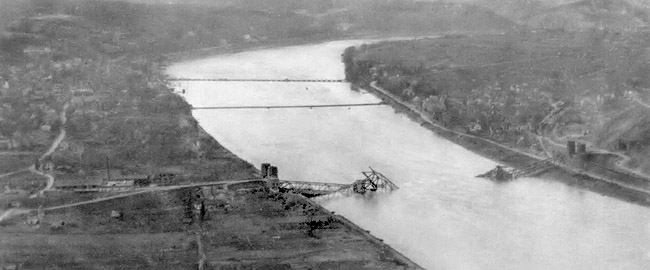 088–24 March 1945Holding the Bridgehead: Jets, V-2s and the CollapseEisenhower pours divisions across, Hitler executes the bridge’s officers, the Luftwaffe and V-2 rockets strike, engineers build bridges under fire, and the Ludendorff Bridge falls on 17 March.
 091944 – todayThe Cost and the Memory: A Misconceived Battle and a Bridge That Changed the PlanThe casualty count and the verdict of historians, the Carolinas connections, the cemeteries at Hürtgen and Vossenack, and the Peace Museum at Remagen.
Maps
Three interactive maps
The first map follows the Allied armies from the German border to the Rhine. The second follows the battle in the Hürtgen Forest, phase by phase. The third shows Remagen and the bridgehead. Press Play, or choose a phase.
Interactive map 1 of 3 · from the West Wall to the Rhine
The First Army from the West Wall to the Rhine, September 1944 – March 1945
Interactive map 2 of 3 · the Hürtgen Forest
The Hürtgen Forest and the Roer dams, September 1944 – February 1945
Interactive map 3 of 3 · Remagen and the bridgehead
The Remagen bridgehead, 7–24 March 1945
Forces
Who fought
The main American and German formations in this collection. Filter by side.
Interactive · filter
Who fought in the Hürtgen and at Remagen, 1944–1945
Fought the Hürtgen from September to February and crossed the Rhine at Remagen.
Chapter 1 →Sent the 9th Division into the forest in September and October.
Chapter 1 →Directed the 28th Division’s attack on Schmidt in November.
Chapter 3 →Held the Remagen bridgehead until Millikin was relieved on 17 March.
Chapter 8 →First into the forest; about 4,500 casualties in October; among the first across at Remagen.
Chapter 2 →Took and lost Schmidt, 2–8 November; 6,184 casualties.
Chapter 3 →Fought through the north of the forest in November; more than 6,000 casualties.
Chapter 5 →Took the village of Hürtgen at the end of November.
Chapter 5 →Stormed Hill 400 above Bergstein in December and held it until relieved.
Chapter 5 →Took Kesternich and Schmidt and reached the Roer dams; fought in the Remagen bridgehead.
Chapter 6 →Its Combat Command B, under Brig. Gen. William M. Hoge, captured the bridge at Remagen.
Chapter 7 →Built the treadway and pontoon bridges and repaired the Ludendorff Bridge under fire.
Chapter 8 →Commanded against the Americans from the Hürtgen to the Ruhr.
Chapter 1 →Held most of the forest in September and October.
Chapter 2 →Helped drive the 28th Division out of Schmidt and Kommerscheidt.
Chapter 3 →Tried and failed to blow the Ludendorff Bridge on 7 March.
Chapter 7 →You decide
Command decisions
Every chapter puts you in a commander’s place before showing what actually happened.
Command decision · you decide
Through the forest, or around it?
You are General Hodges in September 1944. Your First Army is breaking through the West Wall near Aachen. On its right is the Hürtgen Forest, dense, hilly and held by the Germans. Your army is short of men and supplies after the race across France.
Numbers
By the numbers
Every figure carries its source. Where sources disagree, the Army’s official histories are used and the difference noted.
American casualties, division by division
Losses of the 112th Infantry at Schmidt
The Luftwaffe against the bridge, 8–16 March 1945
People
Commanders, fighters and writers
Select a name for the chapter where they appear.
Sent his army into the forest and pushed divisions across at Remagen.
Decided with Hodges that the forest had to be cleared.
Led the attack on Schmidt and watched it fail.
Commanded against the Americans; died in the Ruhr pocket, buried at Vossenack.
Mortally wounded helping a wounded American; honored by American veterans.
The only American soldier executed for desertion since the Civil War.
Followed the 4th Division into the forest in November.
Served through the Hürtgen in the division’s counterintelligence detachment.
Sent his men across the bridge without waiting for orders.
Led the first company across the Rhine.
The first American across the Ludendorff Bridge.
Took command of the bridge the morning it was lost; executed on Hitler’s orders.
Valor
Medals of Honor
Five of the Medals of Honor earned in and around the Hürtgen Forest, all told in this collection.
Detonated a Bangalore torpedo on himself to breach the wire. Chapter 5
Led his battalion through a minefield and took three bunkers. Chapter 5
Wounded, destroyed two machine-gun positions near Grosshau. Chapter 5
Destroyed German positions near Schevenhütte with a bazooka. Chapter 5
Led attacks on house after house in Kesternich until he was killed. Chapter 6
Myth or fact
What people get wrong
Myth or fact · open each card
Six things people get wrong
The Hürtgen was a short, local fight.
It lasted from September 1944 to February 1945 and drew in at least nine American divisions and the Rangers. See Chapter 1.
The Americans went into the forest to take the Roer dams.
For most of the battle the aims were the First Army’s flank and the way to the Roer plain; the dams became the main objective only late in the campaign. See Chapter 6.
The battle ended when the Ardennes offensive began.
It paused. The 78th Division took up the attack on the dams again at the end of January 1945. See Chapter 6.
The bridge at Remagen collapsed while the Americans were capturing it.
It was captured on 7 March and collapsed ten days later, on 17 March. See Chapter 8.
The Germans did not try to blow the bridge.
They did. A demolition charge went off as the Americans approached, but it failed to bring the bridge down. See Chapter 7.
The Bridge at Remagen was filmed at Remagen.
The 1969 film was shot in Czechoslovakia, at Davle on the Vltava. See Chapter 9.
Gallery · 12 photographs · select to enlarge
The Hürtgen and Remagen in photographs




Gallery · 12 more photographs · select to enlarge
More from the border, the forest and the Rhine


Before and after
Then and now
Drag the slider to compare.

Quiz
Test yourself
Eight questions. Every answer is explained in the chapters.
Score: answer a question to begin.
1. Why did the First Army go into the Hürtgen Forest?
Later the Roer dams became the main objective. See Chapter 1.
2. Which division, raised at Fort Bragg, attacked into the forest first?
It lost about 4,500 men in October. See Chapter 2.
3. What was the 28th Division’s only supply route to Schmidt?
Tanks slid off it and blocked it. See Chapter 3.
4. What happened at the Kall bridge in November 1944?
A sculpture there now marks the truce. See Chapter 4.
5. Which division from Camp Butner, North Carolina, reached the Roer dams?
It reached the Schwammenauel Dam on 9–10 February 1945. See Chapter 6.
6. Who was the first American across the Ludendorff Bridge?
Lt. Timmermann was close behind him. See Chapter 7.
7. What did Eisenhower order when he heard about Remagen?
About 8,000 men crossed in the first 24 hours. See Chapter 7.
8. When did the Ludendorff Bridge collapse?
Twenty-eight Americans were killed. See Chapter 8.
Questions
Frequently asked questions
When was the Battle of Hürtgen Forest?
American troops first attacked into the forest on 19 September 1944. The heaviest fighting came in October and November 1944, and the battle ended when the 78th Division reached the Roer dams on 9–10 February 1945. It is usually counted as the longest single battle the U.S. Army fought in Europe in World War II. See Chapter 1 and Chapter 6.
Where is the Hürtgen Forest?
In western Germany, between Aachen and the Roer River, just inside the border with Belgium. It is a dense, hilly forest of about fifty square miles cut by deep gorges such as the Kall valley. The villages of Vossenack, Schmidt, Hürtgen and Grosshau lie in and around it.
Why did the Americans fight in the Hürtgen Forest?
To protect the right flank of the First Army as it attacked past Aachen, to deny the Germans a base for attacks into that flank, and later to take the Roer dams, which the Germans could use to flood the valley below. See Chapter 1.
How many Americans were lost in the Hürtgen Forest?
The figure usually given is about 33,000 American casualties, including some 9,000 nonbattle casualties from trench foot, exposure and combat exhaustion. German casualties are usually estimated at about 28,000. See Chapter 9.
What happened at Schmidt and the Kall trail?
On 2 November 1944 the 28th Infantry Division attacked across the Kall gorge and took Schmidt on 3 November, but a German counterattack retook it the next day. The only supply route was a narrow cart track down the gorge. The attack cost the division and attached units 6,184 casualties. See Chapter 3 and Chapter 4.
What was the Kall truce?
In November 1944 German and American medics agreed to informal truces at the Kall bridge so that wounded men of both sides could be treated and evacuated. A sculpture at the bridge now commemorates them. See Chapter 4.
Who won the Medal of Honor in the Hürtgen Forest?
Did Hemingway and Salinger fight in the Hürtgen?
Both were there with the 4th Infantry Division in November 1944: Ernest Hemingway as a war correspondent with the 22nd Infantry, and J. D. Salinger as a staff sergeant in the 12th Infantry’s counterintelligence detachment. See Chapter 5.
What were the Roer dams?
A chain of dams on the Roer and Urft rivers south of Schmidt, the largest at Schwammenauel. As long as the Germans held them, they could flood the Roer valley and cut off any American force that crossed downstream. When the 78th Division reached Schwammenauel in February 1945 the Germans had wrecked its valves, flooding the valley and delaying the Ninth Army’s crossing until 23 February. See Chapter 6.
What happened at the bridge at Remagen?
On 7 March 1945 troops of the 9th Armored Division found the Ludendorff Bridge over the Rhine at Remagen still standing. As they rushed it, the German demolition charges failed to bring it down, and Lt. Karl Timmermann’s company crossed. It was the first Allied crossing of the Rhine. See Chapter 7.
Who was the first American across the Rhine at Remagen?
Sgt. Alex Drabik of Company A, 27th Armored Infantry Battalion, followed closely by his company commander, Lt. Karl H. Timmermann. Both received the Distinguished Service Cross. See Chapter 7.
Why did the Ludendorff Bridge collapse?
It fell into the Rhine on 17 March 1945, ten days after it was captured, killing 28 Americans and injuring 93. It had been weakened by Allied bombing, the failed German demolition, German shelling and bombing, and the weight of traffic and repair work. See Chapter 8.
What happened to the Germans blamed for losing the bridge?
Hitler’s “flying” court-martial condemned five officers. Majors Herbert Strobel, August Kraft and Hans Scheller and Lt. Karl Heinz Peters were shot; Capt. Willi Bratge, already a prisoner, was condemned in his absence. Hitler also replaced Field Marshal von Rundstedt with Field Marshal Kesselring. See Chapter 8.
Is the film The Bridge at Remagen accurate?
The 1969 film is loosely based on the events and uses invented characters. It was shot in Czechoslovakia, at a bridge at Davle on the Vltava, not at Remagen. See Chapter 9.
What are the North Carolina connections?
Can you visit the Hürtgen Forest and Remagen today?
Yes. The forest has hiking trails, including along the Kall trail, German military cemeteries at Hürtgen and Vossenack, and a museum in Vossenack. At Remagen the bridge towers house the Peace Museum Bridge at Remagen. Unexploded ordnance is still found in the forest, so visitors should stay on marked paths. See Chapter 9.
Sources
Sources and further reading
- Charles B. MacDonald, The Siegfried Line Campaign, ch. XIV (U.S. Army in World War II) — the forest, the 9th Division’s attacks and the reasons for them
- Charles B. MacDonald, The Siegfried Line Campaign, ch. XV — the 28th Division at Schmidt: plan, Vossenack, the Kall trail and casualties
- MacDonald and Mathews, Three Battles, “Objective: Schmidt” — the 28th Division’s plan and the opening attack
- MacDonald and Mathews, Three Battles: Arnaville, Altuzzo, and Schmidt, “Action at Schmidt” — the loss of Schmidt and the fight at Kommerscheidt, 4 November 1944
- Charles B. MacDonald, The Last Offensive, ch. IV, “The Roer River Dams” — Kesternich, Schmidt and the Schwammenauel Dam, February 1945
- Charles B. MacDonald, The Last Offensive, ch. XI, “The Remagen Bridgehead” — the capture of the bridge, the decisions, the German response and the collapse
- U.S. Army, “4ID and the Battle of Huertgen Forest” — the 4th Infantry Division’s casualties and Medals of Honor
- Wikipedia, “Battle of Hürtgen Forest” — a general summary with references, used to cross-check dates and totals
- Wikipedia, “Ludendorff Bridge” — the bridge’s history, the collapse and the Peace Museum
- National WWII Museum, “Crossing the Rhine at Remagen” — a short account of 7 March 1945
- HistoryNet, “Battle of Hürtgen Forest” — a narrative of the battle
More from The Lake Norman Brief
The Lake Norman Brief · History collections
Keep reading the Second World War
Every collection on lkn-law.com is free to read and built from official histories, archival photographs and primary sources. The Lake Norman Brief is published by Christopher Adkins of Adkins Law, PLLC in Huntersville, North Carolina.
Hürtgen Forest and Remagen collectionAll World War II collectionsThe Battle of the Bulge