
Religion & Philosophy / Philosophy
1813–1855 · An illustrated collection
Søren Kierkegaard
The individual, the leap, and the difficult art of becoming a self
Curated by Christopher Adkins of Huntersville, NC

The individual, the leap, and the difficult art of becoming a self Copenhagen in Kierkegaard’s student years: Eckersberg’s harbor painting (1832) restores the maritime scale and luminous atmosphere of the city that surrounded his intellectual life. Public domain.
Christoffer Wilhelm Eckersberg, The Harbour of Copenhagen on the 1st of May 1832; National Museum, Oslo; via Wikimedia Commons · Public domain.


Explore the historical images.
The collection
A life. A body of thought. A continuing conversation.
A person can know a great deal about courage without becoming courageous. Someone may explain love beautifully and still fail the person standing beside them. A society may call itself Christian while making the demands of Christianity almost disappear. These gaps between knowing, saying, and living are the territory of Søren Kierkegaard. His books bring philosophy close enough to interrupt a life.
Born in Copenhagen in 1813, Kierkegaard made a remarkable literary world out of a relatively small geographical one. His writing moves between drawing rooms and churches, opera and newspapers, the memory of a broken engagement and the biblical story of Abraham. It contains sharp comedy, elaborate invented authors, unsettling psychological observations, and Christian devotional prose. The combination makes him difficult to classify and unusually rewarding to read. This collection follows the movement from his historical city into the questions his books place before every reader.
Read in order or follow your curiosity
Five chapters to explore

Kierkegaard’s Copenhagen: A Life of Love, Loss, and Literary Defiance
Walk through the Copenhagen that shaped Søren Kierkegaard, from his merchant family and university years to Regine Olsen, Socratic irony, and the public controversies of his final decade.
1,726 words · 9 min read

Either/Or: Desire, Commitment, and the Voices Inside a Life
Explore Kierkegaard’s pseudonyms, the aesthetic and ethical lives, the seducer, Judge William, irony, marriage, and the choices that shape a self.
1,728 words · 9 min read

Fear and Trembling: Abraham, Faith, and the Limits of Explanation
Read Fear and Trembling through its narrator Johannes de silentio, Abraham’s ordeal, infinite resignation, the ethical problem, and the difference between faith and self-authorized certainty.
1,743 words · 9 min read

Anxiety and Despair: The Difficult Work of Becoming a Self
Understand The Concept of Anxiety and The Sickness unto Death: why possibility can unsettle us, what Kierkegaard means by despair, and how his Christian account of selfhood differs from self-invention.
1,756 words · 9 min read

Works of Love: The Neighbor, the Crowd, and Kierkegaard’s Legacy
Discover Kierkegaard’s account of neighbor-love, his attack on comfortable Christendom, his critique of the public, and a thoughtful route through his continuing philosophical and Christian legacy.
1,757 words · 9 min read
A visual reading aid
Before collecting the quotation, identify the voice
Kierkegaard creates authors, editors, and correspondents whose different positions ask the reader to judge. These five voices offer useful bearings.
Victor Eremita
The fictional editor of Either/Or claims to have discovered the competing papers he presents. His editorial frame makes the reader encounter differing lives and arguments without treating their arrangement as an automatic resolution of their disagreement.
Judge William
The ethical correspondent in Either/Or, Part Two, argues for choosing oneself through responsibility, marriage, and continuity. His serious defense of commitment deserves attention, while his confidence in respectable social forms remains open to the reader’s criticism.
Johannes de silentio
The pseudonymous author of Fear and Trembling admires Abraham but says he cannot accomplish the movement of faith. His professed limitation matters: analyzing or admiring faith is not presented as equivalent to possessing it.
Vigilius Haufniensis
The authorial voice of The Concept of Anxiety examines possibility, freedom, and sin. His philosophical and theological inquiry should be read on its own terms; it is not a modern diagnostic account of anxiety disorders.
Anti-Climacus
The pseudonymous author of The Sickness unto Death writes from a demanding Christian standpoint, examining despair as a disorder of self-relation before God. Kierkegaard appears as editor; the standpoint cannot simply be equated with autobiographical self-description.
A guide to literary roles, not a ladder of personal development. Judge William is a character and correspondent within Either/Or; the other names have distinct editorial or authorial roles. None should automatically be treated as Kierkegaard’s unqualified voice. Follow the primary works through the critical edition index. Read the source →
Why read Kierkegaard now?
Kierkegaard asks what happens when possibilities multiply faster than commitment. If every choice can be deferred, does freedom become richer—or does life quietly pass while we prepare to begin it? If approval is always available from some audience, can that approval replace an honest account of what we are doing? His concern is not that thinking is useless. It is that thinking can become a magnificent shelter from action.
Our contemporary examples are our own: the person who endlessly revises a public identity, the professional who understands every moral complication except the decision immediately required, the believer who confuses belonging with transformation. Kierkegaard did not anticipate our technologies, and applying his language to them requires judgment. Yet he supplies a powerful question: where does the responsibility belong when explanations have run out?
A journey in five chapters
Begin with Copenhagen: its prosperous interiors, intellectual ambitions, religious institutions, and crowded streets. The first chapter puts the author among the people he knew, including Regine Olsen, whose life must not be reduced to her role in his story. The second opens Either/Or and explains why a seductive voice in one of his books is not automatically the author’s own conclusion.
The third follows Fear and Trembling into its most troubling problem: how can Abraham be praised when the action described seems to violate the obligation to protect his son? The fourth examines anxiety and despair as philosophical and theological categories, with careful distinctions from modern clinical meanings. The fifth turns outward, to neighbor-love, the press, established Christianity, and the long afterlife of his work. Each chapter includes a quotation with a traceable source, questions for reflection, and a route back to the primary texts.

How to read a writer with so many voices
A useful first habit is to ask who is speaking. Johannes de silentio, Johannes Climacus, Anti-Climacus, Judge William, and the aesthetic writer called A occupy different positions. Some cannot understand what others describe. Their limitations are part of the work. Kierkegaard also published signed religious discourses alongside pseudonymous books; the critical edition’s publication list makes this parallel activity visible.
A second habit is to slow down when a sentence seems perfect for a poster. Its speaker may be ironic, its argument may continue in an unexpected direction, or its familiar English wording may be a later paraphrase. We identify translations and the textual setting of the quotations used here. The aim is not to drain the writing of its force, but to let its force reach us accurately.
Faith, without losing the difficulty
Kierkegaard is often called a precursor of existentialism. That label helps locate his influence but does not adequately describe his project. His account of selfhood is deeply entangled with Christianity, grace, sin, love, and the individual’s relation to God. Readers who do not share his faith can still engage the arguments. They understand them better when those religious commitments remain visible.
Nor does his concern for the individual mean that other people disappear. Works of Love presses the obligation to recognize the neighbor, including people we do not find attractive, useful, or agreeable. The individual must answer for a life; that answer includes how the life treats others. This is a philosophy of inwardness with consequences beyond the inward world.
A life in time
Open a moment in the story.
Choose a date to read its context. Approximate dates and disputed traditions remain marked as such.
1813
Born in Copenhagen on 5 May.
1830
Enrolls as a theology student at the University of Copenhagen.
1840–1841
Engagement to Regine Olsen; theological examination and thesis on irony; the engagement ends.
1843
Publishes Either/Or, Fear and Trembling, Repetition, and signed upbuilding discourses.
1844
The Concept of Anxiety and Philosophical Fragments appear.
1847
Works of Love is published.
1849
The Sickness unto Death appears under Anti-Climacus.
1854–1855
Public attack on established Christianity, culminating in The Moment.
1855
Dies on 11 November; buried in Assistens Cemetery.
Chronological orientation: read the scholarly source. Begin the biography chapter.
An illustrated history
Look closely
Portraits, manuscripts and places carry different kinds of evidence. Open each image to inspect the full composition and read its credit.


The visual reading room
Look closely. Ask better questions.
Eight images invite a slower look at places, portraits, manuscripts, and later interpretations. What can an image reveal—and what must a text or argument establish? Select any image to enlarge it; the source and reuse credit remain with every item.


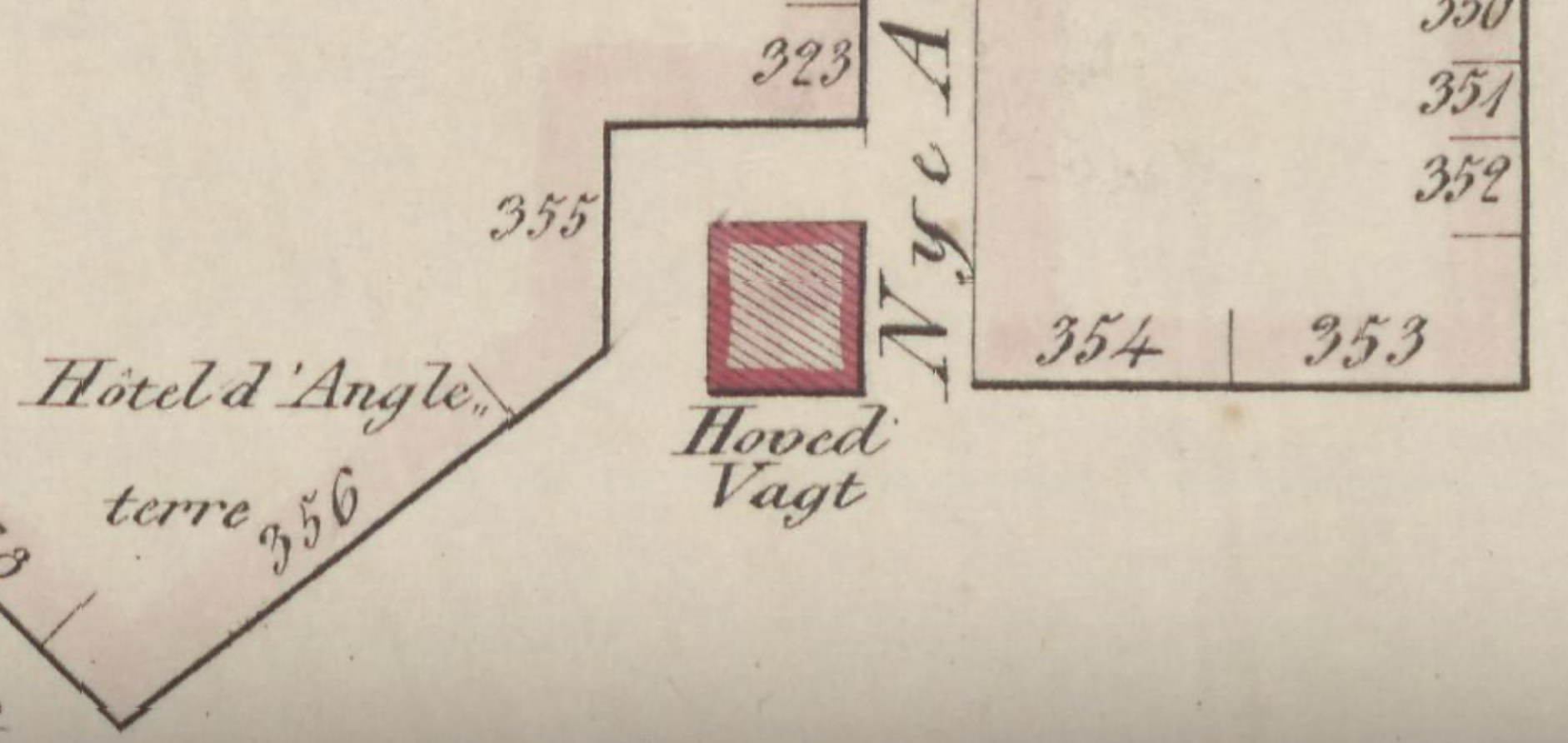
Geographic orientation
A city small enough for reputations to travel.
The Copenhagen detail brings streets and public spaces into view around Kierkegaard’s early adulthood. Compare its ordered plan with the 1840 daguerreotype in the visual collection: one organizes space; the other records a particular view.
The underlying archival sheet belongs to Sterm’s 1838–1841 map series and is dated 1839–1841 by Copenhagen City Archives. This is a historical map detail, not a reconstruction of Kierkegaard’s private movements.
Words with their sources
Read the quotation. Follow the argument.
A memorable sentence opens a question. Speaker, translation, and textual location help keep it connected to the work from which it comes.
“to find the idea for which I will live and die.”
Journal AA:12, 1 August 1835; SKS 17, pp. 24–26 (excerpt).Editorial translation from the verified Danish original; not presented as a quotation from a published English translation.Read the chapter and its context →
“The great thing is not to be this or that, but to be oneself.”
Judge William, Either/Or, Part Two, “The Balance between the Aesthetic and the Ethical in the Development of the Personality”; SKS 3, p. 173 (excerpt).Editorial translation of the verified Danish original; the speaker is Judge William, not an unqualified direct authorial voice.Read the chapter and its context →
“I cannot carry out the movement of faith”
Johannes de silentio, Fear and Trembling, preliminary discussion; in Selections from the Writings of Kierkegaard (1923).Lee M. Hollander; brief excerpt from the public-domain 1923 translation. The speaker is the pseudonymous narrator.Read the chapter and its context →
“The self is a relation that relates itself to itself.”
Anti-Climacus, The Sickness unto Death, Part One, A.A; SKS 11, p. 129.Editorial translation from the Danish: “Selvet er et Forhold, der forholder sig til sig selv”.Read the chapter and its context →
“Purity of heart is to will one thing.”
Kierkegaard, Upbuilding Discourses in Various Spirits, “An Occasional Discourse” (1847); SKS 8, p. 138.Editorial translation of the verified Danish “Hjertets Reenhed er at ville Eet”. In context, the one thing is the good, not any arbitrary obsession.Read the chapter and its context →
Before the first chapter
Which evidence supports the claim?
This collection treats source awareness as part of philosophy. A work’s speaker, genre, date, and transmission affect what we can responsibly claim from it.
Name the source
Is this a primary philosophical text, a later account, an artifact, or a modern interpretation?
Name the claim
Does the evidence establish a historical event, interpret an argument, or show how a later audience imagined a thinker?
Name the limit
Identify what you still do not know. A clear limit makes the next question more precise.
Check the distinction
Read the answer and explanation
As a later drawing from memory Marstrand’s remembered likeness belongs to Kierkegaard’s reception. Its date and medium prevent us from treating it as a contemporary photographic record.
Continue the conversation
Follow the question into another room.
These are invitations to comparison. A shared question does not make different thinkers or traditions interchangeable.
Socrates and his sources
Compare the distance between a historical life and its literary or visual portraits.
Explore this connection →The Socratic afterlife
Follow the ancient figure who mattered deeply to Kierkegaard’s study of irony.
Explore this connection →A Grief Observed
Compare biographical suffering and religious reflection without treating one author as the other.
Explore this connection →Presbyterian history
Place another Christian institutional tradition beside the Danish setting, with differences intact.
Explore this connection →Before you turn the page
Was Kierkegaard an existentialist?
He was a major precursor of later existential philosophies, but his own project was explicitly Christian and cannot be reduced to the positions of later atheistic existentialists.
What should I read first?
Begin with selected signed discourses or the opening movements of Fear and Trembling, using an edition that identifies the pseudonym. Then explore Either/Or and Works of Love before the dense arguments of The Sickness unto Death.
Does “subjectivity” mean that facts do not matter?
No. Kierkegaard asks how an existing person relates to ethical and religious truth. A committed relation is different from a factual claim becoming true merely because someone feels strongly about it.
Sources and further reading
Each chapter supplies its own focused source list and linked passages. This reading room brings together the wider collection.
Open the collection bibliography
- Søren Kierkegaards Skrifter: critical edition indexAuthoritative dates, pseudonyms, works and links to the Royal Danish Library texts.
- University of Copenhagen: chronologyChronology of the life and publications.
- University of Copenhagen: quotation verificationIdentifies original Danish sources and warns about common misquotations.
- Stanford Encyclopedia of Philosophy: Søren KierkegaardScholarly orientation and interpretive debates; consulted alongside the primary works.