
Religion & Philosophy / Philosophy
384–322 BCE · An illustrated collection
Aristotle
The world is worth understanding. A life is worth learning to live well.
Curated by Christopher Adkins of Huntersville, NC

The world is worth understanding. A life is worth learning to live well. Rembrandt’s Aristotle with a Bust of Homer (1653) brings the philosopher into conversation with poetic memory. It is a seventeenth-century imaginative portrait, useful for considering Aristotle’s later reception and his interest in poetry.
Rembrandt van Rijn, Aristotle with a Bust of Homer, 1653; Metropolitan Museum of Art, accession 61.198; reproduction via Wikimedia Commons · Public domain.


Explore the historical images.
The collection
A life. A body of thought. A continuing conversation.
A bird’s wing. A persuasive speech. A friendship that survives misfortune. A city divided over justice. Aristotle approached these subjects with the same demanding curiosity: what is this thing, how does it work, and what would it mean for it to work well? His philosophy begins in the world we encounter and pushes toward the explanations that make its details intelligible.
This five-chapter guide follows the philosopher from the Greek world of the fourth century BCE into the libraries, classrooms, religious debates, and moral questions that his writings helped shape. It treats him as a living intellectual challenge: a thinker to understand closely, question seriously, and sometimes oppose.
Read in order or follow your curiosity
Five chapters to explore

A Mind at Work: Aristotle’s Life, Landscapes, and Lyceum
Follow Aristotle’s life through the places, relationships, and research practices that shaped his philosophy—and learn to separate historical evidence from seductive legend.
1,775 words · 9 min read

How the World Makes Sense: Logic, Causes, and Being
Understand syllogisms, the four causes, matter and form, potentiality and actuality, and the difference between knowing a fact and knowing why it is true.
1,969 words · 10 min read

The Art of Living Well: Virtue, Friendship, and Flourishing
A detailed guide to eudaimonia, the doctrine of the mean, practical wisdom, responsibility, weakness of will, friendship, and the place of contemplation in Aristotle’s ethics.
1,979 words · 10 min read

Citizens, Speakers, and Stories: Politics, Rhetoric, and Tragedy
Explore the polis and citizenship, constitutional government, Aristotle’s defenses of hierarchy, ethical persuasion, and the enduring questions of plot, tragedy, and catharsis.
1,989 words · 10 min read

The Philosopher Across Civilizations: Legacy and Reading Aristotle
Discover how Aristotle was preserved, translated, transformed, and challenged by later thinkers, then follow an accessible reading path through his major works.
1,954 words · 10 min read
A visual reading aid
One bronze statue, four kinds of explanation
Aristotle’s causes answer different questions about the same thing. A commemorative bronze statue makes the distinctions tangible.
Material — What is it made from?
Bronze supplies the material from which this statue is made and which remains in the finished work. Naming the metal explains its material basis, but does not explain why this bronze constitutes a statue.
Form — What makes it this thing?
The organized figure gives the bronze the form of a statue rather than a shapeless mass. Its defining structure explains what the object is; the material alone could instead have become a bowl or a tool.
Efficient — What brings it about?
The sculptor’s activity and sculptural skill supply a source of the change that produces the statue. This answer concerns the making: it differs from identifying the bronze, describing the figure, or explaining the commission’s purpose.
Final — What is it for?
In this example, the statue is commissioned to commemorate an honored person. That purpose helps explain why the work is undertaken and how choices are organized. It is the intended end, not simply the last event.
An illustrative extension of Physics II.3, 194b23–195a3. These are four explanatory answers about one object, not four sequential causes or stages of manufacture. The commemorative purpose is supplied for this example. Read the source →
A philosophy with room for the whole world
Aristotle studied with Plato, taught Alexander, and developed a research community at the Lyceum in Athens. Yet the familiar procession of famous names can obscure the most unusual feature of his work: its range. The same surviving collection asks about animal bodies, valid arguments, human choices, political institutions, theatrical plots, and the nature of existence. To read across it is to discover a mind unwilling to let one attractive explanation answer every kind of question. His biological writing, for example, invites the reader to attend even to creatures that initially seem unappealing. Understanding can disclose interest where habit sees only ugliness.
That breadth does not mean he possessed modern science in miniature. Many of his conclusions were wrong; some of his social judgments were gravely unjust. His lasting interest lies partly in the questions his errors sharpen. How should a philosopher move from observation to explanation? When does an account of what is common become an unwarranted claim about what is natural? Can a community cultivate excellent lives while excluding much of its population from full participation?
The questions behind the five chapters
Begin with the life if you want to understand the settings in which Aristotle worked: Stagira, the Academy, the eastern Aegean, Macedonia, and the Lyceum. Continue to logic and metaphysics to see why he distinguishes a convincing inference from a complete explanation. The ethical chapter then turns from knowing to living. Its central term, eudaimonia, is often translated as happiness, but flourishing better captures the sustained activity and formation of character involved. The Nicomachean Ethics does not promise a permanent pleasant mood. It asks what makes a human life go well as a whole.
The fourth chapter moves outward into institutions and public speech, then into the imagined actions of tragedy. The fifth follows Aristotle beyond Greece and offers a practical route through difficult books. These are connected investigations. A theory of virtue needs an account of choice; a theory of citizenship needs a view of justice; a theory of tragedy needs to understand how actions make a life intelligible. Read sequentially for the connections, or choose the question that already has a claim on your attention.

Read critically, and look closely
The images in this section have their own histories. Roman portrait sculpture, Renaissance frescoes, medieval manuscripts, and modern archaeological photographs do not provide interchangeable windows onto Aristotle’s life. A later artist’s philosopher is evidence of how another period imagined him. A manuscript is evidence of the labor that kept a text available. Ruins locate an inquiry in an actual landscape without restoring the voices that once filled it. Captions therefore identify both what an image shows and what it can legitimately tell us.
The same care applies to quotations. Brief passages here identify a work and translation; popular sayings without a secure textual home are not silently promoted into ancient testimony. Dates follow the conventional chronology, while stories preserved by much later writers are marked as traditions. The history of Aristotle’s texts makes this caution essential: the books now read under his name reached us through centuries of copying, ordering, and interpretation.
One useful habit can accompany the entire series. When an argument feels immediately persuasive, write down its hidden assumption. When it feels immediately unacceptable, identify the precise step that fails. That practice leaves room both for admiration and for judgment. Aristotle’s strongest invitation is to participate in the work of understanding, and the most rewarding reader accepts it actively.
A life in time
Open a moment in the story.
Choose a date to read its context. Approximate dates and disputed traditions remain marked as such.
384 BCE
Born at Stagira in northern Greece.
c. 367 BCE
Joins Plato’s Academy in Athens.
347 BCE
Leaves Athens around the time of Plato’s death.
340s BCE
Works in the eastern Aegean, including Assos and Lesbos.
343/342 BCE
Traditionally dated beginning of his tutorship of Alexander.
335/334 BCE
Returns to Athens and establishes his school at the Lyceum.
323 BCE
Leaves Athens after Alexander’s death.
322 BCE
Dies at Chalcis on Euboea.
Chronological orientation: read the scholarly source. Begin the biography chapter.
An illustrated history
Look closely
Portraits, manuscripts and places carry different kinds of evidence. Open each image to inspect the full composition and read its credit.


The visual reading room
Look closely. Ask better questions.
Eight images invite a slower look at places, portraits, manuscripts, and later interpretations. What can an image reveal—and what must a text or argument establish? Select any image to enlarge it; the source and reuse credit remain with every item.


Geographic orientation
Ideas have places. Maps have histories.
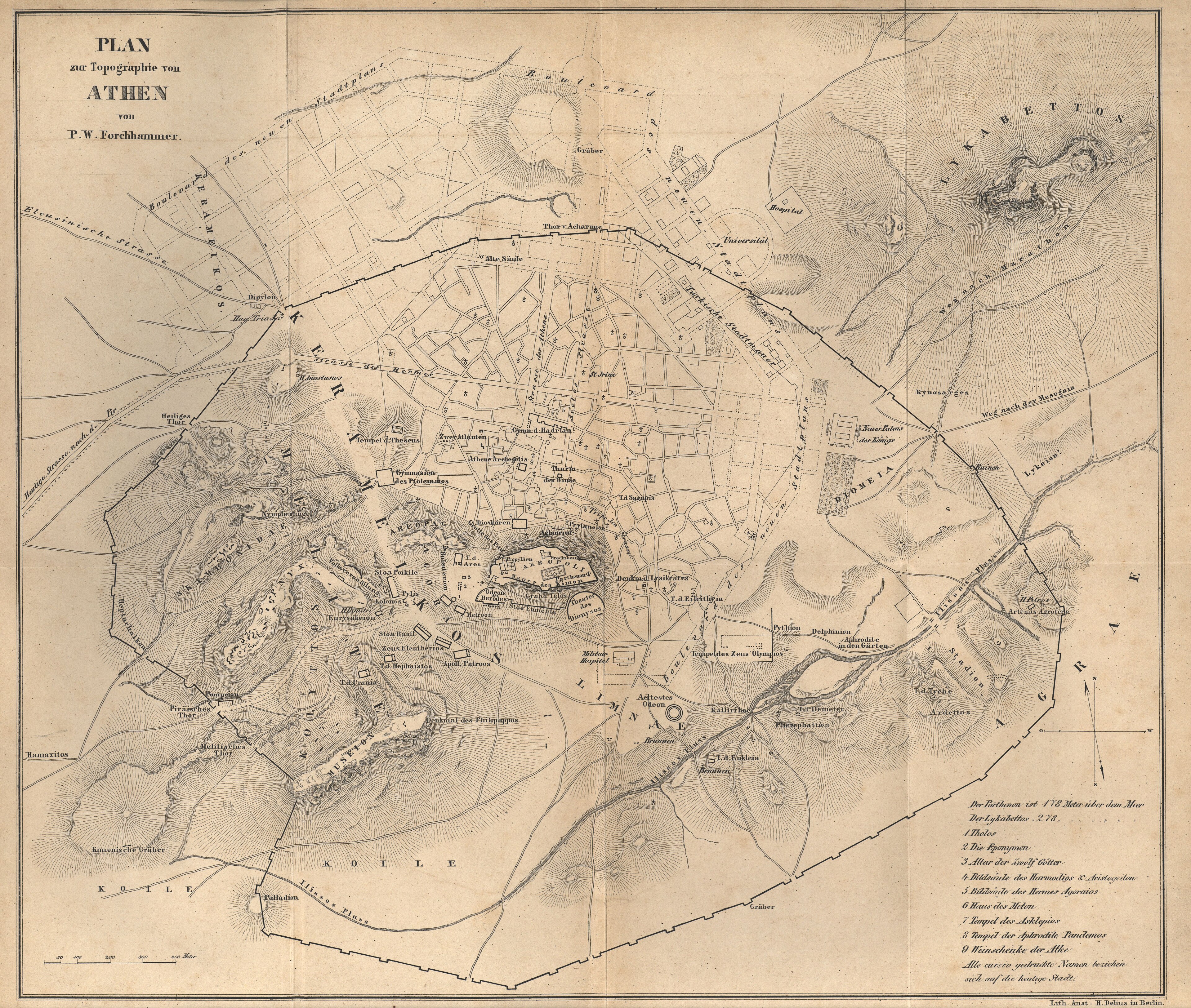
Athens supplies the civic and intellectual setting for much of this collection: public argument, Socrates’ trial, Plato’s Academy, and Aristotle’s Lyceum. Keep the differences between those institutions and generations in view.
Forchhammer’s 1841 plan is a historical reconstruction of ancient Athens. Its labels and proposed identifications belong to nineteenth-century scholarship; it is not a modern excavation plan or a photograph of the ancient city. Use it for orientation, then consult current site scholarship.
Words with their sources
Read the quotation. Follow the argument.
A memorable sentence opens a question. Speaker, translation, and textual location help keep it connected to the work from which it comes.
“Every realm of nature is marvellous”
Parts of Animals I.5, 645aWilliam OgleRead the chapter and its context →
“All men by nature desire to know.”
Metaphysics I.1, 980a21W. D. RossRead the chapter and its context →
“one swallow does not make a summer”
Nicomachean Ethics I.7, 1098a18–19W. D. RossRead the chapter and its context →
“Poetry, therefore, is a more philosophical and a higher thing than history”
Poetics 9, 1451bS. H. ButcherRead the chapter and its context →
“we are inquiring not in order to know what virtue is, but in order to become good”
Nicomachean Ethics II.2, 1103b26–29W. D. RossRead the chapter and its context →
Before the first chapter
Which evidence supports the claim?
This collection treats source awareness as part of philosophy. A work’s speaker, genre, date, and transmission affect what we can responsibly claim from it.
Name the source
Is this a primary philosophical text, a later account, an artifact, or a modern interpretation?
Name the claim
Does the evidence establish a historical event, interpret an argument, or show how a later audience imagined a thinker?
Name the limit
Identify what you still do not know. A clear limit makes the next question more precise.
Check the distinction
Read the answer and explanation
He made major contributions to systematic inquiry that still require critical assessment Historical importance does not require infallibility. Aristotle’s questions, methods, evidence, and conclusions can be assessed separately.
Continue the conversation
Follow the question into another room.
These are invitations to comparison. A shared question does not make different thinkers or traditions interchangeable.
Plato’s Academy
Place Aristotle’s early formation beside the intellectual community in which he studied.
Explore this connection →Socrates and evidence
Compare the kinds of evidence that support ancient philosophical biography.
Explore this connection →The natural world
Bring ancient natural inquiry into a careful comparison with modern evolutionary explanation.
Explore this connection →History of God
Consider how broad histories organize the relation between ideas and their settings.
Explore this connection →Before you turn the page
Where should a new reader begin?
Begin with Chapter 1 for the historical setting, or Chapter 3 for virtue, friendship, and the good life. The final chapter offers a gradual route into the primary works.
Was Aristotle simply the opposite of Plato?
No. He developed major criticisms of Plato while sharing many of the Academy’s questions about knowledge, explanation, and the good. The contrast between pure idealist and pure empiricist is too simple.
Are the portraits contemporary likenesses?
The surviving images here have different dates and evidentiary value. Roman copies, medieval illuminations, and Renaissance paintings must be read through their captions rather than treated as photographs of Aristotle.
Sources and further reading
Each chapter supplies its own focused source list and linked passages. This reading room brings together the wider collection.
Open the collection bibliography
- Diogenes Laërtius, Lives of the Eminent Philosophers, Book V: AristotleR. D. Hicks translation, 1925, public domain. A late ancient source containing conflicting traditions; anecdotes are not treated as eyewitness evidence.
- Christopher Shields, Aristotle, Stanford Encyclopedia of PhilosophyScholarly overview and orientation to disputed interpretations.
- Hellenic Heritage: Aristotle’s LyceumOfficial archaeological destination account for the surviving Lyceum site.
- Aristotle, Parts of Animals, Book IWilliam Ogle translation. Especially I.1 on method and I.5 on the worth of studying animals.
- Aristotle, Metaphysics, Book IW. D. Ross translation. Experience, explanation, wonder, and criticism of earlier philosophy.
- Aristotle, Physics, Book IIR. P. Hardie and R. K. Gaye translation. Nature, four causes, chance, and purposive explanation.
- Aristotle, Posterior Analytics, Book IG. R. G. Mure translation. Demonstration and explanatory knowledge.
- Aristotle, On the Soul, Book IIJ. A. Smith translation. Soul, actuality, and the capacities of living organisms.
- Aristotle, Nicomachean Ethics, Book IW. D. Ross translation. Ends, flourishing, the human function, and the appropriate precision of ethics.
- Aristotle, Nicomachean Ethics, Book IIW. D. Ross translation. Habituation, character, choice, and the mean.
- Aristotle, Nicomachean Ethics, Book IIIW. D. Ross translation. Voluntariness, deliberation, courage, and temperance.
- Aristotle, Nicomachean Ethics, Book VW. D. Ross translation. Justice, equality, and equity.
- Aristotle, Nicomachean Ethics, Book VIW. D. Ross translation. Practical wisdom and intellectual virtues.
- Aristotle, Nicomachean Ethics, Book VIIW. D. Ross translation. Weakness of will and the relation between knowledge and desire.
- Aristotle, Nicomachean Ethics, Book VIIIW. D. Ross translation. The varieties and conditions of friendship.
- Aristotle, Nicomachean Ethics, Book IXW. D. Ross translation. Friendship, self-love, shared activity, and the good life.
- Aristotle, Nicomachean Ethics, Book XW. D. Ross translation. Pleasure, contemplation, education, and legislation.
- Aristotle, Politics, Book IBenjamin Jowett translation. The polis, household, natural slavery, and gender hierarchy; discussed critically.
- Aristotle, Politics, Book IIIBenjamin Jowett translation. Citizenship, constitutions, justice, and the common advantage.
- Aristotle, Politics, Book IVBenjamin Jowett translation. Constitutions in practice, mixed government, and the middle element.
- Aristotle, Rhetoric, Book IW. Rhys Roberts translation. The art of persuasion and the modes of proof.
- Aristotle, Poetics, chapters 1–11S. H. Butcher translation. Representation, plot, tragedy, and the comparison between poetry and history.
- The Textual Transmission of the Aristotelian Corpus, Stanford Encyclopedia of PhilosophyThe difference between Aristotle’s lost public works and the surviving technical corpus; manuscript history and Bekker references.
- Greek Sources in Arabic and Islamic Philosophy, Stanford Encyclopedia of PhilosophyThe multilingual translation movement and its philosophical setting.
- Medieval Philosophy, Stanford Encyclopedia of PhilosophyGreek, Arabic, Hebrew, and Latin routes of translation and philosophical exchange.
- Influence of Arabic and Islamic Philosophy on the Latin West, Stanford Encyclopedia of PhilosophyThe substantive contributions of Arabic philosophers to Latin philosophy.
- Ibn Sina [Avicenna], Stanford Encyclopedia of PhilosophyAvicenna as an original philosopher, not merely a transmitter of Aristotle.
- Ibn Rushd [Averroes], Stanford Encyclopedia of PhilosophyAristotelian commentary, demonstration, religious inquiry, and the wider work of Ibn Rushd.
- Maimonides, Stanford Encyclopedia of PhilosophyAristotelian influence and the limits of philosophical knowledge in the Guide of the Perplexed.
- Thomas Aquinas, Stanford Encyclopedia of PhilosophyAquinas’s creative reworking of Aristotle within Christian philosophy and theology.