
Religion & Philosophy / Philosophy / Aristotle
Aristotle · Chapter 04 of 05
Citizens, Speakers, and Stories: Politics, Rhetoric, and Tragedy
How shared life depends on institutions, persuasion, and the stories through which actions become intelligible.
Curated by Christopher Adkins of Huntersville, NC

Can a persuasive public argument still be a bad argument? Rembrandt’s Aristotle with a Bust of Homer (1653) brings the philosopher into conversation with poetic memory. It is a seventeenth-century imaginative portrait, useful for considering Aristotle’s later reception and his interest in poetry.
Rembrandt van Rijn, Aristotle with a Bust of Homer, 1653; Metropolitan Museum of Art, accession 61.198; reproduction via Wikimedia Commons · Public domain.


Explore the historical images.
01 / 08
The city and the question of living well
A city can keep people alive without giving them an admirable common life. It can organize trade, police disputes, and defend a border while leaving the ends of those activities unexplained. Aristotle’s Politics asks what makes political association more than a convenient arrangement for mutual survival. His answer connects the city with living well. Human beings speak about what is beneficial and harmful, just and unjust, and that capacity makes shared deliberation central to their characteristic form of life.
Calling a human being a political animal therefore means more than saying that people like company. The relevant association involves judgments about how a community ought to be ordered. A crowd may occupy a place without agreeing on its purposes; a political community gives some institutional form to common decisions. Aristotle’s argument asks whether law, education, and citizenship help cultivate the activities that make a life worthwhile. It does not treat the state as merely an external referee among entirely self-sufficient private lives.
Modern readers can accept the importance of shared institutions while disputing Aristotle’s stronger claims about nature and the priority of the city. Individuals have interests and rights that cannot safely be absorbed into an official account of collective excellence. Still, his opening question remains searching: what kinds of people do our institutions encourage us to become? Political arrangements distribute more than income and office. They shape attention, aspiration, opportunities for participation, and the habits through which disagreement is conducted.
02 / 08
Citizenship is participation, not merely location
In Politics III, Aristotle asks who counts as a citizen. Residence alone is insufficient: people may live within a city without sharing in its governing activities. His central account connects citizenship with participation in deliberative and judicial functions. That focus makes citizenship an activity and a standing within institutions, not simply a feeling of belonging. It also exposes a question that remains important: who lives with the consequences of political decisions while lacking a meaningful part in making them?
Aristotle distinguishes being a good citizen from being a good person. The former can be relative to a constitution: someone may serve an existing political arrangement effectively even when the arrangement itself is defective. This is an especially useful distinction for understanding loyalty. Faithfulness to an office or institution does not by itself establish that the institution deserves the form of service it receives. A person can be admirable by local expectations and still contribute to a larger injustice.
His model of participation is narrower than modern democratic citizenship, and its exclusions must remain explicit. Women, enslaved people, and many laborers do not receive equal standing in his preferred political order. We should not smooth away that difference by substituting contemporary meanings for his words. The productive approach is double: understand the participatory insight closely, and examine why the author fails to extend its implications broadly. Aristotle helps clarify the value of citizenship while also supplying a case study in the dangers of defining the eligible citizen too narrowly.
“Poetry, therefore, is a more philosophical and a higher thing than history”
Poetics 9, 1451bS. H. Butcher

03 / 08
Constitutions, common advantage, and a middle element
Aristotle classifies governments partly by the number who rule and partly by the end they pursue. Rule for the common advantage differs from rule directed toward the rulers’ private benefit. The distinction lets him criticize a government without assuming that numerical form alone settles its justice. A single ruler, a few, or many may govern in ways that serve or exploit the community. His terminology does not map neatly onto modern political labels, so readers should resist turning the classification into a ready-made chart of contemporary parties.
The later constitutional analysis in Book IV becomes more practical. What arrangements can work for a population with its actual distribution of wealth, habits, and power? Why do factions form? How can institutions reduce domination by competing extremes? His attention to a substantial middle element reflects the concern that severe inequalities can turn politics into a contest for mastery rather than cooperation. This is a diagnosis to examine, not a claim that every middle-income group is automatically virtuous.
One of the strongest features of the inquiry is its refusal to ask only what an ideal regime would look like. Political judgment also concerns the best attainable arrangement under particular conditions and the means by which a constitution can endure. Yet stability is not the only value. An unjust order may be stable, and a reform may disturb settled expectations. The Aristotelian reader must therefore keep two questions together: what enables a community to hold together, and what makes that community worth sustaining in the form it has?
04 / 08
The hierarchy that must be confronted
Aristotle’s defense of natural slavery in Politics I is a fundamental moral and philosophical failure. He attempts to distinguish people supposedly suited by nature to be ruled as possessions from those suited to direct their own lives. He also notices that actual enslavement through warfare does not reliably track the natural distinction he proposes. That difficulty should intensify criticism of the category, not soften it. The argument turns alleged differences in rational capacity into a justification for subordination and exploitation.
His treatment of women similarly assigns unequal authority within the household and polity. He recognizes forms of deliberation and virtue in women while subordinating them to male rule. The structure exposes how a philosopher can identify important human capacities and then interpret their social restriction as evidence of natural hierarchy. A modern reader should ask whether the claimed differences are independently demonstrated or whether existing institutions are quietly supplying the result the theory then announces as natural.
Historical context helps explain the availability of these assumptions; it does not vindicate them. Nor should criticism end with a declaration that people in the past were wrong. The deeper lesson concerns the movement from description to entitlement. Who is allowed to count as a reliable witness about another person’s capacities? What opportunities were denied before incapacity was alleged? Which interests benefit when unequal power is presented as a fact of nature? Aristotle’s failures deserve sustained attention because his influence was substantial and because the habits of reasoning involved are not confined to antiquity.

05 / 08
Persuasion needs reasons, character, and an audience
The Rhetoric examines how persuasion works where citizens or judges must decide matters that cannot simply be handed over to a mathematical demonstration. Aristotle identifies persuasion through the speaker’s character, the audience’s emotional condition, and the argument presented. These are often summarized as ethos, pathos, and logos. The familiar three-word formula can be useful, but it becomes shallow if treated as a recipe for decorating a speech with credibility, feeling, and a statistic.
Character matters because an audience must judge whether the speaker is knowledgeable, fair-minded, and acting in good faith. Emotion matters because fear, resentment, pity, and confidence affect what listeners notice and how they assess a situation. Argument matters because persuasion should show a connection between accepted considerations and a conclusion. The three can support honest deliberation or be exploited against it. Their effectiveness does not by itself establish their ethical use.
Aristotle’s own text contains a tension worth preserving. He criticizes attempts to distort a judge’s assessment through irrelevant emotional pressure, while also analyzing emotions as integral to persuasive practice. A careful reader asks when an emotion discloses a relevant feature and when it distracts from one. Compassion might help an audience recognize a harm previously ignored; it might also be manipulated to hide a weak factual case. The aim of ethical rhetoric is therefore not to abolish feeling. It is to make persuasion answerable to the matter being judged.
06 / 08
The enthymeme and the power of what remains unsaid
A persuasive argument often relies on a premise the audience supplies without hearing it stated. Suppose a speaker says a proposal should be accepted because respected communities have adopted it. The missing premise might be that those communities’ decisions are a dependable guide here. Sometimes that assumption is reasonable; sometimes differences in circumstances make the comparison weak. Aristotle’s treatment of the enthymeme directs attention to the inferential structure of public argument, not merely to its memorable phrases.
Modern introductions often describe the enthymeme as a syllogism with a missing premise. That is a useful first illustration, but Aristotle’s account also concerns the probable and accepted considerations appropriate to rhetoric. It should not be reduced to a grammatical deletion trick. The important work is to identify what makes the argument convincing to this audience and whether that basis deserves confidence. A conclusion can feel inevitable because a shared assumption has never been exposed to examination.
Try the exercise with a speech or advertisement. Write down the claim, the evidence expressly offered, and the assumptions that connect them. Then ask whether the speaker has changed the meaning of a term, substituted an example for adequate evidence, or treated popularity as proof. This use of Aristotle is especially valuable because it turns rhetorical education toward the listener. Understanding persuasion should improve resistance to manipulation as well as the ability to speak. The best audience is not one that applauds every elegant inference, but one that can distinguish clarity from concealed weakness.

07 / 08
Why a story is more than a sequence of events
The Poetics turns to artistic representation and, above all in its surviving form, to tragedy. Aristotle gives unusual importance to plot: the organization of actions into a whole. A succession of striking incidents is not enough. Events should be connected so that what comes later grows intelligibly from what precedes it. A reversal feels powerful when the action itself makes it possible; a recognition matters when it changes how a character understands the situation already unfolding.
This is why a story can reveal something general without functioning as a disguised lecture. By arranging possible actions, it makes visible connections among choices, circumstances, ignorance, and consequences. Aristotle’s comparison between poetry and history does not mean that factual history is worthless or that fiction may invent evidence. He distinguishes their characteristic aims: the historian recounts particular happenings, while the poet can explore what a certain kind of person might do in a certain kind of situation. Historical writing can of course also explain patterns; the ancient contrast is deliberately sharper than every modern practice would allow.
For a reader or writer, the practical test is structural. If a scene were removed, what would become harder to understand about the action? Does a character’s decision arise from an established pressure, or appear only because the author needs the next event? Does a revelation reorganize what has been seen, or merely add information? These questions explain the endurance of Aristotle’s account. They do not oblige every novel or film to imitate Greek tragedy, but they clarify the difference between an accumulation of episodes and an intelligible action.
08 / 08
Tragedy, catharsis, and responsible interpretation
Aristotle associates tragedy with pity and fear and introduces the famous term katharsis. Its meaning has been contested for centuries: interpreters have proposed purgation, purification, clarification, and related accounts. An introductory guide should not present one gloss as an uncontested definition. What is clear is that the audience’s emotional experience belongs to the theory, and that the organization of the action matters to the emotions produced. Spectacle alone is not the whole achievement of tragedy.
The concept of hamartia also needs care. It is commonly rendered as error and often popularized as a tragic flaw. The latter phrase can suggest a fixed personality defect that mechanically causes catastrophe. Aristotle’s analysis permits a more complex relation among action, ignorance, and consequence. Tragedy becomes compelling because a reversal can arise in a life that is neither simply exemplary nor wholly wicked. The spectator is asked to recognize vulnerability, not merely to watch a villain receive the punishment the plot has advertised.
Politics, rhetoric, and tragedy finally meet in a shared concern with judgment. Institutions organize decisions; speeches guide or distort them; stories allow us to consider actions and consequences at an imaginative distance. Aristotle offers powerful tools in all three domains, together with exclusions and assumptions that demand criticism. Reading him well requires both capacities: the patience to understand how an argument works and the independence to judge where it fails. A professional philosophical culture needs admiration that remains examinable and criticism that knows its object in detail.
The visual reading room
Look closely. Ask better questions.
Eight images invite a slower look at places, portraits, manuscripts, and later interpretations. Can a persuasive public argument still be a bad argument? Select any image to enlarge it; the source and reuse credit remain with every item.


Geographic orientation
Ideas have places. Maps have histories.
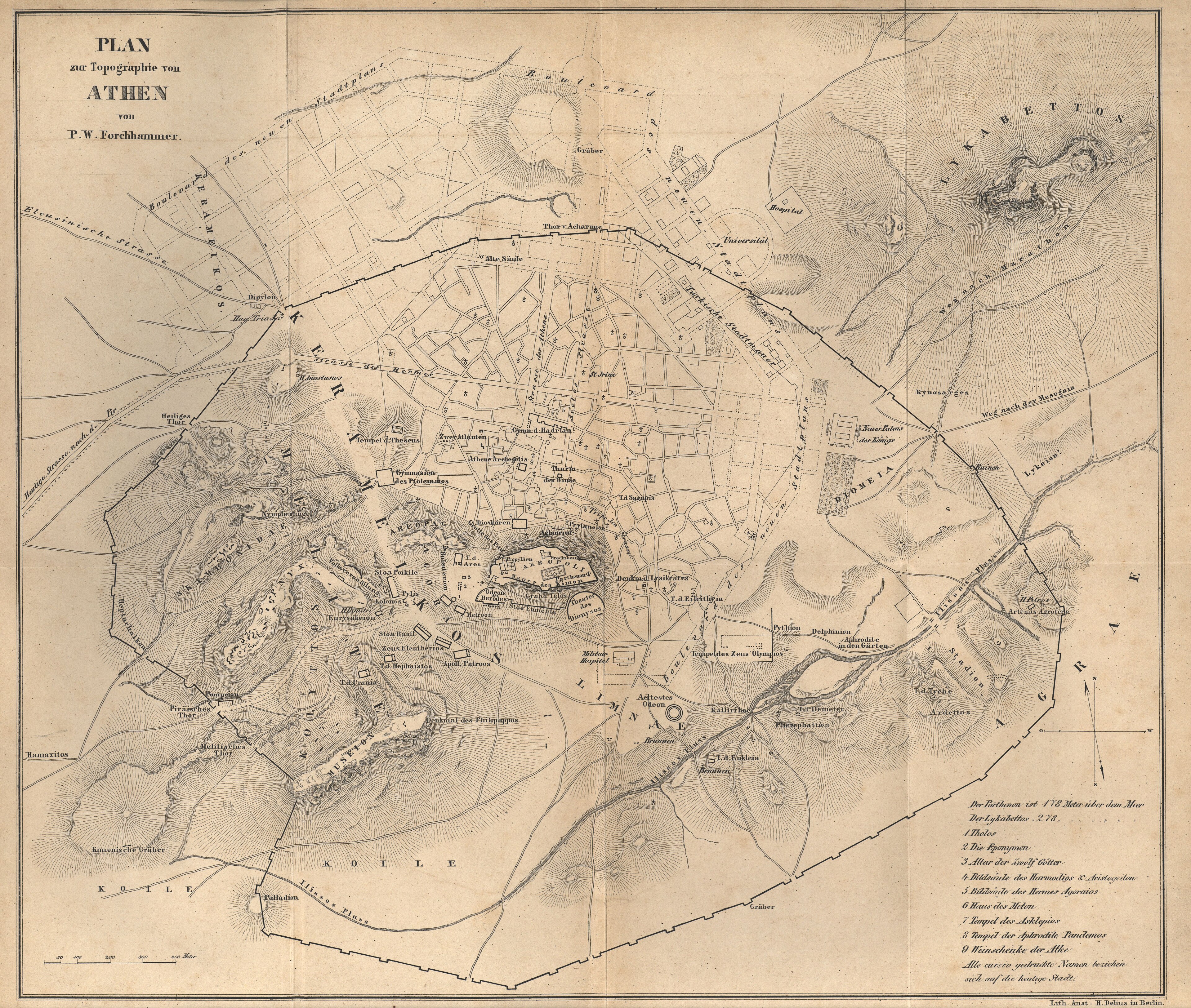
Athens supplies the civic and intellectual setting for much of this collection: public argument, Socrates’ trial, Plato’s Academy, and Aristotle’s Lyceum. Keep the differences between those institutions and generations in view.
Forchhammer’s 1841 plan is a historical reconstruction of ancient Athens. Its labels and proposed identifications belong to nineteenth-century scholarship; it is not a modern excavation plan or a photograph of the ancient city. Use it for orientation, then consult current site scholarship.
The argument workshop
Persuasion and the common good
Can a persuasive public argument still be a bad argument?
A speaker earns trust, arouses sympathy, and organizes a compelling case. Those achievements explain how persuasion works. They do not independently establish that the proposal is true, just, or directed to the common advantage.
1. Distinguish the appeals
Look for the speaker’s presented character, the audience’s emotions, and the argument’s reasoning. Ask what each contributes and what each could conceal.
2. Examine the political purpose
Aristotle distinguishes rule for common advantage from rule serving the rulers. Test how that distinction works when the definition of citizenship excludes many people.
3. Read critically across the corpus
His accounts of slavery and women are substantive failures, not decorative footnotes. A serious use of his political concepts must confront those exclusions while examining the arguments on their merits.
Return to the chapter’s primary-text anchor: Poetics 9, 1451b. These exercises are editorial prompts, not quotations from the philosopher.
Check the distinction
Read the answer and explanation
How a speech seeks to persuade, which still leaves its claims open to scrutiny The analysis identifies forms of persuasion. Truth, evidence, fairness, and political purpose remain questions for judgment.
Continue the conversation
Follow the question into another room.
These are invitations to comparison. A shared question does not make different thinkers or traditions interchangeable.
Plato’s Republic
Compare political judgment and common advantage with Plato’s ideal of justice.
Explore this connection →Conscience and law
Return to an ancient confrontation between a philosophical life and public authority.
Explore this connection →Tocqueville
Extend questions about citizenship and democratic habits into a later setting.
Explore this connection →Elinor Ostrom
Consider a modern inquiry into how people organize cooperation and institutions.
Explore this connection →Pause · question · discuss
Carry the argument further
Was Aristotle a modern democrat?
No. He analyzed many constitutions and emphasized participation and common advantage, but his political categories and exclusions differ sharply from modern equal citizenship.
Can Aristotle’s defense of slavery be excused as merely historical?
Historical context explains how an argument became possible; it does not make the argument sound or just. The section treats the natural-slavery theory and gender hierarchy as serious failures.
Does catharsis simply mean letting emotions out?
That is one simplified reading, not an established consensus. The exact force of katharsis in the Poetics remains debated.
The reading room
Primary texts and source notes
- Aristotle, Politics, Book IBenjamin Jowett translation. The polis, household, natural slavery, and gender hierarchy; discussed critically.
- Aristotle, Politics, Book IIIBenjamin Jowett translation. Citizenship, constitutions, justice, and the common advantage.
- Aristotle, Politics, Book IVBenjamin Jowett translation. Constitutions in practice, mixed government, and the middle element.
- Aristotle, Rhetoric, Book IW. Rhys Roberts translation. The art of persuasion and the modes of proof.
- Aristotle, Poetics, chapters 1–11S. H. Butcher translation. Representation, plot, tragedy, and the comparison between poetry and history.
- Aristotle, Nicomachean Ethics, Book VW. D. Ross translation. Justice, equality, and equity.