




World War II · A special collection
The Art of World War II
Posters that sold the war, photographs that defined it, paintings by the artists who saw it, and the pin-ups, slogans and insignia that soldiers carried into battle. More than 1,300 works, each with the story behind it.
World War II was fought with pictures as well as weapons. Governments printed posters by the millions to recruit soldiers, sell bonds, ration food and warn that careless talk could sink a ship. Photographers and newsreel crews followed the troops ashore. Painters went into the line under official commissions. And the men and women who served covered their aircraft, tanks, jackets and helmets with names, cartoons, pin-ups and tallies of their missions.
This collection brings that art together in one place: eight galleries, more than 1,300 posters, photographs, paintings, nose art, vehicle and ship art, patches and insignia. Every work carries its maker, date and the history behind it, and every image is public domain or openly licensed, with a link to its source. Tap any image to open it full screen, zoom in, and read its story.
The eight galleries
 1 / 8
I Want You, We Can Do It!, war bonds, loose lips and the Double V: 243 posters that sold the war at home.
 2 / 8
Keep Calm, Dig for Victory, Fougasse and Abram Games, Canada, Australia, Free France and the occupied nations: 205 posters.
 3 / 8
What Germany, Italy and Japan told their people and the occupied, and what it concealed: 110 posters as historical evidence.
 4 / 8
Iwo Jima, Into the Jaws of Death, the USS Shaw, the V-J Day kiss: 85 photographs and the stories behind them.
 5 / 8
Memphis Belle, Bockscar, shark mouths and mission markers: 191 paintings on the planes.
 6 / 8
Named tanks, jeeps, dazzle-painted carriers, submarine battle flags and Kilroy: 150 images.
 7 / 8
Shoulder patches, squadron emblems, Disney insignia and painted A-2 jackets: 160+ designs and what they meant.
 8 / 8
Shepler, Coale, Draper, Nash, Ravilious, Colville: 150 works by the artists who saw the war.
How the war was sold, recorded and remembered
Posters were the mass medium of the home front. In the United States the Office of War Information, created in June 1942, worked with the Treasury, the War Production Board and the armed services to put images on factory walls, post-office lobbies and store windows. Britain’s Ministry of Information did the same with humor (Fougasse’s “Careless Talk Costs Lives”) and modernist design (Abram Games). Germany, Italy and Japan used posters to mobilize their people and to spread the lies that prepared the way for persecution and genocide; we show those as evidence, with the history that answers them.
Photographs turned battles into icons. A handful of frames — the flag on Mount Suribachi, the landing craft at Omaha Beach, the destroyer Shaw exploding at Pearl Harbor — became the way the world remembers the war. Many were taken by military photographers whose work belongs to the public; their stories, including the ones that were staged, cropped or misidentified, are part of the history.
Combat art came from painters sent to the front by the U.S. Navy, the War Department, the Marine Corps and Britain’s War Artists’ Advisory Committee. Dwight Shepler painted Omaha Beach from a destroyer; Paul Nash painted a sea of wrecked German aircraft; Eric Ravilious died on a search flight off Iceland in 1942. Their work shows what cameras could not: weather, color, exhaustion and scale.
Soldiers’ art is the most personal of all. Nose art gave a bomber a name and a personality; mission markers counted the raids. Tank crews painted names on their turrets, sailors flew battle flags from submarines, and Disney’s studio drew more than a thousand unit insignia. “Kilroy was here” turned up wherever Americans went. Some of it — the pin-ups especially — reflects attitudes of its time, and the galleries say so.
Highlights of the collection
Thirty of the most famous and striking works from across the eight galleries. Open any one to read its story, then follow the link to see it among its neighbors.
The most copied recruiting image in American history was already a quarter-century old when Pearl Harbor was bombed. James Montgomery Flagg drew it in 1917, using his own face, aged and given a goatee, as the model for Uncle Sam; the Army printed roughly four million copies during the First World War. In 1940–41, as the peacetime draft began, the War Department brought it back with the line “Enlist Now,” and it hung in recruiting stations throughout the Second World War.
The design borrows its accusing finger and foreshortened arm from Alfred Leete’s 1914 British poster of Lord Kitchener, but Flagg’s version outlived its model and became the visual shorthand for the American state itself.
Today it is the most famous American poster of the war, but almost no one saw it in 1943. The Pittsburgh artist J. Howard Miller painted it for Westinghouse Electric’s internal War Production Co-ordinating Committee; it was one of a series of morale posters hung inside Westinghouse plants for two weeks beginning February 15, 1943, and no more than about 1,800 copies were printed.
It was never called “Rosie the Riveter” during the war. Rediscovered in the early 1980s and reproduced in a 1982 Washington Post Magazine feature, it became a feminist emblem and one of the most requested images at the National Archives. Several women have been proposed as the inspiration; none can be confirmed as Miller’s model.
A drowning man, his finger aimed at the viewer, turns a slogan into an indictment. Frederick “Fritz” Siebel, an Austrian-born illustrator who later served in the U.S. Army, entered the design in a 1942 competition for an image about protecting sensitive information; the Office of War Information then printed it as OWI Poster No. 18 (GPO 1942-O-496733).
It is the purest example of the “careless talk” genre: no enemy is shown, only the consequence. Some library catalogs credit it to Glenn Grohe; the Franklin D. Roosevelt Library and the National Archives attribute it to Siebel.
Norman Rockwell based Freedom of Speech on a real Arlington, Vermont, town meeting where a neighbor stood alone to oppose a popular proposal; the mechanic Carl Hess posed as the speaker. Rockwell restarted the canvas four times. It appeared in The Saturday Evening Post on February 20, 1943, the first of his Four Freedoms, illustrating the four goals Franklin Roosevelt had set out in his State of the Union address of January 6, 1941.
The government had initially turned Rockwell’s offer down. After the Post published the series and readers requested 25,000 reprints, the Office of War Information issued the paintings as war-bond posters; this sheet is OWI Poster No. 44.
The old Yankee proverb “use it up, wear it out, make it do, or do without” became official policy in this OWI poster (No. 39, GPO 1943-O-506726). A couple mends trousers and oils a mower instead of buying new, and the caption below spells out the logic: “Our labor and our goods are fighting.”
Rationing, salvage drives and the end of civilian car and appliance production made thrift a patriotic act. The poster’s domestic calm is deliberate; the home was presented as a front line where every repaired shirt freed cloth, steel and labor for the war.
Bernard Perlin, a young artist in the OWI’s Graphics Division, produced this answer to Pearl Harbor in 1942: a sailor with a raised fist in front of the burning fleet. It was issued as OWI Poster No. 15.
Perlin later went overseas as an artist-correspondent for Life and Fortune, drawing the war in Greece and the Pacific. His Pearl Harbor poster turned the defeat into a call to vengeance, the emotional register in which most Americans first experienced the war.
Jean Carlu, one of France’s leading modernist poster designers, was in the United States when France fell in 1940 and stayed to work for American agencies. This 1942 design for the Office for Emergency Management reduces the arsenal of democracy to a single gesture: a gloved hand tightening a bolt through the O of “Production” (GPO 1942-O-454042).
It won the New York Art Directors Club’s top poster award and became the standard example of European modernism serving American war production.
Almost 2.5 million copies of “Keep Calm and Carry On” were printed in August–September 1939, then kept in reserve and largely pulped for paper salvage in 1940. In 2000 Stuart and Mary Manley found this copy in a box of second-hand books bought at auction for their shop in Alnwick, Northumberland, and hung it by the till. Customers asked for copies, and a forgotten poster became a global meme. (Photograph of the original, 2011.)
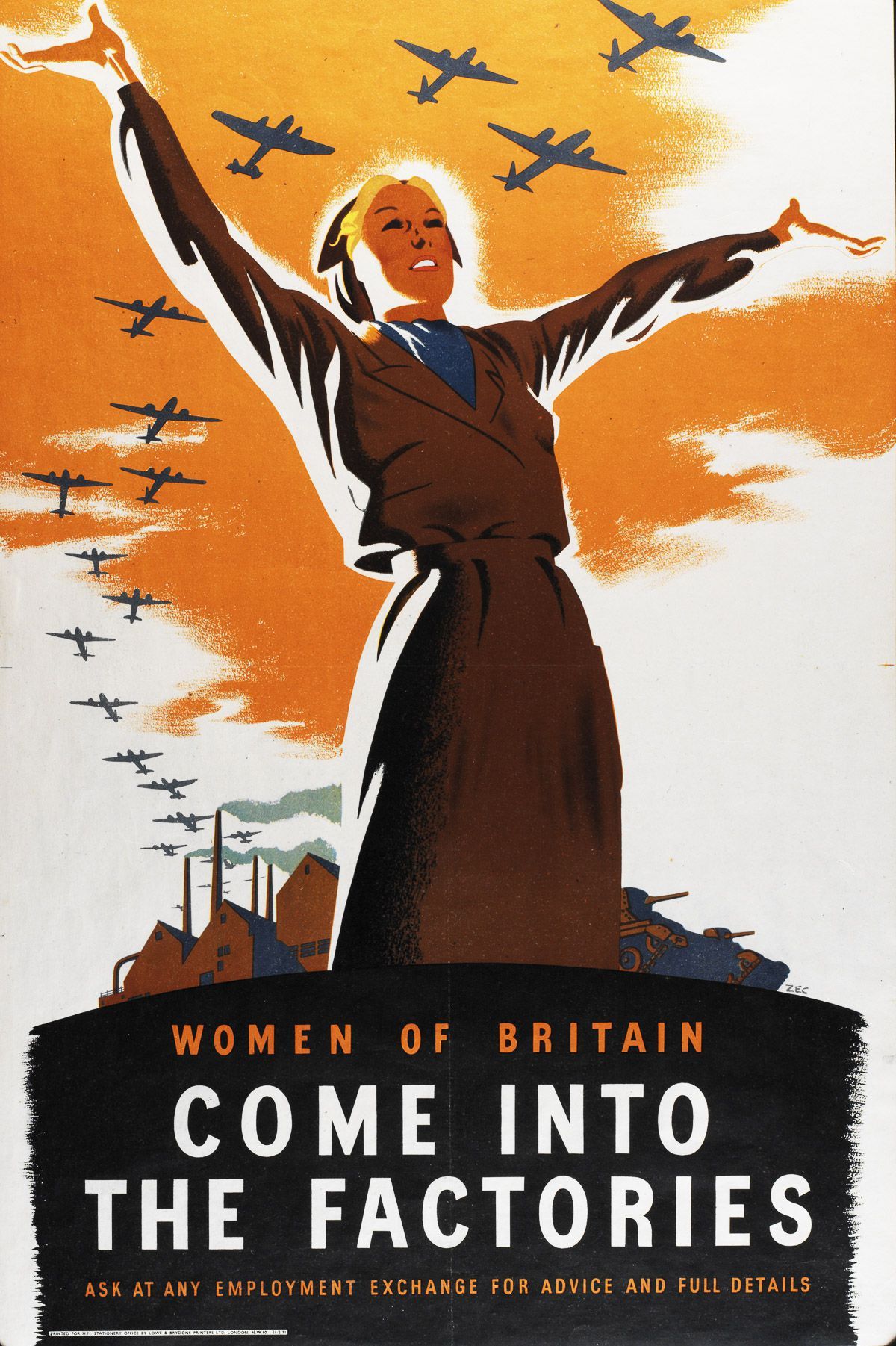
Philip Zec was the Daily Mirror’s left-leaning cartoonist; a year later his “price of petrol” cartoon so enraged the government that it threatened to close the paper. His 1941 appeal for women war workers came months before the National Service Act of December 1941, which made Britain the first Western democracy to conscript women. By mid-1943 more than seven million British women were in paid work, the forces or civil defence.
Abram Games’s most famous security poster: a spiral of gossip coming from a soldier’s mouth tightens into a bayonet that stabs his comrades. It shows his rule of “maximum meaning, minimum means”, with one image, no extra explanation, and a shock delivered in a second. It was made for the War Office to hang in barracks, not in the street.
A glamorous blonde lounges while officers of the Army, Navy and RAF crowd round her, spilling secrets. Aimed at officers, this 1942 poster turned the spy into a seductress and drew criticism then and since. It is a good example of how wartime propaganda blamed women for leaks while making them the object of the joke. Read one way, she is the spy; read another, she is a warning to men to guard their tongues around any pretty face.
A booted foot drives a spade into the soil against a background of children’s faces. The spade-and-boot image became the emblem of the campaign. Imports were the problem: before the war Britain bought about two-thirds of its food abroad, and every ton grown at home freed a ton of shipping space in the U-boat-infested Atlantic. Variations of the boot-and-spade design were printed for years, and it is now one of the most reproduced images of the British home front.
Britain and the Soviet Union became allies overnight when Germany invaded on 22 June 1941, and the Ministry of Information had to sell a partnership with a regime it had attacked for years. Its “Unity of Strength” series reached for old symbols: here a British and a Soviet serviceman stand over a slain dragon in the manner of St George. The catalogue date of May 1941 cannot be right.
Henry Eveleigh’s soldier, rifle and bayonet ready, is the best-known Canadian poster of the war. It was issued in English and in French (“Allons-y… Canadiens!”, compared above). Canada recruited volunteers for overseas service and sent conscripts overseas only from late 1944. Getting the message right in Quebec was a political necessity. Behind the soldier flies the Union flag, then still Canada’s flag in all but name.
Made in Strasbourg, which Leclerc’s armoured division liberated on 23 November 1944. Below are portrait photographs of de Lattre de Tassigny, de Gaulle and Leclerc. Above are the Cross of Lorraine and the flags of France, Britain, the United States and the USSR. Alsace had been annexed outright by Germany, so liberation there meant reunion with France. The order of the flags is a diplomatic statement in itself.
This is the first flag raising on Iwo Jima, the one most people have never seen. At about 10:20 a.m. on 23 February 1945, a 40-man patrol of Company E, 2nd Battalion, 28th Marines, led by First Lieutenant Harold G. Schrier, reached the crater rim of Mount Suribachi and lashed a small flag, 54 by 28 inches and carried ashore from the transport Missoula, to a length of Japanese water pipe. Ships offshore sounded their whistles and men on the beaches cheered.
Leatherneck photographer Lou Lowery was the only cameraman on the summit. His pictures show Schrier, Platoon Sergeant Ernest I. Thomas Jr., Sergeant Henry O. Hansen, Corporal Charles W. Lindberg and others, with Private First Class James Michels on guard in the foreground. Minutes later a Japanese grenade attack sent Lowery tumbling down the slope and smashed his camera, but the film survived. Thomas and Hansen were killed within days. The flag is displayed today at the National Museum of the Marine Corps.
Of all the images of 7 December, this is the one most Americans picture: Arizona‘s forward tripod mast canted over a hull that is already on the bottom, smothered in smoke from burning fuel oil. It was made from shore or a boat during the attack or just after, when the fires were at their worst. At left, men on the stern of Tennessee, moored inboard and trapped by the wreck, play fire hoses on the water to push the burning oil away from their own ship.
Early wartime publicity minimized the damage at Pearl Harbor, and many photographs of the wrecked fleet were withheld until the Navy released a large set around the first anniversary of the attack in December 1942. Once published it became the emblem of “Remember Pearl Harbor,” reproduced on posters, magazine covers and newsreels. Arizona burned for two days; her superstructure was later cut away, and relics such as her bell and an anchor are preserved in the state of Arizona.
On the morning of 11 May 1945, while supporting the invasion of Okinawa, the carrier Bunker Hill, flagship of Vice Admiral Marc Mitscher, was hit by two kamikaze aircraft within about thirty seconds. Their bombs and burning fuel set off the fueled and armed planes waiting to launch on the flight deck, and fire raced into the hangar below. Photographed from the light carrier Bataan, the ship seems to be consumed by her own smoke.
Nearly 400 men were killed or listed as missing and about 260 wounded, many of them asphyxiated by smoke below decks. Yet Bunker Hill did not sink. The light cruiser Wilkes-Barre came alongside, firefighters fought for hours, and the carrier steamed home for repairs. The photograph was released and widely published in the summer of 1945, when Americans were beginning to understand what an invasion of Japan itself might cost.
The “V for Victory” campaign began not with Churchill but with Victor de Laveleye, a Belgian exile broadcasting for the BBC, who in January 1941 urged listeners in occupied Europe to chalk the letter V on walls. The BBC added the Morse code for V, dot-dot-dot-dash, which matched the opening notes of Beethoven’s Fifth Symphony, and in July 1941 Churchill endorsed the campaign and made the hand gesture his own.
This photograph, taken in Downing Street on 5 June 1943, is one of the definitive images of the gesture. Early on, Churchill sometimes made the sign palm inward, which in Britain is an insult; his staff reportedly pointed this out, and he usually turned his palm outward thereafter. The V sign became a worldwide symbol, painted on walls in Paris and Oslo, and outlived the war to be adopted, with very different meaning, by the peace movement of the 1960s.
Alfred T. Palmer, a commercial photographer hired by the Office of War Information, made a series of color and black-and-white pictures in February 1943 at the Vultee Aircraft plant in Nashville, Tennessee, where women built the A-31 Vengeance dive bomber. In this one, a woman in a bandana and coveralls works a hand drill on a bomber’s fuselage. It is a carefully lit, posed industrial photograph, made to be published.
The name “Rosie the Riveter” came from a 1942 song; Norman Rockwell’s Saturday Evening Post cover of 29 May 1943 fixed it to a face; and the Westinghouse “We Can Do It!” poster by J. Howard Miller, little seen during the war, became the icon only in the 1980s. Palmer’s photographs show the reality behind them: by 1944, women made up more than a third of the civilian workforce and a large share of aircraft workers. The individual workers in his Vultee series are mostly unnamed.
Toni Frissell’s portrait of Edward M. Thomas of Chicago, a graduate of flying class 43-J, at Ramitelli in March 1945 is perhaps the single best-known image of an individual Tuskegee Airman. She shot him from below against the open sky, in leather helmet and goggles, a framing more often used for movie stars than for Black servicemen, who were almost invisible in mainstream wartime publicity.
The Tuskegee program, begun in 1941 as an “experiment” that many senior officers expected to fail, produced nearly 1,000 pilots. Those of the 99th Fighter Squadron and the 332nd Fighter Group flew more than 15,000 sorties in North Africa and Europe and won 96 Distinguished Flying Crosses; their bomber-escort record became a point of pride, even as later research showed that early claims that they “never lost a bomber” were exaggerated. Their service helped persuade President Truman to order the desegregation of the armed forces in 1948.
B-17F 41-24485 of the 324th Bomb Squadron, 91st Bomb Group, was named for pilot Robert Morgan’s fiancée, Margaret Polk of Memphis. The pin-up — a different swimsuit on each side — was adapted from George Petty’s illustration in the April 1941 Esquire and repainted at Bassingbourn by Cpl. Tony Starcer, the group’s line mechanic and resident artist, who decorated more than a hundred B-17s. The 25 bomb symbols record the tour completed in May 1943; eight swastikas for enemy fighters claimed by the gunners were added weeks later. This photograph was taken in 2009 during the museum’s long restoration; the Belle went back on display in Dayton in May 2018.
Staff Sergeant Robert Astrella, a photographer with the 7th Photographic Reconnaissance Group, shot rare colour slides of the unit’s unarmed, synthetic-haze-blue F-5 Lightnings at Mount Farm, Oxfordshire. F-5C 42-67128, “Dot + Dash”, flown by Lt. Everett A. Thies, carried its name in bold letters — and in July 1944 flew all the way to Poltava in the Soviet Union on a shuttle mission, where an American GI was photographed checking it over.
A Chinese soldier guards a line of P-40s of the American Volunteer Group — the Flying Tigers — painted with the most imitated nose art of the war. In late 1941 AVG pilots training in Burma saw a colour photograph of a shark-mouthed No. 112 Squadron RAF Tomahawk in North Africa and copied it on their own P-40Bs. The winged-tiger emblem on the fuselage was designed by Walt Disney’s studio. Between December 1941 and July 1942 the group was credited with nearly 300 Japanese aircraft destroyed, and the shark mouth became shorthand for American defiance in Asia.
Air and ground crew of No. 467 Squadron RAAF celebrate the 100th operation of Lancaster R5868, “S for Sugar”, at Waddington after a raid on a Belgian rail target on 11–12 May 1944. The average Lancaster survived about 21 sorties; R5868 flew 137 — 68 with No. 83 Squadron as “Q for Queenie”, the rest with the Australians. Beneath the cockpit its crews painted a mocking quotation from Hermann Göring: “No enemy plane will fly over the Reich territory.” Saved in 1945, the aircraft is now at the RAF Museum in London.
The Commemorative Air Force’s B-17G “Sentimental Journey” wears the most famous pin-up of the war: Betty Grable in a one-piece swimsuit, glancing back over her shoulder, from Frank Powolny’s 1943 studio photograph — a picture reportedly requested by millions of servicemen. Name and image together evoke 1945: Doris Day and Les Brown’s “Sentimental Journey” was the homecoming song of the war’s end. Photographed at Chico in 2021.
A railway boxcar is painted on the nose of Bockscar, a visual pun on its commander’s name. Below the cockpit runs its mission tally: black silhouettes of the Fat Man-shaped “pumpkin” practice bombs the 509th dropped on Japanese targets in July and August 1945, and one red symbol for the plutonium bomb released over Nagasaki. The “77” was a late change: the Victor number 7 was altered on 1 August 1945 so the aircraft would not be confused with a real bomber of the 444th Bomb Group — part of the 509th’s camouflage of borrowed identities.
Tomahawk IIBs of No. 112 Squadron RAF in the Western Desert in 1941; in the foreground is AN218 “Menace”, in which Flying Officer Neville Bowker shot down an Italian SM.79 on 14 September. The squadron had copied its shark mouths from the Luftwaffe’s Bf 110 “Zerstörers” seen over Crete — and pictures like this one, published in late 1941, inspired the Flying Tigers.
From the destroyer USS Emmons, Shepler watched the assault on Omaha Beach on 6 June 1944. When the landing stalled under fire from the bluffs, destroyers closed to within a few hundred yards of the shore, scraping bottom, to shoot directly at German strongpoints. His watercolour shows Emmons in action off the Fox Green sector. It is one of the most important eyewitness paintings of D-Day.
A U.S. Marine stands at parade rest on the bow of a PT boat as it leaves Midway to bury at sea the Japanese airmen shot down over the atoll. Coale makes the sun the subject: a red disc with spreading rays, echoing the Imperial Japanese flag, setting into the Pacific. It is one of the few American combat paintings of 1942 to show the enemy dead with dignity, and its title makes a confident prophecy at a moment when the war's outcome was far from settled.
A timeline of World War II art
- Britain creates the Ministry of Information on the outbreak of war; the “Keep Calm and Carry On” poster is printed but almost never issued.
- Britain’s War Artists’ Advisory Committee, chaired by Kenneth Clark, begins commissioning official war art.
- The Flying Tigers paint shark mouths on their P-40s in Burma and China.
- The U.S. Office of War Information is created on 13 June; “Someone Talked!” and “Loose lips might sink ships” appear on walls across America.
- Norman Rockwell’s Four Freedoms run in The Saturday Evening Post (February–March) and tour the country, helping raise about $133 million in bonds. The War Department’s art program sends artists overseas; Congress cuts its funding that summer, and Life magazine and Abbott Laboratories take on many of the artists.
- Nose art reaches its height on U.S. bombers in Europe and the Pacific; the Memphis Belle completes its 25th mission in May 1943.
- Navy combat artist Dwight Shepler paints the D-Day landings from the destroyer USS Emmons.
- Joe Rosenthal photographs the second flag raising on Iwo Jima on 23 February; Victor Jorgensen and Alfred Eisenstaedt photograph the V-J Day kiss in Times Square on 14 August.
See the originals
Many of these works survive in public collections: the Naval History and Heritage Command’s Navy Art Collection (Washington Navy Yard), the Army Art Collection at the National Museum of the United States Army (Fort Belvoir), the National Museum of the U.S. Air Force (Dayton — home of the Memphis Belle and Bockscar), the Smithsonian’s National Air and Space Museum (Enola Gay, at the Udvar-Hazy Center), the National Archives and Library of Congress poster collections, the Imperial War Museums (London), the Canadian War Museum (Ottawa) and The National WWII Museum (New Orleans).
Keep exploring World War II
The World War II hub · Special Units of World War II · The Filthy Thirteen · Operation Husky: Sicily 1943 · The Flying Tigers · The Battle of the Bulge · Iwo Jima
About the images and sources
Images are public domain (mostly U.S. federal government works and expired Crown copyright) or openly licensed (Creative Commons BY / BY-SA, credited on each item), drawn from Wikimedia Commons and the archives credited on each work. Each gallery page lists its own sources. Images are delivered through the WordPress.com image CDN in modern formats for fast loading on phones.