
Religion & Philosophy / Philosophy / Plato
Plato · Chapter 01 of 05
Plato’s Athens: A Life Rebuilt as Dialogue
War, Socrates, uncertain biography, and the making of the Academy
Curated by Christopher Adkins of Huntersville, NC

Does a political disappointment explain a philosophical dialogue? A surviving portrait type of Plato, traditionally connected with the sculptor Silanion. Ancient portraits transmit an image of the philosopher; they are not photographs from his lifetime. Photograph: © Marie-Lan Nguyen / Wikimedia Commons, CC BY 2.5.
© Marie-Lan Nguyen / Wikimedia Commons · CC BY 2.5.


Explore the historical images.
01 / 07
1. A city brilliant enough to question itself
Athens is not incidental scenery in Plato. Its assembly, courts, festivals, military campaigns, aristocratic households, and public conversations supply the situations in which his questions become urgent. A city can celebrate freedom and still condemn a troublesome citizen. It can admire intelligence while rewarding the performance of intelligence. It can possess procedures for making decisions without knowing whether its decisions are good. Plato repeatedly asks what sort of education would make political judgment worthy of the power it exercises.
His lifetime crossed the end of the Peloponnesian War, the brief oligarchic rule of the Thirty, and the restoration of Athenian democracy. These experiences help explain the pressure behind his political writing, but they cannot turn every argument into a coded response to one event. The Seventh Letter, 324b–326b, presents a retrospective narrative of political disillusionment. Because the letter’s authenticity remains disputed, its account belongs in a carefully qualified reconstruction, not in an unquestioned autobiography.
The philosophical issue survives that uncertainty. If both a narrow ruling clique and a broader citizen body can act unjustly, identifying the correct number of rulers cannot by itself identify a just regime. We must also ask what rulers know, what they want, how their desires are trained, and how their decisions can be challenged. Plato’s historical city gives these abstract problems their emotional charge. The people asking them have seen public institutions produce both civic achievement and catastrophic judgment.
02 / 07
2. What can we know about Plato’s life?
The customary outline is familiar: Plato came from an Athenian family of standing, knew Socrates, traveled, gathered a philosophical community around the Academy, and died in 347 BCE. It becomes less secure when filled with picturesque particulars. Ancient biographies were often written long after their subjects. Stories about prophetic dreams, athletic nicknames, extraordinary journeys, or encounters with rulers can reveal what later admirers wanted a philosopher’s life to mean as much as what actually happened.
Diogenes Laertius, Lives of Eminent Philosophers, Book III, is therefore valuable evidence that must be read as a collection of reports. He preserves family traditions, rival explanations, anecdotes, and earlier sources. He is not a contemporary witness to Plato’s childhood. The correct response is neither to repeat everything nor to discard everything. It is to ask which claims have independent support, how late the testimony is, and what purpose a story serves.
The Sicilian episodes demand the same discipline. Traditions connect Plato with Dion and the rulers Dionysius I and II at Syracuse. The Seventh Letter presents philosophy’s attempt to influence a ruler as a venture endangered by jealousy, suspicion, and inadequate character. Even readers who accept its authenticity must distinguish its author’s self-defense from neutral history. Its enduring question is sharp: can someone use proximity to power to improve political life without allowing power to redefine the purpose of philosophy?
“wonder is the feeling of a philosopher, and philosophy begins in wonder.”
Socrates in Plato, Theaetetus 155dBenjamin Jowett

03 / 07
3. Socrates as an event in Plato’s imagination
Socrates’ trial and execution in 399 BCE gave Plato a subject that resisted a single genre. The Apology stages a public defense; the Crito tests an escape plan in prison; the Phaedo presents a remembered conversation on the final day. Together they ask how a person should answer an unjust accusation, whether obedience to law has limits, and what courage means when neither reputation nor survival can be secured.
In the Apology, 29d–30b, Socrates places care of the soul above the pursuit of wealth and reputation. The order matters. He does not simply supply a more refined strategy for acquiring admiration. He asks whether admiration is an adequate measure of a life at all. That challenge helps explain why a philosophical conversation can feel threatening even when its speaker holds no public office. It unsettles the criteria by which established people recognize their own success.
Plato’s response also creates a problem for historians: the Socrates who speaks in a dialogue is inseparable from the author who has arranged the scene. We should not assume that every elaborate doctrine attributed to Socrates records a view of the historical man. Nor should we suppose that literary composition makes the portrait worthless. A drama can preserve characteristic questions while developing arguments its subject never delivered in precisely that form. The reader’s task is to keep historical reconstruction and philosophical interpretation in conversation without confusing them.
04 / 07
4. Why write philosophy as conversation?
A treatise can state its definitions at the beginning. A dialogue can show why the apparent definition was inadequate. Someone confidently identifies courage with standing firm in battle, only to discover cases in which retreat is intelligent and stubborn endurance is foolish. Someone equates justice with paying debts, only to confront a situation in which returning a weapon would put another person in danger. These exchanges expose not merely missing information but habits of attention.
The opening of the Republic, 327a–354c, makes that method visible. Cephalus, Polemarchus, and Thrasymachus offer different pictures of justice, and their social situations help give the proposals their appeal. The answers are not detachable slogans. They belong to people concerned with old age, loyalty, reputation, money, victory, and political control. The argument grows richer when readers ask why a particular answer satisfies a particular speaker.
Dialogue also makes space for interruption, embarrassment, play, and unfinished inquiry. Some works reach aporia: an impasse in which an answer has failed and a satisfactory replacement remains unavailable. That is not automatically an authorial failure. Recognizing that one cannot defend a conviction can be a genuine intellectual achievement. It removes the false security that prevents further thought. But bewilderment is not enough by itself; the challenge is to return with better distinctions, more careful examples, and less vanity about being the person who already knows.

05 / 07
5. The Academy: inquiry with a place to meet
The Academy takes its name from an area outside Athens associated with a gymnasium and sacred grounds. Plato’s teaching community developed there and on nearby property. The familiar date of 387 BCE is a convention, not the date on a surviving charter. As the Internet Encyclopedia of Philosophy’s study of the Academy explains, the community’s emergence is better understood as a developing association than as the opening of a modern university. Discussion, mathematical inquiry, and sustained philosophical collaboration mattered more than a standardized curriculum or a degree.
This setting gives a useful counterweight to the image of an isolated genius delivering a finished system. Philosophical work requires people capable of asking the next question. A claim can seem transparent when its author repeats it privately; it becomes more precise when another person offers an example it cannot handle. Institutional continuity preserves that encounter. Students can inherit a problem without being required to repeat their teacher’s solution.
Aristotle’s long association with the Academy illustrates the point. His criticisms of separate Forms do not make the school an intellectual failure. They show how consequential a teacher’s questions can become when a student reorganizes them. Plato’s influence is partly a history of disagreement disciplined by shared concerns: explanation, definition, evidence, ethical formation, and the relation of theoretical understanding to human activity. The best modern analogy is not a room where everyone reaches the same conclusion, but a community that makes disagreement more knowledgeable.
06 / 07
6. Learn to read a scene before extracting a doctrine
Three distinctions prevent many mistakes. First, separate the dramatic date from the date of composition. A dialogue can be set decades before Plato wrote it. Second, separate the speaker from the author. Socrates, Diotima, an Eleatic visitor, an Athenian visitor, and other characters cannot be collapsed into a single voice without argument. Third, separate an argument from a myth or an illustration. A story may guide attention toward a question while leaving its literal details unproved.
The Symposium, 172a–174a, makes the distance unusually clear. The gathering is related through a chain of recollection. Speeches heard at a dinner party become a story repeated to someone else and eventually encountered by the reader. The framing invites us to think about memory, selective emphasis, and the way a striking encounter survives. It also prepares us for rival accounts of love, each revealing something about the person offering it.
Keep a small reading record: the initial question, the proposed answer, the example that challenges it, and the revision that follows. Add a note whenever the conversation changes speaker, method, or emotional temperature. This habit protects against quote collecting. A sentence that sounds wise in isolation may be a proposal immediately rejected, a joke, or a step whose limitations appear later. Plato’s work rewards patience because its meaning is often distributed across an exchange rather than concentrated in a single memorable line.

07 / 07
7. Wonder is a beginning, not an excuse to stop
In the Theaetetus, 155d, Socrates connects philosophy with wonder. The word should not be reduced to pleasant astonishment. Theaetetus is troubled because apparently reasonable ideas have produced consequences he cannot reconcile. Wonder names an interruption in the usual confidence that experience explains itself. It becomes philosophical when that interruption leads to inquiry rather than to a pose of mysterious depth.
A useful way to begin with Plato is to choose a word that organizes your judgments: fair, useful, free, loyal, successful. Write down what you mean by it. Then consider a case in which the meaning becomes unstable. Is loyalty still admirable when it protects a friend’s wrongdoing? Is success still success when it destroys the activity that originally made it worth pursuing? These are original exercises in the spirit of the dialogues, not hidden quotations from Plato. They make the transition from admiring a philosopher to doing philosophical work.
The point is not to make ordinary life impossible through endless qualification. It is to recognize where certainty outruns understanding. Plato’s Athens becomes relevant whenever a persuasive voice is mistaken for a knowledgeable one, whenever a group treats its inherited standards as beyond examination, or whenever someone discovers that a familiar virtue cannot be explained. To enter the Academy imaginatively is to accept a demanding hospitality: bring your convictions, allow them to be questioned, and remain long enough to learn what the questioning reveals.
The visual reading room
Look closely. Ask better questions.
Eight images invite a slower look at places, portraits, manuscripts, and later interpretations. Does a political disappointment explain a philosophical dialogue? Select any image to enlarge it; the source and reuse credit remain with every item.


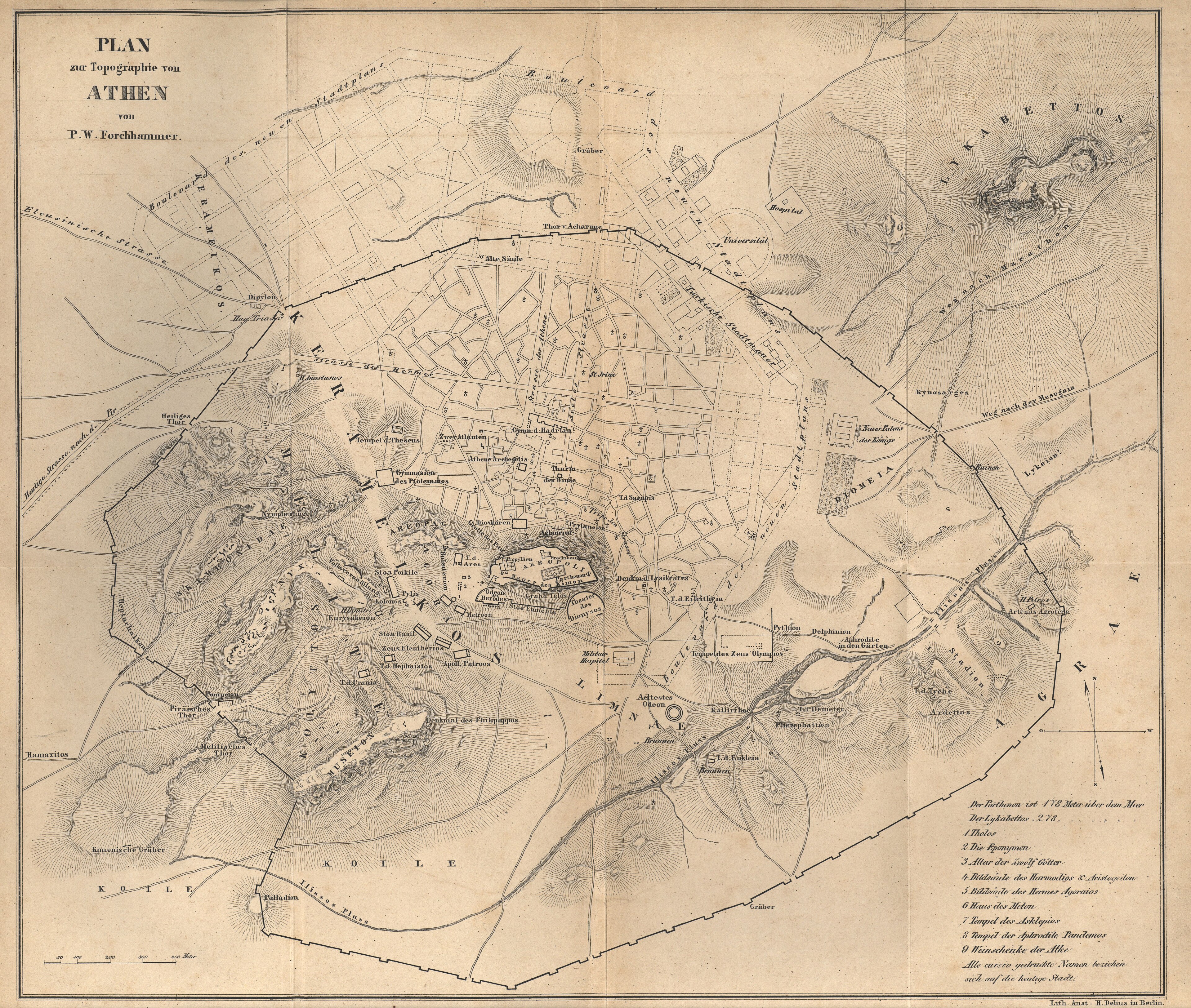
Geographic orientation
Ideas have places. Maps have histories.
Athens supplies the civic and intellectual setting for much of this collection: public argument, Socrates’ trial, Plato’s Academy, and Aristotle’s Lyceum. Keep the differences between those institutions and generations in view.
Forchhammer’s 1841 plan is a historical reconstruction of ancient Athens. Its labels and proposed identifications belong to nineteenth-century scholarship; it is not a modern excavation plan or a photograph of the ancient city. Use it for orientation, then consult current site scholarship.
The argument workshop
Biography without a master key
Does a political disappointment explain a philosophical dialogue?
Plato’s life, Socrates’ execution, the Academy, and the Sicilian episodes all help orient a reader. None supplies a shortcut that makes the arguments unnecessary.
1. Separate setting from proof
A historical event may explain why a question became urgent. It does not establish that the answer offered in a dialogue is true.
2. Read the dramatic design
Notice who speaks, who is absent, what each participant wants, and where an answer meets resistance. A dialogue can expose a position through its consequences rather than announce an author’s conclusion.
3. Handle disputed testimony openly
The Seventh Letter is important but contested evidence. A responsible account tells the reader that its authorship is disputed and avoids treating every reported detail as settled autobiography.
Return to the chapter’s primary-text anchor: Socrates in Plato, Theaetetus 155d. These exercises are editorial prompts, not quotations from the philosopher.
Check the distinction
Read the answer and explanation
Track speaker, setting, argument, and dramatic resistance The literary form helps the argument work. Attending to speakers and dramatic pressures supports philosophical analysis without pretending to solve every question about Plato’s own final commitments.
Continue the conversation
Follow the question into another room.
These are invitations to comparison. A shared question does not make different thinkers or traditions interchangeable.
Socrates in Athens
Distinguish the historical Socrates from Plato’s dramatic and philosophical portraits.
Explore this connection →Aristotle’s life
Follow the Academy’s most famous student into a different project of inquiry.
Explore this connection →Sacred texts
Compare the work of reading texts across language, genre, and historical distance.
Explore this connection →A Short History of Myth
Explore myth as a subject of interpretation while keeping Armstrong’s project distinct from Plato’s.
Explore this connection →Pause · question · discuss
Carry the argument further
Why not treat the Seventh Letter as Plato’s autobiography?
Its authorship is contested, and even an authentic political self-defense would still require critical reading. It is valuable testimony with explicit limits.
Was the Academy a university?
It was an enduring philosophical community, but modern assumptions about charters, degrees, departments, and standardized courses should not be projected onto it.
What should I notice in a dialogue?
Track the question, speakers, examples, revisions, dramatic setting, and unresolved difficulties before deciding what view the author endorses.
The reading room
Primary texts and source notes
- Plato, ApologyJowett; especially 29d–30b and 38a.
- Plato, Seventh LetterJ. Harward; authenticity disputed; especially 324b–326b.
- Plato, Republic IJowett; 327a–354c.
- Plato, SymposiumJowett; framing narrative at 172a–174a.
- Plato, TheaetetusJowett; wonder at 155d.
- Internet Encyclopedia of Philosophy: The AcademyInstitutional setting and cautions about the conventional founding date.
- Stanford Encyclopedia of Philosophy: PlatoBiography, literary form, and disputed letters.
- Diogenes Laertius, Book IIIAncient biography, translated by R. D. Hicks; distinguish reports from established facts.