


Nature › Wildlife
Nature · WildlifeWild North Carolina
Black bears in the swamps and the Smokies. Elk bugling in Cataloochee. The only wild red wolves on Earth. Horses that have run the Outer Banks for centuries. Here is where they live, how they came back, and how to watch them the right way.
By Christopher Adkins · The Lake Norman Brief · Huntersville, North Carolina
Move your cursor or finger across the picture.
North Carolina packs an extraordinary range of wildlife into one state. A single drive from the Great Smoky Mountains to the Outer Banks crosses spruce-fir forest a mile high, Piedmont hardwoods around Lake Norman, longleaf savanna, blackwater swamp and salt marsh. Each holds animals that most Americans only see on television. Several of them nearly disappeared in the twentieth century. Their return is one of the best conservation stories in the country.
This guide follows the five animals visitors ask about most. It explains where each one lives, what the latest official counts say, and how to see them without putting yourself or the animal at risk. Numbers here come from the agencies that manage these animals: the National Park Service, the U.S. Fish and Wildlife Service and the North Carolina Wildlife Resources Commission. Where an estimate is uncertain, the guide says so.
The black bear comeback


The American black bear is North Carolina’s largest land animal and one of its great comeback stories. In the early twentieth century, habitat loss and unregulated hunting pushed bears back into a handful of remote mountain and swamp strongholds. Today the Wildlife Resources Commission manages bears in three regions, the mountains, the Piedmont and the coast, and the population has grown for decades.
The surprise for many visitors is where most of those bears live. Biologists quoted in recent public reporting estimate roughly 20,000 black bears statewide, and believe more of them live in eastern North Carolina than in the mountains. The pocosins, farm fields and swamp forests of the Albemarle–Pamlico region feed bears on corn, wheat, berries and acorns, and coastal bears can grow very large. The Commission now estimates populations with hair-snare DNA studies and camera traps rather than guesswork.
Bears have also returned to parts of the central Piedmont where they were absent for generations, so a sighting near the Uwharries or along a river corridor is no longer astonishing. Most encounters end with a bear running away. Problems begin when bears learn that people mean food.


Elk return to Cataloochee


Elk once roamed the Southern Appalachians, but hunting and settlement wiped them out of North Carolina by the late 1700s or early 1800s. In February 2001 the National Park Service released 25 elk into the remote Cataloochee Valley of Great Smoky Mountains National Park, followed by 27 more in 2002. The animals came by way of Land Between the Lakes on the Kentucky–Tennessee border and from Alberta, Canada.
The experiment worked. Park and regional sources now describe a herd of well over a hundred animals, with elk regularly seen in Cataloochee and around the Oconaluftee Visitor Center near Cherokee, and some wandering onto surrounding private land. The park stopped radio-collaring every animal once the herd became stable.
The best viewing is early morning and the hour before dusk, when elk graze the open fields. September and October bring the rut, when bulls bugle, a high, eerie whistle that carries across the valley, and spar with their antlers. Calves are born in late spring, and cows defend them fiercely. Stay at the edge of the field or in your car, use binoculars or a long lens, and give the animals at least 50 yards.


The world’s only wild red wolves


The red wolf is one of the most endangered mammals in the world, and every wild one lives in North Carolina. Smaller than a gray wolf and larger than a coyote, with tawny, reddish fur, long legs and big ears, it once ranged across the eastern United States. By 1980 it was declared extinct in the wild. The last survivors had been captured along the Gulf Coast to start a breeding program.
In 1987 the U.S. Fish and Wildlife Service released captive-bred red wolves at Alligator River National Wildlife Refuge on the Albemarle Peninsula. It was the first reintroduction of a wolf species that had been declared extinct in the wild. The wild population grew to more than a hundred in the early 2000s, then collapsed to fewer than ten in 2021 amid gunshot deaths, vehicle strikes and management disputes.
Since then the recovery program has rebuilt slowly with releases of captive wolves, pup fostering and new litters born in the wild. The Fish and Wildlife Service’s 2026 updates estimated roughly 22 to 24 adults and subadults in the wild, plus a new generation of pups. Every number matters at that scale. Vehicle strikes on U.S. 64 remain a leading cause of death.


The wild horses of the Outer Banks


For centuries, small, tough horses have survived on the Outer Banks on marsh grass, sea oats and fresh water they find by digging in the sand. Most researchers trace the herds to horses brought by Spanish explorers and colonists in the 1500s and 1600s, and genetic and historical studies support a Colonial Spanish heritage for several herds. In 2010 North Carolina named the Colonial Spanish Mustang its official state horse.
Four groups remain. The Corolla herd roams the northern Currituck Outer Banks, protected by the Corolla Wild Horse Fund and held at a little over a hundred animals. The Shackleford Banks herd in Cape Lookout National Seashore is of similar size and is managed under federal law. A herd on the Rachel Carson Reserve across from Beaufort lives on protected islands. On Ocracoke, the National Park Service keeps the island’s historic “Banker ponies” in a large pasture, the Pony Pen, which visitors can view from a platform.
These are wild animals. In Corolla it is against local law to come within 50 feet of a horse, and feeding them is dangerous: their digestive systems are adapted to coarse beach grasses, and apples, carrots or lawn clippings can kill them. Watch from a distance, keep dogs leashed and never block a horse’s path to water.


Sea turtles on the beach at night

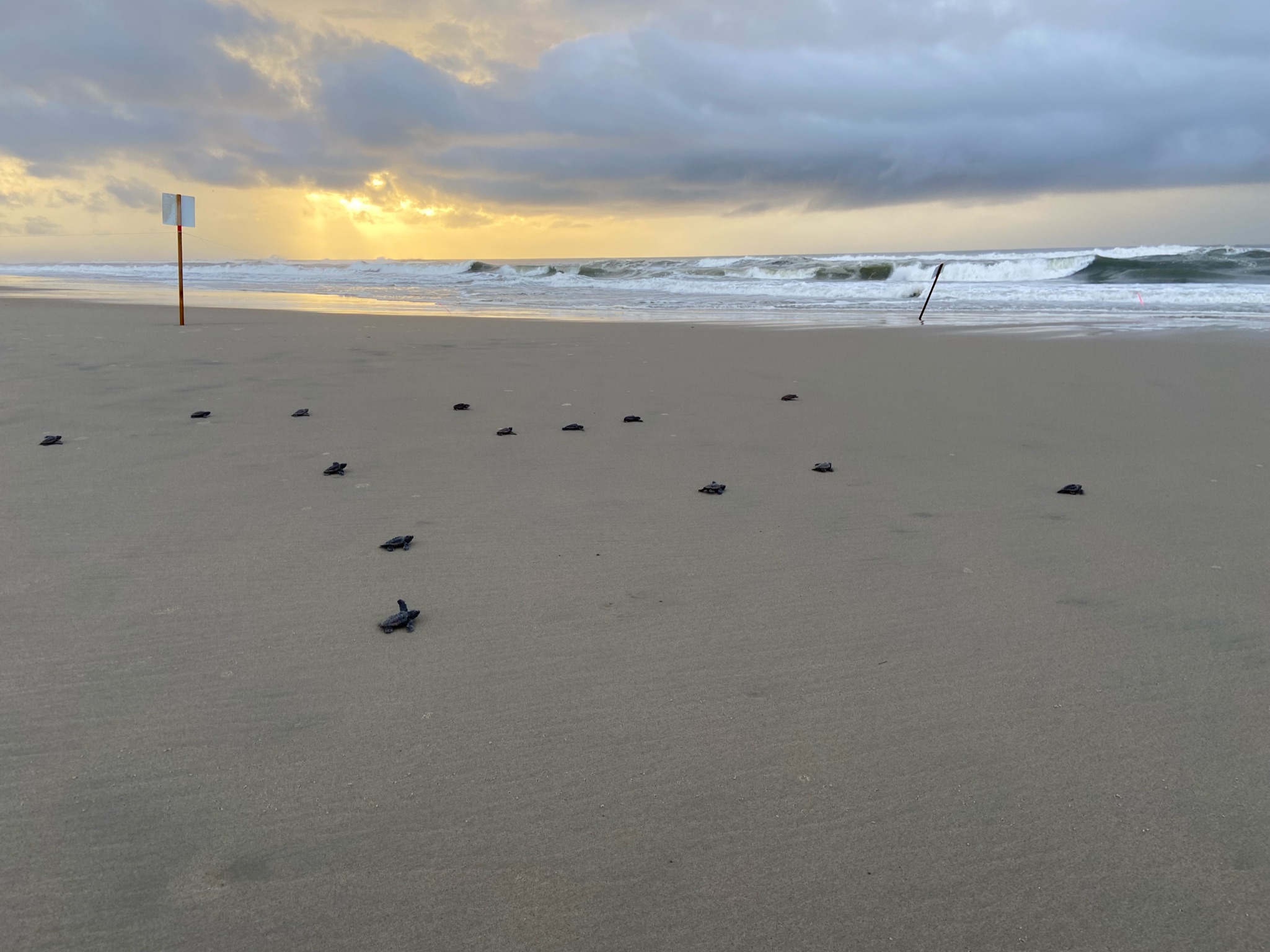
From May through August, female sea turtles haul themselves out of the surf at night, dig a nest above the high-tide line and lay around a hundred leathery eggs. About 60 days later, hatchlings dig out together, usually after dark, and race toward the brightest horizon, which on a natural beach is the moonlit ocean.
The loggerhead is by far North Carolina’s most common nesting turtle. Green turtles nest in smaller numbers, leatherbacks occasionally, and Kemp’s ridleys, the world’s most endangered sea turtle, now nest on the state’s beaches in small numbers in many years. At Cape Lookout National Seashore in 2023, staff documented 325 nests: 300 loggerhead, 19 green, 5 leatherback and 1 Kemp’s ridley.
Volunteers and park staff mark and monitor nests, which is why you see staked rectangles of tape on summer beaches. Beachgoers can help by filling holes, knocking down sandcastles at the end of the day, removing beach gear overnight and keeping lights off or shielded near the beach. Artificial light confuses hatchlings and leads them inland.
Sea turtle nests at Cape Lookout, 2023
Source: Cape Lookout National Seashore 2023 sea turtle reportMore wild neighbors
Flip a card to meet more of the animals that make North Carolina wild.
Other residents worth seeking include river otters in clean rivers from the mountains to the sounds, bottlenose dolphins in the sounds and inlets, white-tailed deer nearly everywhere, wild turkeys in field edges, and bobcats, gray foxes and coyotes that most people never see. The Wildlife field guide has a searchable species index.
Where to watch
Tap a pin. Colors show the kind of place. Locations are approximate.
How close is too close?
The rule for all wildlife is the same: if an animal changes what it is doing because of you, you are too close. Some places put that in law.
Minimum viewing distances
A football field is 300 feet long- Use binoculars and long lenses instead of footsteps.
- Never feed wildlife. Fed animals lose their fear of people and often have to be killed.
- Keep dogs leashed. Many parks require it.
- Drive slowly at dawn and dusk, when deer, bears and wolves cross roads.
- Report injured wildlife to the N.C. Wildlife Helpline rather than handling animals yourself.
The Wild North Carolina quiz
Eight questions
Answers are explained as you goWhich have you seen in the wild?
Tick each animal you have seen. Your list is saved only in this browser.
Wildlife FAQ
Are there wolves in North Carolina?
Yes. North Carolina is home to the only wild population of red wolves in the world, on the Albemarle Peninsula in the northeast. Federal estimates in 2026 counted roughly two dozen adults and subadults in the wild plus pups. Coyotes, which look similar, live statewide.
Where can I see elk in North Carolina?
The Cataloochee Valley in Great Smoky Mountains National Park and the fields near the Oconaluftee Visitor Center outside Cherokee are the most reliable places, especially early and late in the day. September and October bring the bugling rut.
How many black bears live in North Carolina?
Recent public reporting citing state biologists puts the statewide population at roughly 20,000, with more bears in the east than in the mountains. The Wildlife Resources Commission refines its estimates with DNA hair-snare and camera studies.
Can I ride or touch the Outer Banks wild horses?
No. They are wild animals. In Corolla you must stay at least 50 feet away, and feeding or harassing the horses is prohibited. On Ocracoke the ponies are kept in a pasture you can view from a platform.
When do sea turtles nest in North Carolina?
Mostly from May through August, with hatchlings emerging about 60 days after the eggs are laid, so hatching runs into fall. Loggerheads are the most common nesters.
What should I do if I meet a bear on a trail?
Stay calm, stand tall, talk firmly and back away slowly. Do not run or climb a tree. If a black bear follows or approaches, make noise and stand your ground. Carry bear spray where allowed and store food properly at camp.
Sources and further reading
- U.S. Fish and Wildlife Service, Red Wolf Recovery Program — population updates and history
- National Park Service, Elk in Great Smoky Mountains
- National Park Service, Cataloochee Valley
- N.C. Wildlife Resources Commission, Black bears — bear management and BearWise guidance
- WFAE, Black bears return to central North Carolina (April 2026)
- Cape Lookout National Seashore, 2023 Sea Turtle Summary Report
- N.C. Wildlife Resources Commission, Help protect sea turtles
- Corolla Wild Horse Fund
- National Park Service, Shackleford Banks horses
- N.C. General Statutes Chapter 145, State symbols

Christopher Adkins is a Huntersville, North Carolina attorney, the founder of Adkins Law, PLLC, and the editor of The Lake Norman Brief. A Charlotte native, former Army officer and former CMPD officer, he writes these guides to share the wild places that make North Carolina home. More from Christopher Adkins: the Nature atlas and Lake Norman guides.
Keep exploring wild North Carolina
 Nature atlas home
 Nature calendar & fall color
 Blue Ridge Parkway
 Fireflies & night skies
 Outer Banks
 Lake Norman’s wild side
 Salamander capital
 Venus flytrap & carnivorous plants
 Mountains
 Piedmont
 Coast & Coastal Plain
 Waterfalls
 250 hiking trails
 Wildlife field guide
 Plants & trees
 Lakes & river basins
 Mount Mitchell & Kuwohi
 Nature by the numbers
 Intracoastal Waterway
 Article directory