
Religion & Philosophy / Philosophy / Aristotle
Aristotle · Chapter 05 of 05
The Philosopher Across Civilizations: Legacy and Reading Aristotle
The journey through Greek, Syriac, Arabic, Hebrew, and Latin learning—and a practical way into the books themselves.
Curated by Christopher Adkins of Huntersville, NC

What changes when a book enters another language and tradition? Aristotle instructs a pupil in an Arabic manuscript about animals, c. 1225, possibly made in Baghdad. The image witnesses a later culture of learning; it does not record an ancient classroom.
Unknown artist, Kitab na‘t al-hayawan, c. 1225, possibly Baghdad; British Library, Or. 2784, ff. 95v–96r; CC0 reproduction via Wikimedia Commons · CC0 1.0 (Commons image); medieval artwork public domain.


Explore the historical images.
01 / 08
Survival was an achievement
It is easy to imagine a great book traveling intact from antiquity to a modern shelf. Aristotle’s history is more demanding. His surviving corpus contains technical treatises with complicated relations to teaching, revision, and subsequent organization. Many writings intended for a broader audience have been lost. The books available now therefore represent both an intellectual achievement and a history of survival. Their compressed style is not the only style in which Aristotle ever wrote, and their present arrangement is not a transparent record of a single authorial plan.
The history of the Aristotelian corpus documents the long work of copying and editing through which readers gained access to these texts. Manuscripts can differ; a familiar division into chapters may be later than the work itself; a title may shape expectations that the text does not straightforwardly fulfill. The modern reference system based on Immanuel Bekker’s nineteenth-century edition offers a common way to locate passages across different translations, but it does not eliminate textual or interpretive questions.
The larger implication is worth pausing over. The endurance of an idea depends on material acts: a page copied, a term translated, a commentary written, a book taught to a new group of students. Intellectual history is therefore populated by people who do not always appear in the heroic portrait of a philosopher. To look at a manuscript image is to look at the conditions under which a philosophical argument remained available to be accepted, rejected, or understood differently.
02 / 08
Greek philosophy in a multilingual world
Aristotle’s later life in thought cannot be told as an uncomplicated journey from Greece to a single European destination. Greek scholarly traditions continued, while Syriac-speaking and Arabic-speaking scholars participated in major movements of translation and interpretation. The transfer of vocabulary was itself philosophical work. A translator must decide how a term functions in an argument, how it relates to neighboring terms, and which expression in another language can preserve those relations. Even a conscientious choice can create new possibilities of interpretation.
The Greek-to-Arabic translation movement brought Aristotelian works into a setting that also contained other ancient philosophical traditions and new religious and intellectual questions. The resulting philosophy was not a storage room in which Greek ideas waited unchanged. Thinkers selected problems, reorganized disciplines, developed arguments, and challenged their predecessors. Their work deserves attention for its own achievements as well as for its influence on later readers.
This is why the familiar language of saving Aristotle, although it can acknowledge essential labor, may still obscure too much. Preservation and transformation are not rival descriptions. A text can be preserved precisely because a community finds new work for it to do. Reading the medieval Arabic manuscript illustration in this section, we should see both a memory of Aristotle and a witness to the world that made that memory intellectually active. The image belongs to its medieval context; its value does not depend on pretending it gives us direct access to an ancient lesson.
“we are inquiring not in order to know what virtue is, but in order to become good”
Nicomachean Ethics II.2, 1103b26–29W. D. Ross

03 / 08
Avicenna and Averroes: philosophy beyond transmission
Ibn Sina, known in Latin as Avicenna, created a comprehensive philosophical system that engaged deeply with Aristotle while developing distinctive accounts of existence, necessity, intellect, and explanation. His achievement cannot be measured by how closely each proposition repeats an Aristotelian text. It belongs to an argument about what a systematic understanding of reality requires. The scholarly introduction to Avicenna is a useful next step for readers who want to follow those transformations rather than stop at a name in a timeline.
Ibn Rushd, known in Latin as Averroes, made Aristotle central to an extensive program of commentary and philosophical investigation. He was also a jurist and physician, and his work asks how demonstrative reasoning relates to the different audiences and purposes of religious and public discourse. The account of Ibn Rushd’s philosophy shows why the label commentator should not imply intellectual passivity. Clarifying a difficult predecessor can require choosing among rival interpretations, defending a method, and generating new arguments.
The distinction between these thinkers is educational in itself. A tradition is not a line of identical minds. Agreement that Aristotle matters does not settle how his works should be read or which conclusions should be retained. Readers who encounter the Latinized names in later European texts should reconnect them with their own linguistic, religious, and institutional worlds. Doing so changes the history from a relay race of possession into an exchange of serious philosophical projects, each with its own stakes and its own capacity to transform what followed.
04 / 08
Maimonides and the discipline of limits
Maimonides, or Moses ben Maimon, placed philosophical reasoning in sustained conversation with Jewish law and scriptural interpretation. His Guide of the Perplexed, written in Judeo-Arabic, addresses problems that arise when a serious reader attempts to think carefully about both inherited religious language and philosophical explanation. Aristotelian concepts matter to that undertaking, but Maimonides also insists on limits: some claims about God and the world cannot be secured with the confidence that an attractive system might encourage. The Stanford account of his philosophy emphasizes both the influence and the departure.
This encounter is especially important because it prevents a simplistic opposition between reason and faith. A religious thinker may use philosophy to criticize crude understandings of religious language. The same thinker may question a philosopher’s claim to have demonstrated something about ultimate reality. The intellectual work takes place in the distinctions, not in a slogan announcing that one entire category has defeated the other. A reader must ask what kind of language is being used, what kind of evidence is available, and what level of certainty is justified.
For the present series, Maimonides illustrates how Aristotle’s legacy could be strongest where his authority was not treated as unlimited. A philosophical tool may be useful without being sufficient for every question. To distinguish what one knows from what one conjectures is not a retreat from inquiry. It can be one of inquiry’s most demanding results. That discipline also supplies a bridge to other figures in this philosophy collection: the relation between reason, inwardness, commitment, and uncertainty remains a live problem when the historical setting changes.

05 / 08
Aquinas and a transformed Aristotelian vocabulary
The growth of Aristotelian learning in Latin involved several routes, including translation from Greek and from Arabic, and the influence of substantial Arabic philosophical works. Medieval intellectual history should not be compressed into a single moment when Europe suddenly rediscovered a philosopher it had entirely forgotten. Some logical works had long been known; other parts of the corpus became newly available or more widely influential. Institutions, translations, and arguments changed together.
Thomas Aquinas engaged Aristotle’s accounts of nature, form, causation, knowledge, and virtue within a Christian philosophical and theological project. His work is a creative reconstruction, not a simple substitution of Christian names into a completed Greek system. Questions of creation, divine knowledge, human destiny, and grace altered the setting in which Aristotelian concepts operated. The scholarly overview of Aquinas helps distinguish shared vocabulary from identical doctrine.
That distinction matters when modern readers encounter a religious claim supported by an appeal to Aristotle. The route between the ancient text and the later claim may contain major arguments of its own. It is worth asking which premise is Aristotle’s, which belongs to a commentator, and which is supplied by a theological commitment. This does not diminish the later thinker. On the contrary, it gives that thinker credit for the work performed. A tradition becomes clearer when each act of interpretation is allowed to be an intellectual event rather than hidden beneath the authority of a famous origin.
06 / 08
Influence includes resistance
An influential philosopher can shape a field even when later investigators reject central conclusions. Aristotle’s natural philosophy no longer provides an adequate account of motion, matter, or biological development by modern scientific standards. His logical system is not the whole of modern logic. His political hierarchies cannot be accepted as a just account of human standing. A serious appreciation should state these limits without turning them into a dismissal of every question he asked.
The useful distinction is between an answer and the problem it helped make visible. A particular biological explanation may fail while the demand to relate a part to the organism remains fruitful. A constitutional classification may be inadequate while the distinction between common benefit and private domination remains illuminating. A theory of artistic form may not govern every genre while still explaining why some sequences of events feel dramatically necessary and others arbitrary. Intellectual inheritance often works by selective revision.
This is also a safeguard against the prestige of antiquity. An idea is not strengthened simply by being old, and a modern idea is not refuted simply because Aristotle did not hold it. What matters is the argument and the evidence appropriate to its subject. The reader’s aim should be neither to recover a lost authority who settles every dispute nor to demonstrate superiority over the past. It is to make present judgment more exact by encountering a powerful alternative carefully enough to understand both its insight and its failure.
07 / 08
A reading route through the primary works
Start with Nicomachean Ethics I, then move to II and VI. These readings establish the questions of flourishing, character, and practical wisdom. Continue with VIII and IX for friendship. Keep a notebook of examples that clarify a distinction and examples that strain it. You do not have to settle every scholarly controversy before an argument can become useful to think with.
Next read Poetics 1–11 beside a tragedy or a carefully structured modern story. Ask what Aristotle’s analysis makes you notice. Then try Rhetoric I, testing its distinctions against an actual public argument. These works provide concrete occasions for using philosophical vocabulary rather than memorizing definitions in isolation. Follow them with Politics I and III, keeping the critique of hierarchy active throughout.
For the theoretical works, read Physics II before attempting the whole Metaphysics. The four causes supply a vocabulary for later problems. Then read On the Soul II.1–3 and the opening of the Metaphysics. The public-domain translations linked here give immediate access, but their English can be old-fashioned and their choices sometimes conceal disputes. Comparing a difficult passage with a recent scholarly translation and its notes can be valuable. A translation is a guide through the Greek argument, not an invisible pane through which no interpretive choices have passed.
08 / 08
How to disagree with a great philosopher
Read a short passage twice. On the first pass, identify the question. On the second, mark the steps of the answer. Separate the author’s own conclusion from an objection being reported, and distinguish an example from the principle it illustrates. If a passage cites a position only to criticize it, copying its most striking sentence as Aristotle’s belief will invert the argument. Slow reading is not an ornamental respect shown to an ancient author; it is protection against misdescription.
Use references that another reader can follow. A citation such as Nicomachean Ethics II.2 identifies a work, book, and chapter. A Bekker reference such as 1103b adds a common textual location across many editions: page number and column, with line numbers often added. Record the translator when quoting English wording. Do not turn a modern summary into an ancient quotation merely because it sounds memorable. A quotation’s authority depends on what the source actually says and how the excerpt functions in its context.
Finally, formulate the strongest version of your objection. Identify whether the problem lies in a premise, an inference, a missing perspective, or the application to a case. That approach is especially necessary when confronting Aristotle’s hierarchies: moral clarity is strengthened by an exact account of the reasoning that supports them. It is equally necessary when defending an insight that a casual reader dismisses. The five chapters end where a philosophical education begins: with a reader better equipped to ask, interpret, test, and judge. Aristotle remains worth reading because the encounter can sharpen those capacities, not because it requires surrendering them.
The visual reading room
Look closely. Ask better questions.
Eight images invite a slower look at places, portraits, manuscripts, and later interpretations. What changes when a book enters another language and tradition? Select any image to enlarge it; the source and reuse credit remain with every item.


Geographic orientation
Ideas have places. Maps have histories.
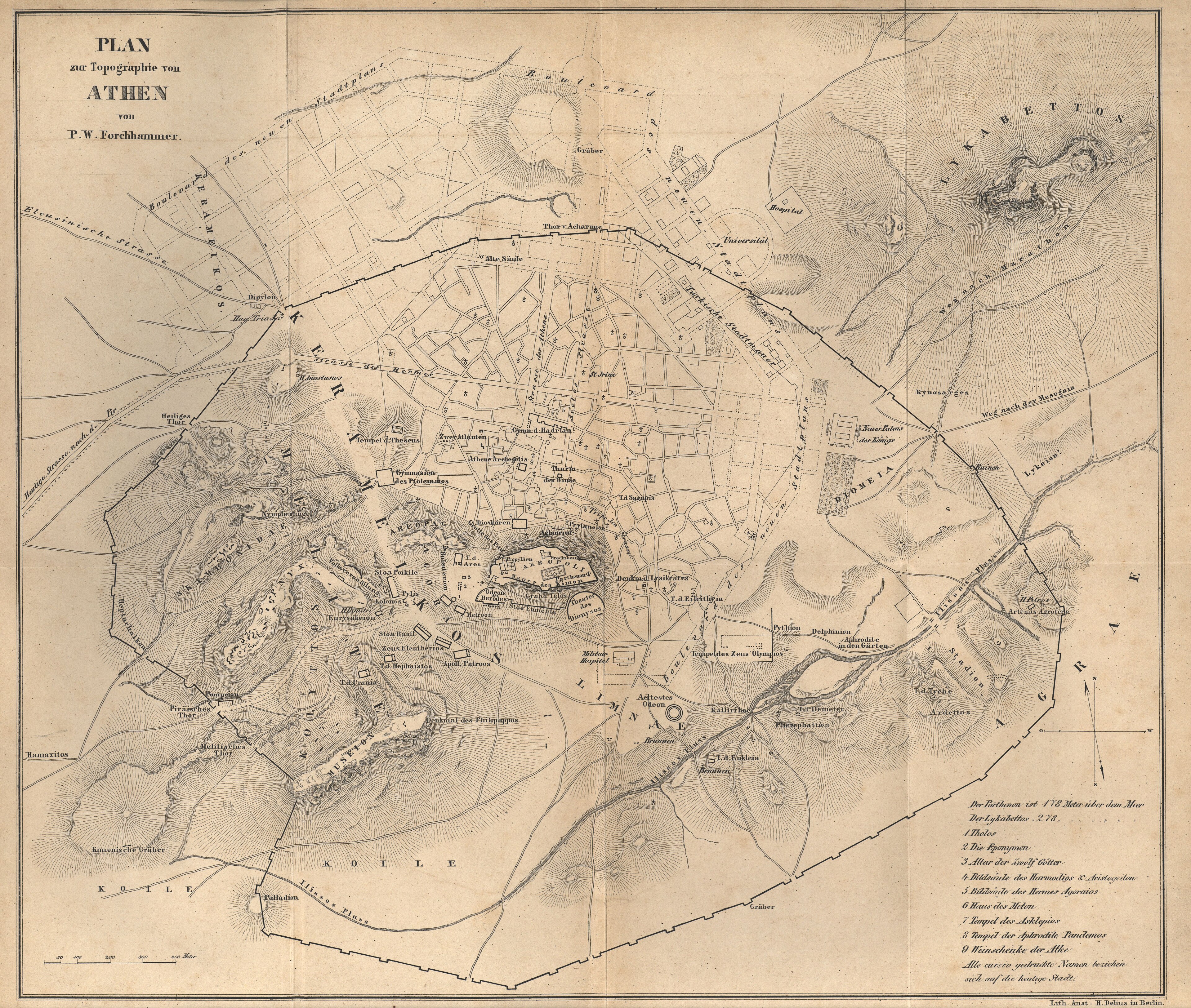
Athens supplies the civic and intellectual setting for much of this collection: public argument, Socrates’ trial, Plato’s Academy, and Aristotle’s Lyceum. Keep the differences between those institutions and generations in view.
Forchhammer’s 1841 plan is a historical reconstruction of ancient Athens. Its labels and proposed identifications belong to nineteenth-century scholarship; it is not a modern excavation plan or a photograph of the ancient city. Use it for orientation, then consult current site scholarship.
The argument workshop
Transmission as intellectual work
What changes when a book enters another language and tradition?
Aristotle’s writings travel through manuscripts, translations, commentaries, and new arguments. A useful history follows the people doing that work rather than imagining a book moving intact between sealed civilizations.
1. Replace the relay-race picture
Greek, Syriac, Arabic, Hebrew, and Latin scholarly worlds overlap in complex ways. Translation and commentary can generate new philosophical problems rather than merely transport old answers.
2. Name the disagreement
Ibn Sina, Ibn Rushd, Maimonides, and Aquinas do not form a single unbroken doctrine. Ask what each accepts, revises, or contests, especially concerning intellect, causation, creation, and the relation between philosophy and revelation.
3. Read with a question in hand
Begin with Nicomachean Ethics I–II, then a focused selection on friendship or explanation. Use work, book, chapter, and Bekker references to compare translations without confusing modern page numbers.
Return to the chapter’s primary-text anchor: Nicomachean Ethics II.2, 1103b26–29. These exercises are editorial prompts, not quotations from the philosopher.
Check the distinction
Read the answer and explanation
A set of translations, interpretations, original developments, and disputes The history includes preservation, but its intellectual importance also lies in development and disagreement. Later philosophers deserve attention as thinkers in their own right.
Continue the conversation
Follow the question into another room.
These are invitations to comparison. A shared question does not make different thinkers or traditions interchangeable.
Plato’s reception
Compare two intertwined but distinct histories of philosophical interpretation.
Explore this connection →The Quran
Orient yourself to the scripture engaged by thinkers working within Islamic traditions.
Explore this connection →The Torah
Read the Jewish scriptural setting without reducing its interpretation to Greek philosophy.
Explore this connection →The Bible
Explore the Christian textual world within which medieval Aristotelian arguments were debated.
Explore this connection →Pause · question · discuss
Carry the argument further
Did Arabic philosophers merely preserve Aristotle for Europe?
No. Preservation mattered, but scholars working in Arabic also developed original philosophical systems, commentaries, and critiques. Their achievements should be studied in their own contexts.
Was Aquinas’s philosophy identical to Aristotle’s?
No. Aquinas adopted and transformed Aristotelian concepts within a distinct Christian philosophical and theological project.
What is a Bekker number?
It is a standardized location based on Immanuel Bekker’s edition of Aristotle: a page number, column a or b, and often line numbers. It helps readers locate the same passage across different editions and translations.
The reading room
Primary texts and source notes
- The Textual Transmission of the Aristotelian Corpus, Stanford Encyclopedia of PhilosophyThe difference between Aristotle’s lost public works and the surviving technical corpus; manuscript history and Bekker references.
- Greek Sources in Arabic and Islamic Philosophy, Stanford Encyclopedia of PhilosophyThe multilingual translation movement and its philosophical setting.
- Medieval Philosophy, Stanford Encyclopedia of PhilosophyGreek, Arabic, Hebrew, and Latin routes of translation and philosophical exchange.
- Influence of Arabic and Islamic Philosophy on the Latin West, Stanford Encyclopedia of PhilosophyThe substantive contributions of Arabic philosophers to Latin philosophy.
- Ibn Sina [Avicenna], Stanford Encyclopedia of PhilosophyAvicenna as an original philosopher, not merely a transmitter of Aristotle.
- Ibn Rushd [Averroes], Stanford Encyclopedia of PhilosophyAristotelian commentary, demonstration, religious inquiry, and the wider work of Ibn Rushd.
- Maimonides, Stanford Encyclopedia of PhilosophyAristotelian influence and the limits of philosophical knowledge in the Guide of the Perplexed.
- Thomas Aquinas, Stanford Encyclopedia of PhilosophyAquinas’s creative reworking of Aristotle within Christian philosophy and theology.
- Aristotle, Nicomachean Ethics, Book IIW. D. Ross translation. Habituation, character, choice, and the mean.
- Aristotle, Nicomachean Ethics, Book VIIIW. D. Ross translation. The varieties and conditions of friendship.
- Aristotle, Nicomachean Ethics, Book IXW. D. Ross translation. Friendship, self-love, shared activity, and the good life.
- Aristotle, Physics, Book IIR. P. Hardie and R. K. Gaye translation. Nature, four causes, chance, and purposive explanation.
- Aristotle, On the Soul, Book IIJ. A. Smith translation. Soul, actuality, and the capacities of living organisms.