
Religion & Philosophy / Philosophy / Plato
Plato · Chapter 02 of 05
Out of the Cave: Forms, Knowledge, and the Good
Why appearances are not enough—and what education must change
Curated by Christopher Adkins of Huntersville, NC

Would showing a prisoner one more shadow count as liberation? Jan Saenredam’s 1604 engraving, after Cornelis van Haarlem, transforms the Republic’s cave into a densely populated visual argument. The scene illustrates an allegory of education and appearance, not an identified archaeological location. Public domain.
Jan Pietersz Saenredam, after Cornelis Cornelisz. van Haarlem / Wikimedia Commons · Public domain.


Explore the historical images.
01 / 07
1. The puzzle hiding inside ordinary judgments
Take three acts that seem fair: dividing an inheritance according to an agreed rule, hearing both sides of a disagreement, and giving someone an opportunity they were wrongly denied. The acts are different. Yet we use the same evaluative word. What makes that possible? A list of examples cannot by itself explain what the examples share, and public approval cannot settle the matter if a whole community approves an injustice. This is one path into the question that Plato’s Forms address.
In the Phaedo, 74a–75d, Socrates asks about equal sticks and stones. Material things can appear equal under one comparison and unequal under another. The standard of equality by which we judge them is not simply another imperfect pair. Likewise, the beauty of a face may change, while the question of what beauty is remains. Plato’s proposal gives intelligible objects—Forms—a role that no shifting individual example can perform.
The proposal is stronger than saying that human beings use concepts. In the relevant dialogues, Forms are not treated merely as convenient labels invented by the mind. They are what thought seeks to understand and what particulars depend on to be the kinds of things they are. That ambition explains both the theory’s attraction and its difficulty. A stable standard could make criticism of custom intelligible; an additional realm of objects could also leave us wondering how the standard relates to the world we actually encounter.
02 / 07
2. Forms are not a warehouse of perfect copies
A misleading introduction pictures an ideal chair somewhere beyond the clouds, surrounded by ideal spoons and ideal shoes. Plato’s dialogues do not present one simple inventory of a duplicate universe. They differ in emphasis, and they repeatedly examine what the range of Forms should be. The key issue is explanatory: how can something be beautiful, equal, just, or one when its sensible appearance is changeable and its character depends on a context?
Terms such as participation and likeness express the relation between particulars and Forms, but naming the relation does not explain it. Does a beautiful thing receive part of Beauty, or does Beauty remain wholly present in many instances? If a Form is a model, what makes model and copy alike? The Parmenides, 130a–135c, presses these questions against a young Socrates. This is Plato writing a formidable examination of positions associated with Plato.
One famous difficulty generates a regress. Suppose large things are large through one Form of Largeness. If that Form and its instances are all themselves large, it seems possible to require another Form to explain their shared largeness, and then another. The argument’s exact assumptions matter, and interpreters disagree over its final implications. Its immediate lesson is clear: an explanation must not reproduce the original problem at a higher level. Readers need not choose between accepting the Forms without reservation and treating Plato as unaware of their difficulties.
“the power and capacity of learning exists in the soul already”
Socrates in Plato, Republic VII, 518cBenjamin Jowett

03 / 07
3. The sun and the strange priority of the Good
In Republic VI, 507b–509c, Socrates compares the Good to the sun. The sun makes visible things available to sight and supports their growth; analogously, the Good makes intelligible things knowable and gives truth its illuminating order. The comparison does not supply a neat dictionary definition of goodness. It raises a deeper question: what makes a collection of correct observations amount to an understanding of what matters?
Consider a person who can calculate exactly how to achieve an objective but cannot defend the objective. Their competence may be considerable, yet it does not establish that their life or institution is well directed. This is an illustrative modern comparison, not Plato’s example. It helps explain why the Good is not simply one useful item among others. If we evaluate every goal only by reference to a further goal, practical reasoning seems to postpone rather than answer the question of purpose.
Plato’s language is difficult. The Good is described as beyond being in dignity and power at 509b, a passage that has generated centuries of debate. It should not be casually converted into a statement about a creator God, an energy field, or a positive attitude. The dialogue’s argument concerns intelligibility, value, and explanation. The sun image offers orientation while acknowledging the speaker’s limitations: Socrates gives an offspring or likeness of the Good rather than claiming to deliver the final account his listeners request.
04 / 07
4. Four conditions of understanding
The divided line follows at Republic VI, 509d–511e. Socrates distinguishes images, the visible things of which they are images, mathematical reasoning that proceeds from hypotheses, and dialectical understanding that examines its starting points. The customary Greek labels are eikasia, pistis, dianoia, and noēsis. Translations vary; what matters initially is the change in how a claim is supported.
A drawing can represent a triangle. Mathematical proof, however, concerns more than the thickness of its ink or the slight irregularity of its lines. The geometer uses a visible figure while reasoning about an intelligible relation. Yet mathematics can still take initial assumptions for granted. Dialectic, in the contrast Socrates develops, investigates the assumptions themselves and seeks a firmer account of why they deserve acceptance. The ascent concerns the structure of justification, not the accumulation of prestigious vocabulary.
One practical exercise is to place a belief beside the support you actually possess for it. Do you rely on a compelling image, firsthand observation, a model with stated assumptions, or an argument about the assumptions? The exercise does not prove that every contemporary field fits neatly onto Plato’s line. It reveals something useful about the line’s aspiration: different kinds of confidence have different grounds. A person who can repeat a conclusion may be unable to reproduce the reasoning that warrants it. Greater fluency is not automatically greater understanding.

05 / 07
5. Inside the cave: why learning can hurt
The cave at Republic VII, 514a–517a, converts those distinctions into a drama. Prisoners have been chained since childhood, looking at shadows produced by objects carried behind them in the light of a fire. Their situation is ordinary to them because it is all they have known. The familiar world acquires the authority of reality through repetition, shared agreement, and the practical ability to anticipate what appears next.
Release initially makes things worse. Turning toward the fire hurts the eyes; being led upward brings bewilderment. The former prisoner cannot immediately recognize the sources of the appearances once mastered. Education therefore looks, for a time, like diminished competence. That is one of the image’s most humane insights. A student abandoning a false explanation may temporarily feel less capable than someone still protected by a confident mistake. Difficulty can accompany progress, though difficulty alone never proves that progress is occurring.
Outside, the learner adjusts gradually: shadows and reflections, things themselves, the night sky, and finally the sun. This is an ordered reorientation, not an instantaneous revelation granted by secret information. The cave should not become a flattering label for everyone who disagrees with us. Claiming to be awakened while refusing questions reproduces the prisoners’ certainty. A responsible use of the allegory asks which assumptions organize our own field of vision, what evidence would correct them, and whether we can explain the route from our present beliefs to a better-grounded account.
06 / 07
6. The part everyone forgets: coming back down
The liberated person returns to the cave. Now accustomed to daylight, he initially performs badly in its darkness and may be mocked by those who never left. The story turns toward the philosopher’s difficult relation to the community. Having acquired a broader view does not automatically produce the ability to communicate it, and people invested in an existing order may mistake the learner’s awkwardness for proof that education was harmful.
At Republic VII, 519c–521b, the issue becomes an obligation to rule. Those educated by the city cannot simply remain in contemplation and refuse the burdens from which others supported their escape. This conclusion belongs to Plato’s controversial political design, not to a harmless motivational fable. The ascent and return bind philosophical insight to questions about authority, repayment, common welfare, and coercion.
There is nevertheless a distinction modern readers can use without accepting philosopher-rule. Understanding can create responsibilities of explanation. Someone with specialized knowledge should be able to show the relevant evidence, acknowledge uncertainty, and translate without contempt. The cave’s returning figure warns that intellectual superiority can be socially ineffective when it cannot meet others where they are. But the city must also provide ways to challenge the alleged expert. A claim to have seen the light becomes dangerous when it exempts itself from the examination that made education valuable in the first place.

07 / 07
7. What survives if we doubt the Forms?
The Theaetetus, 151d–210d, tests knowledge as perception, true judgment, and true judgment accompanied by an account. It ends without a settled definition. This is a useful companion to the bold architecture of the Republic. Plato can construct a picture of intellectual ascent and also subject apparently promising definitions of knowledge to prolonged difficulty. His corpus contains both system-building and resistance to premature completion.
A reader may reject the existence of separate Forms while retaining several demands generated by the inquiry. A standard should not be confused with whichever example first suggested it. Accurate belief should be distinguished from the ability to explain why it is accurate. Education should attend to the formation of attention and desire, because someone may possess information yet be unwilling to consider what threatens a cherished identity. These are philosophical lessons drawn from reading the texts, not claims that Plato anticipated every modern theory of learning.
The final question is personal without being merely subjective: where do your standards come from, and how could they improve? A familiar answer is not false because it is familiar. An unfamiliar answer is not true because it feels liberating. Plato’s cave is most useful when it interrupts both errors. The exit begins with examination; the ascent requires disciplined reasoning; the return tests whether what has been learned can contribute to a life shared with other people.
The visual reading room
Look closely. Ask better questions.
Eight images invite a slower look at places, portraits, manuscripts, and later interpretations. Would showing a prisoner one more shadow count as liberation? Select any image to enlarge it; the source and reuse credit remain with every item.


Geographic orientation
Ideas have places. Maps have histories.
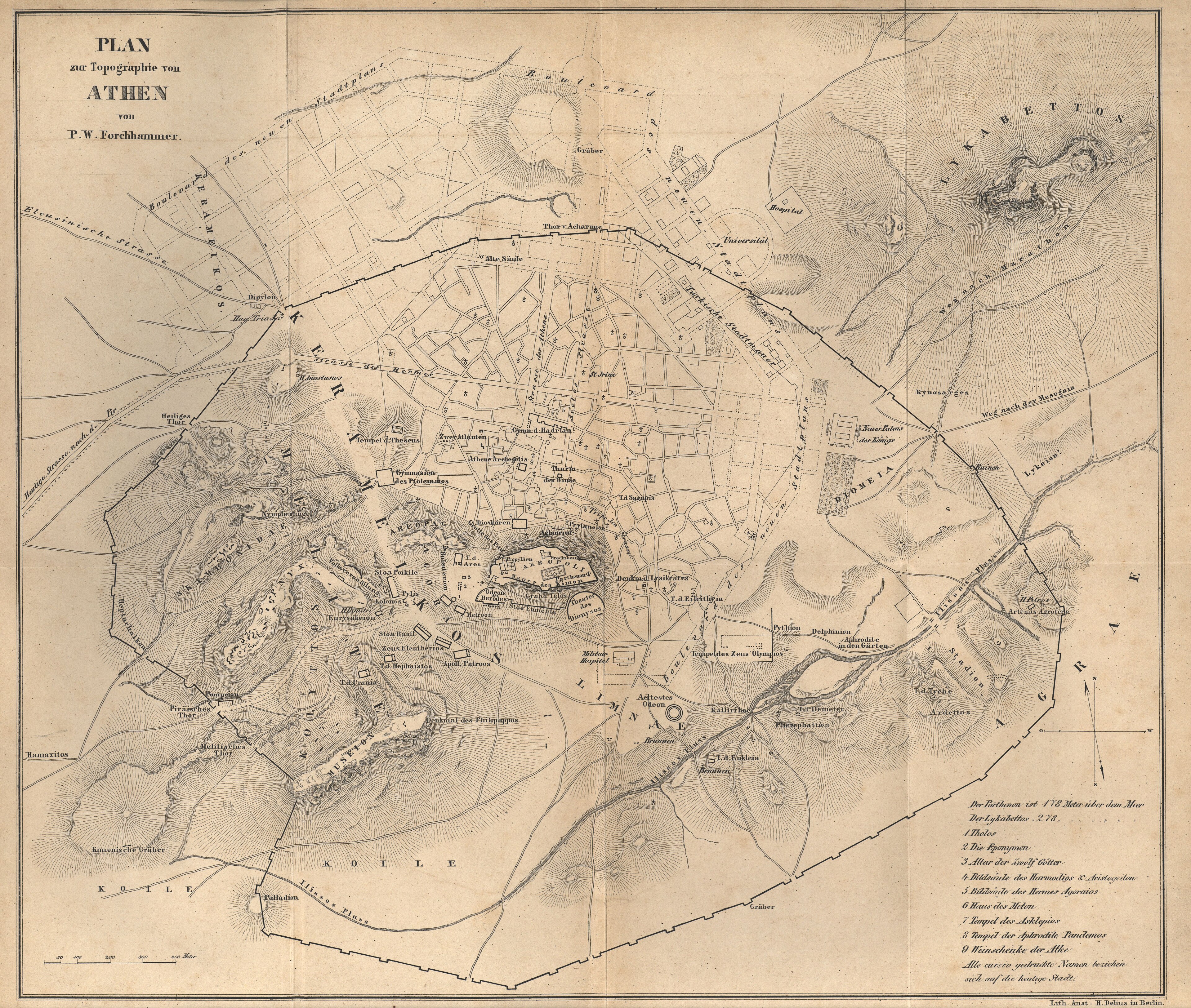
Athens supplies the civic and intellectual setting for much of this collection: public argument, Socrates’ trial, Plato’s Academy, and Aristotle’s Lyceum. Keep the differences between those institutions and generations in view.
Forchhammer’s 1841 plan is a historical reconstruction of ancient Athens. Its labels and proposed identifications belong to nineteenth-century scholarship; it is not a modern excavation plan or a photograph of the ancient city. Use it for orientation, then consult current site scholarship.
The argument workshop
Education as a change of direction
Would showing a prisoner one more shadow count as liberation?
The cave asks readers to distinguish receiving another image from changing the way they judge appearances. A larger supply of information may leave a faulty standard of judgment intact.
1. Follow the sequence
Trace shadows, the ascent, the difficulty of adjustment, and the return. Each stage adds something to the inquiry into knowledge and education.
2. Challenge the interpretation
Does the image support an escape from public life, or a responsibility to return? Test your answer against the surrounding argument in Republic VII instead of treating the cave as a free-standing modern fable.
3. Apply with restraint
Choose a familiar claim you accepted because it was repeated. Identify the evidence, the standard by which you judge it, and what might force you to revise that standard. This is an analogy, not a proof that modern media are Plato’s cave.
Return to the chapter’s primary-text anchor: Socrates in Plato, Republic VII, 518c. These exercises are editorial prompts, not quotations from the philosopher.
Check the distinction
Read the answer and explanation
Turning an existing capacity toward what it should examine The passage at 518b–d describes a turning of the soul. The capacity to learn is present, while its direction and formation require sustained work.
Continue the conversation
Follow the question into another room.
These are invitations to comparison. A shared question does not make different thinkers or traditions interchangeable.
Socratic questioning
Return to definitions, contradictions, and the recognition of ignorance.
Explore this connection →Aristotle’s explanations
Compare intelligible Forms with Aristotle’s accounts of substance and causation.
Explore this connection →The Case for God
Broaden the discussion of what knowledge, practice, and religious language can mean.
Explore this connection →The natural world
Ask how evidential standards change with the kind of claim being investigated.
Explore this connection →Pause · question · discuss
Carry the argument further
Are Forms just ideas inside our minds?
In the dialogues that develop the theory, Forms are not merely subjective concepts. They are proposed as intelligible realities and explanatory standards. Plato also examines objections to that proposal.
Does the cave say that all sensory experience is worthless?
No. Its ascent uses successive encounters and comparisons. The central problem is mistaking limited appearances for complete understanding.
Why must the philosopher return?
In the Republic, the city’s educated guardians owe service to the community that formed them. That return links the image of knowledge to a controversial account of political obligation.
The reading room
Primary texts and source notes
- Plato, Phaedo74a–75d on equality and recollection; 100b–102a on Forms as explanations.
- Plato, Parmenides130a–135c, objections to Forms and participation.
- Plato, Republic VI507b–511e: the sun and divided line.
- Plato, Republic VII514a–521b: cave, education, and return.
- Plato, Theaetetus151d–210d: competing definitions of knowledge. All primary links use Benjamin Jowett’s public-domain translation.