
Religion & Philosophy / Philosophy / Plato
Plato · Chapter 03 of 05
The Soul in Love: Desire, Beauty, and Mortality
From a crowded dinner party to the last conversation in prison
Curated by Christopher Adkins of Huntersville, NC

Does loving beauty mean abandoning particular people? Anselm Feuerbach’s 1869 interpretation of Plato’s Symposium stages the philosophical dinner party as a monumental scene. It is a nineteenth-century reception of the dialogue, not a contemporary record of ancient Athens. Public domain.
Anselm Feuerbach / Staatliche Kunsthalle Karlsruhe / Google Cultural Institute / Wikimedia Commons · Public domain.


Explore the historical images.
01 / 07
1. A dinner party where every account of love reveals a life
The Symposium begins with a remembered party at the house of the tragic poet Agathon. Its speakers decide to offer speeches in praise of Eros. A physician interprets love through harmony; a comic poet imagines divided creatures seeking reunion; a successful dramatist produces a beautifully arranged tribute. Their speeches are arguments, performances, and self-portraits. Each makes certain features of desire visible while leaving others obscure.
The historical setting is distant from a modern dinner party. Several speeches concern relationships structured by the age, status, and gender inequalities of elite Greek society. Understanding that setting does not require endorsing its assumptions. The dialogue’s questions about education and desire remain fruitful, but its social arrangements should not be quietly translated into contemporary ideals of equal partnership. The text provides material for examination, including examination of its exclusions.
In Symposium 189c–193d, Aristophanes tells the famous story of once-whole beings divided by the gods. It captures the feeling that love might repair an incompleteness deeper than loneliness. Yet it is one speaker’s myth, not a straightforward announcement of Plato’s final doctrine. Its poignancy should sharpen a question: does the feeling that someone completes us establish that the relationship is good? A powerful account of desire can describe its emotional force without providing a sufficient standard for judging its direction.
02 / 07
2. Diotima changes the question
When Socrates speaks, he begins by questioning Agathon and then recounts what he learned from Diotima. The literary arrangement matters: a woman’s instruction becomes the philosophical center of a gathering whose visible speakers are men. We cannot securely reconstruct Diotima as a historical teacher independently of Plato’s account. We can, however, recognize the authority the dialogue assigns to the voice Socrates reports.
At Symposium 200a–206a, love is associated with lack and with the desire for the good to be one’s own enduringly. Love is not simply a possession already completed. It reaches beyond its present condition. This explains why fulfillment does not always put an end to desire: the lover also wants what is valued to remain, to flourish, and somehow to escape the vulnerability of time.
Diotima’s account tests the myth of the missing half. People do not want every part of themselves preserved merely because it belongs to them. They may reject what harms them. The deeper object is therefore not sameness or completion in isolation, but goodness. That move remains challenging. Desire feels authoritative from the inside, but its intensity does not settle whether its object deserves pursuit. Philosophy enters the space between wanting something and knowing why having it would make life better. Love becomes an inquiry into value as well as an experience of need.
“the love of the everlasting possession of the good”
Diotima, as reported by Socrates in Plato, Symposium 206aBenjamin Jowett; excerpt from a longer sentence

03 / 07
3. Creativity and the wish to outlast ourselves
Diotima describes desire as productive: it seeks generation in beauty, in body and in soul. The language brings childbirth, the making of poems, the establishment of laws, and the education of another person into one field of reflection. At Symposium 206b–209e, human beings pursue forms of continuity because they are mortal. What they bring into being may carry something valued beyond the limits of their own lives.
This need not be read as a claim that biological parenthood is the only meaningful response to mortality. The speech deliberately broadens creation beyond that category. A teacher can help another person develop a judgment that will operate independently of the teacher. A craftsperson can create an object whose use outlives its maker. A lawgiver can shape a community’s future, for good or ill. These modern examples extend the text’s question without claiming that every project is automatically admirable.
The evaluative difficulty remains essential. Wanting to be remembered is not the same as creating something good. A monument can preserve vanity; a persuasive institution can perpetuate injustice. Diotima’s framework asks us to examine the quality of what is generated and the kind of person its pursuit makes us become. Love, ambition, education, and art are connected because each can move beyond immediate consumption into creation. But each needs a standard more demanding than the fact that someone passionately wished it to exist.
04 / 07
4. The ladder of love—and its uncomfortable question
The ascent at Symposium 210a–212a moves from attraction to one beautiful body, to recognition of beauty in many bodies, to the beauty of souls, practices, laws, and forms of knowledge, and ultimately to Beauty itself. The motion is an education of attention. The learner gradually discovers that what first appeared concentrated in one object has a wider and more intelligible significance.
That ascent is often flattened into the idea that physical attraction is bad and disembodied affection is good. The text is more demanding: the first attraction can begin the process, but it cannot remain the final measure of value. Nor is the summit simply liking someone’s personality. The question concerns a reality that does not become beautiful only from one perspective or during one brief season. Beauty itself offers the permanence that particular experiences cannot guarantee.
An objection should accompany admiration. If a beloved person becomes a rung on an ascent, has the lover learned to see them more truthfully or learned to leave their particularity behind? Readers disagree about how the dialogue answers that question. Its dramatic conclusion, with Alcibiades’ intensely personal speech about Socrates, prevents the discussion from remaining a bloodless diagram. A responsible modern application must preserve the other person’s agency and dignity; it should never use philosophical improvement as an excuse to treat someone merely as an instrument for the lover’s development.

05 / 07
5. In the Phaedrus, desire grows wings
The Phaedrus moves outdoors, beside the Ilissus, where a discussion of speeches becomes a meditation on love, madness, soul, and education. Socrates’ great second speech distinguishes destructive disorientation from forms of divine inspiration. Erotic experience can unsettle a settled life and still open the possibility of insight. The point is not that every overwhelming feeling deserves obedience, but that reason’s relation to desire may involve transformation rather than simple suppression.
At Phaedrus 246a–254e, the soul is compared to a winged team guided by a charioteer, with two markedly different horses. The image dramatizes internal conflict. Aspiration, appetite, shame, admiration, discipline, and memory pull in different directions. It is an image, not a physiological account, and it should not be mechanically equated with every other division of the soul elsewhere in Plato.
Beauty matters because it can strike the embodied person with unusual force. The encounter awakens a longing that the philosophical lover must learn to interpret and govern. Self-command is not the absence of feeling; it is the difficult work of responding to feeling in a way that supports a worthwhile life. A modern reader can recognize the distinction between being moved by another person and being entitled to possess them. The text’s ancient social assumptions require criticism, while its account of education through desire remains a rich subject for thought.
06 / 07
6. The Phaedo: argument at the edge of grief
The Phaedo surrounds arguments about the soul with the approaching death of Socrates. Its philosophical discussion is inseparable from the vulnerability of those listening. They need reasons, but they also want reassurance. Plato makes that combination visible rather than pretending that inquiry occurs in an emotional vacuum. The reader must ask whether the arguments establish their conclusions while also noticing why their conclusions matter so urgently.
The dialogue offers several approaches to the soul’s survival: the relation of opposites, recollection, affinity with intelligible realities, and the soul’s relation to life. These are not a single proof repeated in different language. They depend on distinct assumptions and face distinct objections. At Phaedo 85e–91c, Simmias compares soul to the attunement of an instrument, while Cebes raises a different concern about whether long survival implies indestructibility. Socrates’ response includes a warning against becoming hostile to argument because arguments have disappointed us.
That warning may be the dialogue’s most transferable lesson. Discovering that an attractive proof is weak should not lead us to conclude that reasoning itself is worthless. Neither should emotional need authorize an unearned conclusion. A reader can honor the scene’s courage while remaining unconvinced by the metaphysics. The philosophical achievement lies partly in maintaining the conversation under pressure: grief does not eliminate the obligation to examine, and examination need not require indifference to grief.

07 / 07
7. What care of the soul asks of a reader
The soul in these dialogues is not simply a private inner possession to be protected from the world. It is the locus of judgment, desire, understanding, and character. Its condition changes through what a person repeatedly attends to and pursues. The Symposium asks what love brings into being; the Phaedrus asks how desire can be guided; the Phaedo asks what can remain valuable when bodily security and future plans are stripped away.
Try three questions drawn from that encounter. What does this attachment teach me to notice? What does it encourage me to create or preserve? Would I still call its effect good if the same pattern were operating in someone else’s life? These are original reading prompts, not formulas guaranteed by Plato. Their purpose is to connect philosophical interpretation with the examination of a life without reducing a difficult thinker to advice for immediate self-improvement.
Plato’s love is unsettled, ambitious, and sometimes troubling. It reaches from the face of a particular person toward the possibility of an enduring good. It can educate or mislead; it can generate a work, a community, or an illusion. The richest reading keeps both the grandeur and the danger in view. We need not accept every step of the ladder to see the force of its first demand: ask whether the things you desire are helping you become capable of loving what deserves to be loved.
The visual reading room
Look closely. Ask better questions.
Eight images invite a slower look at places, portraits, manuscripts, and later interpretations. Does loving beauty mean abandoning particular people? Select any image to enlarge it; the source and reuse credit remain with every item.


Geographic orientation
Ideas have places. Maps have histories.
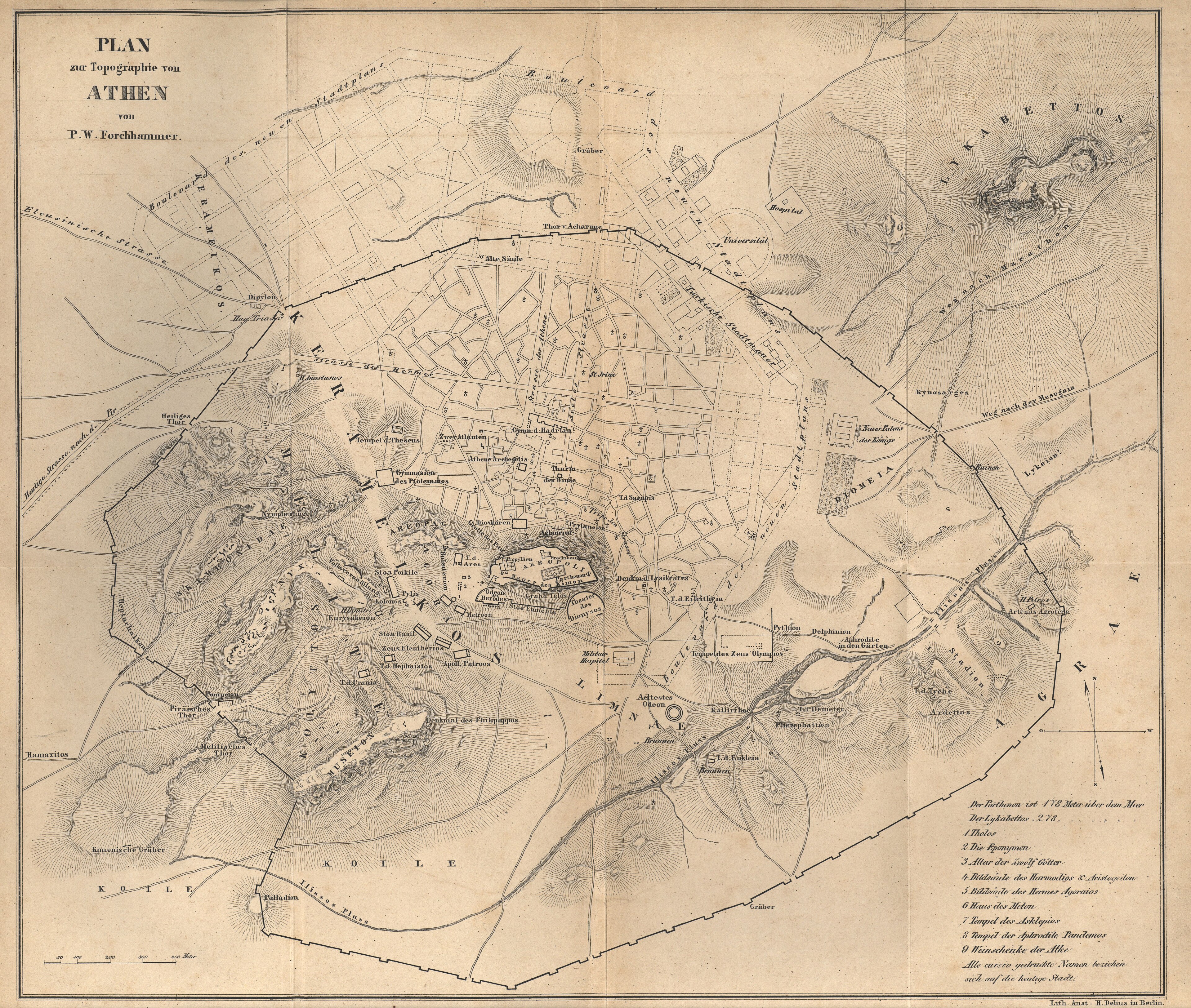
Athens supplies the civic and intellectual setting for much of this collection: public argument, Socrates’ trial, Plato’s Academy, and Aristotle’s Lyceum. Keep the differences between those institutions and generations in view.
Forchhammer’s 1841 plan is a historical reconstruction of ancient Athens. Its labels and proposed identifications belong to nineteenth-century scholarship; it is not a modern excavation plan or a photograph of the ancient city. Use it for orientation, then consult current site scholarship.
The argument workshop
What does love seek?
Does loving beauty mean abandoning particular people?
The Symposium’s ascent from particular beauty toward beauty itself can enlarge desire’s horizon. It also raises a hard question about what happens to the individual person with whom the ascent begins.
1. Distinguish the speakers
Diotima’s teaching reaches us through Socrates’ reported speech within a dialogue containing several accounts of love. Do not flatten that architecture into a single unqualified maxim.
2. Expose the tension
A universal account of beauty may challenge possessiveness. A critic can still ask whether the beloved becomes an instrument for the lover’s advancement. State that objection fully before answering it.
3. Read across dialogues
Compare the Symposium with the Phaedrus and its image of the soul. Ask how desire can educate attention, what discipline it needs, and whether knowledge alone resolves its conflicts.
Return to the chapter’s primary-text anchor: Diotima, as reported by Socrates in Plato, Symposium 206a. These exercises are editorial prompts, not quotations from the philosopher.
Check the distinction
Read the answer and explanation
Plato gives her reported teaching a major role in the Symposium Her dramatic and philosophical role is secure; her independent historical status is uncertain. The argument can be examined without inventing a biography.
Continue the conversation
Follow the question into another room.
These are invitations to comparison. A shared question does not make different thinkers or traditions interchangeable.
Friendship and flourishing
Compare the ascent of desire with an account of friendship as a shared activity.
Explore this connection →The neighbor
Explore the tension between preference and a responsibility extending beyond attraction.
Explore this connection →A Grief Observed
Read another sustained encounter with love, loss, and questions about what survives.
Explore this connection →The Bible
Compare literary and religious ways of speaking about love without collapsing their distinct settings.
Explore this connection →Pause · question · discuss
Carry the argument further
Is Diotima a historical person?
Her historical status is uncertain. The secure evidence is the role Plato gives her reported teaching within the Symposium.
Is the ladder of love a rejection of every particular person?
That is a serious interpretive question. The ascent broadens attention toward Beauty itself, while Alcibiades’ speech restores the difficulty of loving a particular person. Readers disagree about how the tension should be resolved.
Does the Phaedo prove immortality?
It presents several arguments and objections whose premises remain contestable. The page explains their purposes without treating the dialogue as empirical verification of an afterlife.
The reading room
Primary texts and source notes
- Plato, Symposium189c–193d on Aristophanes; 200a–212a on Socrates and Diotima; 215a–222b on Alcibiades.
- Plato, Phaedrus244a–257b: inspiration, winged soul, beauty, and erotic education.
- Plato, Phaedo64a–69e on philosophy and death; 70c–107b on immortality arguments and objections. All primary links use Jowett.