
Religion & Philosophy / Philosophy / Plato
Plato · Chapter 05 of 05
The Philosopher Who Distrusted Art—and Wrote Masterpieces
Myth, later dialogues, manuscripts, Renaissance rediscovery, and a reading path
Curated by Christopher Adkins of Huntersville, NC

Can a text teach readers to move beyond passive reading? Raphael’s Renaissance gathering imagines ancient thinkers sharing an architectural world. It is an interpretation of philosophy’s history, painted in 1509–1511, not a record of a meeting that actually took place.
Raphael; public-domain reproduction via Wikimedia Commons · Public domain.


Explore the historical images.
01 / 08
1. The quarrel with poetry is a quarrel about authority
Plato’s criticism of poetry is especially striking because the dialogues are such accomplished works of art. They contain portraits, comedy, dramatic reversals, elaborate metaphors, and scenes readers remember long after the details of an argument have faded. The tension should not be solved by declaring that Plato secretly loved everything he criticized. He asks what gives an artist the authority to educate an audience and whether emotional power can be mistaken for knowledge.
In the Ion, 533d–536d, Socrates imagines inspiration passing like magnetic attraction through a chain: Muse, poet, performer, audience. Ion can speak brilliantly about Homer, yet brilliance does not establish a general expertise in every subject Homer describes. The playful picture exposes a serious confusion between being moved, moving others, and understanding the object under discussion.
Republic X, 595a–608b, develops objections to imitation and its effect on the soul. A depiction can offer an appearance without the maker’s or user’s knowledge, while repeated emotional indulgence can train habits the audience would otherwise resist. These arguments are contestable: art can also disclose, complicate, and educate. Plato himself invites a defense of poetry. The strongest reply takes his concern seriously while challenging the inference that protecting judgment requires excluding imaginative experience.
02 / 08
2. A writer asks what writing cannot do
Near the end of the Phaedrus, 274b–278e, Socrates recounts a story about the invention of writing. Its promise is questioned: marks can remind someone of what they know, but they may also create the appearance of understanding without its substance. A written statement travels beyond its author and encounters readers for whom it cannot adapt its explanation or answer a misunderstanding.
The objection seems almost self-defeating in a written dialogue. Yet the tension is precisely what makes the passage worth reading. Plato’s books do not simply transmit conclusions; they stage difficulties that a reader must actively work through. The written exchange cannot literally respond, but it can make the reader supply an objection, return to an earlier assumption, or recognize that a satisfying phrase has concealed a problem.
This is a useful distinction in any age of abundant text. Possessing a sentence is not possessing the understanding that would allow one to explain and defend it. A beautifully formatted page can aid thought, but its elegance does not substitute for evidence or reasoning. The appropriate response is not to abandon reading. It is to read in a way that restores inquiry: paraphrase an argument, test its examples, compare its assumptions, and notice where a question remains. Plato’s criticism of writing becomes a demand that the reader do more than receive it.
“an intelligent word graven in the soul of the learner, which can defend itself”
Socrates in Plato, Phaedrus 276aBenjamin Jowett; excerpt from the contrast between living understanding and written discourse
03 / 08
3. Myth is not a license to stop distinguishing
Plato uses myths at points where argument encounters questions about origins, destiny, moral imagination, and the limits of human explanation. The myth of Er closes the Republic with a vision of judgment and the choice of lives. The winged chariot in the Phaedrus dramatizes desire and recollection. The stories do different kinds of work; treating all of them as literal doctrine or all of them as decorative fiction makes their functions harder to see.
The Timaeus, 27d–29d, distinguishes what is stable from what comes to be and introduces a qualified account of the cosmos. Its divine craftsman orders the visible world with reference to an intelligible pattern. The explanation connects goodness, order, mathematical proportion, soul, and embodiment. Its cosmology is historically important, but its geometrical account of elements should not be advertised as modern physics in disguise.
The dialogue’s caution about the kind of account available is part of its philosophical interest. A claim should be judged according to its object, method, and degree of support. That does not make every attractive story equally credible. It asks the reader to identify what the narrative is explaining and how its assumptions are justified. Likewise, the Atlantis narrative introduced in the Timaeus and developed in the Critias is evidence for Plato’s literary construction, not independent archaeological proof of a lost civilization.
04 / 08
4. Plato’s later works keep reopening the system
A simplified Plato possesses a finished doctrine of Forms, a three-part soul, and a single political blueprint. The dialogues themselves resist that tidy package. The Parmenides subjects Forms and participation to searching objections. The Sophist, especially 251a–259d, examines how kinds combine and how difference helps make negative statements intelligible. The inquiry is technical because apparently ordinary speech contains difficult commitments about being, sameness, and otherness.
The Statesman, 293a–303d, explores the tension between expert judgment and fixed law. A general rule cannot anticipate every circumstance, yet abandoning rules in favor of whoever claims expertise creates obvious dangers. The dialogue’s method of division and its weaving image examine political knowledge from a different angle than the Republic.
In the Laws IV, 715b–723d, the discussion gives sustained attention to government under law and to persuasive preludes that explain legislation. This does not make the work a modern liberal constitution; its religious and social controls remain severe. It does show a broader institutional imagination than the slogan philosopher-king can contain. Read these works as new investigations with their own speakers and purposes. Their existence is a warning against making a portable system so compact that it can no longer accommodate its author’s questions.

05 / 08
5. Plato reaches us through other people’s labor
The continued existence of the dialogues required copying, preservation, teaching, translation, selection, and argument. Plato’s influence was never a single unbroken message moving unchanged from ancient Athens to the present. Later Platonists organized his work into new explanatory structures. Christian, Jewish, and Islamic intellectual traditions encountered Platonic themes through varied combinations of original texts, summaries, translations, and other thinkers. Similar vocabulary can therefore conceal significant changes of purpose.
The Latin medieval world had limited direct access to Plato compared with later readers. Calcidius’s partial translation and commentary on the Timaeus were especially influential, while Platonic ideas also traveled through authors such as Augustine and Boethius. The Stanford Encyclopedia’s history of medieval philosophy emphasizes this mediated inheritance. “Medieval Plato” must be understood through those channels rather than imagined as universal access to a modern collected edition.
Ficino’s Latin edition, printed in Florence in 1484, made the collected dialogues available in a major new form; the University of Illinois Rare Book and Manuscript Library documents an early printed copy. Translation expanded access while shaping interpretation. The same is true of the public-domain Jowett translations linked here. Their prose is often elegant, but their Victorian vocabulary is one historical English rendering. When a key word bears much of an argument, comparing a scholarly modern translation can reveal alternatives that fluent reading alone conceals.
06 / 08
6. Reading Raphael’s Plato as an interpretation
In Raphael’s School of Athens, Plato and Aristotle occupy the center of an imagined assembly of ancient thinkers. The Vatican Museums identify Plato’s book as the Timaeus and Aristotle’s as the Ethics. Plato points upward; Aristotle extends a hand outward. The gestures have become a visual shorthand for differences in philosophical emphasis, but they cannot substitute for reading either thinker.
The fresco is itself an argument about inheritance. Different periods and intellectual projects meet in a shared architectural space, ordered through perspective and composition. It presents philosophy as a conversation capable of being gathered into a Renaissance cultural vision. The image is powerful precisely because it is not a neutral group photograph. Its choices—who occupies the center, which books identify them, and how bodies are arranged—create meaning.
That makes it an appropriate illustration for Plato only when its date and function remain visible. The same principle governs the Roman mosaic often called Plato’s Academy, whose identification is debated, and nineteenth-century paintings of the Symposium. They show later communities imagining Greek philosophy. Looking at them critically extends Plato’s own questions about appearances: what does this image allow us to see, what does it persuade us to assume, and which claims require evidence beyond the image itself?

07 / 08
7. A reading path with room to stop and think
Begin with the Apology for the relation between examination, civic obligation, and personal integrity. Read the Euthyphro for the problem of definition and the relation between piety and divine approval, then the Crito for the pressures of law, friendship, and escape. These works are brief enough to reread. A second encounter often reveals that the sentence which seemed to settle the issue was the beginning of a difficulty.
Move to the Symposium and Phaedrus to see how philosophy works through speeches, myths, attraction, and literary form. Then read Republic I–II before turning to IV, VI–VII, and VIII–IX. The sequence matters: the cave is more intelligible when the reader remembers the problem of justice and the educational ambitions surrounding it. Read Book X alongside an artwork or poem you value and try to write the defense Plato invites.
For a second circuit, pair the Phaedo with the Theaetetus, then attempt the opening objections of the Parmenides. Approach the Timaeus, Sophist, Statesman, and Laws with a good scholarly introduction. The aim is not to accumulate completed titles. It is to become able to state a question, explain the strongest answer offered, identify its difficulty, and say what would be needed to decide the matter. That is a more faithful measure of philosophical progress than speed.
08 / 08
8. A legacy that remains unfinished
Plato’s endurance rests partly on the fact that his works do not release their readers from judgment. They ask us to trust reason while showing reason interrupted by vanity, desire, fear, and political danger. They pursue stable standards while generating difficult objections to the standards proposed. They criticize images while constructing images with extraordinary power. That combination makes the dialogues resistant to use as a collection of ready-made answers.
The connection with the other thinkers in this philosophy collection is instructive. Socrates supplies the model of examination whose historical character Plato transforms into literature. Aristotle inherits many of the questions and reorganizes their answers. Kierkegaard later returns to Socratic irony and to the problem of communicating something that a reader must personally appropriate. Those are connections to explore, not claims that the thinkers share one doctrine. The most useful intellectual family is often held together by durable disagreements.
Close a dialogue by writing two sentences of your own: the strongest thing it has persuaded you to consider, and the strongest objection you can still make. If those sentences become more precise on a second reading, the text has done something more valuable than confirming your taste. It has changed the quality of the conversation you can conduct—with an ancient author, with another person, and with yourself. Plato’s world remains open wherever that conversation is taken seriously.
The visual reading room
Look closely. Ask better questions.
Eight images invite a slower look at places, portraits, manuscripts, and later interpretations. Can a text teach readers to move beyond passive reading? Select any image to enlarge it; the source and reuse credit remain with every item.


Geographic orientation
Ideas have places. Maps have histories.
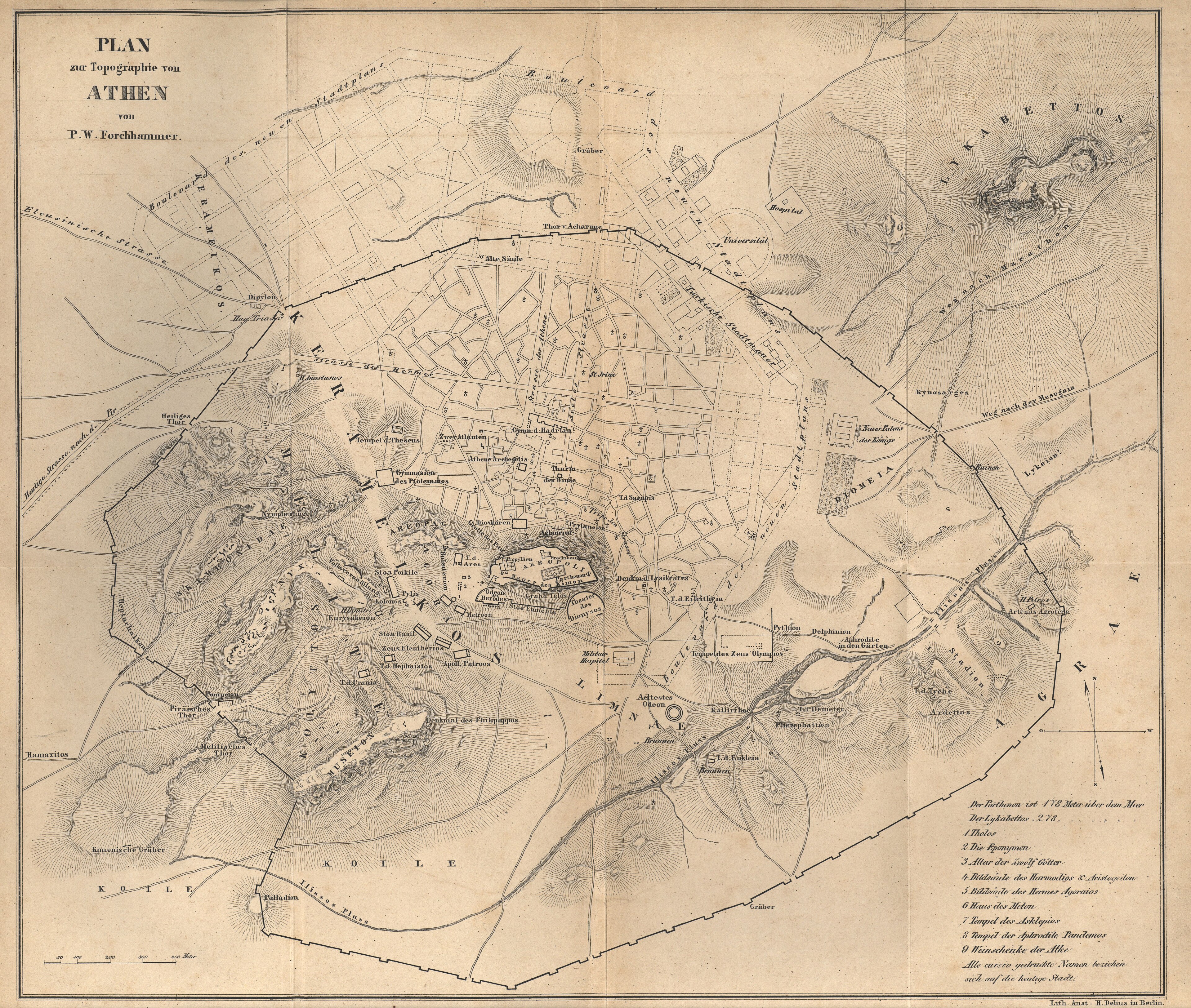
Athens supplies the civic and intellectual setting for much of this collection: public argument, Socrates’ trial, Plato’s Academy, and Aristotle’s Lyceum. Keep the differences between those institutions and generations in view.
Forchhammer’s 1841 plan is a historical reconstruction of ancient Athens. Its labels and proposed identifications belong to nineteenth-century scholarship; it is not a modern excavation plan or a photograph of the ancient city. Use it for orientation, then consult current site scholarship.
The argument workshop
A written argument about writing
Can a text teach readers to move beyond passive reading?
The Phaedrus questions the limitations of writing in a work that survives as writing. The tension invites readers to think about what a text can initiate and what understanding must still do for itself.
1. State the limitation precisely
A written sentence does not answer a new question on its own. Its circulation can separate it from the knowledge and judgment needed to explain it.
2. Look at Plato’s response in form
A dialogue models questions, objections, and revisions. It can prompt active inquiry even while acknowledging that possession of a book is not possession of understanding.
3. Practice the test
Take a quotation from this page. State its speaker, work, location, and surrounding question. Then formulate one objection that would force you to explain the idea in your own words.
Return to the chapter’s primary-text anchor: Socrates in Plato, Phaedrus 276a. These exercises are editorial prompts, not quotations from the philosopher.
Check the distinction
Read the answer and explanation
Using it as a starting point for explanation and questioning A quotation becomes philosophically useful when a reader can reconstruct its reasons, answer questions, and identify its limits. Attribution and context keep the inquiry open.
Continue the conversation
Follow the question into another room.
These are invitations to comparison. A shared question does not make different thinkers or traditions interchangeable.
The Socratic afterlife
Trace how later thinkers make different uses of a common philosophical exemplar.
Explore this connection →Aristotle across civilizations
Study another complex history of translation, interpretation, and disagreement.
Explore this connection →A Short History of Myth
Read a different account of myth’s significance and test the comparison carefully.
Explore this connection →C. S. Lewis
Explore the interplay of literary imagination, argument, and religious reflection.
Explore this connection →Pause · question · discuss
Carry the argument further
Did Plato simply ban all art?
His dialogues offer different treatments of poetry, inspiration, imitation, and rhetoric. The Republic severely restricts poetry, but it also invites a reasoned defense. “Plato hated art” obscures both the arguments and his own literary practice.
Is the Timaeus a scientific textbook?
It is an ancient philosophical cosmology. Its account of order, explanation, and probability deserves study, but its physical theories should not be represented as current science.
How should quotations be checked?
Identify the dialogue, the actual speaker, the surrounding argument, the Stephanus reference, and the translator. A plausible sentence on a quotation website is insufficient evidence of authorship.
The reading room
Primary texts and source notes
- Plato, Ion533d–536d on inspiration and the magnetic chain.
- Plato, Republic X595a–608b on imitation and the defense of poetry; 614b–621d on Er.
- Plato, Phaedrus274b–278e on writing and living understanding.
- Plato, Timaeus27d–29d on being, becoming, and qualified cosmological explanation.
- Plato, Sophist251a–259d on kinds, being, and difference.
- Plato, Statesman293a–303d on knowledge, rule, and law.
- Plato, Laws IV715b–723d on rule under law and persuasive preludes.
- Vatican Museums: School of AthensOfficial artwork interpretation and identification of the books.
- University of Illinois: Opera, 1484Collection record for Ficino’s printed Latin Plato.
- Stanford Encyclopedia: Medieval PhilosophyTransmission and mediated Platonic inheritance.