
Religion & Philosophy / Philosophy
c. 469–399 BCE · An illustrated collection
Socrates
The courage to ask what we mean.
Curated by Christopher Adkins of Huntersville, NC

The courage to ask what we mean. David turns the final conversation into a neoclassical drama of conviction. The elderly Plato at the foot of the bed is a deliberate artistic addition: Plato’s Phaedo says he was absent.
Jacques Louis David; The Metropolitan Museum of Art, Catharine Lorillard Wolfe Collection, Wolfe Fund, 1931 (31.45) · Public domain.


Explore the historical images.
The collection
A life. A body of thought. A continuing conversation.
Before philosophy became a shelf of books, Socrates made it an encounter. A confident speaker named courage, justice or piety; Socrates asked what the word meant; an ordinary conversation became an investigation. He left no philosophical writings. What survives is stranger and more demanding: a life reconstructed through other people’s arguments, memories, comedy and art.
This collection follows Socrates from the streets and battlefields of Athens to the courtroom of 399 BCE, then into the long afterlife of his example. The central question is not whether an ancient man possessed every answer. It is whether a person can love truth enough to risk discovering that an admired belief, a successful career, or a respectable community rests on an unexamined assumption. Read the five chapters in order for a narrative, or enter through the problem that most concerns you.
Read in order or follow your curiosity
Five chapters to explore

Socrates in Athens: A Life We Reconstruct
Meet Socrates in the troubled city of Athens and learn how Plato, Xenophon and Aristophanes shaped the evidence for his life.
1,645 words · 9 min read
The Socratic Method: How a Question Changes a Mind
Follow the Socratic method through Euthyphro, Laches and Meno, with clear examples of definitions, objections and honest uncertainty.
1,613 words · 9 min read

Virtue, Conscience and the Good Life
Explore the ethical heart of Socrates: care of the soul, knowledge and virtue, courage, non-retaliation, and the challenge of living by reasons.
1,592 words · 8 min read

The Trial of Socrates: Conscience before the City
Read the trial and death of Socrates through Apology, Crito and Phaedo, with historical context and careful distinctions between evidence and later art.
1,553 words · 8 min read

The Socratic Afterlife: Legacy and Reading Socrates
Trace the many later uses of Socrates, distinguish influence from historical evidence, and follow a seven-dialogue path into his enduring questions.
1,838 words · 10 min read
A visual reading aid
Put a belief through its questions
A modern schematic inspired by Socratic examination: follow the reasons, then let the answer change when it needs to.
Claim
State the belief clearly enough to examine. If courage means standing firm, identify what counts as standing firm and what makes it courageous. A memorable example begins the discussion; it does not yet supply a definition.
Reasons
Ask what supports the claim and what further beliefs it assumes. Does the speaker regard courage as admirable in every case? Make the commitments visible before deciding whether they can consistently be held together.
Test
Try a difficult case fairly. Could a sensible retreat require courage, or stubborn endurance become reckless? A counterexample exposes a tension among the accepted claims; it does not automatically identify which belief must be abandoned.
Revise
Narrow the definition, distinguish meanings, or reconsider a supporting premise. Record what improved and what remains unresolved. The aim is a more defensible account, with both participants open to correction, rather than a victory for the questioner.
This is an original teaching aid, not a four-step formula written by Socrates. Plato’s Laches 190e–199e supplies the central examination of courage; its ending remains unresolved. Read the source →
A thinker who makes the reader answer
A conventional introduction can turn Socrates into a reassuring slogan: ask questions, be humble, think for yourself. The dialogues make those instructions considerably less comfortable. Questions can expose vanity. Humility can become a performance. Thinking for oneself can harden into a refusal to listen. Socrates matters because the encounter tests the questioner as well as the person being questioned.
His challenge reaches into practical life. If courage means never withdrawing, how do we distinguish courage from reckless persistence? If justice means obeying the law, what happens when an authority commands wrongdoing? If success means getting what one wants, who has examined the quality of the wanting? These are interpretive questions drawn from the dialogues, not a modern checklist attributed to Socrates. They give the ancient arguments a present tense without pretending that Athens was our world.
The man, the character, the memory
The historical Socrates and Plato’s dramatic Socrates overlap without becoming interchangeable. Aristophanes caricatures an intellectual troublemaker in Clouds. Plato stages searching exchanges and a defense speech. Xenophon offers another apologetic portrait. Their differences are the beginning of the evidence problem, not an inconvenience to be quietly erased. The scholarly name for this difficulty is the Socratic problem.
That distinction also governs the pictures. Roman portrait busts are later memorials. Jacques Louis David’s Death of Socrates is an eighteenth-century interpretation, not a visual record of the execution. Photographs of Athens show real places, but surviving structures can belong to periods after Socrates. Captions throughout the collection identify what an image can and cannot establish.
Start with a conversation, then test it
The most direct entrance is Plato’s Apology, a defense speech rather than an expression of regret. Follow it with Crito, where a friend offers escape and Socrates asks whether accepting would be just. Then read Euthyphro or Laches slowly, watching an apparently obvious definition come apart.
Keep a small record of the exchange: the original claim, the reason offered for it, the difficult example, and the revised answer. The point is to follow the reasoning before deciding which speaker wins. Some dialogues end in perplexity. An honest recognition that a question remains open can be more valuable than a tidy answer that the discussion has not earned.
The companion Plato collection follows the literary and philosophical worlds that grew around Socrates; Aristotle develops a more systematic account of character and judgment; Kierkegaard returns to irony and the individual’s responsibility. Their disagreements are part of the pleasure of reading them together.
A life in time
Open a moment in the story.
Choose a date to read its context. Approximate dates and disputed traditions remain marked as such.
c. 469 BCE
Born in the Athenian world; precise early biography remains uncertain.
431–404 BCE
The Peloponnesian War transforms the civic setting of his adult life.
423 BCE
Aristophanes first stages Clouds; the surviving play incorporates revision.
406 BCE
Plato reports Socrates resisting an unlawful collective procedure against generals.
404–403 BCE
The Thirty rule Athens; Plato reports his refusal to help arrest Leon.
399 BCE
Tried, convicted and executed in Athens.
Chronological orientation: read the scholarly source. Begin the biography chapter.
An illustrated history
Look closely
Portraits, manuscripts and places carry different kinds of evidence. Open each image to inspect the full composition and read its credit.


The visual reading room
Look closely. Ask better questions.
Eight images invite a slower look at places, portraits, manuscripts, and later interpretations. What can an image reveal—and what must a text or argument establish? Select any image to enlarge it; the source and reuse credit remain with every item.


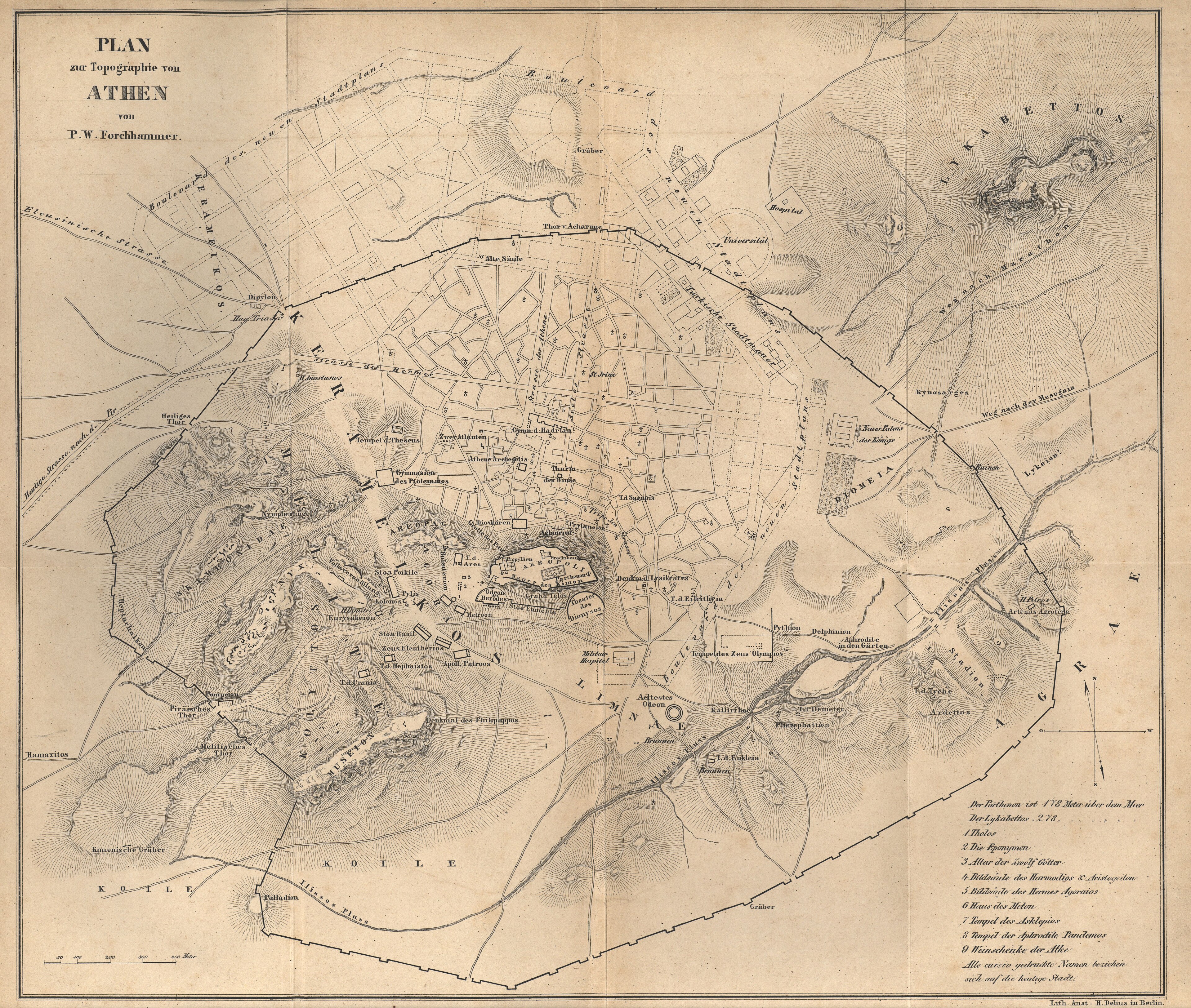
Geographic orientation
Ideas have places. Maps have histories.
Athens supplies the civic and intellectual setting for much of this collection: public argument, Socrates’ trial, Plato’s Academy, and Aristotle’s Lyceum. Keep the differences between those institutions and generations in view.
Forchhammer’s 1841 plan is a historical reconstruction of ancient Athens. Its labels and proposed identifications belong to nineteenth-century scholarship; it is not a modern excavation plan or a photograph of the ancient city. Use it for orientation, then consult current site scholarship.
Words with their sources
Read the quotation. Follow the argument.
A memorable sentence opens a question. Speaker, translation, and textual location help keep it connected to the work from which it comes.
“the life which is unexamined is not worth living”
Plato, Apology 38aBenjamin JowettRead the chapter and its context →
“I have no objection to join with you in the enquiry.”
Plato, Meno 80dBenjamin JowettRead the chapter and its context →
“Then we must do no wrong?”
Plato, Crito 49bBenjamin JowettRead the chapter and its context →
“I shall obey God rather than you”
Plato, Apology 29dBenjamin JowettRead the chapter and its context →
“do not hesitate to say exactly what you think”
Plato, Phaedo 84cBenjamin JowettRead the chapter and its context →
Before the first chapter
Which evidence supports the claim?
This collection treats source awareness as part of philosophy. A work’s speaker, genre, date, and transmission affect what we can responsibly claim from it.
Name the source
Is this a primary philosophical text, a later account, an artifact, or a modern interpretation?
Name the claim
Does the evidence establish a historical event, interpret an argument, or show how a later audience imagined a thinker?
Name the limit
Identify what you still do not know. A clear limit makes the next question more precise.
Check the distinction
Read the answer and explanation
How an eighteenth-century painter interpreted Socratic courage David’s canvas is a later interpretation. It can illuminate the reception of Socrates and invite close reading of Plato, but its composition does not independently authenticate ancient events.
Continue the conversation
Follow the question into another room.
These are invitations to comparison. A shared question does not make different thinkers or traditions interchangeable.
Plato’s Athens
Follow the student who turned Socrates into a central voice of philosophical dialogue.
Explore this connection →Aristotle’s Lyceum
Compare the later school with Socrates’ less institutionalized practice of conversation.
Explore this connection →Sacred texts
Practice distinguishing authorship, transmission, genre, and interpretation across another body of historical evidence.
Explore this connection →History of God
Explore a different long historical narrative, keeping its questions and evidence distinct.
Explore this connection →Before you turn the page
Did Socrates write any books?
No philosophical writings by Socrates survive, and the principal ancient portraits present him as an oral questioner. This guide attributes written passages to their actual authors and speakers.
Is every quotation attributed to Socrates authentic?
No. Here, quotations identify the ancient work and the English translator. A speech spoken by Socrates in Plato remains Plato’s literary presentation, not a surviving transcript.
Where should I begin?
Begin with Chapter 1 for historical context or Chapter 4 for the trial. The reading route in Chapter 5 provides a manageable sequence of primary texts.
Sources and further reading
Each chapter supplies its own focused source list and linked passages. This reading room brings together the wider collection.
Open the collection bibliography
- Plato, ApologyBenjamin Jowett translation; suggested first reading.
- Plato, LachesBenjamin Jowett translation; courage and expertise.
- Aristophanes, CloudsRead as comedy and evidence of reputation, not a transcript of Socrates’ teaching.
- Plato, PhaedoBenjamin Jowett translation; Plato’s literary and philosophical treatment of the final conversation. Brief quotation checked in the section around 84c.
- Stanford Encyclopedia of Philosophy: SocratesScholarly orientation to the competing witnesses and the Socratic problem.
- The Met: David’s painting1787 painting, provenance and interpretation.
- Plato, EuthyphroBenjamin Jowett translation; piety and definition.
- Plato, MenoBenjamin Jowett translation; inquiry and learning.
- Plato, GorgiasBenjamin Jowett translation; persuasion, power, and the good.
- Plato, CritoBenjamin Jowett translation; obligation and the proposed escape.
- The Met: David’s early drawingComposition study, about 1782.
- Aristotle, Metaphysics XIII.4W. D. Ross translation. Aristotle’s retrospective account of Socratic definition and its relation to the theory of Forms.
- Epictetus, EnchiridionElizabeth Carter translation. See §§5 and 46; the linked edition numbers the final exhortation and practice-versus-theory passage §§50–51, while other editions commonly use §§51–52.
- Søren Kierkegaard, Stanford Encyclopedia of PhilosophyScholarly orientation to Kierkegaard’s Socratic engagement within his broader religious and philosophical work.
- Søren Kierkegaard Research Centre, University of Copenhagen: A Reading of The Concept of IronyUniversity reading outline and edition details; a study aid rather than a primary source about ancient Socrates.
- Martin Luther King Jr., Letter from Birmingham Jail, April 16, 1963Primary text hosted by the King Institute. Socrates is invoked in the discussions of constructive tension, civil disobedience, and responsibility for hostile reactions. No extended quotation reproduced.