
Religion & Philosophy / Philosophy / Socrates
Socrates · Chapter 01 of 05
Socrates in Athens: A Life We Reconstruct
The city, the soldier, the questioner—and the witnesses who disagree.
Curated by Christopher Adkins of Huntersville, NC

Can a vivid portrait be weaker evidence than an awkward fragment? The Agora places inquiry among public business, worship and daily encounters. Its surviving buildings and excavations span different periods of Athenian history.
DerHexer, Wikimedia Commons · CC BY-SA 4.0.


Explore the historical images.
01 / 08
Begin in a city, not on a pedestal
Imagine a public place where religion, commerce, law and reputation continually meet. The point is not to invent a particular morning in Socrates’ life, but to recover something of the setting his ancient witnesses assume. The Athenian Agora was not a modern university campus. A conversation there could be overheard by people with immediate interests in persuasion, civic office, family standing and public business. An argument about excellence could touch the education of a son or the qualifications of a political leader.
Socrates lived through a period when Athens combined extraordinary cultural production with imperial ambition, war and civil conflict. The Peloponnesian War, conventionally dated 431–404 BCE, occupied much of his mature life. Defeat was followed by the oligarchic rule of the Thirty and then the restoration of democracy. This sequence matters because his trial in 399 was not staged in an undisturbed society serenely choosing whether it liked philosophy.
Neither should historical context become an automatic explanation of the verdict. The surviving evidence does not let us read every juror’s motives. Religious concern, resentment, political associations and genuine disagreement about education may have interacted. We should resist both a sentimental picture of innocent reason confronting pure stupidity and an equally easy claim that the prosecution was merely a disguised political conspiracy. The evidence and its limits are part of the story.
02 / 08
Four kinds of evidence, four different purposes
Socrates’ lack of surviving philosophical books makes the identity of each witness unusually important. Plato wrote dramatic dialogues in which Socrates often leads the inquiry. Xenophon wrote works defending and illustrating Socrates’ character. Aristophanes placed a comic Socrates on stage. Later writers preserved traditions already shaped by generations of retelling. These are different literary acts. A joke, a defense and a philosophical experiment do not answer the same historical question.
In Clouds, first performed in 423 BCE and subsequently revised, the intellectual establishment becomes a place where clever arguments promise release from ordinary obligations. Its Socrates combines features modern readers might distribute among natural philosophers, teachers of rhetoric and religious innovators. That caricature establishes that a recognizable Socrates could function in Athenian comedy; it does not establish that his actual curriculum matched the play.
Plato’s detail is more seductive because conversations feel immediate. Yet the ability to create a convincing scene is not proof of verbatim reporting. Even when participants and places are historically grounded, the argument may serve Plato’s own purposes. Xenophon’s more practical and pious portrait cannot simply be discarded because it is less exciting to some modern readers. Responsible reconstruction asks what each source is trying to show, and what independent support exists, before combining their statements into one seamless biography.
“the life which is unexamined is not worth living”
Plato, Apology 38aBenjamin Jowett

03 / 08
The questioner had stood in a battle line
The familiar contrast between thinker and man of action fits Socrates poorly. Plato’s Apology, 28e, presents him as having served at Potidaea, Delium and Amphipolis. In the speech, military service becomes an analogy for philosophical duty: a person should not abandon a post merely because danger appears. The analogy is rhetorically powerful because courage already belonged to the city’s language of honor.
The soldier also enters the discussion of courage in Laches. Experienced men can recognize brave conduct and still struggle to say what bravery is. This is one of the great Socratic reversals. Practical experience earns attention, but it does not automatically settle the definition. The experienced soldier knows things the armchair theorist does not; the questioner can nevertheless ask whether standing fast always counts as courage.
That exchange should not be read as contempt for experience. It proposes a demanding partnership between action and explanation. What one has done supplies examples; reasoning tests how far those examples extend. The result may be uncomfortable for every participant. A courageous person can offer a bad definition. A sophisticated definition can coexist with cowardly behavior. Socrates’ importance lies partly in bringing those two possible failures into the same conversation.
04 / 08
Poverty, family and the cost of a public vocation
Plato’s defense speech depicts Socrates as neglecting the pursuit of wealth in order to examine himself and others. He denies teaching for a fee in the manner attributed to professional educators. His poverty becomes evidence within his account of a mission, rather than simply an attractive biographical detail. It tells the jury how he wants the relation between his words and his way of living to be judged. See Apology 19d–20c, 23b–c and 31b–c.
The family complicates any uncomplicated romance of the independent thinker. In Phaedo, Xanthippe appears with a child before the final discussion. The scene reminds us that a public act of principle has consequences for people who do not control it. Ancient anecdotes about a difficult wife often reveal the expectations of their tellers as much as they reveal a household. They should not be recycled as reliable domestic reportage.
A thoughtful biography holds the tension open. Devotion to philosophy can be admirable; obligations to family are not made trivial by that admiration. Nor can a modern reader reconstruct an entire marriage from a handful of staged or hostile glimpses. Socrates’ life is interesting precisely because a practice celebrated as universal was carried out by one particular man, within an unequal ancient society, at costs unevenly shared by others.

05 / 08
The oracle and the strange discipline of not knowing
In Apology 20e–23b, Socrates recounts that Chaerephon asked the Delphic oracle whether anyone was wiser than Socrates, and received a negative answer. Socrates treats the report as a puzzle. He goes to people reputed wise and tests what their knowledge amounts to. The story turns an apparent compliment into an obligation to investigate.
It is important to notice what this story does not say. Socrates is not simply announcing that he knows absolutely nothing. He judges arguments, condemns wrongdoing and claims a vocation. His distinctive contrast concerns the difference between lacking knowledge and falsely supposing that one possesses it. Someone who recognizes a limit may be better placed to inquire than someone who mistakes reputation for understanding.
The religious dimension should also remain visible. Socrates speaks of divine service and a sign that restrains him. He is not accurately summarized as a modern secular rationalist secretly wearing an ancient costume. At the same time, he subjects confident claims about piety to questioning. The result is a distinctive combination of religious commitment and examination. In his account, reasoning need not compete with a divine mission; reasoning can be the work the mission requires.
06 / 08
A conscience troublesome under different regimes
The most striking political episodes in the Apology, 32a–e, place Socrates at odds with both democratic and oligarchic power. He describes resisting the attempt to judge the generals from Arginusae collectively through an unlawful procedure. Later, under the Thirty, he says he refused to help bring Leon of Salamis to execution. In the second episode he went home while others carried out the command.
These are claims made within a defense speech, and should be identified as such. Even so, their pairing is philosophically central. Socrates presents justice as a standard by which different political authorities can be judged. He does not explain his conduct merely as loyalty to the victorious faction. An unpopular refusal can be necessary even when a majority demands compliance; an oligarchic command can be wrong even when disobedience is dangerous.
His association with figures such as Alcibiades and Critias complicates the public picture. Association is historically relevant without establishing responsibility for another person’s later conduct. A useful question is how a teacher or influential companion should be judged: by explicit instruction, by example, by foreseeable effects, or by the worst act of anyone who listened? The sources do not allow a simple acquittal or conviction of an entire educational life on the basis of reputation alone.

07 / 08
How to look at a portrait that is not a photograph
The marble Socrates familiar from museums is already an interpretation. Later ancient portrait types made recognizable features into signs of a philosophical identity. A Roman copy can preserve something of a Greek sculptural tradition while remaining centuries removed from the living man. It should be admired as an object and read as evidence of reception, rather than treated as a documentary photograph.
David’s Death of Socrates makes the distinction especially clear. The painter’s 1787 composition presents controlled gesture amid grief, shaping an ideal of moral resolve for a much later audience. Plato appears as an elderly figure although his own dialogue says that he was absent because of illness. That addition tells us about the transmission of the story: the writer who preserved the death becomes visually present at it.
The same care belongs to archaeological photographs. The Agora is a real setting of Athenian life; the Pnyx evokes democratic assembly; neither image establishes the precise courtroom where the trial took place. Ruins have building phases and later alterations. The pleasure of a well-captioned image is that it lets the reader see more while claiming less. Historical imagination grows stronger when it keeps a visible boundary between surviving evidence and reconstruction.
08 / 08
The life is a question about authority
What emerges from these fragments is neither an easily recoverable personality nor an empty screen. A man lived in Athens, questioned others, attracted listeners, became a comic subject, faced prosecution and was executed. Around that substantial outline, particular claims require different degrees of confidence. The reader can respect the historical core while remaining cautious about speeches, motives and picturesque anecdotes.
The larger challenge is how authority gets made. A famous name can silence questioning as efficiently as a political office. Socrates would become an oddly self-defeating hero if reverence for him replaced examination of what he says. The best tribute is therefore to distinguish a persuasive example from a valid argument, a moving death from a proof, and an admired tradition from an unquestionable inheritance.
Carry three questions into the next chapter. Who is speaking? What reasons support the claim? What would count as a fair objection? Those questions do not remove the drama from Socrates’ life. They recover the intellectual activity that makes its drama worth remembering. The living encounter survives whenever a reader is willing to let a cherished conviction become answerable to reasons.
The visual reading room
Look closely. Ask better questions.
Eight images invite a slower look at places, portraits, manuscripts, and later interpretations. Can a vivid portrait be weaker evidence than an awkward fragment? Select any image to enlarge it; the source and reuse credit remain with every item.


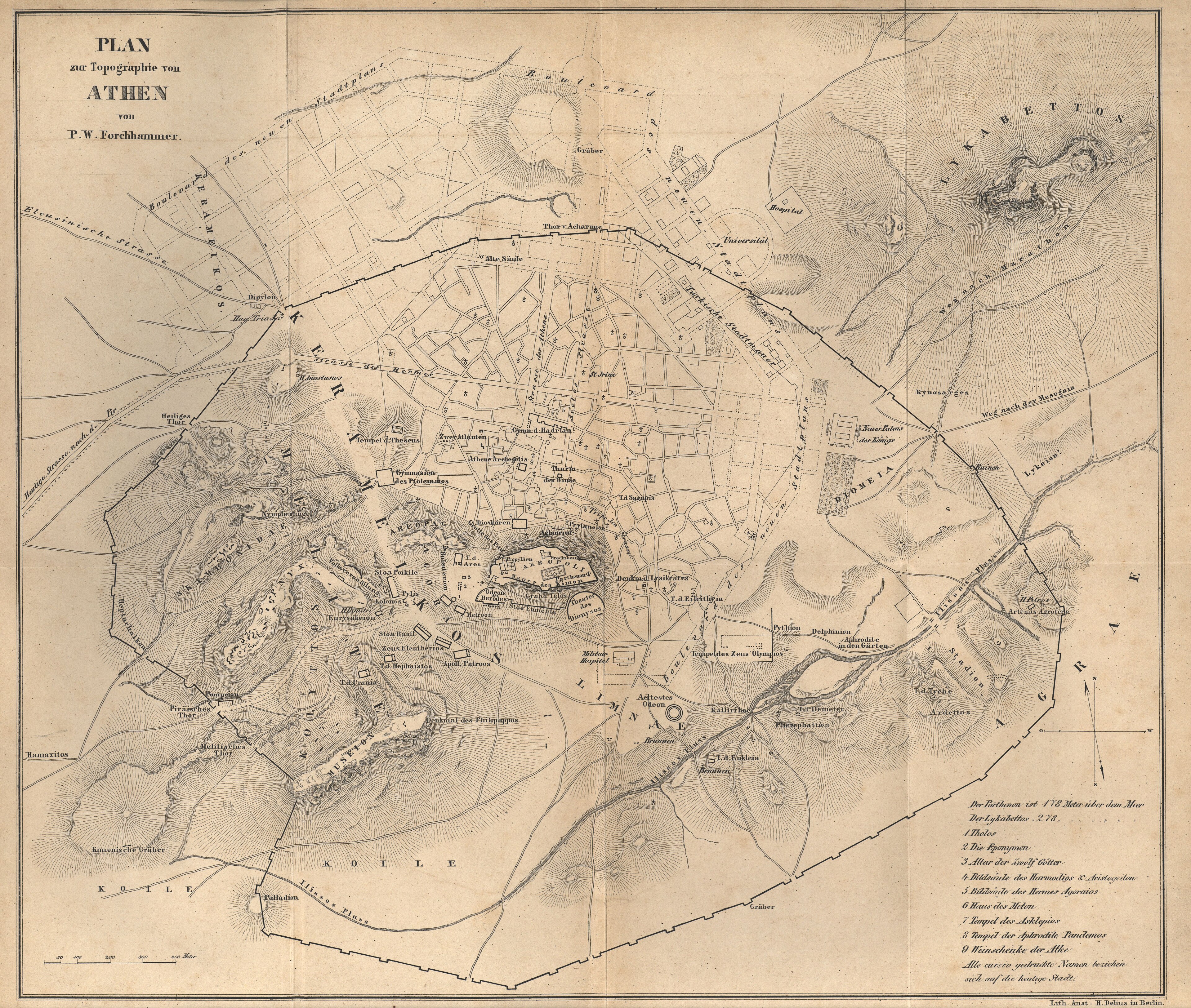
Geographic orientation
Ideas have places. Maps have histories.
Athens supplies the civic and intellectual setting for much of this collection: public argument, Socrates’ trial, Plato’s Academy, and Aristotle’s Lyceum. Keep the differences between those institutions and generations in view.
Forchhammer’s 1841 plan is a historical reconstruction of ancient Athens. Its labels and proposed identifications belong to nineteenth-century scholarship; it is not a modern excavation plan or a photograph of the ancient city. Use it for orientation, then consult current site scholarship.
The argument workshop
Who is speaking for Socrates?
Can a vivid portrait be weaker evidence than an awkward fragment?
Imagine that a comedy, a philosophical dialogue, and a later painting give three different pictures of one public figure. Before deciding which portrait you like, decide what each medium could establish.
1. Separate the voices
Plato and Xenophon wrote philosophical and defensive portraits; Aristophanes worked in comedy. A later artist adds another act of interpretation. Agreement matters, but it does not erase different purposes.
2. Test the inference
A painting can tell us how a later audience imagined Socrates. Its emotional conviction cannot establish his exact posture, words, or companions at a fifth-century event.
3. Return to the evidence
Choose one biographical assertion in the chapter. Identify its ancient source, genre, date relative to the event, and any competing testimony. Keep your confidence proportional to that evidence.
Return to the chapter’s primary-text anchor: Plato, Apology 38a. These exercises are editorial prompts, not quotations from the philosopher.
Check the distinction
Read the answer and explanation
How an eighteenth-century painter interpreted Socratic courage David’s canvas is a later interpretation. It can illuminate the reception of Socrates and invite close reading of Plato, but its composition does not independently authenticate ancient events.
Continue the conversation
Follow the question into another room.
These are invitations to comparison. A shared question does not make different thinkers or traditions interchangeable.
Plato’s Athens
Follow the student who turned Socrates into a central voice of philosophical dialogue.
Explore this connection →Aristotle’s Lyceum
Compare the later school with Socrates’ less institutionalized practice of conversation.
Explore this connection →Sacred texts
Practice distinguishing authorship, transmission, genre, and interpretation across another body of historical evidence.
Explore this connection →History of God
Explore a different long historical narrative, keeping its questions and evidence distinct.
Explore this connection →Pause · question · discuss
Carry the argument further
Why do the sources disagree?
They have different literary and philosophical purposes. Comedy exaggerates, defense literature vindicates, and dialogue can test an idea without reporting a historical conversation word for word.
Was Socrates simply against democracy?
His political associations and criticisms are contested. Plato’s Apology presents principled resistance to wrongdoing under both democratic and oligarchic authorities; that does not amount to a complete modern political platform.
The reading room
Primary texts and source notes
- Plato, ApologyEspecially 19–23, 28–33 and 38; translation by Benjamin Jowett.
- Plato, LachesMilitary experience, education and the definition of courage.
- Aristophanes, CloudsRead as comedy and evidence of reputation, not a transcript of Socrates’ teaching.
- Plato, PhaedoFamily, companions and the account of the final day.
- Stanford Encyclopedia of Philosophy: SocratesScholarly orientation to the competing witnesses and the Socratic problem.
- Metropolitan Museum: The Death of SocratesObject record and interpretation of David’s 1787 painting.