
Religion & Philosophy / Philosophy / Aristotle
Aristotle · Chapter 02 of 05
How the World Makes Sense: Logic, Causes, and Being
An introduction to Aristotle’s tools for distinguishing valid arguments, real explanations, and the structures of things.
Curated by Christopher Adkins of Huntersville, NC

Why does this bridge exist? Aristotle as preserved in the ancient portrait tradition: a Roman copy after a Greek original, now at Palazzo Altemps. The mantle is a later addition, and the sculpture is not a photograph of the philosopher.
Photograph by Jastrow; Palazzo Altemps, Rome, inv. 8575. Roman marble copy after a Greek portrait; the alabaster mantle is a later addition. · Public domain (photographer release and ancient sculpture).


Explore the historical images.
01 / 08
From noticing to understanding
To notice that a window is wet is to know one fact. To establish whether rain, condensation, or a leaking pipe made it wet is to understand something further. Aristotle repeatedly draws our attention to this movement from the occurrence to its explanation. Metaphysics I begins with sensation, memory, and experience, then asks what distinguishes a person who has encountered many cases from one who grasps the reason they occur. Experience can be practically valuable, but explanation makes a different claim: it identifies a connection that can be understood and, in principle, taught.
This does not make bare theory superior in every practical setting. Aristotle explicitly recognizes that someone with experience may succeed where someone who knows a general account but fails to recognize the particular case goes wrong. A doctor treats this patient. A craftsperson works with this material. General understanding becomes useful through accurate perception of the situation. The tension between universal knowledge and particular judgment therefore belongs inside Aristotle’s project from the beginning.
The chapters of logic and metaphysics can look remote from daily life because they make their distinctions slowly. Their practical motivation is easier to see when we ask what goes wrong without them. A conclusion may be true for a bad reason; a persuasive argument may trade on an ambiguous word; a successful intervention may work without its user understanding why. Aristotle wants tools that let us separate these cases. Knowing more facts helps, but it does not eliminate the need to examine the structure of our explanations.
02 / 08
What a syllogism establishes
Aristotle’s logical writings investigate arguments in which certain propositions, once granted, make another proposition follow necessarily. A simple illustration is: every oak is a tree; every tree is a plant; therefore every oak is a plant. The point is not botanical discovery. It is the relation among the statements. If the premises have the stated meanings and are true, the conclusion cannot be false. That relation is different from whether we have adequate evidence for calling every oak a tree in the first place.
Now change the example: every oak is a tree; this specimen is a tree; therefore this specimen is an oak. The conclusion no longer follows. It could be a pine. The faulty argument may sound orderly because all its words concern the same familiar subject, but the direction of inclusion has changed. Formal analysis helps us detect a mistake that familiarity can conceal. Aristotle’s treatment is much richer than this introductory illustration, distinguishing kinds of predication and patterns of inference. The scholarly overview of his logic gives a route into that technical work.
Validity does not supply truth from nothing. An argument with false premises can preserve a perfectly valid structure; a true conclusion may be reached by invalid reasoning. This is why logical skill should make a reader more demanding rather than more impressed by the appearance of precision. Ask two separate questions: does the conclusion follow, and are the premises justified? Confusing those questions turns logic into decoration. Keeping them distinct makes it a discipline of intellectual accountability.
“All men by nature desire to know.”
Metaphysics I.1, 980a21W. D. Ross

03 / 08
Demonstration and the search for first principles
The Posterior Analytics asks what scientific or demonstrative understanding requires. An adequate demonstration must do more than assemble true sentences. Its premises should explain why the conclusion holds. Suppose a sign reliably accompanies an event: knowing the sign may allow a prediction, but a prediction is not necessarily an explanation of the event’s cause. Aristotle is trying to distinguish grasping a regularity from grasping the intelligible dependence that accounts for it.
This demand creates a difficulty. If every premise needs another demonstration, explanation threatens to recede indefinitely. If the premises support one another in a circle, the argument has not acquired an independent foundation. Aristotle therefore holds that demonstration rests on principles not themselves demonstrated in the same way. His account of how we acquire those principles involves perception, experience, induction, and intellectual apprehension. The details are difficult and debated; they should not be reduced to the claim that a wise person simply knows the answer by intuition.
For a reader, the useful question is what burden a foundational claim carries. A starting point is not exempt from scrutiny merely because the rest of a theory needs it. We must ask why it deserves acceptance, whether its terms are understood, and whether experience supports its application. Aristotle’s project exposes an enduring problem for every organized body of knowledge: reasoning requires somewhere to begin, but the need for a beginning is not proof that any chosen beginning is secure.
04 / 08
Four causes, or four dimensions of an answer
In Physics II.3, Aristotle distinguishes four kinds of explanatory account conventionally called causes. Consider a wooden table. Its material cause concerns the wood. Its formal cause concerns the organization that makes the material a table. Its efficient cause concerns the maker or productive process. Its final cause concerns the end for which it is made, such as supporting shared meals or work. These answers do not simply compete to name one event that happened immediately before the table appeared. They answer different versions of why.
The example becomes more revealing when the object fails. A table may collapse because its material is weak, because its design is unsuitable, or because it was badly assembled. A beautifully constructed table might also be wrong for the activity it is meant to serve. Explanatory adequacy can require understanding several dimensions together. This is an original illustrative application of Aristotle’s framework, not a claim that he discussed a modern dining table in these terms.
Natural organisms raise harder questions than artifacts. A craftsperson may consciously intend the purpose of a table, but Aristotle does not assume that every natural process requires a humanlike designer deliberating over it. His natural teleology concerns the way structures and activities contribute to an organism’s characteristic life. Whether particular teleological claims are justified must be examined case by case. The four causes are therefore best understood as a challenge to thin explanations, not as a checklist that automatically converts a description into knowledge.
05 / 08
Matter and form: understanding an organized thing
Matter and form are not merely two ingredients lying side by side. They name related ways of understanding a concrete thing. Bricks can be the matter of a house, but a heap of bricks is not already a house. Arrangement matters. In a living organism the relation is more intimate: its organization is expressed in coordinated capacities such as nutrition, growth, perception, and movement. Aristotle’s On the Soul II describes soul as the form or actuality of a natural body capable of life.
This language can mislead a modern reader. The Greek psychē, translated as soul, is used across living things, including plants; it does not simply mean a ghost inhabiting a human machine. Aristotle asks what makes a living body alive as the kind of organism it is. A dead eye may retain its appearance while losing the capacity to see. That contrast helps explain why a living part cannot be understood fully by listing its material composition alone.
The relation between intellect and body creates further difficulties, especially in On the Soul III, and later traditions disagreed over their implications. It would be too quick to make Aristotle either a straightforward modern materialist or a straightforward defender of every later doctrine of immortality. His framework changes the question. Instead of asking only how two independently complete substances interact, it asks how the capacities of an organized living being are realized. That question remains intelligible even to readers who reject his biological details or metaphysical commitments.
06 / 08
Potentiality and actuality
A person who can play a piece of music but is presently silent differs from someone who has never learned it. Both are not playing, but their capacities are not the same. Aristotle’s distinction between potentiality and actuality helps describe that difference. It also clarifies change: learning can bring a capacity into existence, and performance can exercise a capacity already possessed. In On the Soul II.1, he uses the relation between possessing knowledge and using it to illuminate different senses of actuality.
Potentiality is not simply whatever we can imagine. A stone is not potentially a violinist in the same relevant sense as a child who can learn to play. The account depends on the thing’s nature, its circumstances, and the kinds of change it can undergo. This guards against a motivational misuse of Aristotle in which every desired future is declared an inner destiny. His philosophical category is more discriminating: it asks which capacities are really present, what realizes them, and what conditions their exercise requires.
The distinction also bears on ethics. A good life cannot be secured merely by possessing admirable capacities that are never exercised. Courage that never enters decisions, or understanding that never becomes attentive inquiry, remains different from active excellence. This connection should not be pushed into a single mechanical formula for all kinds of being. Its value is to make us notice an often-hidden difference between having something available and making it actual in the activity for which it matters.

07 / 08
Being, substance, and the limits of a slogan
Metaphysics asks unusually general questions: what is it for something to be, and what deserves to be called a substance? Aristotle does not treat every use of being as identical. A person, the person’s height, and the fact that the person is seated do not exist in precisely the same way. Some features depend on a subject whose features they are. His investigation of substance seeks what is primary in such relations of dependence, while his account of form complicates any simple equation of substance with a lump of matter.
That is why a slogan such as Aristotle believed only in what he could touch is inaccurate. He takes perception seriously, but investigates principles, structures, and explanations that are not themselves objects one handles. His discussions of the ultimate source of motion and divine thought belong to this larger search for explanatory priority. They should not be silently identified with the personal creator of every later religious tradition, nor dismissed merely because they do not fit a modern laboratory procedure.
The disciplined way to read such passages is to ask what explanatory problem each proposed principle addresses. Is the argument about change, dependence, unity, or knowledge? Does the conclusion actually follow from the problem, or does an additional assumption enter? Philosophy becomes less forbidding when its abstract nouns are restored to the work they are doing. Aristotle’s categories are not passwords into a closed system; they are attempts to keep difficult questions from dissolving into verbal confusion.
08 / 08
A working method for the reader
Take a claim from ordinary life: this organization succeeds because it has good leadership. Begin by clarifying the terms. What counts as success, and what activities count as leadership? Next separate observation from inference. Has success actually been measured, and is leadership the cause or merely a feature present alongside it? Then test alternatives: resources, timing, experienced staff, institutional design, or favorable conditions may also matter. Finally distinguish the organization’s immediate achievements from the purposes those achievements ought to serve.
This exercise uses Aristotle as a source of questions, not as an automatic answer generator. It combines attention to particulars, the structure of inference, and the search for a fuller explanation. Different contexts require different levels of precision. The opening of the Nicomachean Ethics cautions against demanding the same kind of exactness everywhere. A judgment about a friendship cannot be made reliable simply by dressing it in numbers, just as a mathematical proof cannot be replaced by a moving story.
The reward is a more patient relation to understanding. We become less willing to mistake a label for an explanation, a repetition for a proof, or an appealing purpose for evidence. Aristotle’s system invites objections, but its most useful habits survive those objections: define carefully, distinguish what follows from what merely sounds plausible, and ask whether the explanation reaches the thing itself. Those habits prepare the transition from how we know to how we should live.
The visual reading room
Look closely. Ask better questions.
Eight images invite a slower look at places, portraits, manuscripts, and later interpretations. Why does this bridge exist? Select any image to enlarge it; the source and reuse credit remain with every item.


Geographic orientation
Ideas have places. Maps have histories.
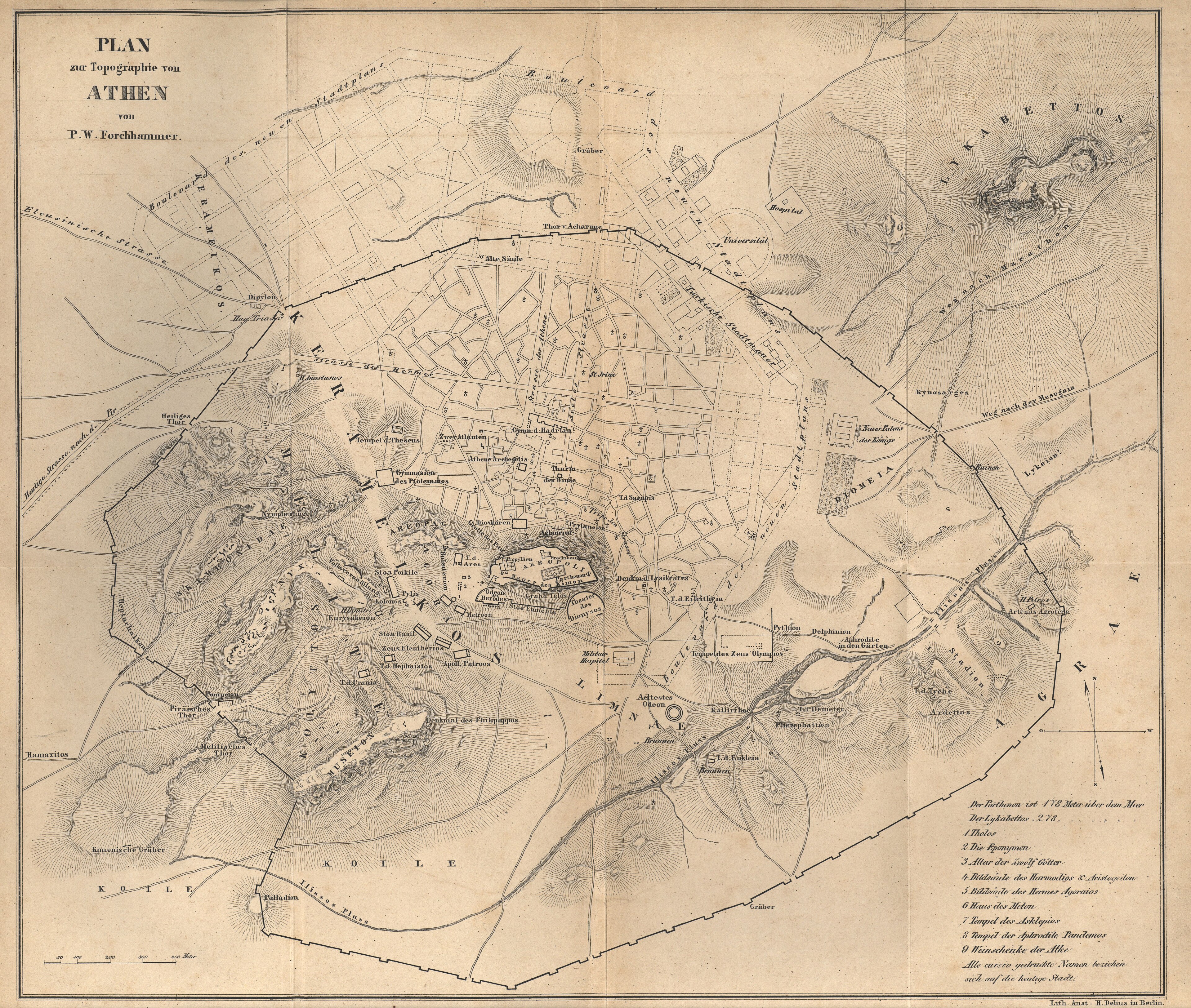
Athens supplies the civic and intellectual setting for much of this collection: public argument, Socrates’ trial, Plato’s Academy, and Aristotle’s Lyceum. Keep the differences between those institutions and generations in view.
Forchhammer’s 1841 plan is a historical reconstruction of ancient Athens. Its labels and proposed identifications belong to nineteenth-century scholarship; it is not a modern excavation plan or a photograph of the ancient city. Use it for orientation, then consult current site scholarship.
The argument workshop
Four ways to explain one thing
Why does this bridge exist?
A bridge can be described through its materials, its design, the people and processes that built it, and the purpose it serves. These answers need not compete because they address different explanatory questions.
1. Classify the answers
Material asks what it is made of; form asks about its organization; the source of change asks how it came about; the end asks what it is for. Keep Aristotle’s broader sense of explanation in view.
2. Test the limits of the example
An artifact has makers and intended uses. Extending purpose to living nature raises further questions. The bridge illustrates the fourfold scheme; it does not settle the disputed status of natural teleology.
3. Connect explanation and demonstration
A valid inference can begin from false premises. Ask both whether the conclusion follows and whether the starting claims are justified. Logic and knowledge are related but not identical achievements.
Return to the chapter’s primary-text anchor: Metaphysics I.1, 980a21. These exercises are editorial prompts, not quotations from the philosopher.
Check the distinction
Read the answer and explanation
The bridge allows people to cross the river The final cause concerns the end or purpose. The material and structural answers address other aspects of the same explanation.
Continue the conversation
Follow the question into another room.
These are invitations to comparison. A shared question does not make different thinkers or traditions interchangeable.
Forms and knowledge
Read the differences between Platonic and Aristotelian explanatory projects.
Explore this connection →Socratic testing
Compare formal reasoning with the conversational examination of an answer.
Explore this connection →The natural world
Distinguish a philosophical taxonomy of explanation from a modern scientific account.
Explore this connection →Sacred texts
Examine how questions about reasons, causes, and interpretation change across textual traditions.
Explore this connection →Pause · question · discuss
Carry the argument further
Are Aristotle’s four causes four competing causes?
They usually answer different kinds of explanatory question: material, organization or form, source of change, and end. A complete account may need more than one of them.
Does a logically valid argument have to be true?
Validity concerns whether the conclusion follows from the premises. A valid argument can start from false premises; a sound argument also requires true premises.
Did Aristotle’s word soul mean only an immortal human spirit?
No. His account of psychē concerns the principle of life in organisms, including plants and animals. His treatment of intellect introduces further disputed questions.
The reading room
Primary texts and source notes
- Aristotle, Metaphysics, Book IW. D. Ross translation. Experience, explanation, wonder, and criticism of earlier philosophy.
- Aristotle, Posterior Analytics, Book IG. R. G. Mure translation. Demonstration and explanatory knowledge.
- Aristotle, Physics, Book IIR. P. Hardie and R. K. Gaye translation. Nature, four causes, chance, and purposive explanation.
- Aristotle, On the Soul, Book IIJ. A. Smith translation. Soul, actuality, and the capacities of living organisms.
- Aristotle, Nicomachean Ethics, Book IW. D. Ross translation. Ends, flourishing, the human function, and the appropriate precision of ethics.
- Christopher Shields, Aristotle, Stanford Encyclopedia of PhilosophyScholarly overview and orientation to disputed interpretations.