
Religion & Philosophy / Philosophy / Søren Kierkegaard
Søren Kierkegaard · Chapter 02 of 05
Either/Or: Desire, Commitment, and the Voices Inside a Life
Why Kierkegaard hides behind invented authors—and what their arguments ask of us
Curated by Christopher Adkins of Huntersville, NC

Is a life of endless possibilities still a choice? The 1843 title page of Either/Or. Victor Eremita appears as the editor, an early clue that the book asks readers to distinguish the author from the voices he creates. Public domain.
Søren Kierkegaard, Enten–Eller (1843), title page; Wikimedia Commons · Public domain.


Explore the historical images.
01 / 08
An editor finds a desk full of lives
Either/Or presents itself through an invented editor, Victor Eremita, who claims to have discovered papers in a writing desk. The papers attributed to A fill the first part; the letters of an ethical advocate, commonly called Judge William, dominate the second. The title page identifies Victor as editor, an important reminder that even the frame is part of the literary invention. The critical edition records the book’s publication on 20 February 1843.
The device does more than make philosophy entertaining. A desk can contain incompatible lives without deciding between them. Likewise a reader can understand an argument, enjoy its style, and postpone the question of whether to live by it. By arranging the book as competing documents, Kierkegaard makes that postponement visible. The imagined archive demands an actual reader’s judgment.
This is the first rule for entering his authorship: do not treat every sentence as a direct statement of Kierkegaard’s beliefs. A character may say something memorable because the character is brilliant, desperate, self-deceived, or all three. The writing can disclose a position from within before showing its limits. To read well is to notice both the force of the voice and the cost of inhabiting it. Philosophical understanding begins here as a form of attentive listening.
02 / 08
The aesthetic life: more than simply liking beautiful things
The aesthetic mode of existence is often summarized as the pursuit of pleasure. That is a starting point, but it misses the sophisticated versions of the problem. A may cultivate music, irony, recollection, and literary insight. Such a person can be perceptive and cultured, yet organize life around what is interesting rather than what is binding. The Danish textual society’s account of the book identifies the first part’s mixture of aphorisms, criticism, and fiction.
The crucial issue is the relation to time. A pleasurable moment promises fullness, then passes. Reflection can recover it as memory or aesthetic arrangement, but recovered experience is not the same as sustaining a relationship. A person may become a brilliant curator of possible lives while declining to inhabit one long enough to accept its obligations.
There is no reason to conclude that art or pleasure is morally suspect in itself. The problem emerges when aesthetic control becomes the organizing principle of existence. Suppose an experience is valuable only while it confirms one’s preferred image of oneself. Another person’s need then arrives as an unwelcome revision to the composition. Kierkegaard’s literary experiment lets the aesthetic life display its intelligence before asking whether its intelligence can bear ordinary dependence, disappointment, and continuity. The test is not the beauty of the language but the shape of the life that the language protects.
“The great thing is not to be this or that, but to be oneself.”
Judge William, Either/Or, Part Two, “The Balance between the Aesthetic and the Ethical in the Development of the Personality”; SKS 3, p. 173 (excerpt).Editorial translation of the verified Danish original; the speaker is Judge William, not an unqualified direct authorial voice.

03 / 08
Boredom, novelty, and the fear of being tied down
In the essay conventionally translated as “The Rotation of Crops,” A imagines refined ways of avoiding boredom. The title borrows an agricultural image, but the concern is the management of experience. If a person can keep changing the way a situation is viewed, perhaps repetition will never become oppressive. The first part of Either/Or is the primary text for this experiment.
There is real insight in the idea that attention can transform an experience. Yet the strategy also reveals anxiety about commitment. To promise something is to surrender some control over future novelty. A friend may need help on an uninteresting afternoon. A marriage cannot remain permanently at the emotional temperature of its beginning. Work may ask for patient repetition rather than a series of revealing first moments.
A contemporary parallel is a life spent keeping every option open. The advantage is obvious: fewer doors close. The hidden cost is that an open door is not itself a place to live. This comparison is an interpretation, not Kierkegaard’s own example, but it helps isolate the issue. Freedom can be diminished by premature conformity, and it can also be emptied by refusing every form. The question is not whether a choice will eliminate other possibilities—it will—but which possibilities deserve to become obligations.
04 / 08
The seducer and the ethics of turning a person into material
“The Seducer’s Diary” intensifies the aesthetic problem by making another person’s feelings the material of an elaborate design. Johannes the seducer plans, observes, and interprets rather than simply following an immediate appetite. His intelligence is therefore part of the moral difficulty. He can notice what matters to someone and use that knowledge to guide an encounter toward his own preferred conclusion. The diary occupies the end of Part One.
The literary force of the diary should not be confused with admiration for its conduct. It allows readers to encounter the attractiveness of control while seeing how that control can hollow out reciprocity. Another person becomes a character in a private work of art. Their independence matters only insofar as it makes the design more challenging or the victory more satisfying.
The problem reaches beyond romance. A teacher, adviser, leader, or friend may be very good at understanding people while remaining interested chiefly in the effects they can produce. Empathy as a skill is not yet love as a responsibility. The question is whether another person’s flourishing can interrupt one’s preferred narrative. If it cannot, insight may serve manipulation. Read this section with particular care: it is one of Kierkegaard’s most effective demonstrations that literary sophistication and moral seriousness are different accomplishments, even when they share the same vocabulary.

05 / 08
Judge William: Choosing a life that can continue
Judge William argues for continuity, work, marriage, and the acceptance of responsibility. He wants the aesthetic reader to choose a self rather than remain dispersed among passing moods. The second part of Either/Or gives this ethical voice space to explain itself. His marriage is not presented merely as the extinction of romance. He argues that love can acquire depth through renewed commitment over time.
Choosing oneself can sound like a modern invitation to invent any identity one wishes. William’s meaning is more demanding. A person must take responsibility for a concrete history, capacities, circumstances, and relationships. Choice does not erase what has been given. It changes one’s relation to it. Even regret becomes part of a life that must be acknowledged rather than disowned whenever it becomes inconvenient.
The judge’s position has considerable force, but readers should still question him. Does his confidence in respectable social forms sometimes conceal their limitations? Does his account give sufficient room to those excluded or harmed by the arrangements he regards as normal? The text invites such questions precisely because William is a voice within it. His ethical earnestness need not make him an infallible spokesman. The difficulty is to preserve the insight that commitment matters while remaining capable of criticizing the particular commitments a society happens to reward.
06 / 08
Aesthetic, ethical, religious: A map, not an escalator
The familiar sequence of aesthetic, ethical, and religious existence can be useful if treated as a map of orientations. It becomes misleading when imagined as a guaranteed escalator that carries every person upward. The modes concern what gives a life its center, how it meets responsibility, and how it understands its relation to God. The Stanford Encyclopedia’s discussion of the spheres emphasizes the interpretive complexity of this scheme.
A reader can recognize features of several orientations at once. One may be ethically responsible at work and aesthetically evasive in love, devout in language and dependent on public approval in practice. Kierkegaard’s categories are most illuminating when they expose such tensions rather than supply flattering labels. The religious does not simply mean an ethical person who has accumulated enough points.
The ending of Either/Or introduces a sermon about the thought that, in relation to God, we are always in the wrong. Whatever one makes of that theological claim, its placement unsettles a self-satisfied reading of the judge. Ethical responsibility is necessary, but a person’s confidence in being good can itself become an evasion. The reader who wants a final victory for one comfortable identity finds the book reopening the question. A life must be lived; no classification can perform that task in its place.

07 / 08
Why indirect communication matters
If Kierkegaard wanted people to live responsibly, why not simply tell them what to do? His retrospective account of authorship answers, in part, that helping requires meeting people where they actually are. The verified passage from The Point of View for My Work as an Author, Part Two, chapter I.A.2, connects help with humility and service. An impressive explanation can fail if it addresses a person who exists only in the explainer’s imagination.
Indirect communication can unsettle an illusion without letting the recipient merely repeat the teacher’s conclusion. A story or pseudonymous voice creates a situation in which the reader must recognize something personally. This is especially important where the subject is how one lives. Memorizing a definition of courage cannot substitute for courage; agreeing that love requires patience does not supply patience when it is tested.
The method has risks. Indirection can confuse, exclude, or give the author too much control over the reader. We need not pretend otherwise. Its value lies in making a certain problem unavoidable: the recipient must appropriate the truth through a responsible relation. A philosophical book can assist, provoke, and clarify. It cannot become the subject who must choose. The space between the book and the reader is therefore not a defect to be eliminated but part of what the writing tries to bring into view.
08 / 08
Reading Either/Or without turning it into a slogan
Try reading the book with three questions in view. What does this speaker desire? What does the speaker regard as a threat? What kind of person becomes possible if the argument is followed over time? These questions slow the rush to collect quotations and reveal how philosophical claims function within a life. A defense of independence may express courage in one context and fear of intimacy in another.
For a first encounter, read the opening aphorisms, a substantial portion of the aesthetic essays, and the judge’s discussion of choosing oneself. Then return to passages that initially seemed obvious. Notice how much depends on tone. The same sentence can be a discovery, a pose, or a way of withholding commitment. Consult the critical edition’s contents to keep the voices and works distinct.
The most useful question at the end is not “Am I an aesthete or an ethical person?” It is more concrete: where am I asking life’s possibilities to spare me the cost of responsibility? The opposite question also matters: where have I mistaken habitual respectability for a freely examined commitment? Kierkegaard’s book becomes fruitful when neither question is used merely against other people. Its dialogue continues in the reader who is willing to let an attractive explanation become a demand for more honest attention.
The visual reading room
Look closely. Ask better questions.
Eight images invite a slower look at places, portraits, manuscripts, and later interpretations. Is a life of endless possibilities still a choice? Select any image to enlarge it; the source and reuse credit remain with every item.


Geographic orientation
A city small enough for reputations to travel.
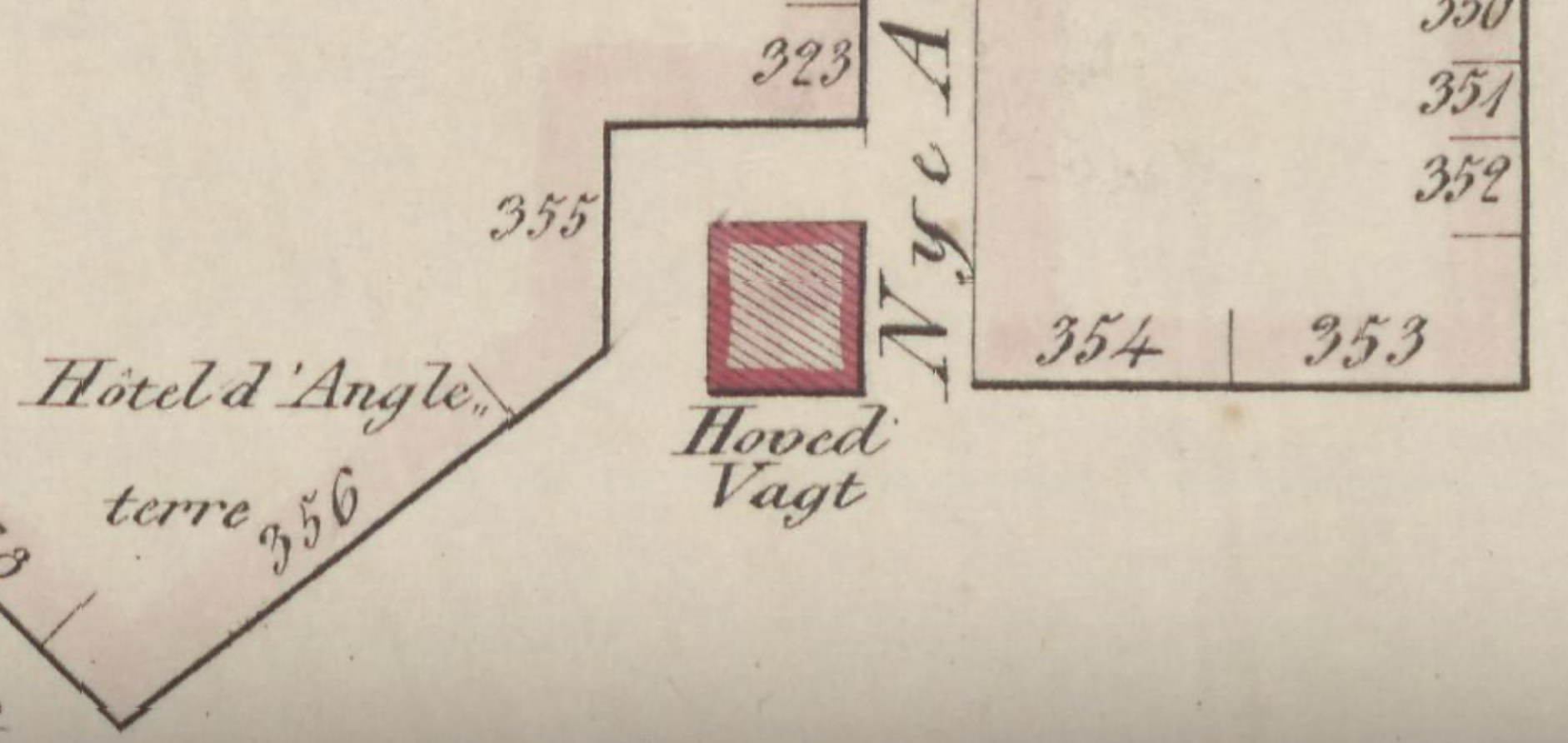
The Copenhagen detail brings streets and public spaces into view around Kierkegaard’s early adulthood. Compare its ordered plan with the 1840 daguerreotype in the visual collection: one organizes space; the other records a particular view.
The underlying archival sheet belongs to Sterm’s 1838–1841 map series and is dated 1839–1841 by Copenhagen City Archives. This is a historical map detail, not a reconstruction of Kierkegaard’s private movements.
The argument workshop
Choose the voice before the verdict
Is a life of endless possibilities still a choice?
A person keeps every commitment provisional to preserve the excitement of possibility. Judge William would ask whether that refusal already shapes a self and therefore carries responsibility.
1. Identify the literary arrangement
Either/Or brings different papers and voices before the reader through an editorial fiction. The aesthetic and ethical positions deserve reconstruction before we decide how Kierkegaard relates to either.
2. Give the aesthetic its strongest case
Art, intensity, and sensitivity are real goods. The ethical challenge targets the evasion of responsibility, not the mere enjoyment of beauty or pleasure.
3. Test commitment without caricature
Ask what makes a promise more than a passing mood. Then ask whether routine and social respectability can themselves become evasions. A good comparison allows both positions to expose weaknesses in the other.
Return to the chapter’s primary-text anchor: Judge William, Either/Or, Part Two, “The Balance between the Aesthetic and the Ethical in the Development of the Personality”; SKS 3, p. 173 (excerpt).. These exercises are editorial prompts, not quotations from the philosopher.
Check the distinction
Read the answer and explanation
As the claim of a specific voice within Either/Or Attribution to the pseudonymous or fictional speaker is part of accurate interpretation. It does not prevent evaluation; it tells us whose position we are evaluating.
Continue the conversation
Follow the question into another room.
These are invitations to comparison. A shared question does not make different thinkers or traditions interchangeable.
Plato’s literary craft
Compare two authors who make literary form part of philosophical inquiry.
Explore this connection →Aristotle on character
Contrast commitment and selfhood with habituation and practical wisdom.
Explore this connection →A Short History of Myth
Explore another account of how narrative can carry questions about a life.
Explore this connection →C. S. Lewis
Read another writer who works through several literary forms and voices.
Explore this connection →Pause · question · discuss
Carry the argument further
Is Kierkegaard against art and pleasure?
No. His concern is a way of organizing existence around interesting experiences while evading commitments. The books themselves display deep artistic intelligence.
Is Judge William simply Kierkegaard speaking?
No. He is an invented ethical advocate with genuine insights and limitations. His arguments should be evaluated within the work’s layered structure.
Are the three stages automatic steps?
No. They are a useful but contested map of existential orientations, not a mechanical psychological ladder or a ranking system for people.
The reading room
Primary texts and source notes
- Either/Or, Part One, Danish critical textVictor Eremita’s frame; A’s papers, The Rotation of Crops and The Seducer’s Diary.
- Either/Or, Part Two, Danish critical textJudge William’s letters and the concluding sermon.
- Danish Society of Language and Literature: author portraitStructure and literary genres of Either/Or.
- University of Copenhagen: verified quotationsLocators for choosing oneself and the art of helping.
- Critical edition publication listDates and pseudonymous attributions.
- Stanford Encyclopedia of PhilosophyDiscussion of the aesthetic, ethical and religious spheres.