
Religion & Philosophy / Philosophy / Socrates
Socrates · Chapter 05 of 05
The Socratic Afterlife: Legacy and Reading Socrates
How Plato, Aristotle, Epictetus, Kierkegaard, and Martin Luther King Jr. put an ancient life to new philosophical work.
Curated by Christopher Adkins of Huntersville, NC

When does an influence become a reinvention? Raphael’s Renaissance gathering imagines ancient thinkers sharing an architectural world. It is an interpretation of philosophy’s history, painted in 1509–1511, not a record of a meeting that actually took place.
Raphael; public-domain reproduction via Wikimedia Commons · Public domain.


Explore the historical images.
01 / 08
A philosopher with many afterlives
Socrates left no surviving philosophical books of his own, yet few thinkers have been so persistently reread. The apparent paradox becomes clearer when we notice what later readers inherit: dialogues, recollections, arguments, dramatic scenes, and an image of a life placed under examination. They do not receive a single authorized system whose terms settle every dispute. The historical uncertainty introduced in the first chapter remains relevant at the end of the series. It makes the later history especially rich, but also especially vulnerable to confident appropriation.
A reader may encounter Socrates as a critic of complacency, an exemplary rational agent, a religious questioner, a martyr to conscience, or a difficult teacher. These uses are not interchangeable evidence about the man who lived in Athens. A nineteenth-century interpretation tells us what that interpreter found philosophically significant; a modern political analogy tells us how an ancient figure could illuminate a new conflict. Neither becomes an eyewitness report by invoking Socrates’ name.
The task in studying a legacy is therefore double. We ask what a later thinker took from the sources, and what the later setting changed. An interpretation can be illuminating without being a complete reconstruction of the historical Socrates. The most interesting inheritance often involves a disagreement, a new application, or a refusal to reduce the philosopher to a reassuring emblem. This chapter follows several such encounters before offering a route back to the dialogues, where the reader can test the interpretations against the arguments that sustain them.
02 / 08
Plato and Aristotle: inheritance through disagreement
Plato made Socrates the central speaker in many dialogues, but a dialogue is not a transcript. Its characters, setting, shifts of tone, and arrangement of arguments shape the reader’s encounter. The Socrates who questions a confident definition and the Socrates who develops extended arguments about the soul cannot automatically be separated into perfectly documented historical layers. Debates about the development of Plato’s thought matter precisely because literary continuity does not guarantee that every proposition belongs to one historical teacher.
Aristotle supplies a different kind of retrospect. In Metaphysics XIII.4, he associates Socrates with ethical inquiry, inductive argument, and the search for universal definitions, while distinguishing this from giving the universals a separate existence. This is influential testimony, but Aristotle was not an eyewitness to Socrates’ conversations. He is explaining an intellectual development through categories connected to his own philosophical concerns. His account is evidence to examine, not a shortcut around the other sources.
The relationship among the three philosophers is therefore best approached as an argument in motion. A demand to explain courage can lead toward questions about what makes any definition adequate. Those questions can lead toward competing accounts of knowledge and being. The movement is intelligible without being inevitable. The Plato and Aristotle sections explore the resulting differences. Their inclusion beside Socrates invites comparison across distinct projects rather than treating two later philosophers as interchangeable custodians of the same doctrine.
“do not hesitate to say exactly what you think”
Plato, Phaedo 84cBenjamin Jowett

03 / 08
Epictetus: let a life show what philosophy has taught
In the Enchiridion, the Stoic teacher Epictetus presents Socrates as an ethical example. Section 5 invokes his response to death when discussing the role of judgments in distress. Section 46 recalls his lack of ostentation and urges the student to display philosophy in conduct rather than advertise mastery of theories. Near the end, the reader is encouraged to aspire toward the kind of rational commitment Socrates exemplifies. In the linked Carter text, the final exhortation and the distinction between practicing ethics and merely discussing it appear in sections 50–51; numbering differs in other editions.
The relationship is an appropriation within a later Stoic framework. It does not prove that Socrates held every Stoic doctrine or that the Enchiridion provides direct access to his psychology. Epictetus selects an exemplary figure whose conduct dramatizes a demanding account of freedom and responsibility. The selection helps readers see how a philosophical life can become an argument addressed to other lives.
The practical challenge remains sharp even for someone who rejects Stoic conclusions about external circumstances. Can a person explain honesty expertly while routinely avoiding inconvenient truths? Can the language of self-command become a performance designed to win admiration? Socrates’ value here is not the prestige of his name. It is the pressure his example puts on the gap between declared convictions and habitual action. Reading becomes ethically consequential when that gap is examined without turning the philosopher into an unattainable statue.
04 / 08
Kierkegaard: irony, inwardness, and the individual
Søren Kierkegaard’s engagement with Socrates belongs to a different setting: nineteenth-century Copenhagen and a body of writing deeply concerned with becoming a Christian. His dissertation, The Concept of Irony, gives Socrates sustained attention, and Socratic questioning remains important to the way he challenges the assumption that possessing correct language is equivalent to existing well. The Stanford account of Kierkegaard places this admiration within the broader literary, philosophical, and religious project.
Irony here deserves more care than the everyday meaning of sarcasm. A speaker can unsettle another person’s confident understanding without handing over a finished alternative that the listener merely repeats. That unsettling may create room for responsibility; it can also leave the listener suspended. The philosophical question is what follows when inherited certainty loses its grip. Kierkegaard’s answers cannot be projected backward into fifth-century Athens, and Socrates should not be relabeled a Christian thinker.
The connection nevertheless gives this collection an especially rewarding route. Move from the Socratic examination of a claimed knowledge to Kierkegaard’s investigation of inwardness and commitment. Ask what can be communicated through direct explanation and what requires the reader’s own appropriation. The University of Copenhagen’s reading outline for The Concept of Irony offers a structured orientation to the work; it is a study resource, not evidence for Socrates’ biography.

05 / 08
Martin Luther King Jr. and the public work of a gadfly
In his Letter from Birmingham Jail, dated April 16, 1963, Martin Luther King Jr. invokes Socrates while explaining why nonviolent direct action can expose a conflict that a community has refused to confront. He compares productive intellectual disturbance with social pressure directed toward negotiation and justice. Elsewhere in the letter, Socrates appears in the discussion of civil disobedience and in a response to blaming a victim for the hostility provoked by principled action.
This is a moral and political analogy, not a claim that ancient Athens and segregated Birmingham had identical institutions or conflicts. King’s argument draws on several traditions, and his civil-rights project cannot be reduced to a modern replay of the Athenian trial. Its Socratic reference shows how an inherited philosophical figure can help make an urgent claim intelligible to a new audience.
The analogy also invites a careful test. Disturbance is not justified merely because someone calls it Socratic. The purpose, evidence, means, and responsibilities still require judgment. A person can provoke without illuminating anything. The question is whether the intervention brings a neglected injustice or contradiction into view and creates a responsible opportunity to address it. A famous predecessor can sharpen that examination; invoking one cannot replace it.
06 / 08
Begin with four conversations
Start with Plato’s Apology. Read it as a defense of a life, noting how the speaker answers both current charges and a longer-standing public image. Write down which commitments Socrates treats as more important than acquittal. Then ask whether the defense persuades you and why. The title means a defense speech here, not an expression of regret. Keep the distinction between Plato’s composition and a verbatim court record visible.
Read the Crito next, placing the arguments for escape beside the arguments against it. Do not make the personified Laws identical with every statement Socrates makes elsewhere. Ask how obligations, prior choices, and the refusal to do wrong interact. The interest lies in the reasoning, not only in the final decision. Comparing these two works creates a question worth carrying forward: how can conscience resist a demand while remaining answerable for its own conduct?
Turn to the Euthyphro and then the Laches. For each proposed definition, make a simple record: the definition, Socrates’ objection, and what the objection actually establishes. Notice how expertise is claimed and tested. A general’s experience of danger does not automatically provide a complete account of courage, just as confidence in religious matters does not automatically explain piety. These short dialogues are useful practice in resisting two opposite errors: assuming every refutation proves Socrates’ own view, and assuming an inconclusive ending means nothing has been learned.
07 / 08
Continue into learning, power, and mortality
The Meno makes inquiry itself a problem. How can someone search for what is not yet known, and how would a successful answer be recognized? Read the geometrical demonstration carefully, attending to the questions that guide the learner. It is not enough to announce that Socrates merely draws out knowledge. Ask how much the structure of the exchange contributes to the result and what the episode is meant to show within the dialogue’s broader argument.
In the Gorgias, follow the change of interlocutors. Each exchange develops a different pressure on the relation between persuasion, power, pleasure, and goodness. What would it mean to possess the ability to obtain whatever one desires while being mistaken about what is worth desiring? Read slowly enough to see where a participant’s concession changes the available position. The drama of resistance is part of the philosophical interest.
Finally, return to the prison in the Phaedo. Treat its arguments about the soul as arguments requiring assessment, while also noticing how grief, hope, friendship, and narrative form shape the reading experience. The character Socrates invites objections from people who hesitate to trouble him. That invitation is a fitting image of the educational aim: admiration for a speaker should not silence scrutiny of what the speaker says. The work offers a powerful literary portrait; it does not relieve us of the historical caution with which the series began.
08 / 08
Read the source, then examine the use
A reliable quotation needs a work, a location, and a translator. Plato is usually cited by Stephanus numbers and letters, such as Apology 38a; these remain useful across editions with different pagination. An English phrase belongs to a particular translation. When a quotation has no traceable location, treat it as unverified until the source can be found. The same caution applies to images: a later painting may reveal a period’s imagination more clearly than an ancient event.
For each reading, keep three columns in your notes: what the text says, what you infer, and what remains uncertain. Those distinctions prevent an interpretation from silently becoming a fact. They also make conversation easier. Two readers may disagree because they interpret the same premise differently, because they disagree about the inference, or because one has imported a claim from a later tradition. Naming the difference is more productive than competing over who understands Socrates best.
End by testing a belief of your own. State it clearly, offer its strongest reason, and identify what evidence or argument could make you revise it. Invite a fair objection. Then consider whether the resulting clarity changes an action, an obligation, or a way of attending to another person. This is an original exercise inspired by the dialogues, not a method guaranteed by an ancient authority. The aim is a more answerable mind: capable of conviction, capable of correction, and willing to keep the two in conversation.

The visual reading room
Look closely. Ask better questions.
Eight images invite a slower look at places, portraits, manuscripts, and later interpretations. When does an influence become a reinvention? Select any image to enlarge it; the source and reuse credit remain with every item.


Geographic orientation
Ideas have places. Maps have histories.
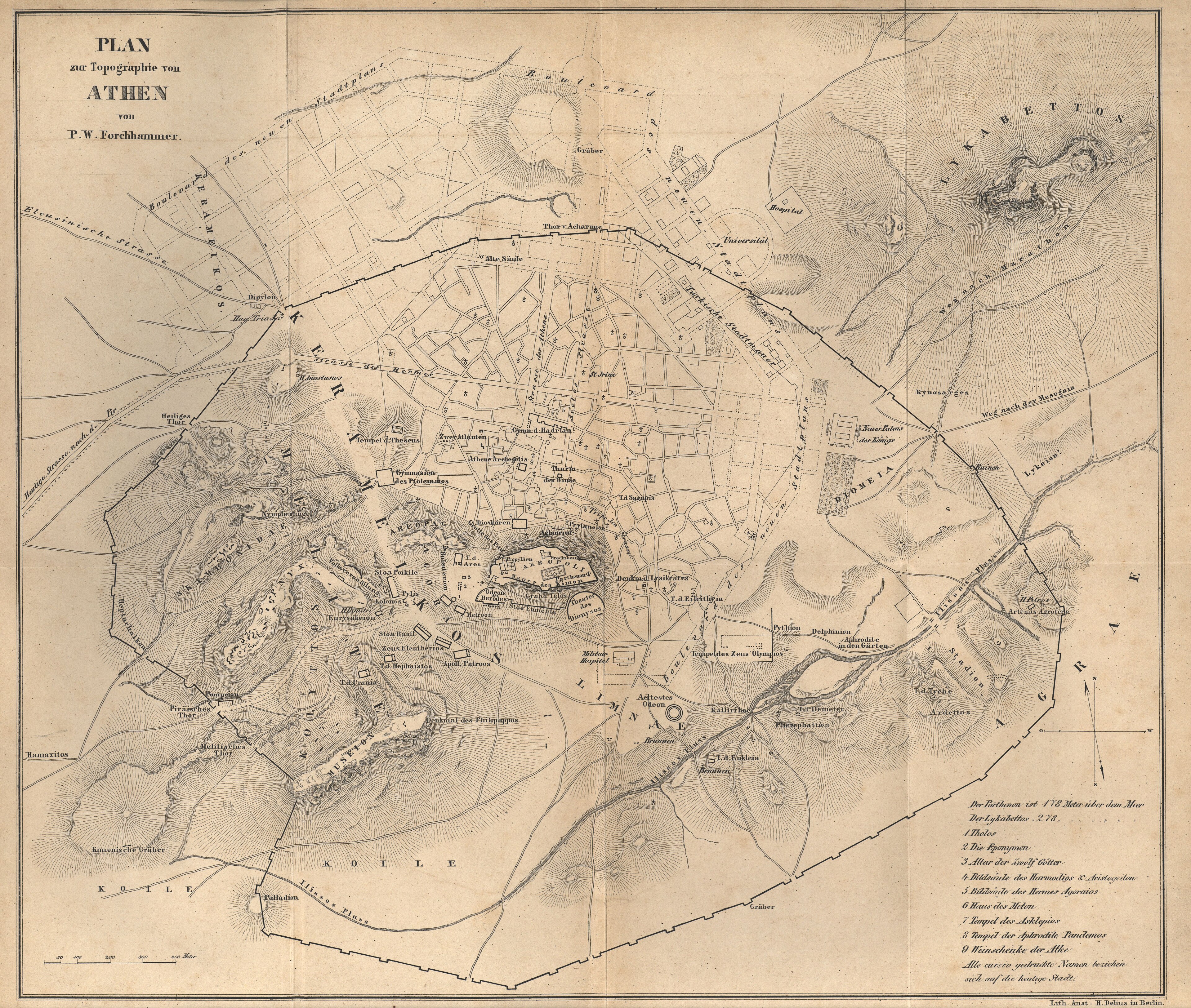
Athens supplies the civic and intellectual setting for much of this collection: public argument, Socrates’ trial, Plato’s Academy, and Aristotle’s Lyceum. Keep the differences between those institutions and generations in view.
Forchhammer’s 1841 plan is a historical reconstruction of ancient Athens. Its labels and proposed identifications belong to nineteenth-century scholarship; it is not a modern excavation plan or a photograph of the ancient city. Use it for orientation, then consult current site scholarship.
The argument workshop
The afterlife of an example
When does an influence become a reinvention?
A Stoic teacher, a Christian writer, and a civil-rights leader each appeal to Socrates. The shared name does not prove that they endorse the same theology, politics, or theory of knowledge.
1. Locate the act of borrowing
Ask whether the later writer borrows an argument, a method, an image of courage, or a model of public questioning. These are different forms of reception.
2. Mark the discontinuity
Epictetus, Kierkegaard, and Martin Luther King Jr. write in distinct settings. Explain the work Socrates does inside each argument without turning that use into a complete line of doctrinal descent.
3. Build a reading path
Move from Apology to Crito and Euthyphro, then to Laches and Meno. Let Gorgias and Phaedo complicate the first picture you formed. Keep a record of passages that revise your understanding.
Return to the chapter’s primary-text anchor: Plato, Phaedo 84c. These exercises are editorial prompts, not quotations from the philosopher.
Check the distinction
Read the answer and explanation
Which feature is being adopted, and for what purpose? Reception is selective. A disciplined comparison identifies the feature carried forward, the new setting, and the differences that remain.
Continue the conversation
Follow the question into another room.
These are invitations to comparison. A shared question does not make different thinkers or traditions interchangeable.
Kierkegaard and irony
Follow a later author for whom Socrates became a central literary and philosophical problem.
Explore this connection →Plato’s literary legacy
Examine how dialogue, myth, and interpretation carried philosophy into later traditions.
Explore this connection →Profiles in action
Read later lives as distinct cases rather than treating influence as identity.
Explore this connection →C. S. Lewis
Compare another writer’s use of argument, literature, and questions of belief.
Explore this connection →Pause · question · discuss
Carry the argument further
Was Socrates a Stoic?
Socrates lived before Stoicism developed. Epictetus and other later thinkers made him an important example within their own philosophical projects; that does not establish that he held all their doctrines.
Does King’s comparison prove that Socrates practiced modern civil disobedience?
King’s use is a moral and political interpretation in a distinct historical struggle. It illuminates a comparison without erasing the differences between ancient Athens and the American civil-rights movement.
What should I read first?
Begin with Apology and Crito, then Euthyphro and Laches. Continue with Meno, Gorgias, and Phaedo, recording the argument rather than extracting isolated quotations.
The reading room
Primary texts and source notes
- Aristotle, Metaphysics XIII.4W. D. Ross translation. Aristotle’s retrospective account of Socratic definition and its relation to the theory of Forms.
- Epictetus, EnchiridionElizabeth Carter translation. See §§5 and 46; the linked edition numbers the final exhortation and practice-versus-theory passage §§50–51, while other editions commonly use §§51–52.
- Søren Kierkegaard, Stanford Encyclopedia of PhilosophyScholarly orientation to Kierkegaard’s Socratic engagement within his broader religious and philosophical work.
- Søren Kierkegaard Research Centre, University of Copenhagen: A Reading of The Concept of IronyUniversity reading outline and edition details; a study aid rather than a primary source about ancient Socrates.
- Martin Luther King Jr., Letter from Birmingham Jail, April 16, 1963Primary text hosted by the King Institute. Socrates is invoked in the discussions of constructive tension, civil disobedience, and responsibility for hostile reactions. No extended quotation reproduced.
- Plato, ApologyBenjamin Jowett translation; suggested first reading.
- Plato, CritoBenjamin Jowett translation; obligation and the proposed escape.
- Plato, EuthyphroBenjamin Jowett translation; piety and definition.
- Plato, LachesBenjamin Jowett translation; courage and expertise.
- Plato, MenoBenjamin Jowett translation; inquiry and learning.
- Plato, GorgiasBenjamin Jowett translation; persuasion, power, and the good.
- Plato, PhaedoBenjamin Jowett translation; Plato’s literary and philosophical treatment of the final conversation. Brief quotation checked in the section around 84c.