
Religion & Philosophy / Philosophy / Søren Kierkegaard
Søren Kierkegaard · Chapter 04 of 05
Anxiety and Despair: The Difficult Work of Becoming a Self
Freedom, possibility, dependence, and the difference between living a life and disappearing into a role
Curated by Christopher Adkins of Huntersville, NC

Can someone feel content and still evade becoming a self? Søren Kierkegaard: a Copenhagen author whose writing brought the demands of existence, faith and responsibility into unusually close focus. Historic portrait reproduced in the 1923 Hollander collection. Public domain.
Royal Library of Denmark; reproduced in Lee M. Hollander’s Selections from the Writings of Kierkegaard (1923), via Wikimedia Commons · Public domain.


Explore the historical images.
01 / 08
Two books, two voices, two different questions
The Concept of Anxiety appeared in 1844 under the name Vigilius Haufniensis. The Sickness unto Death appeared in 1849 under Anti-Climacus, with Kierkegaard named as editor. The critical edition’s catalogue makes the distinction explicit. Both books examine human existence, but they do not ask exactly the same question. Anxiety concerns possibility, freedom, and the emergence of sin; despair concerns a disordered relation of the self to itself and, ultimately, to God.
Their titles can mislead modern readers. They are not diagnostic manuals, and their categories should not be equated with an anxiety disorder or clinical depression. A person experiencing a clinical condition is not thereby convicted of the spiritual condition the books describe. Conversely, Anti-Climacus can call a person despairing even when that person feels comfortable and appears successful. His standard is theological rather than a measure of reported mood.
The pseudonyms matter here too. Vigilius observes and analyzes; Anti-Climacus writes from an exceptionally demanding Christian standpoint. Keeping their voices distinct prevents an easy collage in which every arresting sentence becomes part of one uniform self-help program. These books can illuminate experience, but they also seek to challenge it according to a religious account of what a human being is. Readers should know the terms of that challenge before accepting or rejecting its conclusions.
02 / 08
Anxiety opens onto possibility
In Chapter I of The Concept of Anxiety, fear is distinguished from anxiety through the latter’s relation to possibility. A particular danger can be named; the unsettling openness of what one might do is more elusive. Before an action becomes actual, freedom confronts possibilities that are neither simply facts nor merely external threats. The text makes that strange interval philosophically important.
Imagine being offered a responsibility you have long wanted. The uneasiness may concern practical dangers, but it may also concern the discovery that you can now become someone different. Possibility invites and unsettles at once. This is a contemporary illustration of the distinction, not an attempt to translate every form of anxiety into freedom. Much suffering arises from conditions that philosophical description alone cannot explain.
The argument is also bound to the book’s treatment of Adam and sin. Vigilius tries to avoid explanations that make the first wrong action mechanically inevitable. If wrongdoing were simply the necessary result of prior conditions, responsibility would change its meaning. Anxiety helps describe the setting of possibility without becoming a sufficient causal explanation of the act. The individual remains involved. This is why the analysis cannot be reduced to a pleasant claim that nervousness always means growth: the freedom in question includes the possibility of choosing badly.
“The self is a relation that relates itself to itself.”
Anti-Climacus, The Sickness unto Death, Part One, A.A; SKS 11, p. 129.Editorial translation from the Danish: “Selvet er et Forhold, der forholder sig til sig selv”.

03 / 08
The dizziness of freedom
The image of dizziness appears in Chapter II of The Concept of Anxiety. Freedom looks into its own possibility and reaches for something finite to hold. The metaphor captures a disturbing ambiguity: what unsettles a person may be the openness of their own agency, not simply a force acting from outside. The possibility of doing something can be both attractive and frightening.
This does not mean that a person consciously desires every possibility that comes into view. Nor does the image settle the relation between philosophical freedom and the many psychological processes examined by modern research. Its task is more specific: to prevent a description of human action from leaving out the subject who must inhabit the possibility. We cannot understand a decision solely by listing the options visible to an observer.
The metaphor also challenges a simplistic ideal of unlimited choice. A world containing more possible paths does not automatically provide a person with greater direction. A commitment gives a life form while closing some alternatives. What makes that form worth accepting must be examined; mere reduction of uncertainty is not enough. Someone can escape the discomfort of possibility by surrendering judgment to a crowd, a routine, or an authority. The absence of dizziness may then conceal a loss of responsibility rather than its successful exercise.
04 / 08
The self is a relation that relates to itself
The opening of The Sickness unto Death defines the self through a relation that relates itself to itself. The language initially sounds forbidding. A practical entry is to distinguish having characteristics from taking a stance toward the person who has them. One has a body, a history, limitations, capacities, and relationships; one also responds to having them. Pride, shame, gratitude, refusal, fantasy, and acknowledgment are ways of doing so.
Anti-Climacus describes a human being through paired terms: finitude and infinitude, the temporal and the eternal, freedom and necessity. The pairs name tensions to be lived, not ingredients that can be separated cleanly. A person can imagine beyond present circumstances, yet cannot become wholly independent of a body and history. A life contains possibilities, yet not every possibility is available to this person in this situation.
The theological step is decisive. The self has not established itself from nothing. Its relation to itself is also a relation to the power that established it. For Anti-Climacus, a rightly ordered self rests in God. A secular reader may adapt parts of the analysis, but should identify the adaptation. Removing God changes the argument rather than merely translating its vocabulary. The book’s central question is not how to maximize self-assertion; it is how to become oneself without falsely claiming to be one’s own ultimate ground.

05 / 08
Three ways of failing to become oneself
The opening classification distinguishes an unawareness of having a self, an unwillingness to be oneself, and a despairing determination to be oneself. These are not three entries on a modern clinical scale. They describe different distortions of self-relation in the primary text. The first is particularly challenging because an apparently settled life can conceal the failure even to confront the question of selfhood.
Unwillingness to be oneself can appear as a wish to exchange one’s entire existence for someone else’s, or as an attempt to make a painful circumstance exhaust the meaning of the person. The issue is not that circumstances are unreal. It is that a self tries to escape its own task by treating the whole of itself as intolerable. Anti-Climacus gives that refusal many degrees and forms.
The opposite distortion is defiance: the wish to be oneself entirely on one’s own terms, severed from dependence on what gives the self. This complicates the familiar slogan “be yourself.” In this book, insisting on oneself may express despair rather than its cure. The question is what kind of relation the insistence establishes. A self that refuses every gift, obligation, or dependence may be dramatically self-assertive while remaining unable to receive its own existence. The analysis requires both courage and humility, a combination that easy versions of authenticity frequently pull apart.
06 / 08
How a successful life can become a hiding place
One of the book’s strongest challenges is that social success does not settle the question of selfhood. If a person acquires the expected habits, recognition, and respectable vocabulary, the surrounding world may have little reason to ask further questions. Anti-Climacus’s analysis of finitude asks what happens when conformity consumes the possibilities through which a person might become responsibly individual. The University of Copenhagen’s quotation guide locates this discussion in The Sickness unto Death, Part One, C.A.a, under the despair of finitude.
The point is not that ordinary work or family life is inferior to dramatic rebellion. One can evade oneself just as efficiently by cultivating an exceptional image. The common danger is borrowing a complete answer to the question of who one is. “Everyone does it” and “I am unlike everyone” can both become ways of ending reflection before responsibility begins.
A useful contemporary question is whether a role allows acknowledgment of what is inconveniently true. Can a competent professional admit a mistake? Can an admired parent listen to a child whose experience does not confirm the family story? Can a believer recognize a neighbor whose suffering disturbs a comfortable account of providence? These examples are applications of the philosophical issue. They do not establish diagnoses. They ask whether identity serves truthful attention or protects its holder from having to practice it.

07 / 08
What the analysis reveals—and what we should question
Kierkegaard’s attention to inward responsibility can reveal evasions that purely external accounts miss. Yet it can also be read too narrowly. Poverty, violence, exclusion, illness, and coercion are not simply failures to choose oneself properly. A philosophy of selfhood becomes ethically inadequate if it treats every obstacle as an inward mistake. The book’s categories should therefore be examined alongside the concrete conditions in which people are asked to act.
There is also a question about the authority of Anti-Climacus’s Christian standpoint. Readers may accept his analysis of self-deception while disputing his account of its ultimate remedy. Others may find that the theological relation is precisely what makes the analysis coherent: a self can receive itself as given, rather than oscillate between self-rejection and total self-creation. The disagreement cannot be settled by reducing either position to a temperament.
The productive reading task is to locate the exact claim. Does a passage describe a familiar possibility, argue for a necessary structure of human existence, or interpret that existence before God? These are related but different moves. Keeping them distinct respects both religious and nonreligious readers. It also protects the books from being turned into an all-purpose explanation. Their strength lies in extraordinary attention to certain dimensions of existence, and serious attention includes asking where that account needs criticism, qualification, or another perspective.
08 / 08
Hope is a relation, not a demand for permanent confidence
The ending implied by The Sickness unto Death is not endless introspection. Its account of faith names a self that wills to be itself while resting transparently in the power that established it. The formulation appears near the beginning of the book as the opposite of despair and guides the analysis that follows. It joins agency with dependence: one must become oneself, yet cannot do so by pretending to be self-created.
Read this beside the book on anxiety. Possibility unsettles; responsibility cannot be handed entirely to circumstances; self-assertion alone does not solve the problem. The religious answer is a relation in which finitude can be accepted without surrendering hope. That acceptance is not a claim that losses cease to matter or that all doubts vanish. It is an account of how a life might be received and lived without being reduced to either its limits or its fantasies.
For a careful first reading, use a scholarly edition and proceed slowly through the opening definitions before moving to the examples. Translate each abstract opposition into a question, then return to the text to check what the question leaves out. The reward is not a quick psychological label. It is a sharper capacity to notice the ways people disappear from themselves—and the possibility that becoming a self requires learning how to receive, answer, and love.
The visual reading room
Look closely. Ask better questions.
Eight images invite a slower look at places, portraits, manuscripts, and later interpretations. Can someone feel content and still evade becoming a self? Select any image to enlarge it; the source and reuse credit remain with every item.


Geographic orientation
A city small enough for reputations to travel.
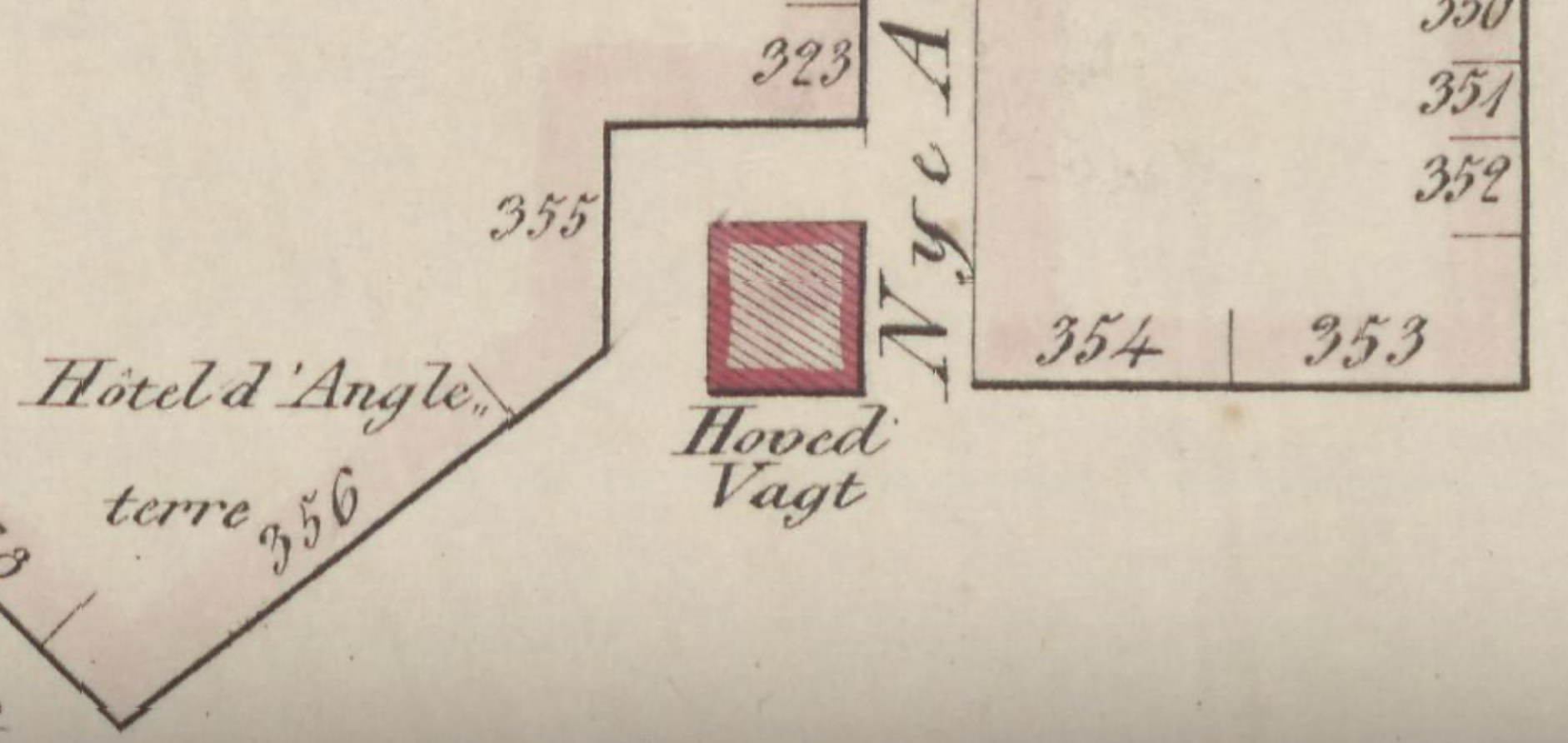
The Copenhagen detail brings streets and public spaces into view around Kierkegaard’s early adulthood. Compare its ordered plan with the 1840 daguerreotype in the visual collection: one organizes space; the other records a particular view.
The underlying archival sheet belongs to Sterm’s 1838–1841 map series and is dated 1839–1841 by Copenhagen City Archives. This is a historical map detail, not a reconstruction of Kierkegaard’s private movements.
The argument workshop
Possibility and the task of selfhood
Can someone feel content and still evade becoming a self?
Anti-Climacus uses despair as a theological and existential category. That account can challenge complacency, but it must not be confused with a clinical diagnosis or used to explain another person’s illness.
1. Separate the books and voices
The Concept of Anxiety and The Sickness unto Death ask related questions through different pseudonymous authors. Anxiety and despair should not be merged into one vague mood.
2. Follow the relation
The self is presented through tensions such as finitude and infinitude, possibility and necessity. Ask how a person might evade limits through fantasy or erase possibility through resignation.
3. Make the application humane
Use the argument to examine your own responsibilities and evasions. It does not give a reader privileged access to another person’s inner life or substitute for care when someone is suffering.
Return to the chapter’s primary-text anchor: Anti-Climacus, The Sickness unto Death, Part One, A.A; SKS 11, p. 129.. These exercises are editorial prompts, not quotations from the philosopher.
Check the distinction
Read the answer and explanation
Anti-Climacus’s account of despair is not a clinical diagnostic category The book’s category concerns self-relation before God. It must be interpreted within that framework and kept distinct from medical claims about mental illness.
Continue the conversation
Follow the question into another room.
These are invitations to comparison. A shared question does not make different thinkers or traditions interchangeable.
The soul in Plato
Compare accounts of inner conflict while preserving their different metaphysical commitments.
Explore this connection →Virtue and flourishing
Read an alternative account of character, activity, friendship, and a good life.
Explore this connection →A Grief Observed
Compare a literary and religious response to loss with Kierkegaard’s account of self-relation.
Explore this connection →Belief and worship
Place the individual’s task beside communal forms of religious life.
Explore this connection →Pause · question · discuss
Carry the argument further
Is Kierkegaard’s despair the same as depression?
No. Anti-Climacus uses a theological category concerning self-relation, which may apply in his account even to someone who feels content. It should not be used as a clinical diagnosis or moral explanation of illness.
Why can freedom be unsettling?
Possibility reveals that a person must act without possessing a complete guarantee of the outcome. The Concept of Anxiety examines that openness and its relation to responsibility.
Does becoming a self mean inventing oneself without limits?
In The Sickness unto Death, no. The self must acknowledge finitude, history and dependence; the book’s Christian account ultimately locates its ground in God.
The reading room
Primary texts and source notes
- The Concept of Anxiety, Chapter IOriginal Danish discussion of anxiety, freedom, Adam and sin.
- The Concept of Anxiety, Chapter IIThe dizziness of freedom and further distinctions.
- The Sickness unto Death, opening analysisOriginal Danish definition of the self, forms of despair and formula for faith.
- University of Copenhagen: verified quotationsLocator for the despair of finitude and correction of the popular “to dare” misquotation.
- Critical edition indexDates and pseudonymous attribution.