


Nature › Field guide › Salamanders
Nature · Mountains · WildlifeSalamander capital of the world
Turn over the forest floor in the Southern Appalachians and you are in the richest salamander country on Earth. Most of them have no lungs at all.
By Christopher Adkins · The Lake Norman Brief · Huntersville, North Carolina
Drag across the mist to clear it.
Why the Southern Appalachians?
No place on the planet has more kinds of salamanders than the mountains of western North Carolina and their neighbors in Tennessee, Georgia and Virginia. Great Smoky Mountains National Park alone has about 30 species, enough that the park calls itself the Salamander Capital of the World.
Three things explain it. These are some of the oldest mountains on Earth, so salamander lineages have had tens of millions of years to diversify here. The mountains are wet, with some high peaks receiving more rain than almost anywhere in the eastern United States. And the terrain is broken into isolated ridges and valleys, so populations separated by a gap or a river slowly became separate species. Some live on a single mountain range and nowhere else in the world.
Breathing without lungs


Most salamanders in the Southern Appalachians belong to the family Plethodontidae, the lungless salamanders. They have no lungs at all. Instead they absorb oxygen through their thin, moist skin and the lining of the mouth. That is why they live under logs, rocks and leaf litter, in seeps and along streams: if their skin dries out, they suffocate.
Going without lungs sounds like a handicap, but it has been a spectacular success. Lungless salamanders are the largest salamander family in the world, and the cool, damp Appalachian forest is their stronghold. Many lay eggs on land that hatch directly into tiny salamanders, skipping the swimming larval stage entirely.
They are also everywhere, even if you rarely see them. In some eastern forests, scientists have found that the salamanders hidden on the forest floor outweigh all the birds living in the same woods. They eat enormous numbers of insects, mites and other small animals and are eaten in turn by snakes, birds and shrews, linking the soil to the rest of the forest food web.
Salamanders of Great Smoky Mountains National Park
Source: National Park Service. Counts change as species are split.Meet the locals
Tap a card to flip it. Several of these live nowhere on Earth but North Carolina and its next-door mountains.
The hellbender, a two-foot salamander


Hellbenders are North America’s largest salamanders, reaching more than two feet long. They are flat, brown and wrinkly, with tiny eyes, and they go by colorful nicknames: snot otter, mud devil and Allegheny alligator. They are completely harmless to people.
A hellbender spends its life under big flat rocks in cold, fast, clean mountain rivers. It breathes mostly through the folds of skin along its sides, which is why it needs water rich in oxygen. Crayfish are its favorite food. In late summer, males dig nests under rocks and guard the eggs for months.
Because they need such clean water, hellbenders are a sign of a healthy river. Silt from construction and farming fills the spaces under rocks they depend on, and they are listed in North Carolina as a species of special concern. Rivers in the French Broad, Little Tennessee and New River basins still hold populations.


The state salamander


In 2013 the General Assembly named the marbled salamander the official state salamander, the same year the pine barrens treefrog became the state frog. Marbled salamanders live in nearly every county, from the mountains to the coast.
Their life cycle runs backward from most amphibians. Instead of breeding in spring, they court in late summer and fall. The female lays her eggs in a dry hollow that will flood when fall and winter rains arrive, and she curls around them until the water comes. The larvae grow in the pool through winter and leave it in spring.
Another North Carolina rarity lives in the rivers of the Coastal Plain: the Neuse River waterdog, a salamander that keeps its feathery gills all its life and is found only in the Neuse and Tar river basins. It was listed as federally threatened in 2021.
How to look for salamanders, the right way
The best time to find salamanders is a warm, rainy night in spring, when they move across the forest floor and roads. In the daytime, look along shaded stream banks, mossy seeps and wet rock faces in the mountains. Some tips:
- Look, then put it back. If you turn a log or rock, roll it toward you, look, and set it back exactly as it was. Never leave a salamander’s home flipped over.
- Wet hands only, or no hands. Their skin absorbs whatever is on yours, including sunscreen, bug spray and lotion.
- Do not stack rocks or build dams in streams. Great Smoky Mountains National Park asks visitors not to, because moving stream rocks destroys salamander shelters and nests.
- Know the rules. Collecting animals is not allowed in national parks, and many species are protected.
- Clean your boots. Scrub and dry boots and gear between sites to avoid spreading disease.
Threats on the horizon
Salamanders face several pressures. Clearing and silt destroy streams and forest floors. High-elevation species, adapted to cool, wet summits, have nowhere higher to go if the climate warms and dries. And a fungal disease called Bsal, short for Batrachochytrium salamandrivorans, has killed salamanders in Europe. It has not been found in North America, and scientists in the United States are working to keep it out by restricting the import of salamanders that might carry it.
The good news is that much of the best salamander habitat in North Carolina lies inside national parks, national forests and state lands, and the everyday habits above make a difference on every trail.
Test your salamander smarts
Seven questions
Answers are explained as you goSalamander gallery
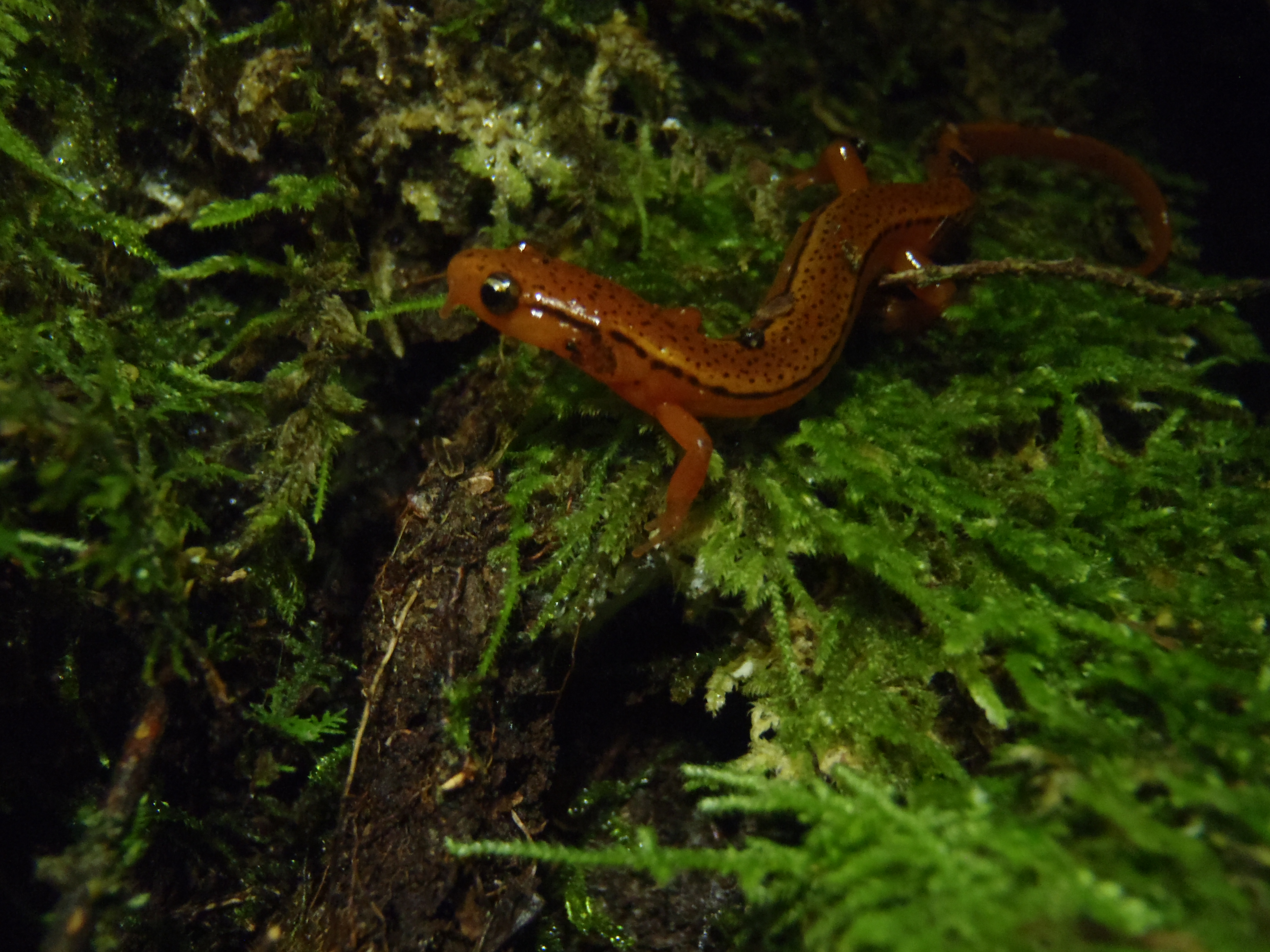
Tap any photo to see it larger.




Salamander FAQ
Why is the Smokies called the Salamander Capital of the World?
Great Smoky Mountains National Park has about 30 species of salamanders, more than almost anywhere else, thanks to old, wet, rugged mountains where populations have diversified for millions of years.
Do salamanders really have no lungs?
Most salamanders in the Southern Appalachians belong to the lungless family and breathe through their skin and the lining of the mouth.
Are hellbenders dangerous?
No. Despite the name, hellbenders are harmless to people. They are a sign of clean, healthy rivers.
What is the state salamander of North Carolina?
The marbled salamander, adopted in 2013.
Can I pick up a salamander?
It is best not to. If you must move one off a road, wet your hands first and avoid sunscreen or bug spray. Collecting is not allowed in national parks.
Where can I see salamanders in North Carolina?
Shaded streams and seeps in the mountains, especially in Great Smoky Mountains National Park, the Nantahala and Pisgah national forests and along the Blue Ridge Parkway, on warm rainy nights in spring and summer.
Sources and further reading
- National Park Service, Great Smoky Mountains salamanders
- National Park Service, Why rock stacking harms salamanders
- NC Wildlife Resources Commission, Eastern hellbender
- North Carolina General Assembly, state symbols (G.S. 145)
- U.S. Fish and Wildlife Service, Neuse River waterdog
- U.S. Geological Survey, Batrachochytrium salamandrivorans
- Amphibians and Reptiles of North Carolina

Christopher Adkins is a Huntersville, North Carolina attorney, the founder of Adkins Law, PLLC, and the editor of The Lake Norman Brief. A Charlotte native, former Army officer and former CMPD officer, he writes these guides to share the wild places that make North Carolina home.
Keep exploring wild North Carolina
 Nature atlas home
 Bears, elk, wolves & wild horses
 Nature calendar & fall color
 Blue Ridge Parkway
 Fireflies & night skies
 Outer Banks
 Lake Norman’s wild side
 Venus flytrap & carnivorous plants
 Mountains
 Piedmont
 Coast & Coastal Plain
 Waterfalls
 250 hiking trails
 Wildlife field guide
 Plants & trees
 Lakes & river basins
 Mount Mitchell & Kuwohi
 Nature by the numbers
 Intracoastal Waterway
 Article directory