
Religion & Philosophy / Philosophy / Socrates
Socrates · Chapter 04 of 05
The Trial of Socrates: Conscience before the City
The accusation, the defense, the offer of escape and the final conversation.
Curated by Christopher Adkins of Huntersville, NC

Can refusing an order coexist with respect for law? David turns the final conversation into a neoclassical drama of conviction. The elderly Plato at the foot of the bed is a deliberate artistic addition: Plato’s Phaedo says he was absent.
Jacques Louis David; The Metropolitan Museum of Art, Catharine Lorillard Wolfe Collection, Wolfe Fund, 1931 (31.45) · Public domain.


Explore the historical images.
01 / 08
What was Socrates accused of?
In 399 BCE, Socrates faced prosecution in Athens for impiety and corrupting the young. Plato’s Apology 24b–c gives an accusation involving the city’s gods and the introduction of new divine things or agencies. English translations differ in rendering the religious vocabulary. It is safer to explain the substance than to import the exact categories of a modern church or criminal code.
Meletus, Anytus and Lycon appear as the accusers. Plato’s work preserves a defense, not a full record containing every prosecution argument and juror’s reasoning. That asymmetry matters. It is possible to criticize the conviction without imagining that we possess a complete modern transcript. We should also distinguish what Socrates says the formal charge is from his account of older rumors that had damaged his reputation.
The opening of the defense makes those rumors central. He describes a caricature of a clever intellectual who investigates the heavens and earth and makes a weaker argument appear stronger. Aristophanes’ Clouds belongs to that world of public representation. In Plato’s presentation, Socrates has to answer both a defined accusation and an accumulated image of the sort of person he is supposed to be. The second task may be harder because its makers are no longer all present to be questioned.
02 / 08
A defense of a way of living
The title Apology means a defense speech. It does not indicate an apology in the modern sense of expressing remorse. Socrates explains his examination of reputed wisdom, denies the educational enterprise his critics attribute to him, and presents his activities as a service connected with a divine obligation. His argument asks the city to reconsider what it calls benefit and harm.
The exchange with Meletus turns the methods of inquiry toward the accusation. Who improves the young? Could a person consistently deny gods while believing in divine agencies? Is the alleged corruption intentional or unintentional? These arguments are distinctive pieces of Plato’s literary defense. A reader can assess their strength without assuming that every point must have been decisive or that the trial unfolded exactly as the surviving speech presents it.
The most consequential passage may be Apology 29c–30c, where Socrates considers being released on the condition that he stop philosophizing. He says he would continue. This is a hypothetical statement of principle within the speech, not evidence that the jury formally offered an uncomplicated choice between recanting and death. Keeping that distinction clear prevents a powerful moral scene from becoming an inaccurate account of the proceedings.
“I shall obey God rather than you”
Plato, Apology 29dBenjamin Jowett

03 / 08
The penalty phase and its provocation
Plato presents the verdict and the assessment of penalty as distinct stages. After conviction, Socrates must respond to the proposed punishment. His suggestion that a civic benefactor deserves maintenance in the Prytaneum is pointedly provocative. He eventually proposes a fine supported by friends. The passage combines irony, argument about desert and a refusal to treat his philosophical activity as a shameful offense. See Apology 35e–38b.
It is tempting to diagnose the speech as bad litigation strategy and leave the matter there. But that assumes persuading the jury at any moral cost is the proper measure of success. Socrates argues that certain tactics would compromise what he ought to be. The conflict is between securing a favorable result and preserving the integrity of the speech by which he seeks it.
The opposing concern deserves attention. A person’s judgment about dignity may become needlessly theatrical, and others may bear the consequences. Crito will later press the obligations attached to friendship and children. The philosophical power of the trial depends on taking that cost seriously. Socrates’ resolve does not spare the reader the question of whether every expression of resolve was required, or whether courage and persuasion might sometimes have been reconciled differently.
04 / 08
Crito’s practical argument
The prison conversation in Crito begins with urgency. Escape appears possible. Money, arrangements and willing assistance are available within the story. Crito argues from affection, reputation and family obligation: Socrates’ friends may look negligent, and his children will lose their father. The argument is not merely cowardice speaking. It represents goods that an ethical theory must explain rather than dismiss.
Socrates asks whether the proposed escape would be just. He refuses to replace the principles they formerly accepted simply because danger has arrived. Their conversation therefore becomes a test of whether reasoning remains authoritative under pressure. The question is not whether survival matters, but whether survival is the only relevant good or an overriding excuse for every means of securing it.
The dialogue’s form is important. Crito is not an abstract representative of selfishness; he is a friend trying to preserve a person he loves. Socrates is not arguing from a safe distance. Both know that the decision will be costly. A reader need not agree with the eventual refusal to appreciate this attempt to prevent fear from silently rewriting the standards by which a decision is made.

05 / 08
When the Laws begin to speak
At Crito 50a–54d, Socrates imagines the Laws addressing him. They invoke the institutions that made his civic life possible, his long residence, and the consequences of individuals setting aside judgments for private advantage. The argument brings gratitude, consent and the stability of a legal order into the same dramatic speech.
These are not interchangeable reasons. Receiving benefits is not identical to freely agreeing to every future command. Remaining in a country can be a complicated form of consent. A claim about preserving institutions does not automatically establish that every application of those institutions is just. Readers should separate the arguments and test each one, rather than accepting their emotional accumulation as a single proof.
The personification also creates interpretive distance. The Laws speak inside a dialogue written by Plato and imagined by Socrates. Their full relation to Socrates’ own position is debated. What is clear is that the escape is evaluated as an action within a network of civic obligations. The reader is asked to consider not only what the city has done to Socrates, but what Socrates’ response would do to others and to the commitments through which he has lived.
06 / 08
Why this is not a simple command to obey everything
The apparent tension between Apology and Crito is one of the collection’s most important questions. In the defense, Socrates says he would continue philosophizing despite an order to stop. He recounts refusing the Thirty’s command concerning Leon. In the prison dialogue, he refuses escape. A slogan that he always obeyed the state cannot accommodate all three passages.
Possible interpretations distinguish obeying a particular wrongful command from accepting the consequences of one’s refusal; distinguish the legal order from the wrong done by particular citizens; or emphasize the specific commitments of Socrates’ own life in Athens. None should be smuggled in as an uncontested solution. The texts sustain a difficult inquiry into conscience, law and obligation.
For contemporary readers, the strongest lesson may be the refusal of shortcuts. Private certainty is not automatically moral authority, and official authority is not automatically justice. Responsible dissent must examine reasons and consequences; responsible citizenship must preserve the possibility of criticism. The ancient dialogues do not provide a ready-made answer to every modern conflict. They give us a disciplined way to see why those conflicts are morally serious.

07 / 08
The final conversation is philosophy and literature
Phaedo recounts the final day through a conversation in which Phaedo tells Echecrates what happened. That framing is easy to forget when the prison scene becomes vivid. Plato explicitly places himself outside it through the report that he was ill. The dialogue is therefore a crafted account with a named narrator, not a claim that Plato personally transcribed each word at the bedside.
Its arguments about the soul’s immortality are more extensive than the simpler moral posture often attributed to the historical Socrates. They include objections and replies, reminding the reader that composure in facing death is not a substitute for examining a proof. The dialogue even reflects on the danger of becoming hostile to argument after being disappointed by bad arguments.
The execution by poison closes the narrative in grief and controlled detail. Socrates’ final request concerning a debt to Asclepius has attracted competing interpretations; it should not be converted into a single certain message about life being a disease. The death is a historical event mediated by an extraordinary literary construction. Its force is not diminished by recognizing that construction. We can be moved by a scene while still asking what its arguments establish.
08 / 08
How a later century pictured the verdict
Jacques Louis David’s The Death of Socrates, painted in 1787, gives moral composure a visible architecture. The horizontal stone setting makes gesture unusually legible: one figure reaches, another turns away, and the central body remains composed. The painting asks viewers to read an arrangement of hands, faces and postures as a statement about conviction.
It also changes the ancient account. Plato becomes an elderly witness at the foot of the bed although the dialogue says he was absent. That choice acknowledges the writer through whom the scene reached later audiences. The museum’s early composition study makes the process of invention still more visible. The image was developed and revised; its authority is artistic rather than eyewitness.
Return from the painting to the texts with that distinction in mind. The memorable image invites admiration, while the dialogues invite argument. We need both capacities, but they do different work. The trial remains philosophically alive when readers can ask whether Socrates was right, whether Athens was just, and whether the reasons offered for his final choices should govern anyone else. A monument closes a story; serious reading opens it again.
The visual reading room
Look closely. Ask better questions.
Eight images invite a slower look at places, portraits, manuscripts, and later interpretations. Can refusing an order coexist with respect for law? Select any image to enlarge it; the source and reuse credit remain with every item.


Geographic orientation
Ideas have places. Maps have histories.
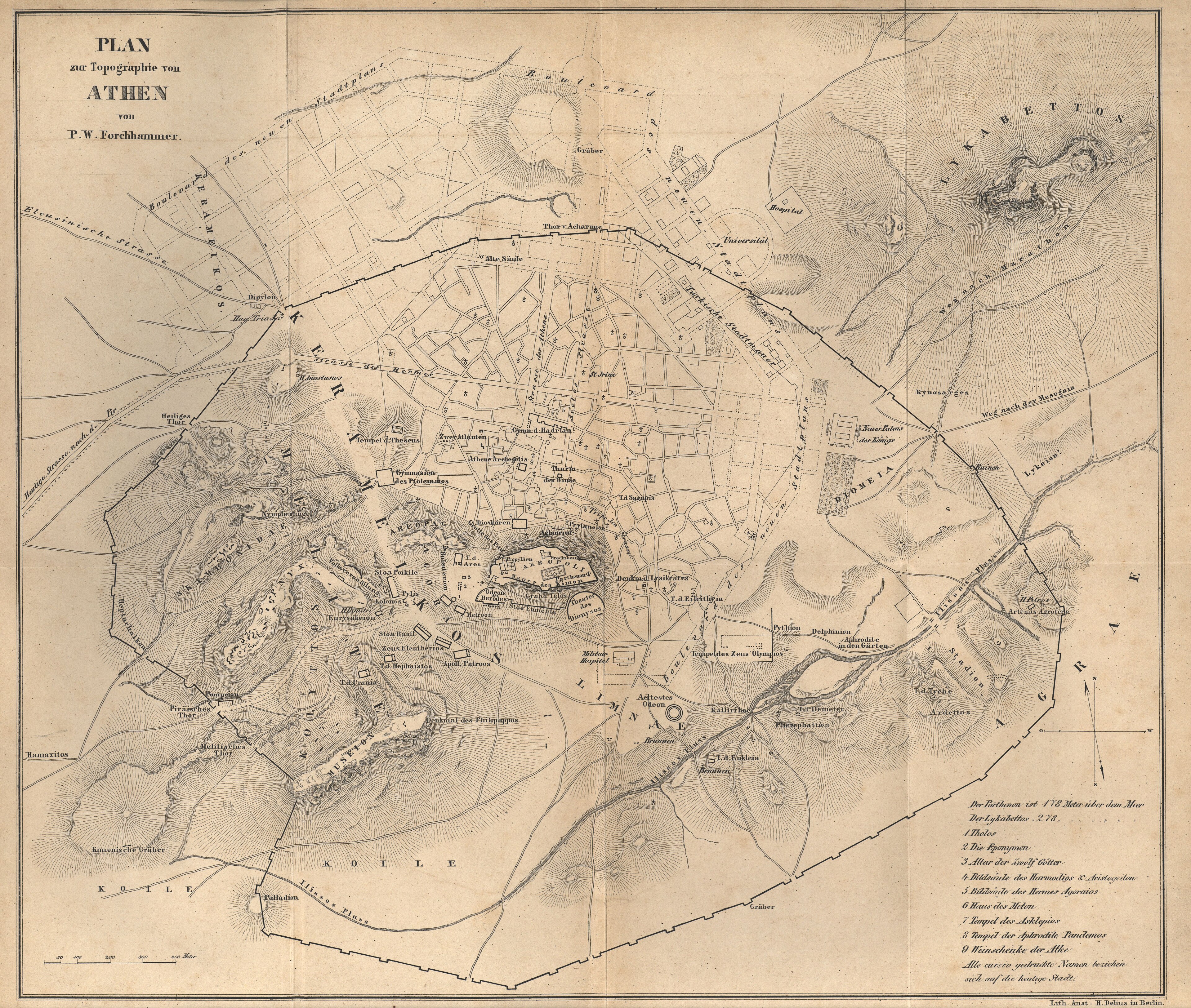
Athens supplies the civic and intellectual setting for much of this collection: public argument, Socrates’ trial, Plato’s Academy, and Aristotle’s Lyceum. Keep the differences between those institutions and generations in view.
Forchhammer’s 1841 plan is a historical reconstruction of ancient Athens. Its labels and proposed identifications belong to nineteenth-century scholarship; it is not a modern excavation plan or a photograph of the ancient city. Use it for orientation, then consult current site scholarship.
The argument workshop
Conscience in the courtroom
Can refusing an order coexist with respect for law?
Read the Apology beside the Crito. One presents a commitment to questioning even under threat; the other stages arguments against escape after conviction. The tension deserves analysis rather than a slogan about obedience or rebellion.
1. Identify the different decisions
A command to stop philosophizing and a plan to escape prison are different acts, with different proposed reasons. Do not assume that one answer automatically settles both.
2. Hear the strongest challenge
If a judgment is unjust, why should it bind? If each person privately exempts himself, what sustains a common legal order? Both questions belong in the comparison.
3. Keep the speakers visible
The Laws speak within Plato’s dramatic construction. Ask which premises Socrates accepts, how the dialogue supports them, and whether his conclusion has been made universal or remains tied to his circumstances.
Return to the chapter’s primary-text anchor: Plato, Apology 29d. These exercises are editorial prompts, not quotations from the philosopher.
Check the distinction
Read the answer and explanation
A hypothetical case in Socrates’ reported argument Plato presents Socrates considering the hypothetical condition. Treating the passage as a documented jury offer turns a philosophical scenario into unsupported procedural history.
Continue the conversation
Follow the question into another room.
These are invitations to comparison. A shared question does not make different thinkers or traditions interchangeable.
Justice and power
Continue from Socrates’ trial to Plato’s investigation of justice and political education.
Explore this connection →Citizens and speakers
Compare law, civic participation, and persuasion in Aristotle’s political analysis.
Explore this connection →Tocqueville
Broaden the inquiry into democratic life, civic associations, and the pressures of majority opinion.
Explore this connection →Confessions and reading
Consider the relation between individual conviction and a community’s articulated commitments.
Explore this connection →Pause · question · discuss
Carry the argument further
Was Socrates formally offered release if he stopped asking questions?
The Apology discusses that possibility hypothetically. It should not be reported as a documented offer by the jury.
Does Crito say every unjust law must be obeyed?
It gives a dramatic argument about this escape and Socrates’ civic obligations. Its relation to the principled disobedience described in Apology is a central interpretive problem.
Was Plato present at the death?
Phaedo says Plato was absent because he was ill. His presence in David’s painting is an artistic addition.
The reading room
Primary texts and source notes
- Plato, Apology24b–c: charges; 29c–30c: hypothetical condition; 35e–38b: penalty.
- Plato, CritoThe full prison dialogue and the speech of the Laws.
- Plato, PhaedoNarrative frame, arguments about the soul, and the final scene.
- The Met: David’s painting1787 painting, provenance and interpretation.
- The Met: David’s early drawingComposition study, about 1782.