Art & Literature / Kurt Vonnegut
Slaughterhouse-Five
Dresden and the time it takes to tell a war story
In February 1945, Kurt Vonnegut survived the firebombing of Dresden in a meat locker. In 1969 he published a book about a man who keeps finding his way back there, even at his wedding anniversary party.
Curated by Christopher Adkins of Huntersville, NC

Dresden · February 1945
The firebombing of Dresden
What could a prisoner in a cellar know about a burning city? Move between the historical record, a survivor’s letter and the scenes Vonnegut gave to Billy Pilgrim.

Before February 1945
Who was in the city?
The historical record
A photograph made for tourists picks out the dome, the square and the surrounding houses. By early 1945 Dresden was also a rail junction crowded with people fleeing west. Among those brought into the city under guard was a young American soldier from Indianapolis. A postcard could show where these people were. It could tell you very little about who was free to leave.
Reading Vonnegut
In chapter six, the prisoners get their first view of Dresden. Give yourself a moment to imagine being new to the city and finding it beautiful. Billy has that moment. A reader who recognizes the city’s name may have to work to recover it.

Night of February 13–14, 1945
What could a prisoner know from underground?
The historical record
Britain’s Royal Air Force bombed Dresden overnight. Fires spread through the built-up center and merged into a firestorm. Kurt Vonnegut and other American prisoners survived in an underground meat locker at the slaughterhouse. People caught elsewhere in the city had very different chances of finding shelter.
Reading Vonnegut
Vonnegut gives Billy no window onto the burning city. The reader waits with him below ground. When the guards eventually see what has become of their home, their faces register something the men in the cellar could never have put on a map. Billy will recognize those faces years later at a party.
Vonnegut’s account of the shelter · Follow the quartet scene


February 14–15, 1945 and after
Coming up into daylight
The historical record
American aircraft attacked on February 14 and 15. The burned-out Frauenkirche collapsed on the 15th. For survivors, the loss of a landmark came amid more urgent searches for people, shelter and a way through the streets. Prisoners, including Vonnegut, were put to work recovering the dead. Dresden’s historical commission later estimated that up to 25,000 people died in the February raids.
Reading Vonnegut
Richard Peter made this photograph months later. Follow the statue’s hand toward the street, then imagine making the same journey on foot. In chapter eight the distance between those two views is what Billy has to communicate to someone who has never set foot in Dresden.
The Frauenkirche’s account · The evidence behind the death toll · Read chapter eight
“But not me.”
Read the letter excerpts at The National WWII Museum.
May 1945 and 1969
How do you tell your family you lived?
The historical record
After liberation, Vonnegut wrote from Camp Lucky Strike in France. His family might still have known him only as missing in action. In a few pages he had to get them from his capture in December to the good news that he was alive. His own early estimate of Dresden’s dead was far too high. The letter is closest to the event when it describes what happened to him.
Reading Vonnegut
Twenty-four years later he gave readers an entire novel in which to consider the distance between the dead and those three words about himself. Try reading the letter before chapter one. When Mary O’Hare challenges him about the book he will write, you can hear how much its audience has changed since he first addressed his family.
The National WWII Museum on the letter · Read Mary O’Hare’s challenge
One square in Dresden, across a century
Find the dome of the Frauenkirche in the first view, then look for its footprint in the second. When Vonnegut published Slaughterhouse-Five in 1969, the church still stood in ruins. The skyline familiar to a visitor today came later. The church’s reconstruction history.


Neumarkt, Dresden
What Dresden kept, stone by stone
Look closely at the wall of the Frauenkirche. Dark blocks interrupt courses of pale sandstone. Each one posed a question for the builders who lifted it from the rubble. Where had this particular stone been on the morning the dome fell?
Curated by Christopher Adkins of Huntersville, NC.


How much of the old church survived?
The foundation counts 8,425 reused cut stones, including 7,110 in the façade. It estimates that about 45% of the whole building’s stone material is historic when surviving portions of the ruin and the lower church are included. Inside, builders returned 1,642 altar fragments to their original places.
Vonnegut’s readers in 1969 knew the Frauenkirche as a ruin. We can look at the rebuilt wall and see two dates at once. Its dark stones do something the backwards film in the novel cannot do. They let a city recover a building while leaving the damage visible.

This guide discusses the ending of Slaughterhouse-Five. Chapter references work across editions.
How do you write the city you survived?
Before Billy Pilgrim goes to war, a grown man sits down with a roll of wallpaper and some crayons. Vonnegut tells us he tried to draw the book he wanted to write about Dresden. Each person could have a colored line, and the lines could meet where their lives crossed. He had the paper, the colors and the experience. Why did it still take him so long to write the book?
Consider the predicament of a survivor who wants to describe a city being destroyed. Vonnegut spent the raid in a cellar. A panoramic account would give him a view he never had. Billy Pilgrim offers another possibility. We can wait underground with him, come out when he does, and see four men’s faces without yet knowing why he will remember them. The gaps in what Billy sees are part of what Vonnegut can tell the truth about.

The soldier who became the narrator
In December 1944, Private First Class Kurt Vonnegut was an intelligence scout in the 423rd Infantry Regiment of the 106th Infantry Division. German forces captured him on December 19. He passed through Stalag IV-B before a work detachment took him to Dresden.
Billy Pilgrim enters the novel as a chaplain’s assistant. Giving him a different job matters. A scout is trained to observe and report. Billy spends much of the book trying to understand what he has already seen.
Read the National WWII Museum’s account and Vonnegut’s 1945 letter.
Reading the novel’s structure
Billy’s life in two orders
A calendar puts Dresden near the beginning of Billy’s adult life. Vonnegut can take us past Billy’s death before he lets us see the faces of the men coming out of the cellar. Switch the order of these five scenes and watch what happens to Dresden.
- 1944Lost in the ArdennesCh. 2
- 1967A speech at the Lions ClubCh. 3
- 1976Billy foresees his deathCh. 6
- 1968The Vermont plane crashCh. 7
- 1945The guards see DresdenCh. 8
In chapter order, we know how Billy expects his life to end before we learn what he saw in Dresden.
Each chapter link opens the notes for a scene told there. Billy’s early life summary anticipates several of these events. The years describe his fictional life. Compare the book’s chronology.
Ten chapters, ten scenes to read closely
Open the chapter you have in front of you. Each note follows a particular exchange, object or phrase and ends with a question you can take back to the text.
Ch. 1The promise in the O’Hares’ kitchen
Mary O’Hare has heard enough veterans talking. She knows what will happen when their stories reach a movie screen. Grown men will play the boys who went to war, and the children in the audience may envy them. Vonnegut lets her interrupt the afternoon he had arranged to collect material from her husband. Her interruption gives him the subtitle of his book, The Children’s Crusade, and a standard by which we can judge every scene that follows.
When Billy first appears in uniform, what part of the promise to Mary can you see?
Ch. 2Roland Weary casts the rescue party
Behind German lines, Roland Weary has an audience of one for his account of military fellowship. He has promoted himself and two scouts into an inseparable band. The scouts have their own idea about whom to travel with. Billy can barely keep walking. On a second reading, watch how often a blow follows a disappointment in Weary’s story. A boy who wants badly to be somebody’s rescuer can still make another boy afraid of him.
Who has agreed to play the parts Weary has assigned?
Ch. 3A prisoner poses, a veteran listens
A German photographer wants a picture of a surrender, so Billy has to perform his capture for the camera. Years later, a Marine major speaks to the Lions Club about bombing North Vietnam. Billy, who has seen a bombed city at street level, sits through the speech. In both scenes someone else has decided how the war should look. His place in the second audience is harder to explain than his obedience in the first.
What could the veteran in that dining room tell the speaker?
Ch. 4The bombing film runs backward
Awake after his daughter’s wedding, Billy watches a war film. As he sees the action in reverse, damaged planes recover and bombs gather up a city’s fires. Then his imagination goes beyond what a camera aboard an aircraft could possibly have filmed. People far from the target begin undoing the manufacture of the weapons. His desire to save the city takes him all the way back to an ordinary working day.
Where does the footage end and Billy’s act of imagination begin?
Ch. 5The books beside the hospital bed
Eliot Rosewater introduces Billy to Kilgore Trout in a veterans’ hospital. Two people who have found ordinary accounts of life hard to believe can pass a paperback back and forth. On Tralfamadore, Billy encounters books whose separate moments can be taken in together. Read the bedside exchange beside that alien account of reading. One offers a theory of how a book works. The other gives a lonely reader some company.
What can Rosewater give Billy simply by handing him a book?
Ch. 6An address a prisoner can learn
Paul Lazzaro promises a future in which an injury will be repaid. Billy sees his own death far ahead. Then a train reaches Dresden, a city the hungry prisoners find beautiful, and the surviving men learn the address of their quarters. A reader already knows what that address will mean for literary history. For a newcomer walking through the gates, it is something much smaller and more urgent to remember in a strange language.
How does it feel to recognize the title while the prisoners are still learning the words?
Ch. 7A spoonful through the window
After the Vermont plane crash, the battered Billy speaks the address he learned as a prisoner in Dresden. The men trying to help him have every reason to find this strange. Back at the malt-syrup factory, a different exchange needs no translation. Billy passes a spoon through a window to hungry Edgar Derby, who cries when he tastes it. For a moment the large question of what one survivor owes another has an answer that will fit in a hand.
What does the spoon tell you about Derby before you reach the account of his death?
Ch. 8The faces of four singers
Howard W. Campbell Jr. offers the prisoners a story about their place in the war, and Edgar Derby stands up to answer him. At Billy’s anniversary party years later, the obstacle is finding any words at all. Four men sing, his guests see his distress, and several explanations are offered before Billy can make his own connection to four guards in Dresden. Follow the interval between recognizing a face and being able to tell somebody what it means.
Who gets to hear Billy tell the story after the guests have gone?
Ch. 9A witness in the next bed
In a hospital room shared by Billy and the historian Bertram Copeland Rumfoord, the documents about Dresden have arrived before the witness. Rumfoord can discuss the raid while treating the man in the next bed as incapable of adding anything. One of Vonnegut’s sharpest jokes is a matter of distance. An authority who can see a whole war from above has trouble hearing a voice a few feet away.
What changes when Rumfoord finally treats Billy’s words as an answer addressed to him?
Ch. 10The unlocked door
The narrator names Martin Luther King Jr. and Robert Kennedy before the story returns to the prisoners working in Dresden. The deaths in the America from which he writes belong on the same last pages as the war he remembers. Liberation reaches the prisoners one morning in the form of a door they can open. Beyond it there is spring, a street and a bird. Read back to chapter one and notice how long the narrator has known that this is the sound with which he will leave us.
Who could answer the bird’s question, and what would you want that answer to accomplish?
What an optometrist can see
In Ilium, Billy earns a living asking people to look through a lens and describe what they see. He has a practice, a family and a place at the Lions Club. Vonnegut can put him back on a winter road among prisoners in the time it takes a patient to blink. His professional success makes that cut more unsettling. There is plenty of evidence to show his neighbors that Billy has come home. What evidence would show them where he goes when he closes his eyes?
Barbara hears her father talk in public about alien abduction and worries about the man she loves. Billy regards the same announcement as good news he ought to share. Try reading the scene once with each of them. From Barbara’s side, a family is running out of ways to help. From Billy’s, a man has finally found words for something enormous and his family would like him to stop talking. Vonnegut gives each of them good reason to feel unheard.
What the Ardennes map leaves out
Locate St. Vith on the Army map, then look at the road in the photograph. From a headquarters, the road is a connection between towns. From a seat in the last truck, it is the vehicle ahead and the wait for it to move. Vonnegut takes the scale down once more, to Billy’s ill-fitting clothes and feet. Read the Schnee Eifel and 106th Infantry Division chapter alongside the novel’s account of capture.


Follow the campaign in the Battle of the Bulge atlas and the illustrated history of St. Vith.
From a division on paper to a parcel in someone’s hands
The 106th Infantry Division reported 6,697 prisoners. Vonnegut later joined a 150-man labor detachment sent from Stalag IV-B to Dresden. These counts describe different groups. The first tells a family how easily one missing son could disappear in the Army’s paperwork. The second brings us closer to the scale at which another prisoner might know his name. The National WWII Museum’s account.


Try reading the photograph from the edge inward. Where does the line begin? Who can see what is being handed over? Questions that basic take us closer to the daily business of captivity than the sweep of a campaign arrow. Compare the Army maps for December 16 and 19.
Would you take the Tralfamadorians’ advice?
Think of a photograph of somebody who has died. You can return to a moment in which that person still lifts a hand or leans toward the camera. Tralfamadore offers Billy an extravagant extension of that familiar comfort. For the aliens, every moment of a life continues to exist, available to a creature that knows how to look. No wonder Billy wants to bring the news home.
The difficulty begins when the aliens tell Billy where to direct his attention. If a happy moment and an unbearable one are equally available, looking at the happy one seems sensible. Apply that advice to this page. A reader could stay with the prewar square and skip the ruins. Vonnegut spent years arranging a book that would keep bringing us back to the people who had to walk through them. His practice as a writer gives us grounds to argue with his aliens.
Can a telescope see the past?

The bright spiral and the faint red smudge beside it share a patch of our sky. Their light can have left home billions of years apart. The telescope brings those arrivals together in one picture. It gives Billy’s way of seeing time a visual analogy we can actually look at.
The difference is what the viewer can do. Hubble receives light that has traveled here. Billy can find himself back in a prisoner’s boxcar, hearing and feeling it again. For a reader, the disturbing question is whether he has any say in when that happens.
What would a clock record?
Two clocks can measure different elapsed times and meet again. Motion affects their readings, and gravity does too. GPS has to account for both effects. Each clock still ticks forward along its own path. Vonnegut gives Billy a different power and a different problem. Billy can know what comes next and still be unable to help the person beside him.
Follow the clock experiment in Special Relativity and Time Dilation, then see what gravity adds in Spacetime and Gravity. NASA’s illustrated guide to time travel explains the GPS example.
How much time does a satellite gain in a day?


Imagine synchronizing two clocks. One stays on Earth and the other goes into GPS orbit. Relative to the ground clock, motion costs the satellite about seven microseconds a day. The weaker gravitational field at its altitude adds about forty-five. Left uncorrected, it comes out ahead by about thirty-eight.
Both clocks pass through the intervening seconds. Billy can walk through a door in one decade and emerge in another. That distinction matters most at the anniversary party, when a set of faces takes him back to Dresden even though he stays in the room. Follow the sequence in chapter eight.
Knowing the ending changes the middle
Vonnegut tells us early what will happen to Edgar Derby. That decision changes a small gesture halfway through the book. When Billy hands him a spoon, we already know how little time Derby has left to take pleasure in anything. Try imagining the same passage with his fate held back for a surprise ending. The taste of syrup would lose something that no amount of suspense could restore.
Read the words “So it goes” aloud after two different deaths. The words take the same time to say on both occasions. The silence afterward can feel quite different. Vonnegut has written a refrain whose delivery he leaves to the reader. Said impatiently, it hurries a death off the page. Said slowly, it can give that person the only pause the story allows.
How four faces bring Dresden into the room
Follow the order in which Billy comes to understand his reaction in chapter eight. The last movement matters as much as the first two.
- At the anniversary partyFour friends sing together. Billy feels ill before he can explain what has upset him.
- Back at the cellar doorHe recalls four German guards seeing Dresden after the raid. Their stunned faces supply the likeness he could not place.
- Telling MontanaWhen Montana asks about the war, Billy can tell someone else what the guards saw. A private association has become a story.
The distinction is in the verb. Here Billy remembers. The quartet gives him a way to recognize something his trips through time have never taught him to say. Read the chapter eight notes.
The people who answer back
Mary O’Hare objects to a book that her visitor has yet to write. Imagine the nerve that takes. Two old friends have come together to talk about a terrible time, and someone who stayed home tells them what their story might do to the children in the house. Vonnegut dedicates the finished book to her and to Gerhard Müller, the Dresden taxi driver who took the two Americans through his city. The dedication makes room for two people a conventional soldiers’ memoir could easily have left out.
Edgar Derby also speaks up when good manners would make it easier to stay seated. Campbell, an American serving the Nazis, wants hungry men to hear his offer as a generous one. Derby answers in public, with no reason to expect the answer will help him. His own death over a teapot makes this scene worth lingering over. A court can enter a verdict against Derby. A reader who has heard him speak possesses evidence of another kind.

Dresden in February 1945 and in Vonnegut’s novel
What lay above the cellar
British aircraft attacked on the night of February 13–14, 1945. American raids followed on February 14 and 15. Dresden was a rail and industrial center, a home for civilians, and a stopping place for refugees fleeing the east. Each description names people who could be on the same street for entirely different reasons. The German Historical Museum’s account of the raids.
After the raids the prisoners were sent to recover bodies. That work gives a different weight to the novel’s famous reversal of a bombing film. Run the film backward and the shattered buildings reassemble. The people doing the recovery work had to live in the direction the film normally runs. Read the WWII air-war statistics beside the history of everyday life in wartime Germany to compare what a sortie count and a civilian account can each show.
How many people died in Dresden?
The figure of 135,000 repeated in the novel far exceeds the upper estimate of 25,000 in the Dresden historians’ commission’s 2010 report. Vonnegut could describe a cellar, a street, and the recovery of the dead from personal experience. Establishing a citywide toll required historians to compare burial records, death registrations, and individual names. A reader can take the witness seriously and follow the better evidence on the count. Read the city commission’s findings (PDF, in German).
The suffering of Dresden’s civilians belongs to the history of a war Nazi Germany started and of the Holocaust it perpetrated. The question the novel keeps pressing is what a person owes the dead even when their government was the enemy.
Four dates in Vonnegut’s life and work
- December 19, 1944
- Vonnegut is captured in the Ardennes. In the novel, Billy’s peacetime life keeps interrupting the march into captivity.
- February 13–15, 1945
- Allied aircraft bomb Dresden. The prisoners experience the city from underground and encounter the scale of the loss afterward.
- May 1945
- Back in France, Vonnegut writes to his family. The letter moves quickly through events that the novelist will take decades to approach.
- 1969
- The novel appears during the Vietnam War. Its first chapter makes room for Mary O’Hare’s fear that a book about young soldiers might make war look like an adventure.
America in 1967
A second war at the Lions Club
In chapter three, the Lions Club invites a Marine major to lunch. He calls for heavier bombing in North Vietnam. Billy’s son is serving there. Billy himself has walked through a city after an air raid. Of all the men in the room, he might have the most interesting question for the speaker. He lets the occasion pass.


These photographs record two public positions a person could take in 1967, the year of Billy’s fictional luncheon. Look at the labor it took just to appear in one of these pictures. Someone had to make a sign, get to the gathering and carry it where strangers could read it. What would count as the equivalent gesture in a dining room when the people listening are your neighbors? Vonnegut leaves that uncomfortable question on the table.
Read the history behind the speaker’s analogy in the World War II air-war statistics, then return to Billy’s backward bombing film.
Who gets to invent somebody else’s part?
For Eliot Rosewater and Billy, one pleasure of a Kilgore Trout novel is the discovery that the world might be arranged differently. A shabby paperback can offer that pleasure to a person whom everybody else is trying to restore to ordinary life. Vonnegut is generous about the circumstances in which people read. A story can be clumsily written and still reach a patient in a hospital bed when a perfectly sensible visitor cannot.
Roland Weary reads life in another genre. He has found himself a part in a tale of comradeship and feels cheated when the other soldiers decline theirs. Campbell wants an even larger cast. Read his recruitment pitch beside his part in Mother Night. In both books, the danger starts when a practiced storyteller acquires an audience whose freedom to refuse him is very small.
The bird at the unlocked door
By the last chapter, Vonnegut has named two recently assassinated Americans, Martin Luther King Jr. and Robert Kennedy. The dates overlap in a reader’s mind. The prisoners we are about to see step into spring in 1945 have no way of knowing the news the man telling their story has just heard. He has no way of returning to their spring without taking that news with him.
Then a bird calls. Try giving the last line to a general, a historian or an older Billy looking back. Any one of them could offer a sentence readers would recognize as a conclusion. A bird has no account to settle with a human audience. For the first time in several pages we have to listen to something in Dresden that is alive and getting on with its morning. The dead are still there.


Read the photograph from the ground up. A city can be declared liberated on a particular day. Clearing brick from one street takes the time it takes. That difference helps explain why the bird at the end of the novel can offer neither a verdict nor a tidy last word.
Read the wagon scene twice
On the first reading, stay in the wagon. Billy lies in the sun, briefly comfortable in a city in which almost every comfort has disappeared. On the second, stand beside it with the German couple who stop him. From the ground they can see the horses’ mouths and hooves. The change of viewpoint is only a few feet. It is enough to make one of Billy’s happiest memories the occasion of his first tears of the war.
The novel is full of such small adjustments to the angle of view. The optometrist who asks others to look carefully needs someone to draw his attention to the front of his own wagon. Keep the couple in mind when you revisit the singers at Billy’s party. In one scene other people help him see what is in front of him. In the other, people stand close enough to touch him and still have no idea what he sees.

Questions worth staying with
- Read Mary O’Hare’s objection beside Billy’s staged surrender. Who gets to decide how old a soldier looks to the people back home?
- Trace the five scenes in calendar order. Which one feels most different when you put Dresden first among Billy’s experiences of a bombed city?
- Put Derby’s spoonful of syrup beside the teapot he takes. Why does one small object bring him joy and another bring a death sentence?
- Look at the town hall photograph before rereading chapter eight. What can the camera establish that a man in a cellar could never have seen? What could he tell you that the photograph cannot?
- Read aloud the sentence you would put after the bird’s call. What would the book gain from your sentence? What would it lose?
Sources & further reading
The novel, the soldier’s letter, the city’s historical inquiry and the photographers’ records answer different questions. Start with the novel for Billy’s story, the letter for Vonnegut’s experience, and the commission for the number of people killed.

Kurt Vonnegut, Slaughterhouse-Five (1969)
The ten chapter notes follow the novel in publication order. Cover shown for identification and review.
- Marion S. Trikosko at the Pentagon and Matthew Black at a pro-war marchTwo 1967 photographs in the Library of Congress collections.
- Publisher: Slaughterhouse-Five
- Dresden historians’ commission: final report
- Kurt Vonnegut Society: bibliography
- The National WWII Museum on Vonnegut’s service and 1945 letter
- German Historical Museum on the Dresden air raids
- Frauenkirche Dresden on destruction, the memorial and rebuilding
- NASA Space Place on clocks, gravity and time travel
Historical atlas
From the Ardennes to Dresden
Begin at St. Vith on the Belgian frontier, move east to the prisoner-of-war camp near Mühlberg, then compare two sites within Dresden. The map pins identify places in Vonnegut’s wartime history. His precise transport route is uncertain.
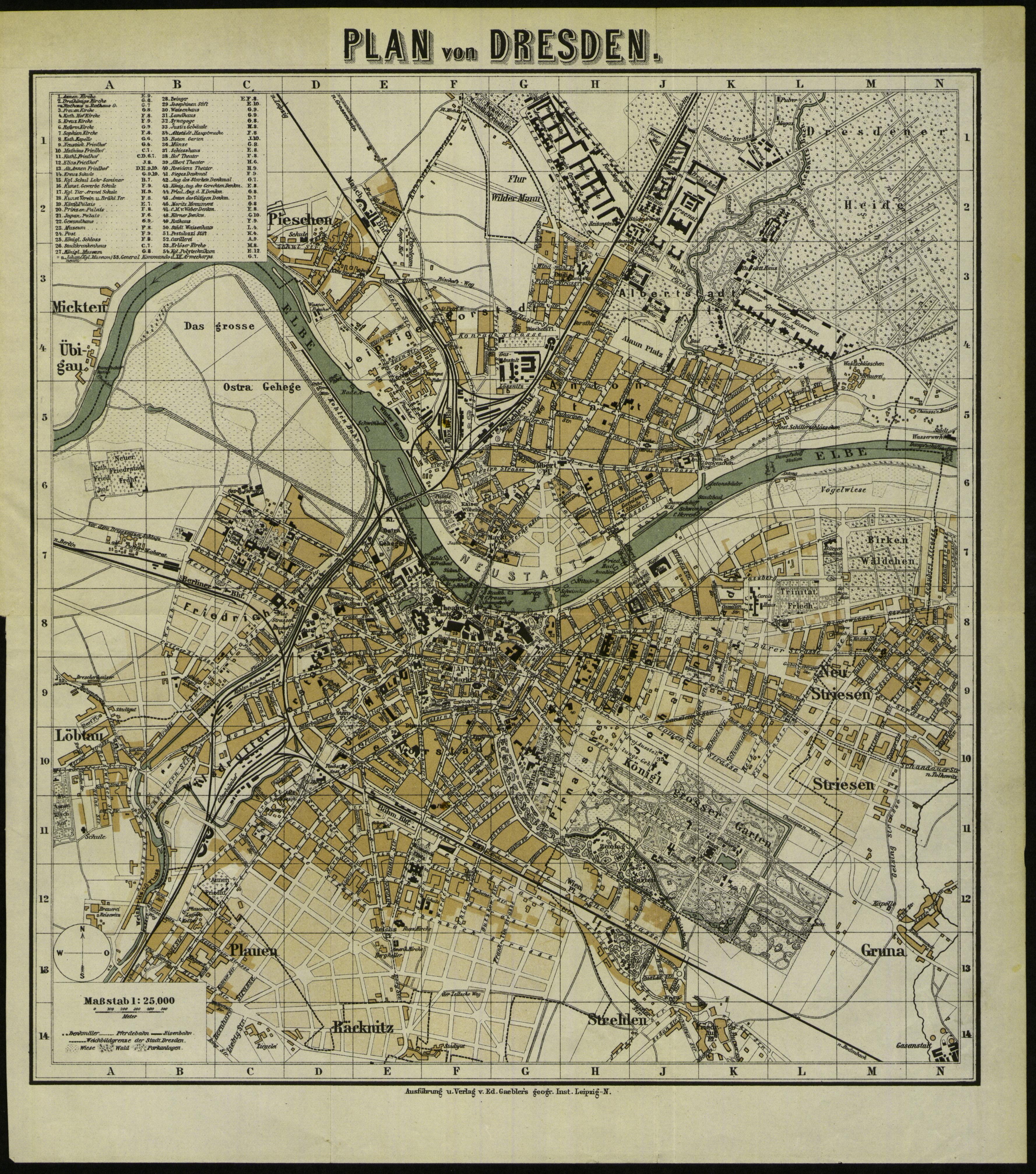
On the 1893 city plan, find the curve of the Elbe and the streets spreading from either bank. It was made for a traveler who wanted to find a way through the city. Read it beside the 1945 photograph, looking for the same river in a landscape whose familiar landmarks have vanished.


The Western Front on the day of Vonnegut’s capture
Open the two headquarters sheets below and find Bastogne on each. The December 16 map shows the front at the opening of the German offensive. Three days later the German advance approached the town, and the American VIII Corps headquarters had moved to Neufchâteau. Vonnegut was captured on December 19. His name appears in the history of that day at an entirely different scale.


Read the Library of Congress map commentary · Follow the 106th Division on the Schnee Eifel.
For a different kind of map, open SLUB Dresden’s collection of 1945–46 damage maps. A headquarters map tracks units over days. A city damage survey asks what happened to each building on a given street. Both can take you to Dresden, but only the second brings you down to the scale of the stones in the Frauenkirche reconstruction photographs.
Modern map and place labels © OpenStreetMap contributors. Direct maps: St. Vith, Belgium · Stalag IV-B near Mühlberg · Slaughterhouse complex, Dresden · Neumarkt and Frauenkirche.
Ilium, New York
Billy’s fictional hometown. A pinpoint on a modern street map would give his optometry practice a spurious address.
Tralfamadore
Vonnegut’s imagined planet belongs on Billy’s personal map. Its inhabitants make time itself look like a landscape. Compare that idea with Hubble’s view of the past.
Keep reading
Where to read Vonnegut next

Cat’s Cradle
Compare the consolations of Bokononism with the philosophy Billy brings home from Tralfamadore.
Read the illustrated guide →

Breakfast of Champions
Trace Kilgore Trout from Billy Pilgrim’s bookshelf into Vonnegut’s 1973 novel about who gets to invent another person’s world.
Read the illustrated guide →

Mother Night
Follow Howard W. Campbell Jr. into Vonnegut’s earlier novel about propaganda and the choices a performance can conceal.
Read the illustrated guide →