


Pacific Theater · Japan · Chapter 7 of 9 · 22 August 1945 – 1974
Wherever Situated: The Surrenders Across Asia and the Pacific
Nanjing, Seoul, Singapore, Hong Kong, Rabaul, Wake: a dozen more ceremonies, three and a half million soldiers to disarm, and a lieutenant who fought on for twenty-nine years.
The ceremony in Tokyo Bay ended the war on paper. Across a quarter of the globe, Japanese garrisons still held cities, islands and prison camps, and each had to be told, in person, by someone it would believe.
Key facts
General Order No. 1
The paper signed on the Missouri surrendered Japan’s armed forces “wherever situated.” Making that true took months. The same morning, Japan’s Imperial General Headquarters issued, at MacArthur’s direction, General Order No. 1, which told every Japanese commander in Asia and the Pacific to whom he was to surrender. Forces in China, Formosa and northern Indochina went to Chiang Kai-shek. Those in Manchuria, northern Korea and Sakhalin went to the Soviets. Southeast Asia from Burma to the Dutch East Indies went to Mountbatten; the bypassed islands of the Pacific to Nimitz; Japan itself, the Philippines and southern Korea to MacArthur. The lines drawn that week for administrative convenience, the 38th parallel in Korea and the 16th in Vietnam among them, shaped the next thirty years.
Japan had some 3.5 million soldiers and sailors outside the home islands and about as many civilians. Many of the garrisons had never been defeated. Some had not been in contact with Tokyo for a year.
The islands
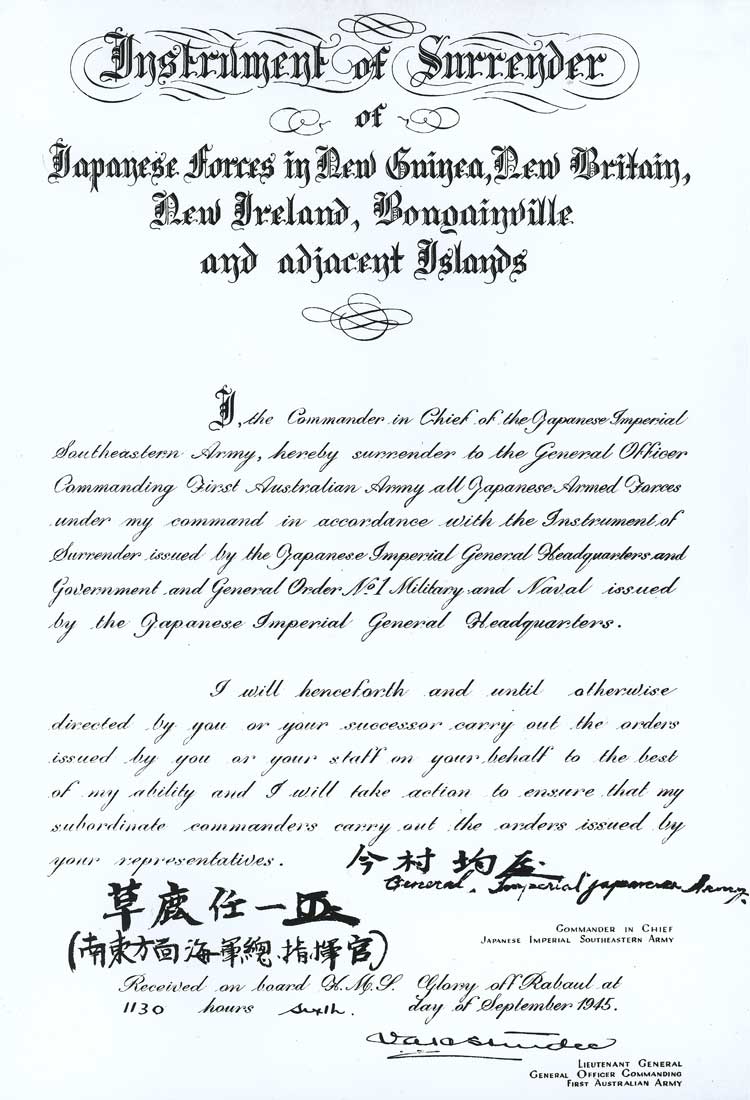
The first to give up were the bypassed garrisons that had been starving since 1944. Mili Atoll in the Marshalls surrendered on 22 August, eleven days before Tokyo Bay. Truk, the great fleet base that American carriers had wrecked and then ignored, surrendered aboard the cruiser Portland on 2 September. On Wake Island on 4 September, Rear Adm. Sakaibara Shigematsu handed over a garrison reduced by hunger to eating rats; he was later hanged for ordering the execution of ninety-eight American civilian prisoners there in 1943. At Rabaul, the fortress that the Allies had spent two years neutralizing, Gen. Imamura Hitoshi surrendered 139,000 men to the Australians on the deck of the carrier HMS Glory on 6 September.
In the Philippines, Gen. Yamashita walked down from the mountains of northern Luzon on 2 September and signed the surrender of his forces at Baguio the next day, with Wainwright and Percival, fresh from the Missouri, watching. He was already under investigation for the destruction of Manila.
Gallery · 6 photographs · select to enlarge
The Pacific islands and the Philippines



China and Korea
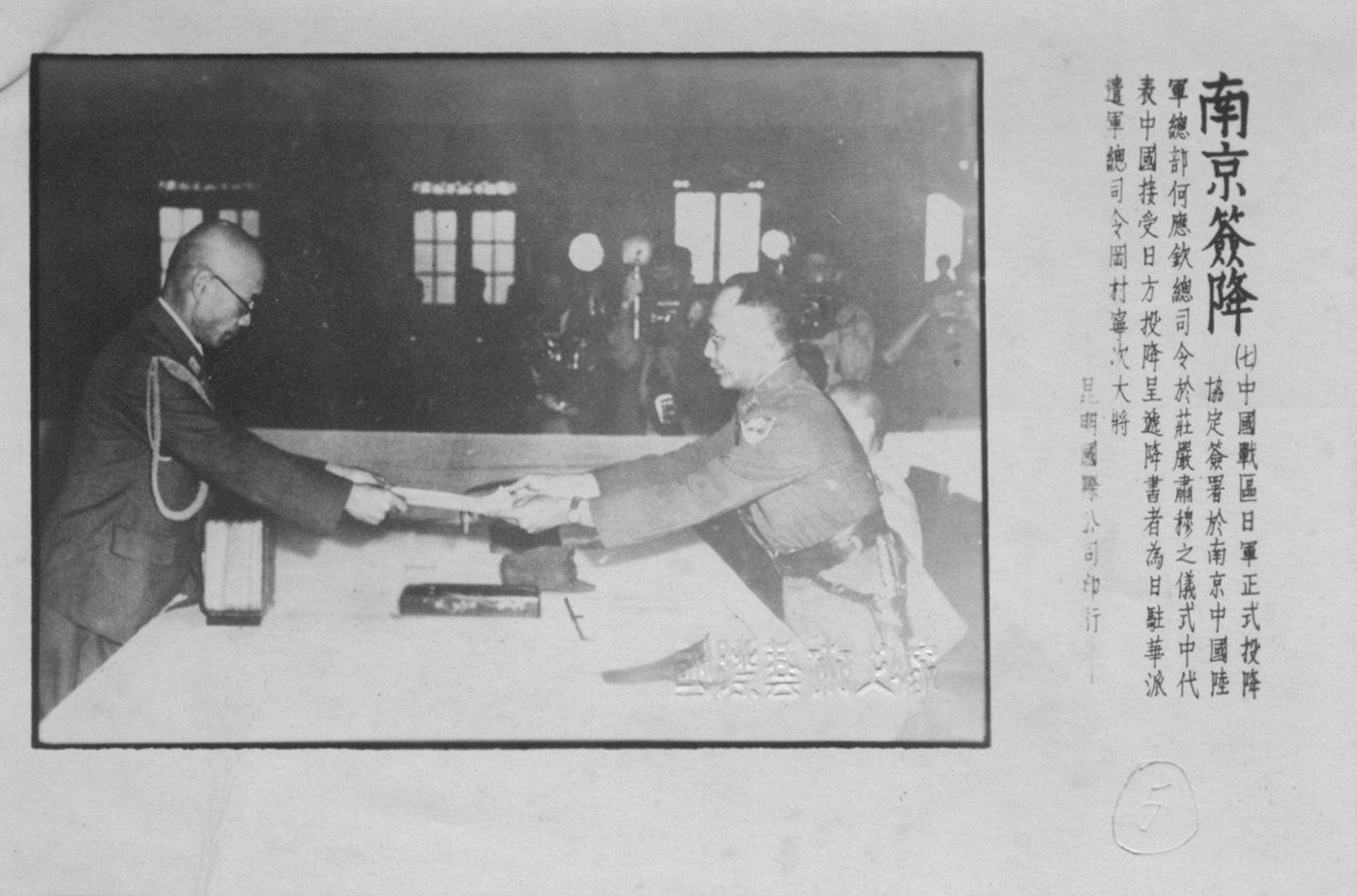
The largest surrender of all took place in Nanjing, the city Japanese troops had sacked in 1937. On 9 September, in the auditorium of the Central Military Academy, Gen. Okamura Yasuji, commander of the China Expeditionary Army, signed for more than a million Japanese troops in China, and his chief of staff carried the document across the room to Gen. He Yingqin. The ceremony took about twenty minutes. In practice the Japanese stayed under arms for months, at the request of both the Nationalists and the Americans, to keep the railways and cities out of Communist hands until Nationalist troops could be flown in. American Marines landed at Tientsin and Tsingtao to take the surrender in north China.
In Korea, Japanese rule had lasted thirty-five years. Lt. Gen. John Hodge’s XXIV Corps landed at Inchon on 8 September, and the next afternoon in Seoul the Japanese governor-general signed the surrender of all forces south of the 38th parallel. The Japanese flag in front of the government building was hauled down and the American flag raised in its place, not the Korean. The Soviets were already at the parallel.
Gallery · 7 photographs · select to enlarge
China and Korea, September 1945


Singapore and Hong Kong
Mountbatten had been about to invade Malaya when the war ended. British and Indian troops landed unopposed, and on 12 September, in the council chamber of Singapore’s Municipal Building, he accepted the surrender of 680,000 Japanese in Southeast Asia. The Japanese theater commander, Field Marshal Terauchi, had suffered a stroke; Gen. Itagaki Seishiro signed in his place. Mountbatten made a point of doing it in the city where Percival had surrendered in 1942, and of making the Japanese generals walk through a crowd to get there. Japanese prisoners were put to work clearing the docks.
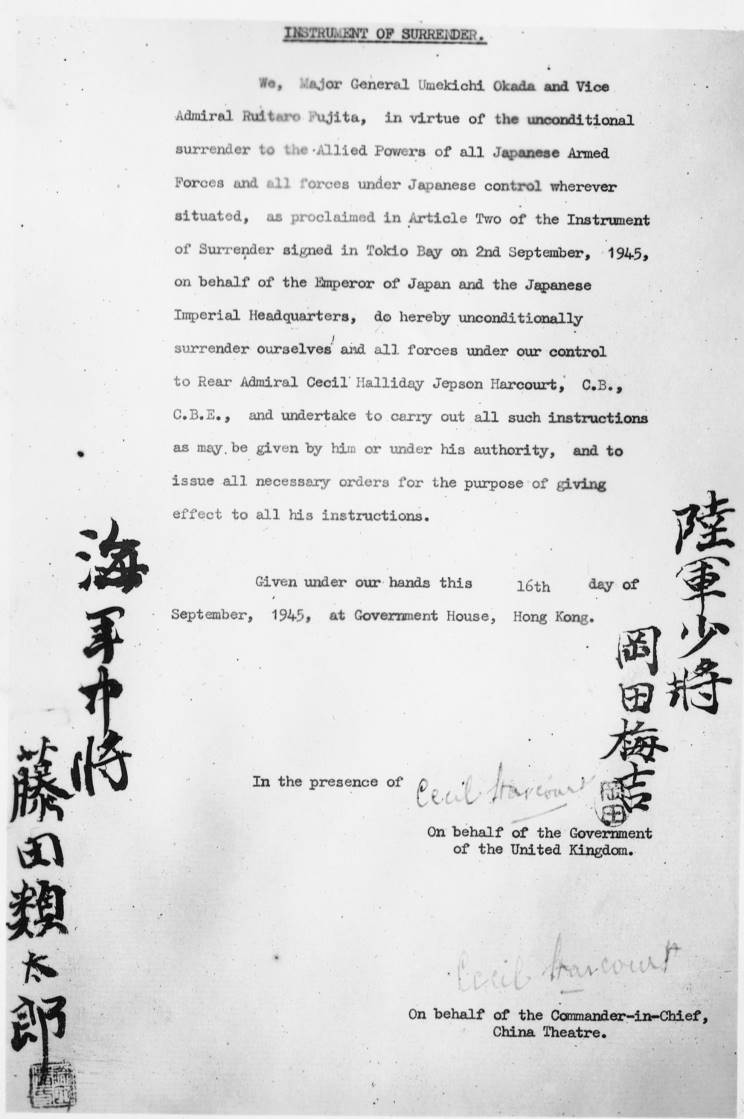
Hong Kong was a diplomatic problem: Chiang Kai-shek regarded it as Chinese territory in his theater. The British settled it by getting there first. Rear Adm. Cecil Harcourt’s squadron entered the harbor on 30 August, and he accepted the formal surrender at Government House on 16 September, on behalf of both Britain and China.
Gallery · 7 photographs · select to enlarge
Singapore and Hong Kong


The ones who did not hear
For some soldiers the order never arrived, or was not believed. Small groups held out in the jungles of the Philippines, New Guinea, Guam and Indonesia for years. Sgt. Yokoi Shoichi was found on Guam in January 1972, living in a hole he had dug under a bamboo grove. Lt. Onoda Hiroo, an intelligence officer left on Lubang Island in the Philippines in 1944 with orders to carry on guerrilla warfare and never to surrender, kept fighting for twenty-nine years; he and his companions killed about thirty Filipinos. He dismissed leaflets and newspapers as tricks. In March 1974 his former commanding officer, by then a bookseller, was flown to Lubang to relieve him of his orders in person. Onoda handed his sword to President Ferdinand Marcos, who pardoned him. The last confirmed holdout, Pvt. Nakamura Teruo, a Taiwanese aboriginal soldier of the Japanese army, was found on Morotai in December 1974.
Command decision · you decide
Who takes Hong Kong?
You are in the British government in August 1945. Hong Kong lies in the China theater, and General Order No. 1 would have its garrison surrender to Chiang Kai-shek. Chiang has said he does not intend to keep it. Once Chinese troops are in, they may not leave.
Interactive map · press “5. September: surrenders across Asia”
The end of the war against Japan, August–September 1945
People, places and pages in this chapter
Sources and further reading
- National Archives, Milestone Documents, “Surrender of Japan (1945)” — the terms of the Instrument of Surrender and its application to forces “wherever situated”
- Naval Historical Center Online Library (HyperWar), “Japanese Surrender, Tokyo Bay, 2 September 1945” — U.S. Navy photographs of the surrenders in Korea, on Wake and elsewhere
- National Archives, DocsTeach, “Instrument of Surrender of Japan” — the Instrument of Surrender
- Truman Library Institute, “The Surrender of Japan” — American policy on the surrender zones
More from The Lake Norman Brief
The Lake Norman Brief · History collections
Keep reading the Second World War
Every collection on lkn-law.com is free to read and built from official histories, archives and public-domain photographs. The Lake Norman Brief is published by Christopher Adkins of Adkins Law, PLLC, in Huntersville, North Carolina.
Surrender in Tokyo Bay collectionAll World War II collectionsThe Manhattan Project