The Lake Norman Brief · Carolina history, Lake Norman & North Carolina law · from Adkins Law, PLLCOffice 704-274-5677  ·  Text 704-231-5762
LKN LawThe Lake Norman Brief

The Lake Norman Brief · from Adkins Law

History, the lake & the law.

Carolina and World War II history, Lake Norman stories, and practical North Carolina legal guidance.

Photo: Christopher Sheridan, CC BY-SA 4.0

Angaur and Ulithi: The Wildcats’ First Fight

The first wave heads for Blue Beach.
Murderers’ Row at Ulithi.
The bombardment of Angaur.
Clear the spray · 3 real photographs

Pacific Theater · Peleliu · Chapter 6 of 9 · 17 September – 21 October 1944

Angaur and Ulithi: The Wildcats’ First Fight

The Army’s 81st Infantry Division lands on Angaur, fights for a month in the Lake Salome bowl, and takes the great anchorage at Ulithi without a shot.

By Christopher Adkins · The Lake Norman Brief · 12 min read

The first wave heads for Blue Beach. Wikimedia Commons
Murderers’ Row at Ulithi. Wikimedia Commons
The bombardment of Angaur. Wikimedia Commons

Six miles south of Peleliu, the Army’s 81st Infantry Division, the Wildcats, went into combat for the first time on the small phosphate island of Angaur. They took most of it in four days and then spent a month digging the last defenders out of a bowl of quarries and cliffs. Another of the division’s regiments sailed northeast and took the atoll of Ulithi without firing a shot, giving the Pacific Fleet the anchorage it would use for the rest of the war.

Key facts

17 Sep 1944The 81st Division lands on Angaur
About 1,400Japanese defenders under Maj. Ushio Gotō
264American soldiers killed on Angaur
About 1,300Japanese killed; 45 captured
22–24 SepUlithi occupied without a fight
6,000 ftLength of each of Angaur’s two new runways

The Wildcats on Angaur

Angaur is a small, roughly triangular island at the southern end of the Palaus, flat in the south and east and rising to ridges and old phosphate diggings in the northwest. Its phosphate had been mined since German times and a narrow-gauge railroad ran to the works. The Japanese garrison, about 1,400 men under Major Ushio Gotō, was built around a battalion of the 59th Infantry Regiment.

The 81st Infantry Division, commanded by Major General Paul J. Mueller, had trained in the United States and Hawaii and rehearsed on Guadalcanal. Its landing was held back until the Marines on Peleliu seemed secure; Julian Smith had argued against the timing, but Admiral Wilkinson ordered it for 17 September. That morning, after a bombardment by the battleship Tennessee and other ships, the 322nd Infantry landed on Red Beach on the northeast coast and the 321st on Blue Beach on the east coast, while the 323rd made a feint toward the west.

Interactive map · Angaur

Angaur, 17 September – 21 October 1944

81st Infantry DivisionAirfieldOn a phone, swipe the map sideways. Coastline © OpenStreetMap contributors (ODbL). Movements are schematic, after the Army’s official history.

Gallery · 8 photographs · select to enlarge

The landing on Angaur, 17 September 1944

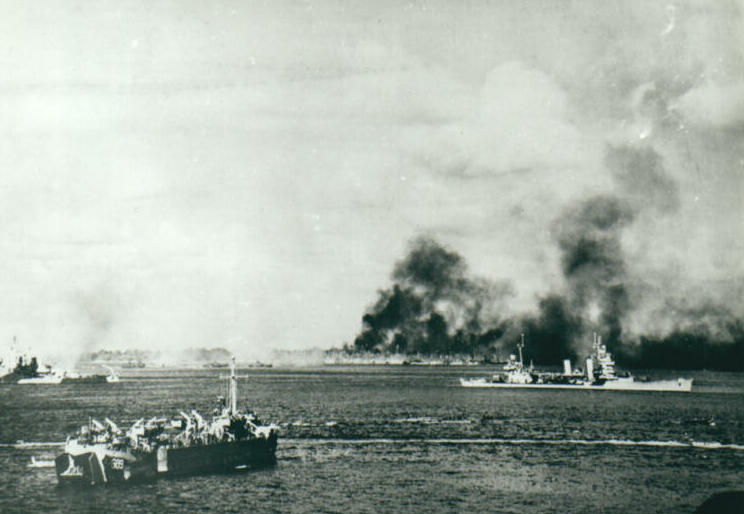
Ships of the bombardment group off Angaur: the battleship Tennessee, an LST and the heavy cruiser Minneapolis.
Ships of the bombardment group off Angaur: the battleship Tennessee, an LST and the heavy cruiser Minneapolis.Photo: USN · Public domain · Wikimedia Commons
The battleship Tennessee bombarding Angaur before the landing.
The battleship Tennessee bombarding Angaur before the landing.Photo: Photographer unknown · Public domain · Wikimedia Commons
The destroyer-minesweeper Perry, mined off Angaur on 13 September 1944, sinks while Preble stands by.
The destroyer-minesweeper Perry, mined off Angaur on 13 September 1944, sinks while Preble stands by.Photo: Photographed from a USS Tennessee (BB-43) airplane. · Public domain · Wikimedia Commons
The first assault wave heads for Blue Beach.
The first assault wave heads for Blue Beach.Photo: Army Pictorial Services · CC BY-SA 4.0 · Wikimedia Commons
An explosion sends black smoke over the beachhead on Angaur.
An explosion sends black smoke over the beachhead on Angaur.Photo: U.S. Marine Corps (Signal Corps Archive) · Public domain · Wikimedia Commons
Soldiers of the 81st Division pinned down by machine-gun fire on Red Beach.
Soldiers of the 81st Division pinned down by machine-gun fire on Red Beach.Photo: Army Pictorial Services · CC BY-SA 4.0 · Wikimedia Commons
Soldiers of the 322nd Infantry and Sherman tanks of the 710th Tank Battalion follow the narrow-gauge railroad toward the phosphate plant and Lake Salome.
Soldiers of the 322nd Infantry and Sherman tanks of the 710th Tank Battalion follow the narrow-gauge railroad toward the phosphate plant and Lake Salome.Photo: Soldiers of the 322nd Infantry Regiment · Public domain · Wikimedia Commons
Soldiers of the 322nd Infantry with a captured Japanese flag on Angaur.
Soldiers of the 322nd Infantry with a captured Japanese flag on Angaur.Photo: Army Pictorial Services · CC BY-SA 4.0 · Wikimedia Commons

The landings went well. The Japanese had expected an attack from the west, and resistance on the beaches was moderate. In three days the two regiments cut across the island, took the town and phosphate works the Japanese called Saipan Town, and drove the defenders into the rough ground of the northwest. On 20 September General Mueller reported that organized resistance had ceased. That proved premature. Gotō had pulled his survivors into a natural fortress around Lake Salome, a bowl of phosphate pits, cliffs and caves, and he had orders from Inoue not to waste them in a final charge.

A map of the battle for Angaur, 17 September – 21 October 1944.
A map of the battle for Angaur, 17 September – 21 October 1944.Photo: Robert Ross Smith · Public domain · Wikimedia Commons

The Lake Salome bowl

With the 321st Infantry sent to Peleliu on 23 September, the 322nd Infantry was left alone with Gotō’s men. The fighting in the bowl went on for a month. The soldiers worked forward along the railroad cut, which they called Bloody Gulch, and up the ridges around the lake, sealing caves one at a time with flamethrowers, demolitions and bulldozers. Prisoners told interrogators that three or four hundred men were still in the bowl at the start of October; the division’s intelligence officers thought fewer.

On 21 October the 322nd overran the last organized defenses. The Army’s official history counts about 1,300 Japanese killed and 45 captured on Angaur. The 81st Division lost 264 men killed and 1,355 wounded or injured from 17 September to 21 October, almost all of them in the 322nd Infantry; another 244 men were treated for combat fatigue and nearly 700 for sickness.

American casualties on Angaur, 17 September – 21 October 1944

soldiers
Source: Robert Ross Smith, The Approach to the Philippines, chapter XXII.

The Japanese survivors of Angaur were few. One of them, Hiroshi Funasaka, a sergeant who was badly wounded and taken prisoner, wrote about the fight after the war, one of the very few Japanese accounts of the southern Palaus.

Gallery · 3 photographs · select to enlarge

Angaur remembers

An American tank from the Second World War near the dock at Angaur, December 2023.
An American tank from the Second World War near the dock at Angaur, December 2023.Photo: U.S. Air Force photo by Staff Sgt. Spencer Tobler · Public domain · Wikimedia Commons
A Second World War memorial near the Angaur airfield, December 2023.
A Second World War memorial near the Angaur airfield, December 2023.Photo: U.S. Air Force photo by Staff Sgt. Spencer Tobler · Public domain · Wikimedia Commons
In 2014 the family of Sgt. William E. Dukes, Company I, 323rd Infantry, 81st Division, gave his wartime memorabilia to the Army Reserve’s 81st Regional Support Command.
In 2014 the family of Sgt. William E. Dukes, Company I, 323rd Infantry, 81st Division, gave his wartime memorabilia to the Army Reserve’s 81st Regional Support Command.Photo: Sgt. 1st Class Joel Quebec · Public domain · Wikimedia Commons

Angaur’s airfield

Angaur was taken for its airfield, and the engineers started on it while the fighting was still going on. The 1884th and 1887th Engineer Aviation Battalions began work on 20 September. A C-47 made the first landing on 15 October, and by 19 October two 6,000-foot strips were finished. The field came too late to help the landings on Leyte, which began on 20 October, but from 17 November bombers flew from the Palaus against the Philippines, and Angaur became a useful heavy-bomber base for the campaign on Luzon.

Angaur’s airfield in June 2024. The strip the Army engineers built in the autumn of 1944 is still the island’s runway, and the Marine Corps has recently repaired it for use by transport aircraft.
Angaur’s airfield in June 2024. The strip the Army engineers built in the autumn of 1944 is still the island’s runway, and the Marine Corps has recently repaired it for use by transport aircraft.Photo: U.S. Marine Corps photo by Lance Cpl. Dahkareo Pritchett · Public domain · Wikimedia Commons

Ulithi: the anchorage taken without a shot

The third regiment of the division, the 323rd Infantry, sailed northeast after its feint at Angaur. Its target was Ulithi, a ring of small islands about four hundred miles northeast of Peleliu enclosing one of the largest lagoons in the western Pacific. The Japanese had left. The 323rd occupied the atoll without opposition from 22 to 24 September 1944.

Within weeks Ulithi became the forward base of the Pacific Fleet. Hundreds of warships, tankers, ammunition ships and repair ships could anchor in the lagoon at once, and the fast carriers came back there between strikes on the Philippines, Formosa, Iwo Jima and Okinawa. Sailors went ashore on the small island of Mogmog for a few hours of beer and baseball. The Japanese struck back on 20 November 1944, when a kaiten human torpedo sank the fleet oiler Mississinewa in the anchorage. Of everything won in the Palau operation, Ulithi was by most accounts the most valuable.

Gallery · 8 photographs · select to enlarge

Ulithi, the fleet’s anchorage

Third Fleet carriers at anchor at Ulithi on 8 December 1944, the line the sailors called Murderers’ Row.
Third Fleet carriers at anchor at Ulithi on 8 December 1944, the line the sailors called Murderers’ Row.Photo: photographed from a USS Ticonderoga (CV-14) plane. · Public domain · Wikimedia Commons
Warships and auxiliaries at Ulithi on 6 November 1944, shortly after the Battle of Leyte Gulf.
Warships and auxiliaries at Ulithi on 6 November 1944, shortly after the Battle of Leyte Gulf.Photo: U.S. Navy · Public domain · Wikimedia Commons
The fast carrier task force at Ulithi in February 1945, before the strikes on Japan and Iwo Jima.
The fast carrier task force at Ulithi in February 1945, before the strikes on Japan and Iwo Jima.Photo: U.S. Navy · Public domain · Wikimedia Commons
The fleet oiler Mississinewa burns at Ulithi after being hit by a kaiten human torpedo on 20 November 1944.
The fleet oiler Mississinewa burns at Ulithi after being hit by a kaiten human torpedo on 20 November 1944.Photo: Storekeeper 1st Class Simon ("Sid") Harris · Public domain · Wikimedia Commons
Officers on liberty at the bar on Mogmog Island, Ulithi.
Officers on liberty at the bar on Mogmog Island, Ulithi.Photo: Charles Kerlee, U.S. Navy · Public domain · Wikimedia Commons
Enlisted men on liberty on Mogmog.
Enlisted men on liberty on Mogmog.Photo: Charles Fenno Jacobs, U.S. Navy · Public domain · Wikimedia Commons
Ulithi’s north anchorage and Sorlen Island.
Ulithi’s north anchorage and Sorlen Island.Photo: US Navy photo from NARA collection. · Public domain · Wikimedia Commons
The attack transport Grafton in Kossol Passage, the lagoon north of Babelthuap used as an emergency fleet anchorage after September 1944.
The attack transport Grafton in Kossol Passage, the lagoon north of Babelthuap used as an emergency fleet anchorage after September 1944.Photo: U.S. Navy · Public domain · Wikimedia Commons

Command decision · you decide

Declare victory on Angaur?

You are General Mueller on 20 September. Your regiments have crossed the island and the airfield site is in your hands. The Japanese survivors have pulled back into the broken ground around Lake Salome. The Marines on Peleliu need help.

You help the Marines, but you leave one regiment to finish a fight whose size you do not know.
You finish the job faster, but the Marines on Peleliu wait for relief.
You save lives, but the Japanese inside can still raid the airfield the engineers are building.
What actually happened. Mueller declared organized resistance ended on 20 September and the 321st went to Peleliu on 23 September. The 322nd fought in the bowl until 21 October.

Gallery · 11 photographs · select to enlarge

Ulithi: the fleet’s Pacific base

Fast carriers at anchor in Ulithi, December 1944.
Fast carriers at anchor in Ulithi, December 1944.Photo: U.S. Navy · Public domain · Wikimedia Commons
The battleship USS South Dakota in Ulithi, December 1944.
The battleship USS South Dakota in Ulithi, December 1944.Photo: United States Navy · Public domain · Wikimedia Commons
Ulithi from the air on 15 March 1945, crowded with ships gathering for the invasion of Okinawa.
Ulithi from the air on 15 March 1945, crowded with ships gathering for the invasion of Okinawa.Photo: Ensign Steinheimer, U.S. Navy (photo 80-G-408116) · Public domain · Wikimedia Commons
The repair ship USS Ajax working on the oiler USS Guadalupe at Ulithi, 9 February 1945.
The repair ship USS Ajax working on the oiler USS Guadalupe at Ulithi, 9 February 1945.Photo: U.S. Navy · Public domain · Wikimedia Commons
The carrier USS Randolph under repair alongside USS Jason at Ulithi, March 1945.
The carrier USS Randolph under repair alongside USS Jason at Ulithi, March 1945.Photo: USN · Public domain · Wikimedia Commons
The first mail call in almost three months for Marine Aircraft Group 45 on Ulithi, 1944.
The first mail call in almost three months for Marine Aircraft Group 45 on Ulithi, 1944.Photo: USMC Archives, Quantico · CC BY 2.0 · Wikimedia Commons
An abandoned R4D transport used as a projection booth for the Marines’ night movies on Ulithi.
An abandoned R4D transport used as a projection booth for the Marines’ night movies on Ulithi.Photo: USMC Archives, Quantico · CC BY 2.0 · Wikimedia Commons
The “Tune Toppers” play for troops on Ulithi, December 1944.
The “Tune Toppers” play for troops on Ulithi, December 1944.Photo: USMC Archives, Quantico · CC BY 2.0 · Wikimedia Commons
Sailors swim at Ulithi with the fleet at anchor behind them.
Sailors swim at Ulithi with the fleet at anchor behind them.Photo: USN · Public domain · Wikimedia Commons
The cemetery at Naval Base Ulithi, kept by the 6th Special Naval Construction Battalion.
The cemetery at Naval Base Ulithi, kept by the 6th Special Naval Construction Battalion.Photo: US Navy Seabees · Public domain · Wikimedia Commons
A 1945 map of Ulithi atoll.
A 1945 map of Ulithi atoll.Photo: Photographer unknown · Public domain · Wikimedia Commons

People, places and pages in this chapter

Sources and further reading

  1. Robert Ross Smith, The Approach to the Philippines, ch. XXII (U.S. Army in World War II) — Angaur: landings, the Lake Salome bowl, casualties and the airfield
  2. Robert Ross Smith, The Approach to the Philippines, ch. XXIV — Ulithi, the relief of the Marines, the end in the Pocket, final casualties and the Army’s assessment
  3. Gordon D. Gayle, Bloody Beaches: The Marines at Peleliu (Marine Corps History and Museums Division, 1996), NPS online edition — the basic modern Marine Corps account, written by the officer who commanded 2nd Battalion, 5th Marines
  4. Wikipedia, "Battle of Angaur" — a general summary
  5. History of War, "Angaur and Ulithi, battle for" — a short account of both operations
  6. Wikipedia, "Naval Base Ulithi" — the fleet anchorage and the loss of Mississinewa

The Lake Norman Brief · History collections

Keep reading the Second World War

Every collection on lkn-law.com is free to read and built from official histories, archival photographs and primary sources. The Lake Norman Brief is published by Christopher Adkins of Adkins Law, PLLC in Huntersville, North Carolina.

Peleliu collectionAll World War II collectionsThe Battle of Okinawa