


Eastern Front · Operation Bagration · Chapter 9 of 9 · 1944 – today
The Cost and the Memory: Belarus and the Forgotten Victory
What Bagration won and cost, why the West barely remembers it, the North Carolina thread, and the memorials of Belarus from the Mound of Glory to Khatyn.
Operation Bagration destroyed a German army group, freed Belorussia and much of Lithuania and eastern Poland, and carried the Red Army to the gates of Warsaw and East Prussia. It cost the Soviet Union more than three-quarters of a million casualties. For Belarus it was the end of an occupation that had killed one in every four of its people. In the West it is barely remembered. This chapter weighs the cost and visits the memorials.
Key facts
The cost
The Soviet victory was costly. By the Soviet figures published after the war, the four fronts lost 180,040 men killed and missing and 590,848 wounded and sick, together with 2,957 tanks and self-propelled guns, 2,447 guns and 822 aircraft. The Germans lost about 400,000 men by their own count and more than half a million by the Soviet one. Almost every family in Belarus had already lost someone in the occupation.
Losses in Operation Bagration
The forgotten victory
Bagration is often called the forgotten offensive. In Western memory the summer of 1944 belongs to Normandy, Arnhem and the Bulge, and the war in the East appears, if at all, as Stalingrad and Berlin. The reasons are not hard to find: the offensive came sixteen days after D-Day, the Soviets released little about it, the Cold War made Western readers wary of Soviet victories, and for decades the main sources in English were the memoirs of German generals, who had little reason to dwell on their worst defeat. Only in the last generation, as Soviet archives opened and historians such as David Glantz wrote from them, has its scale become widely known. The American military historian Robert Citino, quoted by the Imperial War Museums, called it “perhaps the greatest single win in all of military history.”
Myth or fact · open each card
Five things people get wrong about Bagration
It was a response to D-Day.
It was promised at Teheran in 1943 and planned in the spring of 1944 to coincide with the landing in France. See Chapter 8.
It was one battle.
It was a series of linked operations by four fronts, Vitebsk–Orsha, Mogilev, Bobruisk, Minsk, Polotsk, Vilnius, Šiauliai, Białystok, Lublin–Brest and Kaunas, over eight weeks. See Chapter 2.
Hitler’s fortified places slowed it down.
The Red Army went around them, and the garrisons left behind were destroyed. See Chapter 3.
The Western Allies played no part.
American trucks carried much of the Red Army, and American shuttle bombers flew from Soviet bases. See Chapter 8.
The Red Army simply chose not to save Warsaw.
Its armies were exhausted and a German counterattack was real, but Stalin also had political reasons to let the Home Army fail. Historians still argue about the balance. See Chapter 7.
Belarus remembers
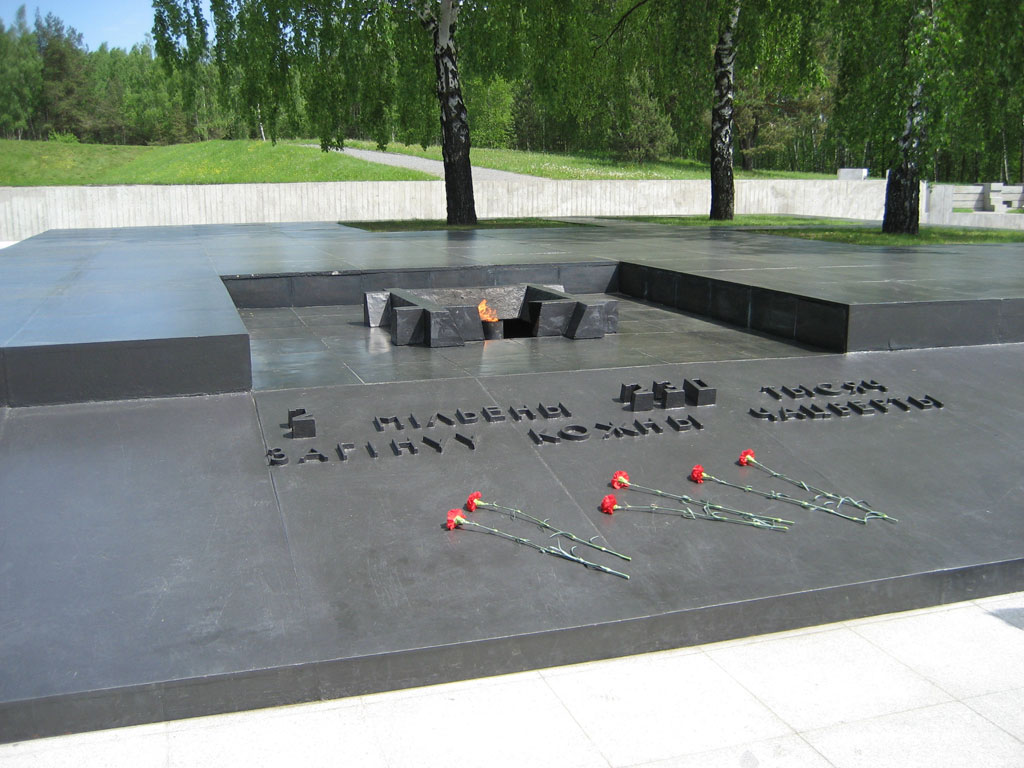
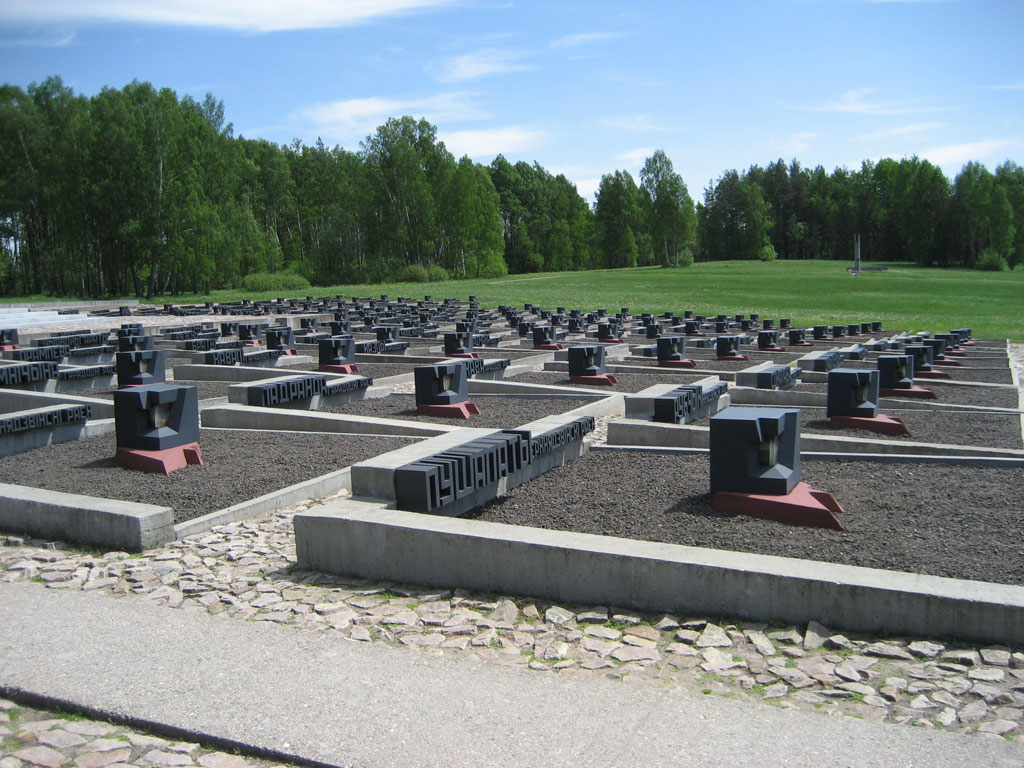
No country suffered more in proportion to its size than Belarus. The Khatyn memorial north of Minsk, opened in 1969 on the twenty-fifth anniversary of the liberation, stands on the site of a village burned with its people on 22 March 1943 by the SS Dirlewanger unit and Schutzmannschaft Battalion 118. Its Cemetery of Villages holds 185 symbolic graves, one for each Belarusian village destroyed with its inhabitants and never rebuilt; 433 more were burned and later rebuilt. A wall of niches remembers the camps, among them Maly Trostenets outside Minsk, one of the largest killing sites in the occupied Soviet Union.
On the Moscow highway 21 kilometers from Minsk, near the forests where the Germans trapped east of the city in July 1944 were destroyed, stands the Mound of Glory, built between 1967 and 1969 and topped by four bayonet-shaped obelisks for the four fronts of Bagration. In Minsk the Museum of the Great Patriotic War, founded in 1944 while the war was still being fought, moved into a new building in 2014. Vitebsk, Mogilev and Bobruisk each have their memorials, and at Brest the ruined fortress where the war in the East began is preserved as a memorial complex, opened in 1971. Belarus celebrates its Independence Day on 3 July, the anniversary of the liberation of Minsk.
Gallery · 10 photographs · select to enlarge
Memorials of Belarus


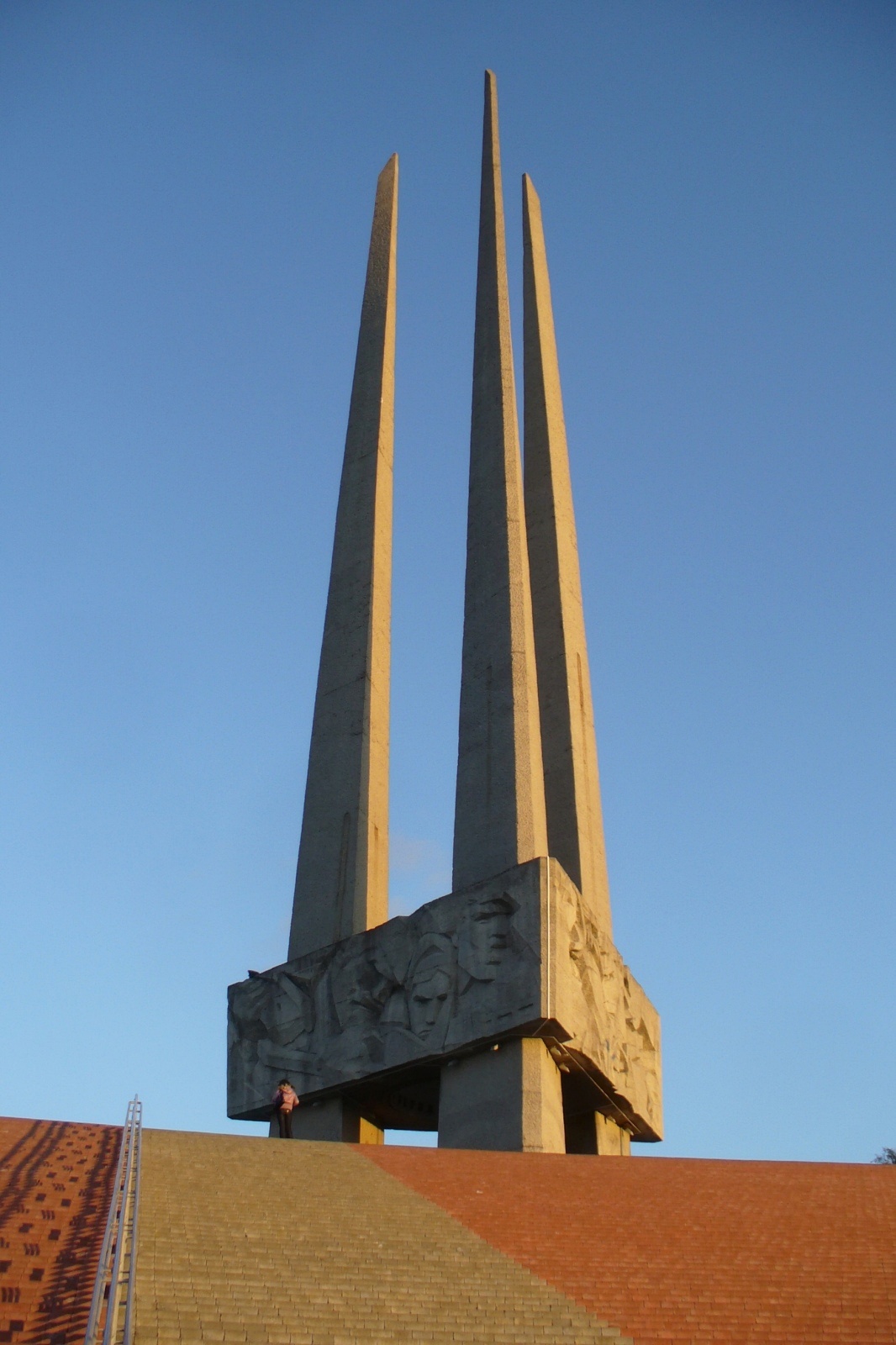

Gallery · in memory
Khatyn and Maly Trostenets



The North Carolina thread
North Carolina’s link to Bagration is a thin but real one. The Liberty ships built at the North Carolina Shipbuilding Company in Wilmington were part of the fleet that carried Lend-Lease supplies, among them the trucks that moved the Red Army across Belorussia (see Chapter 8). And, like Americans everywhere, North Carolinians followed the offensive in their newspapers in the summer of 1944, alongside the news of their own sons in Normandy and Italy.

People, places and pages in this chapter
Sources and further reading
- Wikipedia, “Operation Bagration” — a general summary with references, used to cross-check dates, strengths and losses (Frieser; Glantz and House)
- Imperial War Museums, “Operation Bagration: The Greatest Military Defeat of All Time?” — force ratios, the partisans’ rail attacks, the advance and the losses
- Memorial Museums, “State Memorial Khatyn” — Khatyn and the destroyed villages of Belarus
- Wikipedia, “Mound of Glory” — the memorial on the Moscow highway east of Minsk
- NCpedia, “Liberty Ships” — the North Carolina Shipbuilding Company at Wilmington
More from The Lake Norman Brief
The Lake Norman Brief · History collections
Keep reading the Second World War
Every collection on lkn-law.com is free to read and built from official histories, archival photographs and primary sources. The Lake Norman Brief is published by Christopher Adkins of Adkins Law, PLLC in Huntersville, North Carolina.
Operation Bagration collectionAll World War II collectionsThe Battle of Berlin