

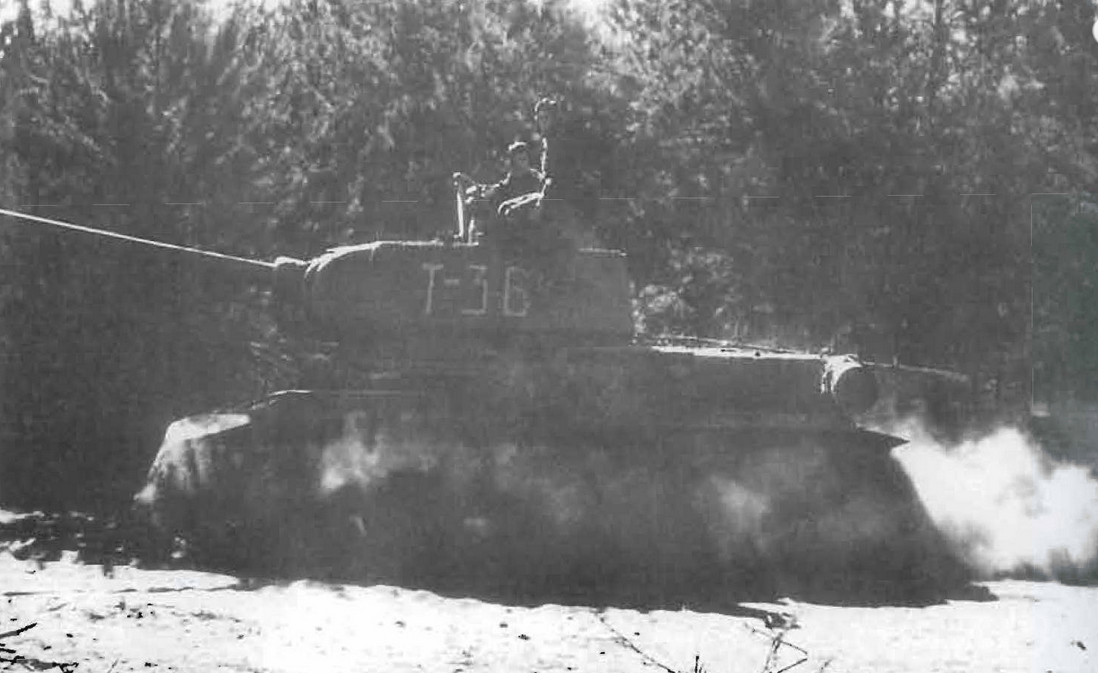

Eastern Front · Operation Bagration · Chapter 4 of 9 · 24–29 June 1944
Bobruisk: Through the Marshes, and the End of the Ninth Army
Rokossovsky’s two blows, one of them straight through the swamps the Germans thought impassable, trap the Ninth Army east of the Berezina.
Bobruisk stood on the Berezina at the southern corner of the balcony, held by the German Ninth Army. In front of it lay rivers, forest and the northern edge of the Pripet Marshes, ground the Germans believed no large force could cross. On 24 June 1944 Rokossovsky’s 1st Belorussian Front attacked from two directions at once, and the southern blow came straight out of the marsh. In five days the Ninth Army was encircled and destroyed.
Key facts
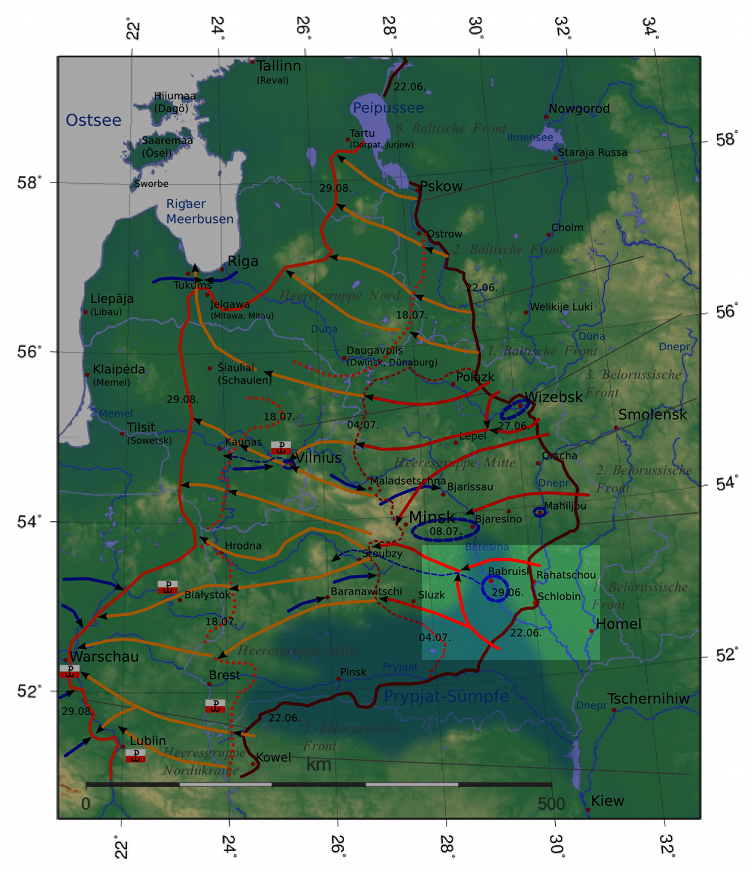
Interactive map · the encirclements
The encirclements in Belorussia, 22 June – 4 July 1944
Two blows
As Rokossovsky had insisted (see Chapter 2), the 1st Belorussian Front struck Bobruisk twice. In the north the 3rd and 48th Armies attacked west from the Rogachev area, with the 9th Tank Corps ready to exploit. In the south the 65th and 28th Armies attacked from the marshes near Parichi, with the 1st Guards Tank Corps and General Issa Pliev’s cavalry-mechanized group behind them. For weeks the Soviet engineers had been scouting routes through the bogs and preparing them to carry troops and vehicles.
The northern attack, on ground the Germans had expected to be attacked, ran into strong defenses and made slow progress on the first day. The southern attack broke straight through. By the evening of 24 June the 65th Army had torn a hole in the German line, and the tanks of the 1st Guards Tank Corps poured through toward the Berezina.
Through the marsh
The ground south of Bobruisk was the reason the Germans thought themselves safe there. The northern edge of the Pripet Marshes is a country of bog, alder thicket, slow rivers and sandy islands, crossed by a few raised roads. Soviet accounts of the battle describe weeks of preparation: engineers and reconnaissance parties, often guided by local partisans, found and marked routes across the bogs; mats of logs and brushwood were laid to carry men, guns and even tanks; and the infantry practiced moving through the swamp at night.
When the 65th Army attacked on 24 June, it came out of ground where the Germans had expected, at most, small raiding parties. The breakthrough there was the fastest anywhere on the first day of the Bobruisk operation, and it put Soviet tanks on the roads behind the Ninth Army before the Germans understood what was happening.

The Ninth Army’s mistake
General Hans Jordan of the Ninth Army had one mobile reserve, the 20th Panzer Division. When the northern attack began, he sent it north toward the Rogachev breakthrough. Then, as the scale of the southern breakthrough became clear, he turned it around and sent it south. It spent a vital day on the roads and arrived too late to close the gap. Hitler relieved Jordan of his command on 27 June.
Command decision · you decide
North or south?
You command the German Ninth Army on 24 June. Soviet attacks have broken in north of Bobruisk near Rogachev and south of it near Parichi. You have one panzer division in reserve.
The pocket
By 27 June the two Soviet pincers had met west of Bobruisk. Trapped east of the Berezina were the five divisions of the XXXV Army Corps and much of the XXXXI Panzer Corps, with the 20th Panzer Division. Soviet aircraft of the 16th Air Army attacked the masses of men and vehicles on the roads around the pocket again and again; the photographs taken for the air army afterward show roads choked with wrecked trucks, guns and horses for miles.
On 28 June the survivors massed for a breakout to the northwest. Some got through to the 12th Panzer Division, rushed in from the north; the Soviet count is that about 12,000 escaped. When the 12th Panzer arrived, the Ninth Army’s chief of staff reportedly told its officers that the Ninth Army no longer existed. Bobruisk itself, another of Hitler’s fortified places, was liberated on 29 June.
The fate of the German forces trapped at Bobruisk
Gallery · 5 photographs · select to enlarge
The roads of the retreat


Pliev rides west
Without waiting for the pocket to be cleared, the 1st Belorussian Front pushed its mobile forces west and northwest. Pliev’s cavalry-mechanized group, a combination of horsemen and tanks particularly suited to the forests and marshes, took Slutsk on 30 June and later Baranovichi on 8 July. The 1st Guards Tank Corps turned north toward Minsk, to close the southern jaw of the trap behind the German Fourth Army (see Chapter 5).
The fortress of Bobruisk, built in the early nineteenth century, still stands. Under the occupation the Germans had used it as a prisoner-of-war camp. Today parts of it are being restored as a memorial and heritage site.

Gallery · Bobruisk then and now
The fortress of Bobruisk


People, places and pages in this chapter
Sources and further reading
- Wikipedia, “Bobruysk offensive” — Rokossovsky’s two blows, the pocket and the end of the Ninth Army
- Wikipedia, “Operation Bagration” — a general summary with references, used to cross-check dates, strengths and losses (Frieser; Glantz and House)
- Imperial War Museums, “Operation Bagration: The Greatest Military Defeat of All Time?” — force ratios, the partisans’ rail attacks, the advance and the losses
More from The Lake Norman Brief
The Lake Norman Brief · History collections
Keep reading the Second World War
Every collection on lkn-law.com is free to read and built from official histories, archival photographs and primary sources. The Lake Norman Brief is published by Christopher Adkins of Adkins Law, PLLC in Huntersville, North Carolina.
Operation Bagration collectionAll World War II collectionsThe Battle of Berlin