


Pacific Theater · Papua · Chapter 6 of 9 · July – November 1942
Fuzzy Wuzzy Angels: Carriers, Air Drops and the Supply Line
Papuan carriers, the dry lakes at Myola, food dropped from the sky, disease and mud, and Damien Parer’s Oscar-winning film of the track.
The Kokoda campaign was decided as much by supply as by fighting. There was no road over the Owen Stanleys, so everything had to be carried by men or dropped from aircraft. On the Australian side the carriers were Papuan men, thousands of them, who brought up food and ammunition and carried the wounded back. The soldiers called them the Fuzzy Wuzzy Angels. Disease killed and disabled more men than bullets did, and a cameraman named Damien Parer brought the track to cinema screens in Australia and won an Academy Award.
Key facts
The carriers
The Australian New Guinea Administrative Unit, ANGAU, ran the territory in wartime, and one of its officers, Lt. Bert Kienzle, a planter from the Kokoda valley, was given the job of organizing carriers for Maroubra Force. Papuan men were recruited, often under compulsion through the wartime labor regulations, from villages across the territory. They carried loads of rations and ammunition up the track, slept in the open in the cold of the high country, and were often underfed themselves. Many fell sick; some died; some, worn out, deserted. Without them the Australian army could not have fought in the mountains at all.

The carriers also brought back the wounded. A stretcher case on the Kokoda Track needed a team of carriers working in relays, lifting the stretcher up muddy slopes and across log bridges, sometimes for days, and the soldiers remembered how gently they handled the men they carried. In 1942 Sapper Bert Beros wrote a poem about them, “The Fuzzy Wuzzy Angels,” which was published in Australian newspapers and gave them the name they have had ever since.
Gallery · 8 photographs · select to enlarge
The Fuzzy Wuzzy Angels


Supply from the air
The other answer was the air. American and Australian transport aircraft, DC-2s, DC-3s and C-47s, flew from the fields around Port Moresby over the range and dropped supplies to the troops below. In August 1942 Kienzle found two dry lake beds high in the range at Myola, large open spaces where aircraft could drop loads safely. Myola became the main supply base for Potts’s brigade. But parachutes were scarce, so most loads were pushed out without them; many burst on impact or fell into the jungle and were never found. Potts arrived to find far less waiting at Myola than he had been promised (Chapter 3).
Gallery · 6 photographs · select to enlarge
The air bridge from Port Moresby

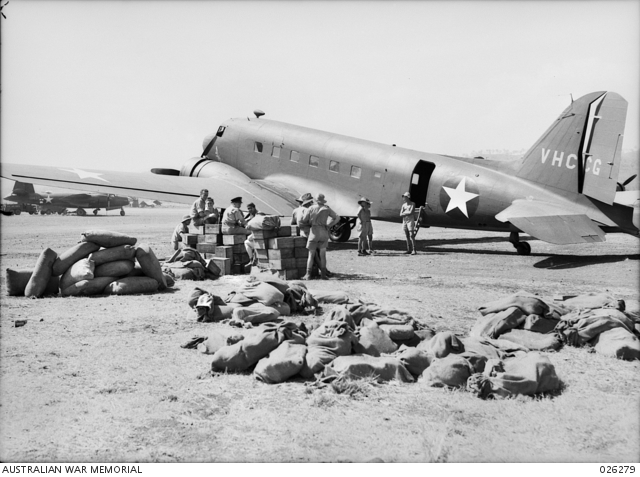


During the Australian advance in October and November, air drops at Myola, Nauro and other clearings fed the 7th Division, and once Kokoda was retaken on 2 November transports could land again. Light aircraft began flying wounded men out.
Interactive · choose a tab
How the armies were supplied
On men’s backs
- Who
- Papuan men recruited by ANGAU
- Loads
- Rations, ammunition, medical stores; stretchers on the way back
The basic method. The farther forward the troops went, the more food the carriers themselves ate on the way, and the less was left for the soldiers.
From transport aircraft
- Who
- U.S. troop carrier squadrons and RAAF transports
- Where
- Myola, Nauro, Efogi, Kagi and other clearings
Fast, but wasteful: many free-dropped loads were lost or broken. Weather over the range often closed the route.
Horses and mules
- Where
- The first stage, from the end of the road down to Uberi
Pack trains carried supplies down the steep track from Owers’ Corner. Beyond Uberi the track was too steep and narrow for them.
The Japanese supply line
- Method
- Carriers and packhorses from the beachhead; a few aircraft drops
- Problem
- Allied aircraft attacked the line and the Wairopi bridge
The Japanese counted on capturing Allied food. As their line lengthened over the range they ran out, and by September many were starving.

Disease and the wounded
Malaria, dysentery and scrub typhus attacked both armies. The U.S. Army’s official history counts 15,575 cases of infectious disease among Australian troops in 1942 alone, 9,249 of them malaria. Of the 32nd Division’s 9,688 casualties in the campaign, 7,125 were men who fell sick. Field ambulances such as the 2/4th and 2/6th set up dressing stations along the track, at Myola, Efogi and elsewhere, operating under canvas in the rain.
Battle casualties and sickness: the U.S. 32nd Division in Papua
Gallery · 4 photographs · select to enlarge
Medicine on the track


Damien Parer and Kokoda Front Line!
Damien Parer, a cinematographer for the Australian Department of Information, had filmed the war in North Africa, Greece and Syria. In August 1942 he went up the track with the war correspondents Osmar White and Chester Wilmot. His footage of the fighting withdrawal, of the wounded, of Papuan stretcher bearers and of the 39th Battalion’s parade at Menari was shaped by Ken G. Hall of Cinesound into a newsreel special, Kokoda Front Line!, first screened on 18 September 1942. Parer opened it himself, speaking to the camera about what he had seen.
Kokoda Front Line! was one of the winners of the Academy Award for documentary in 1943, the first Academy Award for an Australian film. Parer went on to film the war in New Guinea and later the Pacific islands with the Americans. He was killed filming U.S. Marines on Peleliu in September 1944.
Gallery · 4 photographs · select to enlarge
The men who reported the track


A photograph that became a symbol
Raphael Oimbari and George Whittington
On Christmas Day 1942, near Buna, George Silk photographed a wounded Australian, Pte. George “Dick” Whittington, being led along a track by a Papuan orderly, Raphael Oimbari. The picture became the best-known image of the partnership between Papuans and Australians in the war. Whittington died of scrub typhus in February 1943. Oimbari survived the war, and the picture has since been reproduced on memorials and in countless books. See Chapter 8.

People, places and pages in this chapter
Sources and further reading
- Department of Veterans’ Affairs, Anzac Portal, "Kokoda 1942" — the official Australian summary of the campaign: dates, units, battles and casualties
- Milner, Victory in Papua, Chapter XIX, "The Victory" — Allied and Japanese casualties, sickness, forces committed and the comparison with Guadalcanal
- National Film and Sound Archive of Australia — Damien Parer’s Kokoda Front Line! (1942), winner of an Academy Award for documentary
- Australian War Memorial, "Mapping Kokoda" — how the track was mapped and how its places relate
- Wikipedia, "Kokoda Track campaign" — a general summary with references, used for cross-checking dates and unit names
More from The Lake Norman Brief
The Lake Norman Brief · History collections
Keep reading the Second World War
Every collection on lkn-law.com is free to read and built from official histories, archives and public-domain photographs. The Lake Norman Brief is published by Christopher Adkins of Adkins Law, PLLC, in Huntersville, North Carolina.
Kokoda and Buna–Gona collectionAll World War II collectionsThe Doolittle Raid and the Coral Sea