
Rick Atkinson follows the American Revolution from Lexington to Princeton. This review looks at how distance, information, and enlistments shaped the war’s first 21 months.
The British Are Coming
Rick Atkinson

An order crossing the Atlantic by ship can be perfectly clear and hopelessly out of date. Atkinson puts time and distance back into the early years of the Revolution.
Cover of The British Are Coming. Image from Macmillan.Start with the distance between London and Boston. A minister can issue a confident instruction on the strength of a situation that has already ceased to exist by the time the ship carrying it arrives. Atkinson makes this lag almost as consequential as any commander in his account of the Revolutionary War from Lexington and Concord through Princeton. Decisions recover the uncertainty they had before anyone had put them on a monument.
The narrative has an eye for what soldiers ate, carried, lacked, and misunderstood. Those details earn their space because they alter what an army can do. Washington's retreat across New Jersey becomes more interesting once the reader grasps just how many opportunities there were for events to end differently. The density occasionally works against momentum, particularly when a newly introduced officer disappears in the next change of scene. Stay with it for the British side of the story. Few accounts give imperial officials such recognizable motives while making their collective misjudgments quite so plain.
A rebellion at the far end of a letter
A decision made in London and a decision made in Massachusetts can belong to different wars even when the people making them agree about the date. By the time officials in Britain learn what happened on a road outside Boston, the people who walked that road have buried neighbors, told the story to relatives, and begun deciding what they might do if the soldiers come again. Rick Atkinson makes the Atlantic one of the most important presences in The British Are Coming. Water changes what it is possible to know, when it is possible to act, and how reasonable an explanation will sound to somebody who must wait weeks to hear it.
This first volume of his Revolution Trilogy runs from Lexington and Concord to Trenton and Princeton. Twenty-one months is a shrewd span to choose. It allows Atkinson to follow men who began by answering an alarm near home into a winter when the continued existence of an army was itself an open question. A familiar schoolbook sequence can make the progression look natural. Local resistance becomes a national cause and a national cause acquires an army. Spend enough time among people whose enlistments expire, whose families need them home, and whose neighbors do not necessarily share their opinions, and each arrow in that sequence begins to look like a pretty audacious historical claim.
Whose road is this?
On the Massachusetts roads in the opening campaign, geography is intimate before it becomes strategic. A lane that appears as a line of travel to an officer from elsewhere is also the route by which somebody visits a cousin or gets goods to market. An unfamiliar armed presence changes the meaning of the place even for people who have yet to decide what they think of Parliament. Atkinson moves between those ways of knowing a landscape with considerable skill. The professional soldiers have business they have been ordered to perform. The people who live beside the road have the inescapable fact that the business is being performed where their families live. Neither can leave at the end with the other’s understanding of what happened.
The book is generous about restoring British participants to the story as people. An American reader knows the political result and has probably learned the British names in association with their eventual frustrations. Atkinson lets individual moments resume their uncertainty. An officer can make a defensible judgment with the information available, encounter the wrong set of circumstances, and leave a discouraging record for a historian who knows precisely what was waiting over the next hill. That generosity pays an unexpected dividend for readers interested chiefly in the American achievement. It is much easier to appreciate what the rebels accomplished once their opponents are permitted to be intelligent.
The material life of a declaration
Look for the things people have to move. A public statement can travel on a sheet of paper. The equipment needed to make a public statement credible in the face of armed opposition is another matter entirely. Its weight has to be borne somehow. A worn road, an unsuitable boat, the season in which a load must travel: none of these is likely to appear in a list of the political causes of the Revolution. Each can narrow a commander’s options before any question of generalship arises. Atkinson is interested in the people who close the distance between what a government wants done and what a group of bodies in a particular place can actually do.
That approach alters how Washington appears. In the image Americans carry around, the general often occupies an exceptionally good position from which to see what ought to happen next. In the book he must obtain information, decide how far it can be trusted, and keep a difficult association of people together even when a decision made on imperfect information has gone badly. There is a species of leadership involved in getting people to show up again after disappointment. It leaves a less handsome picture than a victory. Read the New York campaign with that question in mind, and the survival of a functioning army begins to look like a result somebody had to produce.
How to read the maps without seeing too much
Maps give the reader a considerable advantage over the participants. You can see several roads, the position of a river, and the relation between towns in a single glance. Try covering everything beyond one town the next time an account reaches a difficult decision. What part of the arrangement could a person actually see? What might a messenger know? If that messenger had left an hour earlier, which parts of the report might already be out of date? Atkinson supplies an abundance of particulars, and this is one way to make them earn their place. A simple geographical question becomes a question about the reliability and shelf life of information.
It also helps with one of the book’s real limitations. Atkinson commands such a wealth of detail that a striking anecdote can briefly pull attention away from a larger question. A reader may remember a physical indignity or a beautifully chosen contemporary expression while losing track of which decision brought the speaker into that situation. The remedy is occasional, modest backtracking. At the end of a section, go back to the place where the commander or civilian had a choice. Which detail changed the choice, which shows its human cost, and which chiefly tells us that a vivid witness was present? All three have value. They perform different jobs in a history.
Ending in New Jersey
Trenton and Princeton make for a satisfying ending, provided you resist borrowing satisfaction from the later peace. Neither engagement could promise a republican constitution or guarantee recognition from abroad. What they could change was the calculation facing the people who had to decide what to do next. A person considering whether to enlist, extend credit, speak openly, risk a family business, or keep quiet did not need certainty about the final settlement. Evidence that a cause still had a future might be enough to change an immediate decision. Atkinson’s stopping place restores some of the force of that limited achievement. A few weeks can matter enormously even when they settle remarkably little.
For a reading group in Huntersville, put a pencil mark by the end of the book’s geographical reach. Much of the fighting familiar from Carolina history still lies ahead. Resist the temptation to turn that observation into a complaint that a first volume has left out later events. Instead ask what a family here could have known by the winter of 1777 about events in Massachusetts, New York, and New Jersey. From whom might they have heard, whose account would they trust, and what would they have to decide before better information arrived? That brings a North Carolina reader surprisingly close to the difficulty facing officials an ocean away at the beginning of the book. Information has to travel. People, inconveniently for historians, have to live while they wait.

LKN-Law historical collection. Photographer uncredited.
Open the full image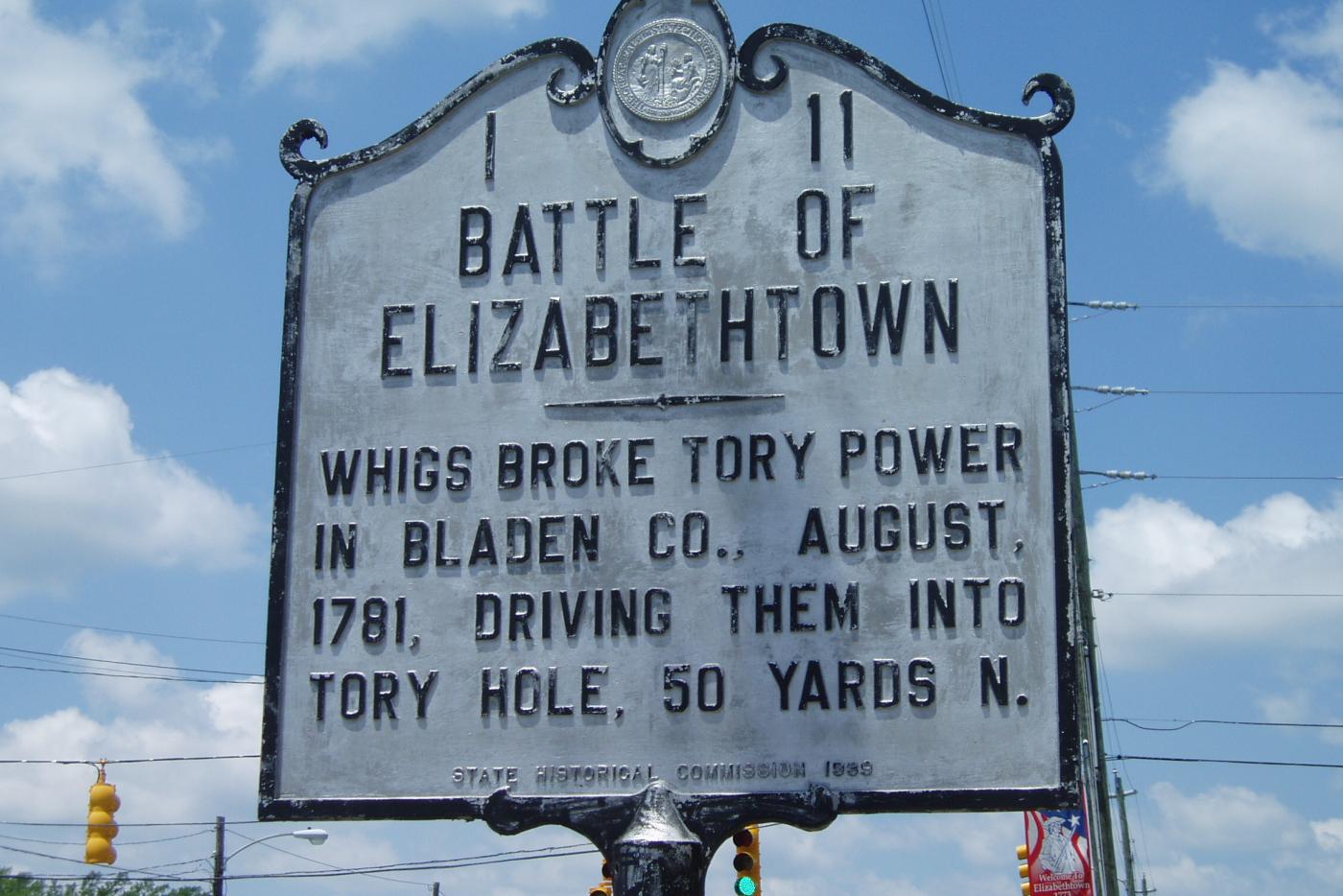
Read alongside
Try reading an episode of the American Revolution first as a political argument and then as a practical problem for the people present.
 John AdamsDavid McCullough
John Adams left a biographer one extraordinary advantage and one sizable problem. He wrote almost incessantly, often in a voice that makes it easy to imagine him in the room.
 1776David McCullough
A reader expecting the Declaration of Independence to take center stage may be surprised by how much of David McCullough's year belongs to an army in retreat.
Reading group guide
Follow a piece of news across the Atlantic. Which decision has already been made by the time it arrives?
Find this book and edition
The British Are Coming · Rick Atkinson · American History
Cover edition ISBN 9781627790437 · Look for this edition in a library