
In Longitude, Dava Sobel follows a clockmaker who took on the problem of finding a ship’s position at sea. The harder question was how to prove his clock worked.
Longitude
Dava Sobel

A captain can find local noon with the sun. Harrison’s harder task is to keep the time of a distant port on a moving deck, then convince the people judging the trial.
Cover of Longitude. Image from Bloomsbury.A map you can fold into your hand
Dava Sobel opens Longitude with a child’s toy. Her father buys her a wire ball; its hinged ribs open and shut, and colored beads slide along them. You could hardly choose a less imposing object with which to begin a history of maritime navigation. Yet the toy does something a handsome engraving of a three-masted ship could never do. It lets a reader hold a system of coordinates in the imagination before anyone has explained what a coordinate is. Years later, when a clockmaker tries to carry the time of one place into another, the reader has already learned to think with an object small enough to hold.
The book’s first words, “Once on a Wednesday excursion,” deserve a second look. A fairy tale might begin with “Once,” but Wednesday belongs to someone who remembers which day she went out with her father. Sobel will spend the book moving between those two registers. John Harrison’s struggle for recognition has the outline of a fable. The performance of a particular clock on a particular voyage is stubbornly a matter of dates and numbers. The pleasure comes from getting both stories at once. The trouble comes when the fable gets the upper hand. Read the opening passage.
How a sailor can be wrong by an ocean
Imagine taking two observations from the same patch of deck. The sun tells you that it is noon where you stand. A timekeeper set at your departure port says it is three in the afternoon back there. Your noon has arrived later than theirs, so you are west of the port. The earth turns through 360 degrees in a day, or 15 degrees per hour. The difference puts you 45 degrees west of your starting meridian. No one has to see the coast. No one even has to agree on the name of the coast. The answer follows from a comparison of two times.
That explanation takes less than a minute over coffee. Now put the clock on a moving ship for weeks, take away the second clock against which you might check it, and ask the person on deck whether they would stake the ship on its answer. Here Sobel earns the right to tell an adventure story. The suspense comes from the gap between understanding a principle and trusting a particular object with your life. Readers who ordinarily skip accounts of machinery may be surprised by how quickly they acquire a personal interest in whether a mechanism runs a little fast.
The most revealing clock is the one that stayed home
In the familiar version of invention, a first attempt fails, a second goes a little farther, and a third finally works. The instruments known as H1 through H4 seem made for that kind of narrative. Their tidy museum names are misleading. H1 went to sea for a trial involving Lisbon. H2 stayed ashore because Harrison found a fault himself. He spent nineteen years on H3. H4, which looks remarkably like a large watch, gives the eye very little warning of the conceptual distance it has traveled from the much larger machines that preceded it. See the four instruments at Royal Museums Greenwich.
Pause over the second of those objects. What should count in a biography as an achievement? Harrison catching a flaw before a trial is an act of judgment. It probably makes a worse scene than a ship approaching a headland with two people disagreeing about where they are. A reader who follows only the victories misses the habit of mind that makes the victories plausible. The years spent on H3 pose an even harder question. From the safe end of the story we know another design lies ahead. Harrison had to decide what to try on an ordinary morning when he knew no such thing.
What would convince you?
Once the instrument goes to sea, the question changes hands. A maker can know his device intimately and still owe strangers an explanation. Consider three people waiting at the end of a voyage. A captain wants to know whether this particular timekeeper got this particular ship where it needed to be. A maker wants credit for accomplishing what had been demanded of him. A public body spending money on a solution wants to know whether another maker can build another instrument and send it out on another ship. The same successful landfall can give each of those people a different amount of satisfaction.
This is where I would push back on the word “lone” in the book’s subtitle. It draws the reader toward the workbench, where the book is wonderfully alive. It also invites us to treat everyone on the other side of the bench as scenery or opposition. Yet even the clockmaker’s victory depends on people who can establish the position of the destination independently. Otherwise, how would anyone know he was right? A voyage designed to test a technology depends on a larger community of people who agree about what can be measured. Readers interested in evidence will find a second, slightly less comfortable book inside the more heroic one advertised on the cover.
Give the astronomers a fair hearing
There is another way to carry a reference across an ocean. The sky is visible from more than one place, and the moon changes position against its celestial surroundings. If you can observe that relationship precisely and consult predictions for a known meridian, you can infer the reference time. It is demanding work. It also has an attraction that becomes clearer if you put yourself on a deck with one splendid watch that has just stopped. The rival methods depend on different things going right. A reader who understands the appeal of both gets more out of the book’s quarrels than one who simply waits for the right side to win.
Sobel favors the reader who wants a human story and is willing to learn enough science to follow it. She gives the eye something to picture and the mind a question to carry into the next chapter. The price of that economy is uneven sympathy. The craftsperson’s long investment is readily imaginable. The labor behind astronomical tables, which can look like rows of finished answers by the time anyone else sees them, is harder to dramatize. Keep that difference in mind when deciding which people in the story seem imaginative and which merely obstructive.
Reading it beside Lake Norman
Try a small change of viewpoint the next time you look across Lake Norman. Pick two features on the opposite shore and imagine losing sight of both. Then suppose someone gives you an exact east–west coordinate. What would you still want to know before taking a boat toward the bank? The Ocracoke photograph below makes a good companion to that thought experiment. From overhead you can see an inlet’s shape in a glance. A clock can help establish where a vessel is while telling its crew very little about what the water directly ahead will allow. Inland readers have an advantage here. A familiar stretch of water makes the distinction easy to feel.
Longitude is a particularly good choice for a reading group divided between biography readers and puzzle solvers. Give each side the same question at the end. If you had been responsible for awarding public money, what test would you have proposed before learning the result? Then ask whether it would have been fair to change the test afterward. The evening may take you a long way from clockmaking. That is a measure of how much Sobel has packed into this little book, and of how many questions remain after its clock has told the right time.


Take a longitude reading
It is noon on your ship. The clock at your reference port reads 2 p.m. Which direction have you traveled, and how far in degrees?
Reveal the bearing and calculation
Your noon came later. You are west of the reference port. Two hours at 15 degrees per hour puts you 30 degrees west of its meridian. Degrees measure angle. The distance on the water for each degree shrinks as you move away from the equator.

Cape Hatteras National Seashore · Public domain · Wikimedia Commons
Open the full image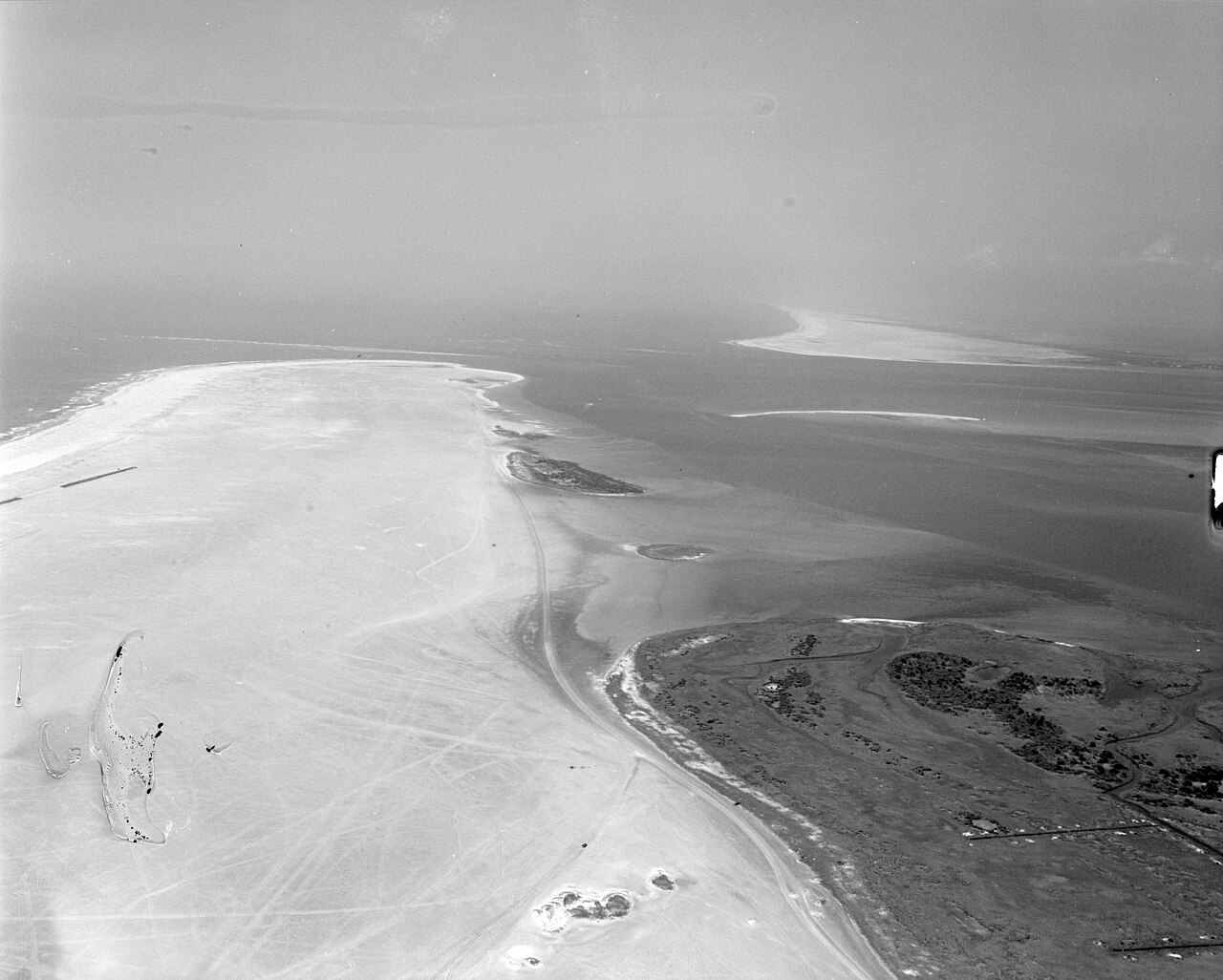
Read alongside
At sea, a measurement or a failed message can change an entire voyage. Watch the writer bring that invisible margin into view.
 A Thread Across the OceanJohn Steele Gordon
The practical unit of transatlantic communication used to be a ship crossing. John Steele Gordon follows Cyrus Field and his collaborators as they attempt to reduce that interval to the time it takes an electrical signal to travel beneath the ocean.
 The Sea Around UsRachel Carson
Rachel Carson asks a beachgoer to imagine the ocean before there was a beach to stand on. Currents, basins and layers of sediment become evidence in a history whose longest chapters unfolded without a human witness.
Reading group guide
What test of Harrison’s clock would you have accepted before you knew the outcome of the voyage?
Find this book and edition
Longitude · Dava Sobel · Seafaring & Exploration
Cover edition ISBN 9780802715296 · Look for this edition in a library