
Rachel Carson’s The Sea Around Us makes a falling scrap of organic matter as interesting as a shipwreck. How does a writer make the invisible ocean worth seeing?
The Sea Around Us
Rachel Carson

Rachel Carson asks a beachgoer to imagine the ocean before there was a beach to stand on. Currents, basins and layers of sediment become evidence in a history whose longest chapters unfolded without a human witness.
The Sea Around Us by Rachel Carson. Edition cover from Open Library.Rachel Carson writes about the sea as a place with a past. An ocean basin, a current and a sediment layer can each tell a different kind of story, unfolding on a timescale that human observation barely touches. Her sentences make those changes imaginable without pretending that a visit to the beach offers an adequate vantage point.
The book's peculiar achievement is the movement between scale and intimacy. An explanation of tides may leave the reader more attentive to the thin line of material left by the water at home. An account of deep water can make the familiar surface seem suddenly provisional. The science dates from an earlier period of oceanography, and later discoveries have changed parts of the explanatory picture. That makes a modern edition with contextual material particularly welcome. What survives intact is Carson's judgment about a reader's capacity for wonder. She is willing to spend time explaining how something happens because she trusts the explanation to deepen its strangeness. Few nature writers have made that trust feel better placed.
How do you write about a place nobody can stand?
On shore, the ocean offers a writer any number of easy beginnings. Sand gives way under a heel. A band of foam collapses. Somebody gets a sleeve wet trying to save a sandwich from a wave. Rachel Carson gives herself a far harder assignment in The Sea Around Us. She wants to describe things happening beyond the reach of a swimmer, across distances no pair of eyes could take in and over periods no observer could live to see. Her solution is to change what counts as a witness. The remains of a minute organism can give evidence. So can the shape of an island or the material that comes up from the bottom on a line. Human beings enter the story carrying instruments and asking questions of things that have been there much longer.
The book appeared in 1951. For readers who know Carson through Silent Spring, that date is a useful invitation to meet a different writer. There is no obvious defendant here, no manufacturer to question about a product, no public official who might set matters right by making a decision. There is scarcely a human protagonist at all. Try explaining, before reading, why the accumulation of sediment ought to keep anybody awake for one more chapter. Then read the chapter Carson called “The Long Snowfall.” The distance between those two experiences tells you quite a lot about what she could do.
The slow descent of a meal
Begin with a small piece of organic debris near the surface. Light reaches the water there, and an enormous amount of living and dying takes place in that light. Material starts downward. On the way it can acquire company, become food, or continue its descent. Imagine the same journey from the point of view of an animal living far below. What looks from above like the disposal of yesterday’s life looks from below like the arrival of dinner. The distance between the two perspectives is vertical. An entire relationship between parts of the sea becomes imaginable the moment the reader stops thinking of a map as a picture that can only be viewed from above. Look at marine snow with NOAA.
Carson’s choice of snowfall for the chapter title does real intellectual work. You know what it is to look into falling snow and lose your sense of how many separate flakes there are. You also know that a few minutes’ apparent inactivity can leave a visible layer on the ground. The metaphor supplies both a picture and a way to think about accumulation. Its limit is instructive too. A flake on a lawn and a scrap of material in the sea do not have the same history or destination. A good science writer can lend you something familiar, let you use it to get your bearings, then show you where you must relinquish it.
The reader who wants a story
One reason this works as a book to read straight through is that evidence often arrives after the question. We start with the difficulty of knowing what is down there. There are obvious limits to what can be learned by looking over the side of a boat. A measurement then acquires a little suspense. You want to know what the instrument can bring back, how somebody on deck will interpret it, and which new uncertainty that interpretation will introduce. It is a modest species of detective story. Its particular pleasure is that the investigator can go home having made a discovery without having exhausted the mystery.
The less successful passages tend to ask the reader to admire magnitude several times in succession. Once a distance is beyond imagining, a still greater distance does not necessarily produce a greater feeling. Carson is better when she lets a particle, a creature, or a change of temperature interrupt the panorama. A reader skimming the grander passages should slow down when the nouns get smaller. Often that is where the argument is about to become testable, or where a sentence is going to change the scale of everything that came before it.
What a modern reader brings aboard
Consider setting Carson’s account of the bottom beside a modern diagram of plate tectonics. A present-day explanation can give you a mechanism for the creation of oceanic crust and for its return to the earth’s interior. It can show why a ridge under the Atlantic occupies a very different place in the system from a trench elsewhere. Carson’s original readers encountered a book written before that framework became established. Reading the two together restores something a current textbook can easily flatten. People had to gather evidence of the shape of the bottom before they could agree about why it had that shape. A picture labeled with the right answer can make this sequence seem absurdly easy in retrospect. Explore NOAA’s illustrated guide to ocean-floor features.
This is also a fair way to judge an older science book. A reader looking for a current account of a particular mechanism deserves a current reference. A reader who wants to understand how an explanation becomes persuasive has something different to gain by watching a writer work with the knowledge available to her. The surprising thing about Carson is how often her habits of attention travel better than a particular explanation. She expects readers to care about the distinction between what someone has directly seen and what the physical evidence gives them good reason to believe. That expectation has aged very well indeed.
An inland experiment in looking
At Lake Norman, look at the boundary between clear water and the reflection of the sky. Change where you stand. Often the surface that looked opaque a moment ago opens enough to let you see a leaf or a branch underneath. You have learned next to nothing about the deep ocean, but you have learned a precise little lesson about an observer. A change in what you can see can happen entirely on your side of the water. Take that idea to the aerial photograph of Ocracoke Inlet below. Its elevated angle gives you a wonderful account of shape and very little access to what is sinking, feeding, or accumulating underneath. Each view is valuable once you know what question it answers.

Cape Hatteras National Seashore · Public domain · Wikimedia Commons
Open the full image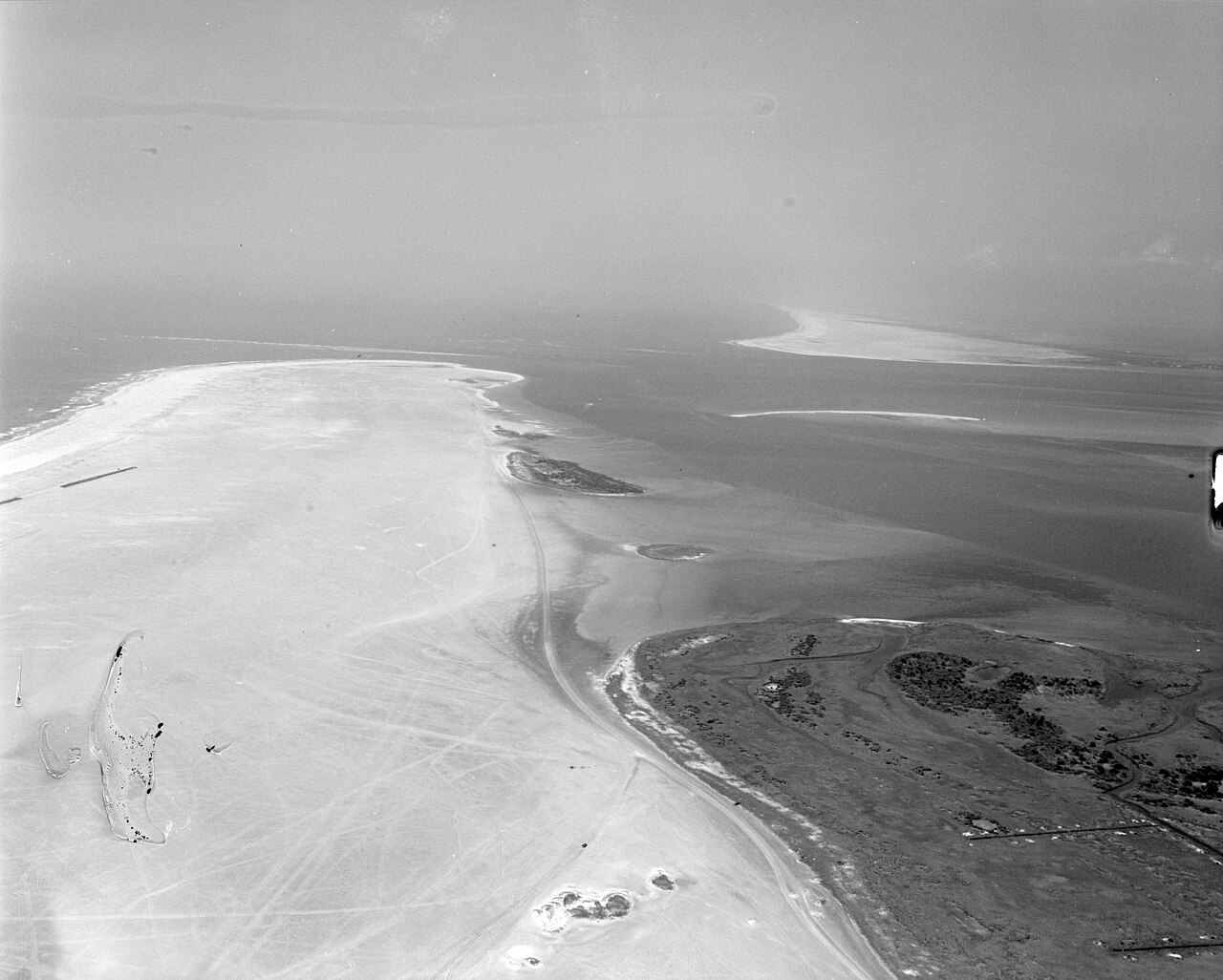
Read alongside
At sea, a measurement or a failed message can change an entire voyage. Watch the writer bring that invisible margin into view.
 Dead WakeErik Larson
The passenger liner Lusitania and the German submarine U-20 approach the same patch of sea carrying different information about what lies ahead. Erik Larson can dispense with secrecy about the outcome.
 Isaac’s StormErik Larson
Galveston had an experienced weather observer when the hurricane of 1900 struck. Isaac Cline's presence makes Erik Larson's account more disturbing.
Reading group guide
Which trace on the shore lets Carson take you furthest from the timescale of a human observer?
Find this book and edition
The Sea Around Us · Rachel Carson · Science, Nature & Technology
Cover edition ISBN 9780195069976 · Look for this edition in a library