


European Theater · Bavaria · Chapter 6 of 9 · Winter 1944 – 2 May 1945
The Last Months: Typhus, Trains and the Death March
Overcrowding and epidemic, transports from camps further east, the death train from Buchenwald, and the evacuation march of thousands of prisoners toward the Alps.
In the last six months of its existence Dachau became a place of mass death. Prisoners evacuated from camps in the path of the Allied armies were crammed into its barracks, typhus raged, and more than a third of all the deaths recorded at Dachau came in that half year. In the last week of April 1945, as American troops approached, the SS loaded prisoners onto trains and drove thousands more south on foot toward the Alps.
Key facts
Overcrowding and typhus
As the Red Army advanced from the east and the Western Allies from the west, the SS emptied the camps in their path and sent the survivors deeper into Germany. Transports reached Dachau from Natzweiler, Auschwitz, Flossenbürg, Buchenwald and many other camps. Barracks built for 200 men held a thousand and more. Typhus, carried by lice, broke out in the winter of 1944–45 and could not be contained. Hundreds died every week. The crematorium could not keep up, and the dead were stacked outside the barracks and the crematorium.
Prisoners registered in Dachau and its subcamps, 26 April 1945
The death train
On 7 April 1945 the SS put several thousand prisoners from Buchenwald onto a freight train bound for Dachau. Allied air attacks, damaged track and detours stretched the journey to three weeks. The prisoners, packed into open coal cars and closed boxcars, were given almost no food or water. Many were shot when they tried to escape or to find food. When the train reached the siding at Dachau on 27–28 April, most of those on board were dead. The Americans found it the next day: Chapter 7.

The death march
Himmler ordered that no prisoner should fall into enemy hands alive. On 26 April 1945, at least 25,000 prisoners from Dachau and its subcamps were sent off on foot or by train. More than 7,000 prisoners from the main camp, most of them Jews, were marched south in columns through the outskirts of Munich toward the Alps. They had no food and little clothing. SS guards shot those who could not keep up. Townspeople along the way watched; some gave the marchers bread or water, some hid escapees, and many looked away.
Interactive map · press “2. 26–30 April: the death march south”
Dachau, Munich and the death march, April – May 1945
The march passed through Pasing, Gräfelfing, Gauting, Starnberg and Wolfratshausen, and on toward Bad Tölz and the Tegernsee. As American forces closed in, the guards began to slip away. On 1 and 2 May, in the hills near Waakirchen, the last column was found in the snow. Among the first Americans to reach the marchers were the Nisei soldiers of the 522nd Field Artillery Battalion, Japanese Americans whose own families were held in camps in the United States.
The last days in the camp
Inside the camp, prisoners organized in secret. An International Prisoners’ Committee, with members from many nations, prepared to take over the running of the camp and to stop the SS from destroying it and its prisoners. In the town of Dachau, on 28 April, a group of escaped prisoners and local men tried to seize the town hall to hand the town over to the Americans; the uprising was crushed by the SS and several of the rebels were killed. Prominent “special prisoners,” among them Martin Niemöller, had already been taken south to South Tyrol, where they were freed at the end of April.
Gallery · 10 photographs · select to enlarge
Remembering the death march


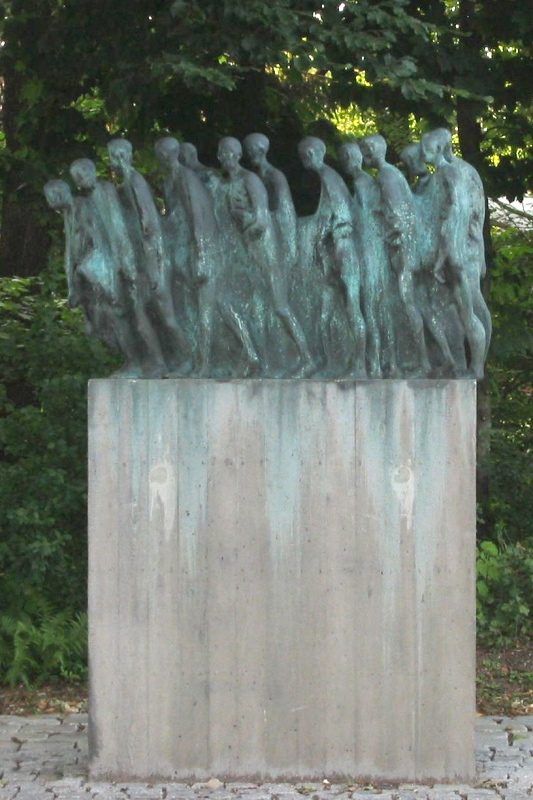


Memory along the road
The bronze marchers
In 1989 the sculptor Hubertus von Pilgrim made a bronze relief of a column of gaunt marchers, and identical casts were set up in more than twenty towns along the route, from Dachau to Waakirchen. They stand by roadsides, in front of town halls and outside cemeteries, so that the march is remembered where it passed. See Chapter 9.
On 29 April, three days after the march set out, American soldiers reached the camp itself: Chapter 7.
People, places and pages in this chapter
Sources and further reading
- United States Holocaust Memorial Museum, Holocaust Encyclopedia, "Dachau" — the opening in March 1933, Kristallnacht, the Soviet prisoners of war, the subcamps, the figures for 26 April 1945, the evacuation and the liberation
- The National WWII Museum, "The Last Days of the Dachau Concentration Camp" — the evacuations, the death train and the arrival of the Americans
- 45th Infantry Division resources (ibiblio), "522nd Field Artillery Battalion" — the Nisei artillerymen and the Dachau death march
- Nisei Veterans Legacy, "522 liberates Dachau prisoners" — the 522nd and the survivors of the death march
- Dachau Concentration Camp Memorial Site (KZ-Gedenkstätte Dachau) — the memorial site’s history of the camp, its exhibitions and its figure of 41,500 dead
More from The Lake Norman Brief
The Lake Norman Brief · History collections
Keep reading the Second World War
Every collection on lkn-law.com is free to read and built from official histories, archives and public-domain photographs. The Lake Norman Brief is published by Christopher Adkins of Adkins Law, PLLC, in Huntersville, North Carolina.
The Liberation of Dachau collectionAll World War II collectionsThe Holocaust by the numbers