

North Carolina • Archaeology • Colonial history
Research reviewed September 6, 2026 · About 46 minutes · 15 original visuals
The most famous word in the Roanoke story was not an undecipherable code. It was the name of a place and a people John White already knew. When he returned to the settlement in August 1590 and found CROATOAN carved into a post, he understood it as a destination. He reported relief. Modern retellings often make the same word the beginning of a horror story.
That reversal is an excellent place to begin an investigation. What did White actually see? What did he infer? Which inferences are supported by later evidence, and which have become familiar through repetition? The distinction matters because the colonists’ disappearance from English records does not demonstrate that every person disappeared from life at the same time.
White found houses taken down, a strengthened enclosure, missing boats and portable equipment, abandoned heavy material, and damaged possessions. He also found the agreed destination marker without the agreed sign of distress. Those observations suggest deliberate movement. They do not provide a passenger list for the move, an arrival record at Croatoan, or a history of what happened afterward.
Where the evidence stands: relocation by at least some colonists is better supported than a sudden event that erased the entire settlement without warning. Croatoan, associated with present-day Hatteras Island, is the clearest destination in White’s account. Movement into other Indigenous communities or dispersal among several places remains possible. Archaeological findings and later testimony add important clues, but the sources reviewed here do not establish the eventual fate of every member of the 1587 group.
The investigation therefore has two tasks. One is to explain why an English settlement became empty. The other is to determine what can be learned about the people after they left. The first question has stronger evidence than the second. Treating them as identical is how a plausible reconstruction becomes an overstated solution.

Explore the investigation
- An inhabited coast, not an empty stage
- Three expeditions that should not become one story
- The 1587 colony was not where its leaders intended it to be
- The missing years and the limits of the rescue story
- Before White reached the settlement, seven men drowned
- Inventory the scene before deciding what happened
- CROATOAN was a destination, and the missing cross mattered
- Why White did not simply sail to Croatoan
- Manteo and the politics of a possible refuge
- Drought explains pressure; it does not supply a death certificate
- Read Harriot as an observer with a purpose
- The map patch: a real hidden mark and an unproven fort
- Hatteras: why ironworking debris is interesting
- Inland sites and the difference between compatible and exclusive evidence
- Lawson's later testimony: important, mediated, and a century removed
- The Dare Stones and the manufacture of a satisfying ending
- Violence, storms, and theories that should not receive equal weight
- Compare complete histories, not isolated dramatic moments
- What would materially change the investigation?
- The judgment the surviving evidence supports
- Sources and research notes
1. An inhabited coast, not an empty stage
The English arrived in a region with existing communities, cultivated landscapes, political relationships, and sophisticated knowledge of coastal resources. Carolina Algonquian peoples grew maize, beans, and squash and combined agriculture with fishing, shellfish gathering, hunting, and seasonal movement. Dugout canoes, fishing weirs, and methods of drying or smoking food belonged to established systems of work. The National Park Service’s account of Carolina Algonquian life provides a useful introduction to this setting.
This background changes the meaning of almost every proposed solution. If the colonists moved to Croatoan, they did not simply retreat into an unoccupied wilderness. They would have entered a community with its own needs and decisions to make. If some moved inland, they would have encountered other political relationships rather than a blank space on an English map. Survival would involve diplomacy, labor, food, kinship, and the willingness of other people to receive them.

The coast itself encouraged movement while complicating access from the Atlantic. Barrier islands separated the ocean from sounds, and inlets offered passages whose usefulness depended on depth, weather, and local knowledge. A place that could support a canoe or small boat might be difficult for a larger vessel. A short distance on a modern map could be a dangerous journey for a heavily loaded ship’s boat in breaking water.
It is important to distinguish Indigenous communities rather than reduce them to “the Indians,” alternately friendly or hostile according to English needs. Croatoan, Roanoke, and mainland communities were not interchangeable. Their leaders could respond differently to visitors, and their decisions could change after violence, disease, shortages, or new alliances. A relationship established on one voyage did not guarantee that every later English party would be welcomed everywhere.
Nor should coastal Algonquian history be blended indiscriminately with the history of other Native peoples elsewhere in North Carolina. Our Lake Norman history concerns a different regional landscape and includes the Catawba River’s past. Shared modern state boundaries do not erase distinct languages, communities, or histories. Precise names keep the people in the story from becoming generic scenery.
John White’s watercolors are valuable evidence of what an English observer chose to depict, but they also require interpretation. A drawing is a composed view, not an aerial photograph. The selection of people, activities, and labels reflects the artist’s purposes and circumstances. Later engravings based on those drawings add another stage of mediation. The original watercolor and a later engraved adaptation should not be treated as identical records.
A reader investigating Roanoke should keep this inhabited geography in view throughout. The mystery exists partly because surviving English documentation becomes thin. That documentary silence is not the same thing as an absence of Indigenous knowledge, social continuity, or descendants. The challenge is to evaluate different kinds of evidence without forcing all of them into a story whose only meaningful actors are the missing English.
2. Three expeditions that should not become one story
Popular accounts often hurry from Raleigh’s name to the missing colonists, merging several voyages into one attempt. The chronology matters. The reconnaissance of 1584, the military settlement of 1585–1586, and the family settlement of 1587 had different purposes and consequences. Confusing them can assign an observation to the wrong group or make a later artifact appear more diagnostic than it really is.
In 1584, Philip Amadas and Arthur Barlowe led a two-vessel reconnaissance that reached the Outer Banks in July. Manteo and Wanchese traveled to England afterward, participating in exchanges across a considerable language barrier. Raleigh remained in England. The NPS account of the first voyage establishes this opening phase and distinguishes it from the larger expedition that followed.
The 1585 expedition brought a military settlement under Ralph Lane. Its dependence on Indigenous food and the deterioration of relations are central to what the next group inherited. Lane’s men killed the leader Wingina, also known as Pemisapan, in June 1586. The settlement was evacuated with Francis Drake later that month. The NPS history of the military colony also notes the scientific and metallurgical work associated with that expedition.
Those events make the 1587 colonists’ situation more complicated than an innocent first meeting that inexplicably went wrong. English violence had already occurred. Expectations and grievances already existed. The newcomers could not control how earlier actions shaped their reception. Nor can a modern investigator take English allegations of Indigenous betrayal as an impartial account of Native intentions. Such allegations need to be read as claims made by participants with interests of their own.
The distinction among expeditions is also essential to archaeology. A European object dating to the late sixteenth century might be connected with reconnaissance, the military settlement, the later colonists, exchange, or another visit. Finding an object compatible with the period is a useful beginning. Identifying it uniquely with a named missing group is a stronger claim requiring additional context.
The same caution applies to numbers. A fleet’s total sailors and soldiers are not necessarily the population of a settlement left ashore. A roster of people who embarked is not automatically a count of those who arrived, stayed, or remained after a leader departed. Large numerical discrepancies can sometimes arise from different denominators rather than a simple mistake. Until the roster is audited person by person, a precise-sounding total can conceal uncertainty rather than resolve it.
The better approach is to establish the sequence before assigning meaning to isolated facts. First came exploration and the movement of intermediaries across the Atlantic. Then came a military foothold, scientific observation, dependence, conflict, and evacuation. The 1587 family group entered a landscape already changed by those encounters. Its later disappearance belongs to that continuing history, not to an untouched world waiting for an English mystery to begin.
3. The 1587 colony was not where its leaders intended it to be
The 1587 expedition intended to settle in the Chesapeake Bay region, stopping at Roanoke to look for an earlier English garrison. After the party reached Roanoke in July, pilot Simon Fernandes refused to continue up the coast. The group remained and began repairing the earlier settlement. The NPS’s 1587 chronology, revised in August 2026, describes the change of destination and the difficult weeks that followed.
The distinction between intended and actual destination matters for later theories. A Chesapeake objective was real. That does not prove that the colonists eventually reached it after White left. An intention can explain a proposal without establishing that a journey occurred. To turn the intention into a completed route, an investigator needs evidence from the intervening period or the destination.
The group included women and children as well as men. Virginia Dare, White’s granddaughter, was born during the brief settlement period, as was a child in the Harvie family. The familiar focus on Virginia should not erase the other families. Nor should the infants be used to justify an invented final scene: their later lives are precisely what the surviving evidence does not establish.
Violence quickly complicated the settlement. George Howe was killed after the English arrived. A retaliatory expedition attacked Croatoan people whom the English had mistaken for enemies; Manteo intervened. These events underline how dangerous misidentification could be in a political landscape the newcomers understood imperfectly. “Friendly” and “hostile” are inadequate permanent labels for communities responding to changing circumstances.
White returned to England to seek supplies and assistance. His departure left an expectation of renewed contact, but the settlement was not necessarily intended to remain fixed in place indefinitely. In his later account, White described arrangements for leaving a destination name if the colonists moved and an additional cross if they were in distress. The marker system makes sense only because movement was an anticipated possibility.
How many people should an article call “the lost colonists”? Current institutional summaries use figures that do not always refer to exactly the same stage of the voyage. The NPS’s 2026 account gives 118 expedition members, while other summaries use 117 settlers. Rather than silently merge embarkation, arrival, and remaining-population counts, this investigation uses “more than 100” where an exact roster is unnecessary. The uncertainty in counting does not change the core observation that the settlement was empty when White returned.
The group faced a difficult practical problem. It needed food, shelter, workable relations with neighboring people, and a plan for surviving until support arrived. Remaining together might preserve labor and defense, but it could also concentrate demand on scarce supplies. Moving might improve access to resources while making later contact with an English ship harder. We cannot reconstruct the colonists’ deliberations word for word. We can recognize that relocation was a practical option explicitly anticipated before White’s departure.
That is a more useful starting point than assuming a sudden disappearance from a stable, well-supplied town. The settlement was already provisional, politically vulnerable, and dependent on connections extending far beyond its palisade.
4. The missing years and the limits of the rescue story
White reached England on November 8, 1587. He did not return to Roanoke until 1590. The Spanish Armada crisis, available shipping, and competing maritime objectives complicated attempts to bring relief. The NPS account of the return voyage explains why the delay cannot be reduced to a simple decision by White to abandon the settlers.
The delay is central because it creates the largest gap in the evidence. White’s 1590 observations tell us what the site looked like at the end of that interval. They do not supply a continuous record of the intervening seasons. A house taken down could have been dismantled soon after he left or much later. A stored object could have been damaged at a different time from the departure. The site contained traces of events without a surviving dated sequence for every trace.
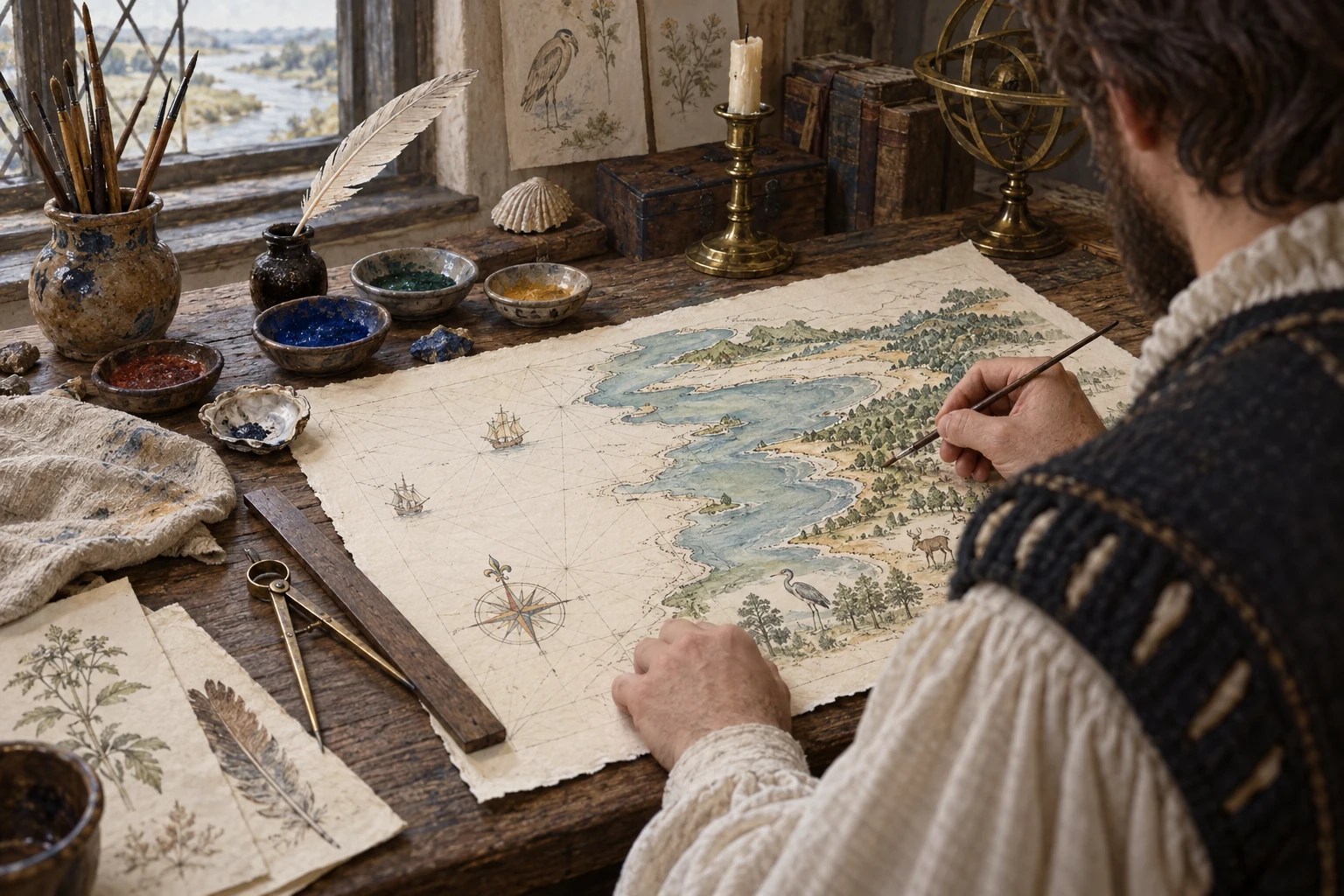
It is tempting to fill those years with a single escalating narrative: supplies fail, people panic, an enemy approaches, the colony vanishes. But several processes could have occurred at different times. Some people could have moved while others stayed temporarily. Illness could have affected one subgroup. A decision to join another community could have been voluntary, negotiated, constrained by need, or different for different individuals. The absence of a continuous diary prevents an honest account from selecting a detailed sequence solely because it is dramatically satisfying.
The relief voyage also needs to be understood as a maritime enterprise, not a modern rescue mission with a dedicated vessel, reliable communications, and unlimited time on scene. Ships had their own command structures, provisioning needs, and competing objectives. White could urge and negotiate; he could not simply suspend weather, repair every cable, or command a modern search organization into existence.
This matters when readers judge his failure to reach Croatoan after seeing its name. From a modern road map, continuing the search can look like an obvious short detour. On a dangerous coast, after casualties and equipment losses, it was a different calculation. Explaining those constraints is not the same as declaring every decision ideal. It is the necessary context for evaluating the decisions that were actually available.
The missing years also limit arguments from silence. A lack of recorded contact does not prove a lack of contact. Conversely, the possibility of unrecorded contact cannot authenticate a preferred theory. Silence can leave several explanations open, but it cannot be made to testify positively for whichever one an investigator favors.
Our Theodosia Burr investigation confronts a related problem: an expected arrival never occurs, and the gap attracts later stories. Roanoke offers more evidence at the abandoned site, but it still requires restraint between the known endpoints. The historian’s task is to explain the gap’s boundaries and consequences, not to disguise its existence with an invented narrative bridge.
5. Before White reached the settlement, seven men drowned
The return to Roanoke nearly failed before the searchers reached the abandoned town. White’s account of August 1590 describes a landing attempt in difficult surf. One boat shipped water but reached shore. Another overturned in breaking seas. Of eleven people aboard the overturned boat, seven died and four were rescued.
The numbers belong to the 1590 landing accident. They are not a count of deaths among the missing colonists. This distinction may seem obvious, but a graphic or retelling detached from its date can transform an unrelated casualty figure into false evidence about the colony’s fate.

White named the dead: Edward Spicer, Ralph Skinner, Edward Kelly, Thomas Bevis, Hance the surgeon, Edward Kelborne, and Robert Coleman. He described people holding on to the overturned boat and attempts to save them. He also blamed Skinner’s handling of the boat. The account is strong evidence of the reported accident and losses; its allocation of fault remains the judgment of a participant, not the result of an independent marine inquiry.
The incident changed the search party’s circumstances. White reported that sailors were reluctant to continue, and that persuasion and the determination of the leaders were needed to proceed. That reluctance should not be caricatured as cowardice or indifference to the colonists. The men had just watched companions die in the approach. Their assessment of the coast was informed by an immediate, lethal demonstration of its hazards.

Nineteen people later continued in two boats. Darkness caused them to pass the intended place before they noticed a fire through the trees. They sounded a trumpet, sang familiar English tunes, and called out without receiving an answer. At daylight they found burning vegetation. The fire did not become a successful contact with the settlers, but neither does the description identify who started it or when. An unexplained fire is an observation, not proof of a particular group nearby.
The detail of the songs is especially revealing. The searchers were trying to make themselves recognizable. They were not merely scanning for structures; they were attempting communication with people they hoped could hear them. The absence of a response under those circumstances is evidence of failed contact at that moment. It is not a comprehensive demonstration that no person remained anywhere on the island.
This episode gives the reader a more realistic scale for the search. It involved small boats, wet supplies, hazardous water, limited daylight, uncertain positioning, and a party reduced by loss. White’s later observations are invaluable, but they came from a constrained visit rather than an exhaustive archaeological or forensic survey. Any theory that relies on what he “must have found” should first account for what he actually had the time and ability to examine.
6. Inventory the scene before deciding what happened
The surviving description of the settlement is specific enough to resist some dramatic versions of the story. White did not describe a town of intact houses with meals waiting on tables. He described houses taken down and a place strongly enclosed by a substantial palisade. Heavy metal items remained, partly overgrown. Boats and some portable ordnance could not be found. Chests had been opened and their contents damaged or scattered.

Each observation has a different evidentiary value. Dismantled houses suggest purposeful human activity. They are harder to reconcile with a single sudden event that destroyed an occupied settlement exactly as it stood. Yet dismantling does not identify the date, every participant, or the ultimate destination of the materials. An orderly-looking departure can still precede hardship later.
The heavy objects are suggestive for another reason. People moving with limited carrying capacity might leave things that were difficult to transport while taking boats, weapons, tools, food, and other essentials. That is a plausible explanation of the pattern White recorded. It is not the only conceivable explanation, and the account does not provide a complete inventory of what had originally been present. An apparent pattern of removal should remain an inference from an incomplete comparison.
The strengthened enclosure complicates simplistic images of a defenseless camp. It suggests investment in protection or organization at some stage. It does not establish that a battle occurred there. A defensive structure can be built because danger is feared, because it is customary, or because the occupants want security while planning their next move. The structure’s existence is stronger evidence than any one explanation of its purpose.
The chests require especially careful reading. White recognized three of five as his own. He described damaged books, spoiled pictures and maps, and badly rusted armor. Those observations are personal and concrete. His conclusion that particular neighboring people had damaged the goods after the settlers left is different: he did not report witnessing that act. The identity and timing of whoever opened the chests cannot be established merely by repeating his accusation.
Weather damage also accumulates. Rotten frames and rusted metal can reflect exposure over time rather than a single violent episode. A scattered object can be moved more than once. An abandoned place can have a history after its occupants leave. These possibilities are familiar in archaeology, where a site’s final appearance can combine construction, use, abandonment, scavenging, erosion, and later disturbance.
The most defensible scene reconstruction therefore contains both facts and open spaces. Buildings had been taken down. A fortified enclosure remained. Some equipment was absent and some heavy material remained. Possessions had been disturbed. The observations support movement and subsequent change at the site. They do not provide a complete sequence of deaths, an authenticated attacker, or proof that the entire group shared one eventual fate.
7. CROATOAN was a destination, and the missing cross mattered
White described two inscriptions: CRO on a tree encountered on the approach and CROATOAN on a stripped post at the right side of the enclosure’s entrance. The full word was carved about five feet above the ground. Combining those observations into a single sinister word on a remote tree loses the setting in which White understood the message.
The arrangement had been anticipated. White said the settlers were to leave the name of their new location if they moved. If they were distressed, they were to add a cross. He found the name and did not find that cross. In his account, Croatoan was associated with Manteo’s home and people the English regarded as friends. The message therefore made sense to him as evidence of an intended move to a known community.
The absence of the cross is meaningful but bounded. It supports the proposition that the people who left the marker did not use the agreed distress signal at the time of carving. It cannot guarantee that nobody was hungry, ill, frightened, or later harmed. A signal is produced at a moment under particular circumstances. It is not a certificate covering every person’s subsequent life.
Nor can the full word identify every traveler. One group could leave a message for the settlement as a whole, while another group moved elsewhere or departed earlier. Some individuals might have died before a move. Others might have changed destinations afterward. These are possibilities rather than demonstrated events, but they explain why a destination marker is not equivalent to a final census.
White’s relief should also be treated as evidence of his interpretation, not as proof that the interpretation was completely correct. He had good reasons to read the sign hopefully: an agreed procedure, a recognizable name, and an existing relationship. He did not reach Croatoan to confirm the inference. The historian can recognize that his conclusion was reasonable while preserving the difference between inference and verification.
This is where Roanoke departs from the Beale Ciphers and Kryptos. CROATOAN does not require a hidden key or a new algorithm. Its literal reading was available to the returning governor. The harder problem is historical: whether, when, and how the people reached the named destination, and what happened to them there. Calling the word a code can make the problem seem more obscure than the actual evidence requires.
The strongest use of the inscription is therefore modest and consequential. It moves planned relocation toward the center of the investigation. It makes a wholly unanticipated disappearance less persuasive. It identifies Croatoan as the most direct destination clue. It does not close the investigation into the colonists’ later lives.
8. Why White did not simply sail to Croatoan
After examining the settlement, White intended to search at Croatoan. His account then becomes a record of increasingly constrained seamanship. Weather worsened. Water collected ashore could not safely be brought aboard. An anchor cable broke during recovery. Another attempt to hold the vessel failed, and a cable had to be slipped as the ship was driven toward danger. By the end of the sequence, only one anchor and cable remained from four.
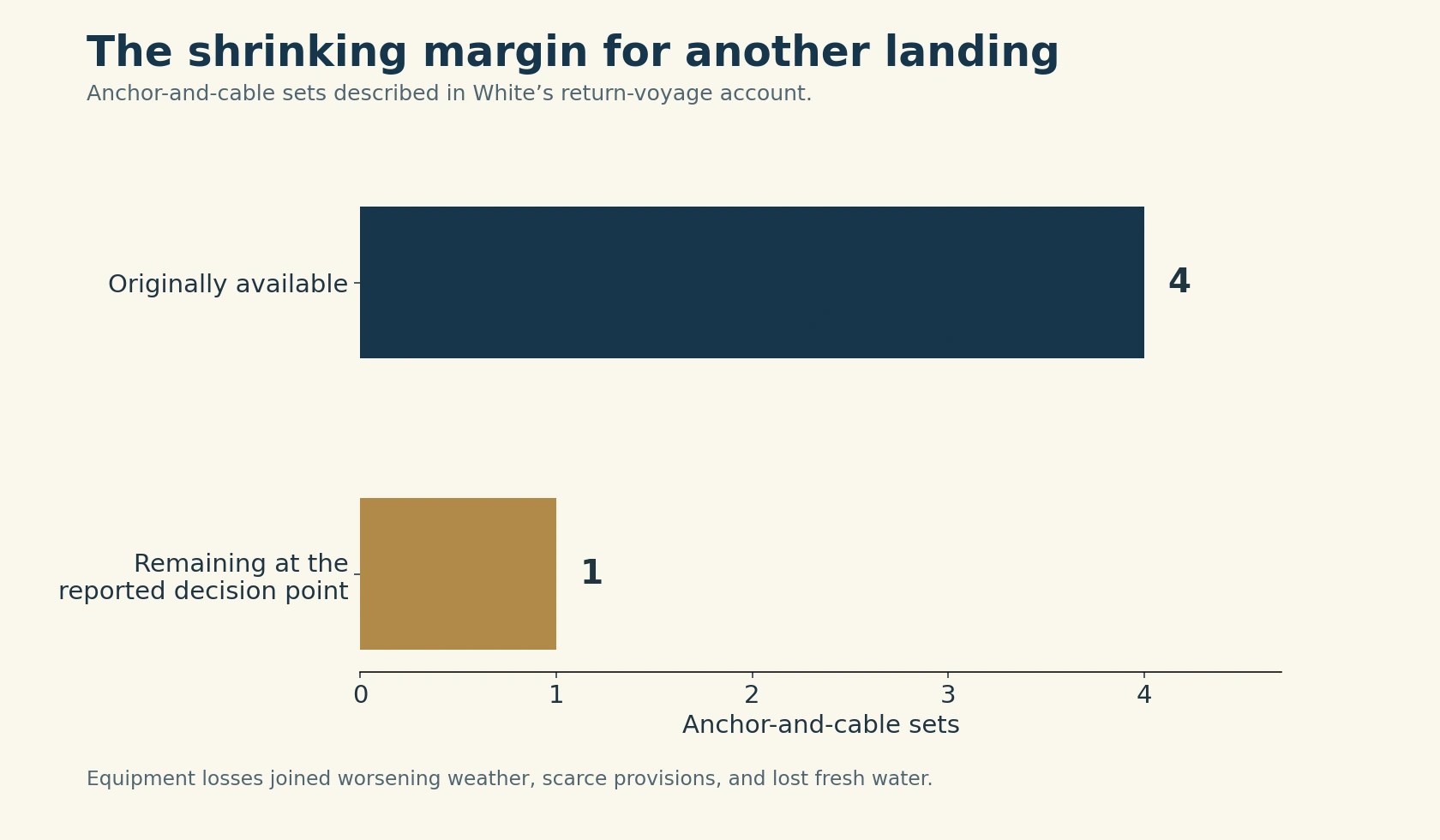
An anchor was not an incidental piece of equipment. On a hazardous coast, the ability to hold a vessel away from shoals or an exposed shoreline could determine whether the ship survived. Losing several anchors reduced the margin for another landing or a prolonged wait. The account’s combination of equipment loss, rising weather, scarce provisions, and missing fresh water explains why the next decision was not made under ordinary cruising conditions.
The distinction between a missing destination and an uncompleted visit is important. White had a destination he wanted to investigate. He failed to reach it. That failure preserved the uncertainty; it did not demonstrate that the destination was false. An unsuccessful search can reflect the limits of the search rather than the absence of the people being sought.
Modern readers may understandably find the decision devastating. White’s daughter and granddaughter were among those whose fate remained unknown. But an investigation should not invent a private confession, a secret motive, or a final emotional speech to intensify what is already a profoundly human record. His documented attempts, observations, and expressed reactions are enough to show the stakes.
There is a related error in treating the 1590 visit as the last possible moment at which any evidence could have been obtained. Later travelers, Indigenous communities, and eventually archaeologists encountered traces and traditions. Those later sources have their own limitations, particularly delay and mediation, but they belong to the investigation. White’s failure to complete the immediate search explains why later evidence became so important.
The anchor graphic is deliberately simple. It records the starting number and the remaining usable anchor-and-cable set at the stage White describes. It does not invent a loss-by-hour chart or a precise reconstruction of every maneuver. The purpose is to make a documented constraint visible without creating measurements the source does not supply.
The broader maritime lesson recurs in the Carroll A. Deering investigation. A vessel’s condition, the coast, weather, and available equipment constrain human choices. Readers cannot assess an abandoned ship or an unfinished search solely by asking what seems obvious from land. The water is part of the evidence, not merely the backdrop.
9. Manteo and the politics of a possible refuge
Manteo is often introduced as the English colonists’ helpful interpreter. That description captures part of his role and risks obscuring the rest. He came from Croatoan, traveled to England, and acted across political and linguistic boundaries. The NPS biography also identifies his mother as a weroansqua, a woman holding leadership authority. He belonged to a community with interests of its own.
If some colonists sought refuge among Croatoan people, their reception would not have been an automatic response to an English request. Hosts would have had to consider resources, security, obligations, relationships, and the consequences of association with newcomers. A useful reconstruction makes those decisions visible even though the surviving English record does not preserve a full account of them.
Malinda Maynor Lowery’s Lumbee perspective on Wingina, Wanchese, and Manteo offers a framework centered on kinship, diplomacy, and Indigenous historical understanding. Her discussion helps move the investigation beyond a binary in which Native people are either rescuers or attackers in someone else’s story. It also cautions against making a community’s history or sovereignty depend on whether English ancestors can be attached to it.
The word “assimilation” needs similar care. It can describe a broad process of joining another society, but it can conceal a variety of experiences. Marriage, adoption, labor, language learning, dependence, and incorporation through kinship do not all mean the same thing. Different individuals could have different positions and degrees of choice. No source examined here allows a detailed biography of every missing settler’s incorporation into a particular household.
It is also misleading to imagine that English people would remain archaeologically obvious forever if they lived in an Indigenous community. People can use locally made food vessels, adopt local clothing, repair familiar tools with available materials, and change practices over time. Conversely, Indigenous people can acquire and use European objects without hosting a colony of Europeans. Material culture does not map mechanically onto ancestry.
That flexibility is not a reason to declare archaeology incapable of answering anything. It is a reason to ask better questions. A cluster of artifacts, features, dates, and manufacturing evidence can reveal activity more convincingly than one isolated object. Historical context can narrow interpretations. But the investigator must explain why a pattern identifies these particular people rather than simply assuming that a European-made item carries an English owner wherever it is found.
A possible refuge at Croatoan is therefore plausible for reasons grounded in the direct destination clue and known relationships. Its plausibility grows stronger when the receiving community is understood as a real society rather than a plot device. The unresolved question is the specific history of arrival and incorporation, not whether Indigenous people possessed the resources and social institutions that made such a history conceivable.
10. Drought explains pressure; it does not supply a death certificate
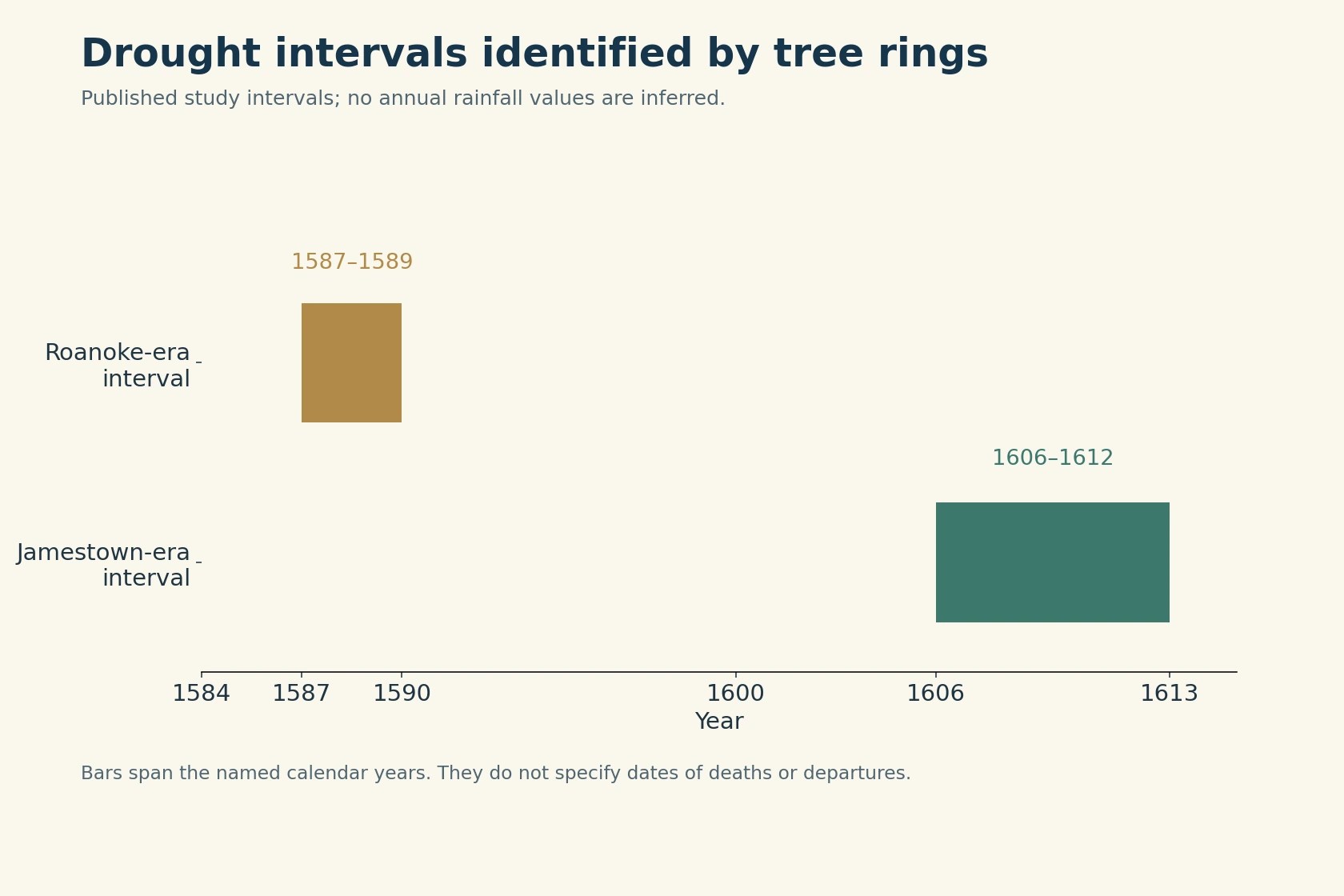
Environmental evidence adds a serious constraint to the missing years. A 1998 study by David Stahle and colleagues used tree rings to reconstruct severe drought during 1587–1589, placing the period in an approximately eight-century comparison. The same study identified a later prolonged drought associated with the early Jamestown years. The published abstract establishes the study’s findings and scope; this article does not claim to have reanalyzed its underlying measurements.
A drought could affect several parts of the colonists’ survival problem at once. Reduced harvests could make food harder to obtain. Water conditions could change. Communities asked to supply newcomers might have less to spare. An already strained relationship could become more difficult when exchange or assistance carried higher costs. These are mechanisms by which climate can alter the setting for human decisions.
They are not proof of a particular death sequence. A regional drought does not tell us which person became ill, how much food remained in a particular store, or whether every settlement experienced the same conditions. It cannot establish that all colonists starved on Roanoke, especially when the abandoned site’s evidence suggests movement. Climate is a pressure that proposed histories should accommodate, not a substitute for those histories.
The timing matters too. The reconstructed interval overlaps the years when English documentation becomes thin. That makes the result relevant, but overlap alone is not causation. A causal argument needs a plausible mechanism and evidence connecting that mechanism to the people or activities at issue. In Roanoke, drought strengthens the importance of food, mobility, and diplomacy; it does not independently select one destination.
Readers should also distinguish tree-ring reconstruction from a surviving rainfall ledger. Tree growth can carry information about past environmental conditions, but a published description of an extreme interval does not give an article permission to invent annual inches of rainfall or an exact graph of crop failure. The visual here shows the dated drought intervals discussed in the study. It deliberately avoids numerical rainfall values that were not supplied by the inspected source.
There is a human consequence to the environmental interpretation. A shortage affecting both newcomers and established communities changes the ethics of the familiar question, “Why did the Native people not simply feed them?” Assistance is not costless, and Indigenous communities did not exist to sustain an English venture regardless of their own needs. Environmental pressure belongs in the analysis of all parties, not only the colonists.
A credible explanation can therefore combine migration and hardship. Some people might have moved because conditions worsened; some might have suffered before or after moving. Those possibilities are compatible rather than competing answers that require a single winner. The evidence supports treating drought as part of the problem the colonists faced, while leaving the ultimate individual outcomes unresolved.
11. Read Harriot as an observer with a purpose
Thomas Harriot’s A Briefe and True Report of the New Found Land of Virginia is among the most substantial contemporary texts associated with the earlier expedition. Its descriptions of crops, resources, food, technology, beliefs, and illness can make the coastal setting less abstract. The public-domain text also makes its promotional and missionary purposes visible. Harriot was explaining a place to people interested in English colonization, not writing a neutral modern ethnography.

His attention to usable resources reveals what English sponsors hoped to obtain. Plants and materials appear within an argument about a venture’s prospects. Descriptions of agricultural abundance can therefore be both observations and persuasion. A reader should not turn a promotional estimate of crop output into a modern experimental yield, especially when units, labor assumptions, and growing conditions are not equivalent.
His account of Indigenous beliefs is similarly mediated. Harriot translates unfamiliar concepts into a Christian framework and discusses the possibility of conversion. He can admire ingenuity while asserting English superiority. Those tensions are evidence about the encounter and the writer’s assumptions. They prevent us from treating every theological term in his English account as an exact, unfiltered statement by the people he observed.
The illness passages require particular care. Reports of deaths following contact are historically serious. They can illuminate the fear and disruption associated with new arrivals. They do not permit a retrospective diagnosis of a specific pathogen merely from a brief description, nor do reported losses in particular communities provide a complete regional mortality census. The limits of the account should be retained even when its implications are disturbing.
Most important for the mystery, Harriot’s experience belongs to the earlier expedition. He did not witness the ultimate fate of the 1587 settlement. His observations can establish context: how English visitors understood the environment, what resources they recognized, how relationships were strained, and how contact could be interpreted. They cannot supply an eyewitness ending to a later disappearance.
This distinction is a common source of historical overconfidence. A contemporary witness feels close enough to an event that everything the witness writes acquires the authority of direct observation. But proximity in time and place is not the same as presence at the decisive moment. A person can be an excellent source for one phase of an encounter and only an indirect source for another.
Harriot remains valuable precisely when read critically. His text lets readers see the commercial hopes, religious assumptions, technical interests, and unequal judgments that accompanied the English venture. That context helps explain why a settlement could fail to achieve its sponsors’ aims without requiring every settler to die. The continuation of individual lives within another society would not necessarily appear as success in a report written to promote an English colonial project.
12. The map patch: a real hidden mark and an unproven fort
In 2012, researchers examining John White’s map of Virginia identified a fort-like symbol beneath a paper patch. The technical study by Janet Ambers, Joanna Russell, David Saunders, and Kim Sloan described the examination of two patches, using methods including transmitted light and other non-destructive analytical techniques. The British Museum repository record identifies the paper; an author-posted readable version supplies its substantive discussion.
The hidden symbol is real evidence on a historical object. A built secret fort is an interpretation of that evidence. Those statements must remain separate. A map can record a proposed location, a surveyed possibility, an abandoned plan, an uncertain feature, or a completed structure. The presence of a symbol does not identify which of those functions it served without additional evidence.
The patch itself also admits more than one explanation. A cartographer may cover a feature to revise a map, protect information, correct an error, or reflect a change of plan. The study considered material behavior and fading; it did not simply establish a dramatic scheme involving invisible ink. A visually striking discovery should not cause the analytical qualifications to disappear from the story.
There is an important conservation point as well. Discovering what lies beneath a patch does not mean that researchers peeled away an irreplaceable part of the map. Imaging and analysis can reveal information while preserving the object. Illustrations should not show a scholar casually removing the patch as though that were the documented procedure. A reconstruction that invents the method can mislead even if the broad discovery is real.
For the Roanoke investigation, the symbol makes an inland search more intelligible. It identifies a place on a map where an English cartographic interest existed. It does not prove that the 1587 colonists built and occupied a fort there, nor does it contradict a Croatoan move by another group. A map clue and a destination inscription could relate to different stages, plans, or people.
The best next step is therefore archaeological and documentary comparison. Does the relevant area contain securely dated occupation evidence? Are there features whose construction and use fit the proposed period? Do artifacts form a coherent pattern rather than an isolated scatter? Is there independent correspondence or another map that clarifies the symbol’s meaning? These questions turn the discovery into a research program rather than a premature verdict.
The map’s power lies in opening a testable possibility. It narrows attention and gives investigators something specific to examine. Its limitation is equally clear: a mark on paper and a settlement in the ground are different kinds of evidence. The history between them has to be demonstrated.
13. Hatteras: why ironworking debris is interesting
Recent Hatteras claims deserve more than either an excited headline or a reflexive dismissal. Reporting in 2025 described hammerscale—small residues associated with working hot iron—among material recovered in 2024 excavations. Researchers argued that such debris could indicate sustained activity rather than the mere arrival of a traded European object. The claim appears in WHRO’s January report and Island Free Press’s May account.
Why does manufacturing waste matter? A finished object can travel far from where it was made. It can be traded, given, stolen, inherited, scavenged, or reused. Waste from a process may connect an activity more closely to the place where it is found. That makes a well-contextualized production residue potentially more informative than an isolated imported object.
The next question, however, is whose activity it records. Evidence of ironworking does not by itself identify a named colonist or even require a permanent English population at the site. Different users, visitors, and periods must be considered. The argument becomes stronger when the residue is securely associated with dated features, tools, hearths, and other material that supports a coherent account of how the activity occurred.

The May reporting said associated animal teeth had been radiocarbon dated and conveyed a late-sixteenth-century interpretation. The accessible account did not provide the full laboratory identifiers, calibrated ranges, or a complete technical excavation report. That matters because a date belongs to a sampled material and context, not automatically to every nearby object. An investigator needs to know how the association was established and whether later disturbance could have mixed deposits.
Kristina Killgrove’s June 2025 report in Live Science included both the researchers’ interpretation and skeptical questions from other specialists. It described the absence, at that time, of a peer-reviewed excavation publication and emphasized the need for fuller context. The bounded research reviewed through September 6, 2026 did not establish a later publication that conclusively resolved the attribution.
A responsible reader should therefore preserve two judgments. The reported evidence is potentially significant and deserves serious technical examination. It does not yet support an account in which every colonist is known to have arrived safely and lived together at one Hatteras site. Even researchers favoring relocation can allow dispersal, deaths, and different outcomes among subgroups.
The useful question is not whether the discovery is exciting. It is what additional evidence would make its interpretation more specific. Complete context records, dating information, evidence of the working installation, and a careful comparison with alternative users would help. A “smoking gun” headline should not substitute for that chain of reasoning.
14. Inland sites and the difference between compatible and exclusive evidence
Inland investigations in Bertie County form another important part of the search. The 2023 volume Excavating the Lost Colony Mystery: A Map, a Search, a Discovery, edited by Eric Klingelhofer, discusses Site X and later Site Y work. The available chapter previews are especially valuable because they preserve limitations that can disappear in popular summaries. This article does not claim to have read unprovided chapters of the complete book.
In the visible Site X discussion, Nicholas Luccketti acknowledges the absence of an exclusive sixteenth-century artifact, an English structural feature, a burial, or a fort that would conclusively identify the lost colonists. That is a consequential qualification from within the research, not merely an objection imposed by an outsider. Suggestive material can justify a hypothesis while still falling short of unique attribution.
“Compatible with” and “diagnostic of” are different standards. A ceramic fragment may be compatible with the period in which the colonists could have arrived. To diagnose their presence specifically, its context or combination with other evidence must distinguish that explanation from trade, earlier visitors, later settlers, or movement through existing networks. An artifact’s European origin alone does not settle the identity of its last user.
Sampling introduces another layer. Archaeologists examine selected areas under practical constraints. A failure to find a structure in sampled units does not establish that no structure existed anywhere nearby. Conversely, finding a few relevant objects in a limited sample does not establish the size or duration of an entire settlement. The scale and placement of the work should accompany claims about what the site represents.
The inland evidence can coexist with the Croatoan marker. If the original group divided, or if people moved more than once, different locations could preserve different portions of the history. That possibility is useful only if it remains constrained: every new site cannot be declared a colony outpost merely to make all clues fit. Each location still needs its own evidence for date, activity, and connection to the missing people.
One benefit of comparing Hatteras and inland work is that it reveals the kinds of proof the problem requires. Repeated occupation, household activity, manufacturing traces, securely dated features, and identifiable connections can be more persuasive together than any single spectacular object. The task is to assemble a pattern with a defensible context, not to choose the most attractive artifact and build the whole story around it.
15. Lawson’s later testimony: important, mediated, and a century removed
John Lawson’s A New Voyage to Carolina, published in 1709, preserves a frequently cited account of Hatteras ancestry. In the relevant passage of the public-domain text, Lawson reports that Hatteras people described some ancestors as white and able to read. He then treats gray eyes as confirmation of an English connection. The statement deserves attention, and his claimed confirmation deserves scrutiny.
The passage is not a surviving interview with a named 1587 colonist. It is an early-eighteenth-century writer’s report of what people told him about ancestors. That creates several questions: how the account was transmitted, what period the ancestors belonged to, how Lawson understood the language and context, and whether later European contact could explain part of the tradition. The account can preserve meaningful historical memory without uniquely identifying the Roanoke group.
Gray eyes are not a genetic test. Physical appearance cannot establish descent from a particular missing person, and Lawson’s racial categories belong to his own period and assumptions. Repeating his inference as modern scientific proof would transform an old interpretation into a finding the source cannot support.
The surrounding text makes Lawson’s method and outlook more visible. He discusses remains and objects associated with earlier English settlement, then speculates about failed supplies and cohabitation. His language treats adopting Indigenous ways through a derogatory hierarchy of cultures. That framework should be analyzed as the author’s bias, not adopted as the meaning of survival among Native relatives.
The next part of his account also reports a local tradition of Raleigh’s ship appearing offshore. Its presence beside the ancestry discussion reminds us that Lawson collected different kinds of material: observation, reported finds, remembered history, speculation, and stories attributed to credible local informants. It would be simplistic either to accept every passage as established fact or dismiss the whole work because it includes a marvelous tradition. Each claim needs its own evaluation.
Oral history requires respect and context, not an automatic pass or automatic rejection. It can preserve information overlooked or excluded by written colonial records. It can also change through transmission, translation, and the concerns of later generations. Written sources undergo their own forms of selection and distortion. The comparison should be between particular evidence chains, not a hierarchy in which writing is inherently truthful and speech inherently unreliable.
For Roanoke, Lawson’s passage makes later memories of European ancestry relevant to the investigation. It strengthens the reason to examine continuity and incorporation rather than assume universal annihilation. It does not supply an authenticated genealogical bridge from Eleanor or Virginia Dare to a named living family. That bridge would require evidence of its own, and the value of Indigenous communities’ histories does not depend on producing it.
16. The Dare Stones and the manufacture of a satisfying ending
The Dare Stones offered something the genuine record lacked: a purported sequence of messages that supplied an ending. Forty-eight stones were reported between 1937 and 1940. The first, presented by Louis Hammond, was said to have been found near Edenton. Bill Eberhardt supplied forty-two of the later stones. A 1941 investigation by Boyden Sparkes exposed serious fabrication evidence, and the scholar H. J. Pearce Jr. acknowledged having been deceived. The NCpedia account by Kelly Agan and T. Mike Childs traces the episode.

The first stone should be distinguished from the discredited later chain. That distinction does not authenticate it. A disputed object does not become genuine merely because the case against other objects is stronger. Its alleged message, provenance, material history, lettering, and circumstances of discovery still require independent examination.
The episode illustrates a familiar investigative hazard: evidence that supplies exactly the narrative a searcher wants can receive less scrutiny than it deserves. A missing person’s supposed final message can name places, dates, and survivors with an apparent precision that makes the story feel complete. Yet precision inside an unauthenticated inscription is still a claim made by that object. It cannot be used as demographic data before the object itself is established.
Rewards and publicity can also alter the environment in which evidence appears. When a discovery creates a market for more discoveries, the supply of objects may respond to incentives. That does not make every newly found object fraudulent. It makes provenance, independent documentation, and the relationship among finders especially important. A chain of mutually supporting objects is weak if the chain depends on the same compromised source.
The graph distinguishes the reported total from the group supplied by Eberhardt. It does not label the six remaining stones collectively genuine. One of them is the separately disputed first stone; the status of a category cannot be inferred by subtracting one supplier’s count from a total. Arithmetic can organize the history without deciding authenticity.
The comparison with the Beale treasure papers is useful. In each story, an intriguing object offers a route from uncertainty to a vivid narrative. The first question must be whether the object’s claimed history is authenticated. A readable inscription, a dramatic message, or an internally consistent itinerary is not enough. Fabrication can be detailed, and an invented ending can be more narratively satisfying than the fragmentary truth.
The Dare Stones belong in a full Roanoke investigation because they shaped public expectations of what a solution should look like. They also offer a warning: the desire to give missing people a final voice can make readers vulnerable to someone else’s invention.
17. Violence, storms, and theories that should not receive equal weight
Violence is a legitimate part of the Roanoke inquiry because earlier encounters included killings and retaliation. It would be unreasonable to declare that no colonist could have died violently. It would be equally unreasonable to convert that possibility into a demonstrated massacre of the complete group at a particular place and time. The evidence supports the existence of conflict in the wider history, not every later story attached to it.
Reports gathered in the Jamestown period have been used to argue that colonists moved toward the Chesapeake and were later killed. Those accounts deserve examination as later, mediated testimony. They were recorded around two decades after the Roanoke settlement’s disappearance and do not function as eyewitness descriptions of what happened on Roanoke in 1587. The NPS review of major theories describes the proposal and its unresolved evidentiary problems.
A careful evaluation asks who reported the event, who supposedly witnessed it, how the information passed between them, what group was being identified, and what archaeological evidence could corroborate the account. A later report can be important even when it is not conclusive. Its distance from the event must remain part of the reader’s assessment rather than disappear when the story is retold.
Spanish destruction is another recurring proposal. Spain had reasons to be concerned about English activity, but motive does not establish an attack. The NPS synthesis notes Spanish reconnaissance that failed to locate the colonists and does not identify a demonstrated Spanish destruction of the settlement. A theory cannot cross the gap from “someone had an interest” to “someone carried out this event” without evidence of the act.
Storms are a more immediate environmental possibility on this coast. White’s own return showed their danger. Yet the settlement he described does not look like a simple snapshot of a town obliterated without warning while everyone remained inside. Dismantled houses and a destination marker require an explanation. A storm could have affected people during a later journey or at another location, but that is a different claim from a storm erasing the original settlement in one moment.
Disease and hunger also remain possible contributors. The problem is scale and sequence. Some people could die while others moved. An epidemic could affect more than one community. A shortage could force dispersal rather than universal death. The absence of discovered graves does not prove nobody died, just as the possibility of undiscovered graves does not establish a death toll.
These theories should therefore be compared by the evidence they explain and the additional assumptions they require. They are not equally supported simply because each has appeared in a book or documentary. Planned movement has a direct marker and a compatible site pattern. Particular final catastrophes generally require evidence not presently established. The reader can recognize that imbalance without claiming certainty about every individual outcome.
18. Compare complete histories, not isolated dramatic moments
The most useful explanations are sequences that connect the known starting conditions with the 1590 observations and any later evidence. A proposed history should explain why the settlers left a destination name, why buildings were taken down, why some equipment disappeared and heavy items remained, and why no confirmed English reunion followed. Explaining only the most famous word is not enough.

Relocation to Croatoan with some degree of incorporation has the strongest direct destination clue. It fits an existing relationship and the expectation that a move would be signaled. Its unresolved parts include the number of people who traveled, their dates of arrival, the conditions of reception, and their later lives. The hypothesis is stronger as an account of at least some movement than as a complete biography of the group.
Dispersal among several communities can accommodate the possibility of different destinations and the pressures of supporting a substantial number of newcomers. It may also help explain why clues appear in more than one area. Its weakness is the temptation to make it explain everything without testing anything. Each proposed branch still needs evidence; an adaptable story is not automatically a well-supported one.
Movement followed by deaths from hunger, disease, or violence is compatible with relocation and the difficult setting. It avoids the false choice between survival and catastrophe as all-or-nothing outcomes. But it cannot supply named victims, dates, or proportions without additional records or physical evidence. The possibility of mixed outcomes is reasonable; the details remain unresolved.
A Chesapeake move followed by later killing draws on the original destination and later reports. It needs a stronger chain connecting those reports to the particular 1587 colonists. An intended destination cannot stand in for proof of arrival, and later testimony should be examined in its own historical circumstances.
A single sudden destruction at Roanoke fits the popular image of disappearance poorly when tested against White’s description of dismantled buildings and the agreed marker. It would need to explain those observations rather than ignore them. Spanish-attack versions additionally need evidence for the attack itself. These proposals should receive less weight than theories that begin with the direct departure evidence.
The matrix assigns no invented percentages. A numerical probability would require a declared model and defensible inputs, neither of which the surviving record supplies at the necessary level. Qualitative judgment is still possible: some explanations account for more of the strongest evidence with fewer unsupported steps. The task is to make those reasons visible so the reader can assess them.
There may never be one sentence that accurately describes what happened to every member of the group. A settlement can cease to exist while individuals continue in several places. Recognizing that possibility changes the question from “What single event swallowed the colony?” to “What paths did its people take after an English colonial project ceased to be visible in English records?”
19. What would materially change the investigation?
A new discovery should be judged by the uncertainty it resolves. A securely dated occupation feature at a candidate site would strengthen the case for activity there. A coherent assemblage linked to a particular household or expedition could narrow attribution. An authenticated contemporary letter naming colonists at a destination could transform the documentary record. None of those hypothetical discoveries should be announced before it exists and has been examined.

For archaeological claims, the crucial chain runs from recovery context to dating, identification, association, and interpretation. Where was the object found? Was the deposit intact? What else was present? Which material was dated, by which method, and with what uncertainty? What alternative routes could have brought the object there? A press photograph of an attractive artifact cannot answer all of those questions.
Dating deserves special precision. A date range is not an exact year. The date of a material’s formation is not always the date of its final deposition. An old object can remain in use, move through exchange, or be redeposited later. These are ordinary archaeological problems, not objections invented to keep a mystery alive. A strong publication explains how it addressed them.
Genealogical and genetic proposals require comparable restraint. A claim of descent from a particular colonist needs an evidentiary bridge to that person. Broad evidence of European ancestry cannot uniquely identify a member of the Roanoke expedition. A physical trait is still less specific. Community traditions should be approached respectfully, and participation in research belongs under the control and consent of the people concerned. A mystery article should not treat living communities as collections of specimens waiting to validate an English narrative.
For documents, provenance comes first. An old-looking sheet or inscription requires a history of custody and examination of its material and textual features. A detailed message can be fabricated. A document discovered after a famous story became widely known can draw on that story. Independent evidence predating the publicity is especially valuable because it reduces the risk that the apparent discovery is merely the legend returning in material form.
Negative evidence must also be calibrated. If a carefully designed excavation examines the place where a theory predicts a substantial fort and finds no compatible structure, that result can weaken the theory. It does not prove that no colonist ever passed through the broader region. The strength of an absence depends on what was searched, how, and what should have survived if the claim were true.
Finally, a new result should be described at its actual scale. Evidence for a blacksmithing activity is evidence for an activity. Evidence for a settlement is evidence for a settlement. Evidence naming one colonist is not automatically evidence for the whole group. Progress does not need to solve every question to be important. The strongest investigation welcomes a partial answer that is well supported and resists a complete answer that is not.
20. The judgment the surviving evidence supports
The Roanoke settlement was empty when John White returned in 1590, but it was not silent in every sense. Dismantled buildings, missing boats, abandoned heavy material, and an agreed destination marker all conveyed information. CROATOAN was intelligible to the person who had arranged the signal. It directed his attention toward a known community, and his failure to complete that visit left the inference unconfirmed.

The best-supported conclusion is that at least some colonists moved deliberately, with Croatoan the clearest named destination. The surviving evidence does not establish that all traveled together, that all arrived safely, or that all shared one final outcome. Incorporation into Indigenous communities, dispersal, and deaths from several causes can coexist within a history more complicated than the familiar disappearance story.
Modern research has added meaningful evidence. The map patch revealed a genuine hidden symbol. Archaeology has identified suggestive material in more than one location. Climate reconstruction establishes serious environmental pressure. Later testimony preserves memories that deserve consideration. Each contribution narrows or changes questions; none should be asked to prove more than its own context allows.
The clear answer is therefore about the limits of the legend: no supernatural explanation is needed to account for an English settlement that people were already prepared to leave. The unresolved history concerns the particular journeys and lives that followed. That distinction permits a reader to reject an exaggerated mystery while remaining honestly uncertain about its human ending.
For North Carolina readers, Roanoke is also an invitation to understand the state’s past through more than English arrivals and departures. Indigenous communities were already making history before the settlers appeared and continued to do so afterward. A fuller investigation places the missing colonists within that continuing world. It allows the evidence to suggest survival without inventing certainty and allows uncertainty without erasing the people who knew the coast best.
Sources and research notes
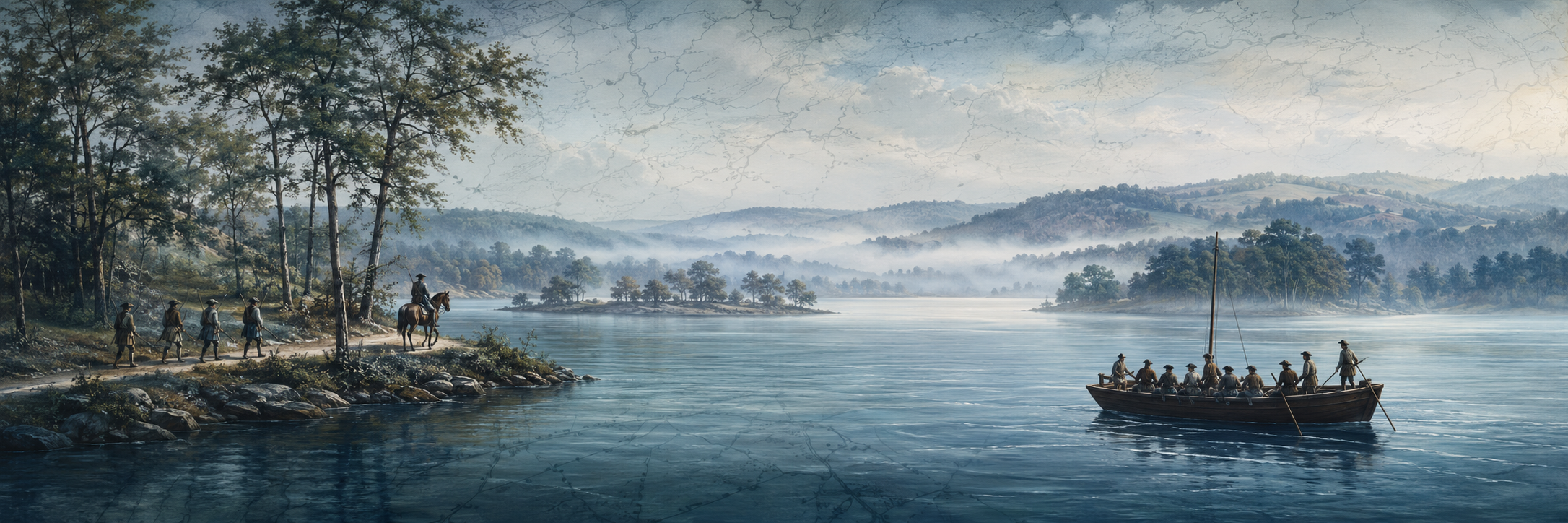
This article distinguishes contemporary observations, later testimony, archaeological interpretation, and modern reporting. It is based on published sources reviewed through September 6, 2026; it does not claim a new excavation, an archive visit, interviews with the named researchers, or an identification of descendants. The watercolors are labeled reconstructions. Analytical graphics use only stated counts, dated intervals, or qualitative comparisons; no probabilities or annual rainfall values are invented.
- John White, account of the 1590 voyage. Public-domain primary narrative, available in a modern ANCHOR transcription. Its observations are separated from White’s accusations and interpretations. The apparent 1586 reference in the excerpt is not used to change the date of the 1587 settlement, and the modern Saint John location gloss is not adopted. Read the account.
- Thomas Harriot, A Briefe and True Report, 1588/1590. Primary account of the earlier expedition, with promotional and missionary purposes. Public-domain text.
- John Lawson, A New Voyage to Carolina, 1709. Later reported ancestry tradition and the author’s surrounding interpretation. The complete relevant passage was inspected; appearance is not treated as genetic proof. Public-domain text.
- National Park Service, expedition histories. Institutional chronologies distinguish reconnaissance, military settlement, the family colony, and the unsuccessful return search. 1584, 1585–1586, 1587, and 1590.
- National Park Service, Carolina Algonquian history and Manteo biography. Regional context and documented intermediary history. Communities and Manteo.
- Malinda Maynor Lowery, “Wingina, Wanchese and Manteo: A Lumbee Perspective on the Lost Colony,” Coastwatch, 2019. Indigenous scholarly perspective on kinship, diplomacy, and historical framing. Read the essay.
- David Stahle and colleagues, “The Lost Colony and Jamestown Droughts,” Science, 1998. Published abstract of the tree-ring study; underlying annual measurements were not reanalyzed here. Study record.
- Janet Ambers and colleagues, “Hidden history?: examination of two patches on John White’s map of ‘Virginia’,” 2012. Technical examination; a concealed symbol does not establish a built fort. Repository record and readable author-posted paper.
- Eric Klingelhofer, editor, Excavating the Lost Colony Mystery, 2023. Visible chapter previews, including the Site X attribution limits; the entire book was not inspected. Publisher-platform record.
- Hatteras reporting, 2025. Claims and expert responses, distinguished from a complete technical excavation publication. WHRO, Island Free Press, and Live Science.
- Kelly Agan and T. Mike Childs, “The Dare Stones,” NCpedia. Reported totals, suppliers, and fabrication history; the first stone remains separately disputed. Reference account.
- National Park Service, “Major Theories of the Lost Colony,” 2025. Comparative institutional synthesis, not an announcement that the complete fate has been solved. Theory review.
Leave a Reply