
North Carolina • Maritime history • Disappearance
Research reviewed September 6, 2026 · About 50 minutes · 15 original visuals
A sailing ship could be seen from the North Carolina coast, its canvas raised and its hull fixed in the breakers. The men trying to reach it could see the problem more readily than they could reach the people who ought to have been aboard. There appeared to be nobody answering. The boats were gone. For days, the sea prevented a close examination.
The date was January 31, 1921. The place was Diamond Shoals, offshore from Cape Hatteras. The ship proved to be the Carroll A. Deering, a large wooden schooner built less than two years earlier. The wreck was real. The absence of its crew was real. The pirate message that later seemed to explain the absence was a fabrication.
That combination makes the Deering unusually instructive. It is a maritime disappearance with a surviving vessel, a rescue operation, government inquiries, an acknowledged hoax, and an extensive documentary afterlife. Yet the evidence does not give us a witnessed departure from the ship, an authenticated final account by a crew member, or an established fate for everyone aboard. A great deal happened around the missing interval. The interval itself remains obscure.
This investigation follows both the schooner and the changing claims about it. Institutional histories provide the principal chronology; published transcriptions preserve portions of Coast Guard reporting; archival inventories identify records still needing direct examination. They are different kinds of sources. The account below makes that distinction visible rather than pretending that every surviving folder has been opened.
Where the evidence stands: The Deering was found abandoned and aground, and dangerous seas delayed boarding until February 4. Its people and boats were missing. The bottle message attributed to the crew was a hoax. Accidental abandonment, mutiny, and other proposed sequences have not been conclusively established. The central unanswered question is the sequence connecting the last sightings, the departure of the people, and the grounding. The National Park Service reconstruction and Hoover Library discussion agree on the unresolved outcome.
Explore the investigation
- Begin with a ship, not a disappearance
- A Maine shipyard at the end of a long working tradition
- What five masts do—and do not—tell us
- A return voyage with an incomplete human record
- The encounter at Cape Lookout Lightship
- The anchor problem
- Lake Elon and the last probable sighting
- Diamond Shoals as a physical place
- The rescue operation deserves its own chronology
- Four calendar days that changed the evidence
- The missing inventory: a departure, but whose departure?
- The meal that cannot serve as a clock
- The boats and the possibility of an accidental loss
- The captain, his family, and the danger of retrospective accusation
- Mutiny: a plausible suspicion with an unproved final act
- The bottle message: the clue that has a clear answer
- Why the case reached Herbert Hoover
- Piracy, politics, and the problem of a supposed pattern
- Hewitt: can one disappearance explain another?
- Financial motives and what an insurance theory would need
- The wreck was altered, salvaged, and destroyed
- The archive is a research path, not a solved case in a box
- How a story becomes more certain than its sources
- A verdict the evidence can support
- Sources and further investigation
1. Begin with a ship, not a disappearance
The first useful distinction is geographical. The Deering did not vanish into an unlocated patch of ocean. It ended on a known, dangerous shoal. People watched it, approached it, eventually boarded it, and removed property from it. The unknown history belongs principally to the people and the actions that preceded that discovery.
This changes the investigation. For the Patriot and Theodosia Burr, the vessel itself has not been authenticated as a recovered wreck. With the Deering, there was a physical scene to examine. But that advantage came with a serious qualification: the scene had been exposed to surf before anyone could inspect it closely. We must distinguish the ship as it was when the crew left from the ship as it was when the first boarders arrived.
Imagine three separate photographs, even though no such complete photographic sequence survives. The first would show the vessel at the moment someone decided to leave. The second would show its first contact with the shoal. The third would show its interior when rescuers entered. The order of the first two images is uncertain. The third is separated from them by an interval in which damage and movement could occur. Treating all three as a single moment produces much of the mystery’s apparent impossibility.
An intact-looking hull also supplies less information than it seems to. From a distance, a ship can retain its outline while suffering a dangerous failure below the observer’s view. Conversely, a vessel can remain afloat after people leave it because those people misunderstood a threat, escaped a danger that later passed, or became separated from it. Those are possible mechanisms, not findings about this particular crew.
The same discipline applies to the phrase ghost ship. It describes an evocative appearance. It does not identify a cause. The words can be a useful doorway into the story if we do not allow them to select the explanation before the records have been considered.
The most productive opening question is therefore simple and concrete: what could each observer actually establish? A watcher ashore could locate a stranded schooner. A boat crew could look for movement and signals. A boarder could inspect compartments. None of those tasks automatically disclosed what had happened offshore the night before.
2. A Maine shipyard at the end of a long working tradition
The Deering belonged to the commercial world of Bath, Maine. The Naval Marine Archive’s shipbuilding table lists it under Gardner Deering’s yard, with official number 217838, five masts, a 1919 build date, a length entry of 255 feet, and 2,114 under the table’s tonnage column. These are useful identifiers, particularly the official number; the table is a modern compilation rather than the original certificate of registry. Its tonnage entry should not be turned into the weight of the hull or cargo. Naval Marine Archive shipbuilding table.

The same table places Deering’s independent business after an earlier partnership with William T. Donnell. Its list runs through decades of three-, four-, and five-masted schooners before reaching the Carroll A. Deering. The final entry is consequently part of a sequence of commercial construction, not an eccentric attempt to build a sailing vessel in isolation from an industrial community.
There is a useful North Carolina connection in that industrial history. Historian David Cecelski, writing after visiting the Maine Maritime Museum, described the shipyard landscape and the museum’s diorama of the Deering under construction. He noted that the schooner was the last vessel built at that particular yard. His account also connects Maine-built vessels with wrecks on the Outer Banks. The locality of construction and the locality of loss belong to the same trading world. Cecelski’s museum visit.
A shipyard perspective restores something usually lost in the ghost story: this was an expensive, complicated object made for repeated work. Its hull, rigging, boats, fittings, and papers had practical purposes before they became clues. The missing log was not originally a mysterious book. The boats were not originally symbols of escape. They were equipment within a business that depended on moving a vessel and its cargo between ports.
That perspective also cautions against treating a new ship as an invulnerable ship. A recent build date does not eliminate navigational error, severe conditions, a failed fitting, poor maintenance, or a human emergency. Neither does it establish any of those causes. It tells us that explanations invoking simple old age need evidence specific to the vessel rather than a generic picture of a rotting derelict.
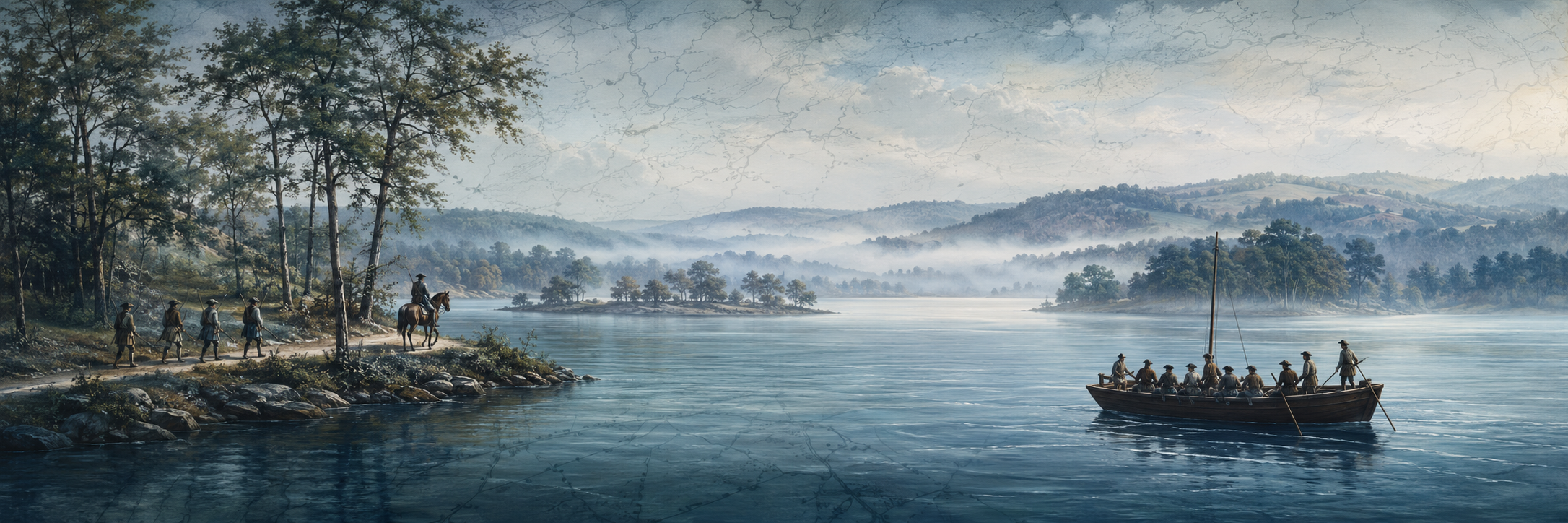
The watercolor above is a regional reconstruction of wooden shipbuilding. It is not a surveyed view of the Deering’s launching ways. The distinction matters because an attractive illustration can otherwise become a false visual source, repeated by later writers as if somebody had documented that exact arrangement of hull, sheds, and workers.
3. What five masts do—and do not—tell us
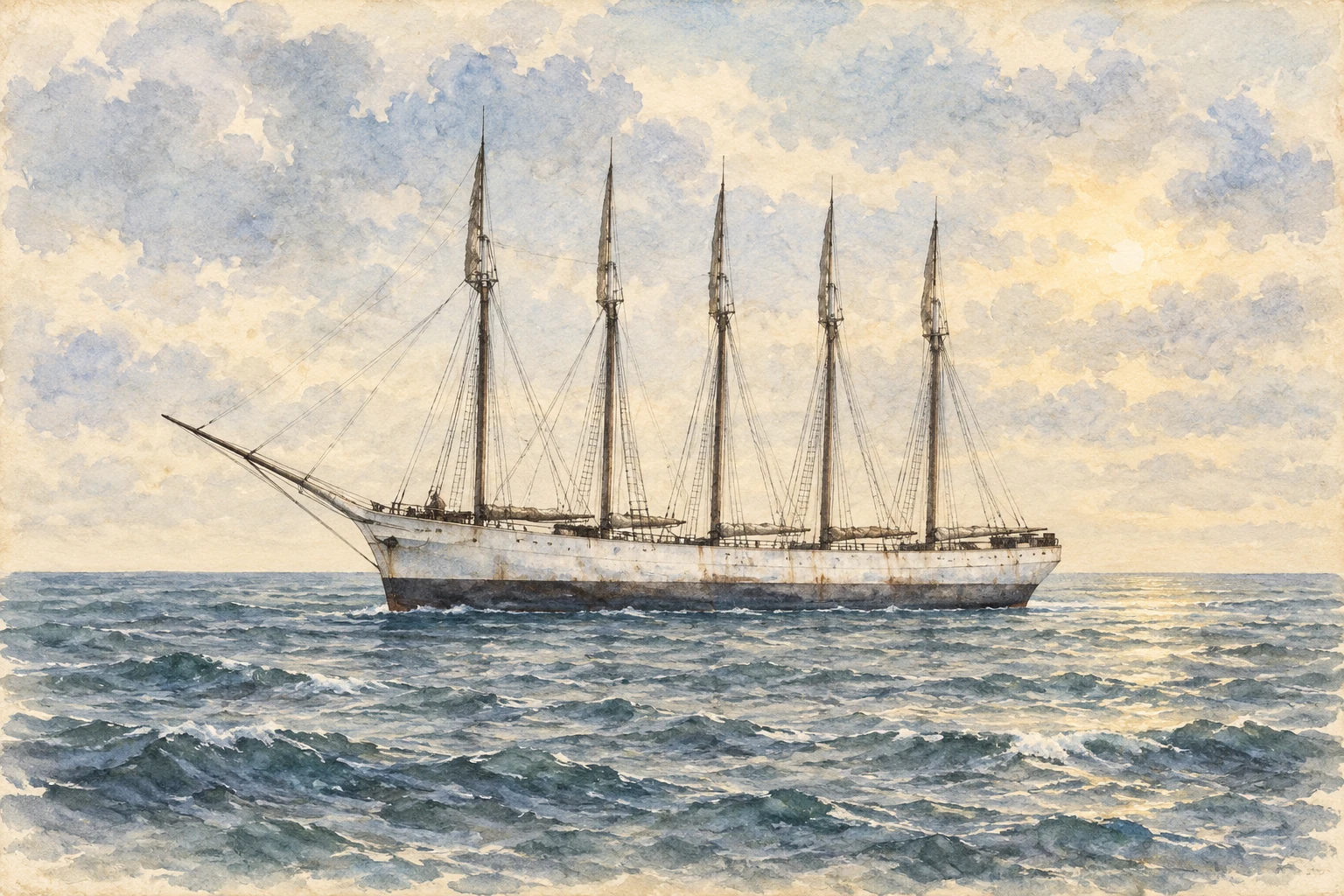
The surviving photograph provides a valuable check on the imagination. The Deering had a long hull and five conspicuous masts carrying a schooner rig. It was not a square-rigged galleon, a passenger liner, or a little coastal fishing boat. The photograph is credited to the Coast Guard and was taken from the Cape Lookout Lightship. Its precise date is one of the small disagreements discussed below. Historical photograph and caption.
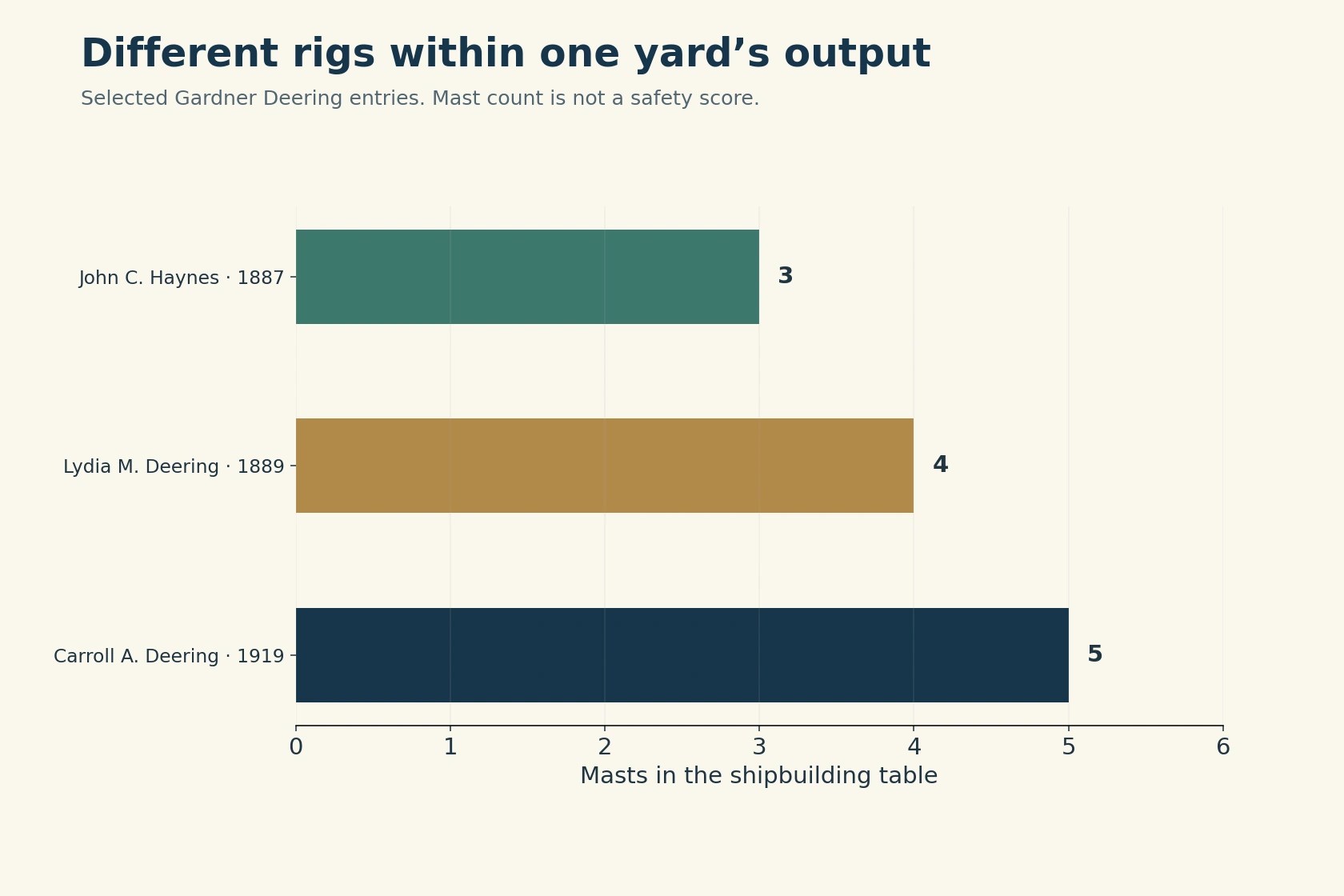
The mast comparison in the graphic uses selected entries from the same shipbuilding list. It illustrates variation within a yard’s output. It does not measure speed, seaworthiness, manpower, or profitability. More masts are not a numerical score for how safe a ship ought to have been.
Rigging terminology can obscure that point. Fore-and-aft sails are arranged principally along the vessel’s length, while a square rig presents a different configuration of yards and sails. Sail plan, hull shape, load, weather, and handling all matter to a vessel’s behavior. Knowing the rig does not let us reverse-engineer an unobserved voyage from one photograph.
A useful comparison comes from another preserved schooner, C. A. Thayer, whose history the National Park Service explains through its working design. Its particular rig allowed much sail work from the deck, and its hull suited the demands of the West Coast lumber trade. Those are facts about Thayer. They show why design must be connected to a particular service, rather than used as an interchangeable description of every schooner. Deering’s different size, rig details, and route require their own documentation. NPS history of C. A. Thayer.
The photograph cannot tell us the crew’s condition. A distant figure might be impossible to identify. A sail can conceal part of the deck. An officer can be below for an ordinary reason. A still image cannot tell us who gave an order five minutes earlier or who would stand the next watch. The photograph is strong evidence for visible structure and weak evidence for invisible relationships.
Nor should the presence of an engineer in accounts of the crew lead us to invent a propulsion system. A sailing vessel could have machinery serving particular tasks without being an ocean-going steamship. To specify Deering’s installations confidently, we would want plans, inventories, survey descriptions, or machinery records. A job title alone does not establish how the ship moved through the water.
This is one reason the archive matters even when the broad story is familiar. Technical documentation can turn a vague theory about what a vessel could do into a testable statement about the equipment it actually possessed.
4. A return voyage with an incomplete human record
The broad commercial itinerary is consistent across the official summaries: the schooner had delivered coal to Rio de Janeiro and was returning toward the Virginia coast, with Barbados appearing in the homeward voyage. The Hoover Library describes the return as being in ballast. The original cargo and the homeward condition should therefore not be merged into an image of a coal-laden ship at Diamond Shoals. Hoover Library account.
Ballast is a practical word with a dramatic afterlife. Readers sometimes hear it as a clue that the vessel was somehow empty, unusually disposable, or secretly available for another purpose. The term alone establishes none of those propositions. A commercial return without the outward cargo is not evidence of a clandestine mission. Any claim about actual stability would require the kind, quantity, and placement of ballast and the vessel’s condition.
The command history likewise needs careful handling. Later accounts describe Captain William Merritt leaving the voyage at Lewes, Delaware, and Willis Wormell taking command. They also describe complaints about the crew and tensions involving the mate. Those accounts deserve investigation, but a reconstructed conversation in a later narrative is not a verbatim deposition. The 1937 account by Karl Baarslag, republished by the Coast Guard in 2024, is one identifiable source for this tradition. Baarslag’s later narrative.
The distinction between a crew agreement and a story about a crew is particularly important. An agreement could establish who signed on, in what capacity, and at what date. A later account may compress changes of personnel, repeat an uncertain nationality, or omit an ordinary sailor altogether. Sources reviewed for this investigation give eleven people in some tellings and eleven or twelve in another. A complete authenticated final roster has not been obtained here.
We consequently should not make a graphic of twelve named victims by gathering names from unrelated versions until the boxes are filled. The uncertainty is small numerically but important historically. Each person was an individual with a family, work history, and possible documentary trail. Accuracy about identity is more respectful than a confident memorial assembled from untested fragments.
The missing roster also affects theories of survival. Searching for a common name without knowing age, birthplace, prior service, or spelling can produce a false match. A credible later identification would have to connect the individual across records, not merely locate somebody with a similar name after 1921.
5. The encounter at Cape Lookout Lightship
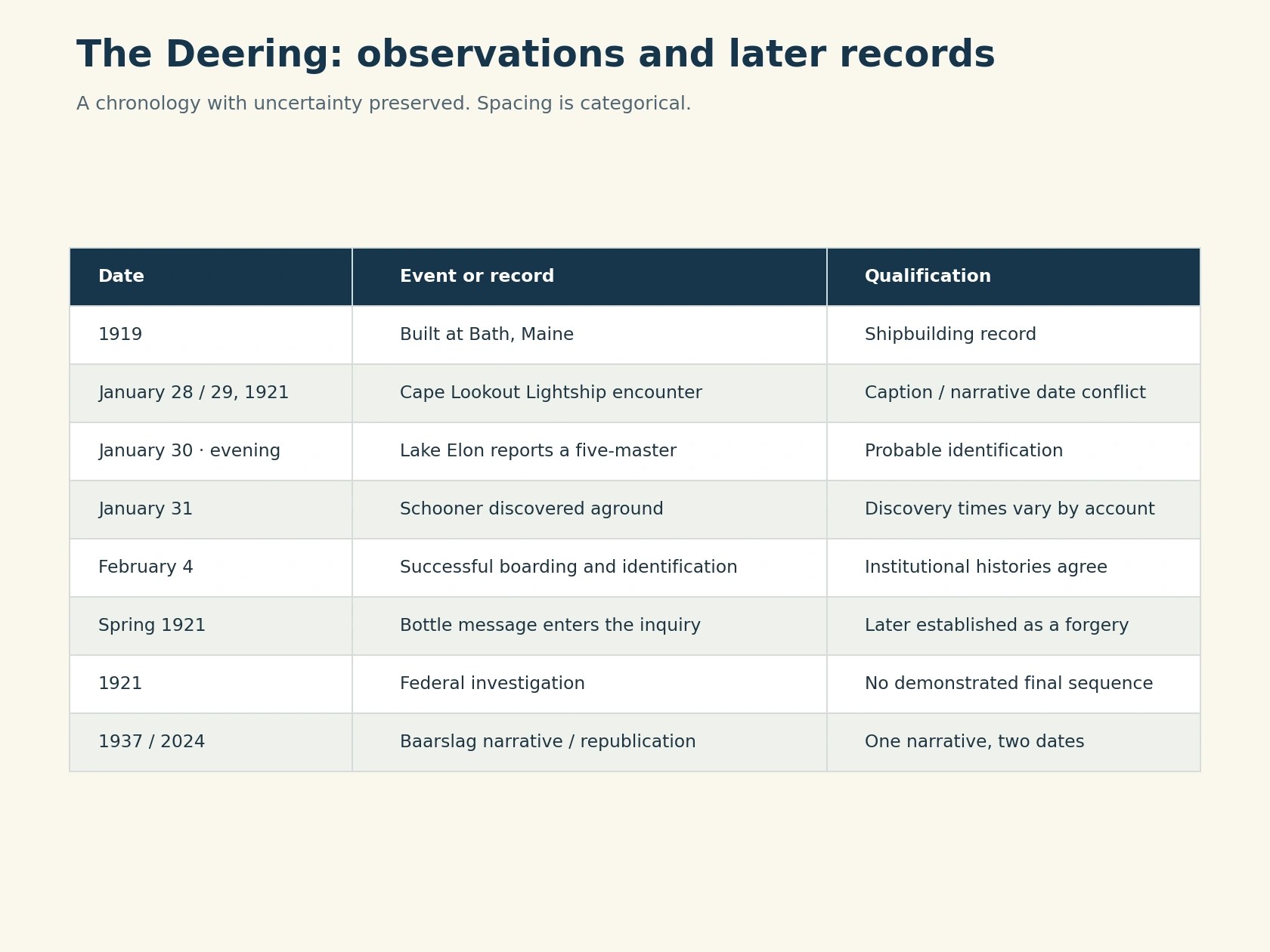
The lightship encounter is the most consequential reported exchange before the wreck. In the NPS chronology it occurred on January 29. A man aboard the schooner, judged by the observer not to resemble an officer, reported lost anchors. The observer also noticed crew members about the deck. The Hoover Library’s photograph caption, however, dates the lightship image January 28. These dates should remain visible rather than being silently reconciled. NPS chronology; photograph caption.
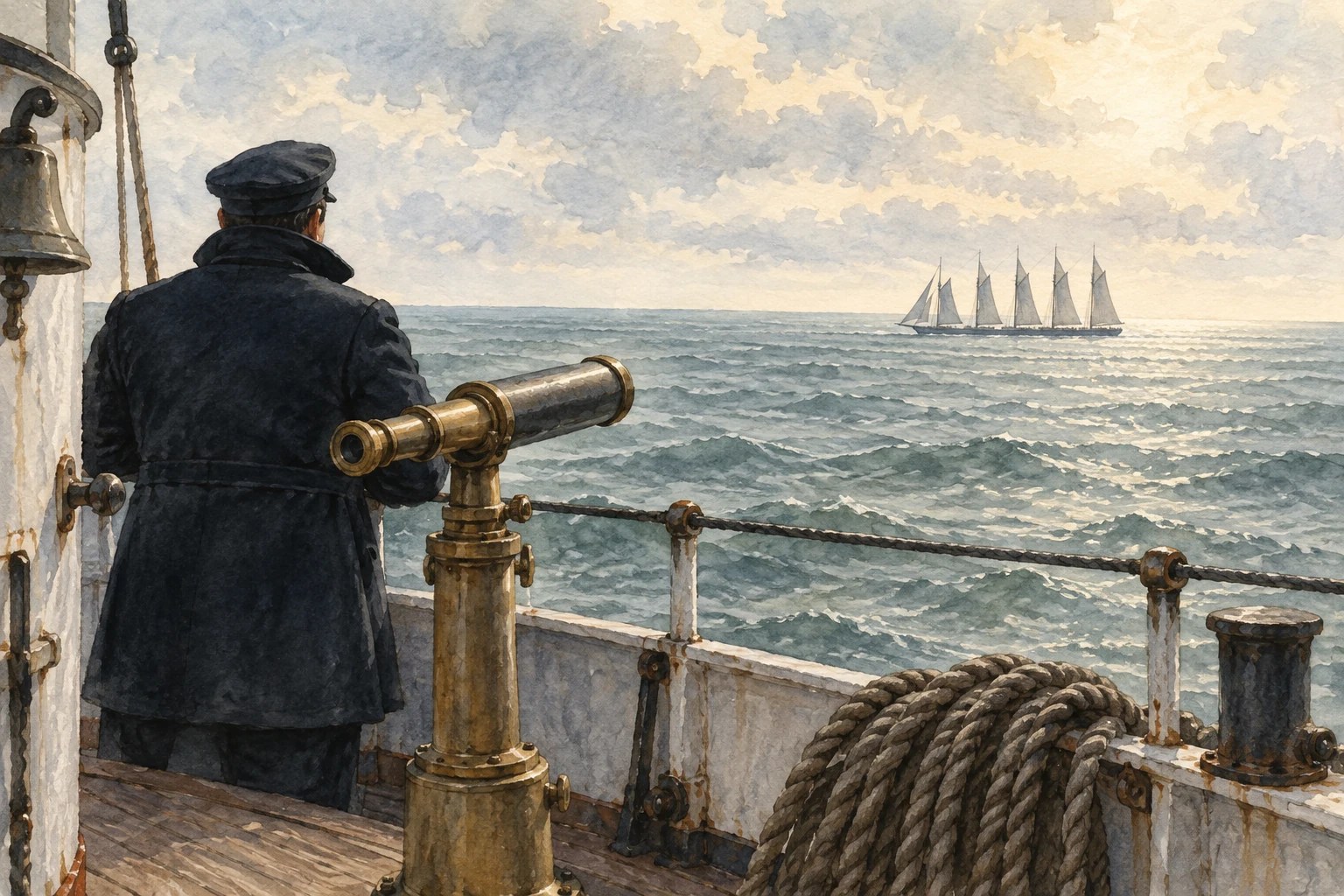
A one-day discrepancy can have several ordinary explanations: a mistaken caption, an incorrect later date, or distinct observations. We cannot select one without checking the underlying records. The disagreement does not invalidate the entire encounter. It does limit attempts to calculate an exact speed or departure window from a supposedly settled timestamp.
The man’s appearance is a different kind of evidence from the content of the hail. Someone could accurately remember a request while misjudging the speaker’s rank. Clothing, accent, posture, and location on deck might inform an impression, but they are not personnel records. An observer’s conclusion that a man did not look like an officer is not equivalent to proof that the officers had been killed or displaced.
Consider what several competing explanations would predict. Under ordinary shipboard operation, another crew member could relay a message. Under an officer’s illness, a subordinate might do so. Under a breakdown in command, a different person might take charge of communication. Under mutiny, the speaker could also be somebody other than the captain. The observed fact is compatible with several states of affairs. Its usefulness depends on what additional evidence distinguishes them.
The captain’s absence from the exchange has the same limitation. We would need to know the observer’s field of view, how long the vessels remained close enough for observation, and whether the captain was expected to appear personally. Not being seen is strongest evidence when somebody was specifically looked for in circumstances where they should have been visible. It is weaker when the record merely fails to mention them.
None of this requires dismissing the lightship keeper. The point is to preserve the value of the observation by keeping it separate from the much larger story later built upon it. A working mariner reporting an unusual exchange supplied an important lead. A reader a century later must still decide which parts of that lead are direct observation and which are interpretation.
6. The anchor problem
Lost anchors could matter greatly to a ship approaching dangerous water. But the statement that anchors were missing contains at least three questions: when were they lost, how were they lost, and what effect did their absence have on the final sequence? The reported hail speaks to the existence of a problem before the grounding. It does not answer all three questions.
An anchor is not a universal brake that stops any ship in any depth or sea state. To evaluate a particular missed opportunity to anchor, one would need position, depth, bottom conditions, available gear, vessel motion, and enough information about the crew’s choices. A map with an anchor symbol placed wherever a modern narrator wishes the schooner had stopped is not a reconstruction.
Likewise, an absent anchor on a wreck need not have been deliberately stolen. Gear can be lost, cut away, damaged, or left embedded somewhere else. The reported earlier message could help narrow the timing if its wording and date were verified. It cannot by itself establish the mechanism of loss. A full equipment inventory would help distinguish main anchors from other anchoring gear, a distinction often flattened in short summaries.
Here is the practical investigative fork. If the principal anchors were already unavailable during the lightship encounter, their absence at the wreck would not be new evidence of later looting. If some remained aboard at that point, the later inventory might describe a different event. Those are conditional statements. They identify why the original testimony and inventory deserve comparison.
A theory that the crew deliberately grounded the schooner must also account for the earlier communication. Was the message a genuine attempt to get assistance, a routine report to the owners, or a deception? Each alternative adds a different intention to the same words. Intentions are not visible in the hardware. They need supporting evidence.
This is a good place for the reader to resist the temptation to reward a theory merely because it mentions every clue. A narrative can incorporate the anchor report, an absent captain, and a missing boat while inventing the connection among them. A stronger explanation shows why those connections are supported or why competing connections would be difficult to reconcile with the record.
The anchors may be central to the Deering’s final navigation. They may instead be an earlier misfortune that later became attached to a different emergency. The surviving summaries do not permit us to decide between those possibilities with confidence.
7. Lake Elon and the last probable sighting
The next sighting in the standard chronology came on January 30, around 5:45 p.m., from the steamship Lake Elon. The NPS describes the schooner southwest of the Diamond Shoals Lightship and notes an unusual course. A modern compilation reproducing the purported witness account makes clear that the name was not read. Because the original statement was not examined here, the prudent description is a probable Deering sighting, rather than an independently certain identification. NPS chronology; transcription lead requiring original verification.
The distinction has practical consequences. If the vessel was the Deering, the sighting places a likely last observation close in time to discovery on the shoal. If it was another schooner, the evidentiary gap begins earlier. Neither possibility licenses a precise line on a map that the evidence has not supplied.
An unusual course is also a description in need of context. Unusual compared with what expectation? Was the observer judging the vessel against a normal route, the wind, nearby hazards, or the observer’s own movement? How many bearings were available? A ship can appear to change direction as the viewing vessel changes position. Conversely, repeated observations can reveal genuine difficulty. The original wording is crucial to distinguishing those situations.
Suppose, purely as an illustration, that a witness records seeing a vessel at one position and then uses a phrase such as steering strangely. That may support concern. It does not supply a continuous track. If a later writer joins the observation to the wreck location with a looping line, the loop comes from the writer unless further positions exist.
The timing is tempting because it appears to concentrate the mystery into a single night. But the sighting, even if correctly identified, would not prove that the whole crew remained aboard. A distant observer may establish that a ship is underway without counting or identifying its people. We must not move the entire roster into the final evening simply because the hull was probably seen.
This is the difference between a last sighting of a vessel and a last verified sighting of a person. Investigations of Rudolf Diesel’s disappearance turn on the same distinction from another direction: a ship’s known arrival does not establish a missing passenger’s fate. The object and the people associated with it have related but separate evidentiary histories.
8. Diamond Shoals as a physical place
Diamond Shoals is not a mysterious name imposed on harmless water. The U.S. Geological Survey describes Cape Hatteras as associated with a shifting sand deposit that affects circulation and presents navigational hazards. Its account explains the coast through sediment movement, waves, currents, storms, and changing island forms. It also distinguishes tropical cyclones from the longer-lasting northeastern storms common in the cooler part of the year. USGS explanation of Cape Hatteras geology.

That physical context is useful without being a complete weather report for January 1921. We should not take a general description of nor’easters and announce the exact storm that struck the Deering. Nor should an older source’s broad use of the word hurricane be converted into a modern meteorological classification without checking the observations behind it.
The wreck’s location matters because the danger is three-dimensional. A chart’s patch of shallow water is not a wall visible above the surface. A ship may look close to open sea while its hull interacts with a bottom that cannot be seen from the deck. Wave action and vessel motion complicate the situation. A reassuring horizon does not tell a navigator how much water is under the keel.
For readers accustomed to Lake Norman, the useful connection is the importance of submerged geography. A surface view can conceal the shape and history beneath it. Our Lake Norman history collection explores a very different water landscape; it should not be treated as a technical analogue for Atlantic surf. The common lesson is to ask what the water hides before drawing conclusions from what can be seen above it.
The coastal setting also explains why being near land did not guarantee safety. The last stretch between vessel and beach could be more dangerous than water farther offshore. A boat must do more than point toward a visible shore: it must remain controllable, avoid overturning, and reach a place where people can get out. Those practical demands become important when judging claims that the crew certainly could—or certainly could not—have landed.
A harsh environment supplies realistic mechanisms for loss. It does not identify the mechanism in this case. The appropriate inference is narrower: an accidental maritime explanation does not require a supernatural force to make the setting dangerous. The evidence for which danger actually acted remains a separate task.
9. The rescue operation deserves its own chronology
The first people responding to the Deering were trying to reach a stranded ship, not stage a future investigation. That priority matters. They had to decide whether they could approach, where to launch, what equipment to take, and whether an attempt would endanger the rescuers without helping anyone aboard.
James D. Charlet’s account in the Island Free Press reproduces portions of Coast Guard reporting supplied through the Outer Banks History Center. The original report images are not provided in that article, so the material here is treated as a published transcription. It describes communication among coastal stations, attempts to approach, and repeated difficulty boarding. One reproduced telegram compresses the situation into the words “SAILS SET BOATS GONE NO SIGNS OF LIFE.” Charlet’s account and quoted reports.

The economy of that message is revealing. It reports visible conditions and an immediate operational problem. It does not claim to know who removed the boats or why the people were absent. A modern reader can recover much of the original uncertainty simply by preserving that boundary.
The reproduced records also introduce an ordinary complication often omitted from mystery narratives: coordinating people and vessels takes time, and messages can be misunderstood. Charlet recounts a signal exchange that incorrectly suggested the wreck had already been brought in, followed by a correction. That is a reason to compare communications carefully. It is not evidence that an unrecorded rescue was secretly concealed.
A rescue chronology should identify what each timestamp measures. The time an order was sent differs from the time it was received. A cutter’s first sighting differs from a boat coming alongside. A first attempt differs from a successful boarding. If two summaries give different times, they may disagree, or they may describe different milestones. Combining them requires the records, not an assumption that every clock refers to the same event.
The several reported discovery times should be handled the same way. The NPS gives a dawn observation by C. P. Brady; the later Baarslag narrative describes an 8 a.m. report at Hatteras Inlet. Different stations could observe the same casualty at different times. We should retain the dated event—discovery on January 31—without pretending that all accounts establish one uncontested minute.
What remains clear is the broad operational pattern. The ship was there. Rescuers tried to reach it. The sea limited them. That pattern is evidence of a difficult response, and it deserves to remain visible even when attention is drawn toward the more theatrical possibilities offshore.
10. Four calendar days that changed the evidence
January 31 to February 4 is four calendar days. This simple interval is more important than many of the story’s colorful details. It separates the discovery of the stranded vessel from the successful boarding described in the official histories. The interval is not an exact measure of time since abandonment, because abandonment itself is not timed.

The graphic deliberately does not draw a rising line of damage. We do not have measurements showing how much damage occurred on each day. Its purpose is to make the exposure interval visible, not to manufacture a mechanical reconstruction from the calendar.
The analytical consequence is substantial. If steering equipment was found broken after the vessel had been battered on the shoal, the break could have preceded the grounding, resulted from it, or developed during the following days. A photograph or inspection from before the grounding could distinguish these possibilities. A later description alone cannot.
The same timing problem applies to disturbed rooms, displaced equipment, open doors, and material washed away. A scene exposed to water is not a sealed room. But it would be equally careless to claim that the sea necessarily erased every trace of violence. We do not know which traces would have existed, where they would have been, or what survived. The argument must not become unfalsifiable: no evidence of violence cannot always be transformed into proof that water removed it.
This creates an asymmetry. The boarders’ observations can establish what they encountered. They are much less secure as a reconstruction of the exact moment when the crew departed. A missing item can be noted accurately without its disappearance being dated. A damaged object can be described accurately without its failure being identified as the initiating event.
For the reader weighing theories, this is a useful stress test. Does a proposed explanation depend on treating a February 4 condition as a January 30 condition? If so, what evidence bridges the interval? A theory about a failed rudder, a staged cabin, or looted equipment should state that bridge openly.
The four days also complicate confident judgments about the crew’s decision. Later rescuers could see that portions of the ship remained above water. The people aboard earlier may have faced a different condition or perceived a danger not visible later. We cannot know that staying aboard would have saved everyone merely because the hull remained accessible to somebody else after the fact.
11. The missing inventory: a departure, but whose departure?
The official summaries report missing boats, navigational equipment, ship’s papers, and personal belongings. The Hoover Library identifies the two boats as a motorboat and a dory and reports three cats remaining aboard. These items have different investigative value. Boats and portable instruments bear directly on the possibility of an organized departure. The cats add a poignant detail, but they cannot identify the people who left or their intentions. Hoover Library inventory summary.

Consider the distinction between an inventory and an interpretation. An inventory might say that a chronometer was absent. An interpretation might say that it was taken to navigate a boat, stolen because it was valuable, or removed to prevent reconstruction of the voyage. All three descriptions can begin with the same missing object. Only additional evidence can choose among them.
Personal effects create similar ambiguity. Taking clothing could indicate preparation for survival. It could also fit a planned transfer. The completeness of the removal matters: an account saying that some good clothing was missing is different from an authenticated checklist proving that every person’s possessions were packed. Later phrases such as everything of value can conceal a great deal of uncertainty about what was actually examined.
There is also a denominator problem. To know that an item is missing, an investigator must know that it was previously aboard. Some absences are obvious because empty boat supports or missing principal equipment are visible. Others require a prior inventory or reliable testimony. An apparently empty drawer is not proof that it once contained a secret document.
The strongest reasonable inference from the combination is that deliberate movement of people and portable equipment deserves serious consideration. That remains an inference, not a witnessed evacuation. It does not tell us whether the captain ordered the movement, whether every crew member participated, or whether it happened before or after the schooner reached the shoal.
A useful exercise is to ask which items an innocent crew facing an emergency might take. Then ask which items a crew abandoning a ship for a different purpose might take. The overlap will be substantial. Evidence is most discriminating when the alternatives predict different observations. Equipment useful under several explanations cannot, by itself, select one.
The original inventories and witness statements would make this analysis more precise. Until they are directly compared, the missing-object list should remain a reported inventory with qualifications, not an exact reconstruction of who carried what down a ladder.
12. The meal that cannot serve as a clock
A prepared or unfinished meal is one of the most durable elements of an abandoned-ship story. It interrupts an ordinary human routine and makes absence feel immediate. That emotional force is precisely why the detail needs careful treatment.
The Deering’s galley appears in the official accounts, but the descriptions do not all say the same thing. One describes preparation for a meal; the later Baarslag narrative supplies particular foods and interprets the remains as evidence of a leisurely meal. These are not interchangeable observations. A pot on a stove can remain after preparation, service, interruption, or ordinary delay in cleaning. NPS account; Baarslag adaptation.
The common embellishment that food was still warm would demand especially strong evidence after several days of exposure. This investigation does not adopt it. No temperature record or contemporary observation reviewed here establishes such a claim. The existence of food does not tell us the minute the crew left.
Nor does a meal necessarily demonstrate either panic or calm. A sudden interruption could leave food behind. People preparing a departure could also leave it because other things mattered more. A routine meal could have occurred long before a separate emergency. The evidence needs context that the vivid image does not provide on its own.
The larger issue is narrative compression. A reader sees pots, then imagines the cook lifting a ladle, somebody shouting, and everyone rushing to a boat. That sequence is easy to visualize. Its intermediate actions are inventions unless a source records them. A responsible reconstruction should stop before the imagined shout.
This is a point of comparison with the Mary Celeste, whose popular afterlife also accumulated memorable domestic details. Similar storytelling habits do not prove similar causes. They show how the ordinary objects that survive a disappearance can become a stage on which later writers supply the missing people.
The galley matters because it was part of the physical scene. It deserves a place in the inventory. It cannot bear the weight of a precise departure time, an emotional diagnosis of the crew, or a verdict about the final emergency.
13. The boats and the possibility of an accidental loss
The missing boats offer the most direct route toward an ordinary explanation: people left the schooner in them and subsequently failed to reach safety. This sequence fits important parts of the reported scene without requiring a second ship or an attack. It still leaves two major questions unanswered: why did they leave, and what happened afterward?
An emergency on a ship can be actual, developing, or mistakenly perceived. A crew may respond to what it believes will happen rather than to what a later investigator discovers did happen. That distinction makes accidental abandonment a serious possibility even if some of the ship’s structure remained intact. It does not demonstrate that the Deering’s people made such a decision.
The competing timings matter. If they left after grounding, they may have tried to escape an immediately dangerous position. If they left before grounding, some other condition must explain the departure, and the schooner’s subsequent movement becomes another part of the reconstruction. If they transferred to a larger vessel, the absent boats might have been used as a means of transfer. The boat inventory alone does not fix the order.
The boats’ own equipment would matter enormously. We would want dimensions, capacity, condition, means of propulsion, provisions, and the number of people in each. The label motorboat does not establish a working engine, adequate fuel, or an ability to handle a particular sea. The label dory does not provide a loading plan. None of those details should be manufactured from a generic picture of a lifeboat.
We should also resist absolute claims about the coast. NOAA’s account of the freighter Merak describes its grounding near Diamond Shoals during a German submarine attack in August 1918 and the escape of all 43 people in two lifeboats. That was a different event in different circumstances. It demonstrates that the broad place-name alone cannot make escape universally impossible. It does not show that Deering’s people could have repeated that outcome in winter 1921. NOAA history of Merak.
An accidental loss in the boats has the advantage of requiring fewer unobserved participants than a coordinated seizure. But simplicity is a starting preference, not proof. A plausible sequence needs evidence of its initiating emergency and subsequent movement. Without that evidence, the responsible conclusion is that accidental abandonment remains a strong category to investigate, not that a particular wave or mechanical failure has been identified as the cause.
14. The captain, his family, and the danger of retrospective accusation
Willis Wormell is often placed at the center of a mutiny narrative because the captain represents the authority supposedly overthrown. That narrative can make his absence appear explained before there is evidence of his death. The records reviewed here do not establish his last moment, a burial at sea, or a violent encounter aboard the schooner.
The family did not have the luxury of treating the event as a puzzle. The official summaries describe relatives and supporters seeking a federal investigation. They differ in how they identify the family delegation and its route through Washington. The NPS emphasizes the captain’s wife and companions; the Hoover Library describes a daughter and an approach to Senator Frederick Hale. Both accounts support family advocacy. They should not be combined into one invented meeting with a single guest list. NPS family account; Hoover Library account.
That advocacy is historically important without being evidence for a specific cause. A family might reasonably press for investigation because an ordinary wreck explanation left too many questions unanswered. Its members might also place confidence in a lead that later failed. Grief can coexist with careful inquiry, mistaken hope, and determined action. None of those states should be used to dismiss the family’s contribution.
The captain’s reputation presents a related problem. Calling him experienced can explain why contemporaries found the casualty surprising. It cannot eliminate error, illness, or an emergency beyond his control. Calling another officer troublesome can explain why investigators considered conflict. It cannot establish murder. Reputation is context; an accusation requires an event supported by evidence.
There is a temptation to give the missing men fixed roles: the honorable old captain, the threatening mate, the discontented crew. Those roles make a story easy to follow, but they can conceal the uncertainty in the sources. We do not possess a transcript of the final watch or testimony from a survivor who describes the relationship at that time.
For that reason, this investigation does not name a crew member as a killer. It examines the mutiny hypothesis as a possible sequence and asks what evidence would distinguish it. The missing people deserve the same care we would apply if a living family were reading an accusation for the first time.
15. Mutiny: a plausible suspicion with an unproved final act
The mutiny theory draws strength from a combination of reported tensions, unusual behavior noticed during the lightship encounter, the captain’s absence from that exchange, and the removal of portable property. The Hoover Library reports that Richey and Herbert Hoover regarded mutiny as the most likely explanation, while retaining the case for further evidence. That is an important record of their assessment. It is not a conclusive finding that a particular person committed a particular act. Hoover Library assessment.

The first question is what mutiny means within a proposed reconstruction. Refusal of an order, displacement of a captain, violence against an officer, and a planned seizure are different events. A story that moves from crew dissatisfaction to murder has crossed a substantial evidentiary distance. It must show how that distance is crossed rather than allowing the word mutiny to carry all of the missing actions.
The second question concerns the reported threats. Who heard them? How soon were they recorded? Were the words remembered after the schooner became famous? Did several witnesses independently hear the same threat, or did several articles repeat one account? Those questions do not assume the reports were false. They establish how much weight the reports can bear.
Even an authenticated threat would not alone resolve the disappearance. A threat can be sincere, drunken, exaggerated, rhetorical, or later abandoned. To connect it to an act, investigators would want evidence of opportunity, subsequent conduct, physical traces, a credible admission, or a witness. The Deering’s silence removes many of those ordinary checks.
A mutiny theory also needs an ending. Suppose command was forcibly changed before the last sighting. Why did the people then abandon the ship? Were they attempting to land, to meet another vessel, or to escape a new navigational emergency? How did every participant disappear from the verified record? Mutiny may explain one possible change aboard while leaving the later loss almost as difficult as before.
This does not make the theory impossible. Events can compound: a conflict could worsen navigation, a grounding could follow, and a boat escape could fail. But each added stage requires support. A chain of individually possible events is not automatically a probable history of their combination.
The theory’s best future evidence would be specific and independent: a contemporary statement recording a threat before news of the wreck, an original report clarifying who was seen aboard, correspondence showing an actual plan, or a securely identified participant’s later account. Its weakest form simply treats every absence as a sign that a mutiny must have occurred.
The reader can reasonably take the investigators’ suspicion seriously while withholding a verdict. That is not indecision for its own sake. It preserves the difference between an informed working hypothesis and a demonstrated sequence of events.
16. The bottle message: the clue that has a clear answer
Unlike the crew’s fate, the status of the celebrated bottle message does not need to be left evenly balanced. Christopher Columbus Gray reported finding it on the North Carolina shore. Its contents described the Deering being seized by another powered vessel and the crew being restrained. The official modern accounts state that Gray fabricated it. The message is therefore evidence of a hoax surrounding the disappearance, not an authenticated account of an attack. NPS account of the forgery.

The note’s initial appeal is easy to understand. It appeared to supply what the wreck lacked: a human voice from inside the missing interval. It named the ship, described an assailant, and gave the appearance of an urgent attempt to reach authorities. The information was direct and vivid in exactly the places where the actual observations were sparse.
That is also why its provenance was indispensable. A message saying what an investigation wants to know should attract more scrutiny, not less. Who recovered it? Who handled it? Could the claimed author have written it? Was the handwriting comparison based on authentic samples? Did the finder know enough from public reporting to construct the story? The object’s apparent drama cannot substitute for those questions.
The expert disagreement is part of the history. The institutional accounts describe conflicting handwriting judgments before the forgery was established. We should not preserve only the early identification while omitting the later correction. Nor should we turn one failed comparison into the claim that every form of handwriting examination is worthless. The lesson is that an expert opinion has to be evaluated alongside provenance and the rest of the investigation.
The outcome also demonstrates why a document can be genuine as an object and false as testimony. The paper existed. Somebody wrote it. It became part of a real inquiry. Those facts do not make the event it describes true. In this respect the bottle belongs beside the disputed documents in the Beale Ciphers investigation: before interpreting a text as a window into an event, we must establish what kind of text it is.
There is one further logical boundary. Discrediting the note removes a purported piece of evidence for piracy. It does not prove that no attack of any kind could have happened. Equally, the mere possibility of an attack does not rehabilitate the forged note. The correct evidentiary action is to remove the note from the list of authentic voyage testimony and reassess the remaining record.
A fair investigation allows some questions to end. Repeating the message as an unresolved last appeal after its correction is known creates suspense by withholding evidence from the reader. The Deering has enough uncertainty without restoring a false clue to service.

17. Why the case reached Herbert Hoover
The Hoover connection is sometimes retold as if a president or the head of the FBI personally confronted a ghost ship. In 1921, Herbert Hoover was secretary of commerce. His department included the Bureau of Lighthouses. Lawrence Richey, his assistant, had an investigative background. The archival finding aid describes earlier Treasury work and later service with Hoover. These institutional relationships explain why the papers came to be preserved in a presidential library. Lawrence Richey Papers finding aid.
This was Herbert Hoover, not J. Edgar Hoover. Likewise, references to an FBI investigation in modern summaries use a later agency name for work in the era of the Bureau of Investigation. Names and offices are worth getting right because they help the reader understand who could act, what records might exist, and where those records might have been filed.
The investigation involved more than one department. That breadth can look extraordinary when the event is reduced to a single stranded schooner. It becomes more understandable when placed alongside concerns about other missing vessels, family pressure, and competing allegations of crime. Still, the number of agencies involved is not a measure of how strong any particular theory became.

A collection of official reports can contain disagreement. One witness may emphasize rough seas, another suspicious behavior, another an apparent piece of documentary evidence. An official file is a place where leads are assembled; its contents are not all endorsed conclusions. A speculative memorandum inside an archive remains speculative unless other evidence supports it.
The same is true of the investigator’s reputation. Richey’s experience makes his assessment relevant. It does not make him an eyewitness to the missing interval. We can respect the work of gathering material across agencies while recognizing that the available evidence did not settle the case.
The archival route also offers a practical benefit. Instead of searching only for the phrase ghost ship, a researcher can look for lighthouse reports, correspondence, Treasury material, and shipping records. Administrative categories often preserve the evidence more effectively than the famous nickname. A document may discuss a schooner, a casualty, or an inquiry without adopting the language that later made the story popular.
That is why the presidential-library connection is more than a colorful twist. It tells us where a serious next stage of research can begin, and it reminds us that institutional custody and historical certainty are separate things.
18. Piracy, politics, and the problem of a supposed pattern
Political seizure and piracy were among the explanations considered around the Deering. Historian Mike Dash places those allegations in the climate of the first Red Scare and describes the fear that revolutionary agents might acquire ships through hijacking or sympathetic crews. That is useful context for the questions investigators asked. It is not evidence that such a seizure occurred aboard this schooner. Dash’s historical discussion.
A political explanation can acquire force from a supposed cluster: several ships disappear, therefore a coordinated organization must be taking them. To assess that claim, the list itself must be examined. Did the ships vanish in the same month and the same area? Were they exposed to the same weather? Were some later located? How many vessels traveled those routes without disappearing?
Without those comparisons, a collection of losses is not a measured pattern. It is a selection. A map that expands its boundaries whenever another interesting case appears can make almost any maritime region seem uniquely sinister. The selection rule needs to be established before the cases are counted.
The Deering creates a further difficulty for a simple acquisition theory: the schooner was found. If the proposed motive was to obtain a functioning merchant vessel, the theory must explain why that vessel ended abandoned on a shoal. A failed seizure is possible, but failure is another event requiring evidence. Adding it only because the ship’s discovery conflicts with the original theory reduces the theory’s ability to predict anything.
Rum-running and opportunistic criminal violence present different motives and should not be folded into the same explanation. A smuggling encounter would require evidence of the encounter. A robbery would require evidence identifying what was taken and by whom. A political operation would require evidence of organization or purpose. The shared word piracy does not supply those missing links.
There is an important human caution here. An accent, nationality, or political suspicion cannot establish guilt. The mixed backgrounds attributed to the crew in later narratives should not become a substitute for proof of conduct. The investigation concerns actions aboard a particular vessel, not an argument that a category of sailors was inherently dangerous.
The strongest version of a criminal explanation would identify an independently documented vessel, participant, communication, or transfer. The weakest version borrows the atmosphere of 1921 and treats anxiety as corroboration. Historical context helps explain why a theory attracted attention; it cannot do the evidentiary work of showing that the theory happened.
19. Hewitt: can one disappearance explain another?
The steamer Hewitt appears in a proposed rescue or transfer scenario discussed by Dash. If Deering’s people reached another vessel and that vessel was subsequently lost, their continued absence might be explained. But the transfer itself has not been established in the material reviewed here. The scenario joins two uncertainties with an unobserved event. Discussion of the Hewitt hypothesis.
This is an attractive kind of explanation because it appears to solve a difficult problem: why did nobody arrive ashore or report being rescued? Yet the same attractiveness can hide its additional demands. We would need the other vessel to be in a feasible position, a reason and opportunity for transfer, enough time for the operation, and a later loss consistent with the disappearance of the additional people.
The first task would be to establish independently the other ship’s last reliable observations. A proposed meeting point cannot be selected only because it fits the Deering story. It must be consistent with Hewitt’s own route, timing, and records. If the necessary positions are uncertain, the uncertainty should appear on the map rather than vanish beneath a neatly drawn connecting line.
The second task would be to look for evidence of contact. A wireless message, log entry, witness account, or identifiable object might help. Two vessels being in the same broad region does not demonstrate that they met. A busy maritime corridor creates many possible pairs of ships; only a few actually interact.
The third task would be to explain the Deering’s state after the transfer. Did the crew leave it underway, at anchor, or already aground? Were the boats retained, lost, or taken aboard the other ship? A rescue hypothesis needs to account for the abandoned vessel as well as the missing people.
None of these questions is an objection merely because the theory is complicated. Real events can be complicated. They are a way of identifying the evidence required by this particular complication. If a new contemporary communication documented a transfer, the theory’s status would change substantially. Without it, the hypothesis remains a possible bridge that has not been built from evidence.
The reader should be especially cautious when two famous mysteries are presented as mutually confirming. An unresolved event cannot serve as proof of the missing step in another unresolved event simply because their uncertainties fit together neatly.
20. Financial motives and what an insurance theory would need
Insurance fraud appears in discussions of the case, but no reviewed evidence establishes that the Deering’s owners arranged its abandonment. A ship’s commercial value does not by itself reveal a motive to destroy it. Neither does a difficult shipping market prove that a particular owner preferred a loss. A financial explanation needs financial records.
Useful records would include the policy, the ownership interests, the insured amount, any liens, the vessel’s earnings and expenses, the claim, the insurer’s response, and the disposition of salvaged property. These would not automatically establish fraud either. They would permit a concrete comparison between the suggested motive and the actual transaction.
An owner might benefit from an insurance payment while still suffering a genuine casualty. A payment can compensate a loss rather than reward a scheme. Conversely, suspicious inconsistencies could become meaningful if connected to communications or deliberate acts. The investigation must identify the inconsistency rather than relying on the generic proposition that money can motivate wrongdoing.
The missing crew makes an owner-directed plan more demanding, not less. Such a theory needs to explain how the people were involved, what they expected to happen, and why no verified participant later emerged. If it proposes that they were deceived or killed, it must support those additional acts. If it proposes that they all adopted new identities, it requires a different and equally substantial set of records.
The later sale of salvage also should not be mistaken for evidence of an earlier plan. Recovering usable property from a casualty can be a response to the loss. To connect the sale with a conspiracy, one would need something more than the fact that material had value.
This chapter leaves the financial theory in the category it presently occupies: a proposition that can be tested through records, not a finding supported by the disappearance alone. It also identifies a productive research direction. A policy or ledger may contribute more than another retelling of the meal in the galley, even if its contents are less dramatic.
21. The wreck was altered, salvaged, and destroyed
The Deering did not remain a permanently available scene. The histories describe salvage and the destruction of dangerous wreckage. The Baarslag narrative includes a March episode involving the cutter Seminole and an unsuccessful effort to control a floating section. The broad official account is that wreckage was destroyed as a navigational hazard. Precise sequences should be checked against the cutter’s original records before every date and distance is treated as settled. Coast Guard’s Baarslag adaptation.
For an investigation, this means there were successive transformations: abandonment, grounding, exposure, boarding, salvage, breakup, and deliberate destruction of hazardous remains. A later piece of timber belongs somewhere within that sequence. It is not automatically an undisturbed witness to the initial event.

Destruction can look suspicious when a story is told backward from an unresolved mystery. Why eliminate the evidence? The practical answer recorded in the histories is the danger posed to other navigation. An allegation of concealment would require evidence that this stated purpose was false or that particular information was intentionally suppressed. The mere loss of a research opportunity is not proof of a cover-up.
There is nevertheless a real historical cost. A complete, carefully documented hull could have helped answer questions about construction, steering, collision damage, and equipment. Salvage and breakup reduced those opportunities. Recognizing that cost does not require accusing the people responding to a hazardous wreck of anticipating a century of later forensic interest.
The fate of individual artifacts is a different inquiry. An object attributed to the ship should have a chain of custody: who removed it, where it went, and how its identity was recorded. A nameboard may be more readily connected to a vessel than an ordinary lantern. A later photograph can document an object at a particular place without proving every story about its earlier recovery.
The same principle applies to remains exposed on an Outer Banks beach. Location and appearance can generate a lead, but identifying a wreck requires comparison with construction, measurements, historical positions, and other evidence. A famous ship’s name should not be attached to anonymous timber merely because the story is familiar.
The Deering’s physical afterlife therefore has a different endpoint from its human mystery. We know the vessel was found and substantially dismantled or destroyed. We do not know the final sequence experienced by its people. Resolving the first history does not resolve the second.
22. The archive is a research path, not a solved case in a box
The Lawrence Richey Papers provide a specific route beyond popular retellings. The Hoover Library finding aid lists Deering material in Box 1: lighthouse reports, clippings, Commerce reports, correspondence, evidence copies with photographs, investigative reports, and Treasury reports. It includes a folder label spanning 1921 and 1956. The inventory establishes the existence and organization of material, not the conclusions inside every document. Richey finding aid.
A date on a folder is particularly easy to overinterpret. The presence of 1956 material does not itself prove a formal reopening, a new witness, or a later solution. It may reflect a request, a retrospective memorandum, or something else. Only the contents can answer that question. The collection’s total shelf measurement likewise describes the whole Richey collection, not a vast quantity of Deering evidence alone.
A second useful lead lies in Maine. The Maine Maritime Museum’s manuscript guide identifies Samuel R. Percy Jr.’s papers as including letter books with drawings and information about the Carroll A. Deering. The entry is MS-27, with the papers dated 1910–1935. That is a concrete reason to examine the collection for construction and equipment questions; the drawings themselves were not obtained for this article. Maine Maritime Museum manuscript guide.

The most useful next investigation would organize these records by question. For the lightship encounter, compare the original report, any log entry, photograph documentation, and later summaries. For the rescue, compare station logs and cutter records by the event each timestamp describes. For the bottle, examine the original note, comparison samples, interview record, and account of the confession. For personnel, establish the final crew agreement and any changes during the voyage.
Those tasks can produce improvements even without revealing the ultimate fate. A corrected sighting date would narrow a timeline. An equipment list could eliminate an impossible mechanical claim. A verified crew identity could make a search for relatives or later records more effective. Research progress should not be judged only by whether it delivers a dramatic answer.
Newspaper research also needs chronology. Reports from the first days after the grounding answer a different question from the national stories that followed later piracy allegations. A June article may reveal what officials or reporters then believed, not what a witness saw in January. A later correction must be read alongside the original claim. Bibliographic references to the June and August 1921 press were located during this research, but the linked original pages could not all be examined; they are leads, not silently counted as read evidence.
Finally, a complete archival investigation should record negative results precisely. There is a difference between no relevant document in a specified folder, no result in a particular search, and no surviving evidence anywhere. The first two statements can be verified. The third usually exceeds what a single investigation can establish.
23. How a story becomes more certain than its sources
The Deering’s afterlife shows several common routes by which uncertainty disappears from prose. A probable identification becomes a definite sighting. A reported impression becomes a fact about rank. An absent captain becomes a murdered captain. A meal remnant becomes hot food. A hypothesis considered by an investigator becomes the official solution. None of these changes requires a deliberate liar; each can occur through compression and repetition.
Publication dates can create a further illusion. The Coast Guard’s 2024 page explicitly adapts a 1937 book chapter. It is therefore a modern republication of an older narrative, not a newly completed investigation. Reading the date at the top without the editorial note could cause a reader to mistake an old unresolved presentation of the bottle message for the latest evidentiary position.
The book’s age also helps explain why it is useful and limited. It preserves an identifiable stage in the story’s development, with particular language and interpretations. It can be compared with the modern institutional accounts and the original records when available. It should not be treated as a transparent window into everything that happened in 1921.
The NCpedia article provides a useful bibliography and identifies Bland Simpson’s Ghost Ship of Diamond Shoals as a nonfiction novel. That form can be valuable literature while still requiring caution about reconstructed dialogue and interior thoughts. A scene written to make history immediate is not automatically a witnessed scene. NCpedia’s overview and references.
The same distinction governs this article’s visual material. The watercolors are interpretations. Their skies, anonymous figures, and interiors are not new evidence. The charts display sourced dates, selected counts, and explicit comparisons; they do not assign numerical odds to theories. An illustration should help the reader understand the inquiry without pretending to fill a gap in the record.
There is a productive comparison with Kryptos. In that case, knowing a text, reconstructing a cipher method, and interpreting a work of art are distinct accomplishments. In the Deering case, finding the vessel, establishing a hoax, and explaining the crew’s fate are distinct accomplishments. A headline that compresses them into solved or unsolved can erase the part of the story that most needs explanation.
The reader’s protection is not blanket distrust. It is attention to the smallest changes in claim: seen, reported, inferred, alleged, demonstrated. Those words describe real differences in what the evidence allows.
24. A verdict the evidence can support
The Deering investigation supports several clear conclusions. The schooner was a real commercial vessel. It reached Diamond Shoals and was found without its people. Access was delayed by dangerous seas. Important portable equipment and the boats were reported missing. The bottle message was fabricated. The official inquiries did not establish the crew’s final fate.
The larger explanations remain unequal in their evidentiary demands. An emergency abandonment followed by loss of the boats fits the known maritime setting and missing equipment without requiring an unidentified attacking vessel. Its weakness is the absence of a demonstrated initiating emergency and a verified boat history. Mutiny has a historical investigative pedigree and reported behavioral clues, but it requires proof of a change in command and an explanation for the subsequent disappearance. A transfer to Hewitt or another vessel needs evidence of an actual meeting. Piracy and fraud require concrete participants, acts, or transactions that the general atmosphere of the period cannot supply.
Those differences justify a cautious preference for investigating ordinary maritime and human mechanisms before extraordinary ones. They do not justify declaring a particular mechanism proven. No numerical probability is assigned here because the necessary inputs are not available. An exact percentage would make uncertainty look measured when it is not.
The most consequential unknown is still order. Did a shipboard problem lead to abandonment and then grounding? Did grounding lead to abandonment? Did conflict precede either? Were all the people together when they left? A single trustworthy document could change the weight of several theories because it could place one action before another.
The human outcome is the part that remains hardest to recover. A ship’s name can survive on a photograph and in a registry while the people associated with it disappear behind a collective label. Careful personnel research may restore individual histories even if it never identifies the last boat’s course. That would be a meaningful historical result, not a lesser substitute for a sensational solution.
The Deering therefore ends in two different places. As a vessel, it ends in a documented casualty and the destruction of its remains. As a human story, it ends with an unanswered absence. The reader need not choose between credulity and a forced solution. The strongest judgment is to accept what the evidence establishes, reject the known fabrication, and keep the remaining explanations tied to the particular records that could test them.
More investigations of disappearance, evidence, and historical memory appear in the Roanoke inquiry, the Flannan Isles investigation, and our regional history article library. Each case has its own record. Their value together lies in learning how to ask sharper questions, not in assuming that every unexplained absence has the same cause.
Sources and further investigation
This article is an investigation of accessible records and published accounts, not a claim to have examined every original case file. Research was reviewed on September 6, 2026. Source disagreements are retained where the underlying documents have not resolved them.
- National Park Service, Cape Hatteras National Seashore. The Ghost Ship of the Outer Banks, updated April 14, 2015. Principal institutional chronology, rescue summary, family advocacy, and correction of the bottle-message claim.
- Spencer Howard, Herbert Hoover Presidential Library and Museum. The Wreck of the Carroll A. Deering, January 27, 2016, updated July 3, 2023. Institutional discussion of the inquiry and the historical photograph. The caption’s January 28 date differs from the NPS encounter date.
- Herbert Hoover Presidential Library. Lawrence Richey Papers finding aid. Used for biography and the specific archival roadmap. The case folders themselves were not examined here.
- James D. Charlet, Island Free Press. The attempted Coast Guard rescue, November 26, 2019. Includes transcribed contemporary reports. These were read as reproduced text, not compared with original manuscript images.
- Karl Baarslag. Ghostship Carroll A. Deering, Coast Guard adaptation published October 25, 2024, from The Coast Guard to the Rescue, 1937. A later narrative, used critically; its detailed scenes are not automatically contemporary testimony.
- Naval Marine Archive. Deering & Donnell and Gardner Deering shipbuilding list. Source for vessel identifiers and the mast-count comparison. It is a compilation, not the original registry.
- David Cecelski. On the Kennebec and Penobscot, October 7, 2019. First-person discussion of the Maine Maritime Museum and the connections between Maine shipbuilding and North Carolina wrecks.
- Maine Maritime Museum. Guide to Manuscript Collections, entry MS-27. Identifies the Samuel R. Percy Jr. papers and Deering drawings/information; the underlying letter books were not examined.
- U.S. Geological Survey. Geology of Cape Hatteras National Seashore. Environmental context, not a reconstruction of the January 1921 weather.
- NOAA, Monitor National Marine Sanctuary. Merak. A separately documented 1918 casualty used to test overly broad claims about escape from the shoals, not to infer Deering’s conditions.
- National Park Service, San Francisco Maritime. C. A. Thayer. Comparative explanation of a different schooner’s design and service; its specifications are not transferred to Deering.
- Mike Dash. The ghost ship and the President, April 8, 2010. Historical interpretation of political concerns and the Hewitt proposal, kept distinct from proved events.
- Kelly Agan, NCpedia. The Ghost Ship Caroll A. Deering, 2014. Bibliographic and literary-history lead. Newspaper references are not treated as originals read in full.
- Sunken Ships of the Outer Banks. Carroll A. Deering compilation. Consulted only as a lead to purported witness transcriptions, particularly the uncertainty of the Lake Elon identification. Conflicting or unsupported details on that page are not adopted as established facts.
The fifteen original visuals include seven watercolors and eight evidence graphics. The ship’s silhouette was checked against the surviving Coast Guard photograph. Anonymous people, interiors, sea states, and objects in the paintings are interpretive. The timeline preserves disputed dates; the graphs use calendar arithmetic and selected documented mast counts. None depicts a recovered crew member, an authenticated final scene, or a proven route of abandonment.
Leave a Reply