

Virginia • Cryptography • Art
Research reviewed September 6, 2026 · About 47 minutes · 15 original visuals
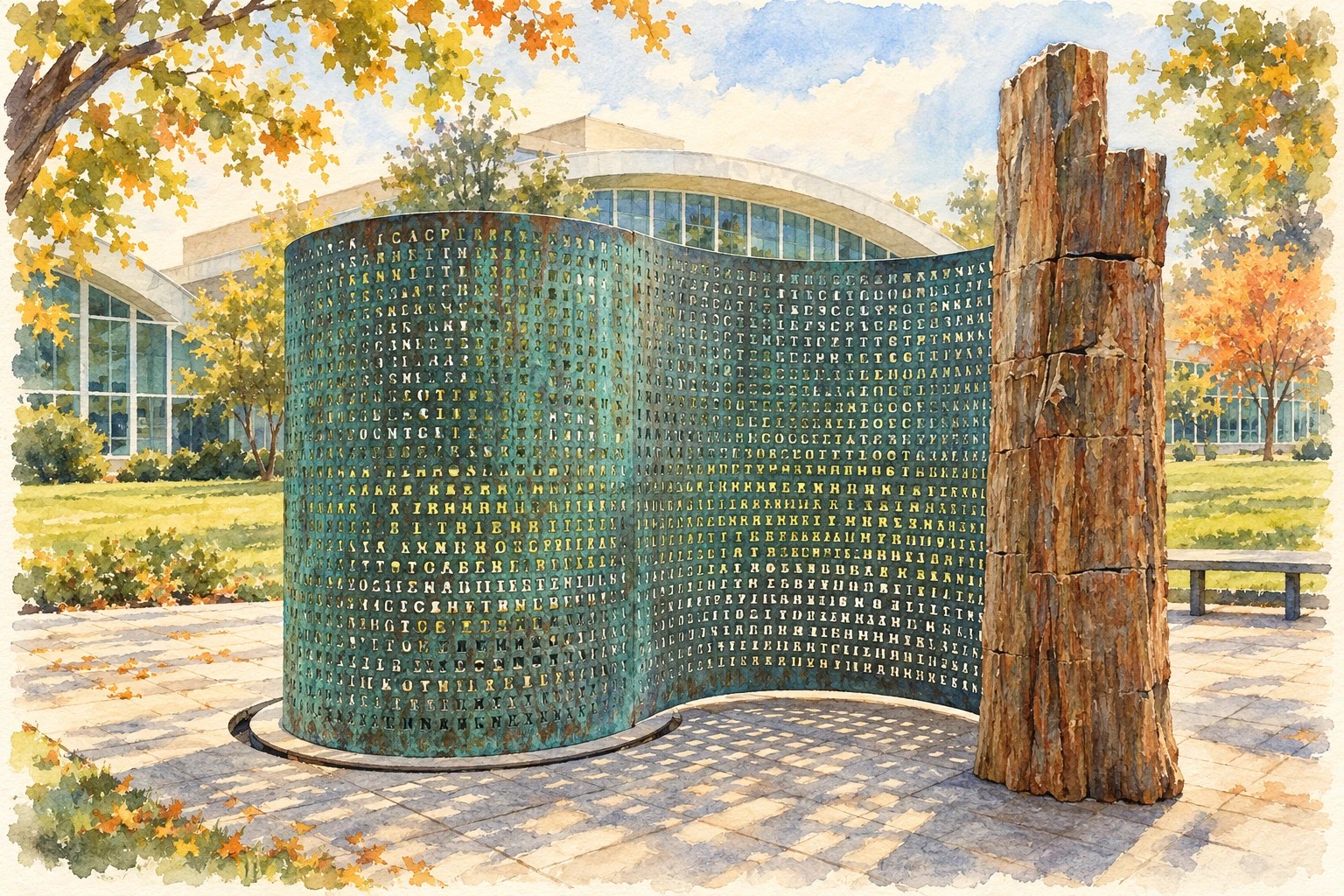
A copper screen stands in a courtyard at CIA headquarters in Virginia. Its surface curves like an enormous sheet of paper. Light passes through rows of cut letters. There is no locked door on the message, no envelope to open, and no hidden compartment that must first be discovered. The words are exposed to anyone who can obtain a good photograph. For decades, their visibility has made their resistance to reading more compelling.
The work is Kryptos, by Jim Sanborn. Calling it the “unsolved statue outside the CIA” gets the spirit of the story but misses several consequential details. It is an installation, not a statue of a person. Its best-known screen sits inside the headquarters grounds, not beside an ordinary public sidewalk. Most of its encrypted message has long been deciphered. And the final section’s history changed dramatically in 2025, when researchers found its underlying text in archival working papers.
That last development did not automatically end the cryptographic challenge. Recovering what an author wrote, proving how those words became particular ciphertext, and understanding what the words mean are three different achievements. Kryptos now offers an unusually clear opportunity to investigate all three.
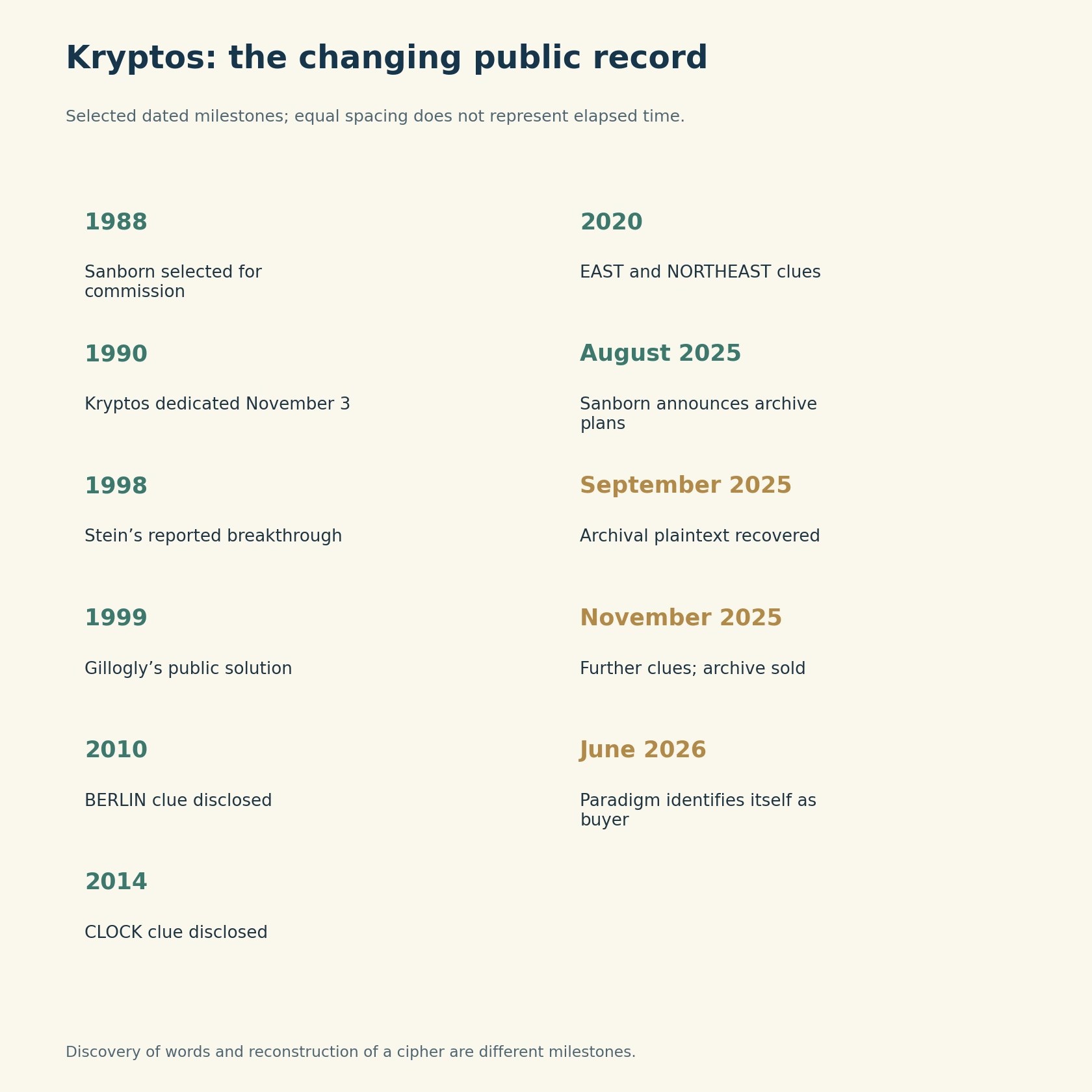
Where the evidence stands: the first three passages have established decipherments. The final 97-letter passage, usually called K4, became the subject of an archival plaintext discovery in September 2025. Sanborn’s archive sold that November, and Paradigm identified itself as the buyer in June 2026. The sources reviewed for this article do not establish a publicly verified reconstruction of the complete original K4 encipherment. A claim that nobody knows the last passage is therefore outdated; a claim that its complete cryptographic problem has been publicly solved goes beyond the reviewed evidence.
This investigation follows the object, the successful work on its first passages, the remaining mathematical problem, the archive discovery, and the changing rules of verification. It also brings the story back to the Charlotte region, where another Sanborn sculpture demonstrates that a seemingly unreadable public artwork can have a recoverable, historically meaningful text.
Explore the investigation
- The object before the legend
- Four passages, several different questions
- What successful cryptanalysis actually looked like
- Substitution: changing the identities of letters
- Transposition: the letters survive, their order does not
- Why the short final passage can be so difficult
- The public clues: powerful constraints with strict limits
- Berlin, Egypt, and the temptation to turn references into routes
- The 2025 archive discovery changed the question
- What a finding aid can tell us—and what it cannot
- An auction of knowledge, not the courtyard sculpture
- The new custodian and the problem of verification
- The Charlotte connection: another Sanborn puzzle nearby
- Transcription errors, artistic choices, and the danger of convenient repairs
- Computers, AI, and the multiplication of plausible answers
- Compare the remaining explanations without inventing probabilities
- A reader's protocol for the next claimed breakthrough
- Why solving the words may not finish the artwork
- The judgment the evidence permits
- Sources and research notes
1. The object before the legend
The CIA dates Kryptos’s dedication to November 3, 1990, following Sanborn’s selection for a $250,000 commission in November 1988. The installation extends from entrance elements to a courtyard centerpiece. Copper, granite, water, lodestone, and petrified wood give physical form to ideas about recording and transmitting information. The celebrated screen is only one part of that arrangement. The CIA’s official installation history and photographs are the appropriate starting point for its location and materials.
Looking carefully at the physical work prevents a series of misleading shortcuts. A photograph taken from the reverse can reverse the apparent relationship between the screen and its supporting wood. A close crop can conceal the neighboring alphabet table. A description that treats the whole installation as one flat inscription can mingle different groups of marks. Even counting “the letters in Kryptos” requires saying which surface and which characters are included.
For this article, the conventional encrypted-message count is 865 alphabetic characters, divided into K1, K2, K3, and K4. Four question marks are counted separately. The neighboring alphabet table is not added to that figure. This convention makes comparisons reproducible. It also explains why a larger total on a general description of the complete screen need not mean that a researcher has discovered hundreds of missing cipher characters.
The visible alphabet table matters because it supplies a plausible starting hypothesis. It resembles a tool for changing letters through a repeating system. But an object placed beside an encrypted message is a clue, not a universal instruction. It does not follow that every section uses the table in the same way, that its displayed orientation is irrelevant, or that no additional operation occurs. The first successful investigators had to test those possibilities against the actual letter patterns.
The setting invites a second shortcut: assuming the artwork must encode an operational CIA secret. Its location gives it extraordinary atmosphere, but location does not establish content. A commissioned artwork can explore intelligence without serving as an intelligence report. A real cryptographer’s involvement can make its construction technically informed without turning its narrative into a government admission. Readers should resist borrowing institutional authority for a claim the inscription itself does not substantiate.
There is a useful comparison with our Beale Ciphers investigation. In Beale, a successful reading of one numerical paper does not authenticate a buried fortune. In Kryptos, successful decryption of an artist’s text does not authenticate every possible literal interpretation of that text. In both cases, the transformation of symbols is one question and the truth or significance of the resulting statement is another.
Start, then, with the modest evidence that is actually strong: this is an identifiable physical artwork, created by a known artist, with a documented commission, a reproducible inscription, and a history of verifiable partial decipherment. Its fascination does not require an invented classified mission. The documented object is already an unusually ambitious experiment in making secrecy visible.
2. Four passages, several different questions
The modern labels K1 through K4 are convenient addresses. They allow a reader to specify which segment is being discussed without copying the whole inscription. They should not be mistaken for four equally long messages or four equally difficult tasks. K1 contains 63 letters; K2, 369; K3, 336; and K4, 97. The division is part of the established specialist treatment summarized in Richard Bean’s 2021 cryptanalytic study.

K1 and K2 use modified forms of the Vigenère family of substitution systems. K3 uses transposition, rearranging letters rather than simply replacing each with a different symbol. These successful readings are important evidence that the installation was constructed to carry meaningful text. They also warn against taking one method that works on one section and imposing it on all the rest.
The recovered passages are themselves enigmatic. K1 meditates on perception and the distinction between light and shadow. K2 evokes hidden information and transmission, includes coordinates, and introduces a voice whose statements still invite interpretation. K3 adapts the account of opening Tutankhamun’s tomb, making the act of revelation part of the message. These are concise descriptions of content, not claims that every image or statement in the passages should be read literally. Readers can follow the established readings through the specialist archive’s documentation.
The mixture helps explain the artwork’s endurance. A conventional puzzle often rewards the solver with an unambiguous instruction or ordinary sentence. Here the recovery of language opens another interpretive task. A coordinate may seem more concrete than a metaphor, but its function still depends on context. The reader must ask whether a passage reports a real event, stages a fictional voice, or connects ideas within the installation. Cryptographic certainty about the letters does not automatically supply historical certainty about the scene they describe.
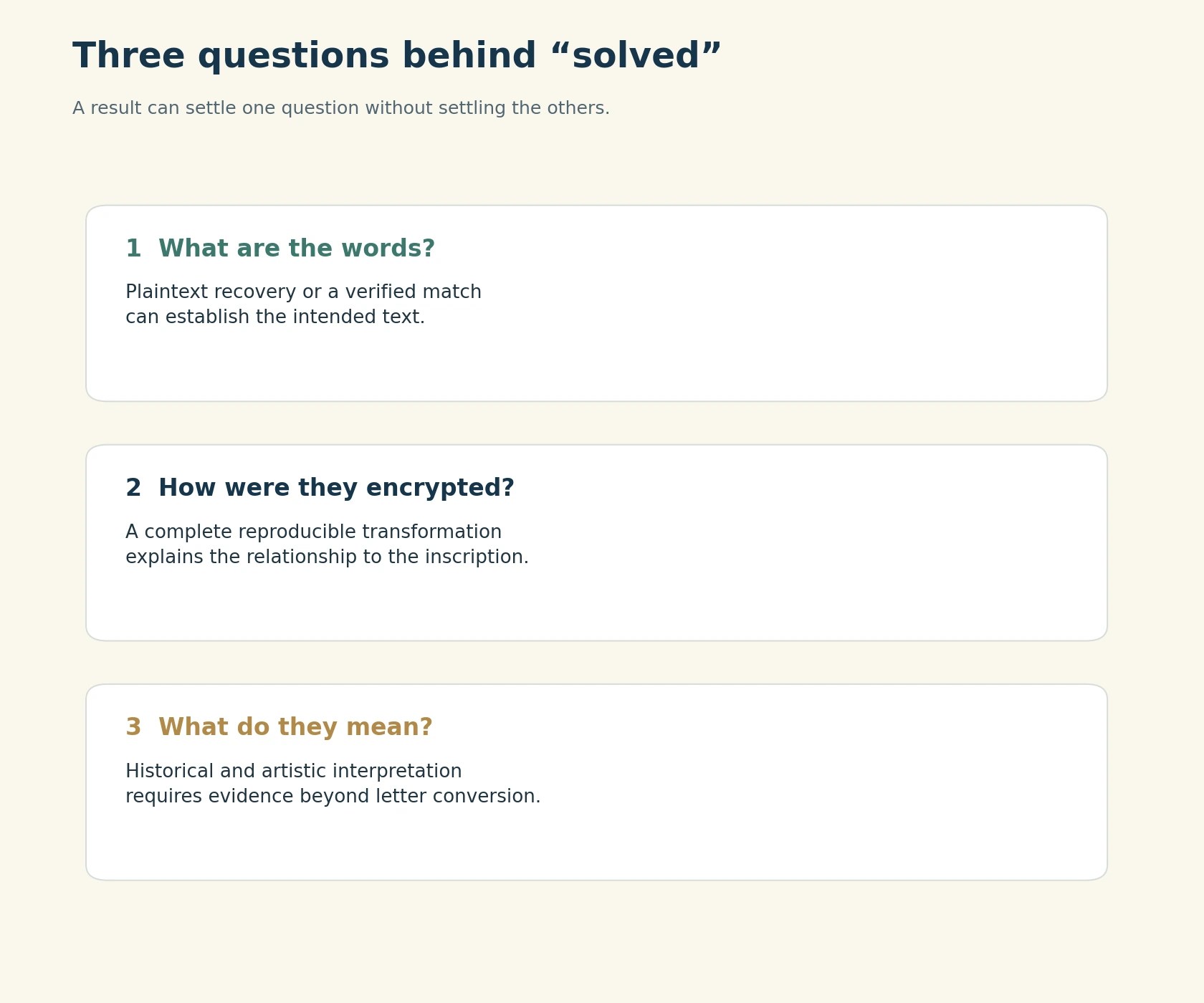
For a newcomer, four layers of the problem deserve separate names. The ciphertext is what a reader sees in the encrypted passage. The plaintext is the text before encryption. The method is the set of operations that connects them, including keys and conventions. The interpretation is the reader’s account of what the recovered words refer to. Evidence can be strong at one layer and weak at another.
Imagine finding a novelist’s draft in an archive. If the draft contains a sentence later printed in scrambled form on a sculpture, the discovery may settle the intended sentence. It may say little about how the artist rearranged or replaced its letters. Conversely, a mathematical procedure that consistently converts the inscription into a coherent sentence can settle the reading while leaving its artistic meaning open. A passage can be cryptographically solved and interpretively mysterious.
The distinction becomes still more important when a discovery is made privately. An owner may possess the original method. A small group may know the plaintext. The public may know only selected clues. A news headline describing what “we know” can silently shift among those three audiences. The right follow-up question is always: known by whom, from what source, and available for which kind of independent check?
Kryptos also has a changing historical status. A careful article published in 2020 could accurately say that 24 plaintext letters had been disclosed as public clues. That article cannot serve unchanged as a complete account of events after the 2025 archival discovery. Historical statements should remain attached to their dates. The chronology is not decorative; it prevents old descriptions from being mistaken for current conclusions.
Nor should the section counts become a progress bar. The first three sections total 768 letters, leaving 97. That arithmetic describes the amount of text, not the percentage of intellectual work remaining. A short unknown passage can be harder than a much longer one because it gives an investigator fewer repetitions, fewer stable frequency patterns, and fewer opportunities to distinguish a promising hypothesis from coincidence. Length measures the specimen. It does not measure how close anybody is to a breakthrough.
3. What successful cryptanalysis actually looked like
David D. Stein’s first-person account supplies one of the best antidotes to the mythology of instant codebreaking. He describes a long, intermittent effort, estimating roughly 400 hours across seven years and dating a decisive breakthrough to February 21, 1998. His account appeared in Studies in Intelligence and is available in a readable specialist mirror of the declassified article.
Stein began by comparing letter counts across rows. A conspicuous change in the occurrence of J helped suggest that the inscription did not use one uniform system. He tried subdivisions, tested a repeating-key hypothesis, and used constraints from likely English to narrow alternatives. A tentative THE became part of THEY. The useful point is that a guess constrained other letters rather than merely producing a pleasing isolated word. His initial numbered subdivisions also differ from the later K1–K4 convention.
Those details illustrate a larger distinction between a hypothesis and a story. A story explains why a particular word would be appropriate to the CIA. A hypothesis specifies what choosing that word would force elsewhere in the text. If those forced consequences fail, the hypothesis can be rejected. If they yield additional coherent material without new improvisation, it gains support. Cryptanalysis moves forward when an attractive idea accepts the risk of being wrong.

Consider an original miniature example. Suppose a cipher repeats a key every four letters. If a solver decides that the first encrypted symbol represents R under the first key position, that same decision must apply to the fifth, ninth, thirteenth, and subsequent letters in that position. The solver does not get to use the rule where it helps and discard it where it hurts. A single proposed letter creates a whole column of consequences.
That is why recognizing a short word is not enough. Common words are plentiful, and a flexible method can manufacture them. The important evidence is whether the same fixed choices recover the rest of the message. A weak proposal produces a dramatic noun and then needs exceptions. A strong proposal produces ordinary connective tissue as well: verbs, prepositions, agreement, and a consistent sequence of operations. Unexciting words can be more persuasive than spectacular ones because they were not the original target.
Successful investigation also requires revising the boundaries of the problem. If two adjacent segments decode with the same rule, their initial separation may have been misleading. If the rule fails on the next segment, the failure may identify a real boundary. Neither result should be forced into the investigator’s original diagram. The arrangement on paper is a working model, not a command from the artist.
This is a broader lesson for the entire History Under Investigation series. A useful investigator does not merely collect details that fit a preferred answer. The investigator asks what the answer predicts, checks those predictions, and keeps a record of where the model had to change. In a disappearance case the prediction might concern a route or a date. In Kryptos it can concern a single letter. The scale differs; the discipline is recognizably the same.
4. Substitution: changing the identities of letters
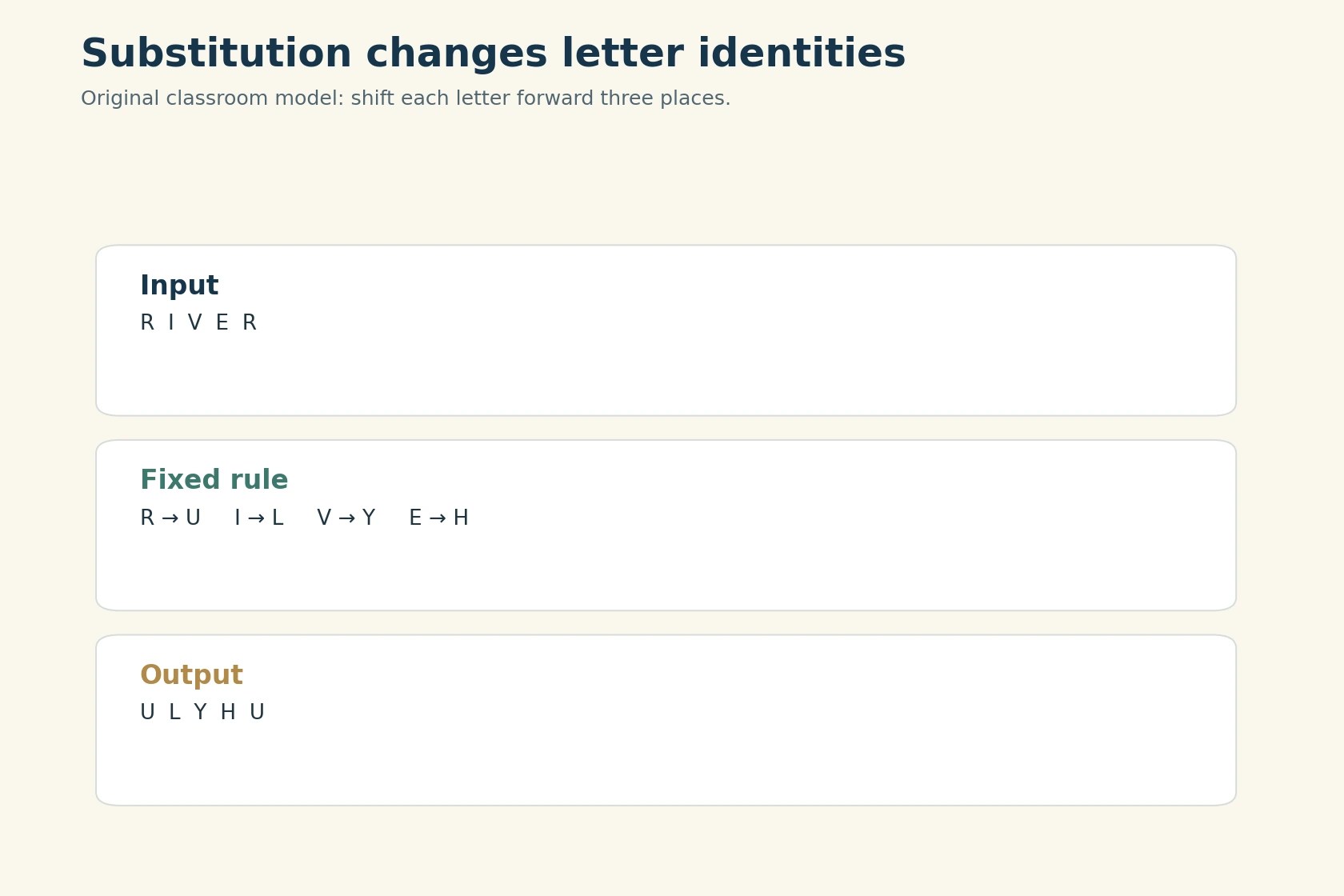
A substitution cipher changes the symbols used to express a message. The easiest teaching example is a fixed shift of the alphabet. Write A through Z in order, then shift each letter three places forward, wrapping around at the end. In this invented example, RIVER becomes ULYHU. Reversing the shift recovers RIVER. No part of that example is Kryptos ciphertext or a proposed solution; it simply makes the operation visible.
A fixed shift preserves more structure than it initially appears to. Every R changes in the same way. Repeated letters remain repeated. The frequency pattern is relabeled rather than destroyed. If E was common before encryption, whatever symbol replaces E will remain common afterward. An investigator can exploit that relationship, although a very short message may not resemble average English closely enough for a confident deduction.
Repeating-key substitution complicates the picture by changing the replacement according to position. In a conventional Vigenère teaching model, letters are represented by numbers from 0 to 25. A repeated key supplies a sequence of shifts. If the key has three letters, the first, fourth, seventh, and later positions share one shift; the second, fifth, and eighth share another. The text combines several different substitutions into one stream.
The pattern creates an investigative opportunity. If the key length is guessed correctly, separating the stream into its repeating positions can reveal simpler components. If it is guessed incorrectly, the separation mixes positions that do not belong together. A test of key length therefore asks whether a proposed grouping brings out a consistent structure. It is not simply a search for a memorable keyword associated with spies or monuments.
The alphabet used in the transformation also matters. An ordinary classroom Vigenère square begins with ABCDEFG. A keyed or otherwise modified alphabet can place letters in a different order. Using the wrong alphabet can make a correct general idea fail. Equally, changing alphabets repeatedly until a favorite phrase appears can make a wrong idea appear successful. A serious submission must identify the exact alphabet and explain how it is used.
The same applies to spaces, punctuation, line breaks, and numbering. Does the key advance when a question mark is encountered? Are spaces removed before encryption? Is the first character numbered zero or one? Are rows read in their physical order? These questions sound clerical until two investigators obtain different results from what they both call “the same method.” A reproducible method makes every such choice explicit.
A helpful reader’s test is to ask whether the proposed decoding can be run backward. Starting with the claimed plaintext, can another person apply the declared key and operations to regenerate the observed ciphertext exactly? A coherent English sentence is evidence of plausibility. Exact re-creation of the inscription is evidence of a working transformation. Even that does not automatically prove historical authorship of the method, but it is a much more demanding test than recognizing a few suggestive words.
5. Transposition: the letters survive, their order does not
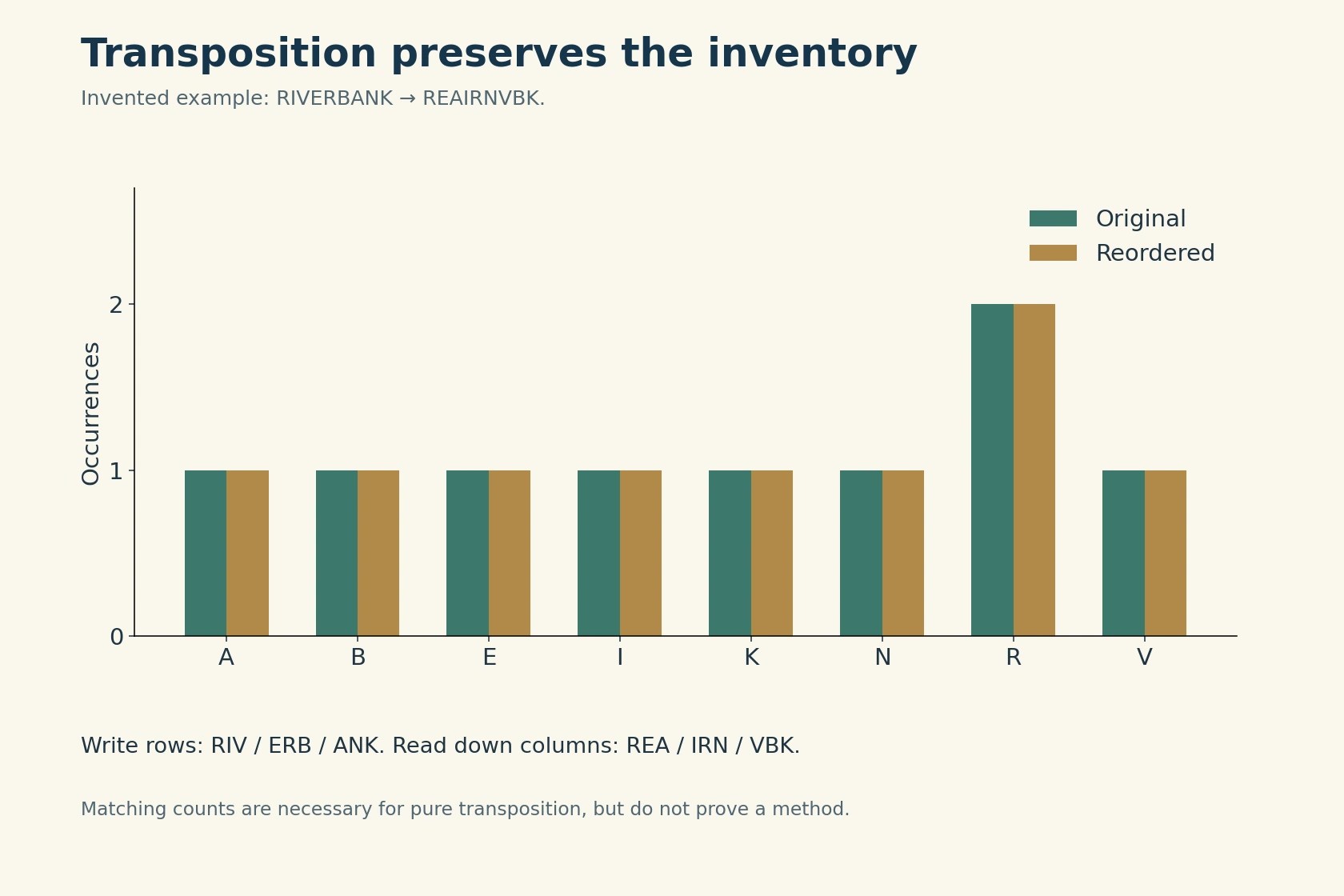
Transposition offers a different form of concealment. Instead of replacing letters, it changes their positions. An original teaching example begins with RIVERBANK, written across a three-by-three grid: RIV, ERB, ANK. Reading down the columns produces REAIRNVBK. Every letter in the original remains present in the result. The order changes, but the inventory does not.
This preservation creates a useful diagnostic. A pure transposition cannot increase the number of R’s, remove an E, or turn V into Q. It can make a familiar sentence unreadable while leaving its letter histogram untouched. If a purported pure-transposition solution contains a different collection of letters from the input, either the proposal is wrong or it includes an additional operation that needs to be declared.
The diagram below compares the invented original, its substitution, and its transposition. It shows why different tests apply to different cipher families. A frequency chart does not read the message for us. It identifies what remains invariant and therefore what kinds of explanation are possible.
Real transposition problems are more demanding than the little square. The grid may be rectangular. The final row may be incomplete. The text may be read from a different corner, by columns rather than rows, or through more than one rearrangement. If there are blank cells, the solver must say whether they are skipped, filled with padding, or treated as meaningful symbols. Each convention affects the result.
For a 336-letter passage, dimensions that multiply to 336 are natural candidates for a completely filled rectangle: 12 by 28 or 14 by 24, for example. They are not proof that the author used either arrangement. An incomplete rectangle can have a different capacity. Merely displaying the text in a visually attractive grid does not demonstrate that the grid explains the inscription. The dimensions have to participate in a fixed transformation that works throughout.
The central difficulty is not that there are infinitely many ways to shuffle a finite text; there are finitely many, although the number can be enormous. The difficulty is choosing a historically and structurally plausible family of rearrangements. A solver who may reorder individual letters arbitrarily can create any anagram with the right inventory. A solver who identifies a simple, repeatable rule has made a substantially stronger claim.
That difference explains why a recovered K3 reading is more than an inspired anagram. The value lies in an intelligible relationship between the inscription and the recovered text. It also explains why applying the word “transposition” to K4 is only the beginning of a hypothesis. Which transposition? In what sequence? With which boundaries? Does it preserve the observed counts? Does it accommodate the confirmed clues without inventing a new rule at each one?
There is a rewarding reversal here. A cipher seems to destroy information, yet a poorly concealed invariant can expose its structure. Counting letters is not a trivial preliminary to the clever work. Sometimes it is the clever work: a simple measurement that rules out an elaborate but impossible story.
6. Why the short final passage can be so difficult
K4’s 97 letters can look inviting beside the much longer sections already read. A reader might expect a short message to require less work. In cryptanalysis, however, a short specimen can be harder to diagnose because it provides fewer observations. The same property that makes a short poem easy to memorize makes it a poor sample from which to estimate the frequency of every letter in English.
Imagine examining only ten letters. A perfectly ordinary phrase might contain no E, several uncommon letters, or an unusually repeated word. None would prove that the language was not English. As the sample grows, broad patterns usually become easier to distinguish from local peculiarities. With a short encrypted passage, many competing models can fit what little is visible.
One common diagnostic is the index of coincidence, which measures how often two distinct positions contain the same letter. If every one of 26 letters were equally likely under an idealized independent model, the expected match probability would be 1/26, about 0.0385. That is a model baseline, not a guaranteed lower bound for every finite sample. A sample with no repeated letters has an observed value of zero. A sample consisting of one repeated letter has a value of one.
Those extremes show why a statistic must be interpreted rather than worshiped. Natural language, encryption, sample length, and deliberate composition can all affect its behavior. A single value cannot uniquely name the cipher. It can help compare hypotheses, especially when accompanied by simulations that use a declared model and preserve the relevant conditions.
There is a further distinction between search difficulty and evidence sufficiency. A computer may examine a vast number of candidate keys quickly. If the method is flexible enough, it will eventually produce fragments resembling language. The problem then becomes deciding whether a result is exceptional under the actual search that generated it. One impressive-looking output among millions of attempts is weaker evidence than the same output from a method specified in advance.
This is why reporting only the winning candidate is misleading. A serious account should describe the family of methods tried, the scoring rule, the number of alternatives considered, and the degree of manual intervention. If spelling corrections, reordered words, and discarded letters were allowed, those freedoms belong in the explanation. They cannot disappear once the final paragraph looks convincing.
K4’s resistance is therefore not evidence that it requires supernatural insight, classified computing power, or an impossibly advanced algorithm. It is evidence that the publicly established constraints have not yet yielded the complete verified reconstruction described in the sources reviewed here. The responsible conclusion is narrower than the legend, and more interesting: a deliberately constructed short problem can remain resistant when many plausible methods coexist and the decisive historical instructions are withheld.
7. The public clues: powerful constraints with strict limits
Sanborn released a small succession of plaintext clues that became central to K4 research. BERLIN was disclosed in 2010, CLOCK in 2014, and NORTHEAST and EAST in 2020. Together those words contain 24 letters. Specialist chronologies, including Elonka Dunin’s Kryptos timeline, document the changing public challenge and link to earlier announcements.
The numerical consequence is straightforward: 24 of 97 letters amounts to approximately 24.7 percent of the final passage’s alphabetic characters. The interpretive consequence is not straightforward at all. A quarter of the characters does not mean a quarter of the difficulty has been removed. The usefulness of known plaintext depends on the encryption method, the positions of the clues, and the relationships they expose.

For a simple fixed substitution, a known word can identify several letter mappings immediately. For a repeating-key system, it can constrain particular positions in the key. For a transposition, it can suggest where letters must be brought together while leaving many arrangements possible. For a construction involving more than one step, it may be unclear at which stage the clue becomes most useful. The same four-letter word can be decisive under one model and insufficient under another.
An investigator should therefore distinguish fitting a clue from predicting it. If a method was designed with BERLIN already in mind, recovering BERLIN is a necessary check but not an independent triumph. The more persuasive result is what the method recovers elsewhere without further adjustments. A candidate that produces the known words and unexplained gibberish between them has not solved the passage. It has accommodated the available constraints.
Bean’s HistoCrypt study makes that limitation concrete. Within one examined search, 39 five-digit primer candidates could satisfy the known clue conditions; none supplied a convincing complete solution. The lesson is not that the clues are worthless. It is that several candidates can survive a partial test. His exclusions concern the cipher families and assumptions he examined, not every imaginable system. The paper’s methods and qualifications should accompany any reference to its negative results.
A helpful analogy is a jigsaw with a few pieces already joined. Their fit constrains the surrounding picture, but it does not establish that every loose piece belongs where a solver first places it. There is one important difference: in cryptanalysis, a solver can accidentally invent new ways of cutting the pieces. Allowing a new alphabet, a reversed segment, an omitted letter, and an arbitrary grid rotation whenever needed can conceal how little a proposed rule actually explains.
The public clues also encourage geographic narratives. BERLIN and EAST readily evoke Cold War borders and directions. CLOCK evokes time, mechanisms, and particular monuments. Those associations may be artistically relevant, but an association is not yet an instruction. “Go east” requires an origin, a distance, and a reason to treat prose as navigation. “Use the clock” requires identifying a clock and specifying how its information affects the letters. Until those steps are supplied and tested, a map remains an interpretation rather than a decipherment.
8. Berlin, Egypt, and the temptation to turn references into routes
In November 2025, reporting on a new Sanborn statement identified his 1986 Egypt trip and the 1989 fall of the Berlin Wall as relevant, and distinguished Berlin’s World Clock from the Mengenlehreuhr, another clock frequently discussed by solvers. It also described a proposed continuation called K5. These details come from Dan Vergano’s contemporary report in Scientific American, rather than a claim that this investigation inspected the original statement scan.
The distinction between the clocks is a good example of why a proper noun matters. Two objects can share a city and a theme while offering different structures. A model built around the wrong object might generate attractive patterns for years. An explicit correction should change the model, not be absorbed as another mysterious layer that allows every previous guess to remain true.

References to Egypt carry a different danger. The known third passage already evokes Howard Carter’s entry into Tutankhamun’s tomb. That thematic connection can explain why archaeological imagery belongs in a discussion of the artwork. It does not make every Egyptian monument, coordinate, or ancient symbol a demonstrated key to K4. A recurring artistic interest can be a source of hypotheses without selecting one precise operation.
There are at least three ways a place can function in an encrypted artwork. It can be subject matter, something the text discusses. It can be key material, information used in the transformation. Or it can be a destination, somewhere a decoded instruction sends a reader. The same place could serve more than one role, but the roles cannot be silently exchanged. A sentence about Berlin is not automatically a cipher keyed by a Berlin clock, and a cipher keyed by a clock is not automatically a direction to travel there.
To evaluate a geographic proposal, ask what was fixed before the result appeared. Was the landmark identified by a documented clue? Were its relevant measurements recorded from an independent source? Was the method for converting those measurements into letters specified in advance? Would a neighboring landmark or a slightly different measurement work just as well? The more interchangeable the ingredients, the less explanatory force the final match carries.
Historical dates require the same care. A date can become numbers in many ways: year alone, day and month, digits summed, digits reversed, or letters derived from a written form. Trying all those versions and reporting only a successful one hides the size of the search. A plausible date is not an unlimited license to transform it. A persuasive method explains why one representation is used and applies that rule consistently.
The proposed K5 continuation should also remain attached to its evidentiary status. An artist’s plan is evidence of an intention. It is not proof that a new installation has been completed, that a public quest has begun, or that a reader should visit a particular location. The sources examined here support discussion of a proposed continuation, not a claim that this article has located a new physical stage of the work.
These limits do not diminish the artistic dimension. They make it possible to enjoy the references without pretending that every resonance is a solved instruction. Kryptos can connect secrecy, travel, revelation, memory, and historical change while still requiring a rigorous account of how a particular line of ciphertext becomes a particular line of language.
9. The 2025 archive discovery changed the question
The most consequential recent event took place away from the sculpture. In September 2025, Jarett Kobek and Richard Byrne recovered and assembled text from working papers in Sanborn’s Smithsonian archive. RR Auction’s later account described five pages connected with content review, rather than the original encryption charts, and said the known clues helped the researchers reconstruct the passage. The auction house characterized the result as a discovery of plaintext rather than a cryptographic solution. Its October 2025 explanation is a participant’s account with a commercial interest in the archive’s remaining value.
That qualification about the source is essential, but it does not make the distinction artificial. An archive can preserve an author’s words through a path entirely separate from the mechanism used to hide them. A draft, a review copy, or a typescript can reveal content without explaining its later transformation. The discovery can be historically decisive and cryptographically incomplete at the same time.

To understand why, imagine a different, invented artwork. Its creator writes a 50-letter sentence, submits the sentence for approval, then encrypts it using a private grid and key. Decades later, a researcher finds the approval copy. The researcher now knows the sentence. That knowledge is valuable and authentic if the copy’s provenance is established. But the approval copy need not contain the grid dimensions, key, reading order, or corrections used to make the finished inscription.
Known plaintext can help recover those missing operations. It does not guarantee a unique recovery. Many transformations can connect two equal-length strings, especially if the investigator permits arbitrary position-by-position instructions. A historically convincing explanation should be economical, reproducible, and compatible with the construction record. The original coding papers would be particularly important because they can distinguish an artist’s actual method from an invented method that happens to reproduce the result.
The discovery also changes how later claims should be credited. A person who encounters the recovered text and then announces the same text has not necessarily independently broken the cipher. A person who reconstructs a method after learning the text has done a different kind of work from someone who derives both method and text from the inscription alone. Both achievements can be valuable, but they deserve accurate descriptions.
This distinction is familiar in other investigations. Finding an old letter naming a ship’s destination can settle where its captain intended to go without proving how the ship was lost. Recovering a wreck can settle a vessel’s location without settling the fate of every passenger. Our investigations of Theodosia Burr and the Patriot and the Franklin expedition ask similar questions about what a newly found object actually establishes.
Kryptos’s archival turn therefore should not be squeezed into a binary headline. The meaningful questions became more specific: what precisely was recovered; how was it authenticated; which people have access to it; what remains private; and has a complete, historically supported transformation been independently demonstrated? Those questions tell the reader far more than either “solved” or “still unsolved” can convey alone.
10. What a finding aid can tell us—and what it cannot
The Smithsonian’s Archives of American Art describes the Jim Sanborn papers in a collection finding aid. A specific listing identifies Box 16, Folder 2, concerning Kryptos. Those descriptions are valuable evidence that an archival collection exists and that its organization includes relevant material. They are not substitutes for examining every item in the folder.
An archival title can refer to a broad span of work. A date range may describe the earliest and latest materials grouped together rather than the date of a particular sheet. A folder labeled with an artwork’s name can contain correspondence, photographs, drafts, publicity, invoices, or later research. A reader cannot infer which of those objects is present solely from the title.
This matters because online retellings often flatten archival discovery into a single dramatic scene: a researcher opens a box, finds “the answer,” and resolves everything. Actual evidentiary work is usually more granular. Which pages were involved? Were they originals or copies? Did the pages retain their original order? Was the text cut up or rearranged? What connected the pages to the final artwork? Which observations were made by the discoverers, and which were confirmed by the artist or later custodians?
The public account does not give this article license to invent answers to every one of those questions. Where a detail was reported by a participant, it should remain attributed. Where the underlying document was not directly inspected, that limitation should remain visible. A polished narrative is not improved by quietly replacing missing evidence with an imagined archive visit.
Restrictions require similar precision. A report that particular material became unavailable does not necessarily mean that an entire collection was closed for the same period. Archives can impose different access conditions on different series or items. Current access can also change. A responsible researcher checks the relevant institution’s current description and procedures rather than treating a generalized news summary as permanent access policy.
There is also a basic difference between accidental public availability and a cryptographic weakness. If an approval draft was deposited where researchers could find it, the plaintext became accessible through documentation. That does not demonstrate that the encryption itself had failed under a ciphertext-only attack. Security analysts would describe those as different routes to disclosure. An investigative historian should preserve the distinction even when both routes reach the same words.
For the reader, the practical lesson is to follow the chain of evidence. “The archive says” is too vague. A finding aid says one thing; a particular page says another; a discoverer interprets it; an artist may authenticate it; an auction house summarizes the sequence. Those are connected steps, each with its own strengths and limitations. Following them carefully makes the story more substantial than the familiar image of a miraculous paper hidden in a box.
11. An auction of knowledge, not the courtyard sculpture
On November 20, 2025, the archive associated with the Kryptos solution sold for $962,500 including the buyer’s premium, according to RR Auction’s sale results. The object sold was the artist’s archive and associated material described by the sale, not the installed sculpture at CIA headquarters. Treating that price as a new valuation of the copper screen would confuse two different assets.
Sanborn had explained his plans in an August 14, 2025 open letter, describing the burden of evaluating claimed solutions, including AI-generated submissions, and his hopes for preserving the challenge. The letter is evidence of the artist’s stated intentions. It does not establish that every later custodian must carry them out or that every purported solution he received was equally serious.

The sale creates an unusual arrangement. The public can study the inscription, while an owner holds private information that can adjudicate or illuminate the remaining problem. That arrangement differs from both an ordinary open mathematical problem and a conventional treasure hunt. The answer is not necessarily waiting to be discovered for the first time by any human being. It can be known privately while the public challenge continues.
Several kinds of value can coexist in such an archive. There is the historical value of an artist’s working papers, the documentary value of drafts and correspondence, and the special value of information that remains unknown to most researchers. The sale price combines a buyer’s assessment of the lot at a particular time. It cannot be converted into an objective dollar value per secret letter, a measure of the cipher’s difficulty, or proof that the archive contains a sensational revelation.
The buyer’s incentives also deserve examination without speculation about motives. A custodian may want to preserve a challenge, support research, promote an organization, or eventually release material. Those are possibilities, not findings about private intentions. Public commitments can be assessed through what is actually announced and subsequently done. An investigator should avoid inferring a secret agenda simply because secrecy is part of the artwork’s appeal.
An archive’s sale can change access without changing the historical facts recorded in it. A page does not become more authentic because it sells for a large sum. Nor does a high price make a weak interpretation stronger. Provenance, internal consistency, physical examination where appropriate, and independent comparison remain the relevant tests. The market’s judgment and the historian’s judgment answer different questions.
This is another point of contact with the Beale story, whose treasure claim can draw attention away from the evidence for the documents. Money is a powerful narrative amplifier. In Kryptos, a nearly million-dollar transaction is a documented event; it should not become a substitute for explaining precisely what was bought, what was publicly disclosed, and what remains to be demonstrated.
12. The new custodian and the problem of verification
In June 2026, Paradigm publicly identified itself as the new steward of the Kryptos archive. Its announcement by Dan Robinson and Matt Huang and Steven Levy’s contemporary WIRED report establish the buyer’s identity and the interest in verification while preserving the challenge. This article does not claim to have audited the custodian’s implementation or tested a submission system.
The underlying verification problem can be explained without pretending to know private technical details. Suppose a custodian has a secret answer and wants to tell a submitter whether a candidate matches. That is a comparison problem. It differs from proving how the submitter obtained the candidate, and differs again from confirming the historical method used by the artist. A successful match can be decisive about one question while remaining silent on the others.
An original classroom analogy makes the distinction clear. A teacher has the answer 144 in a sealed envelope. A student submits 144. The teacher can confirm the match. The student might have multiplied 12 by 12, copied a classmate, guessed, or found the envelope’s contents elsewhere. The match alone cannot distinguish those routes. To assess the method, the teacher needs the student’s work.
For Kryptos, a complete claim might therefore need two tracks. One concerns the proposed plaintext. The other concerns a documented procedure that maps between plaintext and ciphertext. The procedure should identify inputs, alphabets, keys, ordering rules, corrections, and outputs. If historical authenticity is claimed, it should also explain how the method relates to the artist’s working record. These are proposed standards of evidence, not a description of unpublished rules imposed by the archive’s owner.
Secrecy complicates independent review. If reviewers cannot publish the underlying text or coding papers, outsiders may have to rely on attestations by designated people. Such attestations can be credible, but they are not identical to open replication. A news story should specify whether a claim was publicly reproduced, privately checked against an archive, or merely announced by its author. Collapsing those categories makes it impossible for readers to judge the strength of the result.
There is also a timing issue. A procedure developed after the plaintext became known to its author is not the same achievement as a procedure that recovered the text without that knowledge. The former may still reconstruct the original method successfully. It should simply be described as such. Accurate credit depends on the available evidence and the route taken, not on whether a more dramatic label would attract attention.
The ideal outcome for historical understanding would include enough documentation for others to reproduce the transformation and evaluate its provenance. Whether and when a custodian chooses to release that material is a separate question. Until then, a careful article should preserve the distinctions rather than fill the gap with confidence borrowed from a press release, a verification badge, or the prestige of the people involved.
13. The Charlotte connection: another Sanborn puzzle nearby
For readers around Lake Norman, Kryptos has a closer relative than its Virginia setting suggests. Jim Sanborn’s Cyrillic Projector stands at UNC Charlotte. A university news item from October 2025 places it between the Friday and Fretwell buildings. That university confirmation is useful for location, even though the item’s brief reference to the Kryptos discovery does not explain the distinction between finding plaintext and breaking a cipher.
The Cyrillic Projector is a bronze cylindrical work, different in form and alphabet from the familiar Kryptos screen. Dunin’s transcription account dates its Charlotte installation to 1997 and credits photographs taken by Randall Bollig in May 2003 as the basis for her transcription. Accounts of its decipherment describe separate work by Frank Corr and Mike Bales, followed by collaborative translation work associated with Dunin. It should not be compressed into a story in which a single famous solver did everything.
The local significance is more substantial than a shared artist’s name. The Charlotte work demonstrates the importance of producing a dependable transcription before attempting a reading. When letters are cut into a curved surface, photographed at angles, or illuminated from behind, copying them accurately becomes part of the investigation. A faulty input can undermine a brilliant method. A careful photographer and transcriber can therefore make a contribution as consequential as a person testing keys.
Its use of Cyrillic also reminds readers that an unfamiliar alphabet is not necessarily an unknown writing system. A viewer unable to read the script may experience it as mysterious before any encryption is considered. A knowledgeable reader can separate the identity of the symbols from the concealment of the message. Those are different obstacles, and they require different expertise.
The contrast with the Voynich Manuscript is instructive. With Voynich, uncertainty reaches deeper into the nature of the writing and its relationship to language. With Sanborn’s modern works, the artist, materials, and broad construction context are identifiable. Treating every unreadable object as the same kind of code erases those differences. The right first question is not “Which famous cipher should I try?” but “What kind of uncertainty does this object actually present?”
Local history often begins with a landmark that residents pass without examining. The history of Huntersville and our Lake Norman history follow changes that can be hidden by familiar surroundings. The Cyrillic Projector offers a related invitation on a smaller physical scale: pause at a known place, identify the object correctly, and ask what evidence is available to read it.
This does not make the Charlotte work a demonstrated key to K4. Shared authorship and related artistic interests justify comparison. They do not prove that the same alphabet, key, or procedure carries over unchanged. A local connection becomes useful when it sharpens the questions, not when it is promoted into an unsupported solution. The stronger story is already compelling: an internationally discussed cryptographic artwork belongs to a wider practice with a tangible presence in our own region.
14. Transcription errors, artistic choices, and the danger of convenient repairs
Any investigation of Kryptos eventually encounters irregularities. A letter can be copied incorrectly from a photograph. An artist can make a production error. A seemingly incorrect spelling can be intentional. A later correction can alter an established reading. These possibilities are not interchangeable, and a solver should not select among them solely according to which makes a favored theory work.
The specialist record documents a 2006 correction associated with K2. That history, collected in Dunin’s Kryptos research archive, is a reminder to identify the version of a transcription or plaintext being used. It is not permission to repair K4 whenever a candidate solution fails. A documented correction applies to the documented problem; it does not establish a general rule that inconvenient letters may be discarded.

The strongest way to handle an uncertain character is to preserve the uncertainty visibly. Record the image or source from which it was copied. Note the competing readings. Run the candidate method on each version. Explain whether the outcome depends entirely on choosing one of them. If a proposal succeeds only after changing several unambiguous characters, the changes are part of the proposal’s evidentiary burden.
It is equally important not to normalize the material silently. Removing spaces may be a legitimate preprocessing step, but it should be stated. Ignoring punctuation may be necessary for a particular count, but the punctuation should remain available for other analyses. Rewrapping lines for convenient display can destroy information if the original layout matters. An investigator should keep an untouched reference transcription alongside any working version.
This separation prevents circular reasoning. Suppose a researcher believes the plaintext must mention a certain place. One character resists the proposed reading, so the researcher calls it an engraving error. The resulting place name is then presented as proof of the method. The reasoning has gone in a circle: the desired answer justified the repair, and the repair produced the desired answer. Independent evidence for the repair is needed to break the circle.
A good correction can nevertheless be transformative. If a clear photograph shows that a widely copied transcription is wrong, updating the input is an improvement, even if it invalidates years of work. The distinction lies in the source of the correction. The physical object or an authenticated construction record can justify it. A disappointing output alone cannot.
This is where artistic interpretation and technical analysis can pull in different directions. An art critic may explore how an irregularity contributes to a theme of uncertainty. A cryptanalyst needs to know how that irregularity enters the transformation. Both discussions can be worthwhile, but neither should impersonate the other. A suggestive symbolic reading does not establish a letter operation, and a successful letter operation does not exhaust the artwork’s meaning.
15. Computers, AI, and the multiplication of plausible answers
Computers are valuable in this investigation because they can carry out fixed operations rapidly and consistently. They can enumerate candidate keys, calculate letter statistics, compare transcriptions, and check whether a proposed inverse operation recovers the exact input. These tasks reward precision. A program that exposes an error in an attractive hypothesis has contributed to the investigation even if it never prints a dramatic answer.
Generative AI presents a different mixture of possibilities and hazards. It can explain terminology, help organize a research log, or suggest testable families of methods. It can also produce fluent interpretations that sound like discoveries without satisfying the underlying constraints. Fluency is especially dangerous in a short-message puzzle because a convincing sentence is precisely what the reader hopes to see.
Sanborn’s 2025 letter makes clear that AI-generated submissions had become part of the burden he described. That observation supports caution about submission quality; it does not prove that every use of AI is futile or that a future computational contribution is impossible. The relevant question is what the system actually did. Did it execute a declared transformation, or did it invent a sentence and then supply a persuasive explanation around it?
A reader can apply a simple test. Ask for the complete input and the complete procedure. Run the procedure independently. Check every output position. Then run the inverse, if the claimed system is reversible. If the result depends on a language model producing the same free-form answer a second time, the claimed transformation has not been specified adequately. A reproducible algorithm should not depend on a model’s willingness to tell the same story again.
Another useful safeguard is keeping development and evaluation separate. A candidate method can be designed using some known constraints, then tested on additional constraints that were not used to construct it. That separation is harder when all public clues are already familiar, but the principle still matters. A proposal should disclose which facts guided its design and which results emerged without being deliberately built in.
The number of attempts matters as well. If a tool tries thousands of alphabets, reading directions, grids, and word lists, the investigator should not present its best-looking fragment as though it arose from a single prediction. Search can be productive, but it changes the interpretation of a match. A transparent log makes the success assessable and lets others avoid repeating unsuccessful work.
Kryptos does not need a contest between human intuition and machines. The productive division is between procedures that expose themselves to checking and outputs that ask to be believed. A pencil-and-paper method can be sloppy. A computer search can be rigorous. An AI-assisted explanation can be accurate if its factual and mathematical claims are independently verified. The standards should follow the evidence, not the brand of the tool.
16. Compare the remaining explanations without inventing probabilities
What might a complete K4 explanation look like? The reviewed sources do not establish the answer, but they allow us to compare broad possibilities and ask what would distinguish them. The following matrix is qualitative. It does not assign percentages to theories for which no defensible probability model has been supplied.

One possibility is a relatively compact classical construction whose particular key or combination of operations has escaped public reconstruction. Its appeal is economy: an artist working in the late twentieth century could construct a difficult puzzle from familiar components. Its weakness is that familiarity alone selects no specific method. A complete result would have to account for every position, the known clues, and any authenticated production conventions.
A second possibility involves external key material: a text, object, measurement, or other reference that is not recoverable from the ciphertext alone. Public references to places and events make such hypotheses understandable. Yet external material can be chosen in innumerable ways. A strong claim would identify the source precisely, justify its selection, and show that a fixed extraction rule works beyond the clues used to choose it.
A third possibility is a more idiosyncratic layered construction. Combining substitution, rearrangement, and a further convention can make a short message difficult to diagnose. The danger is explanatory freedom: if each layer is invented only after the previous one fails, almost any result can be rationalized. The historical working papers would be particularly valuable in distinguishing an authentic layered method from a retrospective construction.
A fourth issue concerns production and correction. A documented discrepancy between working text and finished inscription could complicate reproduction. This possibility should not become a universal escape hatch. A repair-based theory needs evidence for the repair, not merely a claim that the artist must have made a mistake. The more alterations required, the more independently supported the alteration history needs to be.
These possibilities need not be mutually exclusive. A layered system can use an external key. A conventional method can contain a production error. That overlap is one reason a numerical ranking would be misleading. The useful exercise is to identify each theory’s additional assumptions and the observations that could undermine it.
There is also a possibility that belongs to the history of claims rather than the history of the artwork: a future “solution” might reproduce recovered plaintext without reconstructing the original method. Such a result should be assessed according to what it actually accomplishes. It may confirm a transcription, provide an alternative transformation, or offer an interpretation. None of those achievements should be inflated into independent cryptanalysis without evidence of the route taken.
The responsible reader does not have to select a favorite now. A better provisional judgment is to keep the field of possibilities organized, give established constraints their proper force, and reserve confidence for a complete demonstration. Uncertainty becomes useful when it is structured enough to tell us what new evidence would matter.
17. A reader’s protocol for the next claimed breakthrough
The next dramatic headline about Kryptos will be easier to evaluate if the standards are set before the claim arrives. Start by identifying exactly what is being claimed. Is it a newly recovered document, a proposed plaintext, a new method, a private confirmation, or an interpretation of already known words? A report that fails to specify its achievement has not yet given the reader enough information to assess it.
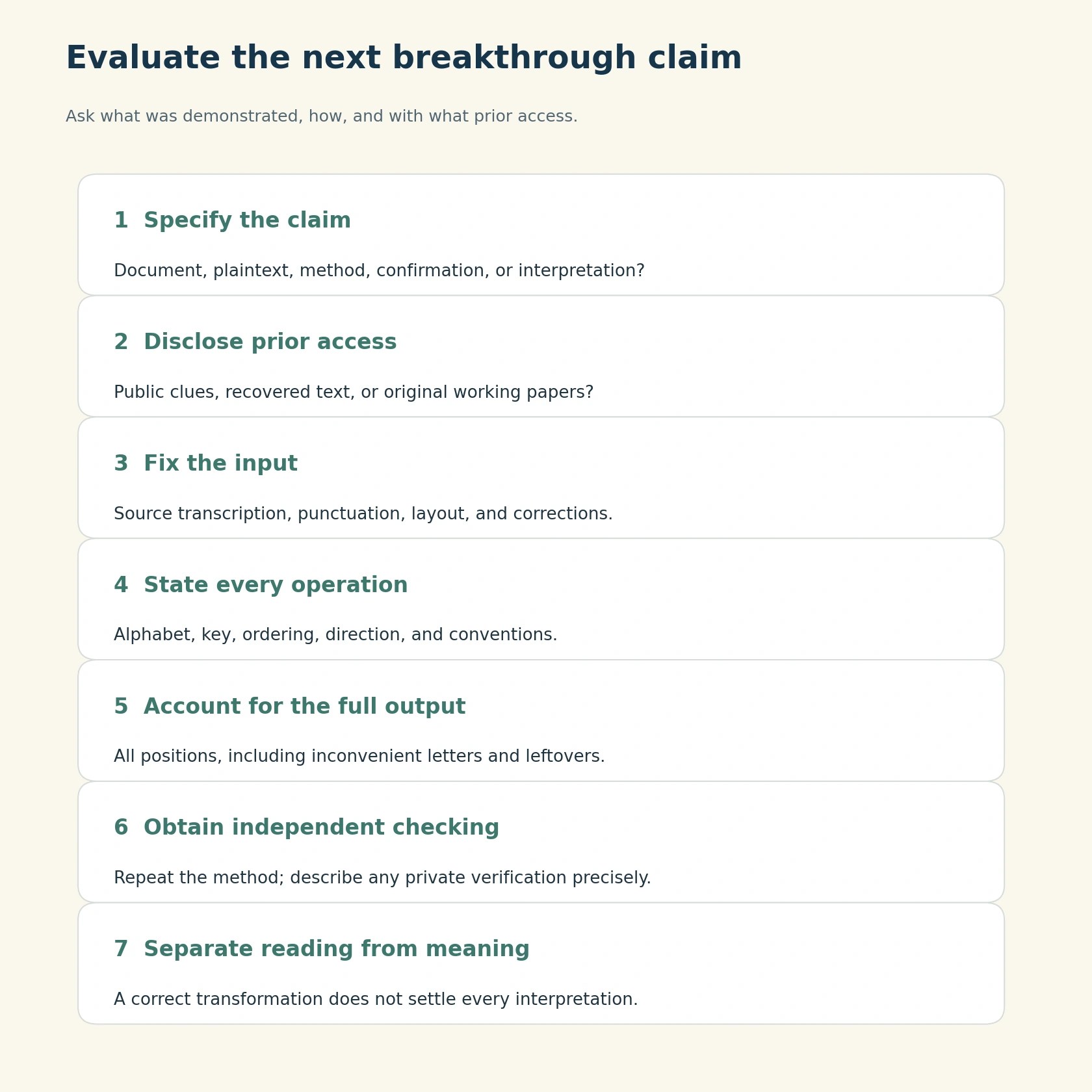
Next, identify the claimant’s access to prior information. Did the researcher know the public clues only, have access to the recovered plaintext, or inspect the artist’s working papers? Access does not discredit a result. It determines how the result should be described. An archival reconstruction can be excellent historical work without being an independent ciphertext-only solution.
Then examine the input. A complete claim should identify the transcription, its source, and any changes made to it. It should distinguish letters from punctuation and preserve the original arrangement where that arrangement is relevant. If the method depends on a particular photograph or edition, that dependency should be explicit. Otherwise a second researcher cannot determine whether a disagreement comes from the method or from different starting material.
The operations should be stated at a level that permits repetition. “Use the Berlin clock” is not enough. Which feature? Which date or configuration? Which conversion? In what order? Similarly, “apply a Vigenère cipher” is incomplete without the alphabet, key, direction, and conventions. A reproducible account closes those gaps rather than relying on the author’s intuition to bridge them.
Check the full output, not just the most exciting line. Do all letters receive an explanation? Are there unexplained leftovers? Were words rearranged after decryption? Are spelling changes treated consistently? Does the method recover ordinary language between the public clues? A complete result should not need the reader to overlook the positions where it fails.
Independent checking follows. Ideally, another person implements the method without receiving hidden instructions and reaches the same result. If verification occurred privately, the report should identify what was checked and by whom, within the limits of any agreement. A general statement that an expert was impressed is weaker than a precise statement that the expert reproduced the full transformation.
Finally, separate decoding from meaning. A successful plaintext might describe an event, point toward a further puzzle, or use symbolic language. Its interpretation can remain disputed even after its letters are settled. The standards for reading a cipher and interpreting an artwork are related but distinct. Neither should borrow more certainty from the other than the evidence supports.
The protocol may sound demanding because it is. A claim to solve a famous, long-resistant problem should be demanding. These checks protect serious researchers as much as readers: a well-documented contribution can receive accurate credit, while a weak claim cannot rely solely on a confident announcement or the audience’s desire for closure.
18. Why solving the words may not finish the artwork
Kryptos is not merely a container holding a sentence. Its physical form makes reading an experience of partial access. Letters are both material and absence: copper surrounds empty shapes through which the world remains visible. The screen curves, so a viewer’s position affects what can be seen. Wood, stone, and water place the inscription among materials that carry different relationships to time. These are observations about the artwork’s form, not claims to have decoded a hidden instruction in its materials.
That distinction leaves room for interpretation without disguising it as proof. A reader might understand the work as an image of intelligence gathering, where fragments become meaningful through patient comparison. Another might emphasize the limits of knowledge: even a legible text can remain ambiguous. The archive discovery adds a further layer, showing that information can escape through the surrounding record rather than through the challenge designed to conceal it.
The history of participation has also become part of the work’s public life. Photographers, transcribers, programmers, historians, archivists, and amateur solvers have contributed different kinds of labor. An account centered entirely on a single heroic codebreaker would miss that distributed effort. The person who supplies a reliable image may enable a transcription; the transcription may enable a test; a failed test may eliminate a family of methods. Progress is not always a final answer.
There is an ethical dimension to the reader’s attention as well. A real artwork and real people should not be turned into props for invented encounters, secret meetings, or unsupported accusations. Sanborn’s documented statements can be quoted or summarized within their limits. His private thoughts should not be supplied by narrative convenience. The same applies to discoverers and custodians whose motives can be discussed only where evidence supports the discussion.
The investigative pleasure lies in watching knowledge change shape. At first, the puzzle appears to be a screen of unreadable letters. Later, it becomes a set of distinct cipher problems. Then it becomes an archival history, a question of custody, and a debate about what verification means. Each development resolves some uncertainty and exposes another. That is a richer story than an endlessly repeated claim that the CIA has a code nobody can crack.
Readers who enjoy that movement from dramatic object to precise questions will find a different version in the Mary Celeste investigation. A ship found without its people invites an immediate story. The surviving record asks slower questions about what was observed, what was inferred, and what later storytellers supplied. Kryptos replaces the abandoned deck with a copper inscription, but the reader’s central task remains the same: keep the evidence and the explanation in view together.
19. The judgment the evidence permits
Kryptos contains a real, deliberately constructed cryptographic challenge. Its first three passages have established decipherments. The final passage’s intended text was recovered through archival material in 2025, and the artist’s archive subsequently changed hands. Those developments are substantial. They should be stated clearly, with dates, rather than buried beneath an older version of the mystery.
The complete public reconstruction of K4’s original encipherment remains a separate question. The sources reviewed here do not establish that such a reconstruction has been publicly verified. That finding is a statement about the reviewed record, not a claim that no private person possesses the method or that no unpublished work could be correct.
The strongest next development would be a complete procedure, supported by the appropriate historical documentation and independently reproduced. A private confirmation could also be significant if its scope were clearly described. Another appealing phrase, another map with a plausible line, or another assertion that a computer has found the answer would need to meet the same standards as its predecessors.
Readers therefore need not choose between dismissing the puzzle and believing every new solution. There is ample reason to take the artwork seriously and equally ample reason to demand precision from claims made about it. Its history rewards curiosity precisely because curiosity can be disciplined: count the letters, identify the source, test the rule, preserve the correction, and distinguish what has been found from what has been explained.
For Lake Norman readers, the investigation can begin with the nearby Charlotte connection and extend outward to Virginia, Berlin, Egypt, and the archive. The route is intellectual rather than a claimed treasure map. The destination is a better understanding of how an object becomes evidence, how evidence becomes an answer, and why an answer can still leave an artwork open to thought.
Sources and research notes
This article is a synthesis of published primary material, specialist research, institutional descriptions, and attributed contemporary reporting. It does not claim an interview with the artist, access to restricted coding papers, a physical archive visit, or a new decipherment. Research was reviewed on September 6, 2026. Watercolors are interpretive illustrations; explanatory examples are original teaching models. Neither should be used as a transcription of the artwork.
- CIA, “Kryptos Sculpture.” Official history, materials, location, commission, and photographs. Its general unresolved-status wording must be read alongside later developments. Institutional record.
- David D. Stein, “The Puzzle at CIA Headquarters: Cracking the Courtyard Crypto,” 1999. First-person account of the early decipherment work, reproduced in a specialist mirror. His numbered subdivisions differ from modern K labels. Read the account.
- Richard Bean, “Cryptodiagnosis of ‘Kryptos K4’,” HistoCrypt 2021. Primary technical analysis. Its negative results depend on the tested families and assumptions. Research paper.
- Elonka Dunin, Kryptos research archive and timeline. Specialist collection of transcriptions, references, corrections, and dated developments. Archive and timeline.
- Jim Sanborn, open letter, August 14, 2025. Primary statement of auction plans and concerns about evaluating submissions. Read the letter.
- RR Auction, October 23, 2025 account of the K4 discovery. Participant source concerning the archival text recovery; its commercial interest is relevant. Discovery account.
- RR Auction, November 20, 2025 sale results. Price includes the buyer’s premium; the archive, not the installed sculpture, was sold. Sale record.
- Dan Vergano, Scientific American, November 12, 2025. Contemporary reporting of Sanborn’s later clues. Its reference to a 79-letter passage is not used; K4 has 97 letters. Read the report.
- Archives of American Art, Jim Sanborn papers. Finding-aid descriptions establish collection organization, not direct inspection of every item. Collection and Kryptos folder description.
- Paradigm, Dan Robinson and Matt Huang, June 12, 2026; Steven Levy, WIRED, same date. Buyer announcement and corroborating contemporary account. This article makes no implementation-audit claim. Announcement and reporting.
- Elonka Dunin, Cyrillic Projector transcription; UNC Charlotte, October 27, 2025. Participant transcription history and university confirmation of campus location. Transcription and university item.
- Berlin.de, “World Clock.” Municipal description of the Alexanderplatz landmark’s form, used to distinguish the object in the watercolor interpretation. City record.


Leave a Reply