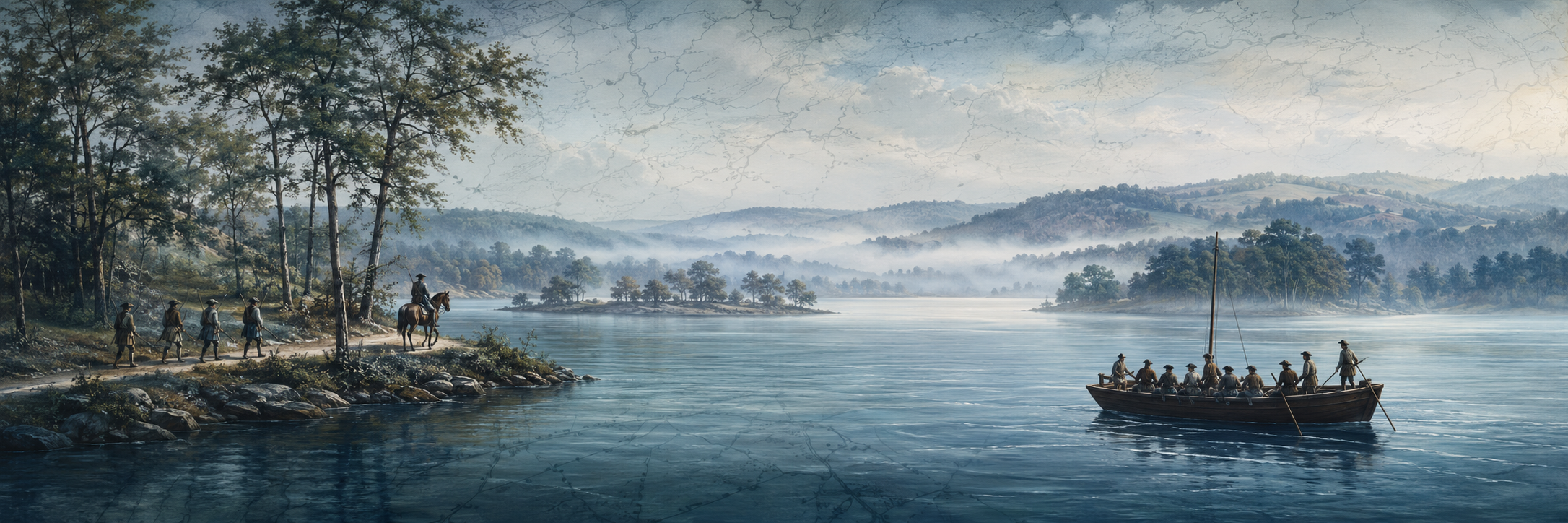


Arctic • Exploration • Archaeology
Research reviewed September 6, 2026 · About 52 minutes · 15 original visuals
The message had been written twice. In the center of a printed form, an officer recorded a working expedition, its position, and an exploratory party setting out across the ice. Around the edges, a later hand described a catastrophe: the ships abandoned, the commander dead, and 105 people attempting to leave the Arctic on foot.
Between those two entries lay less than a year. Beyond the second lay a much larger silence. No returning expedition member delivered the journals that the Admiralty had ordered collected. Instead, knowledge came through Inuit witnesses, searchers, scattered possessions, human remains, and eventually two ships on the seabed. Each discovery answered a question. None supplied an uninterrupted account of the final years.
Where the evidence stands: Franklin’s expedition was lost after prolonged ice entrapment, mounting deaths, and a desperate attempt to escape. Evidence supports severe deprivation and, among some survivors, cannibalism. The wrecks of HMS Erebus and HMS Terror have been identified. The precise sequence of later movements, the causes of individual deaths, and the relative importance of different illnesses remain incomplete. DNA research announced in 2026 has resolved additional identities without resolving every part of the disaster.
This investigation follows the evidence through those different questions. The aim is to understand how a well-equipped naval venture became a struggle for survival, why accounts of that struggle were resisted, and what the latest discoveries actually change. The original illustrations are interpretations, while the charts distinguish recorded quantities from deductions. The sources let readers examine the argument for themselves.
Explore the investigation
- A passage that looked almost within reach
- Preparations behind the public departure
- What the orders required—and allowed
- Steam power did not remove the ice problem
- The scientific work—and the instruments that disappointed
- Crozier's loneliness and the danger of reading backward
- Beechey Island and the first firm interruption
- The two voices on the Victory Point record
- What 129, 24, and 105 can tell us
- Leaving the ships did not end the transport problem
- John Rae's information came through people
- Why Charles Dickens resisted the conclusion
- Ahlangyah's remembered encounter
- Hall's notebook and the second boat
- The boat McClintock examined
- Was the boat returning to the ships?
- Jane Franklin and the question of achievement
- Human remains and the limits of a disturbing conclusion
- Why lead became such a persuasive explanation
- Looking inside the bone instead of averaging it
- Illness was probably plural
- Finding the ships changed the questions
- What the 2026 DNA identifications resolve
- The people who make the investigation possible
- Weighing the explanations
- What would make the next discovery decisive?
- Sources and further investigation
1. A passage that looked almost within reach
The Admiralty’s instructions opened with confidence. Much of a northern sea route between the Atlantic and Pacific had already been explored, and the remaining geographical problem seemed limited enough to justify another attempt. Franklin was to command Erebus, with Francis Crozier and Terror under his orders. A transport, Barretto Junior, would carry additional provisions, clothing, and stores during the outward journey. This was an organized operation with an objective, a supply arrangement, and a planned return. Admiralty instructions, May 5, 1845.
Its confidence depended on an important distinction that the ice would make painfully clear. A gap on a map can look short even when the conditions within it are poorly known. Earlier success through Lancaster Sound and Barrow Strait encouraged hopes about waters farther west. The instructions referred to previous voyages and treated their experience as a guide to what might be possible. Yet they also acknowledged that islands, banks, and fixed masses of ice could frustrate the preferred direction. The remaining distance was a navigational problem, a seasonal problem, and a problem of incomplete information.
The ships departed Greenhithe in Kent on May 19, 1845. Their destination was what is now the Canadian Arctic, including waters around King William Island in Nunavut. They were setting out into a region already inhabited and understood by Inuit communities, though British charts and institutions framed the voyage as discovery. The difference matters throughout this story: a place could be unknown to the Admiralty while remaining part of other people’s lived geography. Royal Museums Greenwich, expedition overview.
The orders even imagined success in concrete terms. After reaching Bering Strait, the ships were to proceed to the Sandwich Islands, now Hawaiʻi, to refit and refresh their crews. Dispatches might travel through Panama; the vessels would return by Cape Horn. Those instructions make the voyage’s intended scale visible. The goal was a completed passage and a navigable connection, followed by a report to London, rather than merely reaching a high latitude or planting a flag at a predetermined point.
Reading the optimistic opening beside the later abandonment message creates an understandable temptation to call the entire enterprise deluded from its beginning. The documents support a more demanding inquiry. What did the planners know, what choices did they leave open, and which assumptions would fail under conditions they could not continuously observe from home? Those questions allow responsibility and circumstance to be examined without pretending that the outcome was already known in May 1845.

2. Preparations behind the public departure
Before the ships sailed, Franklin was reading, consulting, and arranging. In a letter to Jane Franklin dated December 31, 1844, he described discussing earlier Arctic voyages with William Edward Parry. He had been reading Parry’s Melville Island narrative and the work of Ferdinand von Wrangel. A newspaper report about who might receive the command also entered his letter. Appointment, preparation, professional relationships, and public expectation were already intertwined. Franklin to Jane Franklin, December 31, 1844.
An April 2 letter brings the operation down to the practical level of victualling offices and unfinished work. Franklin had visited Woolwich and Deptford with Crozier and the purser to arrange the movement of provisions. Rigging could advance while shipwrights continued their work, and engineers were being reminded of their promises. The letter does not describe a perfectly synchronized machine. It describes the ordinary difficulty of preparing complex vessels while several kinds of work competed for space and time. Franklin to Jane Franklin, April 2, 1845.
Franklin also reported recovering from influenza and a cough. That detail gives the correspondence a human scale, but it cannot responsibly become a diagnosis of his death more than two years later. No continuous medical record connects the spring illness in London to his final condition in the Arctic. A biographical coincidence is a lead to examine, rather than a medical chain already established.
Lieutenant John Irving’s April 18 letter to his sister-in-law Katie is especially revealing about expectations. He described completed masts and rigging, stores being packed, and talk of sailing on May 1, though he suspected a delay. He anticipated a long interruption in correspondence. Two years might pass; perhaps three. His warning that the family should not give up if no news arrived shows that silence was built into the voyage’s anticipated experience. Irving to Katie, April 18, 1845.
Irving combined awareness of danger with confidence in the preparations. He remembered earlier Arctic losses and damage to Terror, while expressing faith in the measures taken for health and comfort. He explicitly resisted the idea that he was writing under a premonition of disaster. That qualification deserves to remain attached to his anxious words. Later readers know what happened and can turn almost any farewell into prophecy. Irving was considering real risks while expecting that he might return.
The letters also explain why the absence of an early distress message was not itself extraordinary. Families and officials expected intervals beyond the reach of ordinary communication. That expectation would complicate the transition from waiting for an expedition to searching for a lost one. The men had not promised to write from every winter harbor, and the Admiralty had no modern means of checking whether a quiet ship was safe, immobilized, or already in danger.

3. What the orders required—and allowed
The preferred approach led through Davis Strait and Baffin Bay to Lancaster Sound, then westward through Barrow Strait toward the longitude of Cape Walker. From there, Franklin was to make every practicable effort southwestward toward Bering Strait. The wording pressed for progress and discouraged delays examining side openings along the initial westward track. It was a purposeful route recommendation, based on the planners’ interpretation of earlier ice conditions. Admiralty instructions, paragraphs 2–7.
It was also conditional. Ice changed from year to year, the orders acknowledged, and Franklin would have to choose his course from his own observations. If apparently permanent ice blocked the preferred direction, he was to consider an alternative channel between Devon and Cornwallis Islands, taking account of the season and the time already spent. The document did not abolish judgment at the moment when judgment became most necessary.
The provisions concerning winter were similarly important. A sheltered harbor should be sought when continued navigation became unsafe. The health of the crews, the condition of the ships, and the surrounding circumstances were all relevant. The commander was expressly left a choice between wintering in an advanced position and returning to England to report and refit. The Admiralty wanted him to weigh the benefit of starting farther west the next season against the costs of another Arctic winter.
These clauses prevent a simple explanation in which Franklin was mechanically obeying an order that permitted no retreat. They do not establish that every later choice was wise. To evaluate an actual decision, however, we would need its date, the available routes, the observed ice, the remaining supplies, and the condition of the people making it. The orders tell us the authorized decision framework. The surviving record does not tell us everything discussed within it.
The two ships were supposed to remain together except where accident or unavoidable necessity forced separation. Franklin was directed to share his intentions with Crozier and maintain frank communication. Scientific observations were also to be exchanged, partly to increase the chance that the results would survive. Redundancy was therefore present in the planning: two vessels, shared information, and arrangements for succession and transfer if a ship became disabled.
That redundancy had limits. Two vessels caught in the same ice could share the same hazard. Two copies of observations could still be lost if neither vessel returned. Cooperation improved the available options without guaranteeing an escape from a regional problem affecting both ships. The later disaster should be examined partly as a failure of those available options under prolonged pressure, rather than as the mysterious disappearance of a single unconnected vessel.
The contrast with the Mary Celeste investigation is useful. There, an abandoned but floating ship generated questions about a rapid decision to leave. Franklin’s record places abandonment after many months of immobilization and deaths. The common word describes very different decision environments.
4. Steam power did not remove the ice problem
The Admiralty had fitted each vessel with a small steam engine and propeller. The intended use was carefully limited: pushing through channels between masses of ice when the wind was unfavorable or absent. Fuel was necessarily restricted, so the engines were to be reserved for difficulty. The instructions do not describe a pair of modern icebreakers capable of forcing a passage through any obstruction. Admiralty instructions, paragraph 4.
That distinction changes how the technology should be judged. Auxiliary power could solve a particular maneuvering problem while leaving the larger geographical and seasonal problem intact. An open lane might permit useful movement; a region of consolidated ice might offer no lane to exploit. The existence of an engine cannot tell us whether it was useful on a particular day, how much fuel remained, or whether movement would have led to safer water.
Loading created another set of tradeoffs. Writing from the Whalefish Islands on July 9, Crozier described the tedious work of clearing the transport and fitting its stores into limited space. He reported a mean draft of sixteen feet before all provisions had been brought aboard. He was sending home heavy equipment, including anchors and cables, and prioritizing food. A large cutter was also being returned, while a launch would hold patent fuel. Crozier to James Clark Ross, July 9, 1845.
These are significant choices, but they require their original context. Returning some equipment to make room for provisions does not show that the ships had no anchors, no boats, or no contingency supplies. It shows Crozier balancing competing loads. A ship could carry only so much, and every item claimed space that another useful item might have occupied. The question was which mixture offered the best prospects for the journey expected ahead.
Crozier’s irritation with the engine and engineer also survives in the same letter. It is evidence of his frustration and assessment at that moment. It is not a technical inspection certificate proving that the propulsion system was unusable throughout the expedition. Personal correspondence can be candid precisely because it is uneven: a difficult day, a disliked colleague, or a persistent inconvenience may receive more attention than systems functioning without incident.
The surviving documents therefore show both technological ambition and practical friction. They do not provide a complete engineering failure report. A later investigator must resist supplying one simply because a modern audience expects every disaster to have a single defective component. The ships were working systems in which fuel, cargo, weather, crew labor, and navigable water affected one another. Prolonged entrapment could undermine the whole arrangement even if no one component failed dramatically.
5. The scientific work—and the instruments that disappointed
The expedition’s purpose extended beyond a navigable passage. The orders gave substantial attention to terrestrial magnetism, including variation, dip, and intensity. Observations were to be made aboard both ships when conditions permitted, with accompanying measurements of air and sea temperature. A portable observatory was supplied for a possible winter. Depths, currents, tides, natural history specimens, and drawings also belonged to the work. Admiralty instructions, paragraphs 12–20.
This scientific program helps explain both the equipment carried and the value placed on records. The officers were supposed to contribute observations that could be compared with a wider network. They were also told to account for the influence of the ships’ iron on measurements. The planners understood that an instrument reading required interpretation and correction; a number written in a notebook was not automatically an accurate description of the external world.
Fitzjames’s July 11 letter to Edward Sabine reveals how difficult that ideal could become. He complained about an instrument whose graduations and condition undermined his confidence in its readings. He continued making observations, but doubted their value and resented the loss of useful working time. His letter is unusually direct about the difference between complying with a scientific task and believing that the available equipment could produce reliable results. Fitzjames to Sabine, July 11, 1845.
He also described attempts to improve the work. A different instrument impressed him, although a lost notebook forced him to repeat observations. Differences among needles prompted repeated trials and a suspicion that the supplied magnets were inadequate. He tried stronger magnets from another instrument and compared the results. Crozier assisted with observations as well. These passages show measurement, troubleshooting, and collaboration, rather than an expedition simply trusting every piece of new equipment.
Crozier’s account of the Atlantic passage complements the complaint. Heavy seas made oscillating instruments difficult to settle. He considered some equipment much more satisfactory in smooth water than in irregular motion. Such observations matter because they identify the circumstances under which confidence changed. They should not be inflated into proof that all navigation was unreliable or that an erroneous magnetic reading directly caused the later ice entrapment. That larger causal claim would require evidence connecting a particular measurement to a particular course decision.
The missing journals are especially consequential here. They could have contained working observations, corrections, positions, and descriptions of changing conditions. Their absence deprives us of much more than dramatic last words. It removes the ordinary records through which an expedition made sense of its surroundings. A future authenticated journal could transform the investigation through mundane daily entries, even if it contained no confession, final revelation, or single explanation of the disaster.
6. Crozier’s loneliness and the danger of reading backward
Crozier’s July letter to Ross is one of the most emotionally exposed documents in the surviving correspondence. He missed a trusted companion, felt isolated, and worried about the lateness of the season. He feared that the ships might have too little opportunity to inspect conditions before entering the ice. Those concerns deserve attention because they were written before the known catastrophe. Crozier to Ross, July 9, 1845.
Yet the same letter complicates a story of open hostility between commanders. Crozier described Franklin as kind and willing to have him dine aboard Erebus frequently. His complaint was that he lacked someone with whom he felt personally at ease. An invitation to dinner and the experience of loneliness can coexist. Their coexistence should not be flattened into either perfect harmony or a proven command breakdown.
He also recognized ability around him. Harry Goodsir’s enthusiasm for natural history impressed him, including his skill at drawing specimens and drawing others into the work. Irving appeared diligent and capable of the chart work Crozier needed. The letter contains irritation, admiration, technical observations, personal affection, and anxiety. Selecting only its darkest lines would misrepresent the document’s range.
Fitzjames, writing two days later, ended his own frustrated technical letter with an upbeat description of Franklin and the expedition’s prospects. The two accounts need not cancel each other. They were written by different people to different recipients for different purposes. One man could feel lonely while another felt energetic; both could complain about instruments and still expect eventual success. Their correspondence gives us a small working community with varied experiences, rather than a single collective mood.
No surviving letter from July 1845 can diagnose the mental condition of all survivors in April 1848. Nor can it establish that a particular later decision arose from depression, resentment, pride, or fear. Such explanations may feel psychologically complete, but the intervening years are precisely where the documentation becomes thin. A private expression of discouragement is not a substitute for the missing deliberations of a later crisis.
The most useful conclusion is therefore limited and concrete. Crozier understood the risks of delay, recognized logistical constraints, and felt the absence of a trusted professional friend. Fitzjames was engaged in the scientific work and voiced confidence despite equipment problems. Those facts enrich the people in the story. They do not authorize an invented conversation aboard an icebound ship or a scene in which one man’s personality is made to explain every death.
7. Beechey Island and the first firm interruption
The final Arctic complement was 129 people after men returned from the outward voyage. The expedition wintered at Beechey Island in 1845–1846, and three crew members were buried there: John Torrington, John Hartnell, and William Braine. Those deaths occurred well before the abandonment recorded in 1848. They are part of the expedition’s loss, even though the later retreat often dominates the narrative. Swanston, Varney, and colleagues, 2018.
The graves establish individuals, a place, and a period of occupation. They do not establish that every later death had the same cause. The men buried at Beechey died during the first winter, while others survived substantially longer and experienced a different sequence of conditions. Their remains would later become central to medical investigations precisely because the preservation and timing offered evidence unavailable at many other sites.
The expedition’s own surviving message contains an error about this winter. Its May 1847 entry says the ships wintered at Beechey in 1846–1847. The correct interval is 1845–1846. McClintock recognized the problem when discussing the record after its recovery. The error should be retained as an error when examining the document, rather than silently corrected in a purported verbatim reproduction or treated as proof that the entire message is fraudulent. McClintock’s account of the record.
A genuine record can contain a mistaken year. That is an ordinary feature of human writing, although its presence in a famous mystery can invite extraordinary interpretations. The appropriate response is to compare the chronology, identify the discrepancy, and ask whether it affects the specific conclusion being drawn. Here it does not erase the record’s value as evidence of the later abandonment, command succession, and reported losses.
Traces of the Beechey winter camp were found in 1850. The discoveries showed that searchers were recovering an expedition’s past rather than receiving its current position. A grave could establish where someone had died without indicating where the living had gone afterward. That difference between a trace and an up-to-date message would recur across the search. Royal Museums Greenwich.
The contrast with the Lost Colony of Roanoke is instructive. A recovered sign or object can narrow a disappearance without providing the next destination. At Beechey, the evidence is more specific about named deaths, yet it still leaves the expedition’s subsequent movements to be reconstructed from other records and places.
8. The two voices on the Victory Point record
The surviving message is often treated as a single final note. It is more revealing when read as two records written at different stages of the expedition. The first entry is dated May 28, 1847. It describes the ships’ winter position, earlier movements through Wellington Channel and around Cornwallis Island, and a party of two officers and six men that had left the ships on May 24. Graham Gore and Charles Des Voeux signed it. Franklin was still commanding. Victory Point record, reproduced by the Canadian Museum of History.
The familiar assurance that all was well belongs to that entry. It should be read as a status formula in a brief report, not as a statement that nobody had died or that a comprehensive medical examination had found every sailor healthy. The three Beechey graves already existed. A short message can summarize a functioning expedition while leaving much of its recent experience unstated.
The second entry, dated April 25, 1848, was written around the margins. It reports that the ships had been deserted on April 22, five leagues north-northwest of the record’s location. They had been beset since September 12, 1846. Franklin had died on June 11, 1847. Total deaths had reached nine officers and fifteen men. The survivors numbered 105 and were now under Crozier’s command. Fitzjames and Crozier signed the update.
Those facts are severe enough without embellishment. Franklin’s death followed the first entry by only two weeks. The document does not give his cause of death. Nor does it tell us when each of the other twenty-three people died, which diseases occurred, how rations changed, or what discussions preceded abandonment. It supplies a small set of exceptionally important anchors within a much larger missing record.
The paper also records its own movement. It had been found by Lieutenant Irving in a cairn about four miles to the north and relocated to the position associated with a pillar of James Clark Ross. Gore is referred to as deceased in the later account. This deposition history matters because a document’s discovery place is not necessarily the place where every entry was first written. The message had already been handled and moved by the expedition before nineteenth-century searchers recovered it. McClintock’s explanation of the record.
At the end, Crozier recorded an intention to start the following day, April 26, for Back’s Fish River. That is the last firm written plan in this central document. It describes a decision made by survivors at a particular moment. It does not show that all 105 subsequently traveled together, that every person reached the same place, or that nobody returned toward the vessels.
The printed form itself had been intended for messages associated with discovery voyages and currents. A request in several languages asked a finder to forward the paper to the Admiralty. The expedition repurposed this means of communication into a record left on land. A small, portable form carried news that the much larger system of ships, officers, and journals could no longer deliver in person.


9. What 129, 24, and 105 can tell us
The arithmetic is straightforward when the correct complement is used: 129 people in the final Arctic expedition, twenty-four recorded deaths by April 1848, and 105 survivors. Roughly 18.6 percent of that complement had died by the time of the marginal update. This is a measure of reported loss by a date. It is not a mortality rate for a specific disease, a measure of starvation alone, or the proportion who died during the retreat. Victory Point record; Swanston and colleagues.
The record’s division into nine officers and fifteen men raises further questions. A count by rank cannot, on its own, show whether officers were more vulnerable than other crew members, because a comparison of rates requires the relevant starting numbers and a consistent classification. Even a demonstrated difference would still leave its cause to be investigated. Age, duties, illness, diet, exposure, and chance would be separate possibilities, not automatic answers.
McClintock’s published discussion illustrates why even important early interpreters require checking. His excerpt uses an erroneous original complement of 138 and consequently creates an apparent discrepancy between calculated and reported survivors. That problem belongs to his arithmetic and starting figure; it should not be used to invent nine secretly missing men in the expedition’s own account. The authentic record and a later explanation of it are different sources. McClintock, The Voyage of the Fox.
The twenty-four deaths also undermine any account in which the catastrophe began only when the men stepped away from the ships. A substantial loss had already occurred. Conversely, the existence of 105 survivors means the situation had not become uniformly fatal before abandonment. Some people remained capable of organizing a movement, carrying equipment, and attempting a route to assistance. Their strength and health would not necessarily have been equal.
The numbers therefore define the scale of the crisis while leaving its distribution unresolved. A group described as survivors can include people who are healthy enough to haul, people who can walk but cannot carry much, and people who require help. The record does not give those categories. Any modern reconstruction that assigns a precise walking speed or daily distance to all 105 must introduce assumptions beyond what the note actually records.

10. Leaving the ships did not end the transport problem
Abandoning an icebound vessel changes the form of a survival problem rather than making it disappear. A ship concentrates shelter, supplies, fuel, tools, and medical space. A traveling party can escape the place where the vessel is trapped, but it must carry enough of those functions to remain alive. The expedition’s later boat and sledge remains show how difficult that conversion could be. McClintock’s boat observations.
A boat had an obvious potential purpose in a region where ice could become water and where the announced destination included a river. It could carry supplies, support crossings, or provide shelter. On land or unbroken ice, however, that same boat became a load. The men had to plan for more than one kind of surface, and the equipment useful on one could be costly on another. A photograph of a boat on a sledge does not by itself demonstrate that the choice to carry it was irrational.
The timing problem was equally difficult. Surface conditions could change within a day as well as through a season. Inuit testimony later described travel when the sun was low because the ice was firmer, and waiting when a crossing became too dangerous. Such evidence shows why a route drawn as a clean line on a modern map can conceal the practical work of moving through it. Ahlangyah’s account.
The written destination, Back’s Fish River, should therefore remain a statement of intended direction. It does not authorize a single uninterrupted itinerary for every survivor. Groups could have separated, paused, changed plans, or attempted a return for supplies. Those are possibilities to test against specific finds and testimony. They should not be assembled into a seamless narrative merely because a seamless narrative is easier to read.
In the Carroll A. Deering case, missing boats are central because the people who left the ship were never found. Franklin offers a different evidentiary problem: boats and human remains were found, but their relationships to one another and to the original plan still require reconstruction. More evidence can narrow a mystery while also revealing that its sequence was more complicated than first assumed.

11. John Rae’s information came through people
In April 1854, John Rae was traveling in the Arctic when he received information about white men who had died far to the west. His September 1 report from York Factory explains how the account developed through encounters and further questioning. It was a field investigation dependent on other people’s knowledge, rather than a discovery of a written confession or an intact final camp. Rae’s 1854 report.
The account described roughly forty white men moving south along the west side of King William’s Land, dragging a boat and sledges. They appeared thin and short of provisions. Communication with the Inuit observers had been through signs, from which the observers understood that the ship or ships had been crushed and that the men hoped to find animals to hunt. A seal, or part of one, had been purchased. Rae related these details as information obtained from others.
Later reports concerned bodies and graves near the mainland and an island in the region of the Back River. Some bodies were said to have been in tents, others beneath a boat used as shelter, and others scattered. The described condition of remains and contents of kettles led Rae to conclude that some survivors had resorted to cannibalism. Reports of shots, birds, and fresh bird remains helped him infer that some men had lived into the season when wildfowl arrived.
His report contains a qualification that is often lost in retelling: the Inuit with whom he communicated had not themselves seen the living party or the bodies in question. They had obtained their information from people who had. Rae did not claim that he had personally examined the remains. This is a documented chain of reported information, and its links must remain visible.
Rae also acquired physical objects, including silver with recognizable markings and a plate bearing Franklin’s name. Such objects supplied a connection to the missing expedition that a vague story about strangers would have lacked. They strengthened the identification of the people under discussion. They did not independently confirm every date, body count, gesture, or medical interpretation within the report.
Dates deserve particular care. Rae rendered one reported encounter as occurring four winters earlier, in the spring of 1850. That conversion belongs to the transmitted account. It should not be imposed on every later description of survivors or treated as a complete expedition chronology. Different witnesses could have seen different groups at different times, and the process of recalling and translating dates added another layer of uncertainty.
The information was nevertheless a major advance. It placed the disaster in a region, connected named expedition objects with reports of distressed travelers, and described an ending that could be investigated further. Its limitations are reasons to examine the chain carefully. They are not reasons to dismiss Inuit knowledge as a category, any more than an error in a British officer’s arithmetic would justify discarding all written naval records.
12. Why Charles Dickens resisted the conclusion
Charles Dickens entered the public argument in Household Words in December 1854. His response is sometimes summarized as a personal attack on Rae, but the first installment was more complicated. Dickens praised Rae’s ability, courage, conscientious reporting, and decision to bring the information home. He acknowledged that the Admiralty, rather than Rae personally, had made the report public. He then attacked the credibility of the conclusion about cannibalism. Dickens, December 2, 1854.
The distinction makes the argument more revealing. Dickens could admire the British investigator while discounting the people whose knowledge made the investigation possible. He treated the character of selected English sailors as a powerful reason to reject the reported behavior, and expressed sweeping racist assumptions about Inuit trustworthiness. National reputation and a hierarchy of whose testimony deserved belief became substitutes for evidence about the particular remains.
Some of his questions concerned real evidentiary issues. Information had passed through more than one person. Interpretation across languages could alter meaning. Animal damage could affect bodies. A gesture might admit more than one explanation. Those are legitimate categories of inquiry. Their value depends on applying them to the actual circumstances, however, rather than declaring in advance that the witnesses must be unreliable and the admired sailors incapable of the reported conduct.
Dickens also suggested the possibility that Inuit had killed the men. The fact that he could imagine such a scenario did not establish evidence for it. Rae’s report had explicitly found no reason to suspect violence by Inuit. An alternative explanation becomes persuasive by accounting for the available evidence more successfully, not merely by allowing a preferred moral image of the missing men to remain intact.
Rae replied in the same periodical. In the continuation published December 30, he emphasized repeated questioning and consistency among informants. He challenged the relevance of comparisons with other starvation cases and maintained that the men had died through deprivation rather than Inuit murder. His defense of Inuit family care and reliability directly confronted the hostile generalizations. Rae’s published response, December 30, 1854.
Rae’s own language also included racial hierarchies and broad character judgments. A careful reading should not turn him into a flawless modern observer in order to recognize the strength of his position on this dispute. His practical experience and evidence gathering can be credited while his assumptions are examined. The standard should remain the quality of a particular observation or argument, applied consistently to every participant.
The controversy matters because it influenced how the disaster could be publicly remembered. A report about desperate behavior became a dispute about national character. Later physical evidence would address some of the disputed behavior more directly. It could not undo the years in which the people carrying essential knowledge were treated as less credible because of who they were.
13. Ahlangyah’s remembered encounter
Among the most important later accounts is that of Ahlangyah, recorded during Frederick Schwatka’s expedition of 1878–1880 and published in 1882. She recalled an encounter near Washington Bay with ten white men dragging a boat on a sledge. Unlike the secondhand information in Rae’s particular 1854 report, this was presented as her memory of people she had personally seen. It was also a memory recorded decades after the event. Both facts belong in the description. Ahlangyah’s account in The Search for Franklin.
Her account began with geography and a practical obstacle: a broad fissure in the ice separated the parties. Five of the white men put up a tent, while five remained with the boat. The Inuit party camped nearby. Over five days, Inuit hunters killed seals and supplied food to the strangers. Ahlangyah’s husband received a chopping knife. The episode describes interaction, assistance, and exchange, rather than a landscape devoid of anyone able to help.
It also describes limits that aid could not simply remove. The parties eventually moved because the deteriorating ice threatened their ability to cross toward the Adelaide Peninsula. They traveled when the sun was low and the surface was firmer. The white men’s heavy boat and sledge slowed them. The Inuit waited at Gladman Point, but the ice prevented their own intended crossing as well. According to the account, they did not see the white men again.
Ahlangyah recalled that the men lacked fur clothing, that some were very thin, and that their mouths appeared dry and dark. These observations are evidence of remembered physical condition. They do not supply a laboratory diagnosis. Several forms of illness and deprivation can produce distressing appearances, and the words reached publication through an interview and an editor. A particular modern disease cannot be securely assigned from this description alone.
Names or name-like sounds were also remembered. The published account acknowledged that some resembled common Inuit names. Later writers have tried to identify officers from them and from descriptions of size and beard color. Such suggestions may help formulate questions, but they should not be treated as identifications equivalent to a personal document or a well-supported genetic match.
The account becomes especially instructive when it turns to a later visit near Terror Bay. Ahlangyah reported bodies in and around a tent, along with possessions. She explicitly could not establish that these were the same people she had met. The narrative that follows attempted to connect the groups and reconstruct their movements. That connection belongs to the subsequent interpretation; it should not be put back into her mouth as something she witnessed.
Her testimony therefore contributes both a vivid episode and a lesson in reading source boundaries. It preserves a remembered encounter, Inuit decisions about food and travel, and an honest limit on identifying later remains. The most respectful use of it is to retain those distinctions rather than treating the witness as a convenient narrator of everything the surviving European documents fail to explain.

14. Hall’s notebook and the second boat
Charles Francis Hall’s notes preserve another strand of Inuit evidence. On May 14, 1869, he recorded information from Innookpoozhejook about a boat near the one associated with McClintock’s earlier discoveries. The brief entry concerns a different boat, its approximate relationship to the shore and the earlier find, and reported human remains and food preparation. Hall’s notebook, Smithsonian collection.
The notebook is valuable partly because it is compact and specific. It is not a polished history claiming to explain the whole expedition. Hall recorded an estimate of distance through the speaker’s indications, and noted that the boats were within reach of the sea. Such details offer questions for archaeological comparison: which site is meant, how close are the relevant places, and what might water have moved or disturbed?
The report of boiled human flesh is also specific in its evidentiary position. It describes what Innookpoozhejook said he found. It does not describe him watching people kill someone or consume a body. Changing an observation of remains into an eyewitness account of the act would materially alter the evidence.
Even a firsthand observer’s account reaches us through layers here: the original encounter with a place, later recollection, communication with Hall, the abbreviated notebook entry, and modern transcription. Those layers do not make the information worthless. They identify where a proposed interpretation can be tested and where caution is needed. The same care applies to a British searcher’s memory and published reconstruction.
Several boats also create a danger for modern storytelling. Objects or people associated with one site can migrate into the account of another, especially when both are called simply “the boat place.” A responsible reconstruction should keep the site, observer, date of observation, and reported objects together. Otherwise apparently corroborating details may be products of a writer merging distinct discoveries.

15. The boat McClintock examined
On May 30, 1859, McClintock’s party camped beside a large boat that Lieutenant William Hobson had already found and examined. McClintock described the search through clothing, the clearing of the boat, and the removal of surrounding snow in the hope of finding a record. No journal or memorandum explaining its final use emerged from that examination. The object itself therefore had to carry much of the evidentiary burden. McClintock, boat account.
He measured it at twenty-eight feet long and seven feet three inches wide. He considered it built for lightness and shallow draft, with modifications that reduced weight. The upper planking had been changed, and the equipment included a weather cloth supported by iron stanchions. Paddles took the place of the missing oars and rudder. Canvas and a small block led him to infer that the boat had carried a sail. His description distinguishes measurements and observed fittings from deductions about how it had been used.
The boat contained portions of two human skeletons. Their condition was disturbed, and McClintock considered animal action a likely explanation for some of that disturbance. He also recorded clothing, footwear, watches, firearms, books, and other possessions. These observations preserve a difficult human scene without giving us the names of everyone who had used the boat, the order in which people died, or the full history of the site’s disturbance.
The books included devotional works and The Vicar of Wakefield. An inscription with initials prompted a tentative association with Gore. The question mark belongs with that association. A book could have been gifted, borrowed, carried for someone else, or left after its owner died. Its presence should not automatically identify the nearest remains.
The same problem applies to the more frequently ridiculed possessions. Watches, boots, soap, a brush, and combs can be made to illustrate supposed aristocratic foolishness. Yet the inventory does not tell us who selected each item, when it entered the boat, or whether it remained useful for navigation, repair, exchange, warmth, hygiene, or personal comfort. Some choices may indeed have been costly. The evidence needed to establish that judgment is more demanding than an object sounding unnecessary to a modern reader.
McClintock found a little tea and nearly forty pounds of chocolate, but no biscuit or meat in the boat. This was the food remaining when searchers examined it years later, after use, abandonment, weather, animals, and possible visits. It was not a complete ration inventory at the moment the party first left the ships. Nor does the remaining chocolate establish that the men enjoyed an adequate diet simply because one recognizable food survived.
His account makes the boat an unusually rich archaeological clue. Dimensions, alterations, fittings, contents, orientation, and human remains can all constrain an interpretation. They also show how much remains unknown when an object survives without the people who could explain its changing purpose. The proper question is what sequence best accounts for this particular assemblage, rather than what moral judgment can be attached to the most surprising item in it.

16. Was the boat returning to the ships?
One observation particularly surprised McClintock: the boat’s sledge pointed northeast. He interpreted that orientation as evidence that a party had been returning toward the ships. He proposed that the people had underestimated the difficulty of travel, exhausted their supplies, and sent a group back for more, leaving two men with the boat. It was an attempt to account for the direction, remaining provisions, and human remains together. McClintock’s reconstruction.
His language makes clear that this was a reconstruction. He did not witness the boat moving, receive an explanation from a survivor, or find a note announcing a return. A direction of rest is useful evidence, but it is not a continuous track. The boat could have been positioned during unloading, sheltering, repairs, a local maneuver, or a journey whose final destination was not recorded. Any proposed sequence must account for the orientation without assigning it more precision than it carries.
McClintock’s theory was also shaped by a reasonable logistical question: why would useful provisions and possessions remain unless someone expected to retrieve them? An intended return could answer that question. Other forms of interruption could also leave equipment behind. Incapacity, worsening conditions, a separation, or a death could prevent the completion of a plan. The fact that an object remained does not reveal which interruption occurred.
The wider importance of the theory is that it challenged a simple one-way march. Even an early investigator looking at the physical evidence considered movement back toward the vessels plausible. Modern discussions of reoccupation should therefore begin with a history of competing interpretations, not with the assumption that the April 1848 note settled every later movement.
The record allows us to say that the ships were deserted on the reported date and that survivors intended to head toward the river. It leaves room for subsequent changes. Whether a particular group returned, when it did so, and whether people later moved either ship require additional evidence. The wrecks make those questions more concrete, but their discovery does not retrospectively turn McClintock’s suggested sequence into a witnessed account.
17. Jane Franklin and the question of achievement
By March 1860, Jane Franklin was writing to Prime Minister Lord Palmerston about how her husband should be officially remembered. She thanked him for a tribute but wanted a more explicit recognition of Franklin as discoverer of the Northwest Passage. Her concern was that parliamentary language and a monument would become standards by which future generations measured his achievement. Jane Franklin to Palmerston, March 8, 1860.
The letter distinguished several meanings of success. A person might identify a geographical connection, travel through a region partly by ship and partly on foot, or complete a continuous sea passage. Jane argued that the evidence brought back by McClintock established the priority of her husband’s expedition over the achievement for which Robert McClure had received recognition. If uncertainty remained, she wanted a committee to examine the matter.
Her letter is strong evidence of an effort to secure historical credit. It is not, by itself, independent proof of every geographical claim she advanced. The distinction is especially important because memorial language often compresses complicated achievements into a phrase that sounds conclusive. Discovering a connection, demonstrating its navigability, and surviving a complete transit are related but different accomplishments.
The correspondence also shows grief expressed through institutions. Jane was concerned with testimony, parliamentary decisions, a proposed monument, and the permanence of official words. Her advocacy should not be reduced to a passive figure waiting at home. At the same time, her commitment to a particular interpretation gives readers a reason to distinguish the evidence she cited from the recognition she wanted it to produce.
This dispute belongs in an investigation of the expedition because public memory influenced what questions were asked and which answers were welcomed. A national story could emphasize sacrifice and achievement while finding desperate survival behavior difficult to acknowledge. The same disaster could be framed as heroic completion, tragic failure, or a scientific and human puzzle. Those frames affect presentation; they cannot replace the underlying records.
For readers following the broader History Under Investigation series, Jane’s letter offers a useful comparison with the retrospective legends surrounding Theodosia Burr. The people left behind and the stories later told about the missing are part of the history, even when they cannot supply the final events themselves.
18. Human remains and the limits of a disturbing conclusion
The nineteenth-century reports of cannibalism were eventually joined by physical evidence. Research on expedition remains identified cut marks consistent with processing human bodies. A later study by Simon Mays and Owen Beattie reexamined at least thirty-five bones and described fractures and polished edges tentatively interpreted as evidence of breaking and heating bones to obtain marrow. The authors distinguished that more specific interpretation from the broader evidence of cutting. Mays and Beattie, 2016, abstract and publication record.
The conclusion is disturbing, but it should remain precise. Postmortem processing establishes something done to a body after death. It does not automatically establish that the person was killed to be eaten. Nor does it identify who performed the processing, whether every survivor participated, or how many separate episodes occurred. Those additional claims require their own evidence.
In 2024, DNA and genealogical research identified remains of James Fitzjames. His mandible bore cut marks consistent with cannibalism after death. The finding placed a named senior officer within the physical evidence of desperate survival behavior. It did not establish his cause of death or identify the people who handled his remains. University of Waterloo, September 24, 2024.
The result also sharpens the historical argument with Dickens. Character and rank did not provide the evidentiary immunity that his reasoning assumed. Yet the correction should not become a reverse caricature in which the expedition is reduced to a horror scene. The same record contains work, illness, assistance, travel, failed plans, and people attempting to preserve life under increasingly desperate conditions.
It is possible to acknowledge cannibalism without inventing a murder mystery. Rae’s account, Hall’s notes, and the skeletal studies address different aspects of the evidence and at different levels of directness. Their convergence supports a conclusion about some survivors’ behavior. It does not license an elaborate final banquet, named perpetrators, or a sequence of killings unsupported by the sources.
The respectful way to investigate these remains is also the more accurate one: keep individuals distinct, preserve uncertainty about their deaths, and avoid images that turn their suffering into spectacle. In this article, the visuals concentrate on the environment, documents, transport, and methods of investigation. The evidence is serious enough to be understood without a fabricated scene of the dead.
19. Why lead became such a persuasive explanation
Lead offered an apparently coherent explanation for a complicated disaster. It had been found in expedition remains, lead-bearing materials were present in nineteenth-century shipboard life, and poisoning could seem to connect physical decline with poor judgment. Tinned provisions became especially prominent in popular accounts. A defective supply, a measurable substance, and a devastating outcome could be arranged into a story with a clear culprit. Swanston, Varney, and colleagues, 2018.
The scientific problem is that those elements do not automatically establish the proposed chain. Detecting lead in bone establishes exposure and incorporation into tissue. It does not, by itself, identify the source, date the exposure to the expedition, establish the concentration in blood at a critical moment, or prove that the exposure caused a particular person’s death. Each step adds a question that needs additional evidence.
Bone is especially difficult to treat as a simple record of one recent event. It can retain material acquired over a long period. The relevant comparison is therefore not merely between an expedition sample and a modern person with a different history of exposure. It also involves people from a reasonably comparable historical setting. If other Royal Navy personnel of the period carried substantial lead burdens, an elevated value in a Franklin sailor would require more careful interpretation.
The possibility of changes after burial introduces another problem. Material can enter or alter archaeological remains through environmental processes. The condition of a sample, its burial context, and the distribution of an element within its structure all matter. A number detached from that context can sound decisive while remaining ambiguous about when and how the substance arrived.
These difficulties do not make lead harmless or irrelevant. They change what would be needed to show that it played a pivotal role in this expedition’s failure. A strong explanation would ideally connect timing, dose, biological effects, and the particular sequence of illness or decisions. The absence of the surgeons’ full records makes that connection harder, while the variety of surviving tissues creates opportunities to test parts of it.
The investigation therefore moved from the dramatic question “Was there lead?” toward a more discriminating set of questions. Was exposure unusually high for the period? Did it increase during the voyage? Did people who survived longer show the expected additional uptake? Could older and newly formed tissue distinguish prior exposure from the expedition years? Those questions can weaken an attractive explanation even when the initial chemical finding remains entirely real.
20. Looking inside the bone instead of averaging it
The 2018 study by Treena Swanston, Tamara Varney, and colleagues examined the distribution of lead within skeletal microstructure using high-resolution confocal X-ray fluorescence imaging. Its importance lay partly in where it looked. Rather than treating a bone fragment only as a bulk concentration, the researchers examined how lead related to structures formed and remodeled at different times. Full open-access study.
The bone sample set comprised fourteen samples representing thirteen individuals, including expedition material from Beechey Island and King William Island and comparative material from a Royal Navy cemetery in Antigua. The study also examined two dental samples from King William Island. Those categories should not be collapsed into fourteen Franklin sailors or treated as a census of the expedition. The investigation necessarily worked with a small, unevenly preserved portion of the available remains.
The first test asked whether people who survived longer showed more extensive lead uptake than those who died during the first winter. If sustained exposure aboard the expedition had driven a large progressive increase, a difference might be expected. The observed patterns from the two expedition settings did not support that prediction in the simple form proposed.
The second test considered recently formed bone and dental structures. Lead was present in some features formed near death, supporting continued exposure. But a marked late increase was not consistently evident across the material. Some samples were more suggestive than others. The result was therefore more nuanced than either “no lead during the voyage” or “a uniform fatal surge in everyone.”
The third test compared the expedition material with the Antigua naval samples. Similar patterns and overlapping evidence of exposure weakened the claim that the Franklin sailors had experienced uniquely high lead burdens for their time and occupational setting. The researchers concluded that their results did not support lead playing a pivotal role in the expedition’s loss.
Their technical limitations are part of that conclusion. The imaging produced relative distributions rather than precise absolute concentrations. Color scales in different images were not interchangeable measures of dose. Preservation, cracks, the amount of available tissue, and the difficulty of identifying some newly forming structures affected interpretation. The study made a significant advance by asking better-timed questions, while remaining explicit about what the method could not measure.
The finding is a useful example of how an investigation can progress without replacing one total explanation with another. Lead exposure remained real. The case for making it the central cause became weaker. A responsible account can accept both statements and continue examining deprivation, disease, exposure, accidents, and the effects of prolonged entrapment.

21. Illness was probably plural
Franklin’s missing medical records create a strong temptation to diagnose the expedition from the most striking surviving specimen. Comparative research offers another approach. Keith Millar and colleagues examined 1,480 illness cases from the sick books of naval search crews operating between 1848 and 1854. Their work considered respiratory and gastrointestinal illness, injury, exposure, scurvy, and other possible causes of death. These were records of the search expeditions, not recovered patient histories from Franklin’s ships. Millar and colleagues, Polar Record, 2016.
The comparison can identify plausible problems in similar working conditions. It cannot establish that a particular lost sailor had the same illness as a particular searcher. The distinction protects the usefulness of the study: historical comparison informs a range of possibilities without pretending to replace the absent clinical record.
A separate investigation of John Hartnell’s nail tissue explored the timing of metal exposure and nutritional condition. Jennie Christensen and colleagues proposed that severe zinc deficiency and malnutrition were important, and questioned a simple explanation based on newly acquired lead poisoning. The institutional report described methods intended to distinguish tissue signals from environmental contamination. Its conclusions concerned evidence from an individual whose remains were available for study. University of Saskatchewan, December 6, 2016.
The broader proposal has to be evaluated at that scale. A useful sequence from one person’s nail can challenge assumptions and generate new questions. It does not establish a diagnosis for all 129 people, especially those who lived much longer under different conditions. Later discussion has also questioned how securely one nail can support a general nutritional explanation. Swanston and colleagues, discussion of competing medical hypotheses.
Scurvy illustrates another difficulty. A lack of clear skeletal evidence cannot automatically exclude illness, because some diagnostic changes depend on survival and healing. Conversely, the plausibility of a disease in polar travel cannot establish its severity at a particular date. The physiological problem and the archaeological visibility of that problem are different questions.
The most defensible model is therefore a combination of pressures whose effects varied by person and time. Immobilization limited options. Illness or injury could reduce a person’s ability to work. Reduced working strength could make transport and food acquisition harder. Deprivation could further impair health. This is an investigative synthesis of the documented circumstances, not a calculated model assigning a known percentage of deaths to each cause. The evidence does not support a complete cause-of-death table.
22. Finding the ships changed the questions
The discovery of Erebus in 2014 made a major part of the mystery physically accessible. Parks Canada’s account describes land finds associated with the expedition immediately before sonar located the wreck on September 2. A davit fitting and a hawse plug helped redirect attention; archaeological interpretation and a revised search brought results. Identification involved matching the remains with historical knowledge of the vessels. Parks Canada, finding Erebus.
The sequence matters because it joins objects, local knowledge, professional interpretation, and survey technology. A sonar image is not an autonomous discovery detached from decisions about where to look. Nor is an artifact’s significance always obvious before someone recognizes its relation to a ship. The result emerged from connecting kinds of evidence that had often been narrated separately.
Terror was located in 2016 after the research vessel Martin Bergmann diverted into Terror Bay following information from Sammy Kogvik. He recalled wood protruding through ice years earlier; other local accounts also concerned a ship in the bay. The September 3 sonar discovery was followed by government notification and archaeological confirmation on September 18. Historical plans and features of the wreck supported its identity. Parks Canada, finding Terror.
Parks Canada’s description also corrects a popular embellishment: Terror was not left at anchor. Some hatches were closed and others open. Its preserved condition invites investigation of how it reached that place and what happened before it sank. It does not, by itself, establish a fully crewed final voyage or a known date of reoccupation.
The discovery of a ship answers its identity and resting-place questions. Reconstructing movement requires additional relationships: the last recorded position, possible drift, evidence of damage, the condition of equipment, and signs of human activity. A closed hatch is an observation. Deciding who closed it, when, and why involves a sequence that must be supported rather than assumed.
The comparison with Kryptos may seem distant, but the underlying distinction is useful. Recovering one missing piece can solve a bounded question while leaving the method or sequence unresolved. Finding both vessels profoundly changed Franklin research. It did not produce the lost journals or make every later event visible at once.

23. What the 2026 DNA identifications resolve
In May 2026, researchers announced four additional DNA identifications: William Orren, David Young, and John Bridgens from Erebus, and Harry Peglar from Terror. The first three were associated with Erebus Bay; Peglar’s remains were found about 130 kilometers away. Together with John Gregory’s identification in 2021 and Fitzjames’s in 2024, these brought the DNA-identified total to six. That total excludes identities known through other historical evidence, including the named Beechey graves. University of Waterloo, May 6, 2026.
Peglar’s case addressed a long-standing conflict between personal papers and clothing found with a body. The 2026 paper linked the sampled remains to his maternal family through DNA and documented genealogy. A paternal comparison was inconclusive; a tooth was excluded because of possible contamination, and a hair sample yielded no usable DNA. The researchers’ conclusion rested on the successful evidence, with those limitations explicitly reported. Stenton, Fratpietro, Gorsalitz, and Park, Polar Record, 2026.
An identity can be firmly resolved while other questions remain open. Knowing whose remains were sampled does not establish the person’s final conversation, the reason for wearing particular clothing, or every movement before death. The associated papers still have to be interpreted as documents, rather than becoming a complete narrative because their carrier can now be named.
The new findings also demonstrate why “solved” needs an object. Whose remains are these? Where did this individual die or leave remains? What caused the death? Who traveled with the person? Each question demands different evidence. A strong answer to the first can materially improve the investigation without automatically answering the others.

24. The people who make the investigation possible
The role of Inuit knowledge extends beyond supplying a clue at the moment a European or southern researcher arrives. Historical searches depended on interpretation, travel, clothing, food, and practical judgment. Ipirvik and Taqulittuq, also known in older records as Ebierbing and Tookoolito, are recognized for contributions that included hunting, dogsled travel, making Arctic clothing, and interpreting. Their work helped sustain expeditions as well as communicate information. Parks Canada, national historic persons designation.
Those activities belong within the history of knowledge production. A notebook entry could be written because someone made the journey possible, understood the language, and helped the recorder ask a question. Naming only the person holding the pen can conceal the labor and expertise that brought the evidence into the archive.
Present-day work also depends on local stewardship. The Inuit Guardians program for the wrecks began in 2017. Community members from Gjoa Haven work from seasonal camps near the sites, protecting and monitoring them and, when possible, working with underwater archaeologists. The program incorporates Inuit knowledge into site operations. Parks Canada, Inuit Guardians.
The current research program should be described with its changes intact. Parks Canada’s account of the 2024 season reports fifty dives over thirteen days at Erebus and explains that 2025 brought a transition toward monitoring and a jointly developed research strategy. It also describes conservation and the return of selected artifacts for display at the Nattilik Heritage Centre. These are continuing forms of investigation and care, even when active excavation is not proceeding in the same way as before. Parks Canada, exploration and next steps.
Preserving an object and recording its context can be more valuable than recovering it quickly. A damaged association may never be reconstructed; a carefully conserved fragment may support future work with methods unavailable today. The investigation is therefore measured partly by what remains available for the next question, not simply by how many objects reach the surface in a season.
25. Weighing the explanations
Prolonged ice entrapment is part of the documented sequence. It restricted movement and preceded the abandonment message. Severe deprivation is supported by descriptions of distressed survivors, the circumstances of the attempted escape, and the physical evidence of desperate subsistence. Illness and exposure are credible parts of that sequence, although the record does not assign their contributions person by person. Together these facts support a disaster unfolding through interacting pressures over time.
A single overwhelming lead-poisoning explanation is less secure than its popularity suggests. Chemical exposure is established; a pivotal role for lead across the expedition is not. A claim that every officer or sailor became irrational from the same cause would exceed the medical evidence and ignore the differing times and places at which people died.
An account of a straightforward southward march by all 105 survivors also asks more of the record than it supplies. The April note establishes intention. Boats, bodies, oral accounts, and wreck locations must determine the subsequent sequence. Return journeys or later use of ships remain questions for evidence, rather than facts that can be established by the note’s silence alone.
Claims of an Inuit massacre have no affirmative basis in the records examined here. They appeared in an argument shaped by prejudice and resistance to the reported behavior of British sailors. The evidence of assistance and the lack of a demonstrated attack cannot be displaced by the observation that a murder scenario is imaginable.
Nor does the mystery require a supernatural cause. The sources already describe a severe environment, finite resources, illness, losses, and difficult choices. Uncertainty about the final movements is an uncertainty about history’s surviving record, not positive evidence that ordinary physical causes ceased to operate.
The strongest conclusion is therefore neither complete ignorance nor a fully solved sequence. The expedition was lost, the two ships are identified, major stages are documented, and some individual identities have been resolved. The remaining questions concern the detailed interaction of events and the separate endings of particular people. That is a substantial, active investigation, even when it refuses to compress 129 lives into one dramatic answer.

26. What would make the next discovery decisive?
An authenticated journal or medical record could be transformative if its provenance, date, and authorship could be established. Its value would lie in the sequence it supplied: changing health, provisions, weather, movements, or decisions. A spectacular phrase would matter less than a reliable series of entries connecting known events. The Admiralty’s original instructions show how many kinds of records the expedition was expected to keep and return.
Additional identifications can also change the map of the human story. A name attached to securely documented remains can test assumptions about which ship’s personnel reached a place, while the archaeological context can help distinguish burial, movement, and later disturbance. The result becomes strongest when independent evidence agrees without being forced into a preferred narrative.
For a claim about reoccupation or movement of a vessel, a dated human trace would be especially valuable. An object merely present aboard a ship could have been loaded in Britain. Evidence showing that it was used, altered, or deposited after a known event would answer a more specific question. The difference is chronological, not merely a matter of how visually impressive the find appears.
Readers can use the same principle when assessing a new headline. Identify the exact question answered, the material examined, the date of the work, and the alternative interpretations considered. Ask whether the evidence is a direct observation, a translated recollection, an archaeological association, a laboratory result, or an inference from several of them. The best discoveries become more interesting when their actual reach is understood.
Franklin’s story remains compelling because the missing record is gradually acquiring names, places, and constraints. The people who carried knowledge across generations, the families who preserved relationships, and the researchers who test specific claims all contribute to that change. Their work makes it possible to recognize both what happened and what remains beyond a defensible reconstruction.
Continue with the Flannan Isles investigation for a smaller disappearance in which a probable accident can be supported without reconstructing every final action. For the relationship between an inventor’s disappearance, a passenger ship, and later murder theories, see Rudolf Diesel and the Dresden. The broader Lake Norman Brief article library connects this series with the site’s regional history.
Sources and further investigation
The linked sources throughout the article are the basis for its factual claims. The following guide groups the most useful starting points by the question they address.
- Planning and command: the Admiralty’s 1845 instructions, Crozier’s July 9 letter, Fitzjames’s July 11 letter, and Irving’s April farewell. These are historical texts presented in modern transcriptions; a transcription’s publication date is not the date of the original letter.
- The expedition’s own surviving chronology: the Victory Point record and McClintock’s discussion and boat observations. The mistaken Beechey winter year and McClintock’s separate complement error are identified in the article rather than silently adopted.
- Inuit testimony and its recording: Rae’s report, Ahlangyah’s account, and Hall’s Innookpoozhejook notes. Direct encounter, secondhand information, and a recorder’s later reconstruction are kept distinct.
- Public controversy and remembrance: Dickens’s first installment, Rae’s published response, and Jane Franklin’s 1860 letter. These establish arguments made at the time, not independent confirmation of every claim within those arguments.
- Lead and illness: Swanston and colleagues’ full 2018 study, Millar and colleagues’ comparative study, and the Hartnell nail research report. The extended explanation of microstructural findings draws on Swanston and colleagues’ openly licensed CC BY paper with attribution. No clinical histories have been invented from comparison data.
- Human remains and identity: Mays and Beattie’s abstract, the Fitzjames announcement, the 2026 identification announcement, and the Peglar paper. The separate 2026 paper on three Erebus identifications was not available in full for this review; those findings are attributed to the institutional announcement. No figures from the Peglar paper are reproduced.
- Wrecks and stewardship: Parks Canada’s accounts of Erebus, Terror, the 2024 season and subsequent direction, and Inuit Guardians.
Research reviewed September 6, 2026. Illustrations are original interpretive artwork and are labeled accordingly. Timelines distinguish events from later reports; counts refer to their stated populations; the hypothesis comparison presents qualitative judgments without invented probabilities.
Leave a Reply