
 USS Hornet (CV-12) in Measure 33, Design 3A, near Okinawa, 27 March 1945. U.S. Navy photo 80-G-K-14466, National Archives; public domain.
The Art of World War II · Section 6 of 8
Painted Steel
Art on tanks, jeeps, ships, submarines and PT boats: the names crews chalked on their machines, the dazzle patterns scientists and painters designed for whole fleets, the battle flags sewn at sea, and the doodle that went everywhere first: “Kilroy was here.”
Every machine of the Second World War left the factory dressed in the same few colours: olive drab, khaki, field gray, haze gray, navy blue. It rarely stayed that way. Tank crews chalked or painted a name on the hull before their first battle. Truck drivers lettered a girlfriend’s name across a hood. Landing-craft crews gave nicknames to boats the navy knew only by number. Submariners sewed homemade battle flags with a little Japanese flag for every ship they claimed. Meanwhile, in Washington and Leamington Spa, artists and physicists covered entire fleets in jagged, carefully engineered patterns meant to fool a submarine commander’s eye.
This section collects 150 freely licensed images of that painted steel, from the named tanks of 1944 to the dazzle-painted carriers of the Pacific, along with the history behind each one. It sits within the site’s World War II collection and the companion pages on aircraft nose art and insignia and jacket art.
Why soldiers and sailors painted their machines
A tank, a jeep or a landing craft was home as well as weapon. Five men might live, eat and sleep in a Sherman for months, and naming it was the first act of ownership. Names came from wives and sweethearts, hometowns and states, songs, cartoon characters, boasts and jokes. Many American and British units kept a simple order by giving every vehicle in a company or squadron a name starting with the same letter. The 4th Armored Division’s Cobra King, the Sherman of C Company, 37th Tank Battalion, that led the relief of Bastogne on 26 December 1944, is the best-known example. Its battalion commander, Lieutenant Colonel Creighton Abrams, called each of his own tanks Thunderbolt. Names were also memorials: when a crewman was killed, a new name often went on the hull in his honour.
Paint also carried a public message. In 1918 British towns raised money in “tank bank” weeks with the promise that a tank would bear the town’s name. In the Second World War the Soviet Union turned the idea into a mass movement. Collective farms, factories, Komsomol branches, churches and individuals paid for tanks and aircraft that went into battle carrying their donors’ names or slogans: “Za Rodinu” (For the Motherland), “Moskovsky Kolkhoznik”, “Dimitry Donskoy”. In March 1944, near Tula, the Russian Orthodox Church handed over a column of 19 T-34-85s and 21 OT-34 flamethrower tanks funded by believers’ donations. The widow Mariya Oktyabrskaya bought a T-34 with her savings, named it Fighting Girlfriend and drove it herself until she was killed.
Each £250,000 raised names a tank ‘Newcastle.’ — War Weapons Week poster, Newcastle, July 1918 (Imperial War Museum PST 10176)
The French 2nd Armored Division painted names on a great many of its vehicles, often battles and places, and it brought those names into Paris in August 1944. Its Spanish Republican company, La Nueve, rode half-tracks called Guadalajara, Teruel, Ebro, Madrid, Guernica and Don Quichotte, and the half-track Ebro fired the first shots at the Hôtel de Ville on the night of 24 August. These names carried a politics of their own: French officers refused one crew’s request to name a half-track after the anarchist Buenaventura Durruti.

Crowds line the Champs-Élysées on 26 August 1944 as tanks and half-tracks of General Leclerc’s 2nd Armored Division pass the Arc de Triomphe in the victory parade after the liberation of Paris. The photograph was taken by Jack Downey of the U.S. Office of War Information.
The 2e DB was a patchwork army: Free French veterans of Chad and Libya, colonial troops, escapees from occupied France and Spanish Republican exiles, equipped with American Shermans, half-tracks and jeeps. Many of its vehicles carried painted names. The Spaniards of La Nueve chose the battles of their own lost civil war, Guadalajara, Teruel, Ebro, Brunete, Madrid, and it was their column, with tanks of the 501e Régiment de chars de combat, that reached the Hôtel de Ville first on the evening of 24 August.
On parade day those names rolled past enormous crowds of Parisians. For the Spaniards they promised that the fight against fascism would continue across the Pyrenees, a promise that went unkept. Painted steel rarely made a plainer political statement.
Feature · Paris, 26 August 1944
The names that liberated Paris
Crowds line the Champs-Élysées on 26 August 1944 as tanks and half-tracks of General Leclerc’s 2nd Armored Division pass the Arc de Triomphe in the victory parade after the liberation of Paris. The photograph was taken by Jack Downey of the U.S. Office of War Information.
The 2e DB was a patchwork army: Free French veterans of Chad and Libya, colonial troops, escapees from occupied France and Spanish Republican exiles, equipped with American Shermans, half-tracks and jeeps. Many of its vehicles carried painted names. The Spaniards of La Nueve chose the battles of their own lost civil war, Guadalajara, Teruel, Ebro, Brunete, Madrid, and it was their column, with tanks of the 501e Régiment de chars de combat, that reached the Hôtel de Ville first on the evening of 24 August.
On parade day those names rolled past enormous crowds of Parisians. For the Spaniards they promised that the fight against fascism would continue across the Pyrenees, a promise that went unkept. Painted steel rarely made a plainer political statement.
Gallery: Tanks and armored vehicles
Very few wartime photographs of individually named tanks are freely licensed, so this gallery combines official photographs, the work of Canadian war artists who painted armour from life, posters that made the tank a public symbol, and modern photographs of surviving and restored vehicles, each labelled as such. Click any image to open the full story.

On 20 September 1944, during Operation Market Garden, Cromwell tanks of the Guards Armoured Division push up the single raised road to Nijmegen that the paratroopers called “Hell’s Highway.” British armour wore a dense layer of official paint — the divisional sign (for the Guards, the “Ever-Open Eye”), a coloured arm-of-service square with a unit number, a bridge-classification disc and the vehicle’s census number. On top of that official layer, many regiments named their tanks, often by squadron initial so that every name in A Squadron began with an A. The habit survives in British and Commonwealth armour today.

A Type 95 Ha-Go light tank rolls off Imperial Japanese Navy landing ship No. 149 on 27 February 1944. The Ha-Go was Japan’s most numerous tank and fought from Manchuria to the Pacific islands. Japanese armour normally wore a mottled earth-and-green camouflage, and crews or units often added emblems, kanji names or patriotic slogans. The home front also paid for weapons directly: civilian “Aikoku” (Patriotism) donation drives bought aircraft that flew with the donors’ names painted on their sides — the Japanese counterpart of the British tank banks and the Soviet donation columns elsewhere on this page.

A Japanese tank lies where it was knocked out on Peleliu, the coral island where the 1st Marine Division and the Army’s 81st Infantry Division fought from September to November 1944. On the afternoon of D-Day, 15 September, the Japanese garrison sent its light tanks across the airfield against the Marine beachhead; they were destroyed within minutes by Marine Shermans, bazookas and anti-tank guns. Wrecks like this one are the last physical evidence of Peleliu’s armour. Whatever paint and markings they once carried have long since weathered away — a reminder that the art on armour was always the most perishable part of the machine. Photographed in 2012.

Charles Comfort (1900–1994), the senior Canadian war artist in Italy, painted Canadian Shermans grinding through the rubble of Ortona, the Adriatic town the 1st Canadian Division took in a week of house-to-house fighting at Christmas 1943 — a battle correspondents called “Little Stalingrad.” Canada’s war artists worked from sketches made close to the fighting and finished larger canvases later, aiming for accuracy as well as atmosphere; their paintings now form one of the best records of what Commonwealth armour actually looked like in the field. The canvas is in the Canadian War Museum’s Beaverbrook Collection of War Art.

Bruno Bobak (1923–2012) became the youngest of Canada’s official war artists in 1944, when he was about 21, and followed Canadian armour from Normandy through the Low Countries into Germany. His convoy captures what most of a tank crew’s war really was: long road marches at close interval, engines, dust and waiting. Every vehicle in such a column carried its formation sign, unit serial and tactical number — the painted grammar that told military police, gunners and pilots who was who — and many also carried a name chosen by the men who lived in it.

Alex Colville (1920–2013), later one of Canada’s most celebrated painters, served as an official war artist in 1944–46. Here he turns to the unglamorous side of armoured warfare: the workshops where engineers rebuilt damaged tanks and returned them to the line. A repaired tank often came back in fresh paint with new markings, and a crew that inherited it would usually rechristen it — one reason the same hull could carry several names in a single campaign. Colville’s cool, carefully ordered composition already hints at the precise style of his postwar work.

Lawren P. Harris (1910–1994), son of the Group of Seven painter Lawren S. Harris, was the war artist attached to the 5th Canadian Armoured Division in Italy. His own title for this canvas reads like a war-diary entry: German planes, Canadian artillery and anti-aircraft tracers over the Shermans of the 5th Canadian Armoured Brigade advancing north of Pignataro on the night of 20–21 May 1944, just before the assault on the Hitler Line in the Liri valley. Harris used the night sky and the arcs of tracer as an almost abstract pattern above the dark shapes of the tanks.

A restored 1942 M3 half-track rolls through the Freedom Festival parade in Provo, Utah, on 4 July 2018. Restorers work from wartime photographs and from AR 850-5, the Army’s August 1942 marking regulation, to reproduce the white star, the bumper codes that identified unit and vehicle, and the registration number on the hood. Many add a name in period style, because wartime half-tracks were named as freely as tanks: the Spanish volunteers of La Nueve, for example, entered Paris in half-tracks called Guadalajara, Teruel, Ebro and Madrid. This is a modern photograph of a restored vehicle.

A museum diorama at the Arquebus War History Museum near Haugesund, Norway, recreates the Soviet assault on Berlin in April–May 1945 with T-34-85 tanks among the ruins. On the real tanks, white slogans such as “Za Rodinu” (For the Motherland) and “Na Berlin!” (To Berlin!) were common, along with names of fallen comrades, heroes of Russian history and the towns or collective farms that had paid for the vehicle. In the last weeks, white turret bands and roof crosses were added so that Western Allied pilots would not attack them. This is a modern reconstruction, not a wartime photograph.

The donated, named war machine began here. In the First World War’s “tank bank” campaigns, real tanks with names such as Julian and Egbert toured British towns as bond-selling booths, and towns competed to out-subscribe each other. This poster for Newcastle’s War Weapons Week of 8–13 July 1918 makes the bargain explicit: every £250,000 in war bonds would name a tank “Newcastle.” The idea returned in the Second World War as Britain’s Warship Weeks and Wings for Victory weeks, as Soviet donation columns, and as American bond drives that named bombers, ships and jeeps.

F. H. K. Henrion (1914–1990), a German-born designer who settled in Britain in the 1930s, made this poster for a 1941 Ministry of Information exhibition about tanks. The Crusader cruiser tank climbs toward the viewer under a heavy sky, rendered with the clean geometry Henrion would later bring to corporate identity design. Exhibitions like this one put tanks in front of the civilians who paid for and built them, turning the tank itself into a piece of public art — the same impulse that led crews to decorate the machines they lived in.

Terence Cuneo (1907–1996), later famous for his railway paintings and for hiding a tiny mouse in almost every picture, produced dramatic battle scenes for the Ministry of Information during the war. His tank battle is pure propaganda spectacle — smoke, flame and steel at full gallop — and it shows how artists at home imagined the armoured war. The paintings in this file of the UK National Archives (INF 3) were the originals from which wartime posters and publications were printed.

Part of the Ministry of Information’s “Unity of Strength” series, this design lines up tanks against a rising sun under a red, white and blue rainbow — the colours of Britain, the United States and France all at once. Posters like this treated armour as a symbol of collective will rather than a weapon, a far cry from the scrawled names and girlfriends’ portraits the crews themselves painted on their tanks.

Roland Davies, a British illustrator best known for transport and aviation art, drew British tanks surging across the desert for an information poster that boasted they had “hurled Italy out of Abyssinia” and wrecked Axis plans in Libya. Italian East Africa fell to British and Commonwealth forces in 1941, and the Western Desert campaign swung back and forth through 1942. The poster is a claim, not a record — armour played only a small part in Ethiopia — but it shows how quickly the tank became shorthand for British fighting power.

Harold Pym’s poster borrows its title from “Land of Hope and Glory” (“God, who made thee mighty, make thee mightier yet”) to announce that Britain’s mechanized army was growing stronger every day. After the losses of France in 1940, when most of the British Army’s tanks were left behind at Dunkirk, rebuilding the armoured force was a matter of national morale as much as military need — and posters like this one turned production figures into confidence.

Fougasse — the pen name of Cyril Kenneth Bird (1887–1965), the Punch cartoonist behind the “Careless Talk Costs Lives” series — used his spare, witty line to ask Britons for scrap metal. The salvage drives that tore out park railings and collected saucepans were sold on a simple promise: your old iron becomes a tank. That sense of personal ownership is one reason towns, factories and schools later wanted their names painted on the machines they had helped to pay for.

“Rush tanks immediately. A message from North Africa. Let’s make those tracks — faster.” Posters like this hung inside American war plants after the first U.S. battles in Tunisia, where American armour suffered painful losses at Kasserine Pass in February 1943. They were part of a vast incentive campaign of company and government posters aimed at absenteeism and lost hours. The tanks those workers built would reach the front stencilled with factory serials and Army registration numbers — and would soon acquire names, slogans and tallies added by their crews.

An Allied information poster salutes the Yugoslav resistance with a single image: a red hand held up against an advancing tank, photographed from below. Partisan forces tied down large German and Italian forces in the Balkans and captured enemy armour, which they repainted with red stars and their own slogans. The poster turns that defiance into a traffic signal — the occupier’s war machine brought to a halt by a raised hand.

Stevan Dohanos (1907–1994), later one of the Saturday Evening Post’s best-loved cover artists, painted a grinning GI counting off “tanks, planes, guns, ships” for a 1942 government production poster. The message to factory workers was that output itself was a letter from home. The tanks counted on those fingers would eventually reach men who stencilled the names of wives, mothers and hometowns on them — the soldiers’ side of the same conversation.
Rules, regulations and what commanders tolerated
Armies did not leave paint to chance. The U.S. Army’s marking regulation, AR 850-5 of August 1942, prescribed the white five-pointed star as the national symbol, the four-part bumper code identifying a vehicle’s unit, branch, company and position in the order of march, and the registration number on the hood. British vehicles carried formation signs, arm-of-service squares and bridge-classification discs. On the official layer, crews added their own, and armour was the most tolerated case: names were generally accepted on armoured fighting vehicles as a form of tactical sign, provided they did not obscure the official markings. In February 1945 American rules added that caricatures, cartoons, coats of arms and symbolic figures were not authorised, a rule observed unevenly at best.
The Red Army went further and regulated inscriptions as a matter of policy. Orders of 1943 on the Leningrad Front directed that heavy and medium tanks in frontline units be given names honouring Russian commanders such as Suvorov and Alexander Nevsky, or distinguished Soviet tankers, and a tank’s name could appear in its commander’s award citation. Navies were stricter still about hulls. The U.S. Navy shrank or painted out hull numbers in wartime, and the Bureau of Ships, not the captain, decided what pattern a ship wore. Inside those limits sailors decorated gun shields, bridge wings and gun tubs with tallies of aircraft shot down and ships sunk. Medical vehicles and hospital ships were the exception to every rule of concealment: by international convention they had to be seen.
Help send our men 20,000 Jeeps by December 7th. — Schools-at-War Jeep campaign poster, U.S. Treasury, 1943
Gallery: Jeeps, trucks and landing craft
Behind every tank stood dozens of trucks, jeeps, ambulances and landing craft. Their crews painted names and jokes on them as freely as tankers did, though such decoration was rarely photographed for the official record. This gallery follows the vehicles that carried the war: Royal Navy landing craft from Torch to Walcheren, presentation trucks paid for by British towns, ambulances under the red cross, and the American schoolchildren who “bought” jeeps with war stamps. For more on amphibious operations see the site’s pages on the invasion of Sicily and on special units.

At a port in southern England in June 1944, jeeps are driven onto tank landing craft while trucks and DUKWs load into the big LSTs behind them, among them USS LST-314. Every vehicle bound for Normandy was waterproofed for wading, carried the white Allied star (often ringed with a circle for the invasion) and was marked with loading numbers so that it would come ashore in the right order. Jeep drivers added their own touches — names on the hood or windshield frame, a sweetheart’s name, a hometown — tolerated by most officers as long as the official markings stayed legible.

“Skipper and crew of L.C.T. 726,” reads the caption on this portrait taken at Subic Bay, Luzon, on 12 March 1946. Tank landing craft like LCT 726 had crews of roughly a dozen men under a junior officer and were known officially only by number; crews filled the gap with nicknames, painted mascots and slogans on the wheelhouse. This print, from the family of the craft’s commander, James Owen Farley, shows the intimacy of small-craft service, where the crew was the ship’s company.

Landing craft were numbered, not named — which is exactly why crews named them anyway. This Landing Craft Support (Medium), LCS 202, carried the unofficial name Margaret II, probably honouring a wife or sweetheart. Manned by Royal Marines of Force T in South West Holland in 1944–45, these little gunboats joined night patrols against the German midget submarines and explosive motorboats that raided the Scheldt approaches to Antwerp from the German-held island of Schouwen.

During Operation Torch in November 1942, American troops carrying boxes of supplies wade ashore at Arzeu, near Oran, from a Royal Navy Landing Craft Assault, LCA 26. The big white hull number was the craft’s most important marking: beachmasters and control vessels directed the waves of boats by number, and a craft that strayed could be identified at a glance. Torch was the first large Anglo-American amphibious operation, and many of the techniques later used in Sicily and Normandy were tested here.

An elderly refugee is helped down the gangway of the Landing Craft Infantry LCI 316 at Barletta on Italy’s Adriatic coast. Landing craft spent far more of their war ferrying people — reinforcements, wounded, prisoners and civilians — than storming beaches. Their bows and wheelhouses carried pennant numbers in large white figures, and many landing-craft crews, British and American, painted tallies of the operations they had survived on the wheelhouse.

A Landing Craft Gun (Medium) — almost certainly LCG(M) 101 — sinks after being hit by shore batteries during the Royal Marine Commando landing at Westkapelle on Walcheren, 1 November 1944. One of her 17-pounder gun turrets is visible. The craft of the Support Squadron Eastern Flank deliberately drew the fire of the German coastal guns to protect the commandos, and the squadron lost most of its vessels that morning. The landing opened the Scheldt and, with it, the port of Antwerp.

Royal Marine Commandos drive an American-built Alligator (LVT) down the ramp of a beached tank landing craft at Westkapelle, Walcheren, with men in a tracked Weasel waiting to follow. British amphibious vehicles carried the same arm-of-service and formation signs as other army vehicles, plus a white star for air recognition. Crews of Alligators and Buffaloes, like tank crews, often christened their machines with chalked or painted names.

LCT 4037, first of the new LCT(8) class, goes down the ways at Sir William Arrol & Co.’s Kelliebank yard at Alloa in Scotland, launched by Commander Earl Beatty. Built for the long distances of the war against Japan, the LCT(8)s were big enough to earn real names after the war — 4037 became HMS Rampart. The launch itself was a small ceremony of the kind that gave even numbered craft a moment of identity before the painters reduced them to a hull number.

Landing craft crowd the quays at Southampton in June 1944, waiting for the invasion of Normandy. Thousands of craft took part in Operation Neptune, the naval side of D-Day, and nearly all were identified only by type and number — LCT, LCI, LCA — painted large so that loading officers, control vessels and beachmasters could find them. Behind the official numbers, crews added nicknames, pin-ups and slogans on wheelhouses and ramps, though few survive in photographs.

LCT 921 awaits repair at Thornycroft’s yard in Southampton after a torpedo almost blew her in half during the Normandy landings. Tank landing craft were simple, slab-sided steel boxes, cheap enough to be built in their hundreds by bridge-builders and structural engineering firms as well as shipyards. That a craft so badly damaged could limp home says something about their crews — the men who painted names and good-luck charms on boats the Navy regarded as expendable.

Men of the 6th Battalion, the Green Howards, ride an assault landing craft during Exercise Fabius on 5 May 1944, one of the full-scale rehearsals for D-Day. A month later the battalion landed on Gold Beach, where Company Sergeant Major Stanley Hollis won the only Victoria Cross awarded for actions on 6 June. The faces here are the human cargo that gave landing craft their purpose; the chalked numbers and names on helmets and craft were the only individuality the system allowed them.

Royal Marines from the cruiser HMS Kenya dash ashore from wooden-hulled assault craft on Cheduba Island, south of Ramree, Burma, on 26 January 1945, covered by cruisers, destroyers and Fleet Air Arm aircraft. The East Indies Fleet’s amphibious war on the Arakan coast was fought with small craft far from the publicity of Europe. Ship’s detachments of Royal Marines took pride in their parent ship, and boats were commonly marked with the ship’s name or initials.

Bren gun carriers drive through the bow doors of HMS Bachaquero at Bône, Algeria. Bachaquero was one of three shallow-draught Lake Maracaibo oil tankers converted in 1941 into Britain’s first ocean-going tank landing ships — prototypes for the American-built LSTs. More than a hundred carriers could be taken in one trip. The little tracked carriers were among the most heavily decorated British vehicles, often carrying names, regimental badges and slogans painted by their crews.

Henry Carr (1894–1970), an official British war artist in North Africa and Italy, painted infantry landing craft discharging troops onto a beach at night, the scene lit from above by parachute flares. Carr was known for portraits, and he gives the soldiers on the ramps a weight and individuality that the anonymous numbered craft lacked. The painting was acquired by the War Artists’ Advisory Committee and is now in the Imperial War Museum.

E. E. James painted the view from the open bridge of a tank landing craft, looking across the well deck toward a coastline on the horizon. LCT crews spent long, wet hours in exactly this position, and the bridge was where personal touches gathered: names chalked or painted on the wheelhouse, a pin-up taped inside, a mascot lashed to the rail. James’s quiet picture captures the waiting that preceded every landing.

Rupert Shephard (1909–1992) painted cranes at London’s Royal Albert Docks swinging small landing craft onto the backs of lorries in 1945. Many assault craft were built inland by firms with no shipbuilding history and moved by road — part of the improvised industrial effort that produced thousands of them. Shephard’s lorries carry the ordinary paint of the home-front transport fleet; the craft on their backs had yet to receive the numbers, and the nicknames, they would carry into action.

Alex Colville painted Canadian landing craft, probably from the infantry landing ship HMCS Prince David, carrying troops toward the beaches during Operation Dragoon, the invasion of southern France in August 1944. Look for the maple leaf painted on the troop-filled Landing Craft Assault in the foreground: a national badge on an otherwise anonymous boat, and one of the clearest examples of “bow art” in this collection. Another craft tows a rubber boat crowded with more men. Prince David’s craft carried French commandos in the landings.

Navy combat artist William F. Draper (1912–2003) painted an LVT, or amphibian tractor, churning ashore on Saipan in June 1944 past foxholes roofed with shelter halves and ponchos; transports lie offshore beyond the shattered trees. Marine amtrac crews named their vehicles as readily as tank crews — at Tarawa the year before, the LVT My Deloris became one of the most photographed wrecks of the war. The Navy Art Collection notes the role of African American Marines in the Saipan landings, where ammunition and depot companies came under fire on the beaches.

Dwight Shepler (1905–1974), a Navy combat artist who landed with the assault waves, painted the Coast Guard-manned LCI(L)-93 aground and holed on Omaha Beach on D-Day. Shepler’s watercolours are among the most immediate American images of 6 June 1944. The big hull number on the craft’s side is the only “art” the Navy intended it to carry; it was enough for Shepler to identify her exactly.

Shepler’s painting of the San Fabian Attack Force at the Lingayen Gulf landing on Luzon, 9 January 1945, was reproduced as a Navy poster. It shows the submarine chaser USS PC-623 serving as control vessel at White Beach, flags flying to marshal the waves of landing craft. Control vessels used flags, lights and big painted numbers to bring hundreds of boats ashore in the right place at the right minute — a choreography that depended on markings legible at a glance.

Clive Uptton (1911–2006) drew a Churchill infantry tank driving off a tank landing craft for this Ministry of Supply poster aimed at the factories that built both. The message was that the humble steel box built in a British yard led the attack. Churchills first went into action from landing craft at Dieppe in August 1942, and crews of the Churchill regiments named their tanks with particular enthusiasm — the Calgary Tanks at Dieppe used names beginning with the squadron letter.

Charles E. Turner’s poster shows amphibious “ducks” — the GMC DUKW — swimming ashore with landing craft, ships and aircraft behind, captioned as fighting vehicles “used for the first time in the Mediterranean landings.” That was the invasion of Sicily in July 1943. DUKW drivers were notorious for naming their vehicles; a duck with a girl’s name and a cartoon on the bow was a common sight from Sicily to the Rhine.

“Help send our men 20,000 Jeeps by December 7th,” this 1943 Treasury poster urged American schools, challenging each to finance one or more jeeps by selling war stamps and bonds — and to be a “triple-threat school” by paying for one of each kind. A jeep cost roughly $1,165–1,200 in stamps. Schools that met their goal received a Treasury citation, and the drives gave millions of children a personal stake in a vehicle they would never see — the same impulse that put donors’ names on British tanks and Soviet T-34s.

With rubber and new trucks reserved for the military, the Office of Defense Transportation launched the Truck Conservation Corps in 1942, asking the owners and drivers of America’s civilian trucks to pledge regular maintenance and careful driving to keep the home-front fleet running. It was one of many home-front campaigns that treated an ordinary delivery truck as a piece of war equipment — and the poster itself, with its bold lettering, is a reminder that the home front, too, wrapped its machines in the language of service.

A canteen truck “presented by the women of Morecambe and Heysham” serves tea to wounded men just arrived from the forward areas at a field dressing station in North-West Europe. Presentation vehicles — ambulances, tea cars, mobile canteens — were bought by towns, firms, clubs and overseas well-wishers and usually carried a painted inscription naming the donors. They are the wheeled cousins of the Soviet donation tanks and the 1918 tank banks: art as a public receipt.

A Royal Army Medical Corps ambulance convoy moves forward in the Western Desert on 12 June 1942, during the Gazala battles that ended with the fall of Tobruk. The red cross on a white ground was the one marking every army agreed to respect under the Geneva Conventions, and medical vehicles carried it large on sides and roofs. It was also one of the few places where painting was a matter of law rather than morale or whim.

Two soldiers receive blood transfusions inside an ambulance beside a casualty clearing station in Normandy, July 1944. The Army Blood Transfusion Service was one of the great medical advances of the war, and its vehicles were among the most carefully marked on any battlefield. Ambulance crews sometimes added names or the badges of the units that had bought their vehicles — small human touches inside a system built on standard paint.

A Mobile Bacteriological Laboratory in Egypt, photographed on 14 July 1944, analysed pathological specimens in the field. Disease caused about one in three British casualties, and specialised trucks like this one took the laboratory to the army. Its painted markings — red crosses, unit signs, the formation badge — told everyone at a glance what it was. Like other British Army trucks, such vehicles could also pick up a name chosen by their drivers.

British troops queue at the Field Cashier’s office — an army vehicle — to exchange money for French francs in Normandy in 1944. Everything in the army had a vehicle, and every vehicle had markings: formation sign, unit serial, census number. The field cashier’s office was among the most popular stops in the army, and its signboards were some of the few “shop signs” a soldier saw at the front.

Trucks wait at a pier in Rangoon in October 1940 to carry supplies up the Burma Road to Nationalist China — the “Chiang aid route,” as this Japanese press photograph calls it. Britain had closed the road for three months that summer under Japanese pressure and reopened it in October. Many of the road’s drivers and mechanics were overseas Chinese volunteers from Southeast Asia. The route’s defence brought the American Volunteer Group — the Flying Tigers — to Burma.

A Japanese woman drives a truck on the home front in September 1944, as labour shortages pulled women into jobs once reserved for men — the Japanese counterpart of Britain’s ATS drivers and America’s women war workers. In Japan, as elsewhere, vehicles and aircraft paid for by patriotic donation campaigns carried the donors’ names in painted characters — a home-front practice this photograph’s driver would have known well.

A 1941 Chevrolet Model 41/E22 general service truck of the Australian Imperial Force mounts a captured Italian Breda Model 35 20 mm anti-aircraft gun in the Second World War gallery of the Australian War Memorial in Canberra. Australians in North Africa happily turned captured Italian weapons against their former owners, and their trucks, like those of every army, picked up painted names and unit symbols along the way. A modern museum photograph of a preserved wartime vehicle, taken in 2014.
Dazzle: the science of confusing the eye
Dazzle began as a painter’s idea. In 1917, with U-boats sinking British merchant ships faster than they could be replaced, the marine artist Norman Wilkinson argued that no paint could make a ship invisible at sea but that bold, clashing shapes could make it hard to read. A submarine commander had a few seconds at the periscope to estimate a target’s course, speed and range; if the bow seemed to be the stern, or the hull seemed to point the wrong way, his torpedoes would miss. The Admiralty set up a Dazzle Section in studios at the Royal Academy in London, and artists including Edward Wadsworth supervised the painting of thousands of ships. The U.S. Navy followed in 1918 with its own camouflage section, which brought together painters and physicists including the commercial artist Everett L. Warner and Loyd A. Jones of Eastman Kodak. Whether dazzle saved ships was never proven either way.
In 1941 the U.S. Navy issued a series of numbered “Measures” in its camouflage instructions. Measure 1 put dark gray below the funnel tops and light gray above; most of the Pacific Fleet wore it at Pearl Harbor. Measure 21 (June 1942) painted every vertical surface navy blue against air observation; Measure 22 graded the hull from navy blue to haze gray. Everett Warner, rehired as a consultant in early 1942, led the revival of pattern camouflage. A March 1943 supplement introduced the dazzle systems: Measure 31 (dark), Measure 32 (medium) and Measure 33 (light), each available in dozens of numbered designs drawn by the Bureau of Ships for particular classes of ship. The Pacific Fleet adopted them in October 1943, and by the summer of 1944 carriers, battleships, cruisers, destroyers and transports were steaming to war in jagged black, gray and blue. The Atlantic Fleet, more cautious, standardised on just two designs, 3D for destroyers and escorts and 4A for escort carriers.
How to read a camouflage designation
“Measure 32, Design 6D” combines two things. The Measure sets the colour system: 31 dark (dull black with ocean or haze gray, and greens for amphibious ships near jungle coasts), 32 medium (dull black with light gray, or with ocean gray and light gray), 33 light (pale gray with haze gray and navy blue, or ocean gray). The Design is the pattern itself, a number plus a letter that generally reflected the type of ship it was first drawn for, though designs moved freely between types. Late in 1944 lower-contrast variants appeared, written 31a, 32a and 33a. Port and starboard sides were deliberately different.

This Bureau of Ships drawing, approved by Captain Logan McKee on 25 January 1944, sets out Measure 32, Design 11A for the veteran carrier USS Saratoga (CV-3), with her starboard and port sides drawn separately. She was repainted to this design during her overhaul in the summer of 1944.
Every dazzle scheme began as a drawing like this. Designers in the Bureau’s camouflage section tested patterns on models, adjusted them for the class’s silhouette, and issued elevations with each area keyed to a standard paint, such as dull black, ocean gray or light gray. Navy yards and builders transferred the shapes to the hull with chalk lines and templates, then photographed the finished ship for the Bureau’s files. That is why so many of the photographs in the galleries below carry precise designations: the record was kept as carefully as the paint was applied.
The aim was not beauty, but the results were spectacular. On a hull 888 feet long the black wedges were meant to falsify Saratoga’s length, break her distinctive single funnel and confuse her heading. The same logic, scaled down, was applied to destroyers, scaled up to battleships and shared between whole classes.
Feature · From drawing board to flight deck
Painting by numbers: the Saratoga plan
This Bureau of Ships drawing, approved by Captain Logan McKee on 25 January 1944, sets out Measure 32, Design 11A for the veteran carrier USS Saratoga (CV-3), with her starboard and port sides drawn separately. She was repainted to this design during her overhaul in the summer of 1944.
Every dazzle scheme began as a drawing like this. Designers in the Bureau’s camouflage section tested patterns on models, adjusted them for the class’s silhouette, and issued elevations with each area keyed to a standard paint, such as dull black, ocean gray or light gray. Navy yards and builders transferred the shapes to the hull with chalk lines and templates, then photographed the finished ship for the Bureau’s files. That is why so many of the photographs in the galleries below carry precise designations: the record was kept as carefully as the paint was applied.
The aim was not beauty, but the results were spectacular. On a hull 888 feet long the black wedges were meant to falsify Saratoga’s length, break her distinctive single funnel and confuse her heading. The same logic, scaled down, was applied to destroyers, scaled up to battleships and shared between whole classes.
Britain’s camouflage, and an artist on HMS Broke
The Royal Navy’s camouflage began with improvisation. In 1940 ships of the Home Fleet and the Mediterranean Fleet painted their own schemes, some of them striking, with patterns often different on each side. The naturalist and painter Peter Scott, serving in the destroyer HMS Broke, had her painted experimentally in pale blues, greens and white to blend into the North Atlantic at night. His “Western Approaches” scheme was ordered for ships in the North Atlantic in May 1941. It worked so well that several British ships, Broke among them, collided with each other. The Admiralty issued its own official disruptive designs from early 1941. Its camouflage centre at Leamington Spa found that under overcast skies a white ship could come about six miles closer than a black one before being seen. In 1944 the complex patterns gave way to the simpler Admiralty Standard schemes: a darker panel along the hull and lighter upperworks.

In James Yunge-Bateman’s 1943 painting, a young woman leans over a rooftop water tank at the Admiralty’s Directorate of Camouflage (Naval Section), her hands in the water beside a model aircraft carrier. Under an open sky, the camoufleurs watched how models painted in candidate schemes looked in real daylight, at different angles and in different weather.
British naval camouflage was worked out this way at the Directorate’s centre in Leamington Spa: by artists, scientists and a large staff of women who painted models, recorded observations and tested patterns against the sea and sky they would meet. The painting, commissioned by the War Artists’ Advisory Committee and now in the Imperial War Museum, is one of very few images of that work.
It also shows the scale of the deception. The model carrier floating in the tank stands for a warship of 20,000 tons or more, and the painted sea behind it was meant to answer one question: what would a U-boat commander or a bomber pilot see?
Feature · Camouflage as science
A carrier in a tank on a roof
In James Yunge-Bateman’s 1943 painting, a young woman leans over a rooftop water tank at the Admiralty’s Directorate of Camouflage (Naval Section), her hands in the water beside a model aircraft carrier. Under an open sky, the camoufleurs watched how models painted in candidate schemes looked in real daylight, at different angles and in different weather.
British naval camouflage was worked out this way at the Directorate’s centre in Leamington Spa: by artists, scientists and a large staff of women who painted models, recorded observations and tested patterns against the sea and sky they would meet. The painting, commissioned by the War Artists’ Advisory Committee and now in the Imperial War Museum, is one of very few images of that work.
It also shows the scale of the deception. The model carrier floating in the tank stands for a warship of 20,000 tons or more, and the painted sea behind it was meant to answer one question: what would a U-boat commander or a bomber pilot see?
By late 1944 the threat had changed. Japanese aircraft, and from October 1944 the kamikazes, attacked from above, where dazzle offered little; Everett Warner’s own September 1944 report recommended dropping some patterns, and Pacific commanders asked for lower contrast. On 1 January 1945 the Pacific Fleet ordered its ships back into Measures 12, 21 and 22, and in March a supplement to the instructions discontinued disruptive patterns except Measure 31 for landing ships. Some ships kept their patterns into the summer. A note on one name often linked with this story: the industrial designer Norman Bel Geddes is best documented in wartime for the detailed miniature fleets and battle models he built for Life magazine, which the Museum of Modern Art exhibited in 1944. The Navy’s camouflage designs came from the Bureau of Ships’ own section under Warner and his colleagues.

 The plan · Dec 1943The ship · Jan 1944
Slide to compare. Left: the Bureau of Ships drawing of Measure 32, Design 16D for battleships of the Tennessee (BB-43) class, dated 20 December 1943 and approved by Captain Henry A. Ingram, starboard side. Right: USS California (BB-44), which wore the design, in the Strait of Juan de Fuca on 25 January 1944 (patterns differed between the two sides). Drawing: U.S. Navy, National Archives 80-G-162038. Public domain. Source · Photo: U.S. Navy, National Archives 80-G-211831. Public domain. Source
Gallery: Ships in dazzle
The first of two galleries opens with the First World War origins of dazzle, clearly labelled, then moves to the Bureau of Ships plans and the carriers that wore them. Many of these photographs were taken by navy yards as ships left overhaul, or by Navy blimps on convoy patrol, which is why so many dazzle schemes are recorded in such detail.

The origin story (First World War). The French painter René Pinard recorded dazzle-painted ships in 1918, the year the fashion for “razzle-dazzle” reached its height. The idea came from the British marine painter Norman Wilkinson in 1917: since no paint could hide a ship on the open sea, why not paint it in clashing stripes and wedges so that a U-boat commander peering through a periscope would misjudge its course and speed? The French, American and other navies quickly followed. Pinard’s picture shows why artists loved the subject — warfare had produced abstract art afloat.

The origin story (First World War). Designers of the U.S. Navy’s camouflage section paint small wooden models of merchant ships and warships to test new dazzle patterns, in a photograph published in February 1919. Every full-size scheme began this way: a pattern was painted on a model, studied through a periscope against a painted sea and sky, adjusted, and only then drawn up for the shipyard. The same artist-scientists — above all Everett Warner — would return to the work in the Second World War.

The origin story (First World War). At the Navy’s experimental station, a miniature ship is set in position against a screen of water and viewed through an optical instrument that imitated a submarine periscope. Testers recorded how badly an observer misjudged the model’s heading. American work drew on physicists such as Loyd A. Jones of Eastman Kodak as well as painters, and laid the foundations for the far more systematic programme of 1941–45.

The origin story (First World War). The transport USS Siboney fires her after port 5-inch gun during target practice in August 1918. Look closely at the barrel: it is striped, because dazzle schemes ran across guns, boats and superstructure alike to break up every recognisable shape. The photograph was taken by a crewman, Machinist John G. Krieger, and donated to the Navy in 1967.

The origin story (First World War). A British dazzle plan — Type 14, Design B, starboard side — from the Admiralty’s Dazzle Section, which Norman Wilkinson ran from studios at the Royal Academy in London. Artists including Edward Wadsworth supervised the painting of thousands of merchant ships to designs like this. The U.S. Navy obtained copies of the British plans, which survive in the U.S. National Archives. When the Second World War came, navies revived dazzle in more scientific form.

A modern diagram explains the intended effect. Dazzle did not hide a ship; it scrambled the cues — bow, stern, funnels, the line of the hull — that a submarine commander used to estimate course and speed in the few seconds of a periscope observation. Norman Wilkinson argued that a confused estimate would put the submarine in a poor firing position. Whether it worked was hotly debated in both wars; it was cheap, it boosted morale, and it was impossible to prove it had failed.

The fleet oiler USS Guadalupe on 21 June 1941, two days after commissioning, wears Measure 1: dark gray up to the top of the funnel and light gray above. Measure 1 appeared in the Navy’s camouflage instructions of January 1941 and was worn by most of the Pacific Fleet at Pearl Harbor. It was the starting point for a wartime sequence of “Measures” — 11, 12, 21, 22 and finally the dazzle Measures 31, 32 and 33 — that turned the U.S. Navy into the largest painted fleet in history.

A Bureau of Ships drawing for Measure 32, Design 3C, intended for the old four-funnel light cruisers of the Omaha class. Each design was drawn in elevation for both sides — the patterns were deliberately different port and starboard — with the colours keyed by code. Measure 32 was the “medium” system, combining dull black with light gray or ocean gray. Compare the photograph of USS Richmond, an Omaha-class cruiser, in the next gallery.
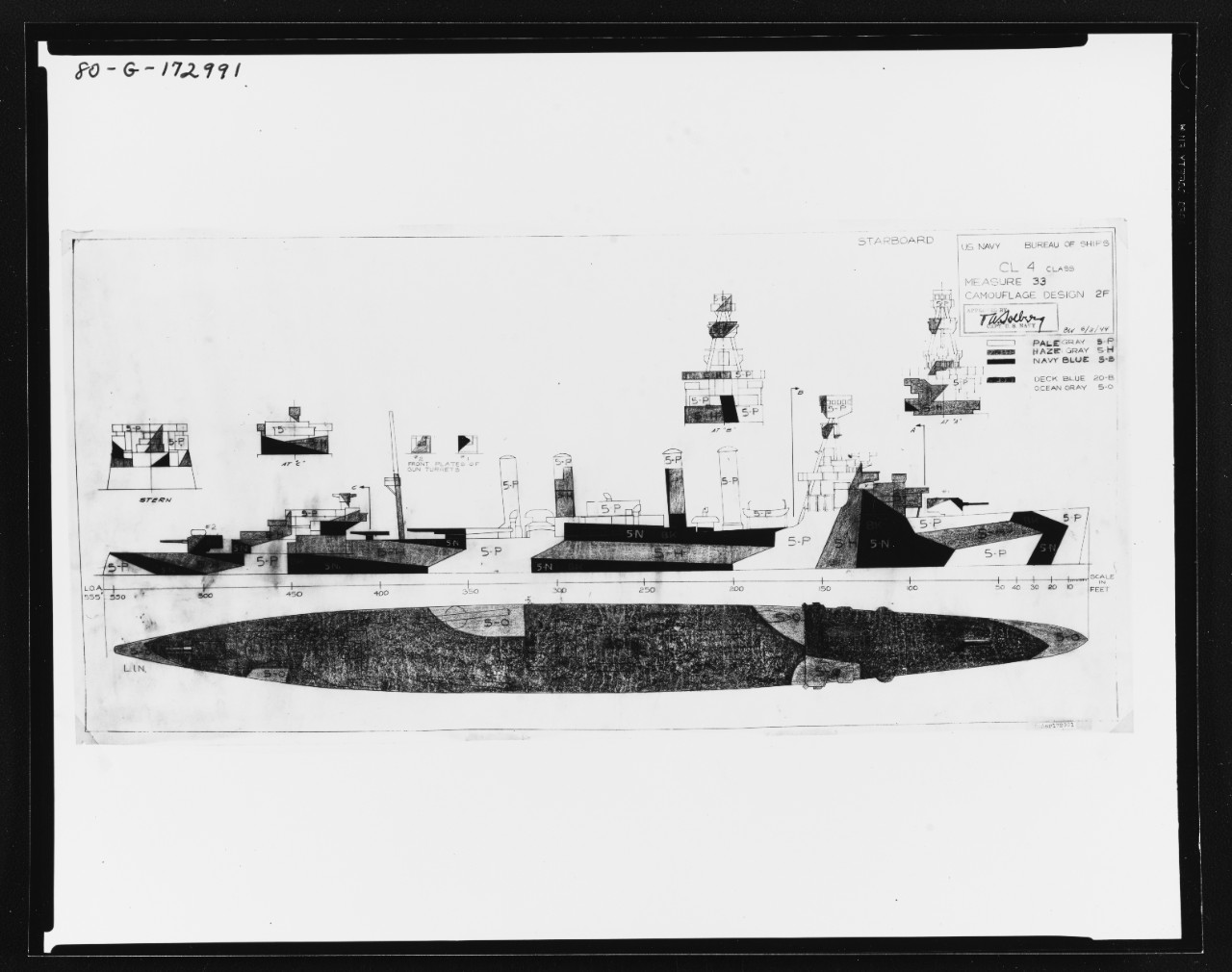
Measure 33, Design 2F, approved by Captain Torvald A. Solberg on 3 June 1944, again for Omaha-class cruisers; USS Concord and USS Trenton wore it. The drawing shows not only the starboard side but the ends of the superstructure and the exposed decks, because aircraft now mattered as much as submarines. Measure 33 was the light system — pale and haze grays with navy blue or ocean gray — meant for hazy or bright conditions.

This port-side plan for Cleveland-class light cruisers was approved by Commander William C. Latrobe on 17 February 1944. Ships reported to have worn it, some in the darker tones of Measure 32, include USS Pasadena, USS Springfield and USS Topeka. Because one design was issued to a whole class, sister ships could look identical — partly defeating the purpose — which is why the Bureau drew several alternatives for the larger classes.

A plan drawn specifically for the light cruiser USS St. Louis, dated 31 March 1944 and approved by Captain Torvald A. Solberg. She wore this Measure 32, Design 2C pattern for much of 1944. Each design received a number and a letter; in this period the letter generally reflected the type of ship it was first drawn for, though successful designs migrated freely between types — Design 2C also appears in the next gallery on the destroyer USS Fletcher.
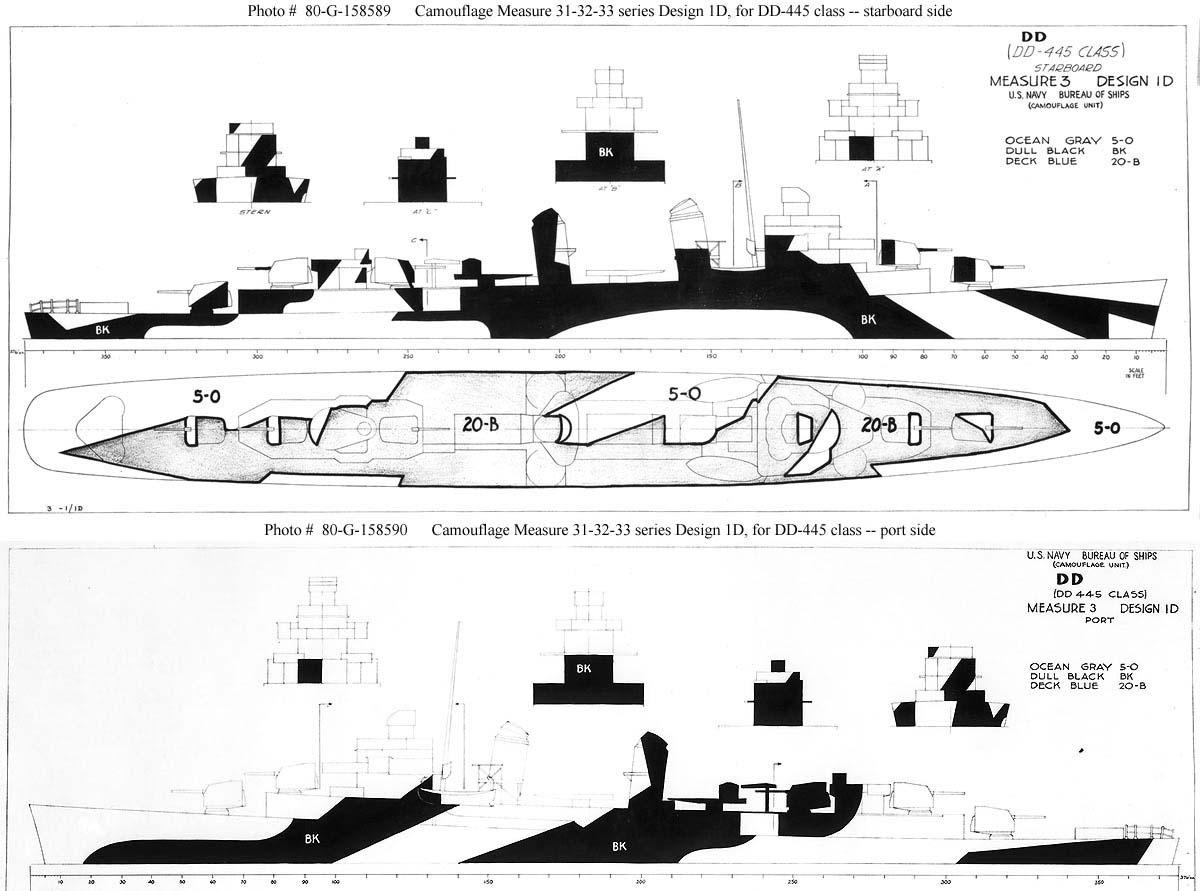
Destroyers got pattern sheets that could be painted in any of the three dazzle systems: dark Measure 31, medium 32 or light 33, depending on the theatre and the fleet commander’s choice. This is Design 1D for the 175 Fletcher-class destroyers. The same 1D pattern, scaled up, was also applied to much larger ships, including the battleship USS Tennessee and the large cruiser USS Alaska, both shown in the next gallery.
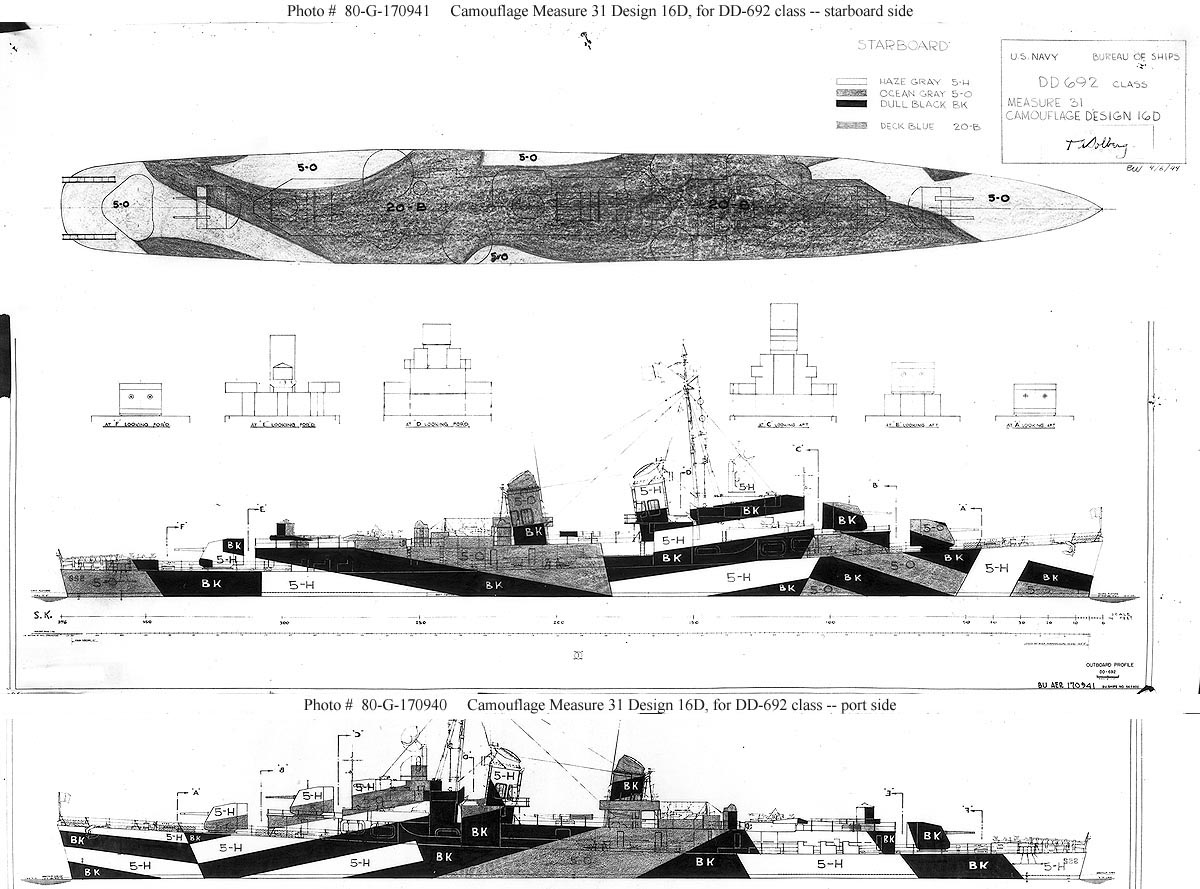
Design 16D, drawn for the new Allen M. Sumner-class destroyers, was one of the most dramatic American schemes. Painted in the dark Measure 31 colours — dull black with ocean gray or haze gray — it turned a destroyer into a jagged, almost unreadable shape. USS Hank, in the next gallery, left the builder’s yard in August 1944 wearing exactly this scheme.

Design 17A for Essex-class carriers, here in Measure 32a, one of the lower-contrast variants introduced in the autumn of 1944 after Everett Warner’s September report and requests from Pacific commanders for less garish patterns. The carrier USS Bennington, shown below, wore a version of this design during her shakedown cruise in October 1944. A carrier’s long, flat hull was especially hard to disguise; dazzle aimed to falsify its length and heading.

One of the great colour photographs of the Pacific war: the Essex-class carrier USS Hornet (CV-12) operates near Okinawa on 27 March 1945, her deck crowded with the aircraft of Carrier Air Group 17. She wears Measure 33, Design 3A — a light dazzle scheme of pale and haze grays with darker blocks. By this date most of the fleet had been ordered back into plain colours, but some ships kept their patterns to the end. Hornet survives as a museum ship at Alameda, California.

The most decorated American ship of the war, USS Enterprise (CV-6), leaves Pearl Harbor on 16 August 1944 in her newly applied Measure 33, Design 4A. On deck are the aircraft of Carrier Air Group 20, whose Bombing Squadron 20 was the first to fly the Curtiss SB2C Helldiver from the “Big E.” Only a month earlier she had still worn plain Measure 21 navy blue — compare the photograph of her beside USS Intrepid.

Two philosophies of camouflage side by side, probably at Pearl Harbor in July 1944: USS Enterprise (left) in Measure 21, solid navy blue on all vertical surfaces, and the newer USS Intrepid in Measure 32, Design 3A. Measure 21 aimed at low visibility, especially from the air; dazzle aimed at deception, especially against submarines. Within weeks Enterprise would be repainted in dazzle — and within months the Pacific Fleet would turn back to plain blue as the kamikaze threat grew.

USS Essex (CV-9), name ship of the class that won the Pacific war, carries a deckload of almost one hundred aircraft in this broadside view of about May 1944. Between April and November 1944 she wore Measure 32, Design 6/10D, a pattern of black, ocean gray and light gray. When she left San Francisco in April 1944, observers noted that her hull number had been painted small — another way of denying the enemy easy identification.

A Grumman F6F Hellcat approaches the deck of an Independence-class light carrier in 1944. The carrier’s Measure 32 or 33, Design 8A identifies her as either USS Independence or USS Bataan; the photograph belongs to a series taken aboard USS Cabot, which never wore dazzle. Built on cruiser hulls, the nine light carriers were narrow and fast, and their four small funnels made them distinctive — exactly the kind of silhouette dazzle tried to confuse.

The light carrier USS Bataan (CVL-29) off the Philadelphia Naval Shipyard on 2 March 1944, freshly painted in Measure 32, Design 8A. Builders’ yards applied the camouflage before delivery, working from the Bureau of Ships drawings and pattern sheets; painters used chalk lines and templates to transfer the shapes from paper to a hull more than 600 feet long. Bataan went on to fight in the Marianas and at Okinawa.

USS Franklin (CV-13) operating near the Marianas on 1 August 1944. Between May and November 1944 she was the only carrier wearing two different camouflage designs at once — Measure 32, Design 3A on the port side and Design 6A on the starboard. Seen from different sides, she would have looked like two different ships, which was rather the point. Less than eight months later, on 19 March 1945, Japanese bombs set her ablaze off Japan, killing roughly 800 men; she survived and steamed home under her own power.

Franklin’s port side in about May 1944, after it was repainted in Measure 32, Design 3A that April; she had been commissioned in January wearing Design 6A on both sides. Look at the masts: the wartime censor has painted out her radar antennas, a reminder that photographs were themselves retouched for security. The censor’s brush and the camoufleur’s brush served the same end — controlling what the enemy could learn from a ship’s appearance.

Seen from the rear seat of a Curtiss SB2C Helldiver, USS Intrepid (CV-11) launches another Helldiver of Bombing Squadron 18 during the Battle of Leyte Gulf on 24 October 1944, a battleship in the distance. From the air, a dazzle pattern looked very different than from a periscope — one of the reasons the Navy reconsidered dazzle as Japanese air attack became the main threat. Intrepid is today the Intrepid Museum in New York.

The Essex-class carrier USS Hancock (CV-19) underway in 1944 in Measure 32, Design 3A, the same design worn on Intrepid and on Franklin’s port side. Because Essex-class carriers were nearly identical, standard designs gave the enemy little chance to tell one from another — useful when Japanese propaganda repeatedly claimed to have sunk carriers that were still very much afloat.

The new carrier USS Bennington (CV-20) on her shakedown cruise in the western Atlantic or Caribbean on 20 October 1944, wearing Measure 32, Design 17A-1 — compare the Bureau of Ships pattern sheet for Design 17A above. A tanker is visible in the distance. Bennington reached the Pacific in early 1945 and took part in the strikes that sank the battleship Yamato in April.

The escort carrier USS Bogue (CVE-9), one of the most successful U-boat hunters of the war, in Measure 32, Design 4A. The Atlantic Fleet was more conservative than the Pacific about dazzle: in July 1944 it adopted only two designs — 3D for destroyers and destroyer escorts and 4A for escort carriers. That is why so many of the Atlantic “jeep carriers” in this gallery look alike.

A Navy blimp of Airship Patrol Squadron 24 photographed USS Guadalcanal (CVE-60) off Hampton Roads on 28 September 1944, with twelve Avengers and nine Wildcats parked on deck. Four months earlier her hunter-killer group had captured the German submarine U-505 — see the next gallery. Overhead views like this show how a dazzle pattern wrapped onto the flight deck and how it read from the air.

The Casablanca-class escort carrier USS Mission Bay (CVE-59) underway on 10 August 1944 in Measure 32, Design 4A, the Atlantic Fleet’s standard escort-carrier scheme. Fifty Casablancas were built by Henry Kaiser’s Vancouver, Washington, yard in barely a year — mass production on a scale that made standard camouflage designs a practical necessity.

A blimp of Airship Patrol Squadron 12 caught USS Shamrock Bay (CVE-84) off the East Coast on 26 October 1944 in Measure 32, Design 4A. Blimps escorted convoys and patrolled for U-boats along the American coast, and their crews took many of the best surviving photographs of camouflaged ships — which is why so many dazzle schemes are documented from above.
The second gallery turns to battleships, cruisers, destroyers, escorts and the auxiliaries of the fleet, ending with the hospital ships whose white paint was meant to be seen. Look for the same designs recurring: 1D on a destroyer, a battleship and a large cruiser; 2C on cruisers and a destroyer; 3D across the Atlantic escort fleet.

A rare colour view of USS North Carolina (BB-55) operating off Saipan in June 1944, her camouflage scheme clearly visible. Commissioned in 1941 and nicknamed “the Showboat,” she fought in every major Pacific offensive. She is now the Battleship North Carolina memorial at Wilmington, where visitors can see for themselves how big the canvas was that the Navy’s camoufleurs had to paint.

USS Missouri (BB-63), the last American battleship completed, lies at anchor during her shakedown cruise in about August 1944, a K-type blimp overhead. A year later her deck would host the Japanese surrender in Tokyo Bay. In 1944 she wore a dazzle scheme — Measure 32, Design 22D, seen in the next photograph — a striking reminder that even the most famous ships of the war passed through a phase of jagged paint.

Missouri during battle practice in Chesapeake Bay on 1 August 1944, wearing Measure 32, Design 22D. On an Iowa-class battleship nearly 900 feet long, a dazzle pattern had to work at the scale of a city block, with shapes sized to be read at many miles. The Bureau of Ships drew different patterns for each side, so an observer who glimpsed both could not easily be sure he was looking at the same ship.

USS Tennessee (BB-43), damaged at Pearl Harbor and rebuilt almost beyond recognition, bombards Japanese positions on Guam on 19 July 1944. She wears Measure 32, Design 1D — the same design issued on pattern sheets for Fletcher-class destroyers, scaled up to a battleship. The old battleships spent 1944 and 1945 as floating artillery for amphibious landings, and their dazzle schemes were seen by more soldiers and Marines than by enemy submariners.

USS Colorado (BB-45) bombards Tarawa on 20 November 1943, photographed from her sister Maryland. She wears Measure 32, Design 3D — among the first dazzle patterns to appear in the Pacific after the Pacific Fleet authorised Measures 31–33 in October 1943. The Tarawa bombardment taught hard lessons about how little naval gunfire could do against well-built bunkers, lessons applied later at Saipan and Iwo Jima.

USS Iowa (BB-61) at a Pacific anchorage in 1944, wearing Measure 32, Design 1B; the stern of an old “flush-deck” destroyer of First World War vintage intrudes at right. The contrast is apt: the flush-deckers had worn the original dazzle of 1918, and here the newest battleship in the fleet wears its descendant.

USS Mississippi (BB-41), in Measure 32, Design 6D, leads USS West Virginia — raised from the mud of Pearl Harbor — and the Australian heavy cruiser HMAS Shropshire in the bombardment of Luzon during the Lingayen Gulf landings, 8 January 1945. These were the weeks of the worst kamikaze attacks yet, and the Pacific Fleet had just ordered its ships back into plain paint; many, like Mississippi, still carried their patterns into action.

USS Maryland (BB-46), another Pearl Harbor survivor, off the Puget Sound Navy Yard on 25 April 1944, displaying her camouflage pattern. Navy yards photographed every ship as it left overhaul — the “19-N” Bureau of Ships series — so that the Bureau could check how its schemes had actually been applied. Those inspection photographs are now the best record of what the fleet looked like.

USS Alaska (CB-1), first of the Navy’s two “large cruisers” — battlecruisers in all but name — off Philadelphia on 30 July 1944. She wears Measure 32, Design 1D, the same pattern the Bureau drew for Fletcher-class destroyers and also applied to the battleship Tennessee. On an 808-foot hull the destroyer pattern becomes almost unrecognisable — exactly the confusion of scale the designers hoped for.

USS Indianapolis (CA-35), flagship of Admiral Raymond Spruance’s Fifth Fleet, at anchor in 1944, probably off Saipan, in Measure 32, Design 7D. In July 1945 she delivered components of the atomic bomb to Tinian; on 30 July she was torpedoed by the Japanese submarine I-58 and sank in minutes, and most of her crew died in the water before rescue. The striking pattern in this photograph belongs to her last full year of service.

The heavy cruiser USS New Orleans (CA-32) swings through a tight turn in Elliott Bay, Seattle, on 30 July 1943, after repairs at Puget Sound. At the Battle of Tassafaronga in November 1942 a Japanese torpedo had blown off her bow forward of the second turret; she reached Australia with a temporary stub bow built from coconut logs. The photograph dates from the months just before dazzle returned to the Pacific Fleet, when overall dark blues and graded grays were the rule.

The light cruiser USS Honolulu (CL-48) underway in the Pacific in Measure 32, Design 2C — the same design drawn for USS St. Louis (see the plan in the previous gallery). Both ships were near-sisters of the Brooklyn type that had survived Pearl Harbor, and the shared scheme made them hard to tell apart. Honolulu was torpedoed off Leyte in October 1944 and repaired.

USS Houston (CL-81) off the East Coast on 26 January 1944 in Measure 32, Design 1D. She carried the name of the heavy cruiser Houston, lost in the Battle of Sunda Strait in March 1942; the people of Houston answered with a bond drive that raised enough money to replace her and with a thousand volunteers sworn in together on Memorial Day 1942. Torpedoed twice off Formosa in October 1944, she was towed to safety and survived.

The new light cruiser USS Duluth (CL-87), seen from the air in Hampton Roads on 10 October 1944 as she headed for sea training, in Measure 32, Design 11A. From above, the pattern wraps across her decks and turret tops, showing how Bureau of Ships drawings had grown to include horizontal surfaces as air attack became the main danger.

USS Guam (CB-2), sister of Alaska, heels as she comes out of a high-speed turn in about 1944, wearing Measure 32, Design 7C. The two sisters were deliberately given different designs. Fast, heavily armed and expensive, the large cruisers spent most of their short careers escorting the carriers in 1945.

The heavy cruiser USS Louisville (CA-28) arrives at Mare Island on 6 February 1945 for repairs, her photograph annotated with the details of two kamikaze hits suffered a month earlier at Lingayen Gulf, where Rear Admiral Theodore Chandler was mortally wounded aboard her. Her camouflage is probably Measure 32, Design 6D. Pictures like this, marked up by naval engineers, recorded damage the way crews’ paintbrushes recorded victories.

The four-funnel light cruiser USS Richmond (CL-9) off the Puget Sound Navy Yard on 24 June 1944, in Measure 32, Design 3D — compare the Bureau of Ships plans for the Omaha class in the previous gallery. Designed just after the First World War, the Omahas spent the Second in secondary theatres; Richmond fought in the Aleutians, including the Battle of the Komandorski Islands in March 1943.

The Fletcher-class destroyer USS Richard P. Leary (DD-664) in about April 1944, wearing Measure 31, Design 13D. Measure 31 was the dark system — reflectances of roughly 10–15 per cent — intended for ships working close to dark coastlines or in dull light. Six months later Leary fought in the Battle of Surigao Strait, the last battleship action in history.

USS Hank (DD-702), an Allen M. Sumner-class destroyer, on delivery from the Federal Shipbuilding & Dry Dock Co. at Kearny, New Jersey, on 26 August 1944, painted in Measure 31, Design 16D — compare the Bureau’s pattern sheet in the previous gallery. Fresh paint, sharp edges and a brand-new hull make this one of the clearest records of how a 16D scheme looked as designed.

The Allen M. Sumner-class destroyer USS Mansfield (DD-728) off Portland, Maine, on 14 April 1944, newly built at Bath Iron Works, in Measure 31, Design 3D. Design 3D was the Atlantic Fleet’s chosen destroyer pattern, and new ships often left the yard in it before heading for the Pacific, where they might be repainted to a fleet commander’s preference.

USS Patterson (DD-392), with an escort carrier behind her, wearing Measure 31, Design 2C at some point between March 1944 and mid-1945. Patterson was a Pearl Harbor veteran and, at the Battle of Savo Island in August 1942, the first ship to broadcast the warning that Japanese cruisers were entering the anchorage. Her dazzle scheme is a late-war coat on an early-war ship.

The Fletcher-class destroyer USS Yarnall (DD-541), in Measure 31, Design 2C, comes alongside the light carrier USS Independence to refuel. Underway replenishment — destroyers drinking from carriers and oilers at sea — let the Pacific Fleet stay at sea for weeks at a time. At such close quarters the dazzle pattern looks almost decorative; it was designed for observers miles away.

The destroyer escort USS Decker (DE-47) off the Boston Naval Shipyard on 30 August 1944 in Measure 31, Design 3D. Destroyer escorts were the workhorses of the convoy war, and in July 1944 the Atlantic Fleet made 3D its standard pattern for destroyers and escorts alike — one reason convoy photographs of 1944–45 show so many ships in the same jagged coat.

The destroyer minelayer USS J. William Ditter (DM-31) off Norfolk in January 1945, in Measure 32, Design 3D, with rows of mines on her deck. Converted from Sumner-class destroyer hulls, the fast minelayers spent much of 1945 sweeping and screening off Okinawa, where Ditter was badly damaged by kamikazes in June. Her photograph shows the Atlantic standard pattern on a ship about to sail for the Pacific.

USS Hoel (DD-533), photographed from the escort carrier Kwajalein on 10 August 1944, wearing Measure 32, Design 1D. On 25 October 1944, off Samar, Hoel and her consorts of “Taffy 3” charged a Japanese force of battleships and cruisers to protect their escort carriers. She was sunk after taking more than forty hits; her sacrifice helped turn back the Japanese attack. This is one of the last photographs of her.

The Allen M. Sumner-class destroyer USS Mannert L. Abele (DD-733) on 1 August 1944, wearing Measure 32, Design 11A. On radar-picket duty off Okinawa on 12 April 1945 she was struck by a kamikaze and then by an Ohka, a rocket-powered piloted bomb — the first American ship sunk by the weapon. Against such attacks, dazzle had little to offer; by then most ships had been repainted in plain colours.

The Fletcher-class destroyer USS Ammen (DD-527) off Leyte during the landings of 20–24 October 1944, with what appears to be a column of medium landing ships behind her. Destroyers screened the transports against submarines and aircraft and fired in support of the troops ashore. On 1 November 1944 a Japanese plane crashed into Ammen’s stacks; she stayed in action.

White phosphorus bursts ashore as destroyers prepare for an Underwater Demolition Team operation off Iwo Jima’s West Beach at 1600 hours on 17 February 1945, two days before the Marines landed. The Fletcher-class destroyer firing at right appears to wear Measure 32, Design 6D. Even as orders went out to repaint the fleet in plain colours, ships already on the gun line kept their dazzle into the spring of 1945.

A blimp of Airship Patrol Squadron 11 photographed the new destroyer escort USS Oliver Mitchell (DE-417) fifty miles east of Nantucket Sound on 20 August 1944, wearing Measure 32, Design 22D. Seen from above, the pattern’s wedges cross the deck and break the slender line of the hull — though the white wake still betrays her course, the one thing no paint could hide.

USS Fletcher (DD-445), name ship of the largest class of destroyers ever built for the U.S. Navy, at Nouméa, New Caledonia, in about May 1944, in Measure 32, Design 2C; her sister Nicholas is barely visible behind her. Fletcher fought through the Guadalcanal campaign and survived the war. The same Design 2C appears on the cruisers St. Louis and Honolulu — proof of how freely patterns moved between ship types.

The destroyer escort USS Moore (DE-240), in a modified Measure 32, Design 3D, comes alongside the escort carrier USS Core in the Atlantic on 9 April 1945, during the last weeks of the U-boat war. Hunter-killer groups like Core’s were still sinking U-boats off the American coast that spring. The Atlantic Fleet had ordered a return to plain schemes that month; photographs like this catch the dazzle era at its very end.

The opposite of camouflage: the hospital ship USS Comfort (AH-6) arrives at Hollandia, New Guinea, on 6 February 1945, painted white with large red crosses so that she could be identified and spared. Under the Hague Convention of 1907, military hospital ships were to be white with a green band, brightly lit at night and never armed. The markings did not always protect her: on 28 April 1945, off Okinawa, a kamikaze crashed into Comfort, killing patients, nurses and crew.

The Army operated its own fleet of hospital ships alongside the Navy’s, converted from transports and liners and painted in the same protective white with red crosses. St. Mihiel was named for the 1918 American offensive; Army hospital ships like her brought wounded soldiers home across the Atlantic. Her paint was a legal declaration rather than an artistic choice — the one scheme on this page designed to be seen as clearly as possible.

The destroyer tender USS Dixie (AD-14) at anchor at Leyte in April or May 1945, in Measure 32, Design 4Ax. Her jack flies at half-staff — dating the photograph to the period of mourning after President Franklin D. Roosevelt’s death on 12 April 1945. Tenders were floating repair yards for the destroyers, and their crews repainted many of the ships in this gallery when orders changed.

The fleet oiler USS Niobrara (AO-72) off the Norfolk Naval Shipyard on 18 April 1944, with a huge 160-ton derrick added amidships to lift tank landing craft on and off LSTs at forward bases. Her camouflage is Measure 32, Design 5AO. Even the fleet’s plainest working ships received individually drawn patterns.

The troop transport USS General W. P. Richardson (AP-118) at sea in the Atlantic on 14 November 1944, photographed from a blimp, in Measure 32, Design 10T. Ships like her carried thousands of soldiers per voyage across waters still patrolled by U-boats, and a successful deception of a submarine commander could save an entire division’s worth of lives.
Small boats, submarines and the art of the trophy
The smaller the crew, the more personal the art. PT-boat squadrons adopted emblems of mosquitoes, wasps and pirates, and in 1942 the Navy asked the Walt Disney studio for an insignia for its new “mosquito boats”: Disney’s artists drew a mosquito riding a torpedo, and it was soon painted on boats across the fleet. By the end of the war the studio had designed more than 1,200 insignia for American and Allied units, free of charge, including the winged tiger of the Flying Tigers. Those designs remain Disney copyrights, so this page describes them rather than reproducing them; the squadron plaques shown in the gallery were made by sailors themselves.
American submarine crews began in 1942 to make battle flags as unofficial records of their patrols. Each crew designed and stitched its own, usually around the boat’s emblem, adding a rising-sun flag for every warship claimed and a red-circle flag for every merchant ship. USS Trepang’s flag shows 18 claimed sinkings, although the postwar Joint Army-Navy Assessment Committee confirmed only seven of her fourteen merchant claims, a reminder that crew art recorded belief, not verified fact. Royal Navy submarines flew homemade Jolly Rogers; Soviet boats painted the number of their victories inside a star on the conning tower. On surface ships, mascots, from dogs such as the Royal Navy’s ‘Ighty’ to the Coast Guard cutter Campbell’s famous Sinbad, shared the decks with captured flags and painted scoreboards on gun tubs and bridge wings.
Gallery: Submarines, PT boats and battle flags
PT boats, submarines and their tenders, the British war artist who drew life inside a submarine, the recruiting posters of the Silent Service, and the mascots and flags of the small-ship navy.

On 19 June 1940 the press got its first look at PT-9, the British-designed 70-foot motor torpedo boat that the Navy bought as a pattern for its own “mosquito boats” under a $15 million experimental small-craft programme. Elco built the American PTs on her lines, culminating in the 80-foot boats such as John F. Kennedy’s PT-109. In 1942 the Navy asked the Walt Disney studio for an emblem; Disney’s artists drew a mosquito riding a torpedo, and it was soon painted on PT boats across the fleet. That design remains under copyright, so it is described here rather than shown.

Plaques bearing the insignia of the Navy’s motor torpedo boat squadrons, on display at the National Museum of the U.S. Navy in Washington. The museum notes that these plaques were created by Navy sailors during the war. Each squadron (“MTBRon”) adopted its own emblem — mosquitoes, wasps, pirates, cartoon animals — and painted it on boats, base signs and jackets. Walt Disney’s studio designed more than 1,200 insignia for American and Allied units without charge, and many sailor-made designs borrowed its playful, cartoon style. A modern museum photograph.

A detail from the same display: the plaque of Motor Torpedo Boat Squadron 43. PT crews were young, informal and fiercely proud of their boats, and squadron emblems were painted on chart-house sides and base buildings across the Pacific and Mediterranean. Two wartime PT boats, PT-617 and PT-796, survive at Battleship Cove in Fall River, Massachusetts.

On 4 June 1944, off West Africa, the hunter-killer group of Captain Daniel V. Gallery forced U-505 to the surface, and a boarding party stopped her from sinking. Here the captured U-boat lies near the escort carrier USS Guadalcanal, painted in Measure 32, Design 4A. It was the first enemy warship captured on the high seas by the U.S. Navy since 1815, and her codebooks were a priceless intelligence prize. U-boat crews, like American submariners, painted emblems on their conning towers; U-505 is now preserved at the Museum of Science and Industry in Chicago.

The submarine tender USS Howard W. Gilmore (AS-16) off Mare Island on 13 July 1944, in Measure 32, Design 4Ax. She was named for Commander Howard W. Gilmore of USS Growler, who, wounded on the bridge in February 1943, gave the order “Take her down!” and sacrificed himself to save his boat; he received the Medal of Honor. Tenders were the submariners’ mother ships, and it was alongside them, between patrols, that crews stitched new victory flags onto their battle flags.

The submarine tender USS Fulton (AS-11) at Pearl Harbor on 30 June 1944, also in Measure 32, Design 4Ax, with the Ford Island ferry behind her. Returning submarines often entered Pearl Harbor flying their battle flags — homemade banners with a small Japanese flag for every ship claimed — and some lashed a broom to the periscope to signal a “clean sweep” of every target attacked.

A 1962 Soviet stamp honours Magomet Gadzhiyev, a Northern Fleet submarine commander and Hero of the Soviet Union who was killed in 1942, with the submarine K-3 and a sinking enemy ship. Soviet submarines had their own victory art: a number painted inside a star on the conning tower recorded each sinking claimed. Small as it is, the stamp shows how the submarine war passed from crew art into official commemorative art after the war.

Eric Ravilious (1903–1942), one of Britain’s first official war artists, attached to the Admiralty, painted Royal Navy submarines in dry dock in 1940 with the cool, patterned watercolour style that made him famous. He spent time aboard submarines at HMS Dolphin, the submarine base at Gosport, and produced a celebrated series of lithographs from the experience. Ravilious was lost in September 1942 when the aircraft he was flying in went missing off Iceland.

From Ravilious’s Submarine Series of colour lithographs (1940–41): an officer at the periscope, the moment on which every dazzle scheme in this collection was meant to work. What the officer saw — a few seconds’ view of a distant ship, low on the horizon — was precisely the observation camoufleurs tried to corrupt. Ravilious drew the cramped interior with affection and an eye for pattern.

Another of Ravilious’s submarine lithographs shows the planesmen at the diving controls, faces lit by instrument lights. Submarine crews were tiny, close-knit societies, and that closeness produced the most personal art of the naval war: Royal Navy boats returning from patrol flew a homemade “Jolly Roger,” with bars, daggers and symbols sewn on to record ships sunk and special operations — the British counterpart of the American battle flag.

“He’s in the Silent Service — Are you? Never mention arrivals, sailings, cargoes or destinations to anybody.” The Royal Navy had long been called the Silent Service, and this British security poster turned the nickname into an instruction for civilians. Careless talk about ship movements could send a U-boat to a convoy; this is the other side of the camouflage story, in which secrecy rather than paint protected the fleet.

American submarines made up less than two per cent of the U.S. Navy but sank more than half of all Japanese merchant shipping lost in the war, at the cost of 52 boats and roughly 3,500 men. Recruiting posters like this one sold the submarine service as the place to strike the enemy directly. Every volunteer was screened for the temperament to live for weeks in a steel tube — and the boats they served in came home flying the battle flags that recorded their claims.

A 1944 Navy recruiting poster in the Franklin D. Roosevelt Presidential Library offers young men the chance to “learn to operate a $7,000,000 sub,” showing a shirtless sailor at the controls looking straight out at the viewer. The appeal is technical and personal at once — skills, responsibility and the glamour of the elite. The same boats would carry crew-made art: battle flags, insignia and names stencilled on the conning-tower fairwater.

“Train today while you fight for tomorrow — learn diesels with the Submarine Service.” The Gato– and Balao-class fleet submarines ran on diesel-electric power, and the Navy promised volunteers a trade that would last after the war. Motor machinist’s mates kept the engines running on patrols of two months or more — and many of them helped stitch the battle flags that recorded each boat’s war.

A Navy color guard parades at the Arlington National Cemetery Amphitheater during the Second World War. The blue-and-white “Navy Battalion” flag carried at right served as an unofficial Navy flag until the service adopted its current flag in the late 1950s. Official colours like these stood at one end of the spectrum of naval flags; at the other were the homemade battle flags of submarines and the captured enemy flags displayed as trophies by small-craft crews.

An officer and four of his crew sit on the deck of their motor launch with their dog mascot, ‘Ighty’, on 3 September 1942. The dog, sitting on a German flag the crew had taken from a German tanker, broke a leg during the Dieppe Raid of 19 August; the bandage is visible on his front left leg. Mascots, trophy flags and painted kill tallies were the folk art of small warships — the naval counterpart of a tank crew’s chalked name.
“Kilroy was here”
No wartime image travelled farther than a bald head peering over a wall. American servicemen drew Kilroy on ships, tanks, latrines, ruined walls and captured bunkers from Normandy to the Pacific, always with the same boast, “Kilroy was here,” as if he had arrived before you. The best-documented explanation of the words points to James J. Kilroy, an inspector at the Fore River Shipyard in Quincy, Massachusetts, who marked riveters’ work with the phrase in crayon. Because many ships went to sea with unpainted interiors, servicemen found it everywhere. In 1946 the American Transit Association ran a contest to find the real Kilroy; more than forty men claimed the honour, and James Kilroy won with the support of shipyard officials. The Oxford English Dictionary still calls him “a mythical person.”
The drawing probably came from Britain, where “Mr Chad” peered over the same wall complaining about shortages (“Wot, no tea?”). He has been credited, uncertainly, to the cartoonist George Edward Chatterton around 1938. Australians had “Foo.” Somewhere in the war the British face and the American words merged. The famous story that Stalin found Kilroy in a VIP washroom at Potsdam and asked who he was is a rumour, but a good one. Kilroy is now carved into the National World War II Memorial in Washington.
Gallery: Kilroy and GI graffiti
Kilroy, Chad and Foo; surviving wartime graffiti; the memorial engravings; and the living-history and postwar Kilroys that keep the joke alive. Modern photographs and reenactment events are labelled as such.

The most famous graffiti of the twentieth century: a bald head and long nose peeking over a wall, fingers gripping the edge, with the words “Kilroy was here.” American servicemen chalked, painted and scratched it wherever they went — on ships, tanks, ruined walls, latrines and even, according to legend, the Potsdam Conference. The doodle and the phrase seem to have had separate origins and merged during the war: the drawing resembles Britain’s “Mr Chad,” while the words were American.
Australians had their own version: “Foo was here.” Some accounts claim that “Foo” was chalked on railway carriages and in camps used by the First Australian Imperial Force in the First World War, which would make him a generation older than Kilroy; others link the name to the acronym for Forward Observation Officer. Neither claim is firmly documented. The picture is a modern recreation of the doodle.

Britain’s Mr Chad peers over the same wall as Kilroy but complains instead of boasting: “Wot, no tea?” “Wot, no fags?” — a running joke about wartime shortages. He may have been drawn first by the cartoonist George Edward Chatterton (“Chat”) around 1938, though that is uncertain. By the end of the war Chad’s face had become Kilroy’s, and the two traditions blended. This modern Chad was photographed on a wall in Stockholm.

An original structure at the former RAF Hawkinge in Kent, the fighter station closest to France during the Battle of Britain, photographed in 1994 “complete with Kilroy — or Foo,” as the photographer put it. Surviving wartime buildings occasionally preserve the doodles left by the men who served there, though their exact dates are usually impossible to prove. Hawkinge closed as an airfield after the war; part of the site now houses the Kent Battle of Britain Museum.

When the National World War II Memorial opened on the National Mall in 2004, its designers slipped Kilroy into the stonework — an unofficial grin in the middle of an official monument, tucked out of the main sightlines so that visitors have to look for him. Veterans recognised him instantly. It is one of the few places where a soldier’s doodle has been carved permanently into a national memorial.

“In the back of the memorial,” as the photographer noted — Kilroy hides in a recess away from the fountains and pillars, rewarding the visitors who go looking. Finding him has become a small pilgrimage for veterans’ families and history buffs. The joke works because Kilroy was always where you did not expect him, and where someone had got there first.

A close view of the carving. The phrase’s best-documented origin story points to James J. Kilroy (1902–1962), an inspector at the Fore River Shipyard in Quincy, Massachusetts, who marked riveters’ work with “Kilroy was here” in crayon; because many wartime ships went to sea with their interiors unpainted, servicemen found his name everywhere. He won a 1946 contest run by the American Transit Association, with shipyard officials backing his claim — though the Oxford English Dictionary still calls Kilroy “a mythical person.”

Kilroy outlived the war that made him. This section of the Berlin Wall, displayed at the Newseum in Washington until that museum closed in 2019, carries his face among the Cold War graffiti of the Wall’s western side. American soldiers had carried him into Germany in 1945; a generation later he was still peering over walls in Berlin.

Another surviving piece of the Berlin Wall, this one from the Sonnenallee crossing area, now stands in the village of Ballrechten-Dottingen in southern Germany, decorated with a Kilroy. Pieces of the Wall were sold and given away around the world after 1989, and Kilroy travelled with them — a Second World War joke preserved on a Cold War relic.

On 29 December 1948, during the Dutch military offensive in Sumatra, an army photographer recorded a soldier whose comrades had drawn on the back of his raincoat: a “Killroy was here” figure with the line “What no women” — Chad’s complaint grafted onto Kilroy’s face — a Donald Duck head and the word “Jampie.” Three years after the war, the American doodle and the British catchphrase had become common property of soldiers everywhere.

A preserved Douglas C-47 Skytrain on museum display carries the name “Kilroy Is Here.” The C-47, military version of the DC-3 airliner, carried paratroopers on D-Day and supplies over the Hump to China, and its crews named their aircraft as freely as bomber crews did. Kilroy was a natural choice: like the C-47 itself, he turned up everywhere. A modern photograph of a museum aircraft.

A restored U.S. Army truck at a vintage-vehicle show in 2012 carries a painted Kilroy. Military-vehicle collectors have made Kilroy part of the standard vocabulary of restoration, alongside the white star and bumper codes, because he so often appeared on the real thing — chalked on tailgates, bumpers and the backs of seats. A modern photograph of a restored vehicle.

A “Kilroy was here” sign rides on the back of a restored Dodge truck at a 2011 Wings & Wheels display. Dodge’s three-quarter-ton and one-and-a-half-ton trucks were the workhorses of the American army after the jeep, and GIs decorated their tailgates with names, unit jokes and Kilroys. A modern photograph of a restored vehicle at a living-history event.

At the National Park Service’s World War II Weekend living-history camp in September 2023, a “Kilroy was here” drawing waits under the open hood of a wartime vehicle. Living historians hide Kilroy as soldiers once did — inside engine compartments, on the undersides of seats, in places only a mechanic would find — continuing the joke for new audiences. A modern photograph of a reenactment event.

A year later, at the 2024 World War II Weekend, another Kilroy — this one holding a wrench — was chalked inside a car hood. “Kilroy could be found all throughout camp if you knew where to look,” the Park Service noted. The mechanic’s Kilroy is a nice touch: motor-pool soldiers were among the most prolific wartime graffiti artists. A modern photograph of a reenactment event.

The concrete anti-tank cubes on the Suffolk coast at Minsmere were cast in 1940, when Britain expected invasion. The photographer describes the marks on this block as Second World War graffiti — the scratched names, initials and dates that soldiers and construction workers left in wet concrete or carved into it while on guard. Such graffiti is the humblest form of the impulse behind every painted tank and ship on this page: someone wanting to say “I was here.”

Kilroy at a scenic viewpoint on U.S. Route 95 north of Lewiston, Idaho, photographed in 2014. Returning veterans brought the doodle home, and it passed to their children and grandchildren as a piece of American folk art. Seventy years on, someone still knew exactly how to draw the nose, the fingers and the wall.

A chalk Kilroy on a classroom blackboard at the Brown v. Board of Education National Historical Park in Topeka, Kansas, photographed in 2022. The park preserves Monroe Elementary, one of the segregated schools at the heart of the 1954 Supreme Court case. Kilroy appears in many such period classrooms because he was so much a part of postwar school life — the doodle every child of the 1940s and 1950s learned from someone who had been in the service.
The uglier side: caricature, pin-ups and later attitudes
Not all painted steel was innocent. Vehicles, bombs and landing craft on every side carried slogans of hatred alongside the sweethearts’ names. American and Australian crews in the Pacific painted racial slurs and caricatures of the Japanese; Soviet tanks carried “Death to the fascists” and promises of vengeance; propaganda posters on all sides dehumanised the enemy in the same visual language. Pin-up figures appeared on jeeps, trucks and landing craft as well as aircraft. They were tolerated by most commanders, banned on paper by the American rules of February 1945, and are seen very differently today. This collection presents such imagery as historical evidence, labelled and explained, not as decoration. The Axis propaganda page and nose art page discuss these questions further.
Legacy: where to see painted steel today
Cobra King was identified in 2008 after decades as a gate guard in Germany, restored, and installed at the National Museum of the United States Army at Fort Belvoir, Virginia, in 2017. Museum ships let visitors walk the decks of the vessels in these photographs: USS Hornet at Alameda, California; USS Intrepid in New York; and, for North Carolina readers, the Battleship North Carolina at Wilmington, seen here in colour off Saipan in 1944. Two wartime PT boats, PT-617 and PT-796, are preserved at Battleship Cove in Fall River, Massachusetts. The captured U-505 is at the Museum of Science and Industry in Chicago. Submarine battle flags survive at the Naval Undersea Museum in Keyport, Washington, and in many local collections. The Canadian War Museum, the Imperial War Museum, Royal Museums Greenwich and the Tate hold the war art shown here, and Kilroy waits, half-hidden, at the National World War II Memorial.
Dazzle itself had a long afterlife. It inspired Cubist and Vorticist painters after 1918, returned to navies briefly in the 1940s, and has reappeared in recent years on art ships, buildings and test vehicles. The names never left: tank crews in Britain, the United States and elsewhere still paint them on their hulls.
- Norman Wilkinson proposes dazzle; the Admiralty’s Dazzle Section opens at the Royal Academy.
- Tank-bank weeks: £250,000 in war bonds “names a tank” for Newcastle. The U.S. Navy paints its own dazzle fleet.
- Peter Scott paints HMS Broke experimentally; Royal Navy ships improvise their own schemes.
- U.S. Navy Measures 1 and 2 issued (January); Western Approaches scheme ordered for North Atlantic escorts (May).
- Measures 21 and 22 (June); AR 850-5 standardises U.S. Army vehicle markings (August); Disney designs the PT-boat mosquito.
- Measures 31, 32 and 33 introduced (March); the Pacific Fleet adopts dazzle (October).
- Dimitry Donskoy tank column handed over (March); La Nueve’s half-tracks enter Paris (24 August); Cobra King reaches Bastogne (26 December).
- Pacific Fleet returns to plain Measures 12, 21 and 22 (1 January); U.S. Army rules bar cartoons and caricatures on vehicles (February).
- The American Transit Association names James J. Kilroy the “real” Kilroy.
- Cobra King installed at the National Museum of the U.S. Army.
About these images
Every image on this page is in the public domain or released under a Creative Commons licence (CC0, CC BY or CC BY-SA), with the author and licence named in each credit and a link to the source file on Wikimedia Commons. Images are displayed from Wikimedia Commons through the WordPress.com image service. Disney-designed insignia, and many famous photographs of named tanks, remain under copyright and are described rather than shown. Modern photographs of museum vehicles, dioramas and living-history events are identified as such and are never presented as wartime images.
Sources
- A Short History of US Naval Camouflage in WWII (USN Dazzle), on SHIPS-2, Measures 1–33, Everett Warner and the 1945 return to plain schemes.
- World War II ship camouflage measures of the United States Navy and the linked lists of Measures 31–33 by ship type (Wikipedia).
- Naval Historical Center online library: U.S. Navy camouflage drawings (HyperWar mirror).
- Alan Raven, Royal Navy camouflage, 1939–1945, shipcamouflage.com.
- Peter Scott (Wikipedia), on the Western Approaches scheme and HMS Broke.
- Museum of Modern Art press release, January 1944, on Norman Bel Geddes’s war models.
- United States military vehicle markings of World War II (Wikipedia), on AR 850-5 and the February 1945 rules.
- U.S. Army, ‘Cobra King’ led 4th Armored Division column that relieved Bastogne (2009); Cobra King (tank) (Wikipedia).
- Tank Archives: Soviet tank inscriptions (2014), on donation tanks and inscription orders.
- How the Russian Orthodox Church helped the Red Army (Russia Beyond), on the Dimitry Donskoy column.
- La Nueve and 2nd Armored Division (France) (Wikipedia).
- U.S. Army, Walt Disney Goes to War, on Disney insignia.
- Naval Undersea Museum: submarine battle flags, on the battle-flag tradition and USS Trepang.
- Kilroy was here (Wikipedia), on James J. Kilroy, Mr Chad and Foo.
- Golden Hill School buys a Jeep (Rochester Post Bulletin), on the Schools-at-War jeep drives.
- Imperial War Museum, Canadian War Museum, Naval History and Heritage Command, U.S. National Archives, Library of Congress, Tate and Royal Museums Greenwich catalogue records cited in each image credit.