
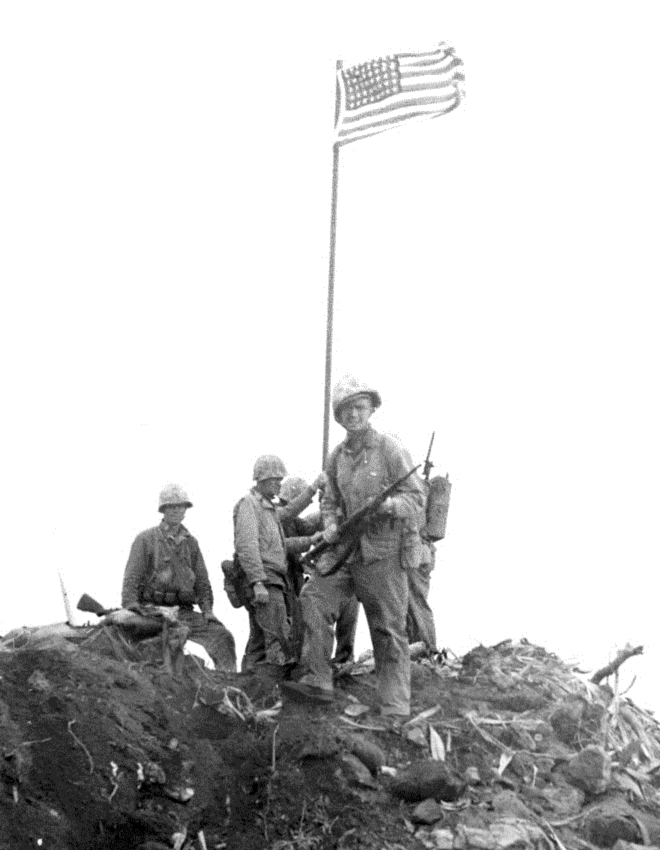
 Joe Rosenthal, Associated Press, 23 February 1945. Public domain in the U.S. (copyright not renewed), via Wikimedia Commons.
The Art of World War II · Section 4 of 8
The Famous Photographs of World War II
Eighty-five photographs that defined the war, from Pearl Harbor to Tokyo Bay, and the true stories behind them: who pressed the shutter, what happened a minute before and after, what was staged, what was cropped, who was misidentified, and how each picture lived on.
World War II was the first war photographed from beginning to end by armies of cameramen. The U.S. Army Signal Corps, the Navy, the Coast Guard and the Marine Corps trained thousands of combat photographers; the British, Soviet, German and Japanese services did the same; and the great picture magazines, Life above all, sent civilian photographers to every front. The result was millions of images. A few dozen of them have become the way the world remembers the war.
This section collects those photographs, and dozens more that deserve to be as well known, with a full story for each: the photographer, the place and the hour, the people in the frame, what the original caption said and what we know now. Click any photograph to open it full-size with its story; use the filters to sort by subject, country or year. Every image here is in the public domain or carries a free license, and every one is credited and linked to its source. Where the most famous version of a picture is still under copyright, we say so, tell its story anyway, and show the best free alternative.
Who took the pictures
Most of the photographs in this section were made by men and women in uniform. In the United States, the Army Signal Corps ran photographic companies attached to every army and many divisions; its cameramen carried bulky 4-by-5-inch Speed Graphic press cameras, smaller roll-film cameras and 35mm motion-picture cameras, and their film went back through channels to be developed, captioned, censored and released by the War Department. The Navy’s photographers worked from ships and aircraft, and in 1942 the Navy recruited the fashion and art photographer Edward Steichen to form an elite Naval Aviation Photographic Unit; one of his officers, Victor Jorgensen, made the V-J Day photograph featured below. The Coast Guard, which manned many of the landing ships, had its own combat photographers, among them Robert F. Sargent, who made “Into the Jaws of Death.” The Marine Corps sent combat correspondents and photographers ashore with the assault waves at every island from Guadalcanal to Okinawa.
Alongside them worked the civilians. The Associated Press, Acme, International News and the other wire services pooled their coverage under military rules; Life, which reached tens of millions of readers a week, sent photographers such as Robert Capa, Margaret Bourke-White, W. Eugene Smith and George Strock. At home, the Office of War Information, which absorbed the Farm Security Administration’s photographic unit in 1942, employed photographers such as Alfred T. Palmer, Jack Downey and Emmanuel F. Joseph and turned their skills to factories, shipyards and bond rallies. On the other side, Heinrich Hoffmann controlled Hitler’s image; German propaganda companies, the Propagandakompanien, embedded photographers with every army; Soviet photographers worked for TASS, Pravda and the army press; and Japanese Navy and Army press corps filmed and photographed for newsreels and newspapers. Some of the most famous images of the war, like the Japanese photographs of Pearl Harbor and the SS photographs of the Warsaw Ghetto, were taken by the perpetrators.
Everything passed through censorship. For the first two years of the war, the U.S. government barred publication of photographs showing American dead. That changed in September 1943, when Life was allowed to publish George Strock’s photograph of three dead soldiers on the beach at Buna, New Guinea, because officials had decided that the public had grown complacent. Even afterward, censors removed unit insignia, faces of the dead, secret equipment such as radar (see the painted-out antenna on Yorktown in the gallery below) and anything that might comfort the enemy. Many images now regarded as iconic were withheld for months or released only after the war.
Pearl Harbor and the Pacific
The Pacific war is bracketed by two of the most photographed events of the century, the attack on Pearl Harbor and the surrender in Tokyo Bay. In between, Navy and Marine photographers documented a war fought across thousands of miles of ocean: carrier battles in which the fleets never saw each other, jungle campaigns, and the island assaults of 1944 and 1945, where cameramen went in with the first waves and suffered heavy casualties. Japanese photographs, some captured, some published in Japan during the war, show the same war from the other side. For more on the battle behind the most famous photograph of all, see our Battle of Iwo Jima section.

The picture that most people remember from Pearl Harbor is not of a battleship but of a destroyer. At about 9:30 a.m. on 7 December 1941, the forward magazine of USS Shaw, sitting in the floating drydock YFD-2 at the Navy Yard, exploded in a gigantic ball of fire and smoke, hurling debris hundreds of feet into the air. A Navy photographer caught the instant of the blast, and that frame (Navy photo 80-G-16871) became the most dramatic single image of the attack, reproduced on posters and in nearly every history of the war since.
Shaw had been in dock for repairs when dive bombers of the second wave hit her with three bombs. With fires out of control and firefighting water exhausted, her crew abandoned ship at about 9:25; efforts to flood the dock only partly succeeded. The photograph shown here, Navy photo 80-G-32719, was taken in those last minutes: the destroyer’s stern in the dock with flames raging forward, and at far right the bow of the battleship Nevada, with the tug Hoga alongside pouring water on her fires. Moments later the magazine went up.
The explosion photograph is often mistaken for Arizona‘s, and it is sometimes printed with the wrong caption even today. Its afterlife carries a twist: the ship survived. Shaw was patched with a stub bow, sailed to San Francisco under her own power in February 1942, received a new bow at Mare Island, and fought through the war (see her wreck the next morning in the gallery below). We show the verified “before” frame here rather than a copy of the explosion photograph whose source file we could not confirm; the explosion image itself is a U.S. Navy photograph in the public domain and is held by the National Archives and the Naval History and Heritage Command.
Pearl Harbor · 7 December 1941
USS Shaw: The Explosion at Pearl Harbor
The picture that most people remember from Pearl Harbor is not of a battleship but of a destroyer. At about 9:30 a.m. on 7 December 1941, the forward magazine of USS Shaw, sitting in the floating drydock YFD-2 at the Navy Yard, exploded in a gigantic ball of fire and smoke, hurling debris hundreds of feet into the air. A Navy photographer caught the instant of the blast, and that frame (Navy photo 80-G-16871) became the most dramatic single image of the attack, reproduced on posters and in nearly every history of the war since.
Shaw had been in dock for repairs when dive bombers of the second wave hit her with three bombs. With fires out of control and firefighting water exhausted, her crew abandoned ship at about 9:25; efforts to flood the dock only partly succeeded. The photograph shown here, Navy photo 80-G-32719, was taken in those last minutes: the destroyer’s stern in the dock with flames raging forward, and at far right the bow of the battleship Nevada, with the tug Hoga alongside pouring water on her fires. Moments later the magazine went up.
The explosion photograph is often mistaken for Arizona‘s, and it is sometimes printed with the wrong caption even today. Its afterlife carries a twist: the ship survived. Shaw was patched with a stub bow, sailed to San Francisco under her own power in February 1942, received a new bow at Mare Island, and fought through the war (see her wreck the next morning in the gallery below). We show the verified “before” frame here rather than a copy of the explosion photograph whose source file we could not confirm; the explosion image itself is a U.S. Navy photograph in the public domain and is held by the National Archives and the Naval History and Heritage Command.
Pearl Harbor to Guadalcanal, 1941–42

This is the attack as the attackers saw it. Taken from a Japanese aircraft at about 8 a.m. on Sunday, 7 December 1941, it looks down on “Battleship Row” on the southeast side of Ford Island in the first minutes of the raid. Read the ships from lower left: Nevada, Arizona with the repair ship Vestal outboard, Tennessee with West Virginia, Maryland with Oklahoma, and the oiler Neosho. Torpedo tracks streak toward the outboard ships, and a spreading ring of water marks a hit on West Virginia; across the harbor, smoke is already rising from Hickam Field.
Japanese crews carried cameras to document the strike for their commanders. Prints were captured later in the war and became part of U.S. Navy files. Within minutes of this exposure Oklahoma would capsize, trapping hundreds of men, and West Virginia would settle to the bottom. More than 2,400 Americans died that morning.

A second captured Japanese photograph, shot straight down from a high-level bomber, records the single worst moment of the attack. Moments earlier an armor-piercing bomb, converted from a 16-inch naval shell, had punched into Arizona near her forward turrets and set off more than a million pounds of powder in her magazines. The explosion lifted the bow, collapsed the forward tripod mast and killed 1,177 of the ship’s crew, nearly half of all Americans who died at Pearl Harbor.
In the frame, a column of black smoke pours from Arizona (with Vestal beside her), while Oklahoma has already rolled over beside Maryland. The horizontal bombers flew at about 10,000 feet, which is why the ships look like models. Arizona was never raised. More than 900 of her men remain entombed in the hull beneath the USS Arizona Memorial, dedicated in 1962, and oil still seeps to the surface.

Of all the images of 7 December, this is the one most Americans picture: Arizona‘s forward tripod mast canted over a hull that is already on the bottom, smothered in smoke from burning fuel oil. It was made from shore or a boat during the attack or just after, when the fires were at their worst. At left, men on the stern of Tennessee, moored inboard and trapped by the wreck, play fire hoses on the water to push the burning oil away from their own ship.
Early wartime publicity minimized the damage at Pearl Harbor, and many photographs of the wrecked fleet were withheld until the Navy released a large set around the first anniversary of the attack in December 1942. Once published it became the emblem of “Remember Pearl Harbor,” reproduced on posters, magazine covers and newsreels. Arizona burned for two days; her superstructure was later cut away, and relics such as her bell and an anchor are preserved in the state of Arizona.

Color photography of the Pearl Harbor attack is rare, and this image is not a still photograph at all. It is a single frame clipped from color motion-picture film shot from the deck of the hospital ship Solace, anchored a short distance away, immediately after Arizona‘s forward magazines exploded. The orange core of the fire and the oily black smoke give a sense of heat that black-and-white prints cannot.
Solace‘s crew were already lowering boats; her motor launches pulled burned and oil-soaked sailors from the water around the battleships, and the ship’s doctors and nurses treated many of the wounded that day. The Navy later filed this frame among its official still photographs. Because it was enlarged from a tiny movie frame, it is grainy and soft, but it remains one of the most reproduced color images of the war’s opening hours.

The explosion of USS Shaw produced the most spectacular photograph of the Pearl Harbor attack (see the feature above). This is the morning after the fireball: the destroyer still smoldering in the half-sunken floating drydock YFD-2, her entire bow torn away by the detonation of her forward magazine. In the right distance is the listing battleship California.
The scene looked like a total loss. It was not. Navy Yard workers fitted Shaw with a temporary bow, and in February 1942 she steamed to San Francisco under her own power, where Mare Island gave her a permanent new one. She returned to the Pacific by late summer and fought through the rest of the war, from the Santa Cruz Islands to Saipan and the Philippines, earning eleven battle stars. The pair of photographs, explosion and wreck, is often used to show how much of the “destroyed” Pacific Fleet the Navy actually brought back.

Naval Air Station Kaneohe Bay, on the windward side of Oahu, was hit a few minutes before Battleship Row. Japanese fighters strafed the patrol squadrons’ PBY Catalina flying boats parked on the ramp and moored in the bay, and a second wave returned with bombs. Of 36 PBYs at the station, 27 were destroyed and the rest damaged, which is one reason the U.S. had so little long-range reconnaissance in the days that followed.
This photograph catches the sailors who tried to fight back with what they had: a single hose, no protective gear, and a flying boat full of fuel burning above them. Men at Kaneohe also fired rifles and machine guns pulled from the aircraft; Aviation Ordnanceman John Finn manned a .50-caliber gun in the open for more than two hours despite some twenty wounds and received the first Medal of Honor of the war. The station lost 18 sailors that day.

Within days of the attack, sailors at Naval Air Station Kaneohe Bay buried their dead in a row of fresh graves near the station and draped them with Hawaiian flower leis. A Navy photographer recorded the ceremony, and the image was released to the press and widely printed as Americans tried to absorb the shock of the first casualties of their war.
The photograph’s power lies in what it does not show. There is no wreckage and no fire, only young men in whites kneeling among mounds of earth, with the leis that islanders give to arriving and departing travelers. In a war whose first photographs were of burning ships, this became one of the defining images of grief. Many of Oahu’s war dead were later reinterred at the National Memorial Cemetery of the Pacific, the “Punchbowl,” in Honolulu, which opened in 1949.

On 10 December 1941 a Navy plane flew over Ford Island and recorded the wreckage in a single sharp frame, the kind of damage assessment photograph that commanders needed and the public would not see for a long time. From left: Arizona, burned out and sunk, with oil still streaming from her bunkers; Tennessee with West Virginia sunk alongside; and Maryland with the overturned hull of Oklahoma beside her.
Compare it with the Japanese photographs taken from nearly the same angle three days earlier and the attack becomes a before-and-after. What the picture also shows, if you know where to look, is what the raid missed: the oil tank farms, the submarine base and the repair shops are intact, and none of the Pacific Fleet’s aircraft carriers was in port. Every battleship here except Arizona and Oklahoma eventually returned to service.

On the morning of 18 April 1942, sixteen Army B-25B Mitchell bombers took off from the deck of the carrier Hornet, something no one had ever attempted in combat. The task force had been spotted by a Japanese picket boat, so Lieutenant Colonel James H. Doolittle launched about 650 nautical miles from Japan, farther than planned and with too little fuel to reach the airfields in China. Doolittle’s own plane went first, with only a few hundred feet of deck; this photograph is often captioned as his aircraft, though which of the sixteen it shows cannot be confirmed.
The bombers struck Tokyo, Yokohama, Nagoya, Kobe and other cities. The damage was slight, but the raid lifted American morale four months after Pearl Harbor and pushed Japan into the Midway operation. Every plane was lost; most crews bailed out over China, eight men were captured, and three of them were executed. Doolittle received the Medal of Honor.

The Battle of the Coral Sea, 4 to 8 May 1942, was the first naval battle fought entirely by aircraft; the opposing ships never saw each other. Japanese torpedo and dive bombers hit the carrier Lexington on 8 May, and although her crew had her under control, leaking aviation-gasoline fumes ignited and set off a chain of internal explosions. This photograph probably shows the blast at 5:27 p.m., as abandon ship was nearing its end.
Around her stand the heavy cruiser Minneapolis and destroyers taking off survivors. Remarkably, more than 2,700 men got off the “Lady Lex,” some reportedly pausing to eat ice cream from the ship’s stores; 216 were killed in the battle. That evening the destroyer Phelps sank the burning carrier with torpedoes. The battle stopped the Japanese seaborne move on Port Moresby. In 2018 Paul Allen’s research vessel Petrel found the wreck nearly two miles down.

Shortly after noon on 4 June 1942, Japanese dive bombers from the carrier Hiryu broke through and hit Yorktown with three bombs. One punctured her uptakes and put out her boilers, and the dense smoke in this picture is from those fires. Photographer’s Mate William G. Roy stood on the flight deck and made a pair of exposures, here joined into a panorama, of damage-control parties going to work; a man with a hammer at right is probably patching a bomb hole in the forward elevator.
The crew had the ship moving again within about an hour, only to be hit by two torpedoes that afternoon. Abandoned, then reboarded for salvage, Yorktown was finally sunk by the submarine I-168 on 7 June. By then American aircraft had destroyed four Japanese carriers, and Midway had become the turning point of the Pacific war. Roy’s photograph became its signature image.

After two aerial torpedoes tore open her port side on the afternoon of 4 June 1942, Yorktown listed so steeply that her captain, Elliott Buckmaster, feared she would capsize and ordered abandon ship. This photograph, taken from an escorting ship, shows her heeled over in a spreading slick of fuel oil, life rafts going over the side, and the destroyer Balch standing by to pick up men from the water.
Look closely at the top of the island: a wartime censor painted out the ship’s CXAM air-search radar before the photograph was released, a small reminder that every published image of the war passed through military review. Yorktown stayed afloat for two more days, long enough for a salvage party to go back aboard, before a Japanese submarine finished her. Her wreck was located in 1998, three miles down, by a team led by Robert Ballard.

The 1st Marine Division landed on Guadalcanal on 7 August 1942 to seize a nearly finished Japanese airfield, the first American ground offensive of the war. For six months the island became a grinding contest of jungle patrols, night naval battles in “Ironbottom Sound” and attacks on the perimeter around Henderson Field, fought by men weakened by malaria and short rations.
This official Marine Corps photograph, captioned as a patrol setting out at sunset in August 1942, is a composed, almost painterly image: a file of men in silhouette against the sky, each separated by the regulation interval. It is less a record of combat than of what combat felt like, the long walk into unknown country, and it was widely reproduced as the Marines’ Guadalcanal story was told at home. The island was declared secure in February 1943, after roughly 7,000 American and more than 19,000 Japanese deaths.

On 20 October 1944, a few hours after the first assault waves hit Red Beach near Palo on the island of Leyte, General Douglas MacArthur came ashore from a landing craft. The beach was too shallow and crowded for the boat to reach dry sand, and by most accounts the busy beachmaster told the general’s party to walk. Visibly annoyed, MacArthur stepped off into knee-deep water and waded in. His personal photographer, Gaetano Faillace of the Signal Corps, made the picture as he strode toward the camera, jaw set, with Philippine President Sergio Osmeña at far left, his staff officers Courtney Whitney and Richard Sutherland, Brigadier General Carlos Romulo and a CBS radio correspondent, Bill Dunn, beside him.
An hour later, in the rain, MacArthur spoke into a radio microphone: “People of the Philippines, I have returned.” He had made the promise to return in March 1942 after escaping from Corregidor, and the photograph became its proof. When he saw how well the image played in American newspapers, MacArthur repeated the wade for cameras at later landings, notably at Lingayen Gulf on Luzon in January 1945, which is why critics long claimed the Leyte picture itself was staged. The weight of evidence is that the first wade was unplanned and the later ones were not.
The scene was later cast in bronze: larger-than-life statues of MacArthur and his party stand in a reflecting pool at the MacArthur Landing Memorial National Park at Palo, near the spot where he came ashore.
The Philippines · 20 October 1944
MacArthur Returns: Wading Ashore at Leyte
On 20 October 1944, a few hours after the first assault waves hit Red Beach near Palo on the island of Leyte, General Douglas MacArthur came ashore from a landing craft. The beach was too shallow and crowded for the boat to reach dry sand, and by most accounts the busy beachmaster told the general’s party to walk. Visibly annoyed, MacArthur stepped off into knee-deep water and waded in. His personal photographer, Gaetano Faillace of the Signal Corps, made the picture as he strode toward the camera, jaw set, with Philippine President Sergio Osmeña at far left, his staff officers Courtney Whitney and Richard Sutherland, Brigadier General Carlos Romulo and a CBS radio correspondent, Bill Dunn, beside him.
An hour later, in the rain, MacArthur spoke into a radio microphone: “People of the Philippines, I have returned.” He had made the promise to return in March 1942 after escaping from Corregidor, and the photograph became its proof. When he saw how well the image played in American newspapers, MacArthur repeated the wade for cameras at later landings, notably at Lingayen Gulf on Luzon in January 1945, which is why critics long claimed the Leyte picture itself was staged. The weight of evidence is that the first wade was unplanned and the later ones were not.
The scene was later cast in bronze: larger-than-life statues of MacArthur and his party stand in a reflecting pool at the MacArthur Landing Memorial National Park at Palo, near the spot where he came ashore.

Around noon on 23 February 1945, four days into the battle, Associated Press photographer Joe Rosenthal reached the summit of Mount Suribachi just as a group of Marines was preparing to replace the small flag raised there that morning (see the first flag and the exchange in the gallery below) with a larger one. He had little time to compose; he stepped back, swung up his Speed Graphic, and caught the second flag going up in a single exposure at about 1/400 of a second. He did not know what he had until the film was developed in Guam. Within two days the photograph was on front pages across the United States. It won the 1945 Pulitzer Prize and became the model for the Seventh War Loan poster, a postage stamp and Felix de Weldon’s Marine Corps War Memorial at Arlington, dedicated in 1954.
Two myths have clung to it. The first is that it was staged. Rosenthal later posed a cheerful group of Marines under the flag, and when asked if his picture was posed he said yes, thinking of that shot; the Marine cameraman Bill Genaust’s color film of the raising, shot from beside him, settles the matter. The second concerns who is in it. The Marine Corps itself got the names wrong for seventy years. In 2016 a Marine Corps board concluded that Navy corpsman John Bradley was not in the photograph and that Private First Class Harold Schultz was; in 2019 a second review identified Corporal Harold Keller in place of Rene Gagnon. The six are now recognized as Ira Hayes, Harold Schultz, Michael Strank, Franklin Sousley, Harlon Block and Harold Keller. Strank, Block and Sousley were killed on the island within weeks.
On copyright: the Associated Press still licenses Rosenthal’s photograph, but Wikimedia Commons lists it as public domain in the United States because its copyright was not renewed. We reproduce it on that basis.
Iwo Jima · 23 February 1945
Raising the Flag on Iwo Jima
Around noon on 23 February 1945, four days into the battle, Associated Press photographer Joe Rosenthal reached the summit of Mount Suribachi just as a group of Marines was preparing to replace the small flag raised there that morning (see the first flag and the exchange in the gallery below) with a larger one. He had little time to compose; he stepped back, swung up his Speed Graphic, and caught the second flag going up in a single exposure at about 1/400 of a second. He did not know what he had until the film was developed in Guam. Within two days the photograph was on front pages across the United States. It won the 1945 Pulitzer Prize and became the model for the Seventh War Loan poster, a postage stamp and Felix de Weldon’s Marine Corps War Memorial at Arlington, dedicated in 1954.
Two myths have clung to it. The first is that it was staged. Rosenthal later posed a cheerful group of Marines under the flag, and when asked if his picture was posed he said yes, thinking of that shot; the Marine cameraman Bill Genaust’s color film of the raising, shot from beside him, settles the matter. The second concerns who is in it. The Marine Corps itself got the names wrong for seventy years. In 2016 a Marine Corps board concluded that Navy corpsman John Bradley was not in the photograph and that Private First Class Harold Schultz was; in 2019 a second review identified Corporal Harold Keller in place of Rene Gagnon. The six are now recognized as Ira Hayes, Harold Schultz, Michael Strank, Franklin Sousley, Harlon Block and Harold Keller. Strank, Block and Sousley were killed on the island within weeks.
On copyright: the Associated Press still licenses Rosenthal’s photograph, but Wikimedia Commons lists it as public domain in the United States because its copyright was not renewed. We reproduce it on that basis.
The island war, 1944–45
From Saipan to Okinawa: the first flag on Suribachi and the photograph that proves there were two, the kamikaze campaign seen from American decks and Japanese airfields, and the end of the largest battleship ever built.

On 21 June 1944, a week into the battle for Saipan, a Marine patrol found a mother, four children and a dog hiding in a hillside cave. The Marine in the photograph is First Lieutenant Robert B. Sheeks of the 2nd Marine Division, a Japanese-language and combat-intelligence officer, talking them into coming out and going to the civilian internment camp. The original wartime caption used the racial slur common in American captions of the period, a reminder of the language in which this war was fought.
Saipan was the first battle in which large numbers of Japanese civilians were caught in the fighting. Japanese propaganda had told them Americans would torture and kill them, and at the end of the battle in July hundreds, perhaps more than a thousand, killed themselves at the cliffs of Marpi Point. Sheeks and other language officers used loudspeakers and leaflets to persuade civilians to surrender, and photographs like this one were meant to show that they could.

Two days before the Marines landed, at about 4 p.m. on 17 February 1945, white phosphorus rounds burst along Iwo Jima’s western beaches to screen frogmen of the Underwater Demolition Teams as they swam in to scout the beaches and obstacles. A Fletcher-class destroyer in dazzle camouflage fires at right. The Japanese, mistaking the operation for the main landing, opened up with guns they had kept hidden, revealing positions that the fleet then pounded.
Iwo Jima received one of the longest preliminary bombardments of the Pacific war, but its 21,000 defenders under General Tadamichi Kuribayashi were dug into tunnels and pillboxes that shells barely touched. When the 4th and 5th Marine Divisions came ashore on 19 February, they met the fire this photograph makes look so easy to suppress. The battle lasted 36 days and cost nearly 7,000 American and almost all of the Japanese garrison’s lives.

This is the first flag raising on Iwo Jima, the one most people have never seen. At about 10:20 a.m. on 23 February 1945, a 40-man patrol of Company E, 2nd Battalion, 28th Marines, led by First Lieutenant Harold G. Schrier, reached the crater rim of Mount Suribachi and lashed a small flag, 54 by 28 inches and carried ashore from the transport Missoula, to a length of Japanese water pipe. Ships offshore sounded their whistles and men on the beaches cheered.
Leatherneck photographer Lou Lowery was the only cameraman on the summit. His pictures show Schrier, Platoon Sergeant Ernest I. Thomas Jr., Sergeant Henry O. Hansen, Corporal Charles W. Lindberg and others, with Private First Class James Michels on guard in the foreground. Minutes later a Japanese grenade attack sent Lowery tumbling down the slope and smashed his camera, but the film survived. Thomas and Hansen were killed within days. The flag is displayed today at the National Museum of the Marine Corps.

Around noon on 23 February 1945, the battalion commander, Lieutenant Colonel Chandler Johnson, decided the small first flag should come down. Accounts say the Secretary of the Navy, James Forrestal, watching from the beach, wanted it as a souvenir, and Johnson wanted it kept by the battalion; he sent up a larger flag, about 96 by 56 inches, obtained from the tank landing ship LST-779, so that it could be seen across the island.
This frame by Marine combat photographer Robert Campbell captures the exchange itself: the first flag being lowered as the second goes up. Campbell, Associated Press photographer Joe Rosenthal and Marine motion-picture cameraman Bill Genaust had climbed the mountain together. Rosenthal’s exposure of the second raising became the most famous photograph of the war; Campbell’s shows that there were two flags, not a staged re-enactment, which became important when Rosenthal was later accused of posing the shot.
This detail, cropped from one of Lou Lowery’s frames of the first flag raising, shows Platoon Sergeant Ernest Ivy “Boots” Thomas Jr. of Monticello, Florida, facing the camera beside the flagstaff. Thomas had already earned the Navy Cross on 21 February for leading his platoon against Japanese positions at the base of Suribachi after his platoon leader was wounded. His identification here follows the Marine Corps historian Robert L. Sherrod’s 1980 article on the two flag raisings in the Corps’ journal Fortitudine.
Thomas was flown out to the flagship Eldorado to be interviewed on CBS radio, where he said that he, Schrier and Hansen had actually raised the flag; the remark angered some superiors, who wanted the story to fit the famous photograph of the second flag. He returned to the fighting and was killed on 3 March 1945. He was 20 years old.

On the morning of 11 May 1945, while supporting the invasion of Okinawa, the carrier Bunker Hill, flagship of Vice Admiral Marc Mitscher, was hit by two kamikaze aircraft within about thirty seconds. Their bombs and burning fuel set off the fueled and armed planes waiting to launch on the flight deck, and fire raced into the hangar below. Photographed from the light carrier Bataan, the ship seems to be consumed by her own smoke.
Nearly 400 men were killed or listed as missing and about 260 wounded, many of them asphyxiated by smoke below decks. Yet Bunker Hill did not sink. The light cruiser Wilkes-Barre came alongside, firefighters fought for hours, and the carrier steamed home for repairs. The photograph was released and widely published in the summer of 1945, when Americans were beginning to understand what an invasion of Japan itself might cost.

At about 10:05 a.m. on 11 May 1945, the second of the two kamikazes that hit Bunker Hill struck near the base of the island. The pilot was identified as Ensign Kiyoshi Ogawa, a 22-year-old former university student who had taken off from Kanoya in Kyushu that morning in a Mitsubishi A6M Zero carrying a 500-kilogram bomb. The bomb penetrated the flight deck and exploded in the gallery level, killing many of Admiral Mitscher’s staff.
The kamikaze campaign off Okinawa sank more than thirty American ships and damaged hundreds; it was the deadliest period in U.S. Navy history. Ogawa’s body was found aboard the carrier, and personal papers recovered from it were reportedly kept by an American sailor for decades and returned to his family in Japan in 2001, a coda to this image that few who saw it in 1945 could have imagined.

Early on 19 March 1945, fifty miles off the coast of Japan, a single Japanese bomber put two bombs into the carrier Franklin as she was launching a strike. The explosions detonated fueled aircraft, bombs and “Tiny Tim” rockets on her decks in a series of blasts that left her dead in the water, listing and burning. More than 700 of her crew were killed (some counts exceed 800), the heaviest loss of any U.S. carrier that survived.
This photograph, taken from the air, shows the light cruiser Santa Fe brought right alongside, her bow crunching against the carrier, so that her crew could take off wounded men and play hoses on the fires. Two of Franklin‘s men, Chaplain Joseph O’Callahan and Lieutenant (j.g.) Donald Gary, received the Medal of Honor. Towed and then under her own power, the ship reached New York, 12,000 miles away. The Navy released dramatic images like this to tell the story of the ship that would not sink.

Yamato was the largest battleship ever built, 72,000 tons fully loaded with nine 18.1-inch guns. On 6 April 1945 she sailed from Japan on Operation Ten-Go, a one-way sortie with fuel for the trip out, meant to beach herself at Okinawa and fight as a fortress. On 7 April, some 380 aircraft from Task Force 58 caught her in the East China Sea and struck her with roughly ten torpedoes and several bombs, most on her port side.
At about 2:20 p.m. she capsized, and as she rolled her forward magazines exploded. A plane from the carrier Yorktown photographed the result, a cloud that rose several miles into the sky and could be seen from Kyushu. About 3,000 of her crew died; only some 270 survived. The photograph came to stand for the end of the battleship age, sunk by the carrier aircraft whose rise had been announced at Pearl Harbor.

The wartime caption calls it “Teamwork”: riflemen sighting on a Japanese hillside position on Okinawa on 11 May 1945 while a flame-throwing tank sends a tongue of burning fuel into a cave mouth. By the spring of 1945 this was the Marine Corps’ standard answer to the cave defenses of the Pacific islands, the method troops called “blowtorch and corkscrew”: flame to burn out a position, demolitions to seal it.
The caption adds a detail that makes the picture haunting. It was “found in the camera of a wounded combat photographer,” so the man who made it never got to file it himself; his name is not recorded. Okinawa, fought from 1 April to late June 1945, was the bloodiest battle of the Pacific war, killing about 12,500 Americans, more than 100,000 Japanese soldiers and conscripts, and a huge number of Okinawan civilians, often estimated at up to a quarter of the island’s population.

Its original caption reads “Show Goes On”: the “dogged character of the Pacific war,” shown by a lone Marine watching a flame-throwing tank work over a Japanese position on Okinawa in May 1945. The man is not charging or firing. He is simply watching, and his stillness says more about weeks of attrition than an action picture could.
May 1945 was the worst month on Okinawa. The Marines of the 1st and 6th Divisions were fighting for Sugar Loaf Hill, the Shuri Line and Wana Ridge in incessant rain and mud, while the Army’s divisions attacked alongside them. Combat fatigue cases ran into the thousands. The phrase “the show goes on” has the grim humor of a front-line caption writer. Photographs like this, released through Marine Corps public relations, shaped how Americans at home saw the island war in its final months: not as a series of victories but as a long, hard job.

In October 1944, as the Americans landed on Leyte, Vice Admiral Takijiro Onishi organized the first Special Attack Unit of Navy pilots at Mabalacat in the Philippines, men who would crash their bomb-laden Zeros into American ships. On 21 October a newsreel cameraman of the Navy press corps, Hirokuni Inagaki, filmed the departing pilots receiving a farewell cup from Commander Asaichi Tamai, seen from behind. From left the pilots are Lieutenant Yukio Seki, the unit’s leader, Iwao Nakano, Noriyuki Yamashita, Nobuo Tani and Hiroshi Shiota.
Bad weather turned them back for several days. On 25 October Seki’s group attacked the escort carriers off Samar, sinking USS St. Lo. Japanese press and newsreels presented the pilots as heroes, and images like this were used to recruit more. Seki, 23, had reportedly told a journalist he was going not for the emperor but for his wife. Some 3,800 kamikaze pilots died before the war ended.

This wartime Japanese photograph shows a young Army pilot accepting tea from a schoolgirl before a special-attack sortie in the spring of 1945, probably at one of the Army’s kamikaze bases in southern Kyushu. At Chiran, the best known, girls from the local high school were organized into a volunteer group, later called the Nadeshiko unit, who cleaned the pilots’ barracks, mended their uniforms and waved branches of cherry blossom as they took off for Okinawa.
Photographs like this were published to present the attacks as a pure, voluntary sacrifice supported by the whole nation. Postwar memoirs by the surviving girls and by pilots whose missions were cancelled tell a more complicated story of pressure, fear and grief. The farewell letters and photographs of the pilots are now displayed at the Chiran Peace Museum for Kamikaze Pilots. The individuals in this picture are not identified, and the exact place and date are uncertain.
Europe, the Eastern Front and the Mediterranean
In Europe the camera recorded the war’s full arc: Hitler’s triumphant morning in Paris, the beaches of Dunkirk, the Battle of Britain, the sieges of Leningrad and Stalingrad, the Warsaw Uprising, and the conferences at which the Allied leaders decided the shape of the postwar world. This gallery also includes Toni Frissell’s portraits of the Tuskegee Airmen in Italy, among the finest photographs of American servicemen made during the war, and the capture of U-505, a secret kept until the war was over. A note on Soviet photographs: many of the best-known Soviet war pictures, including Yevgeny Khaldei’s Reichstag flag and Georgy Zelma’s Stalingrad, may still be protected by copyright in the United States, so we show only Soviet images released under open licenses.

At dawn on 23 June 1940, the day after France signed the armistice, Adolf Hitler made his only visit to Paris: a rapid three-hour tour of the empty city with the architect Albert Speer, the sculptor Arno Breker and the architect Hermann Giesler. They saw the Opéra, the Madeleine, the Arc de Triomphe and Napoleon’s tomb, and on the terrace of the Palais de Chaillot they posed with the Eiffel Tower behind them.
The photographer was Heinrich Hoffmann, Hitler’s personal photographer, who controlled the dictator’s image so tightly that he grew rich from the rights. This frame and its variants became the definitive image of the fall of France, reproduced across the Reich as proof of victory and, after the war, everywhere else as an image of humiliation. Hoffmann’s archive was seized by the U.S. Army in 1945; this print is held by the German Federal Archives, whose captions often retain the original wartime wording.

Between 26 May and 4 June 1940, Operation Dynamo lifted about 338,000 British and French soldiers off the beaches and harbor mole of Dunkirk as German forces closed in. This photograph shows the scene that became the event’s symbol: long, patient lines of British troops snaking across the sand toward the water, waiting for small boats to carry them out to destroyers and transports offshore.
There are surprisingly few photographs of Dunkirk; the army’s official photographers had largely been withdrawn, and many images came from soldiers and from newspapers. That scarcity helped the story become legend, particularly the “little ships,” the civilian yachts and fishing boats that sailed from England to help. Winston Churchill told Parliament on 4 June that “wars are not won by evacuations,” but the rescue of the army made it possible for Britain to fight on. Some 40,000 French troops left behind went into captivity.

Pilots of No. 19 Squadron, Royal Air Force, leap from the back of a lorry and sprint toward their Spitfires at Fowlmere, near Duxford, in September 1940, at the height of the Battle of Britain. It is one of the best-known images of “the Few,” and it is staged. The Imperial War Museums’ own caption says the pilots “scramble” for the photographer, and the record calls it a mock scramble.
That is not a scandal; it is how much wartime photography worked. Real scrambles happened without warning and too fast for a photographer with a large camera to frame; official photographers asked tired pilots to run for the camera between sorties, and nobody at the time thought it dishonest. The men are real Battle of Britain pilots, and 19 Squadron, the first unit to fly Spitfires, fought throughout the battle. The picture became one of the definitive images of RAF Fighter Command in 1940 and has been reproduced ever since.

The “V for Victory” campaign began not with Churchill but with Victor de Laveleye, a Belgian exile broadcasting for the BBC, who in January 1941 urged listeners in occupied Europe to chalk the letter V on walls. The BBC added the Morse code for V, dot-dot-dot-dash, which matched the opening notes of Beethoven’s Fifth Symphony, and in July 1941 Churchill endorsed the campaign and made the hand gesture his own.
This photograph, taken in Downing Street on 5 June 1943, is one of the definitive images of the gesture. Early on, Churchill sometimes made the sign palm inward, which in Britain is an insult; his staff reportedly pointed this out, and he usually turned his palm outward thereafter. The V sign became a worldwide symbol, painted on walls in Paris and Oslo, and outlived the war to be adopted, with very different meaning, by the peace movement of the 1960s.

Churchill visiting Bradford, in Yorkshire, on 4 December 1942: homburg hat, overcoat, cigar clamped in his teeth and two fingers raised. It is a portrait of a politician at work. Churchill toured bombed cities, factories and shipyards throughout the war, and the War Office and Ministry of Information sent official photographers with him to make exactly this kind of picture for newspapers at home and abroad.
The timing matters. A month earlier, Montgomery’s Eighth Army had won at El Alamein, and Anglo-American forces had landed in French North Africa. On 10 November Churchill had told a London audience that this was “not the end… but it is, perhaps, the end of the beginning.” After three years of defeats, the V sign in photographs like this finally matched the news. The cigar, the hat and the gesture had become a brand, and Churchill knew exactly how to perform it for the camera.

Taken on 1 December 1942, as the Red Army’s counteroffensive, Operation Uranus, tightened the ring around the German Sixth Army, this RIA Novosti photograph by Oleg Knorring shows the leadership of the Stalingrad Front. At right is General Andrei Yeryomenko, the front commander; beside him Alexei Chuyanov, the party chief of the Stalingrad region, and General Alexei Kirichenko; and among the group is Nikita Khrushchev, then the front’s political commissar.
Soviet photographs of Stalingrad were tightly controlled and frequently staged, and portraits of commanders were part of the official story of a victory planned at the top. The picture took on a second life after 1956, when Khrushchev, by then the Soviet leader, made his own role at Stalingrad part of his public image. On 31 January and 2 February 1943, Field Marshal Friedrich Paulus and the last German forces in the city surrendered; about 91,000 men went into captivity, and only some 5,000 ever came home.

Its title, “Ne smykaya glaz,” means “Without closing an eye.” The photographer Sergei Strunnikov made it in besieged Leningrad in the winter of 1942–43: a Red Army scout-observer, identified as I. I. Lopatin, on watch on the University Embankment of the frozen Neva, with the city’s classical buildings behind him. Strunnikov was a leading Soviet photojournalist for Pravda; his 1942 photographs of the executed partisan Zoya Kosmodemyanskaya made her a national martyr. He was killed in 1944 during a German air raid on the American shuttle-bombing base at Poltava.
The siege of Leningrad lasted 872 days, from September 1941 to January 1944. Estimates of civilian deaths range from about 630,000 to more than a million, most of starvation and cold in the winter of 1941–42. Soviet photographers were permitted to show endurance and vigilance more readily than the city’s dead, and this image of a lone sentry became one of the siege’s emblems. Moscow’s city archive released it under an open license.

On 1 August 1944 the Polish Home Army rose against the German occupiers of Warsaw, expecting the Red Army, just across the Vistula, to arrive within days. It did not. For 63 days the insurgents fought alone. This photograph, taken on 1 September 1944 by the Home Army photographer Joachim Joachimczyk, shows two medics and a soldier of the “Parasol” battalion on Warecka Street in the city center just after climbing out of the sewers, through which the defenders of the Old Town escaped as it fell.
In the center is Maria Stypułkowska-Chojecka, codename “Kama,” who earlier that year had taken part in the assassination of the SS police chief Franz Kutschera; at right is Krzysztof Palester, “Krzych.” Their exhaustion is real; the passage through the sewers took hours, in darkness and waist-deep filth. The Uprising ended on 2 October 1944. About 16,000 insurgents and perhaps 150,000 to 200,000 civilians were killed, and the Germans then systematically demolished the city.

Two of the most theatrical generals of the war, all smiles at the Palermo airport on 28 July 1943. Lieutenant General George S. Patton Jr., whose Seventh Army had just raced across western Sicily and taken Palermo, sees off General Sir Bernard Montgomery of the British Eighth Army after a visit. The photograph shows the alliance the public was meant to see.
Behind the handshake was one of the war’s most famous rivalries. Montgomery’s plan for the invasion had given the Eighth Army the main role and assigned the Americans to protect his flank; Patton’s dash to Palermo and then his race to beat Montgomery to Messina, which he won on 17 August, were partly a reply. Within days Patton would slap two hospitalized soldiers, an act that nearly ended his career. The rivalry would resume in France and Germany in 1944–45. For more on the campaign, see our Invasion of Sicily section.

On 8 December 1943, flying home from the Cairo and Tehran conferences, President Franklin D. Roosevelt stopped at Castelvetrano airfield in Sicily. There he decorated General Mark Clark and other officers and met the commanders of the Mediterranean theater. This Signal Corps photograph shows him seated in a staff car with General Dwight D. Eisenhower; General Patton stands at the side.
The meeting had high stakes. A few days earlier Roosevelt had decided that Eisenhower, not George Marshall, would command the invasion of northwest Europe, and he had told him so in Tunis. Patton, meanwhile, was in limbo after the slapping incidents had become public in November, his future uncertain. The president’s disability, which the press almost never photographed, is concealed here by the car, as it was in nearly every published image of him. Eisenhower left for London within weeks, and Patton soon followed to command a decoy army.

Toni Frissell was a fashion photographer for Vogue and Harper’s Bazaar who volunteered her camera to the war effort, working for the American Red Cross, the Women’s Army Corps and the Eighth Air Force. In March 1945 she photographed the 332nd Fighter Group, the Black fighter pilots trained at Tuskegee, Alabama, at their base at Ramitelli on Italy’s Adriatic coast.
Her portraits are among the most famous images of the Tuskegee Airmen because they treat them the way fashion photography treated its subjects: with dignity, style and confidence. From left: Robert W. Williams, William H. Holloman III, Ronald W. Reeves, Christopher W. Newman and Walter M. Downs. The 332nd, commanded by Colonel Benjamin O. Davis Jr., escorted Fifteenth Air Force bombers deep into Germany in P-51 Mustangs with red-painted tails. Frissell donated her collection to the Library of Congress, which is why these pictures are free to use.

Toni Frissell’s portrait of Edward M. Thomas of Chicago, a graduate of flying class 43-J, at Ramitelli in March 1945 is perhaps the single best-known image of an individual Tuskegee Airman. She shot him from below against the open sky, in leather helmet and goggles, a framing more often used for movie stars than for Black servicemen, who were almost invisible in mainstream wartime publicity.
The Tuskegee program, begun in 1941 as an “experiment” that many senior officers expected to fail, produced nearly 1,000 pilots. Those of the 99th Fighter Squadron and the 332nd Fighter Group flew more than 15,000 sorties in North Africa and Europe and won 96 Distinguished Flying Crosses; their bomber-escort record became a point of pride, even as later research showed that early claims that they “never lost a bomber” were exaggerated. Their service helped persuade President Truman to order the desegregation of the armed forces in 1948.

Another of Toni Frissell’s March 1945 photographs at Ramitelli shows the other side of the 332nd Fighter Group’s war: P-51C Mustangs parked on a rough Italian field while a herd of goats grazes in front of them. Ramitelli was a farm strip on the Adriatic coast, south of Termoli, and the group’s ground crews kept the fighters flying from pierced-steel matting laid over farmland.
The tails of the Mustangs were painted bright red, the 332nd’s identifying color, which gave the pilots the nickname “Red Tails.” In the spring of 1945 they flew long escort missions to targets in Germany, Austria and Czechoslovakia; on 24 March they escorted B-17s to Berlin, the longest mission flown by the Fifteenth Air Force, and shot down three of the new Me 262 jet fighters. Frissell’s juxtaposition of high-performance fighters and Italian goats is a reminder that much of the air war was fought from improvised fields like this one.

Toni Frissell photographed the pilots of the 332nd Fighter Group in their briefing room at Ramitelli in March 1945, listening to the plan for the day’s mission. Library of Congress notes identify many of them, including Joseph L. “Joe” Chineworth of Memphis, Emile G. Clifton of San Francisco and Richard S. “Rip” Harder of Brooklyn in the foreground, with Frank N. Wright, Robert J. Murdic and Jimmie D. Wheeler along the back wall.
Briefings set the routes, rendezvous points and timing for escorting the Fifteenth Air Force’s bombers; the 332nd was known for staying with the bombers rather than leaving them to chase German fighters. Several men in Frissell’s Ramitelli photographs did not survive the war. Frissell’s work at Ramitelli was little seen until the Library of Congress made her collection available, and today these images are among the most requested in its holdings.

The first meeting of all three Allied leaders took place in Tehran from 28 November to 1 December 1943. Roosevelt stayed at the Soviet embassy, officially for security, and this photograph on its portico, Stalin, Roosevelt and Churchill seated side by side with their advisers behind, became the model for every “Big Three” photograph that followed.
At Tehran the three agreed that the Western Allies would invade France in May 1944, Operation Overlord, while the Soviets launched a simultaneous offensive in the east; Stalin also promised to join the war against Japan after Germany’s defeat. Churchill, who preferred operations in the Mediterranean, was increasingly outnumbered by his two partners. The seating, carefully arranged and repeated at Yalta, put Roosevelt at the center, which was where American power now placed him. Behind the cordial picture, Poland’s future borders were already being discussed without the Poles.

The Big Three met for the last time at Livadia Palace near Yalta, in the Crimea, from 4 to 11 February 1945. This photograph, taken on 9 February in the palace courtyard, shows Churchill, Roosevelt and Stalin seated before their foreign ministers and military chiefs, among them Molotov, Alan Brooke, Andrew Cunningham, Charles Portal, George Marshall and William Leahy.
Look at Roosevelt. Wrapped in his naval cape, gaunt and gray, he had about two months to live; he died at Warm Springs, Georgia, on 12 April. At Yalta the leaders agreed on the occupation zones of Germany, the founding conference of the United Nations, and Soviet entry into the war against Japan within three months of Germany’s surrender. Their promises of free elections in Poland and Eastern Europe were not kept, and “Yalta” became, for critics, shorthand for the division of Europe. The photograph is often read now as the image of that bargain.

On 4 June 1944, two days before D-Day, a U.S. Navy hunter-killer group under Captain Daniel V. Gallery forced the German submarine U-505 to the surface off French West Africa. As her crew abandoned ship, a boarding party led by Lieutenant (j.g.) Albert David scrambled down the conning tower, closed the scuttling valve, and disarmed demolition charges, saving the boat. It was the first enemy warship captured on the high seas by the U.S. Navy since 1815.
This photograph shows the prize lying low in the water near the escort carrier Guadalcanal, painted in dazzle camouflage, after salvage parties rigged a tow. The capture yielded an Enigma machine, codebooks and acoustic torpedoes. To protect the codebreakers, the Navy kept the capture secret until after the war and held the crew apart at a camp in Louisiana. David received the Medal of Honor. U-505 has been at Chicago’s Museum of Science and Industry since 1954.
D-Day and the liberation of Western Europe
On 6 June 1944 some 156,000 Allied troops landed in Normandy. The photographers who went with them, from the Signal Corps, the Coast Guard, the British Army Film and Photographic Unit and the press, produced the images by which the invasion is remembered, though fewer than one might think survive from the beaches themselves. The pictures of the months that followed, the liberation of Paris, Market Garden, the Bulge and the Rhine, are among the most widely reproduced of the war. For the units behind some of these stories, see our Special Units and Filthy Thirteen sections.

On the evening of 5 June 1944, hours after he gave the order to launch the invasion, General Dwight D. Eisenhower drove to the airfield at Greenham Common, near Newbury, to visit the paratroopers of the 101st Airborne Division who would drop into Normandy that night. Air Chief Marshal Sir Trafford Leigh-Mallory had warned him that the airborne divisions might lose most of their men. Eisenhower walked among the troops of Company E, 502nd Parachute Infantry Regiment, talking with them as they blackened their faces and checked their gear.
An Army photographer caught him in conversation with First Lieutenant Wallace C. Strobel of Saginaw, Michigan, who wears the placard numbered 23, his jumpmaster number. Strobel later said Eisenhower asked where he was from and talked about fishing in Michigan, and the men told the general not to worry. Eisenhower stayed until the planes took off, and those who watched him said he had tears in his eyes. That day he had drafted, and put in his wallet, a short note to be issued if the landings failed, beginning “Our landings … have failed” and accepting full responsibility.
The photograph was distributed widely and has been called the most famous image of Eisenhower. It is not a battle picture, yet it captures the weight of command better than any. Losses among the airborne troops were heavy but far below Leigh-Mallory’s fears. Strobel jumped that night, survived the war and died in 1999. The note in Eisenhower’s wallet was never needed; he kept it, and it is now at the Eisenhower Presidential Library in Abilene, Kansas.
Greenham Common, England · 5 June 1944
Eisenhower and the 101st Airborne, the Eve of D-Day
On the evening of 5 June 1944, hours after he gave the order to launch the invasion, General Dwight D. Eisenhower drove to the airfield at Greenham Common, near Newbury, to visit the paratroopers of the 101st Airborne Division who would drop into Normandy that night. Air Chief Marshal Sir Trafford Leigh-Mallory had warned him that the airborne divisions might lose most of their men. Eisenhower walked among the troops of Company E, 502nd Parachute Infantry Regiment, talking with them as they blackened their faces and checked their gear.
An Army photographer caught him in conversation with First Lieutenant Wallace C. Strobel of Saginaw, Michigan, who wears the placard numbered 23, his jumpmaster number. Strobel later said Eisenhower asked where he was from and talked about fishing in Michigan, and the men told the general not to worry. Eisenhower stayed until the planes took off, and those who watched him said he had tears in his eyes. That day he had drafted, and put in his wallet, a short note to be issued if the landings failed, beginning “Our landings … have failed” and accepting full responsibility.
The photograph was distributed widely and has been called the most famous image of Eisenhower. It is not a battle picture, yet it captures the weight of command better than any. Losses among the airborne troops were heavy but far below Leigh-Mallory’s fears. Strobel jumped that night, survived the war and died in 1999. The note in Eisenhower’s wallet was never needed; he kept it, and it is now at the Eisenhower Presidential Library in Abilene, Kansas.

Robert F. Sargent, a U.S. Coast Guard Chief Photographer’s Mate, rode toward Omaha Beach on the morning of 6 June 1944 in a landing craft (LCVP) from the Coast Guard-manned transport Samuel Chase. As the ramp dropped, he photographed from the stern the men of the 16th Infantry Regiment, 1st Infantry Division, wading into chest-deep water toward a beach shrouded in smoke, beneath bluffs held by the German 352nd Infantry Division. Captions usually identify them as men of Company E landing in the Easy Red or Fox Green sector, about 7:40 a.m.; accounts differ on the details.
The picture’s title is borrowed from Tennyson’s “The Charge of the Light Brigade”: “Into the jaws of Death, / Into the mouth of hell.” It is the defining image of D-Day for a simple reason: it shows what the men saw, the boat’s own frame like a doorway onto the beach. Several of the men in it were probably killed or wounded within minutes. Omaha cost about 2,400 American casualties on 6 June.
Sargent’s photograph had a rival. Robert Capa of Life landed on Omaha with the same regiment and made a handful of blurred, grainy frames in the surf, the “Magnificent Eleven,” which are as famous as Sargent’s. Capa’s rights are managed by Magnum Photos and the International Center of Photography, so we do not reproduce them here. Sargent’s image, as the work of a U.S. Coast Guardsman on duty, belongs to the public, and it is the version of the landing that every American can freely use.
Omaha Beach · 6 June 1944
“Into the Jaws of Death”
Robert F. Sargent, a U.S. Coast Guard Chief Photographer’s Mate, rode toward Omaha Beach on the morning of 6 June 1944 in a landing craft (LCVP) from the Coast Guard-manned transport Samuel Chase. As the ramp dropped, he photographed from the stern the men of the 16th Infantry Regiment, 1st Infantry Division, wading into chest-deep water toward a beach shrouded in smoke, beneath bluffs held by the German 352nd Infantry Division. Captions usually identify them as men of Company E landing in the Easy Red or Fox Green sector, about 7:40 a.m.; accounts differ on the details.
The picture’s title is borrowed from Tennyson’s “The Charge of the Light Brigade”: “Into the jaws of Death, / Into the mouth of hell.” It is the defining image of D-Day for a simple reason: it shows what the men saw, the boat’s own frame like a doorway onto the beach. Several of the men in it were probably killed or wounded within minutes. Omaha cost about 2,400 American casualties on 6 June.
Sargent’s photograph had a rival. Robert Capa of Life landed on Omaha with the same regiment and made a handful of blurred, grainy frames in the surf, the “Magnificent Eleven,” which are as famous as Sargent’s. Capa’s rights are managed by Magnum Photos and the International Center of Photography, so we do not reproduce them here. Sargent’s image, as the work of a U.S. Coast Guardsman on duty, belongs to the public, and it is the version of the landing that every American can freely use.

In the first days of June 1944, every port on England’s south coast became a loading dock. This U.S. Army photograph shows jeeps being driven aboard small landing craft in the foreground while larger trucks and DUKW amphibious “ducks” are loaded into the bow doors of tank landing ships behind them. One of the LSTs has been identified as LST-314, which carried troops and vehicles to Omaha Beach.
The invasion was as much a feat of logistics as of courage. More than 4,000 landing ships and craft, and some 7,000 vessels in all, carried about 156,000 Allied troops to Normandy on 6 June; for weeks beforehand, the men were sealed in marshalling camps and the roads leading to the ports were lined with parked vehicles. Days after this picture was taken, LST-314 was sunk off Normandy by German E-boats, one of many ships lost keeping the beachhead supplied.

Operation Market Garden, launched on 17 September 1944, tried to end the war by Christmas with one stroke: three airborne divisions would seize a chain of bridges across the rivers of the Netherlands, and the British XXX Corps would drive up a single road to link them, ending at Arnhem on the Lower Rhine. The narrow, raised road, under constant German counterattack, became known to the American paratroopers who held it as “Hell’s Highway.”
This photograph, taken on 20 September by a sergeant of the Army Film and Photographic Unit, shows Cromwell tanks of the Guards Armoured Division moving along it toward Nijmegen. That afternoon, men of the U.S. 82nd Airborne Division paddled across the Waal in canvas boats to help take the Nijmegen bridge. Arnhem, eleven miles farther, was never reached; the British 1st Airborne Division was destroyed there. The 101st Airborne, which fought along this road for weeks, later fought at Bastogne.

On 26 August 1944, the day after the German garrison of Paris surrendered, General Charles de Gaulle walked down the Champs-Élysées from the Arc de Triomphe to Notre-Dame through a crowd estimated at a million people. Jack Downey of the Office of War Information photographed the scene from above: Parisians packed along the avenue as tanks and half-tracks of General Philippe Leclerc’s French 2nd Armored Division roll past the Arc.
The Allies had planned to bypass Paris, but an uprising by the Resistance and the police, which began on 19 August, forced the issue, and Eisenhower allowed Leclerc’s French division to lead the way in. The parade itself was not entirely safe; snipers fired on the crowds near Notre-Dame and the Hôtel de Ville that afternoon. Downey’s wide view, printed in high resolution, has become a standard image of liberation, showing a city reclaiming its own most famous street.

On 29 August 1944 the U.S. 28th Infantry Division, the Pennsylvania National Guard’s “Keystone” division, paraded down the Champs-Élysées in combat gear, 24 men abreast. It was more than a ceremony. The division was on its way to the front, which lay just east of the city, and many of the men marched straight through Paris and into battle.
This Signal Corps photograph became one of the best-known American images of the liberation. In 1945 it was the model for the U.S. Post Office’s three-cent stamp honoring the Army, which showed the 28th marching past the Arc de Triomphe with aircraft overhead. The division’s next months were among the hardest any American unit endured: the Hürtgen Forest in November, where it suffered thousands of casualties, and then the first days of the Battle of the Bulge, where its depleted regiments slowed the German drive on Bastogne. See our Battle of the Bulge section.

Parachute infantry move across a snowfield toward the front beyond St. Vith, Belgium, on 24 January 1945, keeping up pressure on the retreating Germans in the last phase of the Battle of the Bulge. The long file of dark figures against white, each man separated by a careful interval to limit casualties from artillery, is one of the defining compositions of the winter war.
The German offensive that began on 16 December 1944 had driven a deep “bulge” into the American line in the Ardennes. Airborne divisions, the 82nd and the 101st, were rushed into the battle by truck; the 101st held Bastogne while the 82nd fought on the northern shoulder. The battle cost the U.S. Army about 19,000 dead, its largest single battle of the war, and much of the suffering came from the cold itself: frozen feet, frostbite and trench foot. More in our Battle of the Bulge section.

On 25 January 1945, men of the U.S. 7th Armored Division prepare to move up after giving artillery support to the infantry fighting for high ground near St. Vith, Belgium. The picture has special meaning for the division. In December, the 7th Armored had defended the crossroads town of St. Vith for six days against overwhelming German forces, wrecking the enemy’s timetable before withdrawing on 21–23 December. A month later, it came back and retook the town on 23 January.
The defense of St. Vith, together with the stand at Bastogne and on the Elsenborn Ridge, is generally credited with dooming the German offensive. Photographs like this one, men working among vehicles in deep snow, were the Signal Corps’ everyday record of the campaign rather than a single famous moment, but they shaped the image of the Bulge as a battle against weather as much as against the enemy. More in our Battle of the Bulge section.

On the afternoon of 7 March 1945, an American task force of the 9th Armored Division reached the heights above Remagen and saw, to its astonishment, that the Ludendorff railroad bridge over the Rhine was still standing. German engineers set off their charges as Lieutenant Karl Timmermann’s company of the 27th Armored Infantry Battalion rushed it; the bridge lifted, then settled back, damaged but intact. Sergeant Alexander Drabik was the first American across.
This photograph shows the bridge soon after its capture, seen from the east bank. Eisenhower said the bridge was “worth its weight in gold”: within a day thousands of troops had crossed, and the first Allied bridgehead over the Rhine was established. Hitler had four officers court-martialed and shot. Weakened by demolition charges, German bombs, V-2 rockets and the weight of traffic, the bridge collapsed on 17 March, killing 28 American engineers working on it. It was never rebuilt; its towers survive as a peace museum.

Two days after the capture, on 9 March 1945, a Signal Corps photographer climbed the Erpeler Ley, the basalt cliff that towers above the east end of the Ludendorff Bridge, and photographed the bridgehead from above. A soldier identified as Dan Feltner of Company C, 656th Tank Destroyer Battalion, looks down on the bridge and the river.
The cliff had been the key to the crossing; its tunnel had sheltered German troops and civilians, and Americans had to clear it on the first night. From the top, the view explains why the bridgehead was so precarious: the narrow bridge, the steep valley, and the open river crossed by engineers’ pontoon bridges as the Germans threw aircraft, artillery and even frogmen against them. The picture is quieter than most war photographs, but it is one of the clearest images of the place where the Allies first crossed the Rhine, a moment that broke Germany’s last great natural barrier in the west.
The home front
The war was won in factories and shipyards as well as on battlefields, and the U.S. government photographed that work relentlessly. The Office of War Information’s pictures of women welders, riveters and pilots were made to recruit, and many were posed and lit like advertisements; they are also the best record we have of the millions of women who entered war work. Read them as both: honest documents and skillful publicity. (For the posters that accompanied them, see our American Posters page.)

Alfred T. Palmer, a commercial photographer hired by the Office of War Information, made a series of color and black-and-white pictures in February 1943 at the Vultee Aircraft plant in Nashville, Tennessee, where women built the A-31 Vengeance dive bomber. In this one, a woman in a bandana and coveralls works a hand drill on a bomber’s fuselage. It is a carefully lit, posed industrial photograph, made to be published.
The name “Rosie the Riveter” came from a 1942 song; Norman Rockwell’s Saturday Evening Post cover of 29 May 1943 fixed it to a face; and the Westinghouse “We Can Do It!” poster by J. Howard Miller, little seen during the war, became the icon only in the 1980s. Palmer’s photographs show the reality behind them: by 1944, women made up more than a third of the civilian workforce and a large share of aircraft workers. The individual workers in his Vultee series are mostly unnamed.

The National Archives caption begins: “With nearly 1000 Negro women employed as burners, welders, scalers, and in other capacities at the…” The rest of the caption, in a matching print at the Schomburg Center in New York credited to the OWI photographer Emmanuel F. Joseph, places the women at the Kaiser shipyards in Richmond, California, ready to weld their first piece of steel on the Liberty ship George Washington Carver, launched on 7 May 1943, and names welders Alivia Scott, Hattie Carpenter and Flossie Burtos.
Black women faced double discrimination in war industry, and many were steered into the dirtiest and lowest-paid jobs. The Kaiser yards, desperate for labor, hired thousands of them. The OWI publicized the Carver, named for the Black scientist, to build support for the war among African Americans and to answer charges of discrimination. Joseph, one of few Black photographers employed by the OWI, made a point of documenting Black workers at the yards. Richmond’s Rosie the Riveter/World War II Home Front National Historical Park tells their story today.

The original caption reads “Line up of some of women welders including the women’s welding champion of Ingalls,” the Ingalls Shipbuilding Corporation yard in Pascagoula, Mississippi, in 1943. The women stand in a row with welding helmets in hand, like a team photograph, which is what it is: Ingalls and other shipyards held welding competitions, and the yard was proud of its champions.
Ingalls was a pioneer of all-welded ship construction; in 1940 it launched the first all-welded merchant ship in the United States, and welding, rather than riveting, became the key skill of wartime shipbuilding. Welding was well paid and women proved highly capable at it, especially in the confined spaces of hulls. When the war ended, most were laid off as returning veterans took back the jobs, but photographs like this, preserved in the National Archives, became evidence for later historians of how much American production depended on them.

The caption says that the two women are welders discussing the production of motor mounts and welded parts in a welding booth at an Inglewood plant, almost certainly that of North American Aviation in Inglewood, California, in October 1942. North American built the B-25 Mitchell and the P-51 Mustang there, and by 1943 women made up a large part of its workforce.
OWI photographers produced thousands of such pictures in 1942 and 1943 for a specific purpose: to recruit women into war work by making it look skilled, respectable and even glamorous. Many of the most famous, by Alfred Palmer and others, were posed and lit like advertisements. They were distributed free to newspapers and magazines. Today they are a remarkable record of the home front, but they should be read as what they were, government publicity, which shows women at work while rarely showing the long hours, child-care problems and lower pay many of them faced.

Britain mobilized women more completely than any other combatant except the Soviet Union. From December 1941, unmarried women aged 20 to 30 could be conscripted into the auxiliary services or essential industry, and by 1943 almost 90 percent of single women and 80 percent of married women with older children were in war work or the forces.
This Royal Navy official photograph shows a woman welding together two parts of a prefabricated ship at the yard of Henry Scarr Ltd at Hessle, on the Humber near Hull. Small yards like Scarr’s built landing craft, tugs and other vessels in sections that could be assembled quickly. Hull itself was one of the most heavily bombed cities in Britain, which makes the image of a woman building ships there all the more pointed. British women’s war work was celebrated in photographs and films, but, as in America, many lost their jobs when the war ended.

Four women pilots walk away from a B-17 Flying Fortress named Pistol Packin’ Mama at the four-engine school at Lockbourne Army Air Field, Ohio. They are Frances Green, Margaret “Peg” Kirchner, Ann Waldner and Blanche Osborn, members of the Women Airforce Service Pilots, the WASPs, who were trained to ferry B-17s from factories to bases. The photograph has become the best-known image of the WASP program.
Formed in 1943 from two earlier programs led by Jacqueline Cochran and Nancy Harkness Love, the WASPs flew nearly every type of aircraft in the Army Air Forces’ inventory, ferrying planes, towing gunnery targets and testing repaired aircraft. Some 1,100 women earned their wings and 38 died in service. They were civilians, so families paid to bring their dead home, and the program was disbanded in December 1944. The WASPs were recognized as veterans only in 1977 and received the Congressional Gold Medal in 2010.

Four members of the Women Airforce Service Pilots receive final instructions as they chart a cross-country course on a flight line. The National Archives caption notes that they were assigned to the ferrying division of the Army’s Air Transport Command and belonged to the first class of American women to complete a rigorous transitional flight-training course for military aircraft.
Ferrying was the WASPs’ core mission: delivering new aircraft from factories across the United States to bases and ports of embarkation, which freed male pilots for combat. A ferry pilot might fly a trainer one day and a fighter or bomber the next, navigating by map, compass and landmarks across the country in all weather. The women flew some 60 million miles in all. Photographs like this, made for publicity, showed them as calm professionals; in reality they faced resentment from some male pilots and an organized campaign in Congress that ended the program in 1944.

The National Archives catalogs this image only as “A war bond rally during World War II,” dated about 1943; it does not record the place. That anonymity is fitting, because scenes like it were repeated in thousands of towns. The Treasury financed the war in part through seven War Loan drives and a final Victory Loan between 1942 and 1945, and each was launched with parades, rallies, celebrity appearances and quotas for every county and factory.
About 85 million Americans bought bonds, raising some $185 billion. Movie stars toured the country; Hollywood’s Victory Committee sent performers to rallies; and in 1945 the surviving flag raisers from Iwo Jima were brought home to headline the Seventh War Loan beneath giant reproductions of Rosenthal’s photograph. Rallies like this one, with bunting, bands and speeches in front of banks and city halls, were where the war’s posters, photographs and celebrities met the public, and where the art in this section was put to work.
The Holocaust and the liberation of the camps
Photographs of the Holocaust present a particular responsibility. Many of the images most often reproduced show the dead, and some were taken by the perpetrators to celebrate their work. In this gallery we have chosen not to show the piles of corpses that Allied photographers found at the camps in 1945. Instead we show the people: Anne Frank and her family before the war; the boy in the Warsaw Ghetto photograph, whose raised hands condemn the men who made the image; survivors at Buchenwald, Dachau and Allach in the days after liberation; and the defendants at Nuremberg, where the photographs became evidence.
The things I saw beggar description. — General Dwight D. Eisenhower, after visiting the Ohrdruf camp, letter to General George C. Marshall, 15 April 1945
Eisenhower ordered that the camps be photographed and filmed comprehensively, and he brought congressmen and journalists to see them, because, he wrote, he wanted to be in a position to give “first-hand evidence” if anyone later claimed the stories were propaganda. The photographs the Signal Corps made in April and May 1945 were shown in newsreels, printed in newspapers and magazines, and screened in court at Nuremberg. The originals are held by the National Archives and the United States Holocaust Memorial Museum.

In 1933, the year Hitler became chancellor, Edith Frank took her daughters Margot, then seven, and Anne, three, into a photo booth at the Tietz department store in Frankfurt am Main. The strip of pictures shows an ordinary family outing: winter coats and hats, a mother smiling with her girls.
Within months the family’s world had changed. That spring the new regime organized a boycott of Jewish businesses and began driving Jews from public life, and the Tietz stores, founded by a Jewish family, were soon “Aryanized.” Otto Frank moved to Amsterdam that summer to start a business; Edith and the girls followed by early 1934. The Anne Frank House, which holds the family’s photographs, has released many of them for free use. Of the four Franks, only Otto survived the war. Edith died at Auschwitz-Birkenau in January 1945, and Margot and Anne at Bergen-Belsen a few weeks later.

This passport-style photograph of Anne Frank was taken in May 1942, a month before her thirteenth birthday. It is one of the last pictures of her. On 12 June she received a red-and-white checked autograph book that she used as a diary; on 6 July, after Margot received a summons to report for “labor service,” the family went into hiding in the secret annex behind Otto Frank’s business at Prinsengracht 263.
The eight people in the annex were betrayed and arrested on 4 August 1944 and deported to Auschwitz. Anne and Margot were sent on to Bergen-Belsen, where both died of typhus in February or March 1945, weeks before British troops liberated the camp. Otto Frank published her diary in 1947; it has since been translated into more than seventy languages. Pictures like this one, ordinary school and family photographs, became some of the most widely reproduced images of the Holocaust because they show a person rather than a victim.

This is probably the most famous photograph of the Holocaust, and it was taken by the perpetrators. It comes from the Stroop Report, a leather-bound album that SS General Jürgen Stroop compiled for Heinrich Himmler in May 1943 to celebrate his destruction of the Warsaw Ghetto during the uprising that began on 19 April. Its German caption reads “Forcibly pulled out of bunkers.”
A small boy in a cap and knee socks raises his hands, and around him women and children do the same, as German soldiers stand guard. The SS man holding a submachine gun at right has been identified as Josef Blösche, who was tried in East Germany and executed in 1969. The boy has never been identified with certainty, despite several claims. Stroop’s album was entered in evidence at the Nuremberg trials, turning a trophy into proof of the crime. Stroop was hanged in Poland in 1952. Nothing in the picture shows violence; its power lies in the boy’s raised hands.

On 16 April 1945, five days after American troops of the Third Army reached Buchenwald concentration camp near Weimar, Private H. Miller of the Signal Corps photographed former slave laborers lying in the crowded wooden bunks of a barracks in the camp’s “Little Camp.” Many of the men in the picture were too weak to stand; many prisoners died even after liberation.
In the second row of bunks, seventh from the left, is a 16-year-old Romanian Jewish boy, Eliezer Wiesel, who had arrived from Auschwitz months earlier and whose father had died in the camp in January. As Elie Wiesel he wrote Night, his memoir of Auschwitz and Buchenwald, and received the Nobel Peace Prize in 1986. Another man in the picture was long identified as a particular survivor, but that identification is now doubted. Miller’s picture was used in newspapers and at war crimes trials, and is now among the most reproduced images of the liberation.

Dachau, opened near Munich in March 1933, was the first concentration camp of the Nazi regime and the model for those that followed. On 29 April 1945, troops of the U.S. Seventh Army’s 45th and 42nd Infantry Divisions entered it and found more than 30,000 prisoners alive, many of them dying of typhus and starvation, and a train of boxcars filled with the bodies of prisoners evacuated from other camps.
This photograph shows another moment of that day: survivors, young and old, crowding the fences and cheering as American soldiers approach. Many held flags they had sewn in secret from scraps of cloth. Such images were as much a part of the record as the horrors the liberators photographed, and they show the prisoners as people who had endured. More than 41,000 people died at Dachau and its subcamps. The camp site has been a memorial since 1965.

Signal Corps photographer Arland B. Musser took this picture at Dachau on 29 April 1945, the day of liberation: women prisoners smiling and waving to their liberators. Dachau had held mainly men, but by the last months of the war women had been sent to the main camp and its subcamps, many on evacuation marches and trains from camps farther east as Germany collapsed.
Musser photographed both the joy and the horror he found. Some of his images of that day document killings and atrocities and are difficult to view; we have chosen this one because it shows survivors as they wished to be seen, alive and free. In the weeks after liberation, Army doctors and relief teams fought a typhus epidemic in the camp, and hundreds more former prisoners died. Many survivors then spent years in displaced persons camps before they could build new lives, often in Israel or the United States.

Newly liberated prisoners of the Allach concentration camp, a subcamp of Dachau on the northern edge of Munich, celebrate their freedom on 30 April 1945. Allach supplied forced labor to the BMW aero-engine works and to a porcelain factory run by the SS. At liberation it held several thousand prisoners from across Europe, among them a large group of Jews who had been brought there in the final weeks of the war.
American soldiers of the Seventh Army, including men of the 42nd and 45th Infantry Divisions and the 20th Armored Division, freed the camp. Dachau had more than 100 subcamps, many of them at factories that relied on prisoner labor, and their liberation is far less well known than that of the main camps. This image, released by the National Guard, which traces the lineage of several of the liberating units, shows a moment of celebration rather than suffering, and it records how many people the system had swallowed even at its edges.

The International Military Tribunal opened in the Palace of Justice at Nuremberg on 20 November 1945. This photograph of the dock shows, in the front row, Hermann Göring, Rudolf Hess, Joachim von Ribbentrop and Wilhelm Keitel, and behind them Karl Dönitz, Erich Raeder, Baldur von Schirach and Fritz Sauckel, guarded by American military police in white helmets.
For the first time, the leaders of a state were tried before an international court for aggression, war crimes and crimes against humanity. The prosecution, led by U.S. Supreme Court Justice Robert H. Jackson, relied on the Nazis’ own documents and photographs, including the Stroop Report, and screened film of the liberated camps in court. On 1 October 1946 the tribunal sentenced twelve defendants to death, seven to prison and acquitted three. Göring killed himself the night before his execution. Photographs of the dock were distributed worldwide, the visible proof that the war’s crimes would be answered in court.
The end of the war
The last months of the war produced its most consequential photographs: the first atomic explosion in the New Mexico desert, the clouds over Hiroshima and Nagasaki, the meeting of American and Soviet soldiers on the Elbe, and the ceremonies of surrender. They also produced its most joyful, the kiss in Times Square.

Three days after Hiroshima, on 9 August 1945, the B-29 Bockscar, commanded by Major Charles Sweeney, set out to drop the plutonium bomb “Fat Man” on the city of Kokura. Haze and smoke obscured the aiming point, and with fuel running low Sweeney diverted to the secondary target, Nagasaki. At 11:02 a.m. the bomb exploded over the Urakami valley with a force of about 21,000 tons of TNT.
Flying alongside was the instrument plane The Great Artiste. In its transparent nose, Lieutenant Charles Levy, a 26-year-old from Philadelphia, photographed the rising cloud with a large-format camera, while the New York Times science reporter William L. Laurence, the only journalist on the mission, watched beside him. Levy later recalled that the cloud “looked alive.” His picture of the column, its boiling head climbing past the clouds, eventually reached some 60,000 feet according to the official caption, and it became the defining image of the atomic bomb for the American public.
What the photograph cannot show is what happened under it. Estimates of the dead at Nagasaki by the end of 1945 range from about 40,000 to more than 70,000, and many survivors, the hibakusha, suffered radiation illness for decades. Japan announced its surrender on 15 August. Levy left the service later that month, became a Philadelphia fire inspector, and died in 1997. His negative and prints are preserved in the National Archives, and Nagasaki’s Atomic Bomb Museum displays the view from below, including Hiromichi Matsuda’s photograph shown in the gallery that follows.
Nagasaki · 9 August 1945
The Mushroom Cloud over Nagasaki
Three days after Hiroshima, on 9 August 1945, the B-29 Bockscar, commanded by Major Charles Sweeney, set out to drop the plutonium bomb “Fat Man” on the city of Kokura. Haze and smoke obscured the aiming point, and with fuel running low Sweeney diverted to the secondary target, Nagasaki. At 11:02 a.m. the bomb exploded over the Urakami valley with a force of about 21,000 tons of TNT.
Flying alongside was the instrument plane The Great Artiste. In its transparent nose, Lieutenant Charles Levy, a 26-year-old from Philadelphia, photographed the rising cloud with a large-format camera, while the New York Times science reporter William L. Laurence, the only journalist on the mission, watched beside him. Levy later recalled that the cloud “looked alive.” His picture of the column, its boiling head climbing past the clouds, eventually reached some 60,000 feet according to the official caption, and it became the defining image of the atomic bomb for the American public.
What the photograph cannot show is what happened under it. Estimates of the dead at Nagasaki by the end of 1945 range from about 40,000 to more than 70,000, and many survivors, the hibakusha, suffered radiation illness for decades. Japan announced its surrender on 15 August. Levy left the service later that month, became a Philadelphia fire inspector, and died in 1997. His negative and prints are preserved in the National Archives, and Nagasaki’s Atomic Bomb Museum displays the view from below, including Hiromichi Matsuda’s photograph shown in the gallery that follows.

At 7 p.m. Eastern time on 14 August 1945, President Truman announced that Japan had accepted surrender, and Times Square filled with an estimated two million people. Victor Jorgensen, a Navy photojournalist who had trained under Edward Steichen, was there with his camera and caught a sailor seizing a woman in a white uniform and bending her into a kiss. Standing a few feet away, Life‘s Alfred Eisenstaedt photographed the same embrace from a different angle. Jorgensen’s photograph was published in the New York Times the next day; Eisenstaedt’s appeared in Life on 27 August and became, in time, the more famous image.
Eisenstaedt’s photograph remains under copyright and is not reproduced here. Jorgensen’s, made by a naval officer on duty, is in the public domain, and its sober framing, with the crowd and buildings behind, is arguably the better historical document. For decades the couple’s identities were disputed, with many claimants. Researchers now generally accept that the sailor was George Mendonsa, a Navy quartermaster on leave, and the woman was Greta Zimmer Friedman, a dental assistant who had fled Austria as a Jewish teenager. She later said the kiss was not her choice: “it wasn’t my choice to be kissed,” a remark that has made the photograph a touchstone in discussions about consent.
The image has had a lively afterlife: the Seward Johnson sculpture “Unconditional Surrender,” reenactments every anniversary, and endless parodies. Friedman died in 2016 and Mendonsa in 2019. The moment the pictures recorded marked the end of the war for millions of Americans, although the formal surrender was not signed until 2 September.
New York · 14 August 1945
“Kissing the War Goodbye”: V-J Day in Times Square
At 7 p.m. Eastern time on 14 August 1945, President Truman announced that Japan had accepted surrender, and Times Square filled with an estimated two million people. Victor Jorgensen, a Navy photojournalist who had trained under Edward Steichen, was there with his camera and caught a sailor seizing a woman in a white uniform and bending her into a kiss. Standing a few feet away, Life‘s Alfred Eisenstaedt photographed the same embrace from a different angle. Jorgensen’s photograph was published in the New York Times the next day; Eisenstaedt’s appeared in Life on 27 August and became, in time, the more famous image.
Eisenstaedt’s photograph remains under copyright and is not reproduced here. Jorgensen’s, made by a naval officer on duty, is in the public domain, and its sober framing, with the crowd and buildings behind, is arguably the better historical document. For decades the couple’s identities were disputed, with many claimants. Researchers now generally accept that the sailor was George Mendonsa, a Navy quartermaster on leave, and the woman was Greta Zimmer Friedman, a dental assistant who had fled Austria as a Jewish teenager. She later said the kiss was not her choice: “it wasn’t my choice to be kissed,” a remark that has made the photograph a touchstone in discussions about consent.
The image has had a lively afterlife: the Seward Johnson sculpture “Unconditional Surrender,” reenactments every anniversary, and endless parodies. Friedman died in 2016 and Mendonsa in 2019. The moment the pictures recorded marked the end of the war for millions of Americans, although the formal surrender was not signed until 2 September.
The flag over the Reichstag: the photograph we don’t show
Yevgeny Khaldei’s photograph of a Soviet soldier raising the hammer-and-sickle flag over the Reichstag in Berlin, taken on 2 May 1945 and published in Ogonyok on 13 May, is the Soviet answer to Iwo Jima, and like Rosenthal’s picture it was not a spontaneous first raising. Khaldei, a TASS photographer, had brought to Berlin a large flag sewn for him from tablecloths, and he asked passing soldiers to climb onto the building with it. The soldier attaching the flag has been identified as Aleksei Kovalyov, supported by Abdulkhakim Ismailov and Leonid Gorychev; the official Soviet story credited Mikhail Yegorov and Meliton Kantaria with raising the Victory Banner.
Then Khaldei edited the negative. At his editor’s request he scratched out a second wristwatch on the arm of the man holding the flag-bearer, which suggested looting, and he darkened the sky with smoke copied from another frame. It is one of the most famous doctored photographs in history. Wikimedia Commons hosts copies as public domain under Russian law, but because the photograph was still protected in Russia in 1996, its U.S. copyright may have been restored, and we have chosen not to reproduce it. It can be seen at Wikipedia and in many books.

At 5:29 a.m. on 16 July 1945, scientists of the Manhattan Project detonated the first nuclear device, the plutonium implosion bomb nicknamed “the Gadget,” on a steel tower in the Jornada del Muerto desert in New Mexico. The explosion equaled roughly 20,000 tons of TNT; the flash lit the mountains for miles around, and the official cover story called it an ammunition dump explosion.
Hundreds of motion-picture and still cameras recorded the test, but nearly all were black and white. This blurred color image is generally credited to Jack Aeby, a civilian physicist at Los Alamos, who photographed it with his own camera loaded with color film from a base camp about ten miles away; it is regarded as the only well-exposed color still of the Trinity explosion. The blur is in the original. Robert Oppenheimer later said that a line from the Bhagavad Gita came to mind that morning: “Now I am become Death, the destroyer of worlds.”

Berlyn Brixner, head photographer for the Trinity test, set up some fifty cameras, many of them high-speed motion-picture cameras running at thousands of frames a second, in bunkers about six miles from ground zero. This frame records the fireball sixteen thousandths of a second after detonation, when its dome was about 200 meters high. The mottled surface shows the shock front; the dark shapes along the bottom are desert brush.
Brixner’s films were scientific instruments: by measuring the fireball’s growth frame by frame, physicists could calculate the explosion’s yield. The British physicist G. I. Taylor famously did exactly that, from published photographs, after the war. Images from his cameras, declassified in stages, became the standard pictures of the birth of the nuclear age, and they still look less like photographs of an explosion than of a new star.

At 8:15 a.m. on 6 August 1945, the B-29 Enola Gay, piloted by Colonel Paul Tibbets, dropped the uranium bomb “Little Boy” over Hiroshima. It exploded about 1,900 feet above the city with a force of about 15,000 tons of TNT. The tail gunner, Staff Sergeant George R. “Bob” Caron, the only crewman facing backward, watched the cloud rise and photographed it with a hand-held K-20 aerial camera as the plane turned away.
Caron’s are the best known of the very few photographs of the Hiroshima cloud taken from the strike force. The original caption notes that smoke had risen 20,000 feet. About 70,000 to 80,000 people were killed immediately, and by the end of 1945 the toll had reached roughly 140,000. His photograph has been reproduced so often that it can obscure what happened beneath it.

For decades almost all photographs of the Hiroshima cloud came from American aircraft. In 2013 this print was found at Honkawa Elementary School, a school near the hypocenter whose building survived and is now a peace museum. It shows the cloud rising over the hills, photographed from the ground about 10 kilometers east of the city by an unknown photographer.
The school’s information suggested it was taken 20 to 30 minutes after the explosion, but the nuclear historian Alex Wellerstein, comparing its shape with known images, has estimated that it was more likely made 2 to 5 minutes after detonation, which would make it among the earliest surviving images of the bombing. Very few photographs were taken in Hiroshima that day; the best known, by Yoshito Matsushige of the Chugoku Shimbun, show survivors on a bridge near the hypocenter. This picture is a reminder that the cloud had witnesses below as well as above.

For decades this dramatic image was published around the world as “the mushroom cloud over Hiroshima.” It is not. Researchers have shown that it was taken hours later, near local noon on 6 August 1945, and that it shows the enormous cloud of smoke and heat rising from the firestorm that consumed the city after the bombing. Meteorologists call such fire-driven storm clouds pyrocumulus or pyrocumulonimbus.
The confusion arose partly because the photograph is more impressive than the actual mushroom cloud images, and partly because wartime captions were vague. It was long displayed and captioned that way even by respected institutions. The correction matters for more than accuracy: the firestorm, not just the blast, killed many of the city’s victims, who were trapped in collapsed wooden buildings. It is one of the clearest cases in this section of a famous photograph whose meaning changed when its date and time were finally established.

Hiromichi Matsuda took this photograph on 9 August 1945 from the rooftop of the office of the Kawanami shipyard on Koyagi, an island south of Nagasaki. It shows the mushroom cloud of the plutonium bomb “Fat Man” towering above the hills that sheltered Koyagi from the blast. It is one of very few photographs of the Nagasaki cloud taken from the ground.
The bomb exploded at 11:02 a.m. over the Urakami valley, well north of the intended aiming point, with a force of about 21,000 tons of TNT. The hills confined much of the destruction to the valley, which was home to the largest Catholic community in Japan, as well as the Mitsubishi arms works. Estimates of the dead by the end of 1945 range from about 40,000 to more than 70,000. On the following day, the military photographer Yosuke Yamahata walked through the ruins and made the most complete photographic record of the aftermath. Matsuda’s picture shows what the survivors saw from outside.

On 25 April 1945, American and Soviet troops met on the Elbe River in Germany, cutting the Reich in two. The first contact came at Strehla, where a patrol of the U.S. 69th Infantry Division under Lieutenant Albert Kotzebue crossed the river; a few hours later, at Torgau, Second Lieutenant William Robertson met soldiers of the Soviet 58th Guards Rifle Division, among them Lieutenant Alexander Silvashko.
The famous picture of Robertson and Silvashko embracing before a hand-painted “East Meets West” sign was made by an Army photographer, and the meetings were restaged for newsreels in the following days, a common practice when events outran the cameras. This version was colorized in 2017; the color is a modern interpretation, not a wartime record. Within a few years the comradeship it celebrated had given way to the Cold War, yet Elbe Day is still commemorated at Torgau.

The last wartime conference of the Allied leaders met at the Cecilienhof Palace in Potsdam, outside Berlin, from 17 July to 2 August 1945. It began with Harry S. Truman, president for only three months, Winston Churchill and Joseph Stalin. Then, midway through, the results of Britain’s general election were announced: Churchill was out, and Labour’s Clement Attlee returned to Potsdam as prime minister. This photograph shows the new “Big Three,” Attlee, Truman and Stalin, together for the first time.
At Potsdam the Allies settled the occupation of Germany, moved Poland’s border west to the Oder and Neisse, and on 26 July issued the Potsdam Declaration calling on Japan to surrender or face “prompt and utter destruction.” On 24 July Truman had casually told Stalin that the United States had a new weapon of unusual destructive force; Stalin, informed by his spies, already knew. Of the three men in this picture, only Stalin had been at the table at Tehran and Yalta.

On the morning of 2 September 1945, eleven Japanese representatives came aboard the battleship Missouri in Tokyo Bay. In front stand Foreign Minister Mamoru Shigemitsu, in top hat and morning coat, leaning on a cane, and General Yoshijiro Umezu, chief of the Army General Staff, who had opposed surrender to the last; behind them are three representatives each of the Foreign Ministry, the Army and the Navy. They stood for several minutes facing the Allied delegations and hundreds of sailors and correspondents.
The staging was deliberate. Above the deck hung the flag that Commodore Matthew Perry had flown when he forced Japan open in 1853, brought from the Naval Academy for the occasion. Shigemitsu walked with difficulty on an artificial leg; he had lost his right leg in a bomb attack by a Korean independence activist in Shanghai in 1932. Toshikazu Kase, a diplomat in the second row, later wrote a memorable account of the humiliation of that morning.

At about 9:04 a.m. on 2 September 1945, Foreign Minister Mamoru Shigemitsu sat down at a table covered with green baize on the deck of USS Missouri and signed the Instrument of Surrender “by command and in behalf of the Emperor of Japan and the Japanese Government.” The diplomat Toshikazu Kase stands beside him to assist, and across the table watches Lieutenant General Richard K. Sutherland, General MacArthur’s chief of staff.
General Umezu signed next for the Imperial General Headquarters; then MacArthur, as Supreme Commander for the Allied Powers, and the representatives of nine Allied nations. The ceremony took about 23 minutes. As it ended, hundreds of Allied aircraft flew over the bay. The Canadian representative signed on the wrong line, displacing the signatures below him, and Sutherland corrected the Japanese copy by hand. Shigemitsu was later convicted of war crimes by the Tokyo tribunal, served a short sentence, and became foreign minister again in the 1950s.

Fleet Admiral Chester W. Nimitz signs the Instrument of Surrender aboard USS Missouri on 2 September 1945 as the representative of the United States. Standing behind him are General of the Army Douglas MacArthur, who had signed moments earlier as Supreme Commander for the Allied Powers (some captions wrongly give that title to Nimitz), Admiral William F. Halsey, whose Third Fleet flagship this was, and Rear Admiral Forrest Sherman, Nimitz’s planning chief.
The choice of a Navy ship and an Army supreme commander was a careful balance between the services that had fought the Pacific war along separate lines. Missouri was chosen partly because she was named for President Truman’s home state. MacArthur opened the ceremony with a short speech hoping that “a better world shall emerge out of the blood and carnage of the past.” Missouri is now a museum ship at Pearl Harbor, moored near the Arizona Memorial, so that the beginning and end of America’s war lie within sight of each other.
Staged, re-enacted, cropped: can we trust these pictures?
Almost every famous photograph of the war has, at some point, been accused of being faked. A few were. Most were not, but nearly all were shaped in some way, and understanding how is part of reading them.
Posed for the camera. Before small, fast cameras became universal, much official photography was arranged. The RAF’s famous “scramble” at Fowlmere in 1940 was performed for the photographer; so were many factory pictures, in which workers held a drill or a rivet gun steady for the flash. No one at the time regarded this as dishonest; the people and places were real. Captions were sometimes less candid than they should have been.
Re-enacted. When events happened too fast, or before the cameras arrived, they were sometimes repeated. The handshakes on the Elbe were restaged for newsreels; MacArthur waded ashore for photographers at later landings after his genuinely unplanned wade at Leyte made headlines; Khaldei’s Reichstag flag was a planned photograph taken after the first flags had gone up.
Accused, but genuine. Joe Rosenthal spent the rest of his life answering the charge that “Raising the Flag on Iwo Jima” was staged, because he had innocently said “sure” when asked whether his picture was posed, thinking of a group shot he made minutes later. Bill Genaust’s film, shot beside him, and Robert Campbell’s photograph of the flags being exchanged prove that the raising was real. Rosenthal’s own summary was characteristically modest:
I took the picture; the Marines took Iwo Jima. — Joe Rosenthal, as widely quoted in later interviews
Cropped and edited. Nearly every famous image was cropped by the editors who printed it, and the crops became the “real” photograph in public memory. Some were edited in more serious ways: censors painted out radar antennas and unit insignia, and Khaldei scratched out a wristwatch. Modern restorations, like several used on this page, remove dust and scratches from scanned negatives; we note them in the credits.
Misidentified. The most important corrections concern people and dates. The Marine Corps announced in 2016 and 2019 that two of the six men it had named in Rosenthal’s photograph for seventy years were not in it. The “mushroom cloud over Hiroshima” reproduced in countless books turns out to be the firestorm cloud hours later. The identity of the boy in the Warsaw Ghetto photograph remains unknown despite many claims, and the couple in the V-J Day kiss were the subject of decades of competing claims before researchers settled on George Mendonsa and Greta Zimmer Friedman.
The photographs we cannot show you
A few of the war’s most famous photographs are still owned by the people or companies who made them. Robert Capa’s blurred frames of Omaha Beach, the “Magnificent Eleven,” are managed by Magnum Photos and the International Center of Photography. Alfred Eisenstaedt’s V-J Day kiss belongs to Life and its successors. Margaret Bourke-White’s photographs of Buchenwald survivors and George Strock’s “Three Americans” at Buna were made for Life as well. We tell their stories in the features above but do not reproduce them, and we have also left out wartime Soviet photographs whose U.S. copyright status is uncertain. In most cases, a photograph made by a U.S. government photographer, which belongs to the public, captured the same moment or a close equivalent, and that is the version you see here.
Afterlives: how a photograph becomes an icon
A famous photograph has a life long after the moment it records. Rosenthal’s image became a war-bond poster, a three-cent stamp, a monumental bronze memorial, a Hollywood film and the subject of a best-selling book, and the surviving flag raisers were sent on a bond tour that haunted Ira Hayes for the rest of his short life. The Arizona burning became the emblem of “Remember Pearl Harbor.” MacArthur’s wade became a monument in the Philippines. The V-J Day kiss became a statue, a reenactment ritual and, in our own time, a debate about consent.
Other photographs gained power slowly. The Japanese photographs of Pearl Harbor were captured war trophies before they were historical documents. The Stroop Report was a Nazi general’s trophy album before it was evidence at Nuremberg. Toni Frissell’s portraits of the Tuskegee Airmen were little seen until the Library of Congress made her collection available, and they are now among its most requested images. Even the corrections are part of an icon’s life: the 2016 and 2019 Marine Corps findings came about because amateur historians studied the photographs frame by frame.
- Japanese aviators photograph Pearl Harbor; a Navy photographer catches the explosion of USS Shaw.
- Life publishes George Strock’s photograph of dead Americans at Buna, the first such image cleared by U.S. censors.
- Robert Sargent photographs “Into the Jaws of Death”; Robert Capa’s D-Day film is nearly ruined in a London darkroom.
- MacArthur wades ashore at Leyte.
- Lou Lowery photographs the first flag on Suribachi; Joe Rosenthal photographs the second.
- Yevgeny Khaldei’s Reichstag flag is published, with a wristwatch scratched out.
- Hiroshima and Nagasaki photographed from the air; Victor Jorgensen and Alfred Eisenstaedt photograph the same kiss in Times Square.
- The Marine Corps War Memorial, based on Rosenthal’s photograph, is dedicated at Arlington.
- The Marine Corps corrects the identities of two of the six Iwo Jima flag raisers.
Where to see the originals
- National Archives, College Park, Maryland: the Still Picture Branch holds the official Army Signal Corps (record group 111), Navy (80-G), Coast Guard (26-G) and Office of War Information collections, including “Into the Jaws of Death,” the Arizona and Shaw photographs, and the atomic bomb images. Many are searchable online at catalog.archives.gov.
- Library of Congress, Washington: the Farm Security Administration/Office of War Information collection and the Toni Frissell Collection, online at loc.gov/pictures.
- Naval History and Heritage Command, Washington Navy Yard: Navy photographs of Pearl Harbor, Midway and the Pacific, with detailed captions at history.navy.mil.
- National Museum of the Marine Corps, Triangle, Virginia: both Iwo Jima flags are displayed here; the Marine Corps Archives at Quantico hold the Lowery and Campbell photographs.
- Imperial War Museums, London: British official photographs of Dunkirk, the Battle of Britain and Churchill, online at iwm.org.uk.
- United States Holocaust Memorial Museum, Washington, and the Anne Frank House, Amsterdam: liberation photographs and the Frank family’s pictures.
- Hiroshima Peace Memorial Museum and Nagasaki Atomic Bomb Museum: the photographs taken on the ground, including Hiromichi Matsuda’s.
- The National WWII Museum, New Orleans, and the USS Missouri and USS Arizona Memorial at Pearl Harbor, where the war’s first and last photographed moments lie within sight of each other.
Continue through the section: the combat artists who painted the same battles, the nose art on the planes in these photographs, or return to the World War II collection.
Sources
- Naval History and Heritage Command, photograph collections and captions for Pearl Harbor (80-G-19942, 80-G-32719, NH 50932, NH 57670), Midway, Yamato and the surrender, history.navy.mil.
- National Archives, “Pictures of World War II” (War & Conflict series) and Still Picture Branch catalog records, archives.gov.
- U.S. Marine Corps, statements on the Iwo Jima flag-raiser identification reviews (2016 and 2019); Marine Corps History Division, usmcu.edu.
- Robert L. Sherrod, “Another View of the Iwo Flag Raisings,” Fortitudine 10:3 (Winter 1980–81).
- Hal Buell, Uncommon Valor, Common Virtue: Iwo Jima and the Photograph That Captured America (Berkley, 2006).
- Library of Congress, Toni Frissell Collection and FSA/OWI photographs, loc.gov.
- Imperial War Museums, photograph records CH 1398, H 25966, HU 55521, NYP 68075, B 10131, A 22763, iwm.org.uk.
- United States Holocaust Memorial Museum, Holocaust Encyclopedia and Photo Archives, ushmm.org.
- Anne Frank House, Amsterdam, photo collection and biography, annefrank.org.
- Lawrence Verria and George Galdorisi, The Kissing Sailor (Naval Institute Press, 2012); Greta Zimmer Friedman interview, Library of Congress Veterans History Project (2005).
- Alex Wellerstein, Restricted Data blog, on the Honkawa Hiroshima photograph and atomic imagery, nuclearsecrecy.com.
- Atomic Heritage Foundation / National Museum of Nuclear Science & History, on the Trinity test photographs (Berlyn Brixner, Jack Aeby), ahf.nuclearmuseum.org.
- Ernst Volland and Heinz Krimmer, eds., Von Moskau nach Berlin: Der Krieg im Osten 1941–1945, gesehen von Jewgeni Chaldej (1994), and Wikipedia, “Raising a Flag over the Reichstag.”
- Daniel V. Gallery, Clear the Decks! (1951), and Museum of Science and Industry, Chicago, U-505 exhibit.
- George H. Roeder Jr., The Censored War: American Visual Experience During World War Two (Yale, 1993).
- Wikimedia Commons file pages linked from each image credit, for file history, licensing and original captions.