
 R. T. Smith of the American Volunteer Group beside his P-40, “40,” at Kunming, China, 23 May 1942; the Flying Tiger decal behind the cockpit was drawn at the Disney studio. Public domain.
The Art of World War II · Section 7 of 8
Patches, Insignia and Jacket Art
The badges men and women wore and painted: Army division patches, air force and squadron emblems, Navy and Marine insignia, Allied formation signs, recognition charts and the painted leather flight jacket. 163 images, each with its story.
Every soldier, sailor and airman of the Second World War carried a small work of art on the sleeve. A shoulder patch told a stranger in a London pub or a Manila street which division a man belonged to, and often where its men came from: a Texas “T” on an Oklahoma arrowhead, a Wisconsin eagle, three blue Virginia hills. Air crews added squadron emblems, many drawn by Walt Disney’s artists, and painted their bombers’ names and pin-ups on the backs of their leather jackets. This section gathers those designs and the history behind them, from the first American shoulder patch of 1918 to the cartoon insignia the new U.S. Air Force retired in 1947. It is part of The Art of World War II, within our World War II collection.
From corps badges to the Wildcat
American soldiers had worn unit symbols before. In the Civil War, after Maj. Gen. Philip Kearny ordered the officers of his division to wear a patch of red cloth on their caps in 1862, the Union armies adopted corps badges: a circle, a cross, a crescent, a star or a diamond in red, white or blue, worn on the cap or coat to identify a man’s corps and division. The custom faded after 1865. The modern shoulder sleeve insignia was born in France in 1918, and it began as an act of defiance.
The 81st Division had trained at Camp Jackson, South Carolina, on a stream called Wildcat Creek. Its men sewed an olive-drab felt patch bearing a wildcat to their left sleeves and wore it to France. Other units protested that the badge was unauthorized. Gen. John J. Pershing, commanding the American Expeditionary Forces, sided with the 81st, the patch was made official on 19 October 1918, and Pershing urged other divisions to design their own. Within weeks the AEF was full of them, many cut from felt and sewn by the soldiers themselves. The 1st Division chose a red numeral 1, the 2nd an Indian head on a star, the 3rd three white stripes on blue for the three major campaigns it had fought in, the 42nd a quarter of a rainbow for a division drawn from many states.

The 81st Division trained at Camp Jackson, South Carolina, by Wildcat Creek, and went to France in 1918 wearing a felt wildcat on the left sleeve: the first American shoulder sleeve insignia. Challenged by other units, the patch was upheld by General Pershing and made official on 19 October 1918, and other divisions were told to design their own. The division wore the wildcat again in the Second World War, when it fought on Angaur and Peleliu in the Palau Islands in September 1944.
The first patch
The 81st Division's Wildcat, 1918–19
A drawing of the insignia that started the American custom of shoulder patches: the black wildcat of the 81st Division, the “Stonewall” or “Wildcat” Division of Southern draftees, which went into the line east of the Meuse in the last days of the war. Pershing’s ruling in its favor in October 1918 turned a unit’s stubborn pride into Army policy.
Every American soldier of the Second World War who wore a division patch, a squadron emblem or a combat patch on the right shoulder was following the Wildcats. The 81st itself wore the cat again in the Pacific, at Angaur and Peleliu in 1944.
Approving a symbol: the Army’s heralds
In 1919 the War Department set up an office on the General Staff to approve and coordinate coats of arms and unit insignia, and in 1924 it handed the work to the Quartermaster General, whose heraldic section drew, described and approved designs for the next generation. A patch now came with a blazon, a written description in the old language of heraldry precise enough for any contractor to reproduce (“on an ultramarine blue shield … a winged unicorn issuant from base in golden orange”), and with an official symbolism. The division’s patch went on the left shoulder, worn by every man assigned to it. The descendant of that office is the U.S. Army Institute of Heraldry, now at Fort Belvoir, Virginia, which still holds the drawings reproduced in the first gallery below.
The Second World War multiplied the work. The Army grew to 89 divisions and dozens of armies, corps and commands, and each wanted its own insignia. New kinds of units brought new conventions: every armored division shared a single triangle in the yellow, blue and red of cavalry, infantry and artillery, distinguished only by its number; airborne divisions added an arched “AIRBORNE” tab above their patches from 1942. Near the end of the war the Army authorized soldiers to wear the patch of a unit they had served with in combat on the right shoulder, the “combat patch” that is still the most prized insignia an American soldier can wear.
- Maj. Gen. Philip Kearny orders red cloth patches for his officers’ caps; the Union armies adopt corps badges.
- On 19 October the 81st Division’s Wildcat becomes the first approved American shoulder patch; Pershing urges every division to design one.
- The War Department creates a central office to approve insignia, then gives the work to the Quartermaster General.
- The 45th Division’s yellow-on-red swastika, a Southwestern sun symbol, is approved.
- The Army Air Corps adopts the A-2 leather flight jacket.
- The Disney studio draws its first military insignia, for a Naval Reserve squadron at Floyd Bennett Field, New York.
- The 45th replaces the swastika with Woody Big Bow’s thunderbird.
- Airborne tabs appear; the Flying Tiger decals reach the AVG in March; Hearst papers sell albums of insignia stamps.
- The blue Ranger diamond is approved on 26 July; the 1st Marine Division adopts its Guadalcanal patch.
- The Navy approves Disney’s “Hell Razors” bat for VB-81 on 23 May; the Mediterranean Allied Air Forces patch is approved on 14 August.
- The right-shoulder combat patch becomes official Army practice.
- The new U.S. Air Force adopts heraldic rules that end the acceptance of cartoon insignia.
- The Army’s heraldic work is organized as the Institute of Heraldry under the Quartermaster General.
Reading a patch
Most division patches answer one of three questions: what number are we, where are we from, and what have we done? Numbers were the easiest: the Big Red One’s plain red 1, the 44th’s back-to-back fours, the 7th’s hourglass of two sevens. Geography came next. The 36th put a Texas “T” on an Oklahoma arrowhead, the 29th joined Union blue and Confederate gray in a single disc for a division of men from both sides of the Potomac, the 80th drew the Blue Ridge, the 101st took Wisconsin’s Civil War eagle. History supplied the rest: the 32nd’s red arrow shot through a line it had pierced in 1918, the 93rd’s French helmet, the 3rd’s three stripes.
Wartime units added drama. Airborne divisions chose eagles’ talons, winged unicorns and winged discs. The 25th struck a Hawaiian taro leaf with lightning; the 66th chose a snarling black panther. Some patches were inventions of the war’s deceivers: the Army designed insignia for phantom airborne divisions that existed only in radio traffic and double agents’ reports, so that the Germans would believe in them. For an infantryman, though, the patch was mainly a matter of belonging. Men who would never have chosen one another bled together under the same small piece of cloth and wore it, for the rest of their lives, on reunion caps and gravestones.
The swastika that became a thunderbird
The strangest story in American heraldry belongs to the 45th Division, raised from the National Guard of Oklahoma, Colorado, New Mexico and Arizona. In 1924 the Army approved a patch for it showing a yellow swastika on a red square: red and yellow for the Southwest’s Spanish heritage, and the swastika as a sun and good-luck symbol found in the art of many Native American peoples of the region. A decade later the same sign flew over Nuremberg. The division gave it up, and after a long review of submissions the Army approved in 1939 a thunderbird, the mythic storm bird of Plains and Southwestern peoples, drawn by Woody Big Bow, a Kiowa artist from Carnegie, Oklahoma. The Thunderbirds made four amphibious assaults in Sicily, Italy and southern France and liberated Dachau, the camp built by the regime that had stolen their first symbol.
Gallery: the Army’s divisions
Shoulder patches of infantry, airborne, armored and cavalry divisions, from the felt patch Theodore Roosevelt Jr. wore in 1918 to the drawings of the Army Institute of Heraldry. Click any patch for its story. Some designs, such as the 3rd Division’s stripes and the 29th’s blue and gray, are described above but were not available among the openly licensed images used here.

A red numeral 1 appliquéd on an olive-drab felt shield, worn on the left sleeve by Theodore Roosevelt Jr., the president’s eldest son, who fought in France with the 26th Infantry of the 1st Division in 1917–18. The division adopted the patch in the last months of the First World War; tradition traces the plain red 1 to markings on its trucks, though accounts differ. A generation later the same patch went ashore in North Africa, Sicily and at Omaha Beach. Roosevelt, by then a brigadier general, was the Big Red One’s assistant commander in Tunisia and Sicily, landed with the 4th Division at Utah Beach on D-Day, won the Medal of Honor and died in Normandy on 12 July 1944.
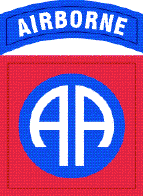
Two white A’s in a blue disc on a red square. The 82nd Division called itself “All American” because its draftees at Camp Gordon, Georgia, in 1917 came from every one of the then 48 states, and the monogram became its patch in 1918, the year Sgt. Alvin York wore it in the Argonne. When the division was converted to airborne in August 1942 under Matthew Ridgway, an arched “AIRBORNE” tab was sewn above it. The patch went on to jump into Sicily, Salerno, Normandy and Holland and to fight in the Ardennes.

The screaming white-headed eagle is “Old Abe,” the live bald eagle the 8th Wisconsin Infantry carried into Civil War battles. When the 101st was organized as a Reserve division in Wisconsin after the First World War, it took the eagle for its insignia, approved in 1923; the black field is usually explained as a nod to Wisconsin’s Civil War “Iron Brigade.” In August 1942 the division was reborn as the 101st Airborne and an “AIRBORNE” tab was added. Its paratroopers, among them the Filthy Thirteen, jumped into Normandy and Holland and held Bastogne in the Battle of the Bulge.

A wartime-pattern 101st Airborne patch with its arched tab, photographed in 2006 at the Kehlsteinhaus, the “Eagle’s Nest” above Berchtesgaden. The 101st moved into the Berchtesgaden area in early May 1945, just after the 3rd Infantry Division and French troops of the 2nd Armored Division reached the town, and which unit first climbed to Hitler’s mountain house has been argued ever since. Cloth patches like this one were made by dozens of contractors, and collectors can often date them by weave, thread and the cut of the tab.

A golden eagle’s talon on a black disc, under a black “AIRBORNE” tab. The Army’s heraldic description says the talon stands for the airborne division’s ability to seize and hold ground, and the black for the darkness in which it would often fight. Activated in April 1943, the 17th reached England in August 1944 and was flown to France as a reserve during the Battle of the Bulge, fighting on the snowbound ground near Flamierge in January 1945. On 24 March 1945 it jumped across the Rhine with the British 6th Airborne Division in Operation Varsity, the largest single-day airborne operation of the war.
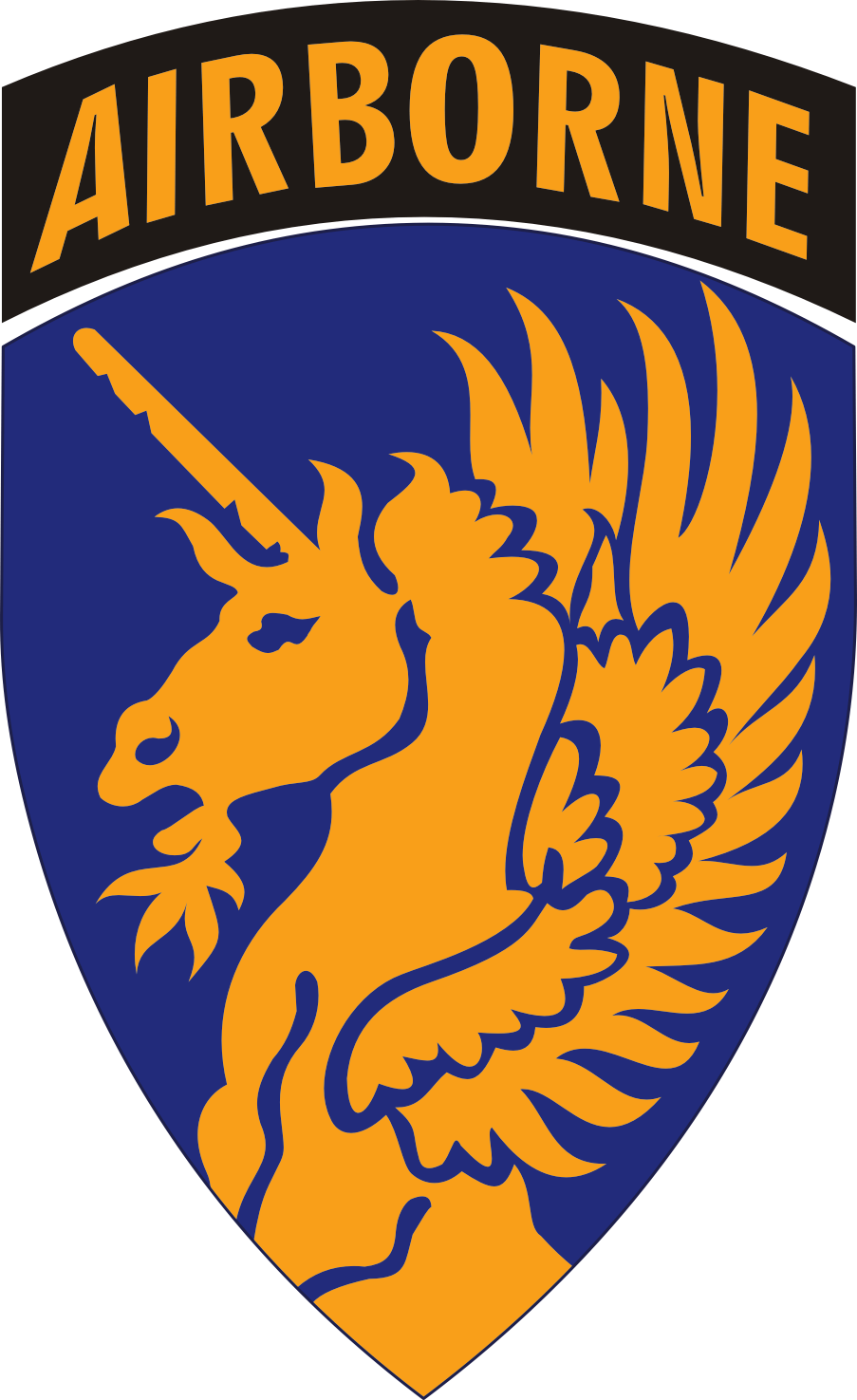
A golden-orange winged unicorn rising on an ultramarine blue shield. The heraldic description chooses the unicorn for virtue, courage and strength, the wings for airborne and the colors for the Air Corps. Activated in August 1943, the 13th trained for two years and reached France in early 1945, where Allied deception planners merged the phantom 9th and 21st Airborne Divisions into its identity. Every drop planned for it, including a role in the Rhine crossing, was cancelled for want of transport aircraft, and the unicorn never saw combat.

A red disc bearing a white “11” on a winged white disc, all on a blue shield: the patch of the 11th Airborne, “the Angels.” Activated in 1943, the division fought on Leyte as infantry in late 1944, jumped onto Tagaytay Ridge on the road to Manila in February 1945, and on 23 February 1945 raided the Los Baños internment camp behind Japanese lines, freeing 2,147 civilian internees. Its men were the first occupation troops flown into Japan, landing at Atsugi on 30 August 1945. This is the drawing of 2022, when the Army revived the 11th Airborne in Alaska under its wartime insignia.

A yellow thunderbird on a red square set on its point. The 45th Division, formed from the Oklahoma, Colorado, New Mexico and Arizona National Guard, first wore a yellow swastika on red, a sun and good-luck symbol common in Southwestern Native American art, approved in 1924. As Hitler’s party made the swastika its own, the division dropped it, and in 1939 the Army approved a thunderbird drawn by the Kiowa artist Woody Big Bow of Carnegie, Oklahoma. The Thunderbirds made four amphibious assaults, beginning in Sicily, spent 511 days in combat and liberated Dachau on 29 April 1945. The drawing shown is the same thunderbird as approved today for the 2nd Battalion, 134th Infantry.
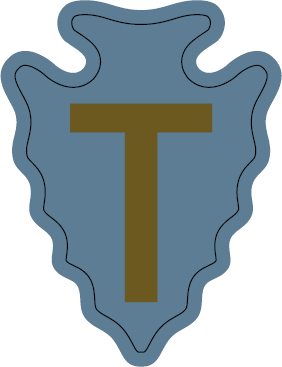
A blue flint arrowhead for Oklahoma carrying an olive-drab “T” for Texas: the insignia of the division formed from the two states’ National Guards in 1917, whose 142nd Infantry included the Choctaw soldiers who passed messages in their own language in the Meuse-Argonne. In the Second World War the T-Patchers were the first American division to land in Europe, at Salerno on 9 September 1943. They lost heavily trying to cross the Rapido River in January 1944, broke the German line at Velletri in May, and landed in southern France on 15 August 1944. This drawing is the Institute of Heraldry’s 2021 update of the design.
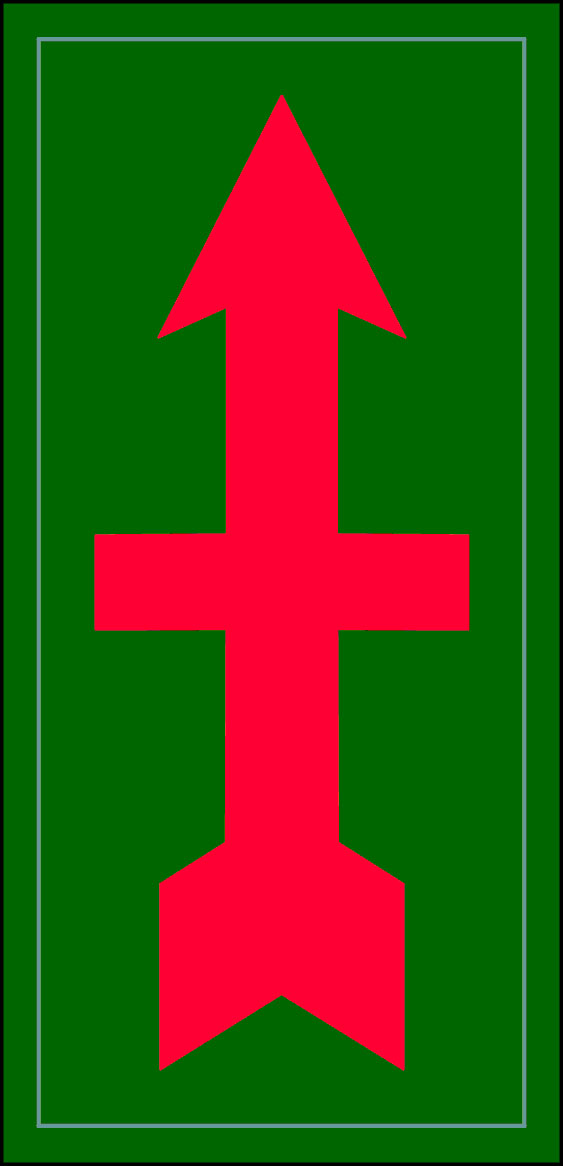
A red arrow shot through a line: the 32nd Division’s way of saying it pierced every German line it faced in 1918, including the Hindenburg Line in October, when the French general Mangin called its Michigan and Wisconsin Guardsmen “Les Terribles.” In the Second World War the Red Arrow went to Papua in 1942 and assaulted Buna from 16 November, one of the most miserable battles Americans fought. It went on to Saidor, Aitape, Morotai, Leyte and the Villa Verde Trail on Luzon, and its 654 days in combat were more than any other Army division’s.

A red taro leaf, the Hawaiian Division’s old emblem, edged in yellow and struck by a yellow lightning bolt. The 25th was formed at Schofield Barracks in October 1941 and was there when Japanese aircraft attacked Oahu on 7 December. It relieved the Marines on Guadalcanal and moved so fast under “Lightning Joe” Collins in January 1943 that it became “Tropic Lightning.” It fought on New Georgia and through 165 days of continuous combat on Luzon in 1945. This file renders the scarlet and yellow approved by the Army’s heralds.
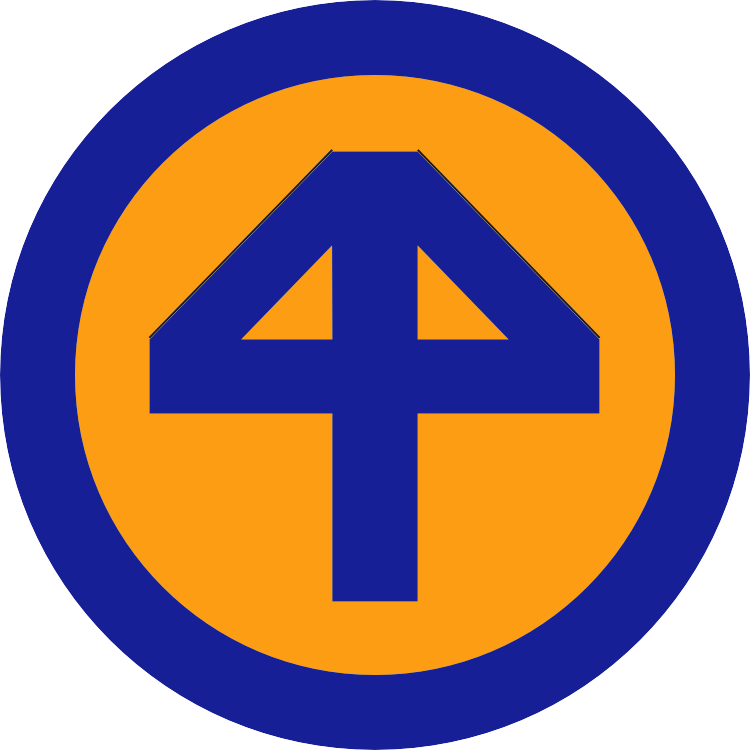
Two numeral 4s set back to back: the plain arithmetic of the 44th, a New Jersey and New York National Guard division. It landed in France in September 1944, fought with Seventh Army in Lorraine and the Vosges and ended the war in Austria. On 2 May 1945 Magnus von Braun bicycled down a mountain road near Reutte and surrendered to a private of the division’s 324th Infantry on behalf of his brother Wernher and the German rocket team, the start of the American missile program.

A snarling black panther, the badge of a division activated in 1943 that suffered one of the worst troopship disasters in American history. On Christmas Eve 1944 the Belgian transport Leopoldville, carrying men of the 66th’s 262nd and 264th Infantry across the Channel to reinforce the Ardennes front, was torpedoed by U-486 about five miles off Cherbourg; about 763 American soldiers died. The Army kept the loss quiet for years. The division spent the rest of the war containing the German garrisons in Lorient and Saint-Nazaire.

A blue French Adrian helmet on black. In 1918 the African American regiments of the 93rd Division, among them the 369th “Harlem Hellfighters,” were lent to the French Army, which issued them its helmets; the patch remembers that. Reactivated in 1942 as one of the Army’s two Black infantry divisions, the 93rd went to the Pacific in 1944. Its 25th Infantry fought on Bougainville and elements served on Morotai and in the Philippines, but the segregated Army used most of the division for labor and garrison duty.
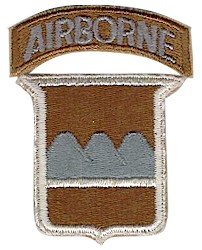
Three blue hills outlined in white on an olive-drab shield: the Blue Ridge Mountains of Virginia, West Virginia and Pennsylvania, home of the draftees who formed the division in 1917. In the Second World War the Blue Ridge Division fought across France with Patton’s Third Army from August 1944, and in December turned north into Luxembourg to hit the southern flank of the German Ardennes offensive. After the war it was reorganized in the Reserve as an airborne division (1946–52), which is why this version wears an “AIRBORNE” tab.

A big yellow shield, cavalry yellow, crossed by a black bar and topped by a black horse’s head, approved in January 1921 when the division was at Fort Bliss, Texas; division tradition credits the first one to an officer’s wife who cut it from a cavalry cape. In the Second World War the troopers left their horses behind and fought as infantry: on Los Negros in the Admiralty Islands from 29 February 1944, on Leyte, and in a “flying column” that reached Manila on 3 February 1945. On 8 September 1945 the 1st Cavalry became the first American division to enter Tokyo.

Every American armored division wore this triangle: yellow for cavalry, blue for infantry and red for artillery, the three arms fused in the armored force, with a tank track, a cannon and a red lightning bolt, and the division’s number in the apex. The 1st Armored, “Old Ironsides,” was the first American armored division to fight the Germans. It went to war in pieces in North Africa, lost two tank battalions at Sidi Bou Zid in February 1943 and finished the campaign taking German surrenders; see Old Ironsides in Tunisia. It then fought the length of Italy.
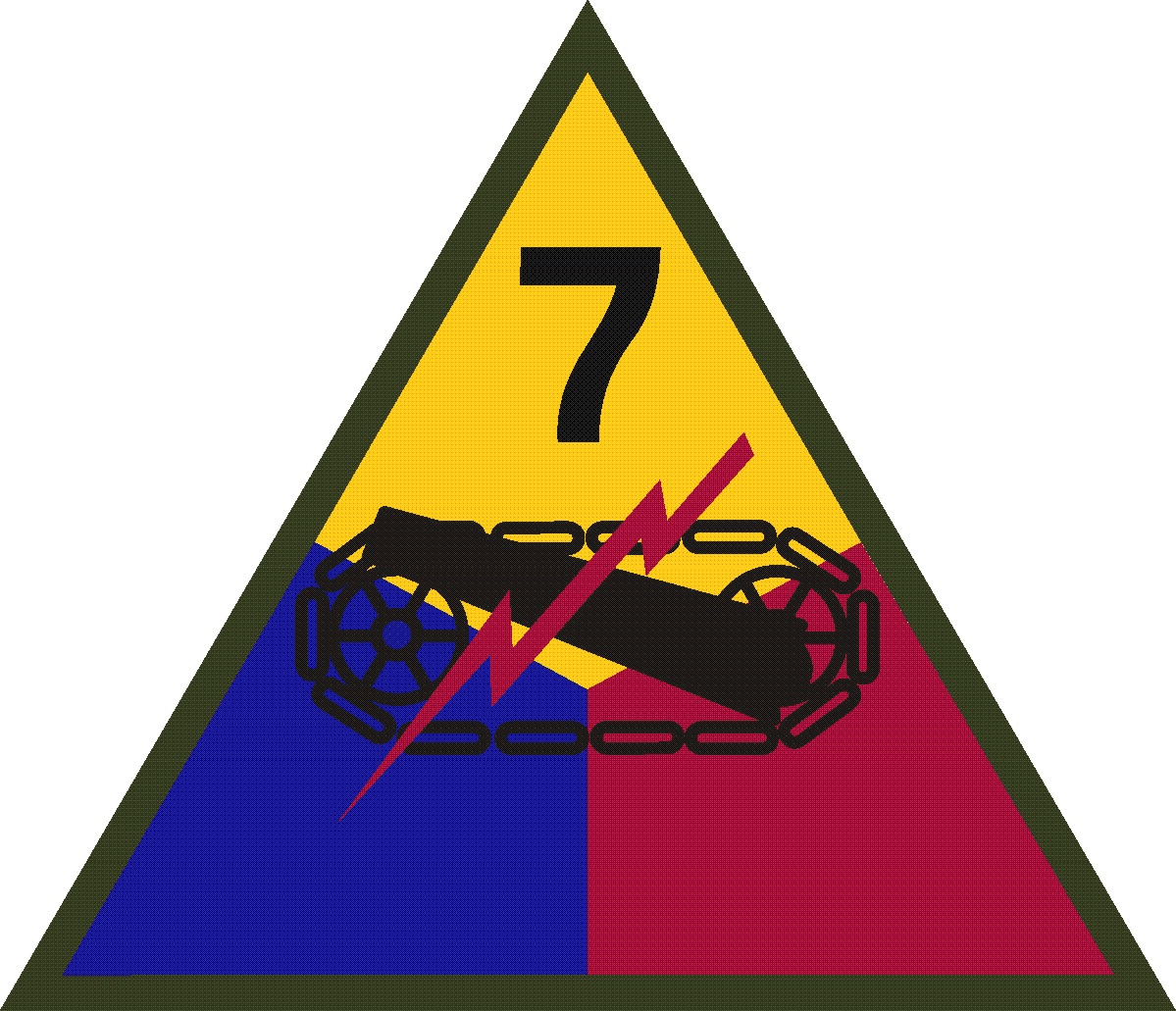
The armored-force triangle, with “7” in the apex. The 7th Armored crossed France with Third Army in 1944, but its defining days came in the Battle of the Bulge. Rushed south to the road and rail town of St. Vith on 17 December, its combat command under Brig. Gen. Bruce Clarke, with remnants of the 106th Division and the 9th Armored, held the town against repeated attacks until 21 December, wrecking the German timetable before withdrawing west across the Salm.
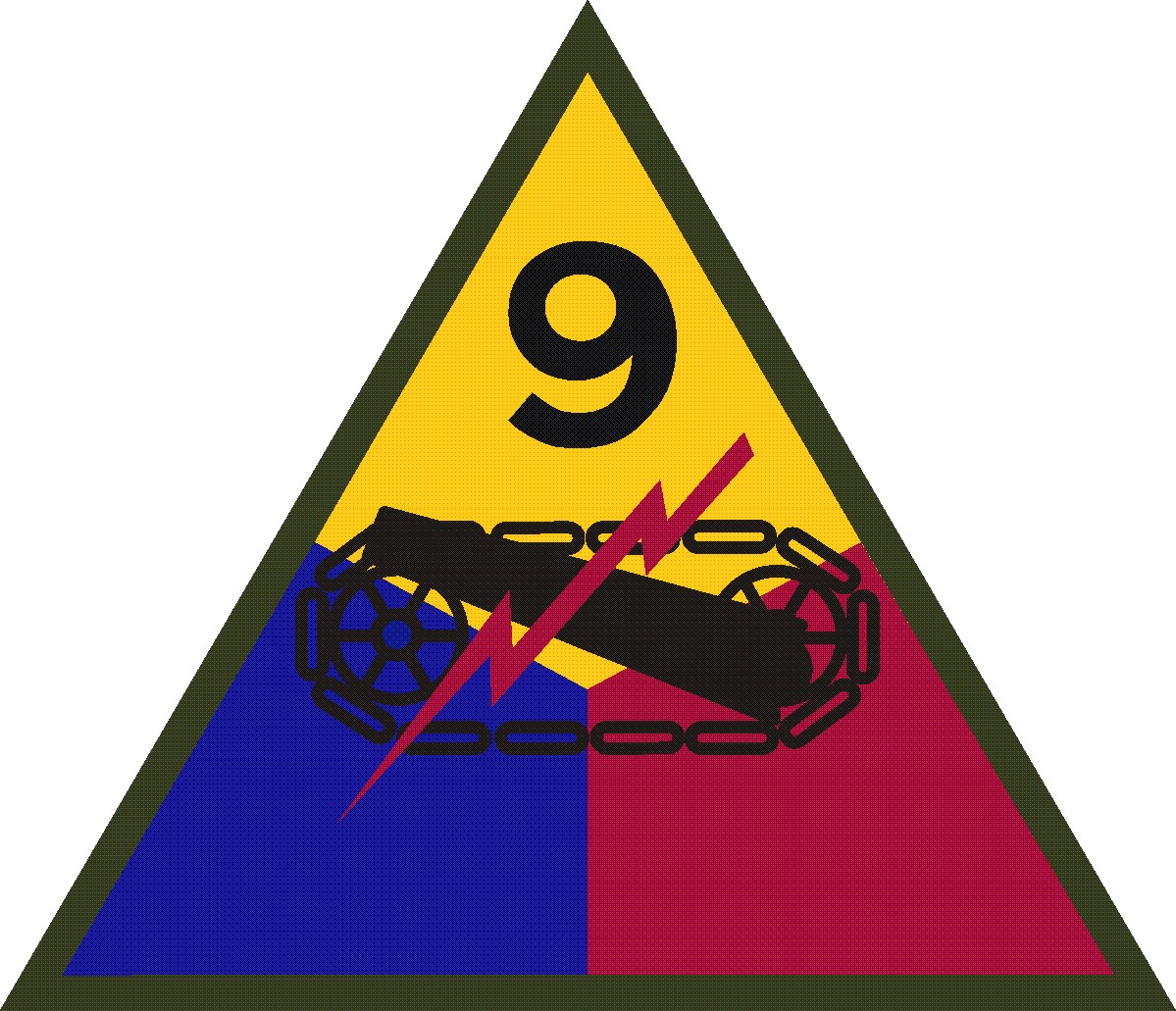
The armored triangle again, with a “9.” The 9th Armored was spread thin in the Ardennes when the Germans attacked in December 1944; one combat command fought at St. Vith and another east of Bastogne. On 7 March 1945 its Combat Command B found the Ludendorff railroad bridge at Remagen still standing, and Lt. Karl Timmermann led a company of the 27th Armored Infantry Battalion across it under fire as German charges failed to drop the span: the first Allied crossing of the Rhine.

A headquarters version of the first American shoulder patch. The 81st Division trained at Camp Jackson, South Carolina, by Wildcat Creek, and sailed for France in 1918 wearing a felt wildcat on the left shoulder. When other units objected, General Pershing ruled for the 81st, the Army made the patch official on 19 October 1918, and other divisions were urged to design their own. The division told its units apart by varying the colors of the cat and its background; this one, from the division historian’s files, marked headquarters.

On 7 June 1944, the day after D-Day, men of the 2nd Infantry Division march up the E-1 draw in the Easy Red sector of Omaha Beach, past the German strongpoint WN 65 that had guarded the route to Saint-Laurent-sur-Mer. Their patch, an Indian head in a war bonnet on a white star on a black shield, dated from 1918. The “Indianhead” division fought through the Normandy hedgerows, took Brest and later held the northern shoulder of the Bulge at Elsenborn Ridge.
Gallery: Rangers, phantom divisions and the home front
Insignia beyond the divisions: the Ranger scroll and diamond, the patches of airborne divisions that existed only in Allied deception plans, the charts that taught a nation to read rank and branch, and the emblems of civil defense and the women’s services.

The Ranger scroll began as an unofficial insignia worn by Darby’s Rangers, the 1st Ranger Battalion raised in Northern Ireland in 1942 on the British commando model, who led the landings at Arzew, Gela and Salerno. The Army had approved a blue diamond for all Ranger battalions on 26 July 1943, but only the 2nd and 5th wore it, and later in the war they too switched to scrolls patterned on the 1st Battalion’s. In 1984 the 75th Infantry adopted the 1st Battalion-pattern scroll, drawn here, for its modern Ranger battalions.

The 2nd Ranger Battalion went ashore on D-Day wearing the blue Ranger diamond. Three of its companies under Lt. Col. James Earl Rudder climbed the cliffs of Pointe du Hoc on 6 June 1944 with ropes and ladders, found the guns moved inland and destroyed them, then held the clifftop for two days. Later in the war the 2nd traded the diamond for an unofficial scroll like the 1st Battalion’s. This is the Institute of Heraldry’s 1984 drawing for the modern 2nd Battalion of the 75th Ranger Regiment.

There was no American 6th Airborne Division, but the Germans were meant to think there was. In Operation Vendetta, from May to July 1944, Allied planners in the Mediterranean dressed real units, including the 517th Parachute Regimental Combat Team and the 550th Airborne Infantry Battalion, as a phantom division under Seventh Army, said to be ready to drop near Narbonne in support of a fictitious invasion. Radio traffic, rumors and insignia gave it substance. It was announced as disbanded in July 1944.
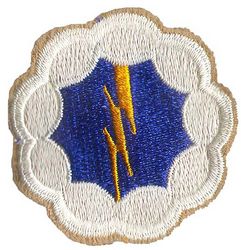
A phantom of Operation Fortitude South, the deception that kept German divisions waiting in the Pas-de-Calais for an invasion that never came. From June 1944 the notional 9th Airborne, like the 21st, stood in the Allied order of battle that German intelligence was fed by double agents and fake radio traffic. In November 1944 the two phantoms were “merged” into the very real 13th Airborne Division, then about to sail for France.

Activated on paper in the United States in 1945, the phantom 18th Airborne served Operation Dervish, an unrealized plan to suggest a large airborne threat to Germany in early 1945. It was then assigned to Pastel, the deception plan meant to hide the real target of the planned invasion of Kyushu. A notional division needed the trappings of a real one, and an insignia was part of the costume.

The 135th Airborne existed only in Allied deception plans, listed with real-sounding subordinate units including the 551st Parachute Infantry. Which operation it served is not clear from the published record, so its story is still incomplete. Its insignia survives in the Army Quartermaster Museum’s collection of airborne patches, a reminder that the war’s deceivers designed patches for armies that never marched.

A page from the Pocket Guide of Uniform Insignia, printed by the Government Printing Office in 1943 for the Army’s Special Service Division to help soldiers “recognize commissioned officers and national colors of the United Nations.” This spread shows American officers’ shoulder-strap insignia and the Navy’s sleeve stripes. A millionfold army of new soldiers had to learn whom to salute, and the guide treated rank badges as a visual language to be memorized like aircraft silhouettes.

A wartime chart, now in the National Archives, titled “Insignia of the Army of the United States.” Posters like this hung in post offices, schools and recruiting stations as the Army grew from about 190,000 men in 1939 to more than eight million, so that families could read the stripes, bars and badges on sons and daughters coming home on leave. They also made the patch system a piece of popular knowledge: newspapers and magazines printed charts of division insignia, and children collected them.

The home front had its own patches. The Office of Civilian Defense, created in May 1941, gave its volunteers a family of emblems built on one device, a white triangle in a blue disc with the letters CD in red, usually credited to the advertising art director Charles Coiner. Each service added its own symbol inside the triangle: air-raid wardens, auxiliary firemen, rescue squads, nurses’ aides, messengers and more. By 1943 millions of Americans wore an armband or patch from this chart.

A Women’s Army Auxiliary Corps recruit stands before the flag in her new uniform. Created in May 1942, the WAAC at first had its own insignia, including an eagle that soldiers nicknamed the “walking buzzard,” and adopted the head of Pallas Athena, Greek goddess of wisdom and war, as its branch emblem. When the auxiliary became the Women’s Army Corps, part of the Army itself, in mid-1943, Athena stayed on the collar. About 150,000 American women served in the WAAC and WAC during the war.
Insignia from Burbank: Disney goes to war
In 1933 the Walt Disney studio drew an insignia for a Naval Reserve squadron at Floyd Bennett Field in New York. When the United States began to mobilize in 1940 the requests became a flood, and Disney answered all of them free of charge. Units could write to the studio directly without going through higher headquarters. By the end of the war the studio had produced about 1,200 designs, according to the National Museum of the U.S. Air Force, for every American service and for units of Britain, Canada, China, France, New Zealand, South Africa and Poland, as well as for civil defense groups and war plants.
Six artists did most of the work: Hank Porter, who led the effort throughout the war, Roy Williams, Bill Justice, Van Kaufman, Ed Parks and George Goepper. Porter drew the boxing-glove eagle of the American Eagle Squadrons of the Royal Air Force, which went on to the 334th Fighter Squadron, and with Williams he drew the Flying Tiger. Donald Duck appeared in at least 216 designs, more than any other character; Pluto, Goofy and Dumbo followed, while Mickey Mouse was saved for gentler units such as signal companies and was never used for combat units. The artists also invented about 90 new cats and 50 new dogs, along with apes, owls, octopuses, roosters and storks. Hearst newspapers sold albums of insignia stamps from February 1942, and Disney let the designs be used without royalties.
The insignia meant a lot to the men who were fighting … I had to do it … I owed it to them. — Walt Disney, as quoted by the National Museum of the U.S. Air Force (“Disney Pins on Wings”)
Few of the Disney designs were ever officially approved. Units were supposed to submit their insignia to the War Department, but in wartime the step was often skipped, and in the Army Air Forces a squadron’s cartoon emblem could be painted on jackets, aircraft and squadron signs for years without Washington’s blessing. The Navy was more formal: the Chief of Naval Operations approved Disney’s razor-beaked bat for Bombing Squadron 81 on 23 May 1944. Other Hollywood animation studios drew insignia too, and so did thousands of amateur artists in the ranks.

R. T. Smith, flight leader in the AVG’s 3rd Squadron, at Kunming on 23 May 1942. The Flying Tiger insignia, drawn at the Disney studio by Hank Porter and Roy Williams, reached the group as decals in mid-March 1942. Smith’s cap carries the badge of the Chinese air force, in which the volunteers nominally served.
Disney's most famous insignia
The Flying Tiger
Robert T. Smith, a flight leader of the American Volunteer Group’s 3rd Squadron, stands beside his P-40, “40,” at Kunming on 23 May 1942. Behind the cockpit is the Flying Tiger, a winged tiger leaping through a V for Victory, drawn by Hank Porter and Roy Williams at the Disney studio. The group already had its nickname; it asked Disney for the picture. The decals arrived in mid-March 1942, and the tiger joined the shark mouth that the volunteers had copied from an RAF squadron in North Africa.
The AVG flew for China from December 1941 until July 1942; read The American Volunteer Group: The Flying Tigers. Its tiger passed to the 23rd Fighter Group and the Fourteenth Air Force, and lives on in their heraldry.
Gallery: Army Air Forces, the Flying Tigers and the Tuskegee Airmen
The patches of the numbered air forces and commands, the Flying Tigers and their heirs, and the Tuskegee Airmen, from the Mighty Eighth in England to the Fourteenth in China.

The basic device of American air power in the Second World War: a white star with a red disc at its center, spread on golden wings against ultramarine blue. Airmen who belonged to no numbered air force wore it on the left shoulder, and it is often called the “Hap Arnold” emblem after the AAF’s commanding general. Commons files this scan as the AAF patch of the World War II schools from which Air University descends. Most numbered air forces built their own patches on the same star.

A golden numeral 8 with wings and a white star with a red center, on blue: the patch of the “Mighty Eighth,” activated at Savannah, Georgia, in January 1942 and sent to England to bomb Germany by daylight. Its B-17s and B-24s and their fighter escorts flew from dozens of English airfields. Regensburg, Schweinfurt, Big Week and Berlin were its battles, and more than 26,000 of its airmen were killed. Its squadrons’ emblems fill the next gallery.

The Twelfth Air Force was activated in August 1942 for Operation Torch and flew into North Africa with the invasion that November. It became the Mediterranean’s tactical air force, supporting the armies in Tunisia, Sicily, Italy and southern France while the Fifteenth, split from it in late 1943, took on the strategic bombing. Its close-support arm in the Kasserine battles is the subject of the page on XII Air Support Command.

An Allied command with an American patch: the Mediterranean Allied Air Forces united the U.S. Twelfth and Fifteenth Air Forces with the Royal Air Force’s Mediterranean commands from December 1943, under Lt. Gen. Ira Eaker from January 1944. Its shoulder insignia was approved on 14 August 1944, the eve of the invasion of southern France, and was worn by American personnel of the combined headquarters at Caserta and elsewhere.

The Twentieth Air Force was created in April 1944 for one aircraft, the B-29 Superfortress, and one purpose, the strategic bombing of Japan. General Arnold commanded it himself from Washington so no theater commander could divert it. It flew first from India and China and then from Saipan, Tinian and Guam, burned Japanese cities from March 1945, mined Japan’s waters, and on 6 and 9 August 1945 dropped the atomic bombs on Hiroshima and Nagasaki.

The winged tiger on this patch is the Flying Tiger of the American Volunteer Group, whose emblem was drawn at the Disney studio. When the AVG was disbanded in July 1942 its commander, Claire Chennault, took over the China Air Task Force, which became the Fourteenth Air Force in March 1943. Supplied over the Hump from India, it fought the Japanese air force over China, attacked shipping off the China coast and kept the tiger’s name alive.

The “Jungle Air Force” was activated in January 1943 on New Caledonia and fought up the Solomons from Guadalcanal, where its fighters shared the Cactus airfields with Navy and Marine squadrons. Its P-38s flew the April 1943 mission that shot down Admiral Yamamoto over Bougainville. It went on to Rabaul, the Netherlands East Indies, Borneo’s oil fields and the Philippines.

The Seventh Air Force grew out of the Hawaiian Air Force that was caught on the ground at Hickam and Wheeler fields on 7 December 1941. Its patch was approved on 21 May 1943. From Hawaii it moved west with the Central Pacific offensive through the Gilberts, Marshalls and Marianas to Iwo Jima and Okinawa, its bombers often flying the longest over-water missions of the war.

The Sixth Air Force guarded the Panama Canal, the most important choke point in the American war effort, flying antisubmarine and reconnaissance patrols across the Caribbean and the Pacific approaches from bases in the Canal Zone, the Galápagos and Central and South America. Few of its men saw combat, but its patch was worn proudly at some of the war’s loneliest stations.

Not every air force fought overseas. The Second Air Force ran the training bases of the American West where heavy-bomber crews learned to fly the B-17, B-24 and later the B-29 together before going to war, and its fields from Washington State to Texas turned out thousands of crews. The 509th Composite Group trained under it at Wendover Field, Utah, to drop the atomic bomb.

I Fighter Command, part of First Air Force, was responsible for the air defense of the Atlantic coast. After Pearl Harbor its interceptor squadrons stood alert against bombers that never came, while its training units turned out fighter pilots and its aircraft-warning network enlisted thousands of civilian volunteers as ground observers who reported every aircraft they saw or heard.

The engineers, supply clerks and mechanics behind the bombers. Formed in 1944 by merging the Materiel Command and the Air Service Command, with headquarters at Wright Field, Ohio, the Air Technical Service Command tested aircraft, bought and shipped parts and ran the great depots that overhauled engines. Its men also gathered captured German and Japanese aircraft for study at the end of the war.
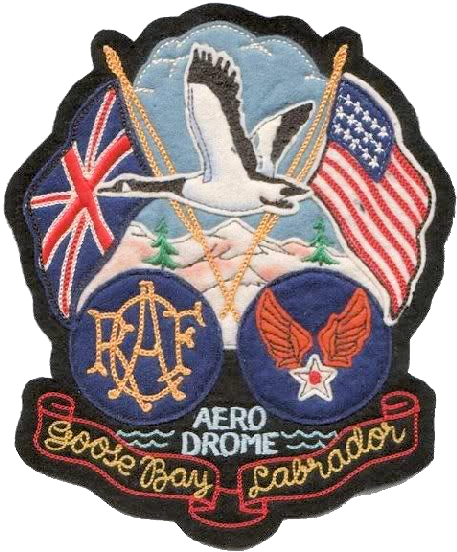
A patch for one of the war’s crossroads. Goose Bay, built in Labrador from 1941, was a stepping stone on the North Atlantic ferry route by which thousands of American-built bombers and fighters flew to Britain by way of Greenland and Iceland. American and Royal Air Force personnel shared the base, and this joint patch belonged to that mixed community.

A detail of the Flying Tiger, a winged Bengal tiger leaping through a V for Victory, on R. T. Smith’s P-40 at Kunming. The American Volunteer Group already had its name when it asked the Disney studio for an emblem; the National Museum of the U.S. Air Force credits Hank Porter and Roy Williams with the design. The decals reached the group in mid-March 1942 and were applied to the fuselages behind the cockpit, where they joined the shark mouths on the noses.

John Petach of the AVG’s 2nd Squadron in the cockpit of a P-40 with the Disney tiger on its side. Petach married the AVG nurse Emma Jane Foster in China. When the group was disbanded on 4 July 1942 he was one of the volunteers who agreed to stay on for two weeks to help the incoming Army Air Forces unit, and he was killed on a mission on 23 July 1942. More of the story is on our page on the Flying Tigers in China.

A Chinese soldier guards a line of P-40s painted with the shark-face emblem of the Flying Tigers. The AVG’s pilots borrowed the shark mouth from a photograph of a Royal Air Force Tomahawk of No. 112 Squadron in North Africa (see the Allied gallery below), and it became more famous than the official Disney tiger. The volunteers were credited with about 296 Japanese aircraft between December 1941 and July 1942, a figure historians still debate.

The 23rd Fighter Group inherited the AVG’s planes, its base at Kunming and its nickname when it replaced the volunteers in July 1942. This American-made patch was donated to the San Diego Air & Space Museum by Sidney Gershow, an armorer with the group’s 76th Fighter Squadron who flew over the Hump to China and serviced the P-51s that raided Hong Kong. The group’s official emblem, a Flying Tiger over a bolt of lightning, was approved only in 1957.

Charles Alston, a Harlem Renaissance painter working for the Office of War Information, drew this tribute to the 99th Pursuit Squadron, the first Black American flying unit, for the Black press in 1943. The airmen wear the helmets, goggles and leather flight jackets that made them recognizable heroes. The 99th reached North Africa in April 1943 and flew its first combat missions over Pantelleria in June; see The 99th Fighter Squadron.

The second Black flying group trained on B-25 Mitchell medium bombers from 1944 but never went overseas. In April 1945 its officers challenged a segregated officers’ club at Freeman Field, Indiana; 101 of them refused to sign a regulation upholding it and were arrested in one of the war’s most important civil rights protests. In June 1945 Col. Benjamin O. Davis Jr. took command, the first Black officer to command an Army Air Forces base. The Air Force set aside the Freeman Field reprimands in 1995.
Gallery: bomb and fighter groups
The emblems of bomb and fighter groups from England and Italy to Australia and the Marianas. Where a group’s official insigne was approved only after the war, the story says so; the American air arm grew far faster than its heralds could work.

A golden cougar’s paw with red claws on blue, approved in June 1941 with the motto Ducemus, “We Lead.” The 22nd took the B-26 Marauder into combat for the first time from Australia in April 1942 and won Distinguished Unit Citations for Papua (1942–43) and for New Guinea on 5 November 1943. Flying Marauders, then B-25s and B-24s, the “Red Raiders” fought from New Guinea to Luzon.
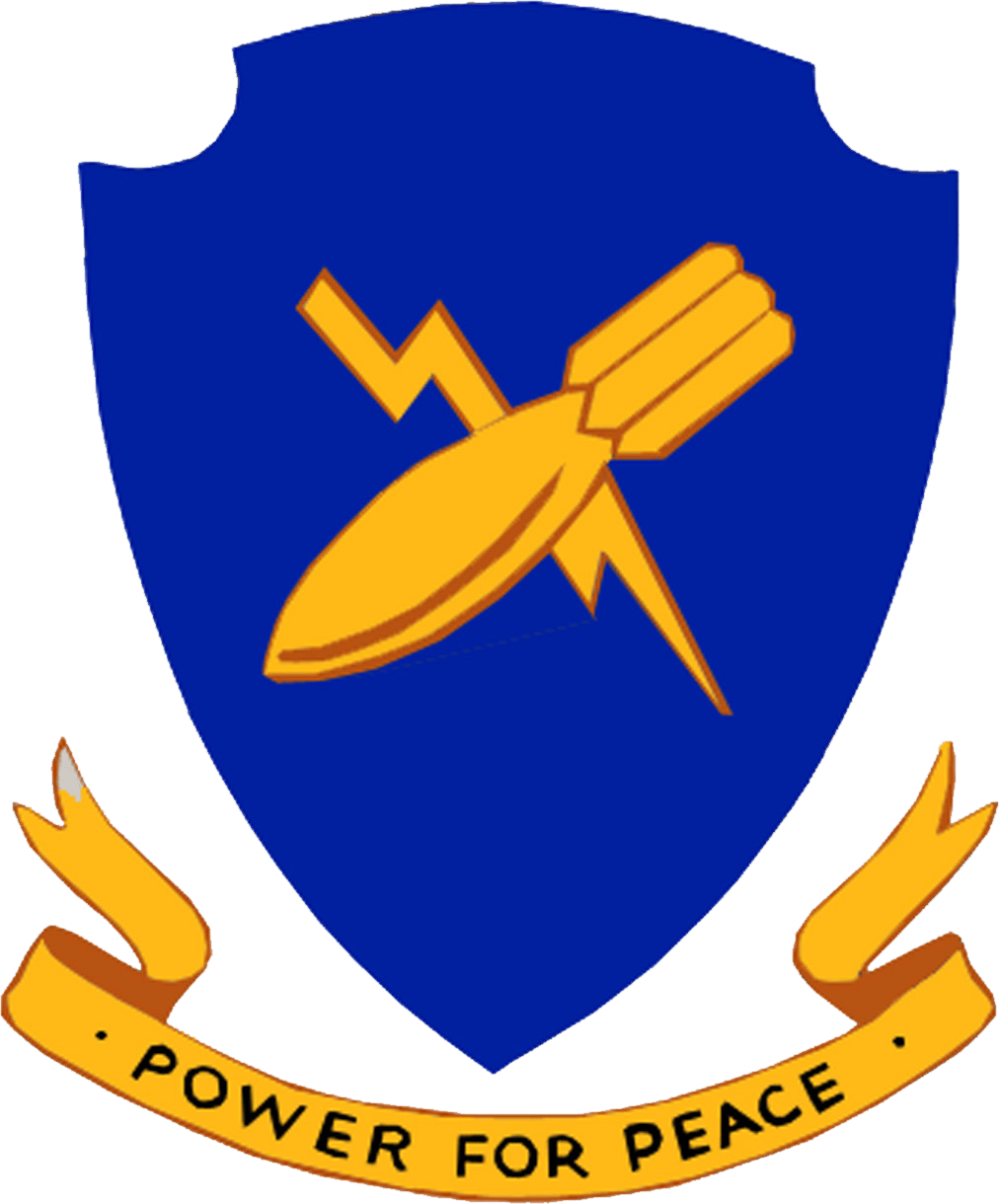
A golden drop bomb and lightning flash crossed on blue, approved in October 1940 with the motto “Power for Peace.” The 29th flew Caribbean patrols after Pearl Harbor and then trained on the B-29. From Guam it bombed Tokyo for the first time on 25 February 1945, flew the low-level fire raids on Japan’s cities from March, and won Distinguished Unit Citations for Omura airfield and the June 1945 attacks on Japanese industry.

Four golden bombs falling in a cross over a bomb burst, approved in March 1942 when the 40th was hunting submarines from Puerto Rico and Panama. Converted to the B-29, it flew from India and staging fields in China, and on 15 June 1944 joined the first attack on the Japanese home islands since the Doolittle Raid, against the Yawata steelworks, which it hit again on 20 August for a Distinguished Unit Citation. It ended the war on Tinian.

A blue dragon breathing fire on gold, holding in its claw a stylized black boll weevil, approved in March 1943; the weevil is a Southern joke about the cotton pest, the dragon what the group meant to be. The 81st flew P-39s with Twelfth Air Force over Tunisia, Sicily and Anzio, then moved to China in 1944, where its P-47s attacked Japanese airfields and supply lines for the Fourteenth Air Force.

The 21st flew some of the longest fighter missions ever: from Iwo Jima to Japan and back, more than 1,200 miles, escorting B-29s. Its P-51s reached Iwo in March 1945 while the island was still being fought for, and on the night of 26 March Japanese survivors attacked its tents, killing pilots and ground crew. On 7 April 1945 its Mustangs flew the first fighter escort over Tokyo.
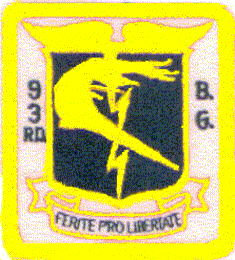
The first B-24 Liberator group in the Eighth Air Force, nicknamed “Ted’s Travelling Circus” for its commander, Col. Edward Timberlake, and for its travels: detachments flew from England, Libya and Tunisia. On 1 August 1943 it flew the low-level raid on the Ploesti oil refineries in Romania, where its leader, Lt. Col. Addison Baker, and his co-pilot, Maj. John Jerstad, held their burning Liberator on course to the target and were awarded the Medal of Honor posthumously.

The “Pyramiders” took their name from their first combat base, Egypt, where their B-24s arrived in July 1942 to bomb Rommel’s supply ports. At Ploesti on 1 August 1943 their commander, Col. John R. “Killer” Kane, led the group through the smoke and flames of a target already bombed, and won the Medal of Honor; the group lost 21 of its Liberators. It went on to fly from Italy with the Fifteenth Air Force.

The 96th Bomb Group’s insignia, photographed in England in 2017. The 96th flew B-17s from Snetterton Heath in Norfolk from 1943 to 1945 and earned Distinguished Unit Citations for the shuttle raid on the Messerschmitt works at Regensburg on 17 August 1943, which flew on to North Africa, and for an attack on aircraft factories in Poland in April 1944. Its four squadrons’ badges appear in the next gallery.

The insignia of the 99th Bombardment Group and its four squadrons, the 346th, 347th, 348th and 416th, drawn together. The “Diamondbacks,” named for the diamond on their B-17s’ tails, flew from Algeria and Tunisia in 1943 and then from Tortorella near Foggia with the Fifteenth Air Force, bombing targets from Sicily to Germany, Austria and the Balkan oil fields.

No Eighth Air Force group had a darker reputation for losses. The 100th flew B-17s from Thorpe Abbotts, Norfolk, marked with a square D on the tail. It lost nine bombers on the Regensburg shuttle of 17 August 1943 and, at Münster on 10 October 1943, twelve of its thirteen; only Lt. Robert Rosenthal’s Royal Flush came home. It won Distinguished Unit Citations for Regensburg and for the Berlin raids of March 1944, and its story was retold in the 2024 series Masters of the Air.

The 340th flew B-25 Mitchells from North Africa, Sicily, Italy and Corsica. In March 1944 the eruption of Mount Vesuvius rained hot ash and rock on its airfield near Pompeii and destroyed dozens of its bombers without a shot fired. On Corsica a bombardier of its 488th Squadron, Joseph Heller, flew 60 missions; his novel Catch-22 (1961) turned the group’s war into the most famous satire of military bureaucracy ever written.

The 351st flew B-17s from Polebrook, Northamptonshire, from May 1943. Its most famous member was a captain who flew five missions as an aerial gunner and cameraman in 1943: Clark Gable, the Hollywood star, sent to England to film gunners for the training film Combat America. Squadron patches were often made in English shops and sewn onto the men’s flight jackets.

The “Flying Circus” flew B-24s from airstrips in Australia’s Northern Territory from 1943, attached to the Royal Australian Air Force and later training Australian Liberator crews. Its longest raids, against the oil refineries at Balikpapan in Borneo on 13, 15 and 17 August 1943, earned a Distinguished Unit Citation. The wartime logo shown predates the group’s official insignia, approved only in 1956.
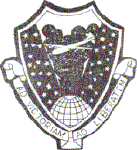
One of the four original B-29 groups of XX Bomber Command, the 444th flew from Charra and Dudhkundi in India, staging through China to bomb Japan, Manchuria and Southeast Asia, and hauling its own fuel and bombs over the Hump. In 1945 it moved to Tinian for the final campaign against the Japanese home islands.

An early emblem based on the Fifteenth Air Force’s first insignia, used by a B-24 group at Grottaglie in southern Italy. The 449th bombed oil, rail and industry across Germany, Austria and the Balkans and won Distinguished Unit Citations for the Bucharest marshalling yards on 4 April 1944 and the Ploesti refineries on 9 July 1944. Maurer’s official history lists no approved insigne for it.
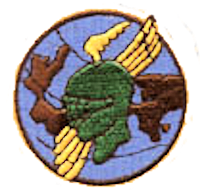
The 450th’s Liberators, flying from Manduria in Italy from January 1944, wore white tails, so the group became the “Cottontails.” It fought through Big Week and won Distinguished Unit Citations for the Messerschmitt factory at Regensburg on 25 February 1944 and the Ploesti marshalling yards on 5 April 1944.

A B-24 group of the Fifteenth Air Force at San Giovanni airfield near Cerignola, Italy, from early 1944. It won Distinguished Unit Citations for the raid on the airdrome at Bad Vöslau, Austria, on 12 April 1944, and for leading its wing against the steel plants at Linz on 25 July 1944, and also supported the drive on Rome and the landings in southern France.
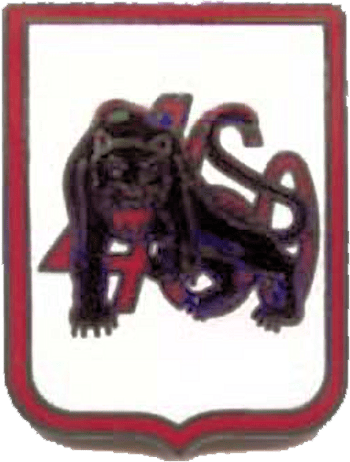
The 460th flew B-24s from Spinazzola, Italy, from March 1944 to April 1945, mainly against oil, rail and industry in Central Europe and the Balkans, winning a Distinguished Unit Citation for leading the wing against the airdrome at Zwölfaxing, Austria, on 16 July 1944. After Germany’s surrender it moved to Brazil to support Air Transport Command.
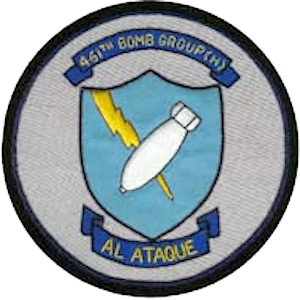
A Fifteenth Air Force Liberator group at Torretta, Italy, from April 1944. It won Distinguished Unit Citations for an aircraft-components plant in Budapest on 13 April 1944 and for the Ploesti oil refineries in July 1944. The emblem shown is the wartime one; the group’s formal insigne, a thunderbolt through cloud between sun and moon, was approved in 1955.

The 467th flew B-24s from Rackheath near Norwich from March 1944, bombing Kiel, Brunswick and Bonn, hitting the Cherbourg defenses for D-Day and supporting the Rhine crossing. It had one commander from start to finish, Col. Albert Shower, and its bombing accuracy was among the best in the Eighth Air Force. Maurer lists no approved wartime insigne; this emblem comes from the group’s veterans.

The Carpetbaggers flew for the Office of Strategic Services. From Harrington in Northamptonshire, black-painted B-24s of the 801st Bombardment Group (Provisional), redesignated the 492nd in August 1944, flew alone at night and low over occupied Europe to drop OSS agents, weapons and supplies to the French, Belgian, Dutch and Norwegian resistance, guided by lights and radio beacons on secret drop zones.
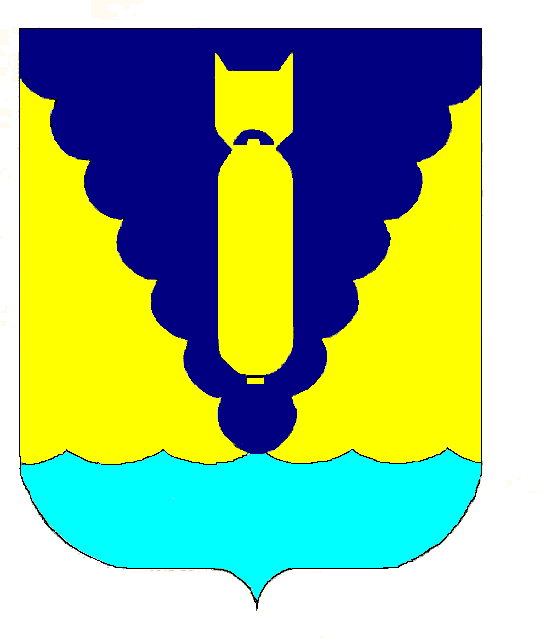
The 497th led the first B-29 raid on Tokyo from the Marianas on 24 November 1944, with Brig. Gen. Emmett O’Donnell in the lead aircraft, Dauntless Dotty, flying from Isley Field on Saipan. This emblem, published in the group’s history The Long Haul, was apparently never officially approved, like many wartime insignia made in the field. The crew of one of its bombers appears in the jacket-art gallery below.

The 509th Composite Group was formed in December 1944 at Wendover, Utah, to drop the atomic bomb. From Tinian, Col. Paul Tibbets flew Enola Gay to Hiroshima on 6 August 1945 and Maj. Charles Sweeney flew Bockscar to Nagasaki on 9 August. The emblem shown is the one the group used after the war, when it was assigned to the 58th Bombardment Wing at Roswell, New Mexico; during the war the group’s secrecy left it little room for heraldry.
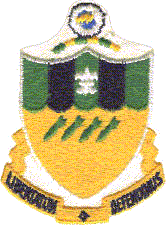
One of the oldest units in American military aviation, tracing its lineage to the 1st Day Bombardment Group of 1918, the 2nd Bombardment Group received the first B-17s in 1937 and flew them on goodwill flights to South America. In the Second World War it took its Flying Fortresses to North Africa in 1943 and then to Italy, bombing for the Twelfth and Fifteenth Air Forces until the end of the war.
Gallery: squadron emblems
A bomb or fighter group usually had three or four squadrons, and every squadron wanted its own emblem. These are the badges of fighter, bomber and photographic reconnaissance squadrons, many drawn by squadron members or by Disney and other studio artists, and scanned from the Air Force’s official histories. For most, the wartime design was later replaced by formal heraldry.

Before Pearl Harbor, American volunteers flew for the Royal Air Force in three Eagle Squadrons. On 29 September 1942 they were transferred to the U.S. Army Air Forces as the 4th Fighter Group at Debden, and No. 121 Squadron became the 335th Fighter Squadron. Its men kept their RAF wings on the right breast of their American uniforms, flew Spitfires, P-47s and finally P-51s, and made the 4th one of the highest-scoring American fighter groups in Europe.
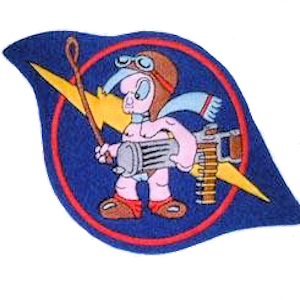
A squadron of the 352nd Fighter Group, the “Blue-Nosed Bastards of Bodney,” for the blue noses of their Mustangs. On New Year’s Day 1945, during the Bulge, twelve of its P-51s were taking off from airfield Y-29 at Asch in Belgium when about 50 German fighters attacked in Operation Bodenplatte. The squadron’s Distinguished Unit Citation credits it with 23 attackers destroyed for no loss of its own. Its pilots included John C. Meyer and George Preddy.

The 487th’s sister squadron in the 352nd Fighter Group at Bodney, Norfolk, which flew P-47 Thunderbolts from September 1943 and P-51 Mustangs from the spring of 1944, escorting the heavy bombers and strafing German airfields. The group’s blue-painted noses made its Mustangs among the most recognizable in the Eighth Air Force.

The 354th Fighter Group was the first to take the Merlin-engined P-51B Mustang into combat, on 1 December 1943, and became known as the Pioneer Mustang Group. Though it belonged to the tactical Ninth Air Force, its Mustangs were lent to escort the Eighth’s bombers deep into Germany that winter, and the 353rd was one of its three squadrons.

On 11 January 1944 the commander of the 354th Fighter Group’s 356th Squadron, Maj. James H. Howard, found himself alone among more than thirty German fighters attacking B-17s near Oschersleben. For about half an hour he broke up attack after attack. The bomber crews’ accounts won him the Medal of Honor, the only one awarded to a fighter pilot in the European theater.

A squadron of the 353rd Fighter Group, which flew P-47s and then P-51s from Metfield and Raydon in Suffolk and became a specialist in dive-bombing and strafing. Its aircraft carried a yellow-and-black checkerboard on the cowling, one of the many recognition markings that turned fighter groups into flying works of heraldry.

The 356th Fighter Group, with the 359th, 360th and 361st Squadrons, flew from Martlesham Heath on the Suffolk coast from 1943, first in P-47s and then in P-51s. It had a hard war, with heavy losses and fewer victories than most groups, but it flew escort to the end and earned a Distinguished Unit Citation for supporting the airborne landings in Holland in September 1944.

A squadron of the 361st Fighter Group, the “Yellow Jackets,” whose P-47s and P-51s wore yellow noses. The group flew escort for the Eighth Air Force from Bottisham near Cambridge and later from Little Walden. Squadron emblems like this one were painted on jackets, ready-room doors and squadron signs as well as sewn as patches.
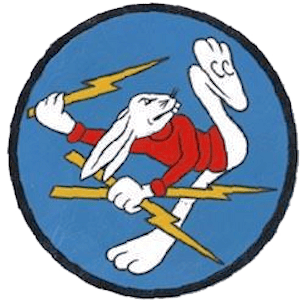
A squadron of the 364th Fighter Group at Honington, Suffolk, which entered combat with twin-boomed P-38 Lightnings in March 1944 and converted to P-51 Mustangs that summer, flying escort and ground-attack missions over Normandy, the Low Countries and Germany.

The 55th Fighter Group was the first P-38 group to fly combat with the Eighth Air Force, in October 1943, and on 3 March 1944 its Lightnings became the first Allied fighters over Berlin. The 338th was one of its squadrons, alongside the 38th and 343rd. The group later flew P-51s from Wormingford in Essex.

The 20th Fighter Group, with the 55th, 77th and 79th Squadrons, flew from King’s Cliffe in Northamptonshire, first in P-38s and then in P-51s. Its pilots strafed so many locomotives in the spring of 1944 that the press called it the “Loco Group.”

The second of the 20th Fighter Group’s squadrons at King’s Cliffe. The 77th, later known as the “Gamblers,” flew escort and strafing missions over Germany in P-38s and P-51s and earned a share of the group’s Distinguished Unit Citation for attacks on airfields and trains in April 1944.

The third squadron of the 20th Fighter Group. The 79th, known today as the “Tigers,” flew P-38s and P-51s from King’s Cliffe from late 1943 to the end of the war in Europe. Its lineage continues in the modern 79th Fighter Squadron.

A squadron of the 339th Fighter Group at Fowlmere near Cambridge, which arrived in England in April 1944 with P-51 Mustangs and became one of the Eighth Air Force’s most aggressive strafing groups, attacking German airfields at low level, the most dangerous job a fighter pilot could volunteer for.

A squadron of the 358th Fighter Group, which flew P-47 Thunderbolts first with the Eighth and then with the Ninth Air Force, supporting Patton’s Third Army across France. The Thunderbolt’s eight machine guns and its ability to carry bombs and rockets made it the Allies’ great ground-attack fighter of 1944–45.

The 359th Fighter Group, with the 368th, 369th and 370th Squadrons, flew from East Wretham in Norfolk from late 1943, first in P-47s and then in P-51s, escorting bombers and strafing targets in support of the Normandy invasion.

A squadron of the 366th Fighter Group, a Ninth Air Force Thunderbolt unit that crossed to Normandy soon after D-Day and flew close support for the First Army across France and into Germany, including the Battle of the Bulge.

A squadron of the 367th Fighter Group, which flew P-38s and later P-47s for the Ninth Air Force. On 19 March 1945 the group attacked the German Commander-in-Chief West headquarters at Ziegenberg and won a Distinguished Unit Citation. A pilot of the 392nd and his P-38 Arkansas Traveler appear in the jacket-art gallery below.

The 367th Fighter Group’s third squadron. Arriving in England in the spring of 1944, the 394th flew P-38 Lightnings on interdiction and close-support missions over France, earning a share of the group’s Distinguished Unit Citation for 25 August 1944, when it attacked German airfields in France and fought off the fighters that rose to meet it.

The 370th Fighter Group, with the 401st, 402nd and 485th Squadrons, flew P-38s for the Ninth Air Force from the spring of 1944, dive-bombing bridges, rail lines and strongpoints in Normandy and Brittany, and converted to P-51s in early 1945.

The third squadron of the 370th Fighter Group, whose Lightnings followed the armies from England to airfields in France and Belgium, supporting the First and Ninth Armies through the autumn of 1944 and the Ardennes.

A squadron of the 406th Fighter Group, a Ninth Air Force P-47 unit. When the weather cleared over the Ardennes on 23 December 1944 the group’s Thunderbolts flew mission after mission in support of the 101st Airborne and the other defenders of Bastogne.

The “Black Scorpions” of the 57th Fighter Group, whose P-40s flew off the carrier USS Ranger to Africa in 1942 and fought beside the British Eighth Army from El Alamein to Tunisia. On Palm Sunday, 18 April 1943, the group broke up a formation of German transports over the Gulf of Tunis.

A squadron of the 31st Fighter Group, the first American fighter group in combat in Europe: it flew Spitfires over Dieppe on 19 August 1942. After North Africa, Sicily and Salerno it converted to P-51s in 1944 and escorted the Fifteenth Air Force’s bombers from Italy.

A squadron of the 58th Fighter Group, which flew P-47 Thunderbolts in New Guinea from late 1943 and later in the Philippines and Okinawa, escorting bombers, attacking Japanese shipping and supporting the ground campaigns of the Southwest Pacific.

A squadron of the 343rd Fighter Group, which fought the forgotten war in the Aleutian Islands of Alaska in P-38s and P-40s, supporting the recapture of Attu and Kiska in 1943 and flying in some of the worst weather any airmen faced.

A squadron of the 21st Fighter Group, which moved to Iwo Jima in March 1945 and flew very-long-range P-51 escort and strafing missions to Japan.

A great white snowy owl on a black triangle and blue field, modified from a 1917 design, earned the 17th its nickname, “the Hooters.” Sent to the Philippines, it flew P-40Es when Japanese bombers struck Clark Field on 8 December 1941. Most of its aircraft were destroyed within weeks; its ground crews fought as infantry on Bataan and marched on the Bataan Death March, while some pilots escaped to fight in Java.

A squadron of the 307th Bombardment Group, the “Long Rangers,” which flew B-24s for the Thirteenth Air Force from Guadalcanal and later Noemfoor and Morotai, raiding Truk and, in October 1944, the oil refineries at Balikpapan in Borneo on some of the longest bombing missions of the war.

A squadron of the 386th Bombardment Group, which flew B-26 Marauders from Essex airfields from 1943, bombing airfields, bridges and V-weapon sites at medium altitude. The group received a Distinguished Unit Citation covering its first year of operations, July 1943 to July 1944.

A squadron of the 22nd Bombardment Group, the Red Raiders, which flew the B-26 Marauder in combat for the first time, from northern Australia against Rabaul and New Guinea in April 1942.

A squadron of the 38th Bombardment Group, the “Sun Setters,” which flew B-25 Mitchells in New Guinea, the Philippines and against Formosa, specializing in low-level attacks on Japanese ships and airfields with forward-firing guns and skip bombs.

The 413th was the fourth squadron of the 96th Bomb Group at Snetterton Heath, Norfolk. Squadron insignia like this were painted on jackets, on signs outside squadron offices and sometimes on the bombers themselves, and veterans and villagers have kept them on memorials near the old airfields. Photographed in England in 2017.

The 337th Bomb Squadron flew B-17s with the 96th Bomb Group from 1943. The group took part in the Regensburg shuttle mission of August 1943, flying on to North Africa after the target. Photographed in England in 2017.

The 338th Bomb Squadron of the 96th Bomb Group. Each of a bomb group’s four squadrons had its own insignia, a matter of fierce pride, even though all four flew together in the same formations. Photographed in England in 2017.

The 339th Bomb Squadron of the 96th Bomb Group. The 96th flew more than 300 missions from Snetterton Heath and suffered some of the heaviest losses in the Eighth Air Force. Photographed in England in 2017.

The “Eight Ballers” flew unarmed F-4 Lightnings, P-38s with cameras in place of guns, from Port Moresby over New Guinea and New Britain from 1942. Their commander, Maj. Karl Polifka, flew many of the early missions himself; their photographs mapped the targets for MacArthur’s campaigns.

A squadron of the 3rd Photographic Group, which photographed North Africa, Sicily, Italy and southern France for the Mediterranean air forces. Its pilots flew alone and unarmed at high altitude; their only defense was speed.

A squadron of the Ninth Air Force’s 10th Photographic Group, which photographed the Normandy beaches and the roads and bridges behind them before D-Day, and followed the armies across France into Germany.

Another squadron of the 10th Photographic Group, flying camera-equipped Lightnings over France and Germany in 1944 and 1945. Photo interpreters turned its prints into the target folders and maps the bomber and fighter crews carried.

The 9th flew photographic missions over Burma and Thailand for the Tenth Air Force from bases in India, covering the jungle airfields, railways and river crossings of the China-Burma-India theater.
Navy and Marine Corps insignia
Naval aviators had painted squadron insignia on their aircraft since the 1920s, and by 1941 every Navy and Marine squadron had one. Most were cartoons, approved by the Chief of Naval Operations, painted on the fuselage and reproduced as leather patches for the pilots’ goatskin jackets. PT-boat sailors carved their squadron emblems into wooden plaques; Disney’s mosquito riding a torpedo became the emblem of the whole “mosquito fleet.”
The Marine Corps came late to shoulder patches. The first was the 1st Marine Division’s, adopted in 1943 after Guadalcanal and made in Australia: a red numeral 1 lettered “Guadalcanal” on a blue diamond set with the stars of the Southern Cross, the constellation the Marines had seen overhead on the island. Other divisions, wings and corps followed, and Marines wore them across the Central Pacific, to Iwo Jima and Okinawa, before the Corps abolished unit patches soon after the war. The Navajo Code Talkers of the 5th Marine Division wore one. Openly licensed images of the wartime Marine patches are scarce, so the gallery below shows Marine squadron insignia on aircraft instead.

A Disney creature from Hell: a bat with a straight razor for a beak, in orange and reddish brown on lemon yellow. The studio drew it for Bombing Squadron 81 (VB-81), established on 1 March 1944 with SB2C Helldiver dive-bombers, and the Chief of Naval Operations approved it on 23 May 1944. Disney also supplied the nickname, “Hell Razors.” The squadron flew from USS Wasp (CV-18) from November 1944 to February 1945, and the bat survived through its later designations to Attack Squadron 174.

This banner hung in the hangar of Scouting Squadron One of the Seventh Naval District (VS-1D7) at Naval Air Station Banana River, Florida, now Patrick Space Force Base. In 1942 German U-boats were sinking tankers within sight of Florida’s beaches, and squadrons like this flew floatplanes such as the OS2U Kingfisher on coastal patrols and convoy escort. Unglamorous as it was, the squadron had its own art. Photographed in 2020.

Insignia plaques of the motor torpedo boat squadrons, displayed at the National Museum of the U.S. Navy in Washington. They were made by the sailors themselves. The PT boats, plywood Elcos and Higgins boats with Packard engines, fought at night in the Solomons, New Guinea, the Philippines, the Mediterranean and the English Channel. John F. Kennedy commanded one of them, PT-109, in the Solomons. The crews painted cartoon mosquitoes, wasps and sea creatures on their boats and plaques; Disney drew the best-known PT emblem, a mosquito riding a torpedo.

A detail from the same museum display, the plaque of a PT squadron numbered 43. Squadron insignia were the PT crews’ coats of arms, painted by whoever in the outfit could draw. They mixed humor and menace in the manner of the Disney studio, whose artists drew dozens of designs for the Navy’s small craft.

Bombs on their carts wait for Marine Scout Bombing Squadron 231’s SBD-5 Dauntlesses on Majuro in the Marshall Islands, March 1944. The ace of spades painted on the aircraft was the long-standing insignia of the Marine Corps’ oldest aviation squadron; in 1942 the squadron had flown at Guadalcanal. From Majuro it bombed the Japanese garrisons the American offensive had bypassed. For another Marine squadron’s story see VMF-211 at Wake Island.

Seven TBM-3D Avengers of Night Torpedo Squadron 90 fly in formation in January 1945. The squadron belonged to Night Air Group 90 on USS Enterprise, one of the Navy’s first carrier air groups trained to fight in the dark; note the radar pods under the right wings and the distinctive tail markings. Carrier aircraft wore air-group tail symbols so that flight-deck crews and pilots could identify them at a glance.

A Vought OS2U Kingfisher of Scouting Squadron 56 over Massacre Bay, Attu, in November 1943, still wearing the plain white star in a blue disc. The American national insignia changed three times in the war: the red center was removed in May 1942 so that gunners would not mistake it for the Japanese red disc, white side bars with a red border were added in June 1943, and the red border was replaced with blue that autumn.

Lt. (jg) John Warren Ramsey in August 1942, when Fighting Squadron 11 was formed at San Diego. The squadron called itself the “Sundowners,” after what it meant to do to the Rising Sun, and its emblem said so. VF-11 flew F4F Wildcats from Guadalcanal in 1943 and F6F Hellcats from USS Hornet in 1944. Ramsey served through the Second World War and Korea and retired as a commander.

A color plate from the Bureau of Naval Personnel Information Bulletin of May 1943, the magazine later renamed All Hands, showing the insignia of the Navy and its related services. The Navy grew from about 380,000 men in 1941 to more than three million in 1945, and almost all of them had to learn ratings, specialty marks and stripes from charts like this.

A wartime wall chart of Navy uniform insignia from the National Archives: sleeve stripes, shoulder marks, rating badges and specialty marks, the eagle-and-chevron “crow” of the petty officers among them. Like the Army’s charts, it taught a nation of new sailors and their families how to read a uniform.

The Coast Guard served under the Navy from November 1941 and manned landing craft at nearly every major amphibious assault, as well as cutters on the North Atlantic convoy routes. This National Archives chart sets out its insignia and the etiquette of salutes and address for the thousands who joined it, including the women of the SPARS.
Allied formation signs, squadron crests and recognition charts
The British Army called its patches formation signs and wore them at the top of the battledress sleeve, under the regiment’s shoulder title: the 7th Armoured Division’s desert jerboa, the 51st Highland Division’s “HD,” the Pegasus and Bellerophon of the airborne forces, the eagle, anchor and tommy gun of Combined Operations. Canadians wore colored rectangles for their divisions, red for the 1st Canadian Division. Royal Air Force squadron badges were heraldry proper, approved by the King under the eye of the Chester Herald, while Bomber Command’s crews painted personal crests on their aircraft; the Australian squadrons, as the photographs below show, were especially inventive.
Recognition was a matter of life and death. American soldiers and sailors were issued pocket guides, posters and the joint Army-Navy manual J.A.N. No. 1, Uniforms and Insignia to identify the uniforms and ranks of allies, neutrals and enemies, and Newsmap printed the national markings of the world’s aircraft for gunners to memorize. Intelligence officers read captured German shoulder straps and Japanese collar patches as evidence of which units were in the line. These charts are some of the most precise and least propagandistic art the war produced.

Three Kittyhawk IIIs of No. 112 Squadron RAF prepare to take off from Medenine, Tunisia, in 1943, all wearing the squadron’s shark mouth. No. 112 began painting shark mouths on its Tomahawks in the Western Desert in 1941, perhaps inspired by German Bf 110s, and a photograph of them in print reached the American volunteers in Burma, who copied the design. The Flying Tigers made it world famous.

A dragon on the nose of Avro Lancaster R5908 “EM-B” of No. 207 Squadron at RAF Syerston. Official RAF squadron badges were approved by the King under the eye of the Chester Herald, the officer of arms appointed as the RAF’s inspector of badges, but crews added personal emblems of their own, and Bomber Command’s artists painted them on the Lancasters’ noses.

Pilot Officer A. V. “Taffy” Clowes of No. 1 Squadron climbs into his Hurricane, P3395 “JX-B,” at RAF Wittering in October 1940, at the end of the Battle of Britain. Below the exhausts is his personal wasp emblem. Fighter pilots’ private insignia were rarer in the RAF than in the American air forces, which makes the wasp a prized detail.

The crest of “R for Robert,” a Lancaster of No. 467 Squadron RAAF at Waddington, photographed on 31 August 1943. The aircraft was originally “W for Willie,” hence the emblem of “King Billy” sitting on a bomb, designed and painted by Sgt. A. M. A. Barnett, cartoonist of RAAF Overseas Headquarters in London. Australians flew in Bomber Command in great numbers, and their crests often borrowed from Australian slang and folklore.

The emblem of “P for Peter,” another No. 467 Squadron Lancaster, in August 1943. In the words of the Australian War Memorial’s wartime caption, it shows a kookaburra holding “that snake Hitler” in the approved manner: the Australian kingfisher is famous for killing snakes by battering them.

The crest of “F for Freddie,” a Lockheed Ventura of No. 464 Squadron RAAF at Methwold in July 1943: an emu and a kiwi, for an Australian and New Zealand crew, sitting on a boomerang inscribed with a pun on the RAF motto, “Per Ardua ad Australian.” The bombs count its operations; the first was painted after the low-level raid on the Philips works at Eindhoven in December 1942.

“Kelly’s Gang Rides Again!” on a Halifax of No. 466 Squadron RAAF at Driffield, Yorkshire, around March 1945. Ned Kelly, the armored bushranger hanged in 1880, was an Australian folk hero, and his gang made a natural mascot for a bomber crew; Kelly’s homemade helmet appeared on more than one Australian aircraft.

The badge of No. 776 Naval Air Squadron, a second-line Fleet Air Arm unit that flew target-towing and fleet-requirement duties during the war. Royal Navy squadron and ship badges followed their own heraldic rules: a design inside a rope frame topped by a naval crown, approved by the Admiralty’s adviser on heraldry.

Cloth badges of the Royal Air Force, the RAF Regiment, the Glider Pilot Regiment, No. 617 “Dambusters” Squadron, the Royal Navy and the Women’s Royal Naval Service, displayed at the Victory Show in Cosby, Leicestershire, in 2011. Displays like this mix originals and reproductions, and collectors judge them by weave and backing. British formation signs, from the 7th Armoured Division’s jerboa to the airborne forces’ Pegasus, were worn at the top of the battledress sleeve.

A British poster by an artist signing himself Mahoney, printed by Fosh and Cross for the National Savings movement, laying out the badges of rank of the Royal Navy, the Army and the Royal Air Force. Saving schemes used anything that would hold the public’s eye, and identification charts were popular: every family wanted to know what the stripes and pips on a son’s sleeve meant.

The British Empire page of the Army’s 1943 Pocket Guide of Uniform Insignia, given to American soldiers bound for Britain. GIs had to learn that a crown on a British officer’s shoulder meant a major and that RAF ranks ran on sleeve rings. The same booklet covered the forces of every one of the “United Nations” then fighting the Axis.

The China page of the same 1943 pocket guide, showing the sleeve-cuff rank insignia of the Chinese Army and Air Force. Thousands of Americans served beside Chinese forces in the China-Burma-India theater, from the Flying Tigers and Fourteenth Air Force to the advisers and engineers on the Ledo Road.

Sheet No. 1 of the uniform regulations issued by the headquarters of the Royal Norwegian Army Air Force in exile in London in May 1942: a “NORWAY” title for the left shoulder and the Norwegian flag for the right, on battledress, service dress and greatcoat. Norwegians who escaped the German occupation trained at “Little Norway” in Canada and flew Spitfires with Nos. 331 and 332 Squadrons in the RAF.

Sheet No. 9 of the same series: the badges for Norwegian aircrews, pilot and observer wings and the air gunner’s and radio operator’s badges, built around the crowned lion of Norway’s arms. Insignia mattered intensely to the exiles; they declared that a country under occupation was still at war.

A plate from J.A.N. No. 1, Uniforms and Insignia, the joint Army-Navy recognition manual compiled by the Military Intelligence Service and the Office of Naval Intelligence, in a supplement page of December 1944: shoulder boards and sleeve lace of the Royal Navy and its reserves. The manual covered the world’s navies, allied, neutral and enemy alike.

The Soviet Navy page added to J.A.N. No. 1 in February 1945. The Red Army and Navy had reintroduced shoulder boards in 1943, symbols of the old imperial officer corps abolished after the Revolution, to restore the prestige of rank in the middle of the war, and American intelligence had to update its charts.

An Army orientation poster of 1943 illustrating the uniforms and insignia of the United States, the Soviet Union, France, Poland, China and the British Empire, with notes on the salutes and forms of address each used. It was distributed by the Army Orientation Course of the Special Service Division, part of the effort to teach Americans that they were fighting in a coalition.

The back of the Army’s Newsmap for 22 March 1943, titled “Military Courtesy”: the uniforms and rank insignia of the armies and navies of the United States, Poland, the Soviet Union, China, France and the British Empire. Newsmap was posted weekly in barracks and mess halls around the world, with the war news on one side and a lesson on the other.

The illustrator Jack Coggins drew the national markings of the world’s air forces, roundels, cockades and stars as they appeared on wings and rudders, for the reverse of the overseas edition of Newsmap of 20 September 1943. Gunners and ground observers were drilled to tell friend from foe in a second, and markings were the first thing they looked for.

A detail from Coggins’s chart showing two Frances: the markings of the Free French, “Fighting France,” whose aircraft carried the Cross of Lorraine, and those of the Vichy regime. In 1943 American gunners could meet either, and the same tricolor roundel could mean friend or enemy.

The Chinese air force’s white sun with twelve rays on a blue disc, from the same Newsmap chart. The Flying Tigers flew under this marking in 1941–42, since the AVG was nominally part of the Chinese air force; the Chinese insignia sat on their wings while the Disney tiger rode the fuselage.

An American recognition poster of 1943 showing a German soldier in field-gray and another in the tan of the Afrika Korps, with the eagle and cockade worn on German caps. Prepared by the War Department’s Military Intelligence Branch, posters like this taught soldiers to read the enemy’s uniforms for intelligence: shoulder-strap colors and numbers could identify a unit, and a captured patch could reveal a new division on the front.

A companion poster on the uniforms of the Kriegsmarine, showing white summer and blue service dress, a signal rating and an officer in field dress, with the emblems on caps and buttons. As U-boat crews were rescued or captured, and as American troops met German naval infantry in the last months of the war, sailors and soldiers alike needed to know what they were looking at.

A 1944 chart from the Office of War Information’s Bureau of Special Services showing the uniforms, collar rank patches and ornaments of the Imperial Japanese Army. Unlike much American wartime imagery of the Japanese, recognition charts were sober and precise, because their job was accurate identification rather than hatred.

A November 1943 page of J.A.N. No. 1 devoted to the Luftwaffe’s sleeve insignia: trade and specialist badges, rank insignia for flight suits and fatigues, and the cuff titles worn by some units. Captured airmen were interrogated with exactly this kind of reference at hand.
Painted leather: the A-2 and jacket art
The Army Air Corps adopted the A-2 flight jacket in 1931: a waist-length jacket of seal-brown horsehide or goatskin with knit cuffs and waistband, a snap-down collar and two flapped pockets. The Navy’s equivalent, the goatskin jacket with a fur collar later known as the G-1, was worn by its aviators and the Marines’. By 1943 the A-2 had become the most coveted garment in the American forces. It was issued only to aircrew, and wearing one announced that a man flew.
Crews made the jacket their own. On the left breast went a leather squadron patch, often made in a local shop in England or Australia, and the AAF star on the left shoulder. The back became a canvas. Airmen painted their bomber’s name and nose art, often a copy of the pin-up on the airplane, and added a small bomb for every mission flown; fighter pilots added kill flags. Some painted the work themselves with whatever enamel they could find; others paid the group’s best artist or a local sign painter. The Women Airforce Service Pilots wore A-2s with Disney’s Fifinella. Few painted jackets were made to last, and the survivors in museums are treasured; the one below, preserved by the San Diego Air & Space Museum, carries the emblem of the 325th Bomb Squadron.

A Type A-2 flight jacket of brown leather, made in 1942, with the 325th Bombardment Squadron emblem on the left chest, the AAF patch on the left shoulder, and a painted green frog and the words “Froggy’s Magic Twanger” on the back. San Diego Air & Space Museum, object 201902002.
A survivor
Froggy's Magic Twanger
A brown leather Type A-2 flight jacket, manufactured in 1942, with the emblem of the 325th Bombardment Squadron on the left chest and the Army Air Forces patch on the left shoulder. On the back its owner had a green frog painted with the words “Froggy’s Magic Twanger.” The 325th belonged to the 92nd Bomb Group, which flew B-17s from Bovingdon and later Podington in England.
Who wore it, and who painted the frog, the museum record does not say: like most jacket art, it was a private joke shared by a crew and now partly lost. It survives in the curatorial collection of the San Diego Air & Space Museum.
Gallery: jacket art and the people who wore it
Wartime photographs of aircrews in their A-2s, from the Memphis Belle to the Tuskegee Airmen at Ramitelli, and of the women pilots who wore Fifinella on their jackets.

Dorothy Kocher Olsen of the Women Airforce Service Pilots in her A-2 jacket with the Fifinella patch. Fifinella, a female gremlin from Roald Dahl’s 1942 story The Gremlins, was drawn by the Disney studio, which let the WASP adopt her as their mascot; they redrew her in red coat and purple trousers and sat her on a bomb. About 1,100 WASP ferried, towed targets and tested aircraft in the United States. They were civilians, and only in 2010 did they receive the Congressional Gold Medal, Olsen among them.

The ten men of the B-17 Memphis Belle, 91st Bomb Group, in England after completing their 25 missions in May 1943, most of them in A-2 jackets. Their tour made them the first celebrity crew of the Eighth Air Force: William Wyler filmed them for the documentary The Memphis Belle (1944), and they toured American war plants and bond rallies.

The crew of the B-29 Waddy’s Wagon, 869th Bomb Squadron, 497th Bomb Group, pose to match the caricatures of themselves painted on its nose. It was the fifth B-29 to take off on the first Tokyo mission from Saipan, on 24 November 1944, and the first to land back at Isley Field. Crews often wore their airplane’s art on their jackets too, so that bomber, crew and clothing told one story.

The crew of the B-17F Black Jack, 63rd Bomb Squadron, 43rd Bomb Group, after their last mission together on 14 February 1943; note the extra machine gun the ground crew fitted in the nose. Black Jack ditched off New Guinea in July 1943 with all aboard surviving, and its wreck, found in 1986, is now a famous dive site. In the tropical Southwest Pacific, A-2s were worn at altitude and in photographs more than on the ground.

A B-17 crew of the 367th Bomb Squadron, 306th Bomb Group, at Thurleigh, England, on 5 December 1942, in the leather and sheepskin of the early daylight raids. The 367th was nicknamed the “Clay Pigeons” for its losses that winter. The A-2 was worn under heavier sheepskin flying clothing at altitude, where temperatures fell to 40 below zero, and over everything on the ground.

The crew of the American Flying Fortress Bearded Beauty, which force-landed at Royal Naval Air Station Yeovilton on 22 January 1943, with the station’s captain, M. S. Thomas, and Lt. H. R. Arnold. A Royal Navy photographer recorded the meeting, and the Americans’ leather jackets stand out beside the British officers’ blue uniforms.

Lt. Everett A. Thies, right, and his crew chief, T/Sgt. Daniel Nobel, beside his F-5C reconnaissance Lightning Dot-Dash in July 1944. Thies photographed German targets and delivered the pictures to American bases in the Soviet Union for the shuttle-bombing missions of Operation Frantic. The pilot’s A-2 was standard issue; the ground crew’s coveralls were not.

Lt. James O. Fincher of the 392nd Fighter Squadron, 367th Fighter Group, with his ground crew and his P-38J Arkansas Traveler at Clastres airfield, France, in October 1944. Fighter pilots often had their airplane’s name and their victory or mission marks painted on their jackets as well; the squadron’s emblem appears in the squadron gallery above.

Frances Green, Margaret Kirchner, Ann Waldner and Blanche Osborn, WASP trained to ferry the B-17, leave Pistol Packin’ Mama at the four-engine school at Lockbourne Army Air Field, Ohio. Their leather jackets, parachutes and coveralls were the same as the men’s, cut for the men’s sizes.

Four members of the first class of American women to complete a nine-week transitional flight-training course receive final instructions before a cross-country flight. Assigned to the Ferrying Division of Air Transport Command, they would deliver new aircraft from the factories to the bases. Their jackets carried the patches of their ferrying groups and, later, the WASP’s Fifinella.

Edward M. Thomas of Chicago, of flight class 43-J, photographed by Toni Frissell at Ramitelli, Italy, in March 1945, where the 332nd Fighter Group, the “Red Tails,” escorted Fifteenth Air Force bombers. Frissell, a fashion photographer who volunteered her camera to the war effort, made some of the finest portraits of the Tuskegee Airmen. The story of their first squadron is told in The 99th Fighter Squadron.

Five pilots of the 332nd Fighter Group at Ramitelli in March 1945: Robert W. Williams, William H. Holloman III, Ronald W. Reeves, Christopher W. Newman and Walter M. Downs, in A-2 jackets and leather and cloth caps. Frissell’s photographs, now in the Library of Congress, record the men as they wanted to be seen, as professionals and as fliers.
Second thoughts: caricature, pin-ups and the end of the cartoon
Insignia were made quickly, by young men at war, and they carried the attitudes of their time. Squadron emblems and jacket art caricatured the Japanese with the same buck teeth and slanted eyes found in American propaganda posters; some showed the enemy being squashed, burned or hanged. Pin-ups painted on jacket backs ranged from the coy to the explicit, and the women who served beside the men, including the WASP, sometimes had to share the flight line with them. Museums now display these objects with their context rather than hiding them.
The 45th Division’s swastika is a reminder that symbols change their meanings: a sun sign of the Southwest became unwearable within a decade. In the other direction, the new U.S. Air Force, created on 18 September 1947, adopted heraldic rules that favored traditional designs and stopped accepting cartoon insignia. Squadrons without approved emblems were refused. Many of the wartime Donald Ducks and bulldogs disappeared, though in recent years some units have revived their Second World War emblems as heritage patches.
Where to see the originals
The National Museum of the U.S. Air Force in Dayton, Ohio, tells the story of Disney’s insignia and displays painted jackets and patches; the National Museum of the Mighty Eighth Air Force in Pooler, Georgia, near Savannah, where the Eighth was born, holds many more. The San Diego Air & Space Museum preserves the A-2 shown above and the Flying Tiger patches in this section. The National Museum of the U.S. Navy at the Washington Navy Yard shows the PT-boat plaques; the National WWII Museum in New Orleans and the National Museum of the United States Army at Fort Belvoir, Virginia, hold division patches and uniforms. The Imperial War Museums in London and the Australian War Memorial in Canberra keep the photographs of the RAF and RAAF crests seen here, and the Institute of Heraldry, also at Fort Belvoir, still maintains the Army’s official drawings. For the art painted on the aircraft themselves, continue to Nose Art: The Paintings on the Planes.
Sources
- National Museum of the U.S. Air Force, “Disney Pins on Wings” (fact sheet).
- D23, the official Disney fan club, “Insignias,” Disney A to Z.
- Wikipedia, “Shoulder sleeve insignia” (81st Division and Pershing’s ruling, combat patch).
- Wikipedia, “The Institute of Heraldry.”
- U.S. Army Institute of Heraldry, shoulder sleeve insignia blazons and symbolism as reproduced on the Wikimedia Commons file pages cited in each credit.
- Air Force Historical Support Division, “United States Air Force Seal” (the Heraldic Section of the Office of the Quartermaster General).
- Maurer Maurer, ed., Air Force Combat Units of World War II (Office of Air Force History, 1961/1983), group insignia and histories, online text; and Maurer, Combat Squadrons of the Air Force, World War II (1969).
- ARSOF History, “Ranger Diamond.”
- Wikipedia, “United States Army deception formations of World War II.”
- Wikipedia, “45th Infantry Division,” “32nd Infantry Division,” “1st Cavalry Division,” and “SS Leopoldville.”
- Wikipedia, “Attack Squadron 174,” “487th Fighter Squadron,” “17th Pursuit Squadron,” “4th Fighter Group,” and “Fifinella.”
- Australian War Memorial and Imperial War Museums photograph captions, and San Diego Air & Space Museum and National Museum of the U.S. Navy object records, as quoted on the Commons file pages linked from each item.