

A Mecklenburg County probate estate starts with the Clerk of Superior Court in Charlotte. If you are opening a full estate, identify the correct application, bring the original will if there is one, and prepare a preliminary inventory. Once the clerk issues letters, turn those papers into a working calendar for creditor notice, the sworn inventory, accounts and distributions. This guide follows those steps through the clerk’s approval of the final account, with current blank PDFs and previews of the forms you will use.
Start with the right Mecklenburg County probate route
If a parent in Huntersville, a spouse in Cornelius or a relative in Charlotte died, begin with the person’s domicile at death. A Mecklenburg mailing address, place of death, nursing facility or the location of the funeral can help explain the facts. The legal starting point is domicile. North Carolina also has venue rules for decedents domiciled out of state who left or brought estate assets into this state. If an estate is already open elsewhere, obtain those letters, the will and any authenticated court records before deciding what must happen in Mecklenburg. An ancillary North Carolina file and the other state’s file each have their own scope. G.S. 28A-3-1 · North Carolina estates overview.
Probating a will means proving it to the clerk. Qualifying means receiving court authority to act for the estate. A named executor needs the clerk’s letters to act in that capacity. An administrator generally serves when there is no will. If there is a will and the named executors cannot or will not qualify, the clerk may appoint an administrator CTA, short for “with the will annexed.” That representative administers the estate under the will. Read the actual appointment and any limitations before using letters with a bank, broker or insurer. Order of qualification · Application requirements.
Collection by affidavit
Check the 30-day waiting period, value, who may file and the local small-estate packet.
Summary administration
Review the conditions in G.S. 28A-28-1. A year’s allowance is a separate route.
A full administration may be appropriate when someone needs authority to collect individually titled assets, address creditors and distribute what remains. Alternatives depend on ownership, value, the identity of the beneficiaries and the authority you need. For the small-estate affidavit route, at least 30 days must have passed since death and the statutory personal-property limit is generally $20,000 after liens and encumbrances. A qualifying surviving spouse who is the sole heir or devisee and is the affiant can use a separate provision with a $30,000 ceiling and statutory allowance adjustments. Review each asset and the statutory eligibility facts before choosing that route. Intestate collection by affidavit · Testate collection by affidavit · Mecklenburg small-estate packet.
Summary administration is another process for a qualifying surviving spouse who is the sole outright beneficiary. A will can exclude it, and a devise in trust is outside the procedure. The order carries responsibility for liabilities to the extent the statute provides. Probate without qualification can serve a different purpose when proving the will is the task and full letters are unnecessary. A year’s allowance is its own petition. For a spouse, the current statute provides a $60,000 allowance subject to its terms. Verify the date-of-death version and any applicable deadlines, including special timing rules when a representative is appointed or an allowance is claimed for a child. Summary administration · Effect of order · Spouse’s allowance · Children’s allowance.

Open the estate with the clerk in Charlotte
Mecklenburg County Courthouse · Estates Division
832 East Fourth Street, Suite 3720
Charlotte, NC 28202
The Estates Division is at 832 East Fourth Street, Charlotte, NC 28202, Suite 3720 on the third floor. The county’s packet lists 704-686-0460. Check the current local instructions for appointments and filing options. The published mailing address for the Estates Division is Clerk of Superior Court, Estates Division, P.O. Box 37971, Charlotte, NC 28237. Confirm how the clerk wants to receive an original will, certified death certificate and any other original or sworn documents before mailing them. Attorneys should follow the applicable eCourts filing rules and original-document procedures. Self-represented filers can use the county’s published directions and the court’s eCourts resources to determine the channel available for their filing. County courthouse · Mecklenburg local forms · eCourts and File & Serve.

Start a folder with the original signed will and codicils, a certified death certificate, the names and addresses of the people who inherit under the will or by law, and enough ownership and valuation information for a preliminary inventory. Verify the relationship of each person rather than assuming the will lists every person the application asks about. A self-proved will may simplify proof. A lost, damaged, handwritten or non-self-proved will can raise different proof and notice issues. Preserve whatever originals, copies and related records exist and get the appropriate procedure before filing.
Use AOC-E-201 when applying to probate a will and obtain letters testamentary or letters of administration CTA. Use AOC-E-202 when there is no will and you seek letters of administration. Both applications include a preliminary inventory. The form’s second side and accompanying instructions help distinguish property controlled by the representative from other reportable assets. Bring the AOC-E-400 oath, any necessary renunciations, local family history affidavit and process-agent paperwork required for your facts. If someone else has higher statutory priority, ask whether a renunciation, notice or other procedure applies. A nonresident may need a North Carolina resident process agent. A bond can be required depending on who serves, the will and the statutory exceptions. Qualifications and disqualifications · Bond rules · Local testate packet · Local intestate packet.


Application for Probate and Letters
Opening a testate estate or requesting letters of administration CTA. Side two is the preliminary inventory.
Instructions and additional PDFs


Application for Letters of Administration
Opening a full estate without a will. Side two is the preliminary inventory.
Instructions and additional PDFs

Oath or Affirmation
The applicant takes the fiduciary oath as part of qualification.

Letters issued by the clerk
Preview of the credential issued by the clerk after qualification.

Renunciation of Right to Qualify
Used when a person with priority formally renounces the right to qualify, as applicable.

Appointment of Resident Process Agent
A nonresident applicant may need to designate a North Carolina process agent.
Once the clerk grants letters, check the spelling of the name, file number, date, role and any limitation. Keep the issued letters with your application and order. Ask for certified copies if financial institutions or title professionals will need them. Enter the date of qualification and the date letters were granted from the court records, and calendar any clerk-printed inventory and account dates. Ask the clerk which filings are outstanding before leaving or after you receive the electronic confirmation.
Set up the estate’s financial records before moving money
Obtain an estate EIN when required and work with the bank to open an estate account in the correct fiduciary name. Use it for estate funds and keep it separate from your own checking account. Ask the bank which certified letters, identification and tax information it requires. Record the source and date of every deposit. Retain the opening statement and the first statement showing funds transferred in. Save statements for the entire administration and maintain a ledger that reconciles to them. IRS employer identification numbers.
Give each transaction a short identifier. A useful entry has the date, payer or payee, amount, category, source and link to the supporting proof. Preserve invoices, check images, settlement statements, statements and beneficiary receipts at the time of the transaction. If a family member has paid an expense, record who paid and whether reimbursement is proper before writing an estate check. Keep original records secure and use the court’s redaction and filing procedures for copies. The account form asks you to omit account numbers from the balance section.
Start the notice file
Preserve letters, start public notice and identify creditors entitled to direct notice.
Publish once each week
The general claim deadline is at least three months from the first run or applicable posting.
Identify creditors
Review unsatisfied claims that are known or reasonably ascertainable and applicable Medicaid notice.
Inventory and proof of notice
File the sworn E-505 and the required proof of notice unless the court extends the inventory deadline.
Review the account calendar
Use the clerk’s deadlines and the annual or final rules. Request any needed extension in time.
Obtain the closing record
Keep the approved final account or discharge and records of remaining court costs.
Publish and send the Mecklenburg County notice to creditors
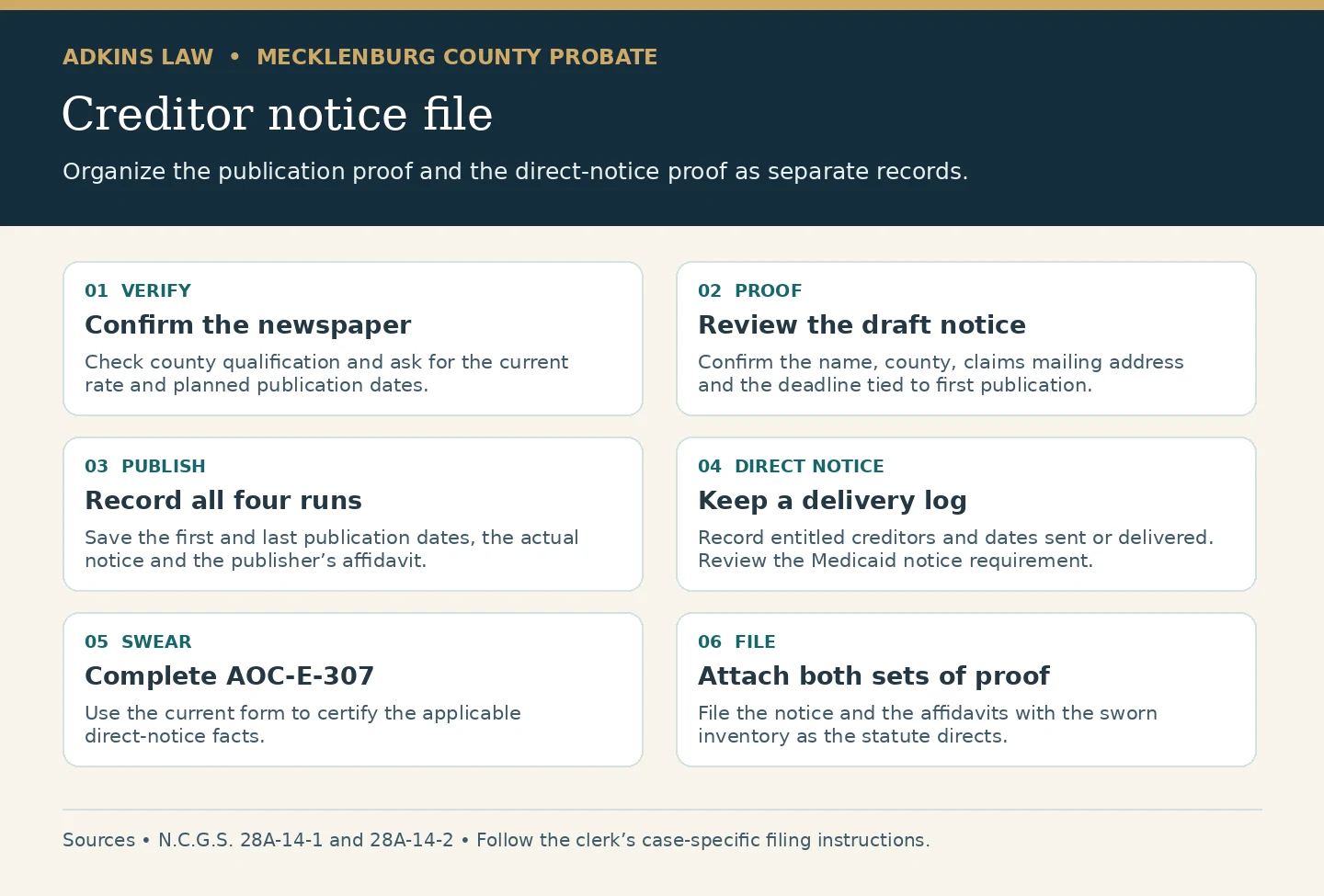
For a typical full estate, start the notice process promptly after the grant of letters. The general notice gives creditors an address to present claims and specifies a deadline at least three months after the first publication or posting. When a qualified legal newspaper is published in the county, the statute calls for publication once a week for four consecutive weeks. Check that the publisher is qualified for Mecklenburg County and get the publication dates in writing. An earlier notice filed in a different state or county needs its own review before you rely on it for a Mecklenburg file. If a predecessor already gave the required notice for the same estate, the statute addresses when another notice is unnecessary. There are also limited exceptions, including specified wrongful-death-only estates. G.S. 28A-14-1.
How to place the notice and keep the proof
The Mecklenburg Times has a public notice desk and a current submission page. Send what the publisher requests through its current channel. For a typical estate, have the issued letters, correct decedent name, representative name and mailing address for claims, case number and a reliable callback contact available. Request a current quote and the planned first and last run dates. Review the proof before approval. Check spelling, county, capacity, claims address and the deadline against the first run. If the first run changes, check the deadline again before approving or relying on the advertisement. Save the publisher’s confirmation, a copy of the notice as it actually ran and the publisher’s sworn proof. Mecklenburg Times submission page · Publisher’s public notice information.

The newspaper notice reaches the public. The representative also has a direct-notice duty for unsatisfied claims actually known or reasonably ascertainable within 75 days after letters are granted, subject to the statute’s recognized-valid-claim exception. Before filing proof, personally deliver or send the notice by first-class mail to entitled creditors at their last known address. Review mail, bills, statements, medical records and the decedent’s payment history with the appropriate authority. If the decedent received the medical assistance described in the statute at death, address the requirement to notify the Division of Health Benefits. Keep a private delivery log with dates and a copy of the exact notice. Direct notice rules · North Carolina Medicaid estate recovery.
A creditor entitled to direct notice can have a deadline later than the printed publication deadline. For covered pre-death claims, the statute generally uses the later of the general deadline and 90 days after delivery or mailing when direct notice is required, with exceptions and additional provisions. For example, if the publication window ends March 4 but an entitled creditor was mailed notice on January 20, review that creditor’s separate clock before distributing funds. Record presentation, review, payment or rejection for each claim. If there is a contested claim, a federal or state tax claim or a secured creditor, get advice on the applicable rules. Presentation of claims · Limitations on claims.
File two kinds of notice proof with the inventory
Put the notice copy and the publisher’s affidavit of publication together. Use AOC-E-307 to document your direct-notice efforts under oath. Read both alternatives on the form before selecting one. The second option concerns cases where, after the required efforts, there are no outstanding claims requiring that direct notice. The Judicial Branch form explains how it applies when there were no outstanding debts or known debts were paid in full. The clerk’s packet pairs this affidavit with the inventory. If the notice or proof is late, speak with the clerk or counsel about the inventory deadline and any extension rather than assuming a publisher’s delay extends the filing date. Proof of notice · Affidavit of Notice to Creditors.

Affidavit of Notice to Creditors
Sworn record concerning direct notice to reasonably ascertainable creditors. File with the separate publisher proof and notice copy when applicable.
File the sworn inventory and calculate the court fee
The opening application’s preliminary list helps the clerk decide how to open the file. The sworn AOC-E-505 inventory is a later report. G.S. 28A-20-1 generally requires it within three months after qualification, unless extended by the clerk. The scanned instruction sheet expresses the target as 90 days. Use the date shown in your own Mecklenburg file and raise any discrepancy with the clerk early. If a new asset is discovered after filing, ask about a supplemental inventory and required supporting proof. Additional inventory rules.
Match each inventory line to title and value
Start with date-of-death statements for sole-name bank and brokerage accounts, vehicle titles and value evidence, and the records for other tangible property. Look at the title, beneficiary designation or account agreement before deciding what goes in the personal-property subtotal. A bank statement with two names may omit the signature-card language that proves survivorship. The packet asks for the signature card or other institutional proof for relevant Part II accounts. For insurance, identify the actual beneficiary. For a vehicle, record the registration, lien information and a supportable date-of-death value. Keep the proof in the same order as the inventory lines so the clerk can match the values.
Side one reports assets of the estate and the subtotal used to calculate the asset-based fee for a standard full-estate inventory. Side two asks for property that can be brought into the estate if needed to pay claims and other specified items. Follow the instructions beside each category. Being reportable on the inventory can differ from being available immediately for distribution. Separate contingent property from assets already in the estate bank account. Attach supporting copies in the form requested by the clerk and take the oath before an authorized officer. Inventory form and instructions · Assets potentially available for debts.


Inventory for Decedent’s Estate
Sworn inventory after qualification. Side two has the contingent and other reporting categories.
A worked example with a bank account, a car and a house
Imagine a Huntersville resident left a $38,000 checking account in her sole name, a car worth $12,000 titled in her name and a house devised to her children. The representative gathers the date-of-death bank statement, title, valuation and any lien documents. The $50,000 personal-property example yields a $200 asset-based inventory fee at 40 cents per $100, assuming the entire amount is assessable and no unusual adjustment applies. The house needs its own title and probate analysis. Check the deed, will and the real-property categories on the form before selecting a box. The example does not include the separate $120 opening fee. Current estates court cost chart · G.S. 7A-307.
Read the house and mortgage separately from the bank account
North Carolina generally vests real property in heirs or devisees at death, subject to probate, administration and statutory rights. The will, deed, survivorship or trust ownership and any order authorizing the representative to act can change the analysis. A mortgage or other lien can continue to encumber the property. Before using estate money for a mortgage, taxes, repairs or an insurance premium, confirm who owns the property, who is obligated to pay and what authority the representative has. A sale or use of real estate to create assets for claims may require a clerk proceeding unless a valid power under the will or another applicable authority supplies the procedure. Ask about title, occupancy and any need to preserve the property while authority is resolved. Title to decedent’s property · Real property and payment of debts · Authority to sell real property.
What Mecklenburg County probate filing costs include
The 2026 Judicial Branch chart lists $120 for a new full estate, plus the value-based General Court of Justice fee. For that separate fee, the chart shows $0.40 per $100, subject to the statutory major-fraction rule, a $15 minimum per applicable filing and a $6,000 cumulative maximum. The inventory generally uses the assessable Part I amount, and later accounts assess additional qualifying receipts reported for the period. Review the current chart and its footnotes, including the filing type and whether an asset was already assessed. For ordinary full administrations the chart explains that all asset-based fees due must be paid before approval of the final account. Confirm the clerk’s collection procedure for your file. Publication, bond premiums, appraisals, professional work and other approved costs have separate charges. Ask the clerk about current payment methods for your channel before sending payment. 2026 estates fee schedule · Mecklenburg payment information.
Use the assessable amount for the inventory or the qualifying new receipts for this accounting. The estimate rounds to the nearest $100, then applies the $15 minimum and remaining $6,000 cumulative cap. The clerk determines the actual assessment.
The estimate excludes the separate $120 opening fee and other expenses. Inputs stay on this page. Check the official 2026 cost chart.
Review claims, taxes and distributions in the right order
Build a claims register before writing checks
For each claim, log the creditor, amount, supporting document, date received and disposition. Identify whether it is a pre-death debt, secured claim, administration expense, tax, reimbursement or another item. Confirm the creditor’s identity and the amount owed. Review the presented claim under the statutory procedure and keep correspondence about any objection or proposed resolution. The claims register supports both your payment decisions and the account you file later. How claims are presented.
An insolvent or potentially insolvent estate needs careful priority analysis. After costs and expenses of administration, North Carolina orders classes of claims by statute. A specific lien has priority to the statutory extent. The $3,500 funeral expense figure in the statute limits the amount receiving that class’s preference, with separate treatment for the burial place and gravestone. A reasonable bill can exceed the preference. The local checklist calls for proof the funeral bill was paid. Retain the bill, payment record and any authorized reimbursement documentation. Ask where the clerk wants the proof filed for your case. Priority of claims.
Avoid paying a relative first because they are asking urgently, giving out the estate balance while claims remain open or using an inheritance check to settle a disputed reimbursement. Record any allowance, taxes, reserved amount and unresolved issue before approving a distribution. If the will has specific gifts or shares, identify the property and recipient for each. In an intestate estate, use the applicable intestate succession rules and document family relationships. A person’s decision to step aside from serving as administrator is a separate matter from their right to inherit. North Carolina intestate succession law · Mecklenburg county filing materials.
Put the estate-tax certification in the correct date range
The AOC-E-212 in the packet is for deaths from January 1, 1999 through December 31, 2012. The older AOC-E-207 applies to deaths before January 1, 1999. If death occurred on or after January 1, 2013, the pre-2013 North Carolina estate-tax certification requirement does not apply. A newer estate can still have the decedent’s final income tax return, a fiduciary income tax return, property tax or federal estate-tax issues. Ask the tax preparer to identify the returns, tax years and proof of payment or reserves. Final account statute · IRS information for estates · North Carolina fiduciary income tax.
The federal estate tax and an estate’s income tax measure different things. For a U.S. citizen or resident who dies in 2026, the IRS lists a $15 million basic exclusion amount. Prior taxable gifts and special elections, including portability, can affect whether a federal estate tax return is needed. A smaller probate estate can still generate income after death from interest, dividends, rent or sales. Check with the preparer about Form 1041 and related North Carolina filing requirements. IRS estate and gift tax updates · IRS Form 1041.


Estate Tax Certification for 1999–2012 deaths
Archive form for deaths on or after January 1, 1999 and before January 1, 2013.

Inheritance and Estate Tax Certification
Archive form for deaths before January 1, 1999.
Prepare the annual or final account with receipts and proof
Calendar the clerk’s dates as soon as you qualify
The post-qualification packet gives a one-year target for the final account. G.S. 28A-21-2 contains a later-of rule that considers the one-year date, the applicable annual-account period and, in relevant older estates, the state estate or inheritance tax release. The clerk can grant an extension. If you expect the estate to remain open, review the annual accounting requirement promptly. Under G.S. 28A-21-1, the ordinary first annual account is due 30 days after the first anniversary of qualification. A properly selected fiscal year changes the deadline. Keep the court’s dates, your statutory calendar and any extension order together, and confirm how they apply to your file. Annual accounts · Final accounts.
An estate can remain open because a claim is disputed, a property sale or tax return is pending, an asset is difficult to collect or a beneficiary’s distribution needs additional authority. Document the reason and the steps remaining. Ask the clerk or counsel about any extension and the account due in the meantime. If an account is late, address the deficiency or notice promptly. The clerk has authority to compel an account, and an unresolved deadline can affect the representative’s appointment. Compelling an account.
Read both sides of AOC-E-506 before starting
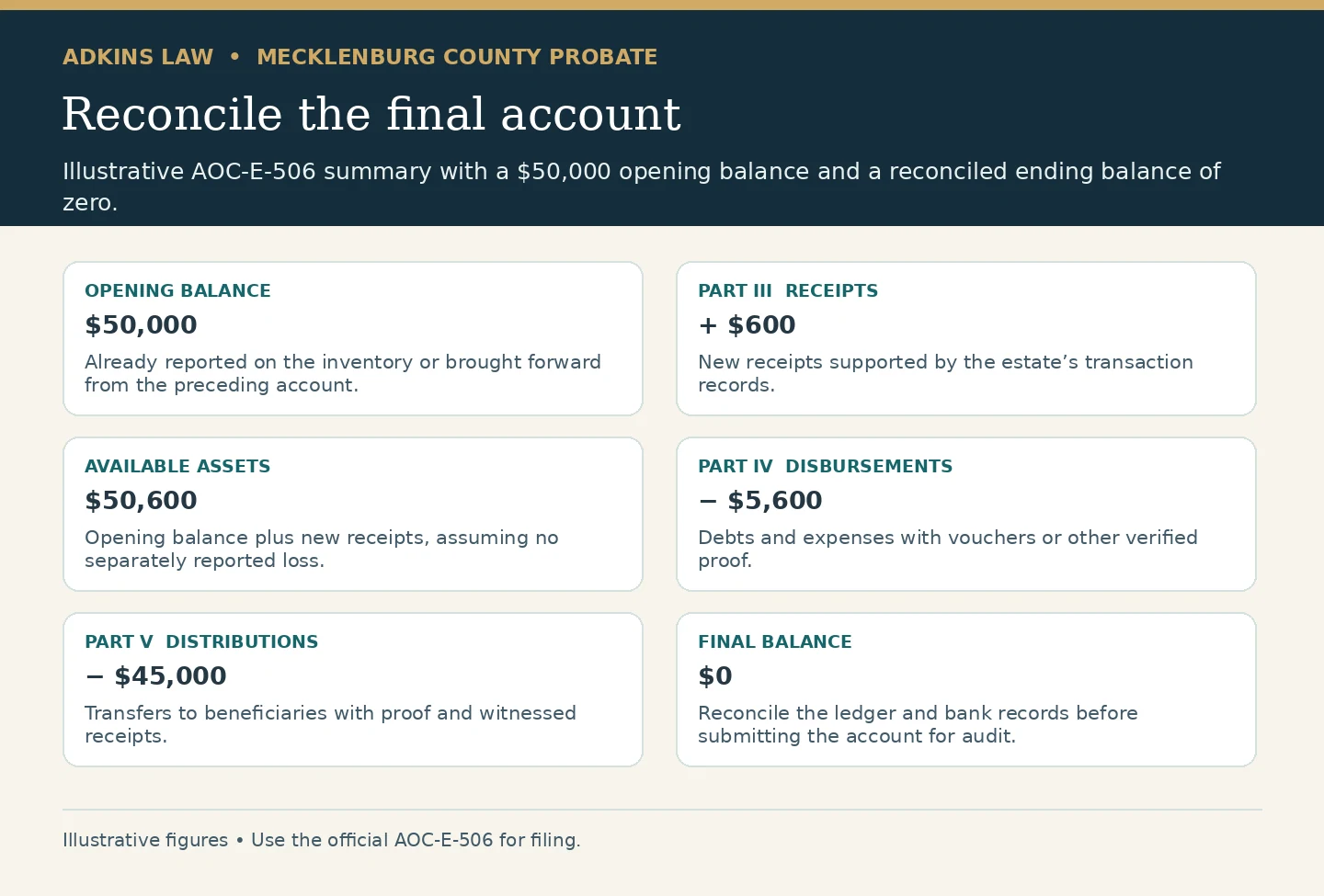
The AOC-E-506 account uses a summary on side one and transaction detail on side two. Use the beginning amount from the sworn inventory or prior account as directed. Explain any loss compared with a previously reported asset value. List new receipts in Part III, disbursements in Part IV and beneficiary distributions in Part V. Complete Part II for an annual account with assets remaining and reconcile the ending balance. The court’s current form page also offers a calculating version and continuation sheets for each of the three transaction categories. Read the instructions for sales, rents and property brought into the estate before treating a deposit as a new receipt. Annual or final account and continuation pages.


Annual or Final Account
Part I reconciles the balance, and side two lists receipts, disbursements and distributions separately.
Instructions and additional PDFs

Receipt for Partial or Final Distribution
Beneficiary acknowledgment of what was actually received, with a witness signature.
A transfer from a decedent’s checking account already reported on the inventory into the estate checking account can move money without creating a second estate receipt. Match it to the earlier inventory line and keep both bank statements. Interest earned after death or a qualifying gain on a sale may be a later receipt. A sale below a previously reported value can call for a loss explanation. Separate principal from gain or loss using the form’s instructions. Keep the transaction documents in chronological order and identify the account line each item supports.

In the worked example, $50,000 was already reported and $600 in later receipts brings the total to $50,600. After $5,600 in supported disbursements and $45,000 in documented distributions, the final balance is $0. This example assumes the claim periods and any tax issues have been addressed, the disbursements were proper, and all distributions were authorized. In a real file, reconcile every number to the bank, prior inventory or account and supporting vouchers. If a deposit or payment has not cleared, identify it and resolve the reconciliation before filing the final account.
Use a witnessed receipt for each distribution
Use the current AOC-E-521 to record what a beneficiary actually received. Its October 2026 revision includes a total amount for the distribution. Mark whether the payment is partial or final and describe the money or property transferred. The beneficiary and witness sign. Use a separate witness. The Mecklenburg instructions specify that the personal representative cannot witness the beneficiary’s signature. Keep the receipt, payment or transfer proof and any applicable authority for payment to a minor, trust or other representative. A beneficiary who cannot sign or cannot be located may require another procedure. Ask the clerk or counsel before treating funds as distributed. Receipt for partial or final distribution.
For cash distributions, track check or transfer evidence and confirm receipt. For tangible property, describe the item, date and reasonable value as the form requires. When a distribution goes through a trust, guardian, agent or estate, document why the person receiving it can do so. If the amount changes after a partial payment, reconcile the prior receipt to the final distribution schedule so the same payment appears once. Preserve the clerk’s accepted proof in the estate record.
Request approval of commissions and professional fees
The packet contains a local petition and proposed order, a reference sheet on commissionable transactions and a calculation worksheet. They address three distinct tasks. Explain what work was done and what approval is requested. Separate qualifying entries from the rest of the ledger. Calculate the possible statutory ceiling, then obtain the clerk’s actual decision. Ask the Mecklenburg Estates Division for its current petition and order procedure and whether it wants invoices, time records, prior orders, statements or specific supporting exhibits. Follow its instructions for obtaining approval before paying commissions or attorney fees from estate funds.
Under G.S. 28A-23-3, the clerk fixes a commission in its discretion, generally up to 5% of qualifying receipts and lawful expenditures. The clerk considers time, responsibility, trouble and skill. The statute has a separate discretionary provision for an estate with gross value of $2,000 or less. It excludes distributions of shares to heirs and devisees from the commission calculation and limits certain real-estate proceeds to the amount actually applied to debts or devises. The clerk may consider professional fees paid by the estate. If an attorney also serves as representative, the separate counsel-fee statute distinguishes legal services beyond ordinary fiduciary management. Representative commissions · Counsel fees for attorney-fiduciaries.

For a simple calculation, imagine $50,000 in qualifying receipts and $5,000 in qualifying expenditures, with distributions and other excluded entries already removed. The usual percentage ceiling would be $2,750 before the clerk decides what, if anything, to approve. Provide a ledger schedule that identifies each included and excluded transaction. Leave property transfers between estate accounts out of the new-receipts calculation when the original receipt already appears. Ask about items such as mortgage payoff, reimbursements, tax payments, sale costs or investment proceeds if their treatment is unclear.
Close the Mecklenburg estate after the clerk audits the account
Prepare a final packet with the sworn AOC-E-506 marked final, its transaction schedules, statements covering the accounting period, evidence of every payment or accepted verified proof, funeral bill documentation, witnessed receipts for distributions, relevant approval orders and proof of any remaining costs. Verify that the inventory and creditor-notice proof are already in the file. If the estate used an extension or changed representatives, include the orders the clerk needs to follow the accounting periods. Remove unnecessary sensitive information from filing copies while retaining records the clerk can inspect.
The typical closing sequence is to resolve or account for claims and taxes, complete authorized distributions, reconcile to the final balance, submit the account and pay fees that remain due. Watch for the clerk’s audit and any request for corrections. Get the approved final account or discharge record. The bank may have its own closure steps. Keep the closed-file records and avoid destroying the original statements, receipts, orders or notices. An asset discovered after closing can require reopening or another approved procedure. Final accounts · Settlement and discharge.
Use these boxes while reviewing your file.


North Carolina estate filings in context
The Judicial Branch counted 86,876 Superior Court filings in its Estates category in FY 2024–25, compared with 86,390 in FY 2023–24 and 86,805 in FY 2022–23. The category is statewide and broader than full decedent estates. The graph pairs filings and dispositions by year. A disposition in a given fiscal year can come from an earlier filing, so the bars cannot be used to estimate the odds that a newly opened Mecklenburg estate will close that year. The statewide median age in the report also combines different estate case types. The calendar for your case comes from your letters, notice, statutory dates and court orders. FY 2024–25 Trial Courts report · FY 2023–24 report · FY 2022–23 report.
Sources FY 2022–23, FY 2023–24 and FY 2024–25 North Carolina Judicial Branch Trial Courts statistical reports.
Blank PDFs and Mecklenburg County probate resources
The previews above show the court forms as published on the North Carolina Judicial Branch site. Use the PDF links for full-size or fillable copies and the form landing pages for revisions, instructions and other available languages. Start with the current statewide forms and check Mecklenburg’s filing instructions. The local testate packet’s cover list references E-202, while its qualification directions call for E-201. Use E-201 for probate of a will with an application for letters and E-202 for ordinary intestate letters. Older forms in a local packet can also differ from current statewide revisions. NC court forms directory · Local Mecklenburg rules and forms.

Mecklenburg full estate with a will
Current local instructions and packet for the testate route.

Mecklenburg full estate without a will
Current local instructions and packet for the intestate route.

Mecklenburg small-estate instructions
Current local instructions for the small-estate affidavit route.
If you choose a simplified route, use the court’s current interview or form and read the follow-up requirements. For example, an eligible small-estate affiant uses E-203B to collect property and generally files E-204 documenting disbursement and distribution within 90 days after filing the qualifying affidavit. Confirm the specific facts and whether any appointment in the estate affects the route. The surviving spouse’s summary administration and year’s allowance have different applications. Small-estate final affidavit statute · NC Guide & File.

Affidavit for Collection of Personal Property
For the eligible small-estate route, for deaths on or after January 1, 2012.

Affidavit of Collection, Disbursement and Distribution
Final affidavit documenting the disposition of property collected by small-estate affidavit.

Application for Probate and Petition for Summary Administration
For a qualifying testate estate with the surviving spouse as sole outright beneficiary.

Petition and Assignment of Year’s Allowance
Current date-of-death version on the Judicial Branch site.
Frequently asked Mecklenburg County probate questions
Where do I file probate for a Huntersville or Cornelius resident?
For a decedent domiciled in Mecklenburg County, start with the Estates Division at the Mecklenburg County Courthouse in Charlotte. The same rule can apply to a resident of Davidson, Matthews, Mint Hill or Pineville if the actual domicile was in Mecklenburg. Check addresses near county lines. Use the local instructions for an appointment, filing in person, mailing or the available electronic process. Venue statute · Mecklenburg courthouse information.
How long does Mecklenburg County probate take?
A typical full estate needs time for creditor notice and claims, the sworn inventory, payment of valid obligations and audit of the account. The ordinary general notice deadline must be at least three months from its first publication or posting. A required direct notice can create a later deadline. The packet gives a one-year final-account target, subject to statutory dates and approved extensions. A clean ledger and completed proofs make review easier. Real estate, unresolved creditors, tax issues and disagreements can extend the work. Creditor notice law · Final-account law.
How much does it cost to open an estate?
The 2026 cost chart lists $120 to start a standard full estate. Add the applicable asset-based court costs and any expenses for publication, bond, title work, valuation or legal and tax assistance. Ask the clerk to confirm the fee for your filing type and when payment is required. The public chart lists separate costs for several alternatives. Current North Carolina estates costs.
Can I distribute assets once the notice has run four times?
The four publication dates and the deadline for claims serve different functions. Check the date in the notice, later deadlines for entitled direct-notice creditors, any claims or tax reserves, statutory allowances and the authority for each payment. Discuss a proposed early or partial distribution with counsel when obligations remain uncertain. Keep a witnessed receipt for each distribution made. Claims limitations · Order of payment.
Does being named executor let me use the decedent’s accounts?
Get the clerk’s appointment and certified letters before representing that you have authority as executor. Ask the institution about its requirements. A named beneficiary or joint owner may claim property under the account or policy terms using a separate process. Verify ownership and record what actually came into the estate. Estates and letters · Estate property rules.
When should I call a Mecklenburg County probate attorney?
Early legal review can help when the original will is missing, a named executor declines, there are multiple states or counties involved, the estate may be insolvent, there is a dispute about a house or beneficiary, or the accounting does not reconcile. Bring the will, certified death certificate, letters or application, asset list, notices, claims and court deadlines. A lawyer can help identify what the clerk is asking for and the correct procedure for that estate. Adkins Law practice areas · Estate planning and probate resources.

Talk with Christopher Adkins about your estate file
For help with a Mecklenburg County estate, bring the will, letters, clerk’s instructions and your current asset, claim and deadline lists.
North Carolina legal information reviewed November 2026. Attorney advertising.




Leave a Reply