

United States • Aviation • Investigation
Research reviewed September 6, 2026 · About 50 minutes · 15 original visuals
The most famous physical discovery in the D. B. Cooper investigation was small enough for a child to uncover in the sand. In February 1980, Brian Ingram found deteriorating currency on the Washington bank of the Columbia River. The serial numbers connected it to the ransom paid during an airline hijacking more than eight years earlier. The money was real. The connection was real. Almost everything about its journey to that beach remained uncertain.
That distinction runs through the entire case. A man threatened an aircraft crew, obtained $200,000, and disappeared during the subsequent flight. Investigators recovered objects he had handled. Witnesses supplied descriptions. Scientists later examined microscopic material on a tie and on one of the recovered banknotes. None of those achievements, individually or together, has produced a publicly established identity and complete account of his fate.
There are therefore three investigations inside the Cooper mystery: identifying the hijacker, determining whether he survived his departure from the aircraft, and reconstructing what happened to the money. They overlap, but they are not interchangeable. A banknote can enter water after its owner has died. A person can survive a jump while losing the ransom. An old parachute can belong to someone who committed a different hijacking.
This investigation follows the crime, then separates the witnesses, objects, experiments, and later claims. It uses the FBI’s public histories and status announcement, selected released records, the published diatom study, and explicitly attributed independent research. It does not claim a complete review of every page in the enormous FBI file. As of September 6, 2026, the official public sources examined still describe an unidentified hijacker. The newest claim discussed below has not changed that documented position. FBI case history, FBI investigation update.
Explore the investigation
- The man who bought the ticket was Dan Cooper
- A briefcase changed the meaning of the flight
- Seattle was an exchange, not the end of the danger
- Four parachutes, four separate histories
- The departure nobody watched from the ground
- Why the flight path does not supply a landing address
- The witnesses saw a person, not a composite drawing
- The profile that grew around the alias
- The ransom has a number; the missing money has no known destination
- The discovery at Tena Bar
- Sand layers can establish order without establishing a year
- The rubber bands were not a universal stopwatch
- The diatoms introduced a different kind of calendar
- What the numbers in the microscope study actually measure
- Could the microscopic material have arrived after burial?
- A proposed season is not a complete itinerary
- The black tie became a collection of possible clues
- Titanium is a material, not an employer’s signature
- More laboratory data still require a reliable chain
- Richard McCoy committed a similar crime; that does not make the crimes identical
- The North Carolina parachute claim and the meaning of FBI silence
- The archive contains claims, and claims can be manufactured
- The strongest case for death, and its limits
- What evidence would actually change the identity question?
- Why the FBI redirected the investigation in 2016
- The evidence supports a real crime and an unfinished explanation
- Sources and research notes
1. The man who bought the ticket was Dan Cooper
On November 24, 1971, a man approached the Northwest Orient Airlines counter in Portland, Oregon, and bought a one-way ticket to Seattle with cash. He gave the name Dan Cooper. The flight was Northwest Orient 305. Its ordinary regional itinerary placed the beginning of the crime inside an everyday transaction: a passenger buying passage between two cities in the Pacific Northwest.
The famous initials were a later complication. The FBI explains that the press confused the hijacker with another man who had been questioned and whose initials were D. B. That other man was not the hijacker. The mistaken name became the enduring public label, while the name used for the ticket was Dan. Neither version establishes the passenger’s legal identity. FBI case history.
This is more than an amusing correction. Names organize archives. A person searching only for the familiar initials can overlook references to the actual alias, while a name coincidence in a family record can acquire significance it does not deserve. There is no reason to assume that the hijacker’s surname was Cooper simply because he used it at the counter. Nor does the press error mean the entire underlying record is unreliable. It identifies one specific error with a documented explanation.
The purchased ticket also marks a boundary between a paper identity and a physical person. Someone was present, paid, boarded, spoke, and was seen at close range. That sequence is stronger than a retrospective claim that an unknown relative once traveled through Portland. A proposed identification must connect an individual to this particular transaction and its surrounding events, rather than merely produce someone who was alive in 1971 and possessed a similar suit.
The setting invites hindsight. Today’s reader may look at a cash ticket and see a warning sign because the subsequent crime is already known. The counter employee was encountering a passenger before that outcome existed. A sound reconstruction keeps those perspectives apart. It examines what a witness could observe at the time, then asks which observations were recorded and retained.
The starting point is consequently modest but firm: the alias, the airline, the flight, the cities, and the date. They anchor a real event. Everything offered as the man’s earlier biography has to earn its connection to that anchor.

2. A briefcase changed the meaning of the flight
The FBI describes the passenger as a quiet man who appeared to be in his mid-forties, wearing a business suit, a white shirt, and a black tie. He ordered bourbon and soda while the aircraft was waiting to depart. Shortly after 3 p.m., he handed a flight attendant a note indicating that he had a bomb and wanted her to sit beside him.
When he opened his inexpensive attaché case, she saw wires and red sticks. He dictated demands for four parachutes and $200,000 in twenty-dollar bills. The attendant carried a written message toward the cockpit. A routine service interaction had become the communication channel for a coercive threat against an occupied aircraft. FBI case history.
The distinction between a displayed threat and a technically authenticated explosive device matters. The attendant’s observation supports the conclusion that he displayed something designed to look dangerous. It does not supply a laboratory examination, a recovered detonator, or a demonstration that the device would function. Calling it a bomb without qualification can quietly add an engineering conclusion to a witness description.
That qualification does not diminish the crime or the crew’s predicament. A person confronted with a credible threat cannot safely assume it is a bluff merely because later investigators lack the device. The crew had to manage the danger as it appeared in the cabin. Their decisions were made under uncertainty imposed by the hijacker, not under the informational conditions of a reader studying the case decades later.
The same care applies to dialogue. Popular accounts often reproduce scenes as though a recorder captured every sentence, pause, and facial expression. The original threatening note is not reproduced here as an authenticated, complete script. The reliable essentials are the communication of a threat, the visible contents of the case, and the demands conveyed to the captain. Embellishing those essentials with invented conversation makes a scene more cinematic while making it less useful as evidence.
Cooper’s controlled manner has helped produce the image of a courteous outlaw. But calm behavior and violent coercion can coexist. The absence of a visible struggle does not mean the people around him were free to leave or disregard his instructions. The central human achievement of this stage belongs to the crew members who kept communication functioning while a passenger claimed the power to destroy their aircraft.

3. Seattle was an exchange, not the end of the danger
The first flight’s destination became the place where the authorities and airline could supply the demanded ransom and parachutes. The FBI’s public account states that Cooper exchanged the flight’s 36 passengers for those items at Seattle. It also records that he retained several crew members and ordered the aircraft to depart again toward Mexico City. Reno became part of the subsequent flight sequence. FBI case history.
The passenger number here follows that FBI account; it should not be used to manufacture an independently verified total for every person aboard at every stage. Passenger counts, crew counts, and whether a tabulation includes the hijacker are different accounting questions. What matters to the narrative is that the first landing released the passengers while leaving crew members under his control.
The distinction changes how the Seattle stop should be understood. For the departing passengers, the immediate confinement ended. For the retained crew, it continued under altered circumstances. They now had to fly a plane occupied by a man with money, parachutes, and a demonstrated willingness to threaten lives. The second departure was not simply an escape scene involving one adventurous passenger; it was another phase of an ongoing hostage situation.
From an investigative perspective, the stop also created several new object histories. Currency was assembled and delivered. Parachutes were obtained, transferred, handled, and placed aboard. Different people could observe different portions of that chain. Later questions about an individual parachute must work backward through those transfers rather than treating all four supplied objects as a single interchangeable item.
The ransom itself became unusually identifiable because its serial numbers were recorded. That preparation would ultimately permit the 1980 discovery to be authenticated. A stack of weathered twenty-dollar bills on a riverbank would otherwise establish only that someone had lost or buried money. Matching serial numbers connected a surviving portion of the currency to this particular exchange.
Seattle therefore accomplished two things at once. It reduced the number of people directly exposed to the hijacker while producing physical evidence that could outlast the flight. It did not, however, create continuous surveillance of the money after delivery or of every action Cooper took in the cabin. Those gaps become central once the plane is airborne again.

4. Four parachutes, four separate histories
The parachute demand is among the best-known features of the case and among the easiest to summarize misleadingly. Four parachutes were supplied. According to the FBI, two were left behind and two disappeared with the hijacker. One of the latter was an instructional reserve that had been sewn shut. Cooper also cut cord from one of the parachutes that remained and used it in securing the money bag. FBI case history and equipment photographs.
This accounting does not describe two canopies observed opening in the sky. It describes which equipment was available and which equipment remained after the hijacker was gone. A reserve can be carried without being deployed. A container can be used or altered without the parachute inside becoming the main descent device. The number requested is not the number successfully used.
The training reserve became part of an argument about experience. In the FBI’s 2007 discussion, Special Agent Larry Carr considered the choice inconsistent with an expert parachutist who would have recognized and checked such equipment. Carr also emphasized the clothing, darkness, and weather. Those are meaningful reasons to question the popular image of a perfectly prepared specialist. They remain an assessment of behavior, rather than direct access to Cooper’s knowledge or intention. FBI, “D.B. Cooper Redux”.
Several different explanations can be compatible with a poor equipment choice. Someone may misunderstand an item, fail to inspect it, accept a limitation, or intend a use that observers do not know. Listing these possibilities does not make any of them true. It shows why the observed choice supports a narrower conclusion than a complete psychological biography.
The surviving equipment also changed during its evidentiary life. Independent researchers later reported a discrepancy between earlier accounts of two or three cut cords and five missing cords observed during their inspection. They did not establish whether the earlier count was wrong or whether additional material had been removed later. That uncertainty belongs in the object’s history. It cannot automatically be assigned to something Cooper did during the crime. Cooper Research Team, physical evidence.
For a newly proposed parachute to resolve the case, the question is consequently very specific. Can it be linked to the particular equipment taken aboard on November 24, and then to the item that disappeared? Resemblance to a period parachute, or ownership by an experienced jumper, does not complete those links.

5. The departure nobody watched from the ground
The FBI places Cooper’s disappearance a little after 8 p.m., during the flight between Seattle and Reno. The aircraft landed safely, and the hijacker was no longer aboard. The accepted reconstruction is that he left through the rear of the Boeing 727 with a parachute and the ransom. His subsequent landing and condition were not observed in a way that produced a verified identification or recovery. FBI case history.
It is tempting to fill that brief interval with confident images: a man bracing on the stairs, a bag positioned a particular way, a clean leap, a canopy opening, a landing beneath a certain stand of trees. Some version of the departure must have occurred. Its precise visual sequence is not established merely because an illustration can make it look convincing.
A reported pressure change provides a more concrete clue. The Cooper Research Team says the aircraft crew noticed a pressure disturbance and suspected that it marked the hijacker’s exit. The team also describes a later test using the same aircraft, in which a 230-pound weight was dropped from the stairs over the ocean to reproduce a similar disturbance. This account comes from the researchers’ examination of FBI material; the complete underlying flight-test record has not been independently inspected for this article. Cooper Research Team, physical evidence.
A successful reproduction can support a proposed mechanism. It shows that an event of a particular kind can generate an observed signal under the tested conditions. It does not turn the signal into a witnessed landing, nor does it identify the person producing it. The interpretation also depends on the time attached to the original observation and the aircraft’s position at that time.
This is the point where the documentary trail becomes a reconstruction problem. A clock reading, a flight track, a pressure observation, and the behavior of a descending person are separate inputs. Errors or ambiguities in any of them can move an inferred search area. A map should display those dependencies, not conceal them beneath a precise-looking dot.
The strongest conclusion remains that the hijacker disappeared during that flight. Determining what happened afterward requires evidence beyond the mere fact that the cockpit crew completed the journey without him.
6. Why the flight path does not supply a landing address
A flight path is a record or reconstruction of where an aircraft traveled. A drop point is where a person left it. A landing point is where that person reached the ground or water. Even a well-established flight track does not make those three locations identical.
Time is one source of separation. If the estimated departure moment shifts, the aircraft will be at a different point along its route. Motion after departure adds another separation. The person, parachute, money, and any loose object need not follow the same trajectory. The state of the canopy, the wind, and the behavior of the object all matter. A useful reconstruction identifies these assumptions before attaching a place name to the outcome.
The Cooper Research Team examined an archived map, radio-navigation references, and the reported recovery of a rear-stair warning placard near Toutle. Its analysis favored the flight path associated with the V23 airway and challenged proposed diversions intended to place the aircraft over the money-find area or farther east. The team acknowledged that the archived map’s precise origin was uncertain and treated its radar derivation as proposed rather than verified. Cooper Research Team, flight-path analysis.
That work is useful as a published argument with identifiable premises. It is not presented here as a new independent reconstruction from the original radar returns. In particular, an aerodynamic estimate for a lightweight placard is not a direct measurement of a human parachutist’s descent. An object found beneath a plausible flight corridor can constrain the aircraft’s presence without fixing the hijacker’s exit to the same location.
A second problem is working backward from the money. If a theory begins with the assumption that the cash must have landed near the beach where it was found, the preferred flight path may be selected to satisfy that assumption. But the money could have moved after leaving the aircraft. The route question cannot be solved by silently ruling out every later transport mechanism at the beginning.
A responsible map would therefore distinguish an aircraft corridor, a hypothesized departure interval, and the independently established money discovery. This article’s graphics concentrate on those evidentiary relationships instead of publishing an unverified landing coordinate. The missing address is a real limitation of the case, not an empty space to be filled by visual confidence.

7. The witnesses saw a person, not a composite drawing
The surviving descriptions begin with human encounters. In its 2007 account, the FBI reported that two flight attendants who spent substantial time with the hijacker were interviewed separately that night in different cities and supplied very similar descriptions. They estimated his height at roughly five feet ten inches to six feet, his weight at about 170 to 180 pounds, and his age in the mid-forties. Brown eyes were among the reported features. FBI, “D.B. Cooper Redux”.
The independence of the interviews matters. Two accounts recorded separately, close to the event, can provide stronger corroboration than two later recollections shaped by years of shared publicity. The opportunity to observe matters as well. A flight attendant sitting beside a passenger has a different view from someone who briefly passes him in a terminal.
Nevertheless, the description is an estimate, not a set of measurements taken with a scale and tape. Clothing, posture, lighting, duration of observation, and stress can affect perception. An estimated age is not a birth certificate. A useful suspect comparison respects both sides of that reality: the testimony has substantial value, and its numerical ranges are not biometric certainties.
Composite drawings introduce another layer. They communicate remembered features through an artist’s interpretation and the witness’s response to that interpretation. They are investigative tools, not photographs of an identified person. Selecting a photograph that resembles a widely circulated drawing may generate a lead. It does not establish that the photographed person occupied the relevant seat on Flight 305.
The problem becomes sharper when many photographs are searched. If a reader examines enough men of broadly similar appearance, some resemblance is likely to emerge. The meaningful next question is whether the candidate has an independently supported connection to the event. Location records, contemporaneous associations, distinctive physical evidence, and reliable contradictions become more valuable than another side-by-side collage.
There is also a duty to preserve the witnesses’ role accurately. They were people responding to a threat, not instruments designed to supply flawless data to future enthusiasts. A discrepancy should be investigated in context rather than used to dismiss everything a witness observed. Conversely, agreement should not be stretched into certainty about details the witnesses never claimed to know.
8. The profile that grew around the alias
In 2009, the FBI described one line of thought pursued by Larry Carr: perhaps the hijacker had an Air Force background, had spent time in Europe, and had worked around military cargo aircraft. Such experience might explain some familiarity with aviation and emergency parachutes without requiring the competence of a practiced sport parachutist. Carr also considered possible connections to the Seattle aviation economy. FBI, “In Search of D.B. Cooper”.
These were explicitly hypotheses. The distinction is easy to lose when a profile is repeated in a documentary or compressed into a suspect description. A sequence that begins with “perhaps he worked around aircraft” can end, after several retellings, with an apparently established occupation. The original uncertainty disappears even though no employment record has been added.
The name Dan Cooper offered another possible connection. A French-language comic-book series featured a Canadian military pilot with that name. Carr thought the hijacker might have borrowed the alias from the comic, which could suggest exposure to it overseas. That is an interesting lead because it proposes a possible source for an otherwise arbitrary name. It is not proof that the passenger read the series, spoke French, or held any particular nationality. FBI’s account of the comic-name hypothesis.
A profile is most useful when it produces a question that can be checked. Did a candidate actually serve where the proposed exposure was possible? Is that service independently documented? Does the person’s age fit the observations? Can the candidate be placed somewhere incompatible with the crime? Those questions can narrow an inquiry. They are less useful if every mismatch is explained away while every ordinary similarity is counted as confirmation.
There is a cumulative trap here. A candidate may fit several characteristics because those characteristics commonly occur together. Military service, aviation familiarity, and parachute experience are not necessarily three independent coincidences. Treating them as independent can make an argument appear much stronger than it is. The same applies when several publications repeat the same original allegation.
The profile should consequently remain a search tool. The identification must come from a chain connecting a real person to the crime. Cooper’s alias began as a thin piece of information. Surrounding it with an elaborate possible life story does not thicken the evidence unless new, independent records hold that story in place.

9. The ransom has a number; the missing money has no known destination
Cooper demanded $200,000 in twenty-dollar bills. That amount corresponds to 10,000 notes. The FBI gives the recovered amount as $5,800, equivalent in face value to 290 twenty-dollar notes, or 2.9 percent of the ransom. These calculations describe money, not the percentage of the mystery solved. They also do not mean that 290 pristine, individually intact notes were lifted from the sand. The recovered material was badly deteriorated. FBI case history.
The arithmetic provides a useful scale. Most of the ransom has no publicly established recovery history. But it would be a mistake to label the remaining $194,200 “spent by Cooper.” That description would assume both his survival and a particular use of the money. It could have been lost, destroyed, retained, transferred, or divided in ways that remain undocumented. “Not recovered in the official account” is the defensible category.
Serial numbers make the recovered portion unusually powerful evidence. They connect a particular object to the money assembled for the hijacking. The connection does not depend on whether someone thinks a suspect looks like a drawing or remembers an incriminating remark. It is a test against an independently recorded identifying feature.
However, authentication answers only the first question. Once the currency is identified, investigators still have to reconstruct its movements. Possession at one time does not establish uninterrupted possession afterward. The ransom was in the hijacker’s control aboard the aircraft. A portion was found on a beach in 1980. The intervening chain is the mystery.
This is why the familiar phrase “follow the money” can be harder to apply than it sounds. Following requires intermediate records or physical traces. Two secure endpoints, separated by years and distance, are not a continuous route. A compelling story can connect them in a paragraph; evidence must connect them step by step.
The correct quantitative graphic therefore has two categories: recovered face value and face value without an established recovery. It cannot fairly divide the second category among death, survival, accomplices, spending, or concealment. No source in this investigation supplies a defensible distribution among those possibilities.

10. The discovery at Tena Bar
Brian Ingram was eight years old when he found the currency during a family outing along the Columbia River. The location is generally called Tena Bar. The money’s deterioration and its recognizable connection to the ransom transformed an ordinary patch of beach into a major investigative site. The FBI later presented the discovery as evidence relevant to the possibility that Cooper had not survived. FBI’s 2009 account, FBI case history.
The 2020 scientific study describes three bundles with severely degraded edges and rubber bands that crumbled when handled. The bundles had become compact masses; separating and examining them required professional work. Those physical conditions matter because later microscopic findings depend on whether a sample came from an exposed outer surface or from within a once-compressed stack. Kaye and Meltzer, 2020.
The discovery date is given here as February 1980. Accounts attach different levels of precision to the initial find, notification, excavation, and public announcement. Combining a photograph’s date with the discovery itself would produce unwarranted certainty. The interval from November 1971 to February 1980 is a little over eight years; descriptions of “nine years later” are rounded calendar language, not nine completed years.
The condition of the beach also complicates retrospective reconstruction. The Cooper Research Team revisited it in 2009 and used older photographs, surviving landscape references, and modern positioning to estimate the original find location. Erosion had removed or altered useful landmarks. Their published coordinates represent a reconstruction from those materials, not a GPS reading recorded by Ingram in 1980. Cooper Research Team, Tena Bar money find.
That distinction does not make the work worthless. It identifies its method. Historical-site reconstruction often depends on matching features across photographs taken at different times. Its accuracy should be judged by the quality and independence of the matches, not by the number of decimal places in a resulting coordinate.
The beach is thus both a source of hard evidence and a changing environment. It preserved identifiable currency while altering the context in which the currency lay. The task is to explain the objects and their surroundings together, without pretending that the 1980 discovery froze every earlier stage of the riverbank’s history.

11. Sand layers can establish order without establishing a year
A buried object can be older than the material above it and younger than the surface on which it originally rested. That simple relationship is the beginning of a stratigraphic argument. Turning relative order into calendar dates requires another step: identifying a layer with an independently dated event.
At Tena Bar, dredging in 1974 became important to that second step. Geologist Leonard Palmer examined the area after the money’s discovery. A later Cooper Research Team discussion reproduces an FBI account describing several layers, including one Palmer considered probably associated with dredging. The same later discussion challenges that interpretation, pointing to natural clay layers exposed by subsequent erosion. This article has examined that published critique and its quoted record, rather than Palmer’s complete original field documentation. Cooper Research Team, discussion of the Palmer report.
The disagreement illustrates a specific evidentiary dependency. If a layer really resulted from a known dredging operation, it could constrain when the money arrived relative to that operation. If the layer is natural and cannot be assigned that date, the chronological conclusion changes. The physical layer may be real while the event label attached to it is wrong or uncertain.
Dredging itself also contains several distinct hypotheses. Machinery might transport money from the riverbed onto a beach. Deposited sediment might cover money already there. Later redistribution of that sediment might expose an object without being responsible for its original arrival. These are different mechanisms and require different evidence. Showing that dredging occurred does not select one automatically.
The team’s Tena Bar analysis questioned whether the reconstructed money location lay within the documented area over which dredged material had been spread. That is a spatial argument worth examining, but its force depends on the reconstruction of both locations and on what the operational descriptions actually establish. Cooper Research Team, Tena Bar money find.
For the reader, the practical question is not simply whether one investigator was right and another wrong. It is which observations remain secure under either interpretation. The money existed. Its serial numbers matched. Sediments surrounded it. The date and mechanism of its burial depend on additional relationships that deserve their own tests.
A changing shoreline can reveal evidence unavailable during an earlier investigation, while also destroying some of the earlier context. Later access is therefore an advantage in some respects and a disadvantage in others. Neither the first examination nor the most recent visit is automatically the complete answer.
12. The rubber bands were not a universal stopwatch
The fragile bands around the money encouraged an experimental approach: how long could comparable rubber bands survive outdoors? The Cooper Research Team obtained similar material from a manufacturer and tested it in different settings. Bands placed in an Arizona river deteriorated substantially over 234 days. A separate outdoor sand-burial experiment had no intact bands remaining by day 355. A laboratory-drawer control retained intact bands after two years. Cooper Research Team, rubber-band analysis.
Those results support the importance of exposure conditions. They do not provide an automatic expiration date for the bands on the actual ransom. The tested bands were analogues, and the experiment did not reproduce every possible period of storage, submersion, shielding, compaction, or burial between 1971 and 1980. The control itself demonstrates that different surroundings can change the outcome substantially.
The researchers used the experiment to argue for relatively early burial. That proposal belongs alongside its assumptions, rather than becoming a precisely dated fact. An intact but brittle band records a history of material change; without a sufficiently matched exposure history, it is not a clock that can independently name a year. Rubber-band study and its stated interpretation.
There is a general reason such analogues are valuable even when they do not settle a date. They can expose an implausible part of a theory. If a proposed journey requires an object to remain unchanged under conditions that repeatedly destroy comparable objects, the proposed journey needs a better explanation. That is a constraint, not necessarily an identification of what really occurred.
A theory can also respond by adding protection: perhaps a bag, a container, a sheltered place, or an interval indoors. Such additions are possibilities to investigate. They should not become free repairs that make a favored scenario compatible with every result. Each extra protective condition is another claim for which the theory owes evidence.
The bands therefore belong in an accumulating physical history, alongside the condition of the notes, the sediment, and the microscopic material. Their significance increases when independent observations support the same sequence. It decreases when a claimed date depends on treating an analogue as a perfect reproduction of circumstances that no one has established.
13. The diatoms introduced a different kind of calendar
In 2020, Thomas G. Kaye and Mark Meltzer published a study asking whether microscopic algae could constrain the season when the money entered water. Diatoms are organisms whose silica structures can persist after the living cells are gone. Different forms occur in different abundances through the year. A surviving assemblage on an object may therefore contain information about its exposure to water.
The study’s central object was one recovered Cooper banknote owned by Brian Ingram. The authors removed small samples and examined them with a scanning electron microscope. They compared the material with samples from modern bills exposed to Columbia River water in November and March, and with published information about seasonal diatom abundance in the river. Kaye and Meltzer, “Diatoms constrain forensic burial timelines,” 2020.
This was a clever shift in the question. Instead of asking only how sand covered the money, the researchers asked whether a microscopic record could reveal an earlier water encounter. If the assemblage differed substantially from a November exposure, a simple story in which the money entered the river immediately during the hijacking might need revision.
The question was also narrower than some later headlines imply. The study did not examine a body, identify a wearer of the tie, or recover a parachute. It examined material on a particular banknote. Its conclusions about the money’s exposure must be established before they can be connected to a broader scenario about the hijacker.
The original bill was sampled in sub-centimeter pieces. Those pieces were mounted on carbon adhesive and coated for microscopy. The researchers visually scanned most of each prepared sample at high magnification and used elemental analysis as an additional line of comparison. Their published methods make the laboratory procedure inspectable in a way that a bare announcement of a “microscopic clue” does not.
The comparison samples also deserve attention. November bills were soaked briefly in the river. A March bill was exposed to water collected at Tena Bar. These were informative controls, but they were not a continuous series of samples taken every month of every year between 1971 and 1980. Their role was to test a seasonal interpretation using the available material and environmental literature.
The study describes its approach as a developing forensic method that needs verification in further investigations. That acknowledgment is part of the result. It encourages the reader to take the research seriously while distinguishing a promising inference from an already universal dating technique.
14. What the numbers in the microscope study actually measure
One diatom genus, Asterionella, was especially prominent on the sampled Cooper note. The published table reports 16.10 identified cells per square centimeter on the Cooper material, compared with 0.23 on the November comparison material. Fragilaria was reported at 2.98 and 1.36 respectively. These are densities normalized to the examined surface area, not counts of banknotes or concentrations measured throughout the entire Columbia River. Kaye and Meltzer, table 1.
The distinction is essential when converting the table into a graph. A taller bar shows a larger reported density in the examined material. It does not show a probability that Cooper survived, a confidence level for the proposed month, or the fraction of all diatoms ever present on the ransom. The samples came from a small portion of one recovered note and from the study’s comparison bills.
The authors identified the diatoms principally to genus. Their discussion uses species names where these could be related to the published river literature. The article’s chart accordingly uses the reported genera, avoiding the stronger impression that every observed fragment received an independently certain species-level identification.
Asterionella was useful because the authors associated its large seasonal bloom with May and June. It was not absolutely absent from the November control: the table records a small amount. That matters. The argument is based on the assemblage and abundance pattern, not a rule that finding even one such structure makes November physically impossible.
Other reported genera broaden the comparison. The Cooper material included Melosira, Stephanodiscus, Cyclotella, and Cymbella, while the November material included a different combination and relative pattern. A dash in a table means that the study did not list a detected value for that sample. It is not a declaration that the genus cannot occur in that environment.
The study also compared elemental signatures, particularly sodium and calcium. The authors explicitly treated that evidence as qualitative because the small signals approached the method’s sensitivity limits and the compared specimens were not always the same genus. The elemental observations should therefore not be converted into an exact chemical calendar or displayed with invented error bars.
The numerical result is interesting precisely because it is specific. It offers a measurable contrast between examined samples. Preserving its units and sampling limits lets the reader evaluate that contrast without being asked to accept a much larger conclusion that the numbers themselves do not contain.

15. Could the microscopic material have arrived after burial?
A seasonal interpretation would be weaker if river water could simply carry the observed diatoms deep into an already buried, compact bundle. In that case, the organisms might record later flooding rather than the exposure preceding burial. Kaye and Meltzer therefore tested penetration into stacks of modern bills under sand. This was an attempt to distinguish competing mechanisms, not merely to find attractive shapes under a microscope. Kaye and Meltzer, methods and results.
The experiment used two stacks of five bills, one placed horizontally and the other vertically, beneath sand. Diatom-rich water was passed through the setup. The researchers found that small material could penetrate near the edges, generally over a distance of only a few millimeters, while the interior areas they examined lacked comparable infiltration.
The original banknote supplied a particularly useful observation. An intact Fragilaria structure lay between adhering layers of currency, about 24 millimeters inward from the original stack edge. The authors argued that this location demonstrated an interior surface and was difficult to explain by the limited edge infiltration seen in their experiment. The organism’s relatively large, fragile structure also mattered to the proposed mechanism.
The accompanying diagram compares two reported distances: roughly three to four millimeters of edge infiltration in the experimental arrangement and the 24-millimeter inward position of the observed structure on the original material. Those measurements refer to different objects and circumstances. Their visual comparison illustrates the argument; it is not a claim that the laboratory stack was an exact model of the ransom’s entire history.
Another experiment examined what happens when a rubber-banded stack of one hundred modern notes becomes saturated. The bills fanned outward and eventually sank, exposing surfaces within the stack to the water. That supplied a plausible way for large diatoms to reach interior surfaces before the bundle compacted into the mass later recovered.
The authors also examined sand from the site. Its assemblage was dominated by smaller forms, unlike the larger material emphasized on the Cooper note. This comparison strengthened their argument that the interior material was not simply a representative sample of particles introduced through the surrounding sand.
Taken together, these observations support a sequence in which water contacted accessible banknote surfaces before the bundle became tightly congealed and buried. The inferential strength comes from the relationship among location, size, experimental penetration, and stack behavior. No single dramatic microscope image carries the entire conclusion.

16. A proposed season is not a complete itinerary
Kaye and Meltzer concluded that the observed diatom pattern aligned more closely with a May–June immersion than with exposure during the November hijacking. They argued against scenarios involving immediate dry burial and against a simple November river entry followed directly by burial. Their interpretation moves an important water encounter away from the night of the crime. Kaye and Meltzer, discussion and conclusions.
Accepting that interpretation for the purpose of testing theories does not tell us which year the encounter occurred. A seasonal pattern can distinguish portions of a year without distinguishing one year from another. It also does not identify who possessed the money at the time. The person moving an object, if anyone moved it, need not be its earlier possessor.
Consider three logically different possibilities without promoting any as the answer. Currency lost during the crime could remain protected for an interval before reaching water. Currency retained by a survivor could later be lost or discarded. Currency found by an unrelated person could undergo another movement. A proposed warm-season exposure might be compatible with elements of each. Additional evidence would be needed to select among them.
The authors themselves did not offer a newly proven route explaining why the money reached Tena Bar. That restraint is worth preserving. A study can eliminate or weaken a simple sequence while leaving the larger sequence unresolved. The gain is a better constraint, not necessarily a completed story.
Several limitations also remain open to further research: how representative the sampled note is of the recovered material, how the controls compare with the relevant historical environment, what different exposure durations would produce, and how later handling or physical change might affect the surviving assemblage. These are questions about robustness. They are not evidence that a particular alternative explanation has already defeated the study.
This is closely related to the distinction in the Franklin expedition investigation. A forensic technique can answer a bounded question about a sample while leaving other questions about the people and their movements open. Likewise, the Voynich manuscript investigation separates the date of a material from the date or meaning of everything subsequently done with it.
For Cooper, the money now carries more than its serial numbers. It may preserve evidence of a seasonally informative water encounter. The proper next step is to test proposed histories against that finding, while remembering that a banknote’s environmental history is not automatically the biography of the man who once held it.
17. The black tie became a collection of possible clues
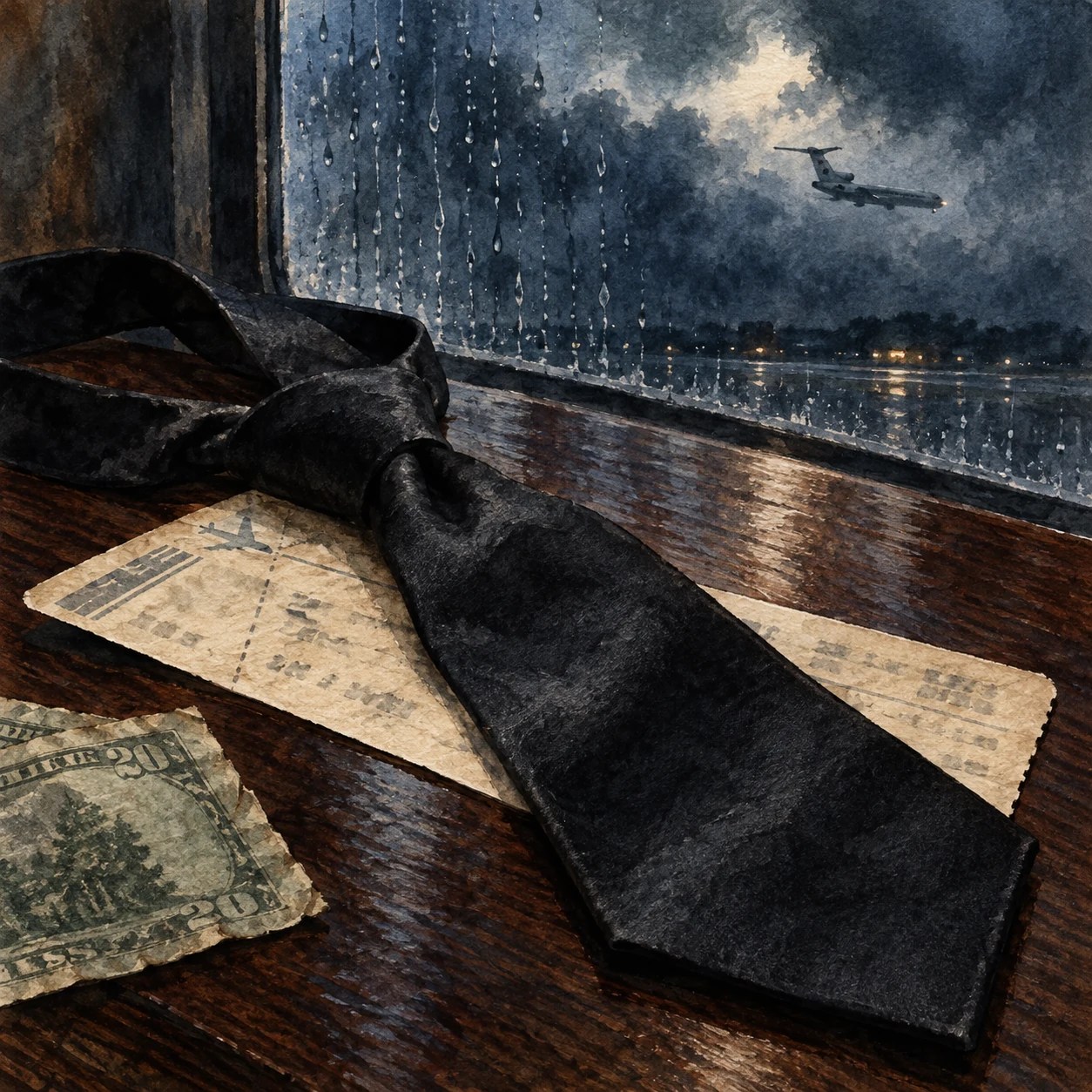
The FBI identifies a black J. C. Penney tie as an item Cooper wore and left on the aircraft. Its value comes from its association with the hijacker and from material retained on its surface. Unlike the missing man, the tie remained available for repeated examination as analytical techniques developed. FBI case history and tie photograph.
The Cooper Research Team used ultraviolet illumination, microscopy, and elemental analysis to examine particles and stains. It interpreted many of the sampled particles as consistent with material from match heads, fitting reports that the hijacker smoked. The team also argued that the particle accumulation reflected repeated wear. Those conclusions should remain proportionate to the observations: a dirty or particle-bearing garment can record exposure, but it does not directly reveal how many days one particular person wore it. Cooper Research Team, imaging and identification of tie particles.
An object can have several relevant owners or handlers. A tie may be bought, borrowed, given away, stored, worn by more than one person, or exposed to a workplace without its final wearer working there. These are not claims that any particular transfer occurred in this case. They are the alternative pathways an identification argument must consider before treating every particle as a record of the hijacker’s employment.
The chronology matters as much as the material. A particle acquired before November 24 could be informative about an earlier environment. Material introduced during collection or subsequent analysis would have a different meaning. A laboratory instrument can identify what a particle contains without automatically determining when it reached the tie.
The tie’s commercial origin likewise supplies context rather than a personal identity. A mass-produced garment can be associated strongly with an event while remaining shared in design with many other garments. Brand recognition does not produce a unique purchaser. The evidentiary strength lies in the recovered object’s chain of association and in any independently interpretable traces it carries.
A productive investigation therefore asks two questions in sequence. Is a proposed trace reliably present on the evidentiary object? If so, how specifically does that trace constrain the object’s history? Skipping the second question is how an interesting laboratory finding becomes an unjustified name.

18. Titanium is a material, not an employer’s signature
The independent team reported microscopic metallic titanium, aluminum shavings, and other metal-bearing particles from the tie. Its published explanation describes comparing elemental signatures and distinguishing titanium metal from titanium dioxide, which contains oxygen. A particle combining titanium and stainless steel was interpreted as evidence of mechanical contact or abrasion. These observations suggested possible industrial environments worth investigating. Cooper Research Team, titanium-particle analysis.
The larger occupational conclusions are less secure. The presence of a metal does not establish a single factory, and access to a factory does not establish one job title. Assumptions that only managers or engineers wore ties, or that a material occurred exclusively in a narrowly defined industry, require independent support. They should not be treated as measured findings from the microscope.
The team’s own account contains a useful example of caution: brass particles were excluded from part of its interpretation because brass components had been used in the sampling equipment. That potential source had to be addressed before the material could be attributed to the tie’s earlier life. Titanium analysis and contamination discussion.
The lesson extends beyond brass. A rare material can be a strong lead when its sources, transfer pathways, and sampling history are well established. Rarity by itself is insufficient. The relevant comparison is not simply whether a particle sounds unusual to the reader, but how often similar material appears in the environments and objects that could plausibly have contributed it.
A persuasive workplace argument would therefore compare actual reference material, explain how it was sampled, document analytical similarities and differences, and examine alternative sources. It would then need a separate connection between the workplace and a proposed person. Even a compelling factory association would not automatically place that person aboard Flight 305.
This is a sequence of increasingly specific claims: a particle contains a material; the material fits a process; the process fits an environment; an individual encountered that environment; that individual committed the hijacking. Each transition adds information that the preceding claim does not contain. The graphic below makes those transitions visible so that the reader can see where a theory is supported and where it is still making a leap.

19. More laboratory data still require a reliable chain
Later particle analysis expanded the amount of material examined. The Cooper Research Team’s account of work funded in 2016 reports automated examination of more than 100,000 particles across twenty sample stubs. It also discloses an important complication: nickel wires were present in the adhesive sampling tabs, so nickel detections should be discounted as a source for historical interpretation. The site warns of problems in some summary totals and distinguishes elemental data from molecular identification. Cooper Research Team, McCrone analysis disclosure.
This article has reviewed that disclosure, not independently recalculated the large workbooks or inspected every particle image. An impressive number of detections is not the same thing as an equally large number of independent clues. Repeated measurements can contain repeated contamination, related fragments, or categories that need further discrimination.
DNA raises an analogous issue at a different scale. The FBI’s public history says the tie supplied a DNA sample. Its 2007 account states that Duane Weber, a man associated with a reported deathbed confession, was ruled out through DNA testing. That is the Bureau’s stated conclusion and should be reported as such. The brief public account does not provide a complete laboratory report establishing every contributor, collection condition, or limitation of the profile. FBI, “D.B. Cooper Redux”.
A claim of a new match must therefore explain more than the existence of DNA somewhere on an object. What sample was tested? What connects it to the relevant person’s contact with that object? Are there multiple possible contributors? What comparison was performed, and what conclusion does the laboratory actually support? Without those details, “DNA evidence” can function as a persuasive label rather than an inspectable identification.
The difficulty should not be exaggerated into the claim that historical DNA analysis is useless. The Franklin investigation shows how genetic work, carefully combined with archaeological and genealogical information, can identify particular remains. The point is that the supporting chain matters. A method capable of answering a question in one well-documented setting does not automatically answer every question involving an old object.
Cooper’s tie remains important because it survives. Its long evidentiary life is both an opportunity and a condition that every new analytical claim must take into account.
20. Richard McCoy committed a similar crime; that does not make the crimes identical
Richard Floyd McCoy, Jr., occupies an unusual place among proposed Cooper identities because his involvement in a separate parachute hijacking was established. On April 7, 1972, he hijacked a United Airlines flight and obtained $500,000. Investigators linked him to that crime through evidence including handwriting and fingerprints. He was arrested two days later, and $499,970 was recovered. The case led to a conviction. FBI’s McCoy case history.
Those facts make McCoy relevant to the broader history. They show that a parachute escape from an airliner was not merely an impossible fantasy. They also provide a comparison in which investigators connected a named person to a particular hijacking through physical evidence and recovered money.
But the comparison cuts in two directions. McCoy’s demonstrated capacity to commit one crime does not establish his presence at another. Similarity of method can arise through imitation, shared knowledge, or repeated opportunities. Establishing that two events had the same perpetrator requires evidence linking them, rather than the observation that one person was capable of both.
The FBI’s Cooper page explicitly states that McCoy was ruled out because he did not match the closely corresponding descriptions supplied by two flight attendants and for other reasons. Its 2007 discussion also described difficulties with the proposed chronology. These are the official public assessments examined for this article. Later private claims should be evaluated against them rather than presented as though the Bureau never considered McCoy. FBI Cooper case history, FBI’s 2007 discussion.
The separate case also clarifies the standard of evidence. In McCoy’s established hijacking, the investigative chain includes a specific aircraft event, documents and traces, a suspect, and recovered ransom. In the Cooper mystery, a proposed name still lacks a publicly accepted chain of comparable force connecting that individual to November 24.
Readers should be alert to another source detail: the FBI’s long McCoy narrative notes that some witness or crew names were changed to protect identities. A vivid official narrative can therefore contain deliberately substituted names. This article avoids reproducing those people as though every name in the account were a verified biographical fact.
McCoy’s relevance is substantial. His identity as Cooper remains a different proposition, and the fact that he was convicted of one hijacking cannot do the evidentiary work required to prove the other.
21. The North Carolina parachute claim and the meaning of FBI silence
Jen Kocher’s February 22, 2026 report describes Dan Gryder’s claim about a parachute found on McCoy family property in Cove City, North Carolina. Reportedly, the FBI collected it in 2024 and returned it in December 2025. The agency referred inquiries to its 2016 statement. Kocher, Cowboy State Daily.
Gryder viewed non-rejection as confirmation of his theory. The reporting establishes no FBI identification of either the parachute or the hijacker. The “one-in-a-billion” label is a claimant’s characterization, not a measured frequency.
An agency’s silence is compatible with several states of knowledge. It may have inconclusive results, information it is not releasing, or no basis for a public change in status. A reader cannot select one of those possibilities merely because it favors a preferred theory. Likewise, an object’s return is an administrative action whose specific evidentiary meaning has to be established; it is not an automatic authentication certificate.
The reverse inference is also unsafe. Silence should not be treated as proof that a particular test definitively excluded the object if no such finding has been released. The proper public conclusion is the limited one: the reported collection and return do not, on their own, disclose a conclusive identification.
A material advance would be documentation connecting the object’s distinctive construction and history to the equipment actually supplied in 1971. A convincing account would distinguish contemporary records from later recollections, specify which features are common and which are unusual, and explain the chain of possession. It would not rely on a dramatic nickname to supply the missing comparison.
North Carolina readers will recognize the attraction of a local connection to an international mystery. As with the Theodosia Burr investigation, however, proximity and a compelling inherited story are reasons to examine evidence closely. They are not reasons to relax the standard applied to it.
22. The archive contains claims, and claims can be manufactured
A large investigative file contains more than established facts. It can preserve tips, interview summaries, hypotheses, newspaper clippings, allegations, and documents from related proceedings. The presence of a story in an FBI release proves that it entered the file, not that the Bureau verified every sentence in it.
The first portion of the public Cooper archive provides a concrete example. A 1972 criminal complaint involving William John Lewis and Donald Sylvester Murphy alleged a scheme to sell a false Cooper story to journalist Karl Fleming. The charging material describes purported supporting currency evidence and a staged interview arrangement. Those are allegations in a contemporary complaint; the selected pages examined here do not establish the eventual disposition of the charges. FBI Vault, part 1, complaint material in PDF pages 12–19.
The importance of the document is methodological as well as historical. Very soon after the hijacking, authorities were already confronting claims that appeared to offer a confession and corroboration. A confession was not automatically self-authenticating. Supposedly supporting objects had to be tested independently.
The same file includes press material that narrates events from the perspective of an alleged Cooper. Reading such a clipping without its document context can create a serious error: a dramatic story may be mistaken for a contemporaneous crew account. The agency’s letterhead elsewhere in the PDF does not convert that clipping into an official finding.
This problem is familiar elsewhere in the series. The Mary Celeste investigation tracks the influence of invented narratives on a real disappearance. The Flannan Isles investigation separates surviving official communications from later literary scenes. In Cooper’s case, a newly released file can contain an old claim; the release date is not the date the alleged event occurred or the date it was proven.
A useful confession would contain verifiable information that genuinely originated with the claimant and was not readily available from publicity. Even then, the surrounding circumstances and independent corroboration would matter. Repeating a famous detail demonstrates familiarity with the famous story. It does not demonstrate participation in the crime.
The archive should be read document by document, with attention to author, date, purpose, and evidentiary status. Its size is a measure of investigative activity. It is not a guarantee that the answer is already written somewhere inside it in a form that can be recognized without further proof.
23. The strongest case for death, and its limits
The FBI has repeatedly discussed the possibility that Cooper did not survive. Its account emphasizes darkness, adverse conditions, unsuitable clothing and footwear, and a parachute it describes as unsteerable. Larry Carr expressed substantial doubt that the hijacker was an expert or successfully completed the descent. The recovered money was also considered relevant to a fatal outcome. FBI case history, Carr’s assessment in the 2007 FBI account.
This is a coherent hypothesis. It takes the risks seriously and does not require an elaborate, undetected life funded by the ransom. The absence of an established later appearance is consistent with it. A reader can reasonably regard it as an important explanation without claiming that the exact cause, place, or moment of death has been proven.
The missing body is the central limitation. No authenticated recovery has connected human remains to the hijacker and established what happened to him. A failure to recover remains does not prove survival, especially where the relevant location is uncertain. But it also prevents a positive forensic account of a death at a specified site.
The money is similarly incomplete as a mortality indicator. Its recovery confirms that some ransom did not remain permanently available for ordinary spending. That can fit a fatal loss, but it can also fit a living person losing a portion of the money. The later environmental history inferred from the banknote does not require the hijacker to remain with it throughout that history.
The survival hypothesis has its own unmet obligations. It needs an explanation for the person’s movements after descent, the handling of equipment and money, and the absence of a publicly authenticated later identification. These requirements are not satisfied merely by pointing to another person who survived a parachute jump under different circumstances.
There is no defensible percentage to assign from the sources examined here. The relevant conditions are incompletely known, and the case does not provide a representative statistical population from which a precise survival rate can be calculated. Numerical confidence would make the article appear more decisive while hiding those limitations.
The evidence permits a serious argument for death and continued consideration of survival. It does not supply equal support for every detailed version of either. Each proposed sequence has to account for the available objects, observations, and gaps without converting assumptions into discoveries.
24. What evidence would actually change the identity question?
A new identification would be strongest if it connected a person to the crime through evidence whose history could be checked independently. Examples might include authenticated ransom currency with a documented chain of possession, a reliably linked parachute, or biological material whose relationship to the hijacker was established well enough to support comparison. These are categories of possible evidence, not claims that such a decisive discovery has occurred.
Contemporaneous records could also matter. A record placing a proposed person somewhere incompatible with the hijacking might exclude that candidate. A record placing the person in Portland would establish opportunity, but opportunity alone would not establish guilt. The difference between inclusion and exclusion should remain clear: many people could have been in the right city, while a securely demonstrated incompatible location could be highly consequential.
A private letter or confession would need authentication of its own. Who wrote it? When? How was it preserved? Which details were available publicly at that time? Did the author supply information that later produced a genuinely independent discovery? Those questions are more useful than deciding whether the tone sounds like a clever criminal.
The Beale Ciphers investigation examines a related problem: a persuasive document can create a large historical claim while leaving its own origin uncertain. The Kryptos investigation likewise distinguishes obtaining an answer through one route from demonstrating the process another claim requires. In Cooper’s case, discovering an interesting object is not the same achievement as demonstrating whose object it was during the hijacking.
A convincing new theory should also explain what evidence would count against it. If every mismatch becomes a disguise, every missing record becomes secrecy, and every official silence becomes confirmation, the theory cannot be meaningfully tested. Its flexibility protects it from contradiction while reducing its historical value.
The reader can apply a straightforward standard: identify the claim, identify the evidence supporting it, and identify the additional assumptions connecting the two. Then ask whether those assumptions have independent support. This does not require the reader to solve the case personally. It makes it possible to recognize the difference between a meaningful advance and a familiar assertion presented with new graphics.
The best discovery would reduce the number of unsupported transitions in the story. It would leave less work for resemblance, intuition, and speculation to perform.
25. Why the FBI redirected the investigation in 2016
The FBI announced on July 12, 2016 that it had redirected resources from the Cooper case on July 8. Its statement described forty-five years of investigative work without a definitive identification and said the surviving evidence would be preserved at FBI headquarters. It explained that reviewing continuing tips diverted personnel from more urgent priorities. FBI investigation update, July 12, 2016.
That decision is often shortened to “case closed.” The phrase can mislead if it is taken to mean the crime was solved or every possible future discovery was ruled out. The same announcement specifically invited contact if physical evidence related to the parachutes or ransom emerged. The operational decision and the historical uncertainty therefore coexisted.
The statement also distinguished a plausible story from the proof needed to establish culpability. This is an institutional account of why the investigation did not produce an identification. It does not require a reader to treat every past investigative judgment as infallible. It does require accurately reporting that the Bureau did not announce a solved identity.
Public research continued because the available material remained unusually rich. An authentic tie, surviving money, photographs, records, and recorded witness descriptions can support useful new work. The independent researchers discussed in this article demonstrate both the possibilities and the limits: better microscopy, more careful object examination, and environmental experiments can add information, while interpretation still depends on provenance and appropriate comparisons.
The public audience also changes the incentives surrounding a case. A dramatic solution travels farther than a carefully bounded finding. A new claimant can receive attention before the supporting documentation has been examined. An old allegation can be rediscovered by readers who have not encountered its earlier investigation. Those conditions make explicit sourcing more valuable, not less.
For people interested in history, an unresolved identification need not mean an unproductive investigation. The work can clarify what happened aboard the aircraft, correct erroneous names and dates, establish the history of a recovered object, or show why a particular explanation fails. Those are real gains even when the final name remains unknown.
The published record should preserve those gains without promising a conclusion it cannot support. That is especially important in a case whose public identity began with a reporting error and whose subsequent history includes repeated attempts to turn uncertainty into a marketable answer.
26. The evidence supports a real crime and an unfinished explanation
The basic event is established. A man using the name Dan Cooper hijacked Northwest Orient Flight 305 on November 24, 1971, obtained ransom and parachutes in Seattle, and disappeared during the subsequent flight. The crew returned safely. The man’s legal identity and ultimate fate have not been publicly established in the official sources examined for this investigation. FBI case history.
The recovered money is also established. Serial numbers connect it to the ransom. Its presence at Tena Bar is not a rumor or a resemblance. What remains uncertain is its movement between the aircraft and the beach, including the timing and mechanism of its water exposure and burial.
The diatom research offers a substantive, testable contribution to that narrower history. Its reported assemblage, interior-banknote observation, and experiments support the authors’ proposed sequence of water contact before burial and a warmer-season exposure. The study does not identify the hijacker, name the year of immersion, or prove that the man remained alive when the money entered the water. Kaye and Meltzer, 2020.
The tie provides another surviving line of inquiry. Material detected on it can generate questions about its earlier environments. The interpretation must account for handling, sampling, alternative sources, and the gap between an object’s history and a person’s identity. More elaborate instruments do not remove the need for that chain.
McCoy’s separate hijacking is an established comparison. His proposed identity as Cooper is not established by that comparison. The reported return of a parachute in 2025, discussed publicly in 2026, does not amount to a new FBI identification. A claim of confirmation requires an actual confirming finding.
The strongest investigation therefore ends with several different levels of certainty, rather than one atmospheric verdict. The hijacking is certain. The recovered ransom connection is certain. Some proposed environmental inferences are scientifically supported but bounded. The complete route, survival outcome, and identity remain unresolved.

That ending leaves room for a future discovery without treating every story as equally persuasive. A genuine advance will connect facts that are presently separated. Until then, Cooper’s disappearance is best understood through the people who witnessed the crime, the objects that survived it, and the limits those objects place on what can responsibly be claimed.
Sources and research notes
The central institutional sources are the FBI’s Cooper case history, its December 31, 2007 discussion, its March 17, 2009 research account, and the July 12, 2016 status announcement. Statements by particular agents are identified as their assessments where appropriate. Historical contact details in archived pages should not be treated as current reporting instructions.
The FBI Vault supplies released documents. This investigation uses selected material, including the part 1 complaint pages, and does not claim an exhaustive review of the complete case file. Newspaper material preserved inside a release remains newspaper material. A complaint records allegations, rather than proving the disposition of a case. The FBI’s separate McCoy history supplies the comparison discussed above.
The principal scientific paper is Thomas G. Kaye and Mark Meltzer, “Diatoms constrain forensic burial timelines: case study with DB Cooper money,” Scientific Reports 10, 13036 (2020), DOI 10.1038/s41598-020-70015-z. The paper is available under Creative Commons Attribution 4.0. The explanatory graphics and discussion here are newly created adaptations of its reported measurements and methods, with the interpretive limits stated in the text; they are not reproduced laboratory micrographs.
The Cooper Research Team supplies first-party accounts of independent examinations and experiments. Its published findings are distinguished from FBI conclusions. Links beside the relevant passages identify the specific pages consulted. Large particle workbooks, complete original flight-test records, and the full original Palmer field documentation were not independently reanalyzed for this article.
The recent parachute discussion draws on Jen Kocher’s February 22, 2026 report. Reported claims remain attributed. All seven watercolor scenes are original interpretations, not authenticated photographs, portraits, banknote reproductions, or exact site reconstructions. Quantitative graphics use stated units and do not assign invented probabilities to guilt or survival. Research status was checked September 6, 2026.
Leave a Reply