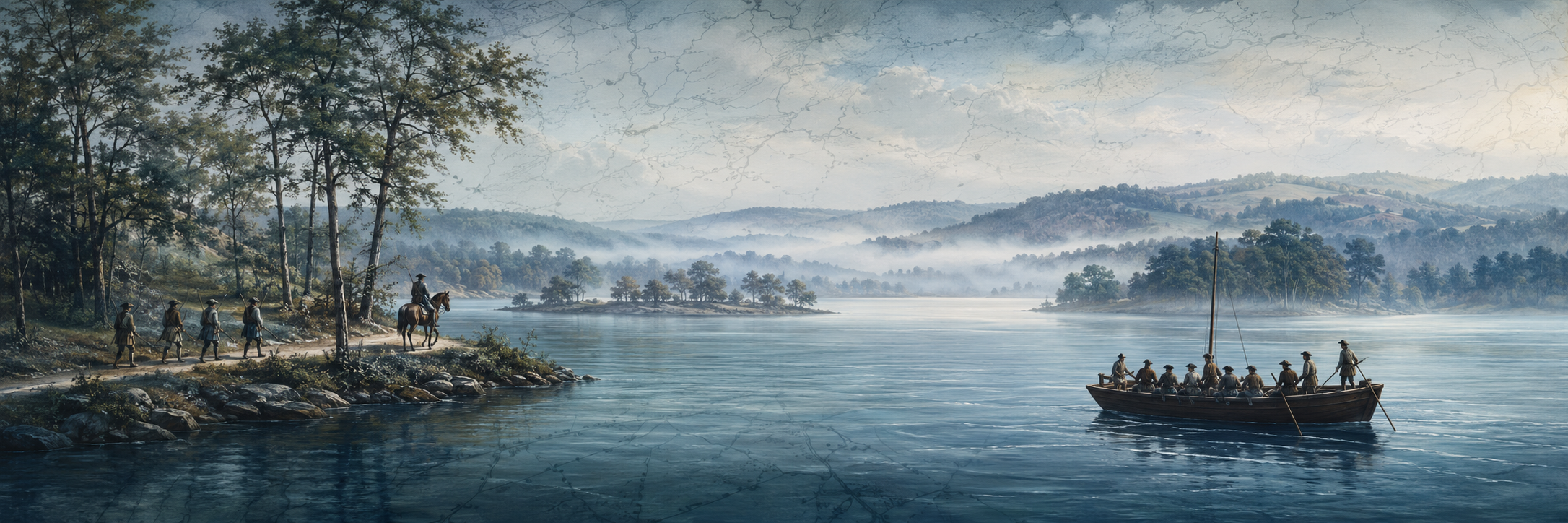


Introduction: Davidson in the Lake Norman Story
Davidson, North Carolina, may be small in size, but its story is central to the history of the Lake Norman region. Nestled on the eastern shore of the lake, Davidson blends the traditions of a nineteenth-century Presbyterian college village with the vibrancy of a modern Charlotte suburb. The town was founded in 1837 alongside Davidson College and named after General William Lee Davidson, a Revolutionary War hero who was killed at the Battle of Cowan’s Ford. From its earliest days, the town has carried both scholarly and patriotic legacies.
It is important not to confuse the Town of Davidson with Davidson County, North Carolina. Both honor General Davidson, but they represent different histories: Davidson County (county seat Lexington) developed around tobacco, furniture, and Piedmont industry, while the Town of Davidson grew from classrooms, cotton mills, and eventually lakefront neighborhoods.
Davidson’s roots trace back to Scotch-Irish Presbyterians in Mecklenburg County—the region once called the “Hornet’s Nest of Rebellion” for its fierce Revolutionary spirit. Those early settlers were linked not only to Charlotte but also to frontier trade routes stretching into the North Carolina mountains, connecting communities like Boone and West Jefferson. By the late nineteenth century, Davidson’s growth intertwined with nearby towns: Huntersville rose as a railroad hub, Cornelius emerged around cotton scales and textile mills, Mooresville became a center for industry and later NASCAR, Denver, NC was shaped by ironmaking and farming, and Sherrills Ford evolved from a cotton community into a lakefront destination. Davidson’s unique contribution was its academic heart—anchored by the college—which gave the Lake Norman story a distinctly scholarly dimension.
Today, Davidson is known for its tree-lined Main Street, historic architecture, and walkable neighborhoods. The town’s government emphasizes sustainability, historic preservation, and careful growth, ensuring that Davidson retains its small-town character even as the Charlotte metropolitan area expands around it. Events like Christmas in Davidson, the Davidson Farmers Market, and community theater at the Armour Street Theatre embody the civic spirit that continues to define the town.
Davidson remains at once a college town, a lake town, and a historic town—a place where the past echoes through brick storefronts and ivy-covered halls, while the future is guided by community values and a strong sense of identity.
II. Early Settlement & Revolutionary Roots
The land that would become Davidson was first home to the Catawba Nation, the “people of the river,” who lived along the Catawba River long before European settlement. By the mid-1700s, waves of Scotch-Irish Presbyterians from Pennsylvania and Virginia began migrating into Mecklenburg County, seeking farmland and religious freedom. These settlers clustered around newly founded congregations like Centre Presbyterian Church, which became one of the earliest anchors of faith and community in the northern part of the county.
Among these pioneering families was the Davidson family. John Davidson, a prosperous merchant, settled at Davidson’s Creek, then the westernmost settlement in North Carolina. His son, General William Lee Davidson, rose to prominence as a Revolutionary War officer. In February 1781, during the Southern Campaign of the Revolution, he was killed while leading Patriot militia against British forces at the Battle of Cowan’s Ford on the Catawba River. His sacrifice became legendary, and decades later his name would be given to both Davidson College and the town that grew up around it.
Davidson’s Revolutionary context places it squarely within Mecklenburg County’s proud reputation as the “Hornet’s Nest of Rebellion.” Local lore holds that even Lord Cornwallis, frustrated by fierce Patriot resistance, used that phrase to describe the region. Northern Mecklenburg militiamen often fought alongside their neighbors in Iredell County and Cabarrus County, forging bonds that connected Davidson to a broader Piedmont resistance.
The Davidson family’s second generation continued to shape the region. William Lee Davidson II, son of the fallen general, sold 469 acres of family land at Beaver Dam Plantation to the Concord Presbytery in 1835. That land became the foundation of Davidson College, which in turn gave birth to the town. Beaver Dam, now owned by the college and listed on the National Register of Historic Places, remains a tangible link to this moment where Revolutionary sacrifice and Presbyterian vision converged.
Frontier roads radiating from Mecklenburg also tied Davidson to the high country of western North Carolina. Trade and kinship networks connected the community to outposts like Boone, West Jefferson, and Wilkesboro, reinforcing its identity as a gateway between the Charlotte lowlands and the Appalachian backcountry. These ties would later help Davidson College attract students from across the state and beyond, ensuring that the small village at Cowan’s Ford became more than just a crossroads—it became a center of learning and leadership.
III. Founding of Davidson College (1837)
The town of Davidson owes its very existence to the founding of Davidson College. In 1835, the Concord Presbytery of the Presbyterian Church sought to create a new institution of higher learning in the Carolina Piedmont. Their goal was to provide a moral and classical education for young men, particularly the sons of the Scotch-Irish settlers who had spread across Mecklenburg and surrounding counties. To accomplish this, they purchased 469 acres of farmland from William Lee Davidson II, son of the Revolutionary War hero General William Lee Davidson. The younger Davidson sold the land at a discounted rate, and in recognition of his father’s sacrifice at the Battle of Cowan’s Ford, the college was named in his honor.
When the college officially opened in 1837, it welcomed sixty-four students, two professors, and a modest collection of buildings that included dormitory rows, a chapel, and faculty residences. Although small, the campus quickly became the focal point of the surrounding community. Local merchants set up shops near the grounds, families opened boarding houses for students, and the steady growth of the school laid the foundation for a permanent town.
From the outset, Davidson College’s mission was deeply religious and educational. Rooted in the Presbyterian and Reformed tradition, the institution emphasized faith, discipline, and service as much as academic learning. Two debating societies — the Eumenean Society and the Philanthropic Society — dominated early student life. Each constructed its own grand hall, both in the classical Greek Revival style, to house meetings and oratory contests. These societies not only trained young men in rhetoric and leadership but also enforced strict codes of behavior, which foreshadowed the Honor Code that remains central to Davidson’s culture today.
Daily life revolved around the rhythms of the college. Students and professors lived in close proximity, with faculty homes appearing along North Main Street and later Concord Road. Boarding houses operated by townspeople provided meals and lodging, fostering constant interaction between residents and the academic community. The bell of the chapel marked the hours, while the debates of the societies and the hum of nearby businesses set the cadence of civic life.
Davidson’s growth was distinctive when compared to its neighbors. While Cornelius developed around cotton scales and textile mills, and Huntersville rose with the arrival of the railroad, Davidson’s nucleus was intellectual. It was built not on commerce or industry, but on the ideals of scholarship, morality, and community life anchored to the college.
Within a single generation, what had been little more than a rural crossroads had transformed into a college village. Though the community would later be shaped by the railroad, cotton mills, and eventually Lake Norman, its character remained inseparable from Davidson College — an institution that gave the town its name, its reputation, and its enduring identity.
IV. Incorporation & Mill Era (1879–Early 20th Century)
By the late nineteenth century, the small college village that had grown around Davidson College was evolving into a more complex community. In 1879, the North Carolina General Assembly officially incorporated the town as “Davidson College, North Carolina,” later shortened to simply “Davidson” in 1891 as the town’s role expanded beyond the campus.
The reactivation of the railroad between Charlotte and Statesville in 1874 had already begun to change Davidson’s destiny. Once an isolated academic settlement, the town suddenly became a shipping point for cotton and other cash crops. Farmers from northern Mecklenburg and southern Iredell brought their goods to Davidson’s depot, and merchants established a growing commercial district along Main Street.
The industrial era soon followed. Davidson’s first major textile plant, the Linden Cotton Mill, opened in 1890 on Depot Street, and was joined in 1908 by the Delburg Cotton Mill, later known as the Davidson Cotton Mill. These factories drew farm families into town, eager for stable wages in a time when agriculture was uncertain. Mill villages sprang up along Delburg Street, with rows of modest houses built by the company to house workers. The daily life of Davidson now carried two distinct rhythms: the intellectual cadence of the college and the industrial pulse of the mills.
This balance gave Davidson a unique dual identity. Professors lectured in Greek and Latin while the mill whistles set the pace for working-class families. Merchants and tradesmen thrived by serving both populations, and the town’s civic character grew more diverse. Davidson was no longer just a college enclave; it was also a small industrial hub.
Regionally, Davidson’s experience mirrored that of its Lake Norman neighbors. Mooresville, just up the rail line, grew rapidly into a textile and railroad center. Sherrills Ford remained rooted in cotton farming, while Denver, NC leaned on iron production and agriculture. Together, these towns formed a network of communities that blended old Piedmont traditions with the new forces of industry and transportation.
By the early twentieth century, Davidson had become a place where professors, mill workers, merchants, and farmers lived side by side. Though the college remained the town’s nucleus, the rise of mills and railroads added a new layer of economic and social life — one that would shape Davidson’s trajectory for generations.
V. Civil Rights & Education
Education has always been at the center of Davidson’s story, but for much of its history, that education was segregated along lines of race and class. As the town grew in the late nineteenth and early twentieth centuries, parallel Black communities emerged, providing their own schools, churches, and businesses in a segregated South. Much like the Smithville neighborhood in Cornelius, Davidson’s African American residents created strong cultural and civic anchors despite limited resources and systemic exclusion.
One of the most important milestones was the construction of the Davidson Colored School in 1938, supported in part by New Deal programs. Originally a modest six-room facility serving grades one through nine, it quickly became a cornerstone of the Black community. Beyond instruction, it hosted civic meetings, church events, and fundraisers. The school was later renamed the Ada Jenkins School in honor of Ada Jenkins, a beloved teacher and counselor who devoted her life to supporting local children. Today, the building serves as the Ada Jenkins Center, housing nonprofit programs and continuing its legacy of community empowerment.
Meanwhile, Davidson College followed a slow and often uneasy path toward racial integration. Founded in 1837 to educate the sons of the white Presbyterian elite, the college remained all-male and all-white for more than a century. It was not until the 1960s, amid the broader Civil Rights Movement, that Black students were admitted. Even then, progress was gradual and sometimes contested. In recent years, the college has taken steps to acknowledge its ties to slavery and segregation, establishing a Commission on Race, Slavery, and Reconciliation and repurposing sites like Beaver Dam Plantation as educational resources to confront difficult aspects of its past.
Despite these struggles, education has remained Davidson’s defining feature. The town’s white residents established early private schools and later a graded public school system in the early 1900s. African American families, excluded from those institutions, built their own parallel structures until desegregation. Over time, these two paths converged, though inequities lingered well into the twentieth century.
Today, Davidson’s identity as a community is still shaped by its schools — from Davidson College to public institutions like Davidson IB Middle School, and from the legacy of the Ada Jenkins Center to modern civic initiatives. The pursuit of learning, once sharply divided by race and privilege, has become the town’s most unifying thread, carrying forward the values of resilience, opportunity, and reconciliation.
VI. Lake Norman Transformation (1960s)
The most dramatic change to Davidson’s physical and cultural landscape came with the creation of Lake Norman. In 1959, Duke Power began construction of the Cowans Ford Dam on the Catawba River. Completed in 1963, the project created the largest man-made lake in North Carolina, stretching 32,000 acres across four counties. What had been farmland, river crossings, and old settlement sites—including fords like Cowan’s that carried Revolutionary War memories—was submerged beneath rising waters.
For Davidson, this transformation was profound. The college town, once ringed by farms and mill villages, suddenly found itself with shoreline property. The new lake spurred the development of marinas, neighborhoods, and recreational amenities that reshaped the town’s identity. Areas near Beaty Street became associated with Lake Davidson, a northern finger of the reservoir, while the larger lake itself brought boating, fishing, and waterfront living within walking distance of downtown.
Yet Davidson’s relationship with the lake differed from its neighbors. Huntersville, closest to Charlotte, rapidly suburbanized, filling with subdivisions and commuters. Cornelius leaned into its new role as a marina hub, with yacht clubs and waterfront businesses driving its growth. Sherrills Ford, once a quiet cotton community, transitioned into a patchwork of lakefront homes and fishing retreats. By contrast, Davidson approached lakefront development cautiously, maintaining its emphasis on college life, small-town character, and historic preservation even as waterfront demand grew.
The creation of Lake Norman also tied Davidson more closely to surrounding counties. The northern reaches of the lake connected it to Iredell County and the booming industrial town of Mooresville, while road networks linked residents southward to Cabarrus County and the Concord area. Davidson was no longer a relatively isolated crossroads community—it was firmly embedded in a new, regional lake economy.
The submergence of farmland marked the end of Davidson’s purely agrarian backdrop, but the rise of lake culture added another defining layer to its story. From rowing teams on Lake Davidson to families enjoying the lake’s marinas, the waters of Lake Norman became as much a part of Davidson’s modern identity as the ivy-covered halls of the college.
VII. Modern Davidson
Today, Davidson is recognized as one of the most distinctive small towns in North Carolina. At its heart, it remains a thriving college town, defined by the presence of Davidson College, founded in 1837 and home to roughly 2,080 students. The college has earned a national reputation for academic excellence, Division I athletics, and a deep commitment to community engagement. Its leafy campus and historic buildings still anchor the town’s identity and economy, just as they did in the nineteenth century.
Beyond the college, downtown Davidson thrives as a cultural center. Brick storefronts along Main Street house independent bookstores, restaurants, cafés, and the beloved Soda Shop, creating the kind of walkable, small-town environment that has become increasingly rare. The Davidson Farmers Market, seasonal festivals like Christmas in Davidson, and community theater at the Armour Street Theatre draw residents and visitors alike, blending heritage with a vibrant modern civic life.
Davidson also stands out for its intentional approach to planning. The town government emphasizes sustainability, historic preservation, and managed growth, a philosophy that has helped it retain its small-town charm even as the Charlotte metropolitan area expands around it. Policies that promote walkability, bicycle access, and green space reflect lessons shared in the UNC School of Government’s Small Towns, Big Ideas project: thriving small towns succeed when they lean on local assets and civic engagement. Davidson has become a model of exactly that kind of development, where historic roots and modern values reinforce one another.
In terms of identity, Davidson is both a Charlotte commuter town and an independent cultural hub. Many residents work in the city, but return each evening to a community that prizes slower rhythms, civic participation, and neighborhood life. At the same time, Davidson attracts tourists and new residents who are drawn to its college events, historic charm, and lakefront amenities.
Comparisons are often made to other North Carolina college towns such as Boone and West Jefferson in the mountains. Like Davidson, these towns have leveraged their colleges and historic Main Streets to create thriving, walkable communities that serve as cultural anchors for their regions. Yet Davidson’s unique combination of college, lake, and Charlotte proximity makes it stand apart.
In the twenty-first century, Davidson has embraced its layered identity: a place of scholarship, a historic Southern town, a Lake Norman community, and a modern model of small-town vitality. Its success lies in balancing growth with preservation, and in carrying forward the academic and civic ideals that gave it life nearly two centuries ago.
VIII. Conclusion: A Crossroads of Tradition and Transformation
The story of Davidson, North Carolina, is one of continuity and change, of traditions carried forward and transformations embraced. From its earliest days, when Scotch-Irish Presbyterians carved out farms and built Centre Presbyterian Church, to the founding of Davidson College in 1837, the town has been defined by education and history. The sacrifice of General William Lee Davidson at Cowan’s Ford gave the community its name, but the vision of his son and the Concord Presbytery gave it its enduring identity.
Across nearly two centuries, Davidson has shown remarkable adaptability. It absorbed the arrival of the railroad in the 1870s, balanced the intellectual life of the college with the industrial hum of mills, weathered segregation and embraced reconciliation, and transformed once-rural edges into lakefront neighborhoods with the creation of Lake Norman in the 1960s. Each new era left its imprint without erasing the foundations of faith, learning, and civic life that made Davidson unique.
In this, Davidson’s journey parallels that of its Lake Norman neighbors. Huntersville rose with the railroad, Cornelius was born from cotton scales and mills, Mooresville surged on textiles and industry, Denver transitioned from ironworks to farming, and Sherrills Ford shifted from cotton to lakefront living. Together, these towns form a patchwork of histories, each distinct yet interconnected by geography, economy, and shared memory.
Davidson’s distinction lies in its scholarly voice within that chorus. Where others were defined by commerce and industry, Davidson was shaped by classrooms, debating halls, and a campus bell tower. And yet it was also touched by the same forces — Revolutionary battlegrounds that earned Mecklenburg its title as the “Hornet’s Nest of Rebellion,” mill whistles that echoed across the Piedmont, and waters that rose to create Lake Norman, the inland sea that unites the region today.
In the end, Davidson stands as a modern lake-and-college town that has never lost sight of its past. It is at once a place of professors and farmers, students and shopkeepers, long-time families and newcomers drawn to the lake. Davidson’s history is not simply a story of survival, but of intentional transformation — of a community that has continually adapted while preserving the ideals that gave it birth.
Adkins Law, PLLC – Serving Davidson and the Lake Norman Region
At Adkins Law, PLLC, we are proud to serve families and individuals across Davidson, Huntersville, Cornelius, Denver, Sherrills Ford, and the greater Lake Norman community. Just as Davidson’s history reflects resilience, tradition, and transformation, we strive to guide our clients through life’s most important transitions with clarity and care.
Our practice focuses on family law, custody, divorce, mediation, and estate planning. Whether you are working to protect your children’s future, plan your legacy, or resolve disputes through mediation, our team is here to provide experienced, compassionate counsel.
As a firm rooted in Huntersville and the Lake Norman area, we understand the values that make this community unique — from strong family ties to a deep respect for history and growth. We live here, we work here, and we are committed to helping our neighbors navigate challenges and plan for what comes next.





Leave a Reply