Estate Planning · Hickory · Newton · Catawba County
In this guide
- Understand the three different jobs
- Financial powers of attorney: durability and timing are different
- Broad financial language does not answer every question
- Health care powers of attorney: choosing a person who can speak for you
- A living will records specific treatment directions
- Signing requirements deserve careful attention
- A Newton incapacity-planning example
- Make your documents accessible without losing control
- Frequently asked questions
- Official North Carolina sources
If a medical emergency left you unable to communicate, who would speak with your doctors? If recovery took several months, who could manage your bills and financial affairs? These are separate questions. For adults in Newton and across Catawba County, a financial power of attorney, a health care power of attorney, and a living will can address different parts of the problem.
The documents should reflect your choices and work together. A label on the first page is not enough: the authority granted, the conditions for using it, the people selected, and correct execution all matter. So does making the documents available when someone needs them.
Understand the three different jobs
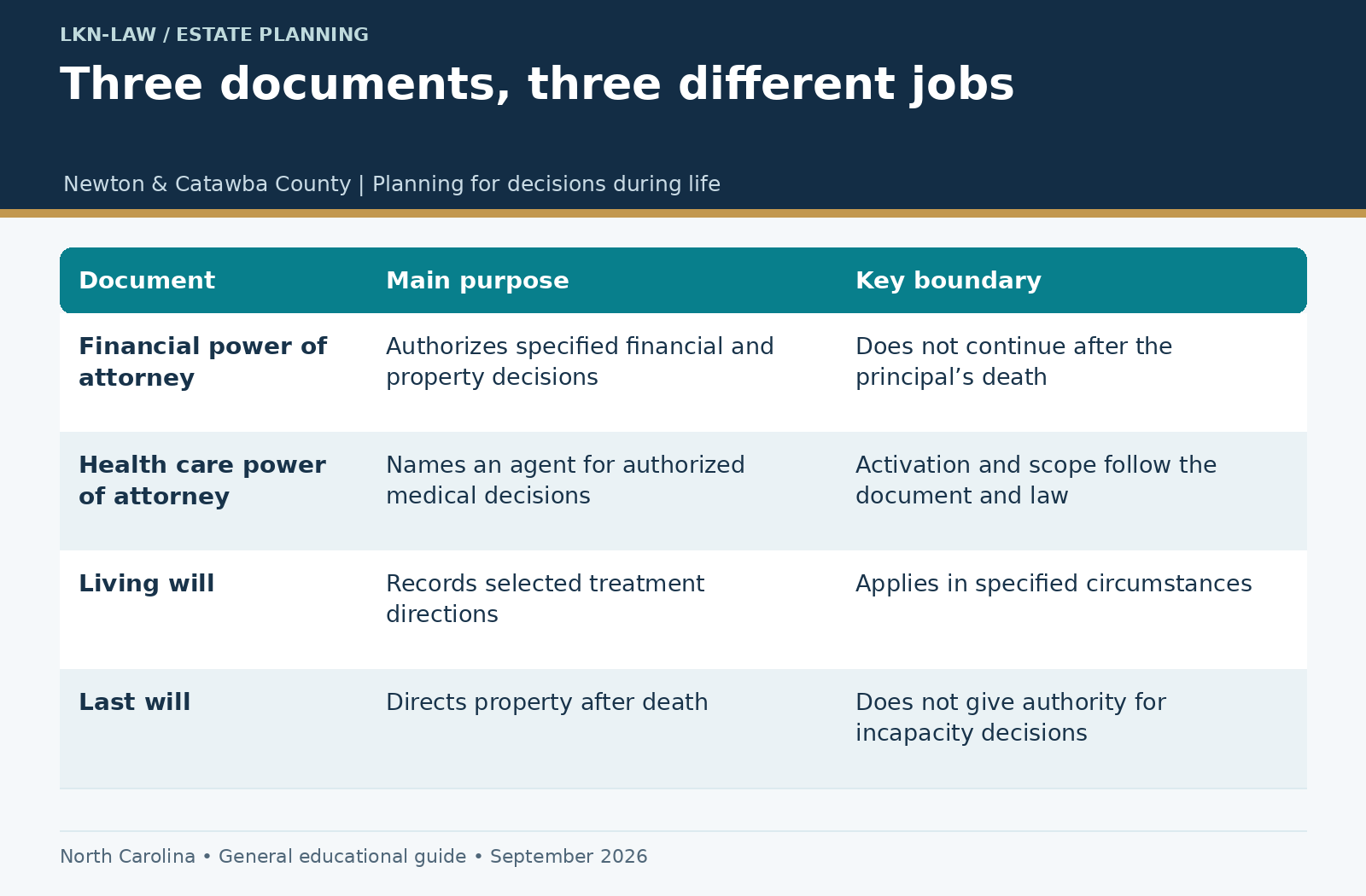
| Document | Main purpose | Important boundary |
|---|---|---|
| Financial power of attorney | Authorizes an agent to handle specified property and financial matters | Does not automatically provide health care authority or continue after death |
| Health care power of attorney | Names an agent for health care decisions under the document and applicable law | Does not simply make the agent owner of your accounts |
| Living will | Records directions about life-prolonging measures in specified circumstances | Does not distribute your property or replace every medical decision |
A last will and testament serves yet another purpose: directions that operate after death through the applicable estate process. The similarity between the phrases “living will” and “last will” causes understandable confusion, but the documents address different situations.

Financial powers of attorney: durability and timing are different
Under North Carolina’s Uniform Power of Attorney Act, a power of attorney is durable unless the document expressly provides that incapacity terminates it. “Durable” concerns whether authority survives incapacity; it does not mean the agent must wait for incapacity before acting.
Under G.S. 32C-1-109, a financial power of attorney is effective when executed unless it specifies a future date, event, or contingency. A document that becomes effective on incapacity therefore needs a workable method for determining that the required condition has occurred. Discuss who will make that determination and how institutions will receive evidence of it.
Immediate authority can make assistance easier, but it places significant trust in the agent. Contingent authority may fit a person’s preferences but introduce practical steps at a difficult moment. Neither choice should be made simply by checking the option that sounds safest. Consider your circumstances, the selected agent, and how the document will actually be used.
What happens at death?
A financial power of attorney terminates when the principal dies. The person who previously paid bills as agent should not assume that authority continues for estate administration. An executor or administrator may need court-issued authority, while a trustee has a separate role over trust property. Documenting this transition helps avoid unauthorized withdrawals or payments.

Broad financial language does not answer every question
Some important powers require specific authorization under G.S. 32C-2-201. Examples include certain trust actions, gifts, creating or changing beneficiary designations, and creating or changing rights of survivorship. Those powers can affect who ultimately receives property. They deserve a separate conversation, particularly when the agent is also a potential beneficiary.
Ask counsel to connect the proposed authority to actual needs. Does someone need to manage a business interest? Deal with a retirement custodian? Maintain real estate? Support a dependent? Work with an existing trust? A form that looks comprehensive may omit the authority needed for a particular task, while an unnecessarily broad grant may permit changes you never intended.
An agent has duties, not personal ownership of your money. North Carolina requires an acting agent to honor the principal’s known reasonable expectations or otherwise the principal’s best interests, act in good faith, and remain within the granted authority. Recordkeeping and loyalty requirements are also important. Clear instructions and organized records can protect both the principal and the person serving.
Health care powers of attorney: choosing a person who can speak for you
A health care agent should be willing to understand your values, ask questions, and communicate with medical professionals. The best choice is not always the closest relative geographically or the person who finds medical conversations most comfortable. What matters is whether the person can represent your wishes thoughtfully under pressure.
North Carolina law provides for activation when the required professional determination establishes that the principal lacks sufficient understanding or capacity to make or communicate health care decisions. The statute and document govern who makes that determination. The agent’s authority operates during the relevant incapacity, subject to the applicable terms and law.
Discuss a successor agent. A single appointment may fail at the worst time if that person is traveling, unavailable, or affected by the same accident. Give your agents a practical way to contact one another and access the current document.
Talk about values before a crisis
Useful conversations include what independence means to you, who should participate in difficult discussions, what religious or personal beliefs matter, and what questions you would want asked about treatment. These discussions should support your written instructions. If a conversation reveals that the documents no longer reflect your wishes, arrange a proper update rather than relying on conflicting informal statements.

A living will records specific treatment directions
North Carolina’s advance directive for a natural death addresses life-prolonging measures in specified conditions. The statute includes an incurable or irreversible condition expected to cause death within a relatively short time, permanent unconsciousness, and advanced dementia or another irreversible substantial loss of cognitive ability. The document’s selections and required medical determinations matter.
A living will is not a blanket instruction to withhold ordinary care whenever you are ill. Discuss the medical meaning of the choices with a clinician, including artificial nutrition, hydration, comfort care, and whether your health care agent may override the directive. Make the relationship between your directive and agent’s authority deliberate.
Do not assume a living will is the same as a portable do-not-resuscitate order or another medical order. Ask your treating clinician which documents and orders fit your health situation and how emergency providers will receive them.
Signing requirements deserve careful attention
North Carolina’s financial power-of-attorney statute requires a signature, or a properly directed signature in the principal’s conscious presence, and acknowledgment. A health care power of attorney generally requires two qualified witnesses and acknowledgment before a notary. The living-will statute also has specific witness and proof requirements.
Witness qualifications are substantive. A person’s relationship to you, possible inheritance, employment connected to your care, or claim against your estate can matter. Do not assume that any two adults in a hospital room qualify or that the notary can fix an incorrect witness arrangement.
Existing documents may be governed by rules applicable when and where they were signed. Do not discard an older or out-of-state document simply because its layout differs from a current form. Have its validity, scope, and practical usefulness reviewed together.
A Newton incapacity-planning example
Hypothetical: Taylor lives in Newton, owns a home, and helps an aging parent. Taylor wants a financially organized sibling to handle bills but prefers a close friend with strong communication skills to speak with doctors.
Taylor’s plan can assign these separate roles, identify successors, and specify how the agents should coordinate. The financial agent may need to arrange payment for care, while the health care agent considers treatment decisions. They need compatible instructions and access to relevant information, not an assumption that one appointment automatically covers everything.
Taylor also identifies recurring obligations, professional contacts, and where the originals are kept. The attorney reviews authority for the actual financial tasks, and Taylor discusses medical preferences with the chosen friend. The result is a plan that connects legal authority to the work someone may need to perform.

Make your documents accessible without losing control
- Keep originals in a secure place and tell the appropriate people how to locate them.
- Provide current health care documents to the agent and relevant medical providers.
- Discuss financial-document acceptance with important institutions before an emergency.
- Maintain a separate, secure list of accounts, recurring bills, insurance, and advisors.
- Label superseded copies and follow the proper process for revocation or replacement.
- Review the plan after marriage changes, an agent’s death, a move, or significant health changes.
For a Catawba County family, this work can also include checking whether the trusted people live close enough to assist, how they will travel if needed, and whether they understand the household’s obligations. Those are practical planning questions rather than county-specific legal rules.
Frequently asked questions
Does my spouse automatically have power of attorney?
No. Marriage is not itself a financial power of attorney. Other legal rules may affect particular medical or property questions, but they should not be treated as a substitute for a coordinated plan.
Can the same person be both agents?
Yes, if legally eligible and appropriate. Consider whether the person has the time, judgment, and skills for both roles, and name suitable successors.
Can an agent rewrite my estate plan?
The answer depends on the granted authority, applicable limits, and the proposed act. Specific powers affecting gifts, trusts, survivorship, and beneficiaries require careful review. An agent’s personal preference is not a substitute for your instructions and the law.
Can I change my mind?
Applicable law provides mechanisms for revocation and replacement, but the requirements differ by document. Communicate changes to the people and institutions relying on the old documents. Signing a replacement and leaving every old copy in circulation can create avoidable confusion.
The best preparation is to choose the right people, explain your wishes, and complete the legal and practical steps together. That makes powers of attorney and advance directives useful tools for Newton families throughout adulthood.
Official North Carolina sources
- N.C.G.S. 32C-1-104: Durability of a financial power of attorney
- N.C.G.S. 32C-1-105: Execution of a financial power of attorney
- N.C.G.S. 32C-1-109: When a power of attorney becomes effective
- N.C.G.S. 32C-1-110: Termination of a power of attorney
- N.C.G.S. 32C-1-114: Agent duties
- N.C.G.S. 32C-2-201: Authority requiring a specific grant
- N.C.G.S. 32A-16: Health care document and witness definitions
- N.C.G.S. 32A-20: Health care power effectiveness and revocation
- N.C.G.S. 90-321: Advance directive for a natural death
Updated September 23, 2026. This article provides general North Carolina legal information. Estate planning documents and asset transfers should be tailored to your circumstances.
This article provides general educational information, not advice for a particular case, and does not create an attorney-client relationship. Examples are hypothetical. Legal rights, deadlines, and planning choices depend on the facts and applicable law.