


Introduction
Huntersville, North Carolina, is more than just a fast-growing suburb north of Charlotte — it is a community with deep roots and a story that stretches back nearly three centuries. From its beginnings as a Scotch-Irish and German farming settlement in the mid-1700s to its rise as a textile hub in the late 19th century, Huntersville has continually adapted to the forces of change. The arrival of the railroad, the creation of Lake Norman, and the suburban boom of the late 20th century all left lasting marks on the town’s landscape and character. Today, landmarks such as the Hugh Torrance House and Store, the Huntersville Rosenwald School, and the Alexandriana site keep its history alive, reminding us that Huntersville’s story is one of resilience, growth, and cultural heritage.
Early Settlements and Growth
In the mid-1700s, waves of Scotch-Irish and German immigrants moved into the fertile Piedmont region of North Carolina, drawn by the promise of farmland and freedom. These settlers cleared dense forests, planted crops, and began forming tight-knit communities rooted in faith, hard work, and independence. The settlement that would eventually become Huntersville was originally known as Craighead, a small but resilient community anchored by agriculture and family homesteads.
As the 19th century progressed, a new force of change arrived: the railroad. When the tracks extended north from Charlotte, Craighead gained an essential connection to regional markets. The railroad allowed farmers and merchants to move cotton, produce, and supplies more efficiently, tying the once-isolated settlement into the expanding economy of Mecklenburg County. This development not only spurred population growth but also laid the foundation for Huntersville’s eventual emergence as a textile and trading center.
Industrial Foundation
By the late 19th century, the modest farming village of Craighead was poised for transformation. The catalyst came in 1873 with the founding of the Huntersville Cotton Mill, a facility that altered the trajectory of the town’s economy and daily life. At a time when the Piedmont region of North Carolina was shifting from a purely agrarian base to the textile-driven “New South,” the cotton mill provided both stability and opportunity. Farmers who once relied solely on fluctuating crop prices could now sell their cotton locally, while townspeople found steady—if demanding—employment within the mill’s walls. The steady whir of machinery and the rhythm of shifts became as much a part of the landscape as the fields and forests that had defined Craighead for over a century.
The success of the cotton mill soon attracted additional investment. The Virgin Manufacturing Company established operations shortly afterward, reinforcing Huntersville’s budding identity as a textile center. These mills did more than produce cloth—they drew in merchants, craftsmen, and families seeking livelihoods, fueling population growth and new commercial activity. Mill villages, boarding houses, and small businesses emerged to serve the growing workforce, binding the town’s identity to the textile industry.
This period of industrial rise also brought with it a shift in civic identity. To honor Robert Boston Hunter, a prominent cotton farmer and landowner whose influence helped shape the town, Craighead was renamed Huntersville. Later in 1873, the same year the cotton mill opened its doors, the community was formally incorporated, becoming the first town in the Lake Norman area to gain official status. This step not only legitimized Huntersville’s presence on state records but also symbolized its evolution from a quiet settlement into a community with regional importance.
The combination of rail access, industrial opportunity, and incorporation marked the beginning of Huntersville’s modern history. What had started as a cluster of farms and homesteads in the 1700s had, by the 1870s, become a center of trade, industry, and ambition—laying the foundation for the explosive growth that would follow in the 20th century.
Mid-20th Century Change
By the mid-20th century, Huntersville was stepping out of its mill town past and into a new phase of modernization. While many rural communities in Mecklenburg County still relied on dirt roads and well water, Huntersville distinguished itself by adopting paved streets, electricity, and running water earlier than most of its neighbors. These improvements brought conveniences that reshaped daily life, from electric lights in homes to safer, more reliable travel through town. More importantly, they positioned Huntersville as a forward-looking community prepared for the waves of growth that lay ahead.
The most transformative shift, however, came with the creation of Lake Norman between 1959 and 1963. When Duke Power built the Cowans Ford Dam on the Catawba River, thousands of acres of farmland and forest north of Huntersville were submerged beneath what would become the largest man-made body of water in North Carolina. The new reservoir stretched over 32,000 acres with 520 miles of shoreline, altering not only the physical landscape but also the cultural and economic identity of the entire region.
For Huntersville and towns like Cornelius and Davidson, the lake was nothing short of revolutionary. What had once been quiet farmland suddenly became prime waterfront property, attracting residential developers eager to market lake living to Charlotte commuters and retirees alike. The lake’s recreational appeal—boating, fishing, swimming, and sailing—drew visitors and new residents, creating businesses to serve them. Marinas, restaurants, and service industries flourished along the shoreline.
Beyond lifestyle and leisure, Lake Norman also linked Huntersville more tightly to Charlotte’s growing metropolitan sprawl. As highways improved and Charlotte expanded northward, Huntersville became a natural magnet for suburban development. The combination of modern infrastructure and the draw of lakefront living shifted the town’s identity away from textiles and toward a future built on community growth, commerce, and recreation.
Huntersville had entered a new era: no longer just a former mill town, but a gateway to Lake Norman and a cornerstone of the region’s postwar transformation.
Suburbanization and New Growth
From the 1950s through the 1980s, Huntersville underwent a dramatic shift as farmland gave way to residential development. Subdivisions like Greenfield provided some of the first planned neighborhoods, offering modern homes to families who wanted the space and quiet of small-town living while staying within commuting distance of Charlotte. Around the same time, the establishment of the Huntersville Business Park—later renamed The Park – Huntersville—introduced a new commercial and industrial anchor. Together, these developments fueled steady suburban growth and began to reshape the character of the town from a rural mill community into a desirable suburban destination.
The pace of growth accelerated in the 1990s and 2000s, when Charlotte’s rapid expansion pushed northward and Huntersville became one of the fastest-growing towns in the state. Town leaders responded by embracing new urbanism principles, adopting development codes designed to manage the influx of new residents while preserving community character. This approach emphasized walkability, mixed-use spaces, and a balance between residential, retail, and green space.
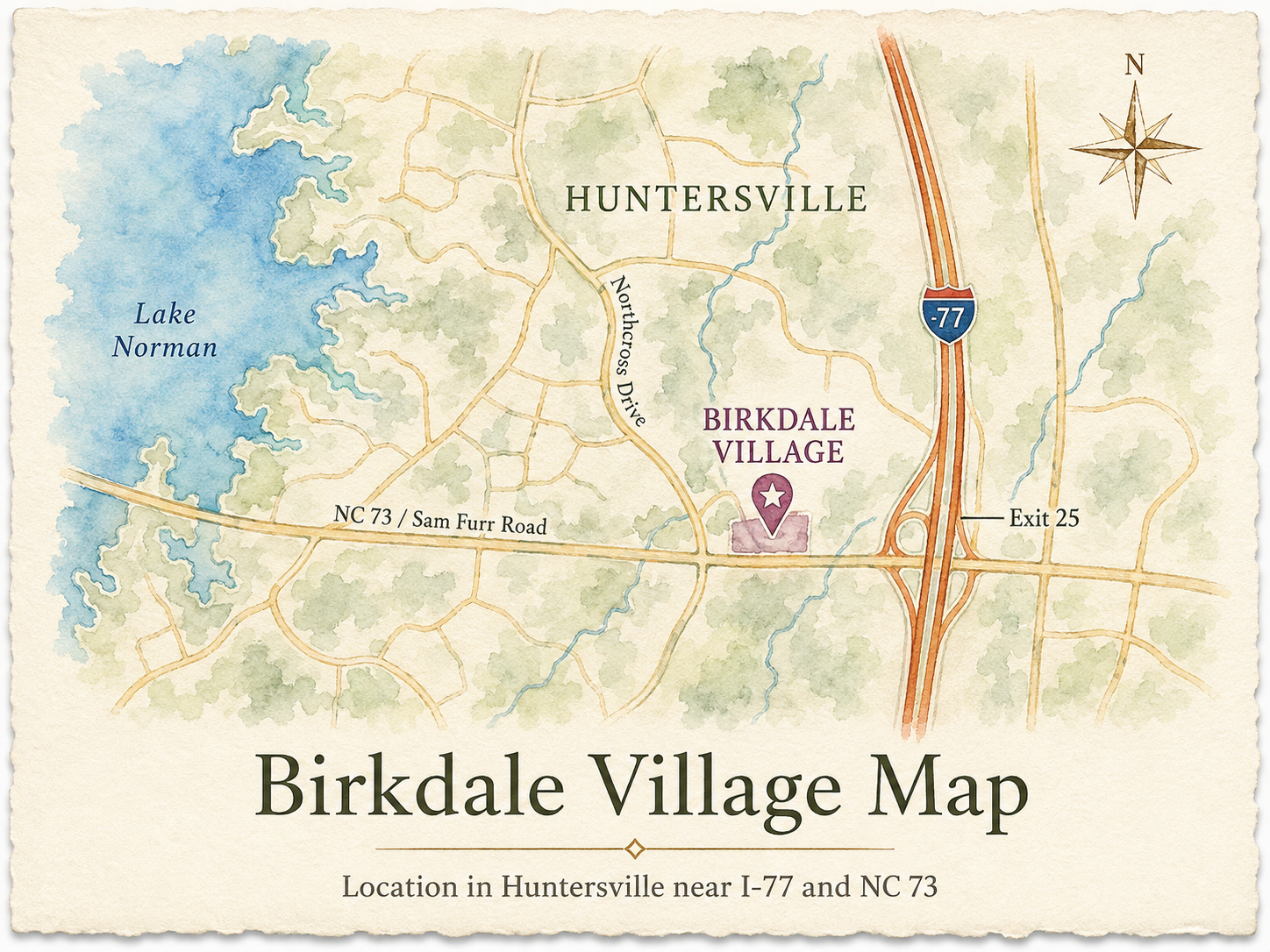
The crown jewel of this era was the creation of Birkdale Village, which opened in 2003. Unlike traditional strip malls or subdivisions, Birkdale Village was a bold experiment in suburban planning—a vibrant mixed-use development that combined residential units with shops, restaurants, offices, and entertainment. With its tree-lined streets, central green, and pedestrian-friendly design, Birkdale became a model of suburban “main street” living. It not only gave Huntersville a commercial and cultural hub but also symbolized the town’s transformation into a modern, thriving community.
By the turn of the 21st century, Huntersville had fully transitioned from farmland and mill villages into a dynamic suburban town, blending historic roots with forward-looking growth. The suburban boom brought new schools, parks, and civic institutions, ensuring that Huntersville could sustain its momentum while offering a high quality of life to its rapidly growing population.
Cultural and Historical Highlights
Even as Huntersville has grown into a modern suburban community, it has carefully preserved key landmarks that tell the story of its past. Among the most significant is the Hugh Torrance House and Store, built in the late 1700s. Recognized as the oldest standing store in North Carolina, it stands as a tangible link to the community’s commercial beginnings. More than just a building, it represents the entrepreneurial spirit of early settlers who built businesses to serve a growing farming community.
Huntersville is also tied to one of Mecklenburg County’s most famous—and debated—historical traditions: the Mecklenburg Declaration of Independence. Local lore holds that in May 1775, a group of residents signed a declaration at the Alexandrina site, effectively breaking ties with Britain more than a year before the Continental Congress signed the U.S. Declaration. While historians continue to debate the authenticity of the “Meck Dec,” the story remains a cornerstone of local identity and pride, woven into Huntersville’s cultural fabric.
Another cornerstone of Huntersville’s history is the Huntersville Rosenwald School, built in the early 20th century during the era of segregation. Funded in part by the Julius Rosenwald Fund—a program that supported schools for Black children across the South—the Huntersville Rosenwald School became a beacon of opportunity and resilience. It provided African American children access to education at a time when resources were scarce and inequality was entrenched. The building remains a testament to the perseverance of the community and continues to symbolize the struggle for educational equity.
Together, these sites illustrate the depth of Huntersville’s past: from early commerce and revolutionary ideals to the pursuit of equality through education. They remind residents and visitors alike that Huntersville’s story is not only about growth and expansion, but also about heritage, resilience, and the values that shaped the town across centuries.
Conclusion
Huntersville’s story is, at its heart, a testament to resilience, reinvention, and steady growth. What began in the mid-1700s as a modest Scotch-Irish and German farming settlement called Craighead has evolved across centuries into one of the most dynamic communities in Mecklenburg County. Each chapter of its history has been marked by transformation—whether through the establishment of the Huntersville Cotton Mill in 1873, which turned the town into a textile hub, or the creation of Lake Norman in the mid-20th century, which reshaped the physical and cultural landscape forever.
The town’s ability to adapt is reflected not only in its economy and infrastructure but also in its people. Generations of residents have built Huntersville into a community where tradition and progress exist side by side. Historic landmarks—like the Hugh Torrance House and Store, the Huntersville Rosenwald School, and the Alexandrina site connected to the Mecklenburg Declaration of Independence—serve as living reminders of the values of enterprise, perseverance, and the quest for freedom and equality. Meanwhile, modern developments such as Birkdale Village embody Huntersville’s forward-looking vision, where commerce, community, and quality of life intersect in vibrant new ways.
As Huntersville continues to expand alongside Charlotte and the greater Lake Norman region, its challenge and opportunity lie in balancing rapid suburban growth with the preservation of its unique heritage. The same spirit of hard work, community, and determination that sustained the town through its earliest days remains its guiding strength. Huntersville’s history is not simply a chronicle of the past—it is the firm foundation on which the town’s future will be built. In honoring its roots while embracing change, Huntersville demonstrates how a small crossroads settlement can grow into a thriving, modern town without losing sight of the values that made it strong.
Adkins Law, PLLC – Serving Huntersville and the Lake Norman Community
At Adkins Law, we are proud to call Huntersville home. Just as the town has grown from its farming and textile roots into a thriving modern community, our practice is dedicated to helping families and individuals navigate life’s most important transitions with clarity and confidence. Whether you are planning your estate, working through family law matters, or seeking mediation, our team is here to provide trusted guidance rooted in experience and a deep commitment to our community. Serving Huntersville and the greater Lake Norman region, Adkins Law is honored to help protect what matters most to you.



Leave a Reply