
The Lake Norman Brief · Estate Planning
Powers of Attorney and Health Care Directives for Catawba and Lincoln County Families
Prepare financial and health care authority before a crisis, with clear agent choices, document access, and North Carolina signing requirements.
If illness or an injury prevents you from handling decisions, your family may need two different kinds of authority: someone to manage finances and someone to address health care. For residents of Catawba County and Lincoln County, including the Lake Norman communities of Sherrills Ford and Denver, preparing these documents before a crisis makes the intended arrangement easier to understand and use.

Give each document a clear job
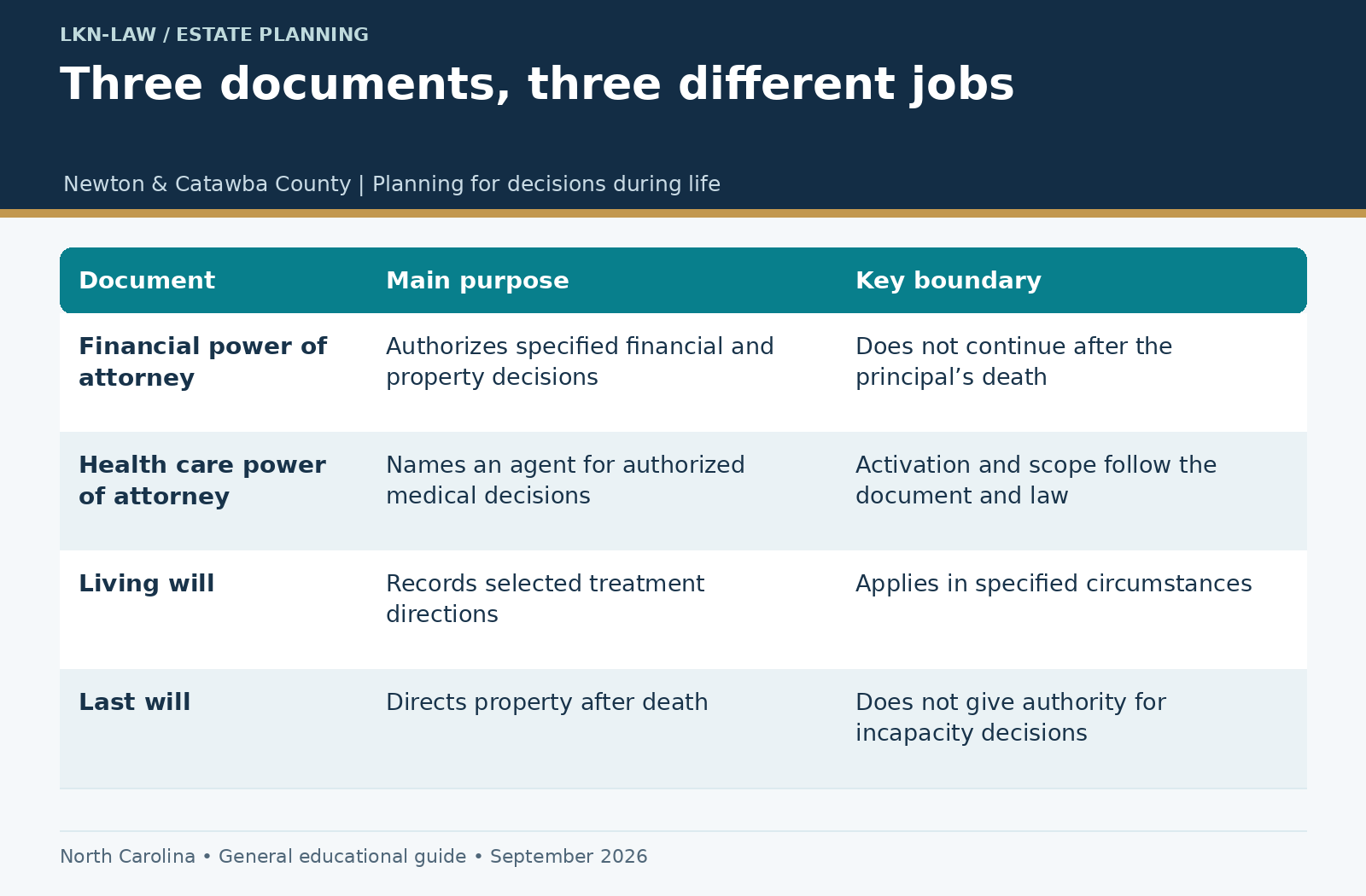
| Document | Main purpose | Question to discuss |
|---|---|---|
| Financial power of attorney | Authorizes an agent to act on specified financial and property matters. | What may the agent do, and when? |
| Health care power of attorney | Names an agent for health care decisions when the legal activation conditions are met. | Who understands and can communicate your preferences? |
| Living will | States choices about life-prolonging measures in specified circumstances. | Which directions should clinicians follow? |
A health care document should not be assumed to authorize general banking transactions. Likewise, a financial agent should not assume the financial document appoints that person to make medical choices. The people may be the same, but their legal authority needs to be addressed separately.
Decide when financial authority should begin
Under G.S. 32C-1-109, a financial power of attorney generally becomes effective when executed unless it specifies a later date, event, or condition. G.S. 32C-1-104 makes a power created under that chapter durable unless it expressly terminates on incapacity. Durability and immediate effectiveness answer different questions: whether authority survives incapacity, and when it starts.
For a Denver homeowner, the discussion might concern who could pay utilities, communicate with an insurer, or handle a property issue during an extended hospitalization. An immediate power can be usable without proving a triggering incapacity, but it also grants authority sooner. A conditional power requires a workable method for establishing that its condition has occurred. Choose deliberately.
Some transactions require more than broad general language. G.S. 32C-2-201 calls for express authority for matters including gifts, beneficiary changes, and changes to survivorship rights. Discuss whether those powers should be granted, limited, or omitted. The objective is authority suited to your needs, not permission for every possible transaction.
Choose a person who can manage responsibility
Under G.S. 32C-1-114, an agent exercising authority must act in good faith, within the granted powers, and according to the principal’s known reasonable expectations or best interests. The statute also addresses duties such as recordkeeping and cooperation with the health care decision-maker, subject to its terms.
Ask whether the proposed agent can organize records, respond promptly, and keep your money separate from personal finances. Discuss an alternate. If one child handles finances and another health care, talk through how they will communicate when a medical decision affects housing or care costs.
Use a practical example at the planning meeting: you are unable to make decisions for several weeks, a home repair is urgent, and a care provider needs payment. Which person calls whom? Which document authorizes the transaction? What records are kept? Testing an ordinary problem often reveals gaps that a list of impressive-sounding powers does not.

Make health care preferences understandable
G.S. 32A-17 permits an adult with the required understanding and capacity to make and communicate health care decisions to create a health care power of attorney. G.S. 32A-20 explains activation when the required determination of insufficient understanding or capacity is made, generally by the designated physician or the attending physician under the statutory rules. A relative’s disagreement with your decision is not itself the activation procedure.
A living will under G.S. 90-321 addresses life-prolonging measures in specified circumstances. The statutory form allows choices about when directions apply and how they interact with an available health care agent. Discuss treatment preferences with your clinician and make sure the agent understands your values. A slogan such as “do everything” or “no machines” may leave too much uncertainty.
Useful conversations include what outcomes matter to you, which religious or personal beliefs should guide decisions, and who should be included in family updates. Ask how the health care power and living will should resolve conflicting instructions. Do not assume one silently overrides the other in the way you intend.
Arrange signing before a crisis
A diagnosis, a family concern, and legal capacity are different issues. If understanding or communication is in question, tell the attorney before the appointment so the appropriate assessment and accommodations can be considered. The person making the document should have an opportunity to explain wishes directly. Relatives should avoid coaching answers or treating a signature as the only task that matters.
Execution requirements also differ. G.S. 32C-1-105 requires a financial power of attorney to be signed as permitted by the statute and acknowledged. The standard North Carolina health care power form calls for two qualified witnesses and a notary; the living will has its own witness and proof requirements. Arrange suitable witnesses rather than assuming that any available relative qualifies.
Make the signed plan available when needed
- Give the appropriate documents to the chosen agents and alternates.
- Ask health care providers to place current directives in the medical record.
- Keep a secure list of institutions, recurring bills, advisers, and document locations.
- Ask financial institutions about their process for reviewing an existing power of attorney.
- Consider the state’s Advance Health Care Directive Registry as an additional access resource.
- Review contact information and appointments after a death, divorce, move, or change in relationships.
For a family coordinating care between Lincoln and Catawba counties, access may matter as much as distance. An agent in another community should know where to find the current version without searching through old emails. A short written handoff can identify what exists, who holds it, and whom to contact.
Contact Adkins Law to discuss powers of attorney, health care directives, and estate planning for your Lake Norman circumstances. Bring existing documents and your proposed decision-makers’ details so the conversation can focus on the authority you actually need.
Educational information about North Carolina law; individual circumstances and document terms matter. Sources checked September 22, 2026.
This material is for general educational information, is not legal advice, and does not create an attorney-client relationship. Legal decisions depend on current law, the facts and the terms of your documents. Contact a North Carolina attorney for advice about your situation.