The Lake Norman Brief · Family Law
Dividing a Cornelius Lake Home in Divorce: Equity, Records, and a Workable Exit Plan
A Lake Norman property guide focused on the records and decisions behind keeping, selling, or dividing a Cornelius home.
A Cornelius home can represent years of savings, family routines, and plans for life on Lake Norman. During separation, “Who keeps the house?” often becomes the first question. A better starting point is: What exactly do we own, what do we owe, and which arrangement can each household actually carry out?
Cornelius sits along Lake Norman in northern Mecklenburg County. That setting makes a property inventory more detailed for some families: a residence may come with a boat, separate storage, association obligations, or documents governing access to a dock. None of those facts should be assumed from a listing photograph. Build the analysis from records for the specific property.

Begin with classification, not a promised percentage
North Carolina equitable distribution distinguishes marital, separate, and divisible property. Under G.S. 50-20, an equal division of net marital and divisible property is the starting presumption, subject to statutory factors that can justify another equitable result. An asset’s title alone does not resolve every classification question.
A home may raise questions about a purchase before marriage, money inherited by one spouse, later borrowing, or improvements made during the marriage. Identify each transaction and preserve its documentation. “My parents helped us” is a starting point for questions, not a complete legal classification. Was the money a loan or gift? To whom? Where did it go? What written records exist?
Keep this tracing exercise factual. Create a simple timeline with the acquisition date, marriage date, separation date, major improvements, and refinancing events. Attach a source to each entry. Counsel can then evaluate the legal significance without spending the first meeting reconstructing the property’s history.
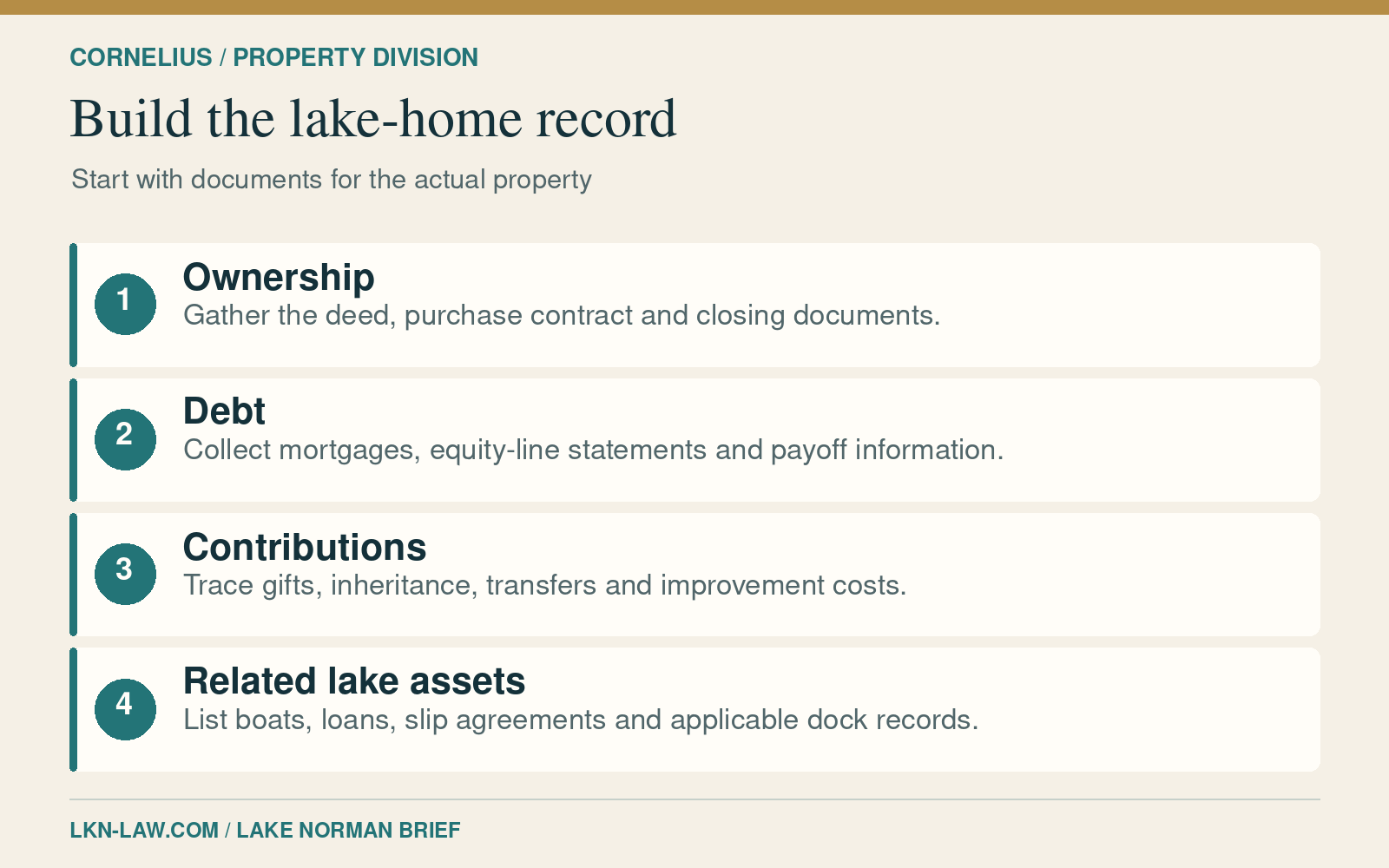
Create one complete file for the residence and related assets
| Record group | What to gather | Question it helps answer |
|---|---|---|
| Ownership and purchase | Deed, closing disclosure, purchase contract | When and how was the property acquired? |
| Debt | Mortgage, equity line, payoff information | What obligations remain and who signed? |
| Contributions | Bank transfers, gift letters, inheritance records | Where did acquisition or improvement funds originate? |
| Condition and use | Repairs, insurance, association documents | What expenses and restrictions affect the proposed arrangement? |
| Lake-related items | Boat title, financing, slip agreement, applicable dock records | Which rights and assets are separate from the house? |
For a boat or recreational vehicle, list the item separately even if everyone thinks of it as part of “the lake house.” Record its identifying information, condition, loan, storage location, and insurance. If a slip or dock arrangement is involved, obtain the actual instrument rather than assuming that a transfer of the home resolves every related right.

Ask what is being valued and as of which date
G.S. 50-21 generally values marital property at separation and divisible property and debt at distribution. A current market estimate therefore may not answer every valuation question in the case. Give an appraiser a clear assignment coordinated with counsel, including the relevant date and the interest being valued.
A practical comparison sheet can show three separate numbers: the supported property value, the documented debt, and the estimated costs relevant to a proposed transaction. Do not mix a date-of-separation mortgage balance with today’s price estimate without labelling the dates. Likewise, a proposed sale calculation and the legal equitable-distribution analysis may require different adjustments.
Consider an illustrative couple who agree that one spouse should retain the residence. They still need to address financing, the amount and timing of any payment, responsibility for carrying costs, and a fallback if the proposed transaction fails. Agreement on a headline value is only the beginning of an executable settlement.
Compare options using the same assumptions
A useful negotiation worksheet places a sale, a proposed buyout, and any agreed deferred sale side by side. For each option, use a realistic monthly budget and identify the documents or third-party decisions needed. The purpose is to reveal differences before anyone commits to terms that depend on an unavailable loan or an uncertain future payment.
- Sale: Discuss selection of the listing professional, preparation, access, price changes, carrying costs, and handling offers.
- Buyout: Discuss value, payment timing, financing, title work, and what happens if a deadline is missed.
- Deferred sale by agreement: Discuss occupancy, maintenance, insurance, major repairs, and an objective event ending the arrangement.
Ask the lender directly, through an appropriate authorized process, about financing requirements. Ask counsel to distinguish obligations between spouses from obligations to a lender. A settlement needs to address both. Avoid equating a deed change with a completed financing solution.
Evaluate the whole settlement and finish the paperwork
A home should be considered alongside cash, debt, and retirement assets. G.S. 50-20.1 addresses ways retirement and deferred-compensation benefits may be distributed. Plan requirements and the necessary orders or transfer documents deserve specific review before treating a retirement account as interchangeable with immediately available cash.
Prepare a closing checklist: who drafts each instrument, who signs, where money comes from, who verifies completion, and where records will be retained. If a term says “promptly,” ask whether an actual date would work better. If a term assumes cooperation, identify the action required from each person.
Families exploring Cornelius divorce and equitable distribution can also read our separation and divorce timeline and mediation preparation guide. Before allowing an absolute divorce to proceed, ask counsel to confirm that any necessary property claims have been protected. Contact Adkins Law for an individual consultation.
General educational information, not a property appraisal or a prediction of a court’s decision. Research checked September 22, 2026.
This material is for general educational information, is not legal advice, and does not create an attorney-client relationship. Legal decisions depend on current law, the facts and the terms of your documents. Contact a North Carolina attorney for advice about your situation.