The Lake Norman Brief · Estate Planning
Estate Planning for Huntersville Parents: Wills, Guardians, and Children’s Inheritances
Choose the people who could care for your children and manage their inheritance, then coordinate your will, trust provisions, and beneficiary forms.
For Huntersville parents, estate planning starts with two different questions: who would care for your children, and who would manage the resources supporting them? A thoughtful North Carolina plan addresses both. Naming someone in an emergency contact list is useful, but it does not replace a properly prepared will or a plan for a child’s inheritance.

What a guardian nomination can accomplish
North Carolina law allows a parent to recommend a guardian for a minor child through a last will and testament. Under G.S. 35A-1225, that recommendation becomes a strong guide for the clerk when there is no surviving parent. The clerk nevertheless decides based on the child’s best interests. A nomination is therefore a meaningful statement of your wishes, not a private appointment that bypasses the court.
The surviving parent’s rights are a separate issue. G.S. 35A-1224 requires substantial weight for a parent’s testamentary recommendation but protects the rights of a surviving parent who has not willfully abandoned the child. A divorced parent cannot use a will simply to award custody to a grandparent instead of the other parent. Bring existing custody orders and relevant family circumstances to the planning meeting.
For a Huntersville family, the practical discussion might include school continuity, travel between households, nearby relatives, and whether the proposed guardian could accommodate siblings. Ask the person before naming them. Choose an alternate, and reconsider the choice if that person’s health, household, or willingness changes.
Separate care, estate administration, and money management
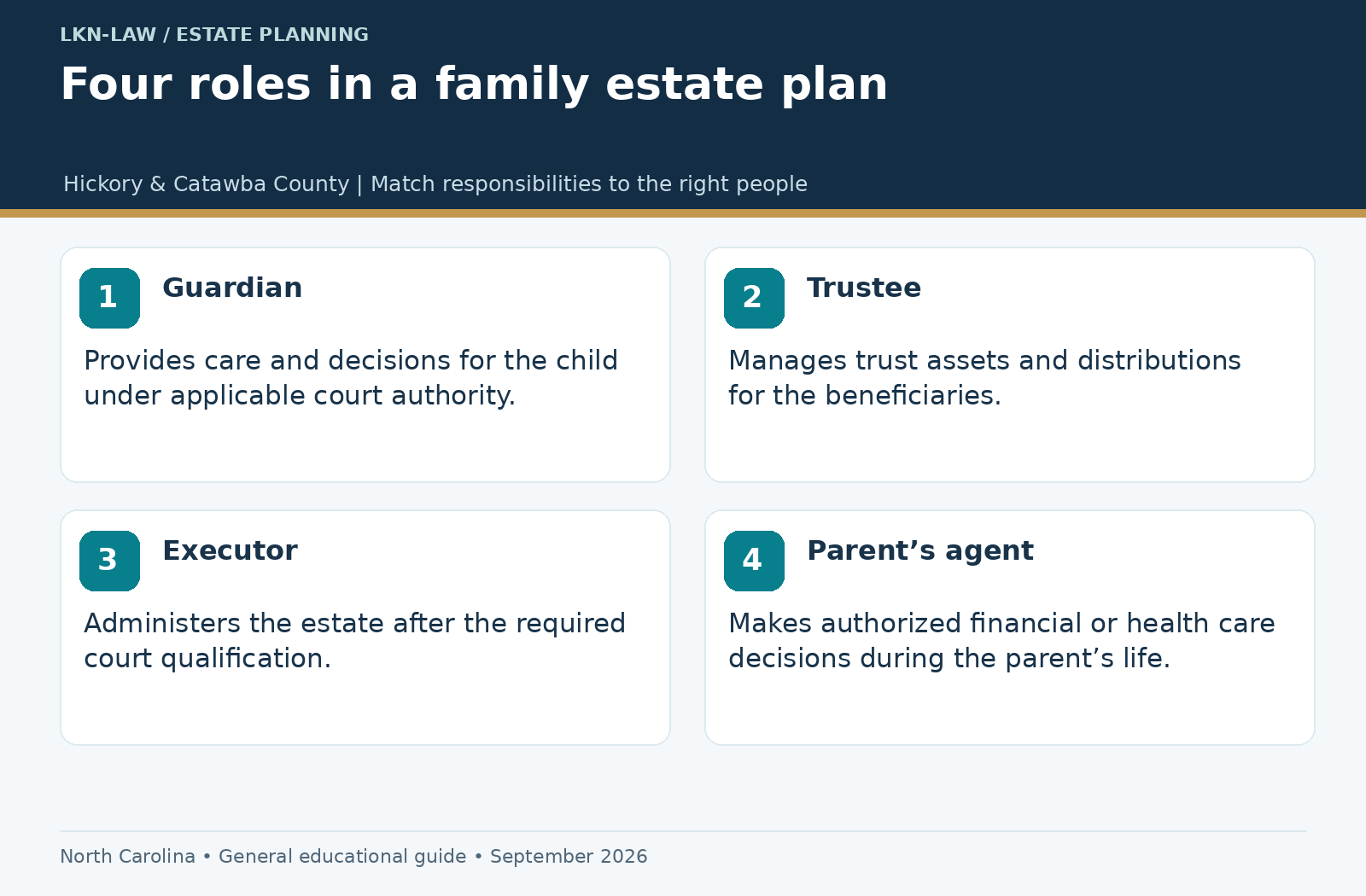
| Role | Central responsibility | Useful selection question |
|---|---|---|
| Guardian of the person | Care and personal decisions within the authority granted by the court. | Who understands the child’s daily needs? |
| Executor | Administer the estate after qualification, subject to the will and law. | Who can organize records and follow through? |
| Trustee | Manage trust property under the trust’s instructions. | Who can make careful financial decisions over time? |
The same trusted person may be considered for multiple jobs, but the jobs are different. A sibling who would provide a loving home may prefer that another person handle investments and recordkeeping. Conversely, splitting duties between relatives who cannot communicate may create unnecessary friction. Think about cooperation as seriously as individual competence.
Plan how support reaches your children
A trust can be created during life or through a will under North Carolina’s trust statutes. For parents, its purpose may be to provide instructions for managing a child’s inheritance: who makes distributions, what expenses may be paid, and when the child receives control. The trust language should reflect your child’s circumstances, rather than use an arbitrary age because it appears in a template.
Consider this illustrative family: two Huntersville parents have an elementary school child and a teenager. They want a relative to raise both children, but they also want education and ordinary living expenses considered over several years. Their planning discussion should address whether each child receives a separate share immediately, whether common resources support both children first, and how a trustee handles unequal needs. A younger child’s longer period of dependency may matter even when the parents want an ultimately equal inheritance.
Life insurance needs its own coordination. G.S. 36C-4-401.1 recognizes arrangements in which a trustee receives insurance or other death benefits. Naming the right recipient on the insurer’s form matters; a sentence in a will does not complete an insurer’s beneficiary paperwork. Ask the attorney and insurance professional to check the trust’s identification, primary beneficiary, contingent beneficiary, and what happens if a named person dies first.
If a child receives needs-based benefits or may require lifelong assistance, explain that before documents are drafted. A general instruction to distribute money at adulthood may not fit that child’s situation. The plan should also consider the other children and the availability of a suitable long-term decision-maker.

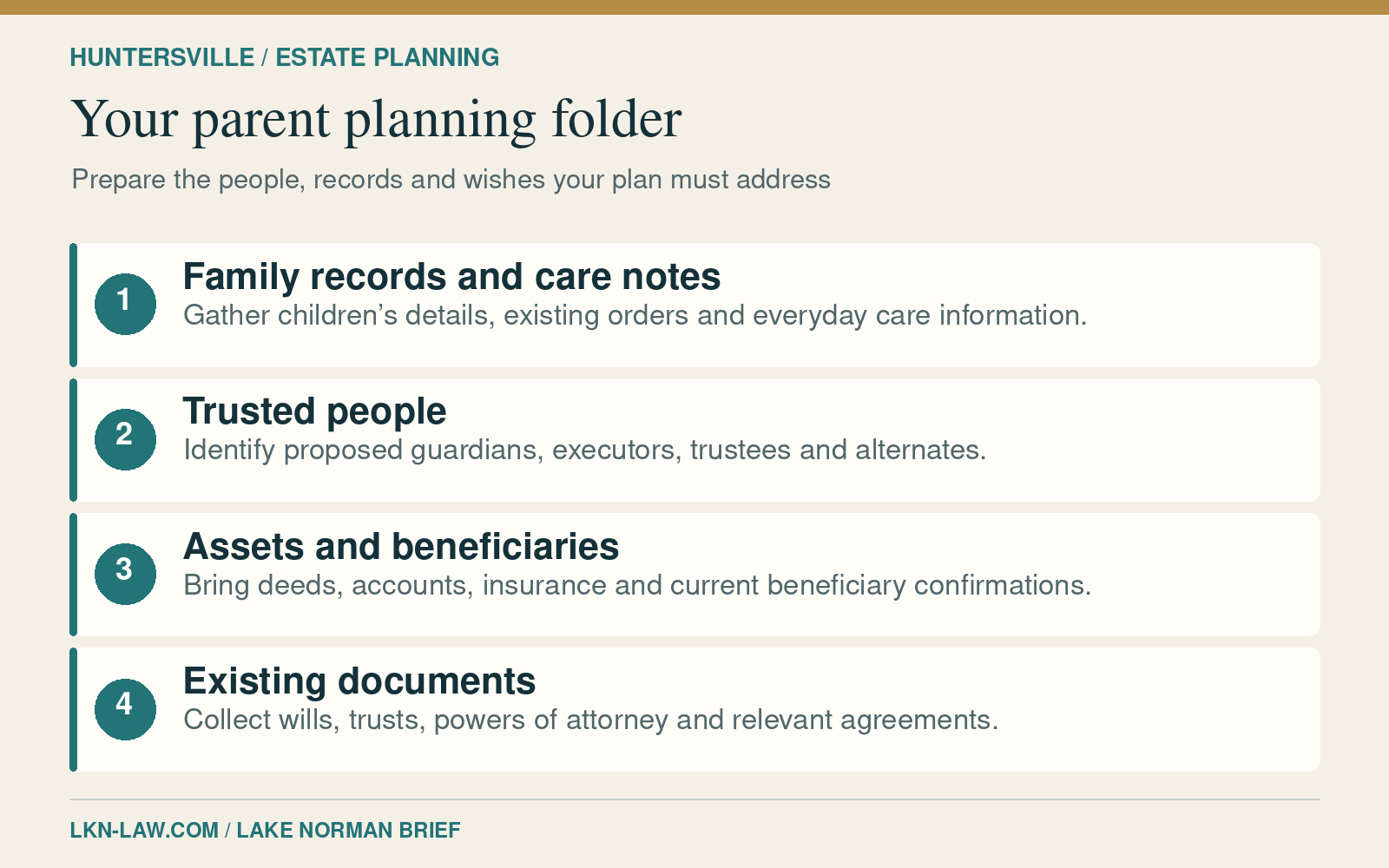
Prepare a useful planning folder
- Family information: children’s names and ages, parentage or adoption documents if relevant, and any custody or support orders.
- People: proposed guardians, executors, trustees, and alternates, with current contact details.
- Assets: home deed, account statements, retirement plans, insurance policies, and existing beneficiary confirmations.
- Existing documents: wills, trusts, powers of attorney, premarital agreements, and separation agreements.
- Care notes: doctors, school contacts, routines, allergies, and important relationships, maintained separately from dispositive legal instructions.
Make the care notes readable. A two-page household guide can be more useful in an emergency than a long document that nobody can locate. Keep sensitive passwords out of an ordinary family email; identify a secure access method instead. Tell the appropriate person where the signed documents are stored.
Signing and maintaining the plan
For a traditional attested written will, G.S. 31-3.3 requires the testator’s signature and at least two competent witnesses, with specific signing and acknowledgment formalities. Notarization alone is not a substitute for those witness requirements. Arrange execution with the drafting attorney so that the actual signing follows the document’s intended legal form.
Review the plan after a birth, adoption, separation, divorce, remarriage, move, significant asset change, or the death of a nominated person. Include beneficiary forms in that review. A beautifully organized binder does little good if its insurance instructions still reflect an earlier family situation.
Common questions from Huntersville parents
Must the guardian live in North Carolina? G.S. 35A-1224 permits an adult individual to serve as guardian of the person even if the individual resides elsewhere. The child’s interests and the proposed arrangement still need consideration.
Does every family need a living trust? No single document package fits every family. Start with the care and inheritance problems you want to solve, then compare a will-based plan with other options.
Where can we begin? Gather the planning folder and write down your three most important goals. Contact Adkins Law to discuss estate planning for your Huntersville or Lake Norman family.
Educational information about North Carolina law; individual circumstances and document terms matter. Sources checked September 22, 2026.
This material is for general educational information, is not legal advice, and does not create an attorney-client relationship. Legal decisions depend on current law, the facts and the terms of your documents. Contact a North Carolina attorney for advice about your situation.