
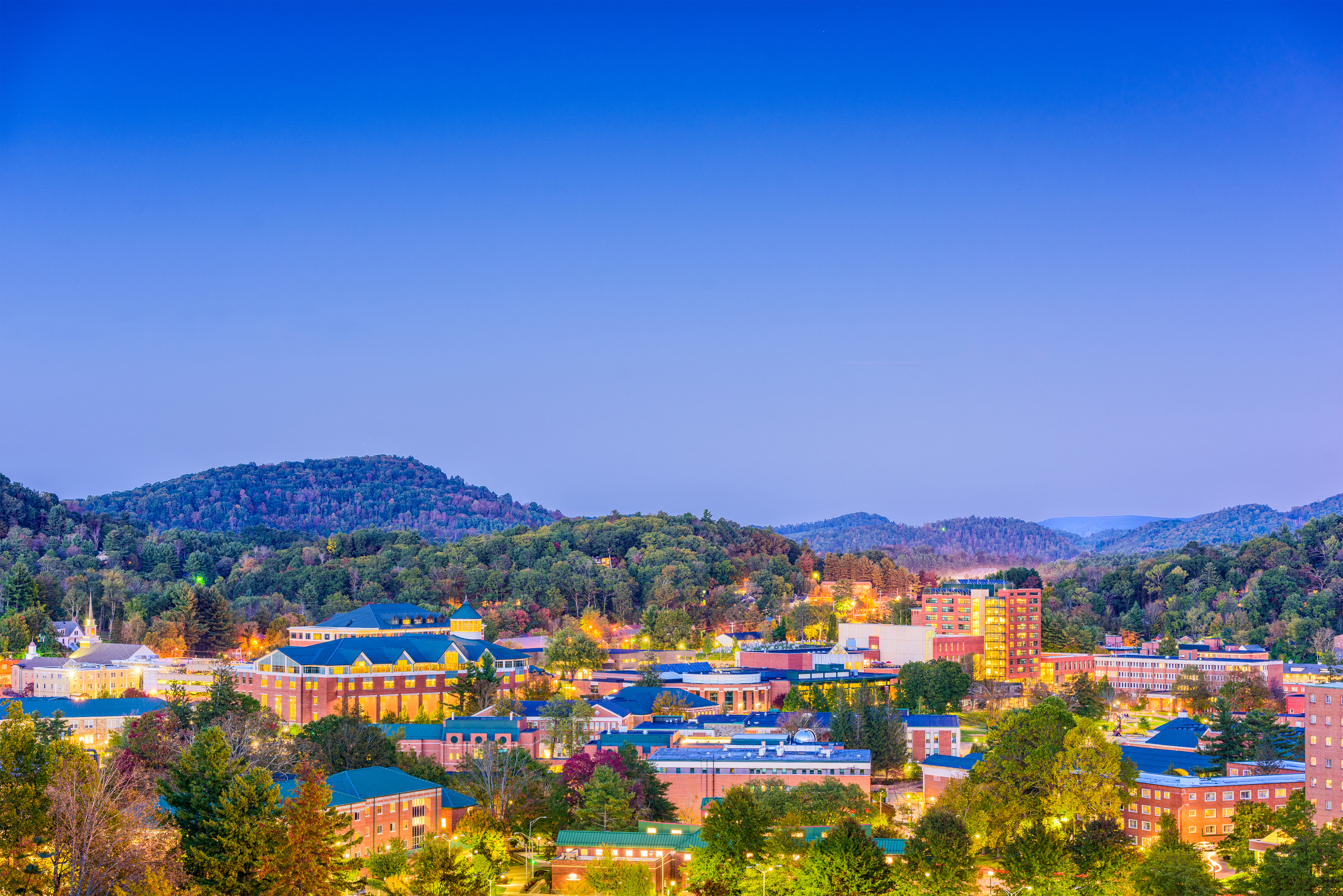

Introduction: A Summit School for a State on the Rise
Set high in the Blue Ridge Mountains of Boone, North Carolina, Appalachian State University—known simply as App State to its 150,000+ alumni—feels both intimate and far-reaching. Visitors arrive by way of winding switchbacks and overlooks, where the air runs a touch cooler than the Charlotte plains and Lake Norman coves below.
It’s a place where a nationally recognized academic profile blends with an outdoorsy mountain culture, where the NC High Country surrounds every lecture hall, and where weekend traffic often includes families from Huntersville, Cornelius, Davidson, Denver, and Sherrills Ford, headed up the mountain for campus tours, music festivals, or Mountaineer football.
App State’s story begins in 1899, when a wooden building with a bell tower housed Watauga Academy, the seed of a dream planted by the Dougherty family. From that humble start, it has grown into a comprehensive public university celebrated for teaching, research, sustainability, and student success.
The school’s motto—Esse quam videri (“to be, rather than to seem”)—is more than words on a seal. It’s a lived philosophy that turned a rural normal school into one of the South’s strongest talent engines, powering not only the NC High Country, but also the economies and communities of Charlotte and the Lake Norman region.
I. Founding in the Blue Ridge (1899–1929): Watauga’s Bell, Boone’s Promise
On September 5, 1899, Blanford Barnard “B.B.” Dougherty, his brother Dauphin Disco “D.D.” Dougherty, and D.D.’s wife Lillie Shull Dougherty opened Watauga Academy in Boone, North Carolina. Their goal was ambitious yet practical: extend education into the so-called “Lost Provinces” of Western North Carolina—mountain counties that state investment often ignored.
The first year, 53 students enrolled. Tuition was modest—$1 to $3 per month—but even that could be waived for future teachers who pledged to serve in North Carolina schools. Boone residents scraped together $1,100, donated logs, and volunteered labor to raise the first building. By 1900, enrollment reached 150; in 1901, two graduates walked—farm boy Thomas Baird of Valle Crucis and merchant’s son Jesse Moore of Tennessee.
From Academy to Training School
By 1903, momentum had outgrown the Academy. With help from the Newland Bill (pushed through the legislature by B.B. Dougherty) and matching funds from Watauga County—plus a $500 gift from Moses Cone—the school became the Appalachian Training School (ATS). Enrollment jumped to 325, faculty grew to six, and three departments opened:
- Public School (grades 1–7),
- Teacher’s Course, and
- High School Department.
The mission was clear: train teachers, then send them back into mountain communities that desperately needed schools. This talent-for-service model prefigured today’s “scholarship-for-service” programs.
Traditions Take Root
The Dougherty family home rose on campus in 1903–04, becoming a hub of community life. The first Administration Building (1905) and Lovill Home (1906) followed, giving women safe residence space. By the 1910s, Boone had Science Hall (1911) and its first women’s athletic grounds (1913, for croquet and tennis).
Cultural traditions began:
- The Dew Drop catalog (1904–1930) shared bulletins and course offerings.
- New River Light & Power (1915) made Appalachian one of the first electrified campuses in rural NC.
- The Rhododendron yearbook (1922) captured student life.
- First football field (1924) and intercollegiate play (1928) gave Boone a team to cheer.
- Duck Pond (1927) became a lasting campus landmark.
Transportation caught up, too: the Tweetsie Railroad reached Boone in 1918; the Wilkesboro–Boone road was paved in 1924. What began as a remote mountain school was now better connected to the foothills and Piedmont.
Symbols of Resilience
The Watauga Academy bell, hung in the original building’s steeple, called early students to class. When a fire destroyed the building in 1946, the bell survived. Today it hangs in the B.B. Dougherty Administration Building—a bronze echo of the school’s founding spirit: access, resilience, community.
Regional Resonance
The “build it ourselves” ethic of Boone’s residents mirrors Charlotte’s Revolutionary War identity as the Hornet’s Nest of Rebellion and the frontier determination shown at the Battle of Cowan’s Ford along the Catawba. Boone’s mountain grit and the Lake Norman basin’s civic backbone were two dialects of the same North Carolina story: ordinary people creating institutions that would outlast them.
From Normal School to Teachers College
By 1925, the school became the Appalachian State Normal School, focused on formal teacher training. In 1929, the legislature authorized Appalachian State Teachers College, a four-year institution devoted to producing educators.
The arc was set: a rural idea scaling into a statewide institution—with the Dougherty vision carrying it forward.
II. Becoming a Comprehensive University (1929–1971): Scope, Scale, and a System
When the Appalachian State Teachers College (ASTC) opened in 1929, it was a four-year institution focused squarely on training teachers. The transition was bittersweet: co-founder D.D. Dougherty died the very day registration began. His brother B.B. Dougherty carried the mission forward, remaining president until 1955 and guiding the school through the Depression, World War II, and the post-war boom.
Surviving the Great Depression (1930s)
The 1930s tested Appalachian’s endurance. Enrollment fell as families tightened budgets, dipping to a low of 350 students. Students resisted strict social codes, staging a two-day strike in 1935 that ended with new representative committees and eased rules for co-ed seating at events.
Campus life persisted:
- The Playcrafters theatre group (1933) and The Appalachian newspaper (1934) were born.
- YMCA/YWCA chapters, glee clubs, and athletics kept morale alive.
- Football thrived under Coach Kidd Brewer, whose 1937 team went undefeated.
World War II & Early Graduate Programs (1940s)
The 1940s brought both sacrifice and expansion. Students collected books for soldiers, planted war gardens, and rationed sugar in the cafeteria. Enrollment shrank as men enlisted, and in 1943, only 38 male students remained.
Yet academics advanced. In 1942, ASTC offered its first graduate courses through UNC, and by 1948 it launched a full graduate program, becoming the first teachers’ college in the South to grant graduate degrees. The first M.A. in Education was awarded that summer. Accreditation by the Southern Association of Colleges and Schools cemented its rising profile.
And culture took root: in 1942, a hand-drawn mountaineer named Yosef appeared in The Rhododendron yearbook. With his shaggy beard and can-do grit, he became the living emblem of App State’s ethos: resourceful, a little scruffy, ready to work.
The Post-War Boom (1950s–1960s)
The G.I. Bill swelled enrollments, and the campus expanded:
- Industrial Arts program (1958) → Kerr-Scott Hall (1961).
- Raley, Trivette, Justice, East, and Hoey residence halls rose to house new students.
- The first language lab (1960), a formal Honors program (1958), and a growing library modernized academics.
By the 1960s, the curriculum stretched beyond teaching. In 1965, App State activated non-teaching degree programs and split Social Studies into History, Political Science, Geography & Geology, and Sociology. The Lucy Brock Nursery School (1965) provided hands-on training for early-childhood educators. Graduate curricula were revised; in 1962–63, 245 master’s degrees were awarded.
Becoming Appalachian State University (1967)
In August 1967, the school’s breadth finally outpaced the “teachers college” label. The legislature authorized a multi-purpose regional university: Appalachian State University. Three undergraduate colleges formed:
- Arts & Sciences (Dean William Strickland),
- Fine & Applied Arts (Dean Nicholas Erneston), and
- Education (Dean Ben Horton).
Pre-professional programs (pre-law, pre-med, pre-dental, pre-engineering, pre-forestry) were added. The W. L. Eury Appalachian Collection (1968) began preserving regional culture, while ROTC (1969) created a military science department. By decade’s end, enrollment exceeded 5,000 students, faculty topped 300, and App State stood poised for a larger stage.
Joining the UNC System (1971)
In 1971, Appalachian joined the University of North Carolina System as one of 16 constituent campuses. Chancellor Herbert Wey became its first UNC-era leader.
This shift didn’t dilute App State’s mountain character; it amplified it. With system resources, App State could scale programs beyond teaching—business, health, sciences, arts—while still feeding the state’s teacher pipeline. The Boone campus now served a statewide mission:
- Teachers for Charlotte-Mecklenburg Schools.
- Business talent for Uptown Charlotte and University City.
- Health professionals for clinics and hospitals across Lake Norman, Iredell, Catawba, and Lincoln counties.
The union of Boone grit and UNC reach defined the modern Appalachian: a comprehensive public university in the High Country with impact across the Piedmont.
III. Academics & Innovation: What App State Does Exceptionally Well
Size & Scope Today
Appalachian State has grown from a rural teacher’s academy into a comprehensive public university enrolling more than 21,000 students across undergraduate, graduate, and doctoral programs. It offers over 150 bachelor’s degrees and 80 master’s and specialist programs, plus a growing number of doctoral tracks. The university’s eight colleges include:
- Walker College of Business
- Reich College of Education
- Beaver College of Health Sciences
- Hayes School of Music
- College of Arts & Sciences
- College of Fine & Applied Arts
- Honors College
- University College
This portfolio is intentionally balanced: honoring App State’s mountain roots while focusing on modern state workforce needs.
Education Leadership
From Watauga Academy in 1899 to the Reich College of Education today, App State has been synonymous with teacher preparation. The Reich College continues to refine North Carolina’s teacher pipeline through partnerships with public schools, student-teaching practicums, and cutting-edge educational research. Many of the strongest educators in the Lake Norman region—working in schools across Huntersville, Cornelius, Davidson, Denver, and Sherrills Ford—are proud App State alumni.
The pipeline isn’t just numbers; it’s identity. Generations of teachers trained in Boone shaped the state’s classrooms and reinforced App State’s reputation as a teacher-maker for North Carolina.
Business & Supply Chain
The Walker College of Business is nationally accredited and consistently ranked among the Southeast’s best. Its programs in accounting, finance, supply chain management, entrepreneurship, and analytics directly serve the needs of the Charlotte metro economy. Students from Boone or West Jefferson often intern in Uptown Charlotte’s banking towers or at logistics and manufacturing hubs around Lake Norman, experiences that tie mountain roots to Piedmont careers.
Walker College alumni can be found in Charlotte’s fintech firms, global banks, and startup scene—illustrating App State’s outsized role in feeding the state’s business infrastructure.
Health Sciences
The Beaver College of Health Sciences, housed in one of the region’s newest and most advanced facilities, addresses one of North Carolina’s most pressing needs: healthcare professionals. Programs in nursing, nutrition, athletic training, speech-language pathology, and public health ensure a steady flow of graduates into Atrium and Novant Health systems, as well as into private clinics serving Mooresville, Lake Norman, and surrounding counties.
Beaver alumni work as nurses on hospital floors, therapists in schools, and wellness specialists across the Piedmont, making the college a vital part of the state’s healthcare workforce.
Sustainability & Energy
App State has a national reputation for sustainability—a legacy that makes sense in the Blue Ridge setting. From early hydropower (New River Light & Power, founded in 1915) to today’s wind, solar, and green building research, the university has pioneered environmental education.
Students study renewable energy systems in labs and on mountaintop test sites, while App State’s campus facilities regularly achieve LEED certifications. It’s no surprise that sustainability is one of the university’s strongest recruiting points and a key part of its brand.
Adult Learners & Access
In Fall 2023, App State opened its Hickory campus, marking a new chapter in its mission. Prior to this, the Greater Hickory metro was the largest region in North Carolina without a public university. Now, students in Hickory, Statesville, and the Catawba Valley can access four-year programs without leaving home.
At the same time, partnerships like Project Kitty Hawk expand online programs aimed at nontraditional learners—working adults seeking credentials in education, business, and healthcare. These moves position App State as a lifelong-learning institution, not just a place for traditional undergraduates.
Recognition & Reputation
App State routinely earns accolades from U.S. News & World Report, The Princeton Review, Forbes, and The Wall Street Journal, placing it among the most respected regional universities in the country. These rankings highlight not just academic quality but also student outcomes: strong graduation rates, career placement, and affordability.
For families across Charlotte and Lake Norman, this reputation matters: App State delivers UNC-quality education in a setting that feels both accessible and distinctive.
IV. The Boone Experience: Four Seasons, One Culture of Making
Place Matters
At App State, place is never just backdrop—it’s part of the curriculum. Students step out of class into a trail world—hiking the Blue Ridge Parkway, paddling the New River, climbing at Linville Gorge, or skiing at Appalachian Ski Mountain, Sugar, and Beech. They also step into a performance world anchored by the Hayes School of Music and the annual Appalachian Summer Festival, which brings world-class symphonies, jazz artists, and theater to Boone every July.
Student life has been chronicled for over a century in The Rhododendron yearbook and The Appalachian newspaper. These outlets capture the rhythm of a campus that changes constantly but somehow keeps its mountain character intact.
Traditions & Icons
Symbols matter here. The Watauga Academy bell links every class back to 1899, ringing with continuity after surviving the 1946 fire. Yosef—formally “Dan’l Boone Yoseff”—was sketched into a yearbook in 1942 when editors needed one more picture. The scruffy, self-reliant mountaineer never left, becoming the school’s enduring mascot.
And then there’s the motto, “Esse quam videri”—to be, rather than to seem. At App State, it’s lived out daily in the unflashy, practical way the university approaches its work: build it, do it, measure it.
Getting Here
For decades, Boone was considered “the town at the end of the road.” That changed as corridors improved: U.S. 321 south to Hickory and Charlotte, and I-77 linking Lake Norman to the High Country. Today, Charlotte-area families can make the climb in two hours or less. Boone feels like “away,” but internships in Uptown Charlotte or University City are close enough that students can split weeks between mountain and metro.
Beyond Boone: The High Country Web
App State’s culture is shaped not just by Boone but also by its regional neighbors:
- West Jefferson (Ashe County): Just 30 minutes north, this arts-centered mountain town is known for its historic cheese factory, murals, and gallery scene. Many App State students intern or exhibit work there, connecting academic programs in art, communications, and business with small-town entrepreneurship.
- Wilkes County: To the east, Wilkes has long been the High Country’s gateway. Known for MerleFest—one of the nation’s premier roots music festivals held at Wilkes Community College—the county links App State’s music heritage with global performers. Wilkes also connects Boone to broader commerce through its foothills industries and festivals, giving students cultural and professional bridges into the Piedmont.
Together, Boone, West Jefferson, and Wilkes form a triangle of mountain culture—outdoors, music, and community—that gives App State students a four-season education in place.
V. Activism, Representation, and Belonging: A Truer Story of “Mountaineers”
App State’s history is also the story of students pushing for change. In 1943, a campus walkout over dancing bans and library hours won immediate reforms, setting a precedent for activism on governance, equity, and culture.
The Black Student Association (1970) advanced representation through events and advocacy; Dr. Beauregard Stubblefield (1971) became the first tenured Black faculty member; and milestones like Judy Gentry (1972) on Homecoming Court and a dedicated Black Cultural Center (1973) marked progress. Later, leaders like Willie Fleming and events like the Black at AppState Collective march (2020) kept equity on the agenda.
For women, the 1970s–90s brought co-ed housing, Title IX compliance, and the creation of Women’s Studies and the Women’s Center. For LGBTQ+ students, groups like SAGA (1990) and the LGBT Center (2008) helped secure protections and visibility.
Representation broadened further through Native partnerships (Cherokee Gadugi Program, 2013), international exchanges, and symbolic steps like raising the Eastern Band of Cherokee and Lumbee flags in the Student Union.
These aren’t endpoints but markers—showing how “Mountaineer” has steadily expanded to include all who come here to learn.
VI. Athletics & the Mountaineer Moment: Why Saturdays in Boone Feel Different
Athletics at Appalachian State matter far beyond Boone. The Mountaineers field 17 NCAA Division I varsity sports, competing in the Sun Belt Conference (football in the FBS; wrestling in the Southern Conference; field hockey in the Mid-American Conference). Black and gold aren’t just colors—they are identity, carried proudly from Boone into stadiums across the South.
Football: The National Calling Card
App State football began in 1928, gained early steam under Coach Kidd Brewer (his 1937 squad went undefeated), and took root in Conrad Stadium (1962)—renamed Kidd Brewer Stadium in 1988. Known as “The Rock,” the venue sits at 3,333 feet and has hosted ESPN broadcasts, a 30-game home winning streak, and record crowds topping 40,000.
The defining moment came on September 1, 2007, when App State stunned #5 Michigan, 34–32, in Ann Arbor—the first FCS team ever to beat a ranked FBS opponent. The win shook college football, vaulted Boone into national headlines, and still stands as one of the sport’s great upsets. But it wasn’t a fluke. The Mountaineers had already built a dynasty, winning three straight FCS national championships (2005–07)—the only program to do so in modern Division I-AA/FCS history.
In 2014, App moved to the FBS Sun Belt Conference, where it quickly proved competitive: multiple conference titles, bowl games, and a 7–1 bowl record. Signature wins over North Carolina (2019) and Texas A&M (2022) confirmed that the Michigan upset was a beginning, not an anomaly.
Other Varsity Sports
While football grabs headlines, other Mountaineer teams carry weight:
- Wrestling dominates in the Southern Conference, often nationally ranked.
- Men’s and Women’s Basketball compete in the Holmes Convocation Center.
- Baseball plays at Jim and Bettie Smith Stadium; softball at Sywassink/Lloyd Stadium.
- Soccer and track programs have produced professional athletes and Olympians.
Across sports, App athletes embody the Yosef ethos: scrappy, competitive, hardworking.
Rivalries & Identity
Rivalries run deep. The fiercest is with Georgia Southern, dating back to Southern Conference days—two former FCS powers now squaring off in the Sun Belt East. New rivalries with Coastal Carolina, Marshall, and James Madison keep Boone electric on game weeks. Historic foes like Western Carolina and Furman remain part of App lore.
These rivalries define more than records; they forge identity. For alumni in Charlotte, Huntersville, Cornelius, Davidson, Denver, Newton, Statesville, and Sherrills Ford, driving up the mountain for a game feels like reconnecting with family.
Student-Athlete Success
The Mountaineer spirit isn’t just about wins. Student-athletes have posted a 3.0+ GPA for over 13 consecutive years, underscoring the balance between academics and athletics. That academic commitment resonates with families in the Charlotte–Lake Norman corridor who see App State as a place where hard work on the field pairs with hard work in the classroom.
Saturdays at Kidd Brewer: The Mountaineer Moment
On fall Saturdays, Kidd Brewer Stadium hums. The Blue Ridge peaks form a backdrop of turning leaves, but the energy comes from elsewhere: the Marching Mountaineers blasting “Hi Hi Yikas,” alumni caravans climbing U.S. 321 from Charlotte and Lake Norman, students packed shoulder-to-shoulder in black and gold.
For fans who grew up with Friday Night Lights in Huntersville or Davidson, a Boone gameday feels both bigger and familiar—a small-town stadium experience magnified by national attention. Sports here aren’t just contests; they’re rituals that bind generations.
Why It Matters for North Carolina
Athletics ripple far beyond campus. Games draw tens of thousands of visitors into Boone, West Jefferson, Blowing Rock, and Wilkes County, pumping dollars into hotels, restaurants, and shops. Success puts App State—and by extension, the NC High Country—on the national map. For current students, sports give rhythm to campus life; for alumni, they create touchstones of shared identity.
App State athletics tell a larger story: resilient teams from a resilient place, punching above their weight, and carrying the High Country into national conversations.
VII. The Charlotte & Lake Norman Connection: A Two-Way Bridge
Internships & Early Careers
For App State students, the Charlotte metro is less a distant city than a laboratory. Internships in banking, fintech, logistics, communications, criminal justice, healthcare, and the arts turn the Piedmont into an extension of the classroom.
- Business majors shadow analysts in Uptown towers.
- Health sciences students rotate through Atrium and Novant clinics in Huntersville, Davidson, and Mooresville.
- Engineering tech and supply chain students work along the Lake Norman industrial corridors, linking design to distribution.
- Communications and arts majors find opportunities in South End media houses or University City nonprofits.
Because Boone is only a two-hour drive from Charlotte, students can split weeks, stack experiences, and graduate with résumés anchored by both High Country service and metro connections.
Alumni Gravity
App State’s alumni presence is thick across the Lake Norman region. In Huntersville, Cornelius, Davidson, Denver, and Sherrills Ford, you’ll find Mountaineers serving as teachers, coaches, nurses, small-business owners, IT specialists, and executives. They carry Boone’s culture into classrooms, clinics, and boardrooms.
Alumni chapters host game-watch parties, raise scholarships, and organize service projects that link the mountains to the metro. A Friday night in Huntersville might feel like Friday Night Lights, but on Saturday, those same families drive up U.S. 321 to Boone to join a sea of black and gold at Kidd Brewer Stadium.
Access Nodes
App State has widened its physical and digital footprint to reach even more of the Piedmont:
- The Hickory campus (opened Fall 2023) placed a public university in the largest metro in NC without one. It now anchors opportunities for first-gen students, transfers, and adults in Catawba Valley and beyond.
- Project Kitty Hawk and App State Online expand access for working adults, career-changers, and veterans across Charlotte and Lake Norman—UNC-quality credentials without uprooting families.
Together, these access points make “Boone” bigger than its mountain zip code.
Economic Impact
App State contributes billions annually to the state’s economy, a ripple felt far downstream.
- In Boone, that means hotels, restaurants, and shops buzzing on football weekends.
- In Charlotte and Lake Norman, it means graduates filling pipelines in banking, supply chain, education, healthcare, law, and tech.
Every Mountaineer who steps from a Boone classroom into a Charlotte boardroom—or from a Hickory lab into a Lake Norman clinic—reminds the state that this is more than a mountain college. It is a statewide talent engine.
VIII. Resilience, Milestones, and the 125th Anniversary
In 2024, Appalachian State University marked 125 years of educational leadership with exhibits, storytelling, and a formal recognition in the U.S. Senate, read into the record by alumnus Senator Ted Budd. The anniversary wasn’t just backward-looking; it was also a forward-facing promise. The same town–gown partnership that built Watauga Academy’s first building in 1899—when Boone residents donated cash, lumber, and sweat equity—still shapes the university’s ethos.
Weathering Crises Together
App State’s timeline is dotted with stress tests, and each reveals the same pattern: campus and community aligned to keep learning alive.
- 1918 Spanish flu: The Appalachian Training School quarantined its campus, barring visitors and halting church services. Classes adapted, and every student recovered.
- World Wars I & II: Enrollment dropped as men enlisted; women stepped into larger roles. Faculty and students ran defense drives, book collections, and War Bond campaigns. By 1945, more than thirty App State students had given their lives in service.
- Postwar recovery: The G.I. Bill swelled enrollments, requiring new dorms, dining halls, and academic programs.
- COVID-19 (2020): Classes pivoted online; testing, quarantine housing, and community partnerships helped Boone weather the storm. App State leaned on technology and resilience to keep students progressing toward degrees.
- Hurricane Helene (2023): Flooding and power disruptions underscored the university’s role as a regional first responder, supporting students while partnering with local agencies.
Through each crisis, one constant emerged: the bell still rang, classrooms filled, and graduates fanned out across North Carolina.
Meeting the State’s Needs in Real Time
App State’s motto, “Esse quam videri”—to be, rather than to seem—may sound old-world, but it works as a modern rallying cry. For 125+ years, the university has met North Carolina’s needs in the moment:
- Early 1900s: Teacher education when rural schools desperately needed teachers.
- Mid-20th century: Expanded into a four-year college and then a university as the state demanded breadth.
- 1970s–2000s: Added business, health, technology, and the arts to meet workforce growth.
- 21st century: Pivoted to sustainability, energy research, and healthcare to match emerging priorities.
- 2023–present: Launched the Hickory campus and online access initiatives to bring opportunity to working adults and underserved metros.
125 Years, and Counting
The 125th anniversary was a milestone, but also a marker: proof that App State’s founding values—access, resilience, service, community partnership—remain intact. It is a place that still builds what it needs, answers when called, and measures its worth not by slogans but by outcomes: classrooms filled, degrees earned, lives changed.
For Boone, Charlotte, Lake Norman, and the NC High Country, the message is the same one carried by the bell: App State will keep showing up.
IX. Practical Guide: Boone & Beyond (For Parents, Students, and Neighbors)
Why Choose App State?
Appalachian State University offers a rare balance of academic rigor, affordability, and outdoor culture, all set in the heart of North Carolina’s High Country. For students, it’s a place where coursework challenges the mind, tuition remains accessible, and weekends are filled with hikes along the Blue Ridge Parkway, ski runs at Beech or Sugar, or concerts at the Hayes School of Music. For families, App State consistently ranks among the Southeast’s best values, delivering strong educational outcomes without overwhelming debt.
While LSU in Baton Rouge represents the flagship spirit of Louisiana, App State stands as North Carolina’s own mountain gem — a university that combines high-quality academics with a lifestyle rooted in natural beauty and community.
Programs with Impact
App State’s academic strengths match the needs of the state:
- Education: Preparing teachers for classrooms across North Carolina.
- Business & Supply Chain: Feeding Charlotte’s banking, fintech, and logistics hubs.
- Health Sciences: Training nurses, therapists, and allied-health professionals for hospitals and clinics across the Piedmont.
- Sustainability & Renewable Energy: Researching solutions in wind, solar, and green building.
- Communication & Criminal Justice: Connecting theory to practice through internships and public service.
- Music & Arts: Anchored by the Hayes School of Music, with national recognition in performance and education.
For Charlotte & Lake Norman Families
Boone is close enough for weekly visits, far enough for independence. The drive up I-77 and U.S. 321 takes about two hours from Charlotte or less from Lake Norman, making it easy to catch a Saturday football game or drop in for a concert while still giving students space to grow. Many families in Huntersville, Cornelius, Davidson, Denver, and Sherrills Ford already have Mountaineers in their households—making the climb part of the culture.
Alumni Network & First Jobs
App State’s alumni footprint in the Charlotte metro is thick: teachers, coaches, small-business owners, nurses, engineers, analysts, and executives. That density translates into mentorships, internships, and first-job ladders. For new graduates, the transition from Boone to the Piedmont often feels seamless because the alumni network is already there, ready to open doors.
Athletics & Shared Experiences
Game days in Boone are legendary. Sun Belt Conference excitement, paired with a consistent 3.0+ student-athlete GPA record, shows that App State blends athletics with academics in a way that resonates with families. Saturdays at Kidd Brewer Stadium—with leaves turning on the Blue Ridge and Yosef leading the charge—are bucket-list experiences for students, parents, and alumni alike.
X. Conclusion: Mountain Roots, Statewide Reach
From a steeple-hung bell in 1899 to a multi-campus public university in 2025, Appalachian State University proves that place and mission can grow together. What began as a vow to educate the isolated “Lost Provinces” of the NC High Country has become a promise to serve all of North Carolina—from Boone’s ridgelines to Charlotte’s skyline, alongside fellow institutions like Davidson College and Queens University of Charlotte.
The arc is striking but consistent: when the state needed teachers, App State delivered. When it needed a comprehensive university, App State evolved. When the future demanded expertise in sustainability, health sciences, and business, the university pivoted. And when geography posed barriers, App State extended its reach with Hickory and online access, ensuring opportunity meets people where they live.
For families in Huntersville, Cornelius, Davidson, Denver, and Sherrills Ford, App State represents more than a college—it’s a familiar ethos. If you grew up near the Catawba River, where Cowan’s Ford markers recall Revolutionary grit, or in Charlotte, still proud of its “Hornet’s Nest” defiance, you’ll recognize the DNA. Boone’s version is mountain-shaped: hands-on, civic-minded, confident without pretense.
And the outcomes endure. App State graduates walk into schools, hospitals, offices, and studios as builders of people: teachers, nurses, analysts, musicians, entrepreneurs. They carry the mountain spirit within them, pouring it into every county they call home—joining the proud legacy of higher education in North Carolina.
So here’s to the next 125 years of Boone sending its best downhill—and to the families from Charlotte and Lake Norman who keep driving up, windows cracked, following the switchbacks to where the air turns crisp and the black-and-gold flags lift in the wind.
About Adkins Law, PLLC – Huntersville, NC
Adkins Law, PLLC is a trusted family law and estate planning practice located in the heart of Huntersville, North Carolina. Founded by attorney Christopher Adkins, our firm is dedicated to helping Lake Norman families navigate life’s most important legal matters with clarity and care. From child custody and divorce to wills and trusts, and mediation, we provide personalized strategies designed for long-term peace of mind. Conveniently serving Huntersville, Cornelius, Davidson, Concord, Mooresville, Statesville, and the greater Charlotte area, Adkins Law is here when you need experienced counsel close to home.



Leave a Reply